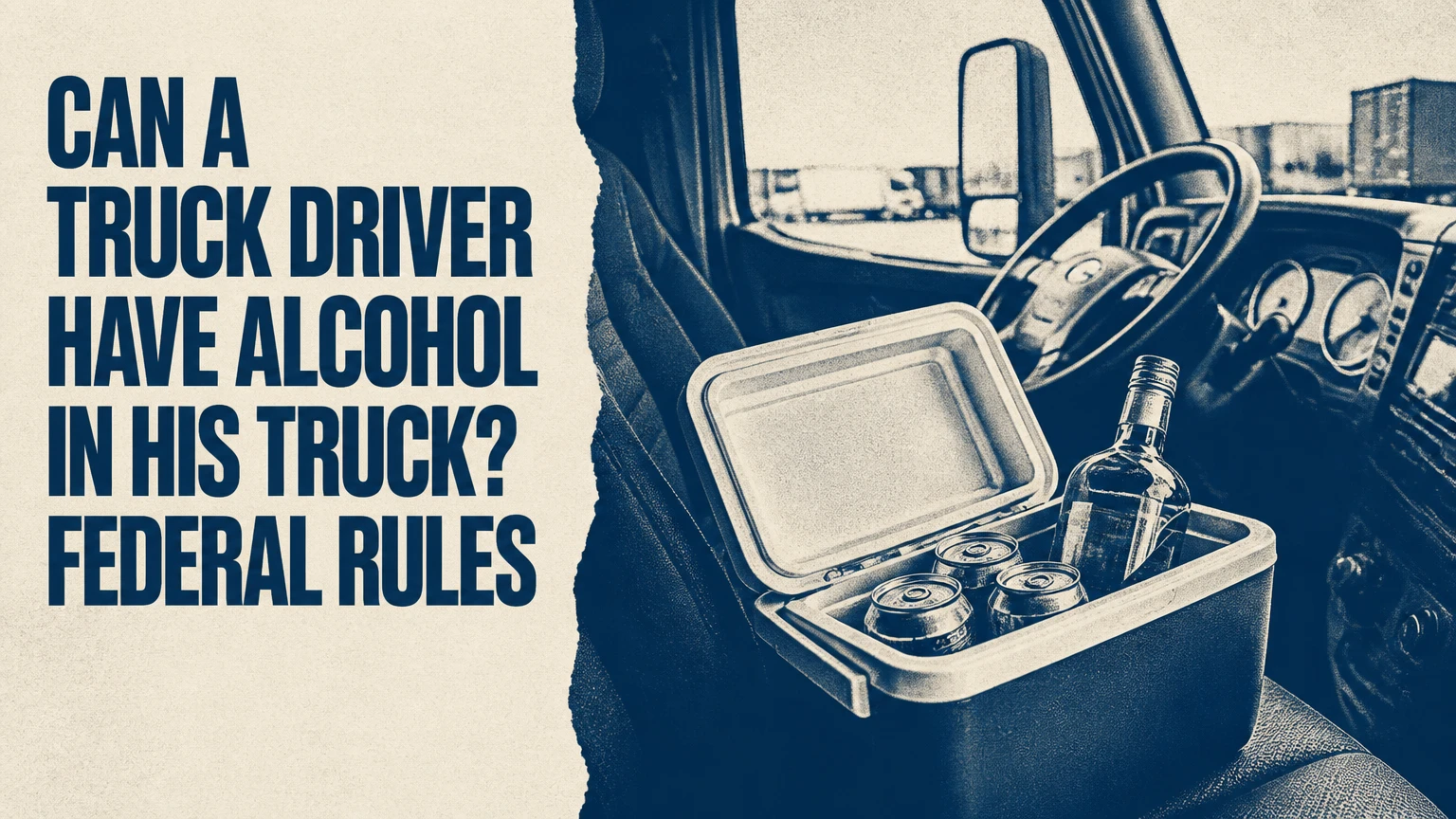
A commercial truck driver may possess alcohol in a commercial motor vehicle only in limited circumstances. Under 49 CFR § 392.5, the federal prohibition applies when the driver is on duty, operating the CMV, or in physical control of it; alcohol carried as manifested freight is treated differently. State law and a carrier’s written policy may prohibit possession more broadly.
Key Facts at a Glance
- 49 CFR § 392.5(a)(3) prohibits a commercial driver from possessing an alcoholic beverage while on duty, operating a CMV, or in physical control of a CMV.
- A sealed bottle is still an alcoholic beverage. Sealing changes the open-container issue, not necessarily the possession issue.
- The four-hour rule prohibits alcohol consumption during the four hours before going on duty or operating, or being in physical control of, a CMV.
- A driver may operate a CMV only below a 0.04% BAC under federal commercial-driver rules.
- A 0.02%-0.039% alcohol concentration can trigger a 24-hour out-of-service order under 49 CFR § 392.5(c).
- A simple bottle-possession finding does not automatically become a Drug and Alcohol Clearinghouse violation. Clearinghouse reporting generally involves a qualifying Part 382 test, refusal, or actual-knowledge violation.
Can a Truck Driver Have Alcohol in His Truck?
Yes, federal law does not create a blanket ban on every alcoholic beverage inside every commercial truck at every moment. The controlling question is whether the driver possesses the beverage while on duty, operating the commercial motor vehicle, or in physical control of it, along with whether a shipment or passenger-property exception applies.
The relevant rule is 49 CFR § 392.5(a)(3). It prohibits a driver from possessing an alcoholic beverage while on duty or operating a motor vehicle, or while in physical control of a motor vehicle. The regulation also prohibits consuming alcohol within four hours before going on duty or operating, or being in physical control of, a motor vehicle.
That wording matters. The commonly repeated claim that federal law bans any alcohol anywhere in a truck, including during every off-duty sleeper-berth period, is broader than the regulation itself. A driver who is genuinely off duty, not operating the CMV, and not in physical control may have a different federal-law analysis, but the arrangement can still violate state law, a carrier handbook, a lease agreement, or a truck-stop rule.
What does “possession” mean under the federal rule?
Possession generally concerns the driver’s control or custody of the alcohol, not whether the container is open. A six-pack in the cab, a bottle in a personal bag, or liquor in a sleeper compartment can create enforcement questions when the driver is on duty or controlling the vehicle.
The regulation does not provide a detailed storage diagram that says “console,” “bunk,” or “side pocket.” Officers and courts assess the facts, including the driver’s duty status, access to the vehicle, keys, location, purpose, and whether the alcohol is cargo. The safest operational rule is simple: do not keep personal alcohol in a CMV used for work.
Does the Sleeper Berth Change the Answer?
A sleeper berth does not automatically turn a commercial motor vehicle into a private residence, but federal possession restrictions depend on duty status and physical control rather than the sleeper berth’s mere existence. Carrier policies commonly impose a stricter zero-alcohol rule that applies during all trips and inspections.
A sleeper berth can qualify as off-duty accommodation for hours-of-service purposes when the driver meets the applicable requirements. Off-duty status, however, does not answer every separate question involving state open-container laws, employer rules, parking location, keys, or physical control.
The federal rule becomes riskier when the driver leaves alcohol in the truck and later returns to duty without removing it. A driver might be off duty at 9 p.m. but on duty at 7 a.m.; possession during the later duty period can become a § 392.5 issue. Storage also creates an avoidable roadside-inspection dispute.
When does physical control matter?
Physical control is a fact-specific concept involving the driver’s ability to control or operate the vehicle. Sitting in the driver’s seat with the keys available presents a stronger physical-control case than occupying a sleeper berth away from the controls, but an idling engine, accessible keys, location, and state law can change the result.
There is no universal federal rule saying that an idling engine automatically makes every sleeper-berth occupant guilty of alcohol possession. The actual question is whether the driver is in physical control and whether the driver possesses alcohol during that prohibited period. State DUI and “actual physical control” statutes may be broader than the federal commercial-driving rule.
An owner-operator should not rely on a technical argument about keys or climate control. Moving the truck, repositioning it in a parking lot, or remaining responsible for its operation can create facts that are difficult to explain during an inspection.
When May a Driver Drink Alcohol?
A commercial driver must not consume alcohol within four hours before going on duty, operating a CMV, or being in physical control of a CMV. The four-hour restriction is separate from the BAC rule, so a driver can violate the timing rule even if a later breath test is below 0.04%.
For example, a driver who finishes a drink at 5:30 a.m. cannot begin a covered duty period at 8:30 a.m. because only three hours have passed. A lawful schedule requires at least four hours between the end of consumption and the start of the prohibited activity, while also allowing enough time for the driver’s BAC to return below the applicable threshold.
The four-hour rule is not permission to drink during a 10-hour break and drive immediately after the break. Alcohol metabolism varies by person, drink strength, food intake, sleep, medication, and elapsed time. The regulation establishes a minimum timing rule, not a guarantee of sobriety.
Which BAC Thresholds Apply to CDL Drivers?
Federal rules use different alcohol thresholds for operation, out-of-service status, and employer testing. A CMV driver is prohibited from operating at 0.04% BAC or greater; a measured alcohol concentration of 0.02% to less than 0.04% can produce a 24-hour out-of-service order, and a DOT alcohol test of 0.04% or greater triggers employer procedures.
| Situation | Federal threshold or rule | Typical consequence |
|---|---|---|
| Operating a CMV | 0.04% BAC or greater prohibited | Federal violation and employer action |
| Roadside alcohol concentration | 0.02%-0.039% | At least 24 hours out of service under § 392.5(c) |
| DOT alcohol confirmation test | 0.04% or greater | Removal from safety-sensitive work and return-to-duty process |
| DOT alcohol screening test | 0.02%-0.039% | Temporary removal, follow-up testing, and employer procedures |
| Alcohol consumption before duty | Within 4 hours | Prohibited regardless of later BAC result |
| Refusal to provide a required test | No BAC number required | Refusal violation, CDL consequences, and Clearinghouse reporting |
The Federal Motor Carrier Safety Administration (FMCSA) and 49 CFR Part 382 govern employer testing and alcohol prohibitions. The public-driver limit of 0.08% is not the correct operating standard for a commercial driver performing safety-sensitive work.
Is any detectable alcohol automatically illegal?
No. A roadside officer may use a state-law standard, a preliminary screening device, or observations that lead to further action, but federal consequences differ by test type and concentration. A reading below 0.02% is not the same federal threshold as a reading from 0.02% through 0.039%.
A driver may still be removed from service under company policy or state law even when the federal threshold for a particular consequence is not met. Documentation also matters. A roadside screening result, a DOT evidential breath test, and a blood test are not interchangeable records.
When Is Alcohol Cargo Allowed?
Alcohol may be transported as commercial freight when it is part of a legitimate shipment and is properly manifested. The driver must not treat freight authorization as permission to possess personal alcohol in the cab or sleeper berth.
Section 392.5 contains an exception for an alcoholic beverage transported as part of a shipment. A bill of lading, delivery documents, trailer seal, and ordinary cargo placement help establish that the alcohol is freight rather than the driver’s personal property. The exception does not eliminate hazardous-material, licensing, shipping, state-control, or carrier requirements that may apply to the load.
| Alcohol situation | Federal treatment | Practical control |
|---|---|---|
| Cases of wine listed on a bill of lading | Shipment exception may apply | Keep cargo in the trailer with shipping records |
| Personal beer in the sleeper | Risky and generally prohibited during covered duty or control | Do not carry it in the CMV |
| Liquor loaded as a customer’s freight | Shipment exception may apply | Verify manifest, consignee, and seal |
| Alcohol purchased as a gift during a trip | Not commercial freight | Store outside the work truck or use another vehicle |
| Passenger’s alcohol on a qualifying bus | Passenger-property exception may apply | Driver must not claim it as personal possession |
| Open drink in the cab | No shipment protection | Remove it and stop operating until legally clear |
A sealed trailer does not cure a missing manifest. Conversely, a properly manifested load does not permit the driver to open, consume, or divert the product.
What Happens if an Officer Finds Alcohol?
An officer who finds alcohol may inspect the container, ask about duty status and ownership, check shipping documents, assess impairment, and conduct authorized alcohol testing. A confirmed violation can prevent the driver from operating until the required period ends, while the carrier may impose additional discipline.
Under 49 CFR § 392.5(c), a driver found to have an alcoholic beverage in possession while operating, on duty, or in physical control can be placed out of service for 24 hours. The same section addresses a measured alcohol concentration, with the 0.02%-0.039% range carrying a 24-hour federal out-of-service consequence.
The practical sequence usually looks like this:
- Discovery: The officer identifies a container, odor, open drink, or alcohol-related evidence.
- Classification: The officer determines whether the item is personal property, manifested freight, or passenger property.
- Duty-status review: The officer examines whether the driver is operating, on duty, or in physical control.
- Testing or investigation: The driver may face an authorized screening or a state-law investigation.
- Out-of-service decision: The officer may prohibit driving for 24 hours or longer under another law.
- Carrier notification: The motor carrier may require removal, replacement, discipline, or a post-incident review.
Do not pour out a container, hide it, or make a false statement. Preserve the inspection report, test paperwork, photographs, bill of lading, duty-status record, and carrier instructions.
Does Alcohol Possession Affect the FMCSA Clearinghouse?
A personal alcohol bottle found during a roadside inspection does not automatically enter the FMCSA Drug and Alcohol Clearinghouse. Clearinghouse reporting generally concerns a verified positive DOT drug or alcohol test, a refusal to test, an employer’s actual knowledge of prohibited use, or another reportable Part 382 violation.
The Clearinghouse is established under 49 CFR Part 382, Subpart G. A DOT alcohol test with a result of 0.04% or greater normally starts the return-to-duty process and must be handled through the employer and a substance-abuse professional. A refusal also carries serious reporting consequences.
A 24-hour out-of-service order under § 392.5 is not automatically identical to a Clearinghouse violation. A driver should ask whether the event involved a DOT test, refusal, actual knowledge, state conviction, or only a § 392.5 possession finding. The answer changes the reporting pathway.
| Event | Clearinghouse result | Immediate concern |
|---|---|---|
| Personal beer found during § 392.5 inspection | Not automatically reported | OOS order, citation, employer discipline |
| DOT alcohol test at 0.04% or higher | Reportable violation | Removal, SAP evaluation, return-to-duty |
| DOT alcohol test at 0.02%-0.039% | Employer follow-up required | Temporary removal and testing record |
| Refusal to take a required DOT test | Reportable violation | Removal and CDL consequences |
| Alcohol conviction under applicable state law | May become reportable through licensing systems | Disqualification or state action |
| Properly manifested alcohol freight | No alcohol violation by itself | Shipping and cargo compliance |
Clearinghouse records can affect eligibility for safety-sensitive employment until the driver completes the applicable return-to-duty and follow-up requirements. The exact duration depends on the violation and completion status, not a universal “three-to-five-year” rule.
Can a Carrier Ban All Alcohol in the Truck?
Yes. A motor carrier can adopt a policy that is stricter than the federal minimum, including a complete ban on personal alcohol in company trucks, terminals, yards, and leased equipment. A carrier policy can produce termination or contract consequences even when a federal violation is difficult to prove.
Large carriers often use zero-tolerance policies because a bottle creates inspection, insurance, public-safety, and employee-relations risk. A company driver must follow the handbook, dispatch instructions, lease terms, and terminal rules rather than relying only on § 392.5.
| Driver status | Federal baseline | Common private-policy result |
|---|---|---|
| Company driver | § 392.5 restrictions during covered periods | Personal alcohol banned at all times |
| Lease operator | Federal rule plus lease agreement | Equipment inspection and contract penalties |
| Owner-operator | Federal rule plus self-imposed controls | Insurance and customer consequences |
| Alcohol-freight driver | Manifested-cargo exception | Personal alcohol still prohibited by policy |
| Team driver | Duty and control analysis for each driver | Shared-cab bans commonly apply |
A carrier’s policy is enforceable through employment or contract mechanisms even when it does not create a federal citation. Ask for the written policy before accepting a truck.
What About Mouthwash, Medicine, and Nonbeverage Products?
Alcohol-containing mouthwash, extracts, medicines, and cleaning products are not automatically alcoholic beverages under § 392.5, but they can complicate a breath test or an officer’s interpretation of the circumstances. The safest practice is to use alcohol-free mouthwash and keep medication in its original labeled container.
A breath test measures alcohol in exhaled air, so using alcohol-containing mouthwash immediately before a test can create mouth-alcohol interference. It does not mean that every mouthwash user has a high BAC. Testing protocols commonly include an observation period before confirmation testing to reduce that risk.
NyQuil and similar products also raise impairment concerns because some formulations contain alcohol, antihistamines, or other sedating ingredients. The FMCSA medical examiner, prescribing clinician, and employer’s drug-and-alcohol policy should guide medication decisions. A prescription does not excuse driving while impaired.
Practitioner insight: product labels matter more than assumptions
Drivers sometimes carry “nonalcoholic” products without checking concentration, while treating every alcohol-based sanitizer as a beverage violation. Product identity, intended use, quantity, and test timing matter. Keep receipts and labels when a product could be mistaken for a beverage, but do not use documentation as a substitute for a carrier’s policy.
How Do State Laws Change the Analysis?
State law can impose separate open-container, DUI, possession, or actual-physical-control restrictions. Federal motor-carrier rules establish a national baseline, but the state where the truck is parked or operated may define vehicle possession more broadly.
Some states prohibit open alcohol containers in a vehicle regardless of whether the driver is drinking. Other states apply exceptions to living quarters, commercial cargo, or passengers, while the language and enforcement vary. A truck parked at a truck stop is not exempt from the state law of the location.
| Location or circumstance | Main legal question | Safer decision |
|---|---|---|
| Private home driveway | Is the vehicle still being used as a CMV? | Store personal alcohol in the home |
| Interstate truck stop | State open-container and federal rules | Keep no personal alcohol in the truck |
| Company terminal | Carrier policy and property rules | Follow written terminal policy |
| Public street | State vehicle-control law | Do not retain or consume alcohol in the CMV |
| Private motel parking lot | State law, keys, and physical control | Leave alcohol outside the CMV |
| Personal pickup truck | State law, not automatically § 392.5 | Use a lawful sealed-transport method |
This article cannot determine the law for every state, municipality, or private property owner. A driver facing a citation should consult a transportation attorney licensed in the relevant jurisdiction.
What Should a Driver Do Now?
A driver who currently has personal alcohol in a commercial truck should stop treating the issue as a storage question and verify duty status, carrier policy, state law, and whether the vehicle is under operational control. Do not drive after drinking, and do not move the truck merely to find a better place to store the alcohol.
Use this compliance sequence:
- Do not consume the alcohol. The four-hour rule and impairment standards remain separate from possession.
- Do not operate the CMV while deciding what to do.
- Call the carrier’s safety or compliance department. Obtain written instructions where possible.
- Check the shipment documents. Determine whether the alcohol is legitimate freight.
- Ask whether the event involved a DOT test or refusal. This distinguishes an inspection issue from a Clearinghouse process.
- Save every document. Keep the inspection report, test result, bill of lading, and carrier communication.
- Get legal advice for a citation or OOS order. Deadlines for hearings and challenges can be short.
Common mistakes and corrections
| Mistake | Why it fails | Better correction |
|---|---|---|
| “The bottle is sealed, so it is legal” | Sealing addresses opening, not all possession rules | Remove personal alcohol from the CMV |
| “The sleeper is my bedroom” | Sleeper status does not override carrier or state rules | Treat the sleeper as work equipment |
| “I am off duty, so I can drive to the store” | Driving to the store ends the purely off-duty analysis | Use another lawful transportation option |
| “A .03 reading is the same as .04” | Federal consequences differ by range and test type | Identify the test, threshold, and paperwork |
| “Any bottle goes to Clearinghouse” | Clearinghouse reporting requires a qualifying event | Ask whether Part 382 reporting criteria apply |
| “Alcohol freight lets me carry my own beer” | Cargo and personal property are different categories | Keep personal alcohol out of the truck |
Expert insight: idling is a poor compliance strategy
Drivers sometimes leave the engine running for air conditioning and assume they are not operating the truck. Idling alone does not establish every legal element, but remaining in the vehicle with keys available can strengthen a physical-control argument under state law and creates poor facts under federal rules. Shut down the uncertainty rather than debating engine status roadside.
FAQ
Can a truck driver buy alcohol while on a trip?
A driver may buy alcohol under state law, but carrying it in the commercial truck creates federal, carrier-policy, and state-law risk once the driver returns to duty or physical control. The safest option is to transport personal alcohol in a separate lawful vehicle or leave it at a residence, hotel, or other location approved by the carrier.
Can unopened beer stay in a semi overnight?
Unopened beer is still an alcoholic beverage, and overnight storage in a semi can violate a carrier’s zero-tolerance policy even when federal possession depends on duty status and physical control. Because the truck may return to service before the alcohol is removed, keeping personal beer out of the CMV is the most reliable rule.
Can a truck driver drink during a 34-hour reset?
A driver must not consume alcohol within four hours before going on duty, operating, or being in physical control of a CMV. A 34-hour reset does not guarantee that a driver can safely or legally drink, because the next duty time, BAC, state law, carrier policy, and physical-control facts still apply.
Can a truck driver transport wine as a gift?
Transporting wine as a personal gift in a commercial truck is different from hauling wine as manifested freight. A gift is not protected by the shipment exception merely because the container is sealed. Use a personal vehicle or another lawful delivery method, and follow the carrier’s written policy.
Can alcohol in the trailer be a violation?
Alcohol in the trailer can be lawful when it is legitimate, documented commercial cargo covered by the shipment exception. Personal alcohol hidden among freight is different and can create a possession issue. A driver should be able to produce the bill of lading and explain the cargo’s destination and ownership.
What is the safest rule for company drivers?
The safest rule for a company driver is to keep personal alcohol completely out of the truck, including the cab, sleeper berth, side boxes, and personal luggage. That practice avoids disputes over duty status, physical control, state open-container rules, inspection discretion, and stricter employer policies.
The Bottom Line
The answer to can a truck driver have alcohol in his truck is not the absolute federal ban often repeated online. Federal regulation 49 CFR § 392.5 prohibits possession during on-duty, operating, or physical-control periods, prohibits drinking within four hours before those periods, and recognizes limited shipment and passenger-property exceptions.
Personal alcohol in a work truck remains a high-risk choice because carrier policies and state laws can be stricter than the federal baseline. Keep personal alcohol out of the CMV, never operate after drinking, verify any testing paperwork, and treat manifested alcohol freight as a separate documented category.