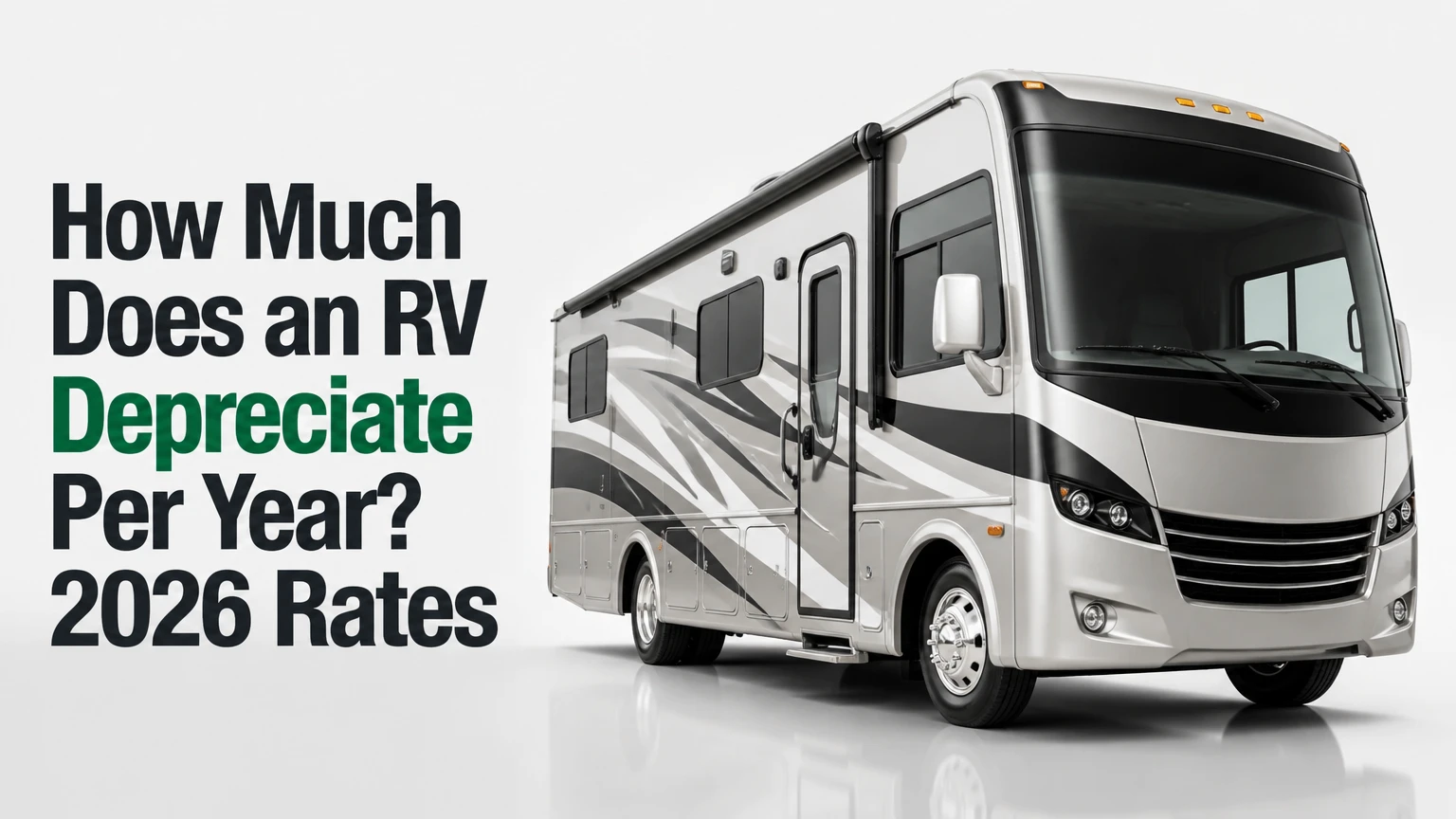
An RV typically loses 20%-30% of its value in the first year, then about 6%-10% annually during the next several years. The exact dollar loss depends on RV class, original transaction price, mileage, maintenance, water intrusion, market demand, and whether value means private-party sale, dealer trade-in, or retail listing price.
Key Facts at a Glance
- A new RV commonly loses 20%-30% of its value during the first year.
- A three-year-old RV often retains about 55%-70% of its original transaction price, depending on type and condition.
- A five-year-old RV commonly retains 40%-65% of original transaction price, with Class B camper vans usually near the high end.
- A water leak can reduce an RV’s market value by more than the repair invoice because buyers price in hidden structural damage.
- RV depreciation is usually calculated on a declining balance, so a 10% annual rate does not remove 10% of the original price every year.
- J.D. Power RV Values provides a valuation reference, but comparable listings and a professional inspection are needed for a defensible asking price.
How Much Does an RV Depreciate Per Year?
The typical annual RV depreciation pattern is steep in year one and slower after year three. A practical planning range is 20%-30% in the first year, 8%-10% in years two and three, and roughly 5%-8% annually from years four through ten, assuming average condition and normal market demand.
The first-year decline often reflects the difference between a new unit’s selling price and its used-market price. Freight, dealer preparation, financing incentives, factory options, and the premium buyers place on warranty coverage do not transfer fully to the next owner. An RV purchased below MSRP may therefore lose fewer dollars than a buyer who pays full sticker price.
After the initial adjustment, depreciation becomes more dependent on condition and liquidity. A clean, popular travel trailer with sealed maintenance records can outperform a newer but neglected unit. Conversely, an older RV with dry storage, recent tires, and documented repairs can sell close to the segment’s normal curve.
The Internal Revenue Service defines depreciation as “an allowance for the wear and tear, deterioration, or obsolescence of the property” in Publication 946. Market depreciation follows the same broad forces, but a resale buyer also reacts to supply, financing, floor-plan demand, and defect risk.
How Does RV Depreciation Work After the First Year?
RV depreciation normally compounds against the vehicle’s current value rather than subtracting the same percentage from its original price. If a $100,000 RV falls 25% in year one and 8% per year afterward, its estimated value is $75,000 after year one, $69,000 after year two, and about $63,500 after year three.
| Ownership point | Example annual rate | Estimated value from $100,000 purchase |
|---|---|---|
| New purchase | 0% starting point | $100,000 |
| End of year 1 | 25% | $75,000 |
| End of year 2 | 8% of current value | $69,000 |
| End of year 3 | 8% of current value | $63,480 |
| End of year 5 | 6% of current value | About $56,100 |
| End of year 10 | 4% of current value | About $46,000 |
These figures are planning examples, not an appraisal. The “remaining value” depends on the starting number. MSRP, actual purchase price, dealer retail, and private-party proceeds produce different results.
A common mistake is to apply 25% plus 8% plus 8% directly to the original price. That method estimates $59,000 after three years, while compound depreciation produces approximately $63,500 in the example. Both methods can be useful for rough budgeting, but they answer different questions.
What Is the Dollar Loss on a $50,000 RV?
A $50,000 RV losing 25% in year one declines by approximately $12,500, leaving $37,500. At 8% annual depreciation afterward, the RV loses about $3,000 in year two and $2,760 in year three, before considering repairs, selling fees, taxes, storage, or financing interest.
| Purchase price | 20% first-year loss | 25% first-year loss | 30% first-year loss |
|---|---|---|---|
| $30,000 | $6,000 | $7,500 | $9,000 |
| $50,000 | $10,000 | $12,500 | $15,000 |
| $100,000 | $20,000 | $25,000 | $30,000 |
| $200,000 | $40,000 | $50,000 | $60,000 |
Absolute depreciation rises with price even when the percentage remains constant. A 10% decline on a $250,000 diesel motorhome removes $25,000 of value, while the same rate removes $3,000 from a $30,000 trailer.
Which RV Types Depreciate Fastest?
Fifth wheels and luxury Class A motorhomes often experience the largest dollar losses, while Class B camper vans frequently retain the highest percentage of value. Travel trailers can depreciate quickly because their construction, towing wear, and water-damage risk make condition differences highly visible to buyers.
| RV type | Typical year-one loss | Typical five-year retained value | Main resale pressure |
|---|---|---|---|
| Class A gas | 25%-30% | 40%-55% | High purchase price, large floor plans, aging appliances |
| Class A diesel | 20%-30% | 45%-60% | Expensive systems, engine service, diesel demand |
| Class B camper van | 15%-22% | 55%-70% | Chassis demand, conversion quality, platform mileage |
| Class C motorhome | 20%-25% | 45%-55% | Cab-over leaks, rental-fleet supply, generator hours |
| Travel trailer | 20%-25% | 40%-55% | Water intrusion, towing wear, floor-plan turnover |
| Fifth wheel | 25%-30% | 40%-50% | Large luxury systems, tow requirements, structural stress |
| Truck camper | 15%-25% | 50%-65% | Pickup compatibility, limited floor plans, shell condition |
These ranges are typical market-planning figures rather than official universal schedules. Brand, floor plan, chassis, regional demand, and condition can move an individual RV far outside them.
Do Class B Camper Vans Hold Value Best?
Class B camper vans often hold value best because the buyer receives both an RV and a usable everyday vehicle. Mercedes-Benz Sprinter, Ford Transit, and Ram ProMaster platforms have broader demand than a large motorhome, although a conversion with poor electrical work, high mileage, or an altered interior can depreciate faster than a factory-built model.
Class A diesel coaches can also retain value well when they have service records, desirable layouts, and a clean roof. Diesel longevity does not automatically preserve resale value, because slide mechanisms, hydraulic systems, air conditioning, electronics, and generators can create large repair liabilities.
Travel trailers usually have lower dollar depreciation than motorhomes because their purchase prices are lower. Their percentage loss can still be severe when a buyer finds soft flooring, delamination, stained walls, or an unrepaired roof.
Is an RV’s Depreciation Based on MSRP or Purchase Price?
An RV’s real-world resale loss is best measured against the actual transaction price, while advertised depreciation percentages often use MSRP. MSRP can exaggerate the apparent loss because RV dealers routinely discount new inventory, add freight or preparation charges, and negotiate below the manufacturer’s suggested price.
Use three separate calculations:
- Economic loss: actual purchase price minus eventual sale proceeds.
- Market retention: current comparable value divided by actual purchase price.
- Accounting depreciation: the tax or financial schedule used by an owner or business.
For example, an RV with a $70,000 MSRP might sell for $56,000 after a discount. If it later sells privately for $42,000, the owner lost 25% of the transaction price, not 40% of MSRP. The buyer’s basis determines the personal financial result.
Dealer trade-in offers will normally be below private-party value because the dealer must inspect, transport, recondition, advertise, finance, and warranty the unit. A private sale can produce more proceeds but requires more time and creates greater exposure to buyer disputes.
What Makes an RV Lose Value Faster?
Water intrusion, deferred maintenance, outdated interiors, high generator hours, tire age, and poor storage accelerate RV depreciation more than ordinary calendar age. A sealed roof and complete service file can preserve more value than a low-odometer reading on an RV that sat outdoors with failed seals.
Water Damage and Delamination
Water damage is the most expensive depreciation risk because a small seal failure can spread into insulation, framing, flooring, and wall lamination. Fiberglass delamination, soft floors, swollen cabinetry, and musty odors tell buyers that the repair scope may be unknown.
A $2,000 seal repair does not necessarily create only a $2,000 deduction. If the buyer suspects hidden framing damage, the market penalty can exceed the direct repair cost. Professional moisture testing and written repair documentation reduce that uncertainty.
Tires, Roofs, and Mechanical Systems
RV tires can age out before tread disappears. DOT date codes identify the manufacturing week and year; many owners replace tires around six to seven years, subject to manufacturer guidance, load, storage, and inspection. A six-tire motorhome replacement can cost approximately $1,500-$3,500, while a trailer set may cost $500-$1,500.
Generator hours matter, but service history matters more. A maintained diesel generator with 2,000 hours may be less concerning than a neglected unit with 600 hours. Buyers also inspect engine fluids, transmission service, brakes, wheel bearings, slide-outs, leveling systems, water heaters, refrigerators, and air conditioners.
Storage and Customization
Outdoor storage exposes rubber, roof membranes, paint, sealants, and tires to ultraviolet radiation and temperature cycling. Covered storage may cost $100-$300 per month in many markets, but that expense can prevent premature seal and exterior deterioration.
Permanent modifications reduce the buyer pool when they remove beds, alter plumbing, overload electrical circuits, or install unbranded lithium systems without documentation. Reversible upgrades, photographs, invoices, and wiring diagrams generally preserve more resale confidence than highly personal renovations.
How Can You Estimate a Used RV’s Current Value?
Estimate a used RV’s value by combining a J.D. Power baseline, three to five comparable listings, condition adjustments, and a professional inspection. No single guide captures every floor plan, option package, regional market, water issue, or difference between dealer retail and private-party pricing.
Use this sequence:
- Record the exact year, make, model, floor plan, chassis, engine, mileage, generator hours, and major options.
- Check J.D. Power RV Values, formerly associated with NADA Guides, for a baseline reference.
- Search comparable units on RV Trader, dealer websites, and regional marketplaces.
- Remove listings with different floor plans, salvage titles, major damage, or unusually high dealer preparation.
- Adjust for tires, roof condition, appliances, batteries, service records, and water intrusion.
- Obtain a pre-purchase inspection, including moisture readings, roof inspection, appliance testing, and chassis review.
- Compare private-party value with dealer trade-in value and expected selling costs.
| Condition adjustment | Typical financial effect | Evidence to request |
|---|---|---|
| Tires older than 6 years | Minus $500-$3,500 | DOT date codes, invoices |
| Recent roof reseal | Plus $500-$2,000 in buyer confidence | Dated invoice and photos |
| Failed refrigerator | Minus $1,500-$5,000 | Diagnostic report and model number |
| Generator service overdue | Minus $300-$1,500 | Service records and load test |
| Confirmed delamination | Minus 20%-60% or more | Moisture report and repair scope |
| Complete service file | Often supports top of local range | Annual invoices and inspection history |
The adjustment amounts are typical planning ranges. They are not guaranteed deductions, because buyers may value a repair differently by region and season.
Is Buying a Three-to-Five-Year-Old RV Financially Better?
Buying a three-to-five-year-old RV is often financially better for buyers who want to avoid the steepest depreciation, provided the unit passes a moisture and systems inspection. The first owner absorbs much of the new-to-used price reset, while the second owner can still find modern appliances, current safety equipment, and available parts.
| Purchase timing | Depreciation exposure | Warranty position | Primary risk |
|---|---|---|---|
| New, year 0 | Highest, 20%-30% first year | Factory coverage, often 1-3 years | Defects and immediate value loss |
| Two years old | Moderate, roughly 30%-40% below original transaction price | Limited or expired | Hidden use and incomplete records |
| Three to five years old | Lower, roughly 40%-60% retained value | Mostly expired | Water damage and deferred maintenance |
| Eight to ten years old | Flatter curve, often 25%-45% retained value | Expired | Aging appliances, tires, electronics |
| More than ten years old | Highly condition-dependent | Expired | Structural and parts availability issues |
New ownership remains rational when warranty certainty, a specific floor plan, financing terms, or full-time reliability outweighs the first-year loss. It is less attractive for a buyer planning to sell after 12-24 months.
An older RV is not automatically a bargain. A $25,000 coach needing $12,000 in roof, tires, batteries, and appliance work is economically more expensive than a documented $32,000 unit requiring only routine service.
Does Mileage Matter More Than Age?
Mileage matters most for motorhomes, while age and environmental exposure often matter more for towable RVs. A motorhome’s chassis, engine, transmission, suspension, and generator accumulate use, but a stationary trailer can develop roof, seal, tire, battery, and plumbing problems without traveling many miles.
For motorhomes, review:
- Odometer mileage and annual mileage pattern
- Generator hours and load-test results
- Engine, transmission, brake, and coolant service
- Rental or commercial use history
- Accident, flood, and title records
For trailers, review:
- Wheel-bearing and brake service
- Tire dates and load ratings
- Frame, suspension, and hitch condition
- Roof seal history
- Slide-out alignment and floor softness
A low-mileage motorhome that sat unused may have dried seals, flat-spotted tires, stale fuel, and neglected batteries. Moderate mileage with consistent service can be the safer resale profile.
Can an RV Ever Appreciate?
An RV rarely appreciates as a normal investment, but exceptional scarcity, inflation, restoration, or a strong chassis market can raise its nominal resale price temporarily. Appreciation in dollars does not necessarily mean the owner earned a real return after storage, insurance, maintenance, taxes, and selling expenses.
Potential exceptions include:
- A discontinued, highly sought-after vintage model
- A professionally restored Airstream or limited-production coach
- A camper van built on a scarce, desirable chassis
- A unit purchased below market during a distressed sale
- A period of unusually high used-RV demand
These cases are speculative. A buyer should underwrite an RV as a depreciating recreational asset, not as real estate or an appreciating collectible.
Which Ownership Strategy Minimizes Depreciation?
The lowest-depreciation strategy is usually buying a three-to-five-year-old, well-maintained RV with strong regional demand and keeping it long enough to spread transaction costs. The best choice changes by use case, because minimizing percentage depreciation can conflict with warranty needs, comfort, reliability, and annual utilization.
Weekend Owner
A weekend owner usually benefits from a three-to-five-year-old travel trailer or compact Class B. The buyer avoids the new-unit premium and does not pay for luxury systems that remain unused for most of the year.
Full-Time Occupant
A full-time occupant may justify a newer Class B, premium Class A, or well-inspected fifth wheel because breakdowns affect housing, work, and relocation. Build quality and service support can matter more than the lowest theoretical depreciation rate.
One-to-Two-Year Owner
A short-term owner should consider an eight-to-ten-year-old RV in unusually good condition. The curve is flatter at that age, but resale depends heavily on water history, tires, appliances, title cleanliness, and market liquidity.
Towing and Seasonal Users
A seasonal towable buyer should prioritize a common floor plan, appropriate tow ratings, dry storage, and accessible service. A rare layout may appear attractive but can require longer selling time and a larger price concession.
What Are the Most Common RV Depreciation Mistakes?
The most common RV depreciation mistakes are ignoring moisture, using MSRP as the financial baseline, treating low mileage as proof of condition, and pricing from active listings without allowing for negotiation. Owners also overestimate aftermarket upgrades and underestimate selling friction.
- Skipping annual roof inspections: Seal failures become structural problems when ignored.
- Leaving tires in direct sunlight: UV exposure ages sidewalls even when mileage is low.
- Using the wrong tow vehicle: Overloaded operation increases tire, brake, suspension, and frame wear.
- Installing undocumented electrical upgrades: Buyers discount lithium, solar, and inverter systems that lack diagrams or invoices.
- Ignoring recalls and service campaigns: Open safety issues reduce buyer confidence and financing options.
- Comparing unlike floor plans: A rear-living trailer and a bunkhouse trailer do not share the same demand curve.
A practitioner rule is to document every moisture inspection, tire replacement, appliance repair, and major upgrade with a date, invoice, model number, and photograph. Documentation converts an owner’s claim into evidence a buyer can evaluate.
How Should You Calculate the Total Cost of RV Ownership?
Calculate total RV ownership cost by adding depreciation, interest, insurance, registration, storage, maintenance, repairs, fuel, campground fees, and selling expenses. Depreciation often becomes the largest cost for a new luxury RV, while maintenance and repairs can dominate an older, inexpensive unit.
| Annual cost category | Travel trailer example | Class C example | Class A diesel example |
|---|---|---|---|
| Depreciation provision | $2,000-$5,000 | $5,000-$12,000 | $10,000-$30,000 |
| Insurance and registration | $500-$1,500 | $1,200-$3,500 | $2,000-$6,000 |
| Storage | $1,200-$3,600 | $1,800-$4,800 | $2,400-$7,200 |
| Maintenance and repairs | $800-$3,000 | $1,500-$5,000 | $3,000-$12,000 |
| Selling transaction costs | $500-$2,500 | $1,000-$4,000 | $2,000-$8,000 |
These are typical annual planning ranges in the United States, excluding fuel, financing interest, campground fees, and major accident repairs. Local storage rates, insurance territory, coach size, and service labor can change the result substantially.
A useful formula is:
Annual ownership cost = depreciation + recurring ownership costs + repairs + usage costs + selling costs, divided by years owned.
This calculation explains why buying a cheaper RV does not always produce the lowest cost. A reliable $60,000 trailer held for seven years may outperform a problematic $30,000 trailer that requires immediate structural work.
What Should You Inspect Before Buying a Used RV?
Inspect the roof, wall seams, ceiling, floor, slides, windows, plumbing, appliances, tires, chassis, generator, and title history before buying a used RV. A professional inspection commonly costs about $300-$1,200, depending on size, location, travel, and testing depth.
Pay special attention to:
- Soft flooring near bathrooms, kitchens, slides, and entry doors
- Bubbling fiberglass or rippled exterior walls
- Musty odors inside cabinets and under mattresses
- Staining around roof penetrations and windows
- Refrigerator cooling performance on all available power sources
- Water pressure, tank leaks, pump cycling, and heater operation
- Slide-out seals, motors, gears, and floor alignment
- Tire DOT dates, cracking, load rating, and uneven wear
- Generator startup, voltage stability, and operating hours
- Title brands, flood history, accident records, and unpaid liens
Do not rely on a short dealership walk-through. Run appliances, operate every slide, test plumbing, inspect underbelly areas, and request a cold-start engine evaluation when practical. A seller who refuses independent inspection creates a valuation risk that should be priced as such or avoided.
The Bottom Line
How much an RV depreciates per year depends primarily on the first-year price reset, RV type, condition, and resale demand. Budget for a 20%-30% first-year decline and 6%-10% annual depreciation afterward, then refine the estimate with actual purchase price, comparable sales, service records, and inspection results.
The strongest financial pattern is usually a well-maintained three-to-five-year-old RV with a popular floor plan, clean moisture history, current tires, and documented service. The weakest pattern is a new, heavily customized unit sold after one or two years, especially when the owner measures loss against MSRP rather than the actual purchase price.
RV depreciation is only one ownership cost. A repair-free, usable RV that supports frequent travel can deliver better value than a nominally cheaper unit that remains unavailable or requires major structural work.
Frequently Asked Questions
Do RVs depreciate faster than cars?
Many new RVs depreciate faster in percentage terms during the first year than ordinary passenger cars because dealer discounts, freight, options, and warranty premiums do not transfer fully to the used market. Later depreciation varies widely, and a popular camper van can outperform a low-demand car or large motorhome.
How much does a travel trailer depreciate after ten years?
A travel trailer often retains about 25%-40% of its original transaction price after ten years, but condition can move the result dramatically. A dry, documented trailer with current tires may sell near the upper range, while water damage, delamination, or obsolete appliances can reduce value far below it.
Is RV depreciation tax deductible?
RV depreciation may be deductible when the RV qualifies as business or income-producing property and the owner follows applicable tax rules. Personal-use depreciation generally is not deductible. IRS Publication 946 and a qualified tax professional should guide treatment because business use, listed-property rules, and records affect eligibility.
Does storing an RV indoors prevent depreciation?
Indoor or covered storage can slow depreciation by reducing ultraviolet exposure, seal deterioration, moisture entry, and tire damage, but it cannot stop normal age, mechanical wear, or market obsolescence. Storage protects condition; it does not guarantee a higher resale price or recover storage costs.
Do RV upgrades increase resale value?
Some upgrades improve saleability without returning their full cost. Current tires, documented roof work, reliable batteries, solar equipment, suspension maintenance, and professionally installed safety systems can support buyer confidence, while personalized furniture, unusual paint, and undocumented electrical modifications often recover little of their purchase price.
What is the best age to buy an RV?
The best age for many buyers is three to five years because the first owner has absorbed much of the new-unit depreciation while the RV may still have modern systems and available parts. Buyers must still prioritize moisture testing, tire dates, service records, and appliance condition over the model year alone.