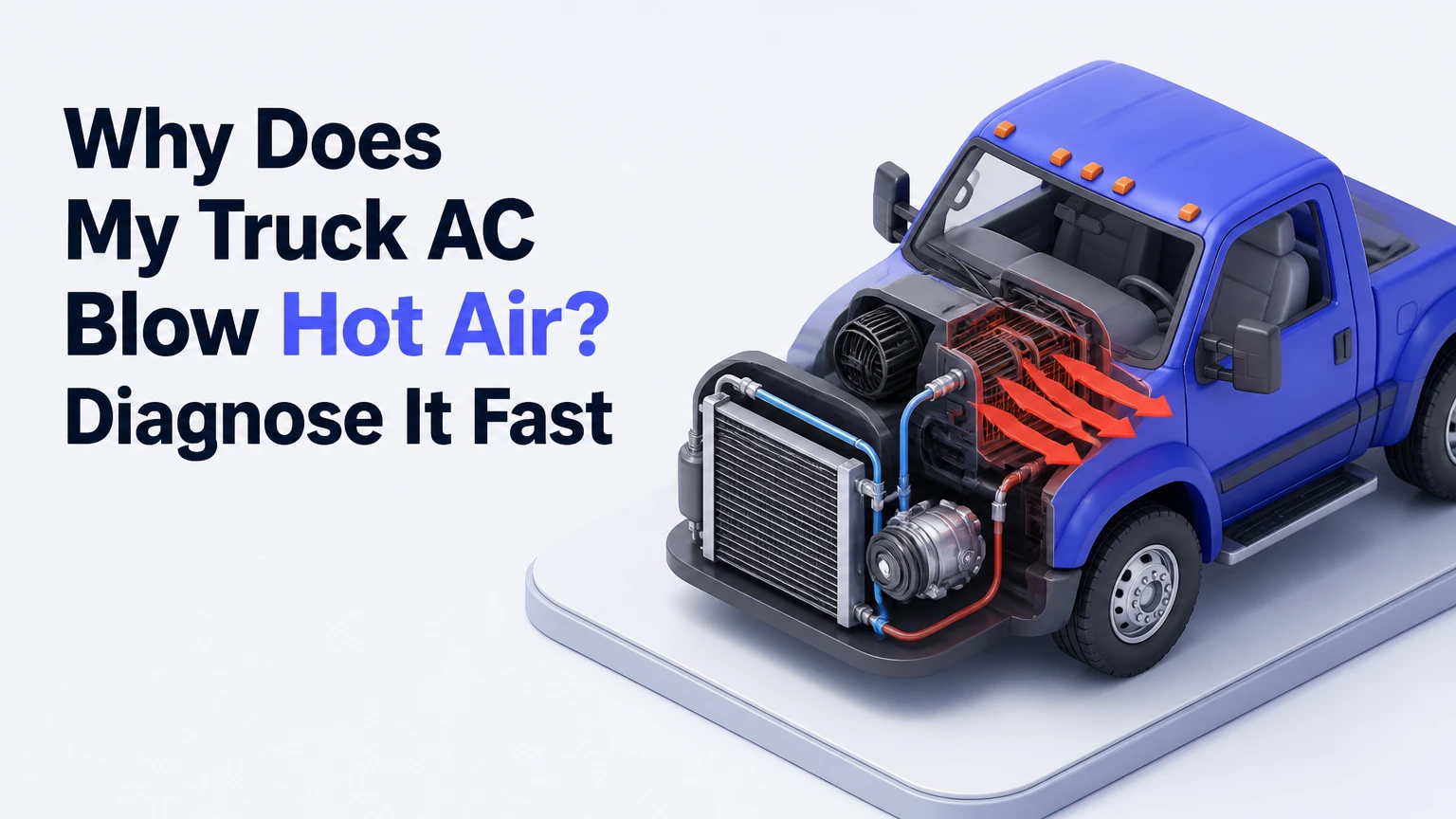
Your truck AC blows hot air when the air-conditioning system cannot remove heat, or when a failed blend door prevents cooled air from reaching the vents. The most common causes are low refrigerant from a leak, compressor or clutch failure, electrical control problems, poor condenser airflow, and a stuck HVAC blend door.
Key Facts at a Glance
Low refrigerant usually means the truck AC system has a leak, not that refrigerant was naturally consumed.
Cold air at highway speed but hot air at idle commonly indicates condenser airflow or cooling-fan trouble.
A compressor clutch that never engages can result from low pressure, a blown fuse, a failed relay, or compressor failure.
Different vent temperatures on the same dashboard often indicate a blend-door or actuator problem.
Refrigerant pressure readings must be interpreted against ambient temperature, refrigerant type, engine speed, and system design.
A recharge can restore cooling temporarily, but it cannot permanently repair a leak.
Why Does My Truck AC Blow Hot Air?
Truck AC blows hot air because one of two functions has failed: the refrigeration circuit is not producing cold, or the HVAC case is mixing cooled air with heated air. Refrigerant must circulate through the compressor, condenser, expansion device, and evaporator before the blower can deliver cold cabin air.
The system is a heat-transfer loop rather than a source of cold. The evaporator absorbs cabin heat, while the condenser releases that heat outside the truck. A restriction, pressure fault, electrical command, airflow problem, or air-direction fault can interrupt the result at several points.
The symptom pattern narrows the diagnosis. Hot air from every vent with no compressor engagement points toward pressure protection or electrical control. Cold air while moving but warm air at a stop points toward condenser airflow. Cold lines under the hood with hot dashboard air points toward a blend door.
How Does Truck AC Make Cold Air?
Truck AC makes cold air by circulating refrigerant through four pressure and state changes:
- Compression: The compressor turns low-pressure refrigerant vapor into high-pressure, high-temperature vapor.
- Condensation: The condenser removes heat and changes the vapor into a high-pressure liquid.
- Expansion: An orifice tube or thermal expansion valve lowers refrigerant pressure.
- Evaporation: The evaporator absorbs cabin heat as low-pressure refrigerant boils into vapor.
The blower moves cabin air across the evaporator fins. Moisture also condenses on the cold evaporator, which explains why a properly operating truck AC system can drain water beneath the vehicle.
What Does Low Refrigerant Feel Like?
Low refrigerant commonly produces weak cooling, longer compressor cycling, vent temperatures that fluctuate, or no cooling after the pressure falls below the low-pressure switch threshold. Refrigerant loss is not a normal fuel-like consumption process because automotive AC systems are designed as sealed circuits.
A small leak can leave the truck moderately cool for weeks before performance collapses. Common leak locations include condenser damage from road debris, compressor shaft seals, hose crimps, service-port valves, evaporator seams, and aging O-rings.
| Low-refrigerant symptom | What the driver notices | Likely system behavior | Best confirmation |
|---|---|---|---|
| Slightly warm air | Cooling declines over several weeks | Low suction pressure | Recover-and-weigh test |
| Rapid clutch cycling | Clicks every 5-15 seconds | Low-pressure protection | Gauge readings and leak test |
| No clutch engagement | Air remains ambient temperature | Pressure switch opens circuit | Electrical and pressure diagnosis |
| Oily residue | Wet-looking fitting or hose | Refrigerant oil escaped | UV dye or electronic detector |
| Frost near expansion device | Localized ice, poor cabin cooling | Incorrect pressure or restriction | Temperature and pressure comparison |
The Environmental Protection Agency states that technicians must be certified to service motor-vehicle air-conditioning systems involving regulated refrigerants. Refrigerant recovery, evacuation, and charging require approved equipment because venting refrigerant is prohibited under United States federal rules.
Why Does a Recharge Not Fix the Problem?
A recharge does not fix a truck AC leak because adding refrigerant replaces the lost charge without repairing the failed seal, hose, condenser, or evaporator. The system may cool for days or months, depending on leak size, then lose pressure again.
A proper repair includes leak confirmation, component replacement or sealing, evacuation with a vacuum pump, and charging by the specified mass. Charging by pressure alone is unreliable because pressure changes with outdoor temperature and compressor speed.
What Should the Compressor Clutch Do?
The compressor clutch should engage when the truck AC is commanded on, although many modern systems cycle or vary compressor output instead of remaining continuously engaged. The outer pulley may spin with the serpentine belt even when the clutch hub is stationary.
With the engine running, the climate control set to maximum cooling, and the blower on high, observe the compressor from a safe distance. Keep hands, clothing, tools, and hair away from belts and pulleys.
| Compressor observation | Most likely meaning | Additional check | Repair direction |
|---|---|---|---|
| Outer pulley and hub both spin | Clutch is engaged | Measure vent temperature | Diagnose pressure and airflow |
| Outer pulley spins, hub stays still | Clutch is disengaged | Check voltage and pressure | Electrical or low-charge diagnosis |
| Hub engages briefly, then releases | Protection or control cycling | Compare pressure and temperature | Leak, fan, or sensor testing |
| Grinding or rattling noise | Mechanical compressor damage | Inspect belt and pulley | Stop operation and inspect system |
| Belt slips or squeals | Pulley or compressor resistance | Check belt condition | Repair before further operation |
A stationary clutch hub does not automatically prove a bad compressor. Low refrigerant, a high-pressure shutdown, a blown fuse, a failed relay, an open clutch coil, and a control-module command can all prevent engagement.
Can a Bad Compressor Cause Hot Air?
A bad compressor can cause hot air when its clutch fails, its internal valves cannot build pressure, or the pump seizes. A compressor that turns but produces almost no pressure difference can look normal from above while the evaporator remains warm.
Compressor noise changes the repair priority. A light click during clutch engagement can be normal, but grinding, metallic rattling, belt squeal, or repeated pulley lockup indicates a risk of spreading metal debris through the AC circuit. Compressor debris can require replacement of the condenser, expansion device, hoses, and accumulator or receiver-drier.
Practitioner rule: Do not repeatedly energize a noisy compressor to “see whether it gets colder.” One short test can become an extensive contamination repair.
Why Does Truck AC Get Hot at Idle?
Truck AC gets hot at idle when the condenser cannot reject enough heat without vehicle speed. The usual causes are a failed electric fan, weak fan clutch, blocked condenser fins, damaged shrouding, or insufficient airflow between the condenser and radiator.
At highway speed, ram air can temporarily compensate for a failed fan. At a traffic light, condenser temperature and high-side pressure rise, causing the control system to reduce cooling or shut the compressor off for protection.
| Idle-versus-road symptom | Probable fault | Quick inspection | Typical consequence |
|---|---|---|---|
| Cold at 45 mph, hot at stops | Electric condenser fan failure | Confirm fan command and operation | High-pressure shutdown |
| Warm at all speeds | Low charge or compressor issue | Check pressures and clutch | No effective heat transfer |
| Hot after dusty driving | Blocked condenser face | Inspect fins with a light | Restricted heat rejection |
| AC worsens with engine heat | Cooling-system airflow fault | Check fan clutch and shroud | AC and engine temperature rise |
| Cold after spraying fins | External debris blockage | Clean gently from engine side | Improved condenser airflow |
Do not place fingers near a mechanical fan or assume an electric fan should run continuously. Some trucks command the fan only when temperature, pressure, and operating conditions require it.
How Can You Check Condenser Airflow?
Check condenser airflow by inspecting the grille and condenser face for mud, leaves, insects, bent fins, or plastic debris, then verify fan operation according to the truck’s service procedure. Disconnecting electrical connectors or probing fan circuits can trigger moving components and control faults.
A dirty condenser can be cleaned with low-pressure water and a soft brush. High-pressure water can flatten fins and worsen airflow, especially when sprayed directly into the delicate condenser surface.
Can the Blend Door Make Cold AC Feel Hot?
A blend door can make cold truck AC feel hot when the refrigeration circuit is working but an HVAC flap directs air across the heater core. The actuator may fail mechanically, lose calibration, strip its plastic gears, or receive an incorrect command from the climate-control module.
A useful distinction is line temperature versus vent temperature. If the large low-pressure line near the firewall is cold and sweating while the vents blow warm, the problem is probably inside the HVAC air box rather than in the refrigerant loop.
| Cabin symptom | Likely HVAC component | Diagnostic clue | Typical repair |
|---|---|---|---|
| Both sides hot, cold line present | Main blend door | Temperature changes do not respond | Actuator or door service |
| Driver cold, passenger hot | Dual-zone actuator | Side-to-side temperature split | Actuator calibration or replacement |
| Air stuck on defrost | Mode door actuator | Vent position buttons have no effect | Mode actuator diagnosis |
| Temperature changes after battery work | Lost actuator calibration | HVAC module needs relearn | Scan-tool or key-cycle procedure |
| Clicking behind dashboard | Stripped actuator gears | Repeated clicking during adjustment | Actuator replacement |
Some trucks use cable-operated doors, vacuum controls, or electronically commanded actuators. A parts catalog lookup by year, engine, trim, and HVAC configuration prevents ordering the wrong actuator.
Why Is One Side Hot and the Other Cold?
One side hot and the other cold usually indicates a dual-zone blend-door problem, not a refrigerant shortage. A low charge generally affects the entire evaporator, while a failed passenger-side or driver-side actuator can create a sharp temperature difference across the dashboard.
A calibration procedure may solve a lost position memory, but calibration cannot repair broken gears or a disconnected door. Shops often use a scan tool to command each actuator and compare requested position with actual position.
Which Electrical Faults Stop Truck AC?
Blown fuses, failed relays, open pressure switches, faulty temperature sensors, damaged wiring, and HVAC control-module faults can stop truck AC operation. Modern trucks may deliberately disable the compressor when refrigerant pressure, engine temperature, ambient temperature, or load conditions fall outside permitted limits.
Electrical diagnosis should start with the wiring diagram and fuse assignment for the specific truck. Testing for voltage at the compressor connector, clutch ground quality, relay output, and control-module command is more useful than replacing parts based on appearance.
| Electrical component | Failure effect | Test value or observation | Common mistake |
|---|---|---|---|
| AC fuse | Clutch or module loses power | Open circuit at fuse | Installing a larger fuse |
| Compressor relay | Clutch receives no switched voltage | Commanded output absent | Replacing compressor first |
| Low-pressure switch | Compressor disabled | Open circuit at low pressure | Bypassing the switch |
| High-pressure switch | Compressor protection active | Open circuit at excessive pressure | Adding more refrigerant |
| Ambient sensor | Incorrect operating command | Implausible scan data | Ignoring stored HVAC codes |
| Clutch coil | Hub never engages | Resistance outside specification | Applying power without safeguards |
Never permanently bypass a pressure switch. The switch protects the compressor and occupants from abnormal system pressure, and bypassing it can convert a diagnostic problem into component damage.
What Other Faults Cause Warm Truck AC?
Warm truck AC can result from an iced evaporator, restricted expansion device, clogged cabin air filter, incorrect refrigerant, heater-control valve leakage, or a recent service error. These faults are less universal than leaks and airflow problems, but their symptom patterns are distinctive.
A frozen evaporator may produce cold air initially, followed by weak airflow and warming vents after extended operation. Turning the AC off while leaving the blower on can melt the ice temporarily, but the underlying cause may be low refrigerant, a failed evaporator temperature sensor, restricted airflow, or a malfunctioning expansion device.
| Less-common fault | Characteristic symptom | Confirmation | Usual remedy |
|---|---|---|---|
| Frozen evaporator | Airflow fades after 20-60 minutes | Ice on evaporator or drain pattern | Correct charge, airflow, or sensor |
| Clogged cabin filter | Weak airflow, normal vent temperature | Filter visibly loaded | Replace filter |
| Restricted orifice tube | Poor cooling and abnormal pressures | Pressure imbalance | Replace restriction and drier |
| Heater-control valve leak | Warm air despite cold evaporator | Heater hose remains hot | Repair valve or control |
| Wrong refrigerant | Poor cooling after service | Refrigerant identification test | Recover and recharge correctly |
| Incorrect charge amount | High or low performance | Recover-and-weigh service | Charge to vehicle specification |
A cabin filter cannot usually make properly cooled air genuinely hot. It can, however, reduce airflow so substantially that the driver interprets weak cooling as a temperature failure.
How Do You Check a Truck AC Safely?
Check a truck AC system with a visual inspection, operating observation, temperature measurement, electrical testing, and refrigerant-pressure evaluation in that order. The process usually takes 15-30 minutes for basic screening, while a leak and performance diagnosis commonly takes 1-2 hours.
Step 1: Confirm the Complaint
Set the system to maximum cooling, recirculation, and high blower speed. Record the outside temperature, vent temperature, whether airflow is strong, and whether the condition changes between idle and approximately 1,500 engine rpm.
Success checkpoint: Vent temperature changes when the compressor engages or the climate setting changes.
Common mistake: Testing with fresh-air mode, a partially open window, or a sun-heated interior and treating the initial warm blast as a fault.
Step 2: Observe the Compressor
Watch the pulley and clutch from a safe position. Listen for grinding, belt squeal, repeated cycling, or a sharp engagement shock.
Success checkpoint: The clutch responds predictably, or the diagnostic path explains why it remains off.
Common mistake: Assuming the spinning pulley proves that the compressor is pumping.
Step 3: Check Airflow and Fan Operation
Inspect the condenser through the grille, check the cooling fan according to the service manual, and compare AC performance at idle and road speed.
Success checkpoint: The condenser receives adequate airflow without overheating or abnormal high-pressure cycling.
Common mistake: Cleaning fins with excessive water pressure or touching a fan that can start automatically.
Step 4: Compare Vent and Line Temperatures
Use an infrared thermometer at the center vent and compare the large and small refrigerant lines near the firewall. The large line is commonly cooler, but exact temperatures vary by design and operating conditions.
Success checkpoint: A functioning system often produces vent air roughly 35-55 degrees Fahrenheit below ambient in suitable conditions, although humidity, sun load, and truck design change the result.
Common mistake: Calling a line “ice-cold” a diagnosis. Surface touch cannot identify charge quantity or confirm compressor efficiency.
Step 5: Test Pressure and Charge by Specification
A qualified technician should recover the refrigerant, test for leaks, evacuate moisture, and recharge by the under-hood label’s specified mass. R-134a and R-1234yf systems require different equipment and must not be mixed.
Success checkpoint: High-side and low-side pressures, vent temperature, cycling behavior, and charge weight agree with the manufacturer’s service data.
Common mistake: Using a single low-side gauge as proof that the system needs refrigerant.
How Much Does Truck AC Repair Cost?
Truck AC repair typically costs $100-$200 for diagnosis, $150-$300 for a recover-and-recharge service, $150-$1,000 or more for a blend-door repair, and $800-$1,500 or more for a compressor assembly. Regional labor rates, refrigerant type, engine access, contamination, and truck trim create large differences.
| Repair or diagnosis | Typical total cost | Typical time | Cost increases when |
|---|---|---|---|
| Visual and pressure diagnosis | $100-$200 | 1-2 hours | Electrical faults require tracing |
| Leak test and recharge | $150-$300 | 1-1.5 hours | Refrigerant, oil, or dye is additional |
| Pressure switch replacement | $100-$250 | About 1 hour | Access is obstructed |
| Condenser replacement | $400-$750 | 2-3 hours | Debris contaminates the circuit |
| Blend-door actuator | $150-$400 | 1-4 hours | Dashboard removal is required |
| Compressor and clutch | $800-$1,500+ | 3-5 hours | Metal contamination requires flushing |
| Evaporator replacement | $900-$2,000+ | 6-12 hours | The HVAC case must be removed |
These are typical United States consumer repair ranges, not guaranteed estimates. A written estimate should identify the failed component, refrigerant type, required replacement parts, labor hours, evacuation procedure, and warranty.
Should You Use a Recharge Kit?
A recharge kit is reasonable only for a knowledgeable owner who confirms the refrigerant type, avoids sealant, follows the label, and understands that a low charge indicates a leak. A basic kit cannot reliably identify a leak, prove compressor condition, or protect against overcharging.
| Service choice | Typical out-of-pocket cost | Diagnostic capability | Best use |
|---|---|---|---|
| Consumer recharge can | $35-$90 | Low, low-side pressure only | Temporary screening by experienced owners |
| Independent AC shop | $150-$750 typical repairs | High, leak and electrical testing | Most truck owners |
| Dealership service center | $200-$2,000+ | High, vehicle-specific scan tools | Warranty or complex module faults |
| Fleet mobile technician | $150-$500 visit range | Medium to high | Work trucks needing reduced downtime |
Avoid cans containing chemical stop-leak. Sealant can obstruct expansion devices and contaminate recovery equipment, increasing the cost of later professional service.
Why Does Truck AC Fail After Recent Service?
Truck AC can fail after recent service because the system was undercharged, overcharged, left with air or moisture, filled with the wrong refrigerant, or repaired without correcting the original leak. A recently replaced compressor also requires correct oil quantity and contamination control.
Ask the servicing facility for the recovered charge weight, final charge weight, leak-test result, vacuum-hold result, and refrigerant identifier reading. Those records separate a new component failure from an incomplete repair.
Overcharging is not a harmless attempt to improve cooling. Excess refrigerant can raise high-side pressure until the protection switch disables the compressor, while liquid refrigerant entering the compressor can damage internal components.
DIY, Independent Shop, or Dealership?
An independent shop is usually the best value for a truck outside warranty when it has certified technicians, recovery equipment, leak-detection tools, and documented HVAC experience. A dealership is preferable for warranty work, integrated climate modules, known calibration procedures, or difficult body-control faults.
DIY inspection is suitable for vent-temperature measurement, filter replacement, grille inspection, and visual belt checks. Refrigerant recovery, evacuation, leak repair, and charging require appropriate equipment and legal compliance.
Which Option Fits Your Situation?
- Budget-conscious owner: Perform visual checks and obtain two written diagnoses before buying parts.
- Work-truck operator: Choose the shop that can test and repair the vehicle quickly, then request a parts and labor warranty.
- Newer truck under warranty: Use the dealer or authorized repair provider to preserve coverage.
- Older truck with a noisy compressor: Stop operating the AC and request a contamination assessment rather than a recharge.
- Truck with one hot and one cold zone: Request HVAC actuator testing before authorizing refrigerant work.
What Should You Tell the Technician?
Tell the technician when the fault began, whether cooling changes with vehicle speed, whether the compressor clicks, whether one side differs from the other, and whether the system was recently serviced. These observations can eliminate several diagnostic branches before testing begins.
Provide the truck’s year, make, model, engine, trim, refrigerant type, and dual-zone or rear-AC configuration. Mention dashboard clicking, belt noise, fan behavior, a previous collision, condenser replacement, or work near the HVAC case.
FAQ
Can a truck AC system lose refrigerant without a visible leak?
Yes, a truck AC system can lose refrigerant through small O-ring leaks, service-port valves, hose crimps, compressor shaft seals, condenser damage, or an evaporator leak that leaves no engine-bay residue. Refrigerant may escape as a gas while a small amount of oil remains hidden, so visual inspection alone cannot rule out leakage.
Should the AC compressor clutch spin all the time?
No, the compressor clutch does not necessarily spin continuously. Conventional systems cycle the clutch to control evaporator temperature, while variable-displacement compressors and modern control modules may alter capacity without the same visible cycling pattern. The vehicle service information determines what operation is normal for a specific truck.
Why is my truck AC cold on one setting but hot on another?
A setting-dependent temperature change may indicate a blend-door command, recirculation-door fault, evaporator freeze-up, or control-panel problem. If cooling changes when switching between fresh air and recirculation, compare vent temperature and airflow while checking whether the actuator moves and whether the compressor remains commanded on.
Can a clogged cabin air filter cause hot air?
A clogged cabin air filter can cause weak airflow and poor cooling performance, but it normally does not make the evaporator produce hot air. Replace the filter when it is visibly loaded or airflow is weak, then retest vent temperature before authorizing refrigerant or compressor repairs.
How long should a truck AC repair last?
A correctly repaired and properly charged truck AC system should continue cooling for years, although component life depends on vibration, corrosion, road debris, climate, and maintenance. A recharge that lasts only days or weeks indicates an unresolved leak, incorrect charge, or another system fault rather than normal refrigerant consumption.
Is warm AC dangerous to drive with?
Warm AC is usually not a direct driving hazard, but compressor noise, belt damage, engine overheating, and refrigerant leaks can create secondary risks. Stop using the AC if the belt squeals, the compressor grinds, smoke appears, or the engine temperature rises, then arrange inspection before continued operation.
The Bottom Line
The answer to “why does my truck ac blow hot air” is usually a failed refrigeration, airflow, electrical, or blend-door function. Start by comparing idle and highway behavior, observing compressor engagement, checking condenser airflow, and comparing vent temperature with refrigerant-line temperature. Do not assume a recharge is a repair.
Low refrigerant, compressor faults, fan problems, and electrical shutdowns require different tests. A cold line with hot dashboard air points toward the HVAC doors, while hot air that appears mainly at idle points toward condenser airflow. Professional diagnosis usually costs less than replacing the wrong component, and safe refrigerant service protects both the truck and the technician.