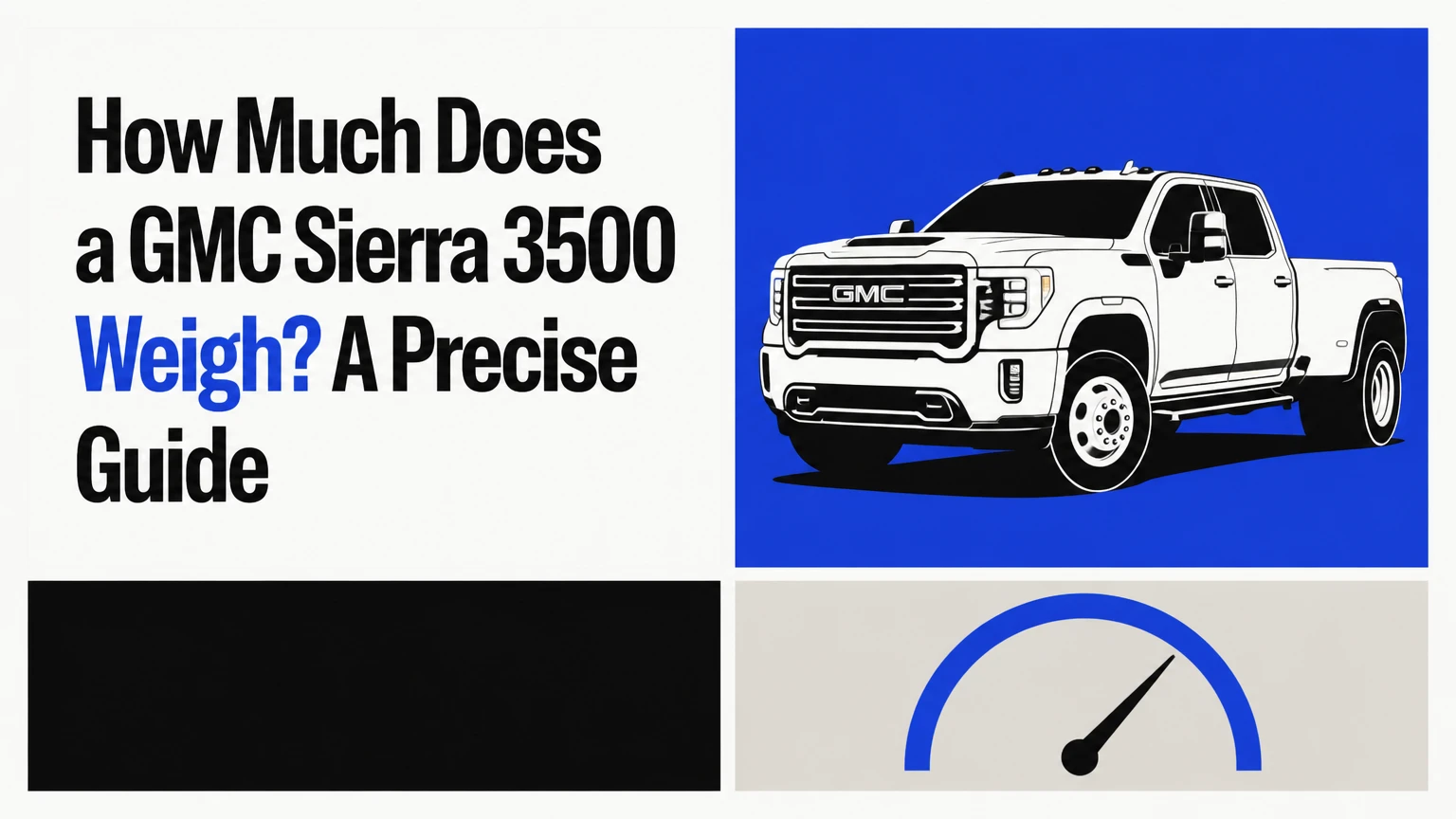
A GMC Sierra 3500 HD typically weighs about 6,300-8,600+ pounds at the curb, depending on cab style, engine, drivetrain, bed length, trim, and single- or dual-rear-wheel configuration. A light regular-cab gas truck may be near 6,329 pounds, while a Crew Cab 4WD Duramax dually can exceed 8,200 pounds.
Key Facts at a Glance
- A GMC Sierra 3500 HD’s typical curb-weight range is approximately 6,300-8,600+ pounds.
- The lightest configurations are usually regular-cab, gasoline-engine, 2WD, single-rear-wheel trucks.
- A Duramax diesel, 4WD system, Crew Cab, luxury trim, and dually equipment each increase vehicle weight.
- Typical Sierra 3500 GVWR ranges from about 11,550 pounds for some SRW models to 14,000 pounds for DRW models.
- Payload equals GVWR minus the truck’s actual as-equipped weight, not its maximum tow rating.
- The driver-door Tire and Loading Information label gives the most useful payload figure for a specific truck.
How Much Does a GMC Sierra 3500 Weigh?
A GMC Sierra 3500 HD weighs approximately 6,300-8,600+ pounds before passengers, cargo, and trailer tongue or fifth-wheel pin weight are added. The exact curb weight depends on the engine, cab, box, drivetrain, trim, options, fuel level, and whether the truck has single or dual rear wheels.
Published specifications often describe a base or estimated configuration rather than every truck on a dealer lot. For example, Edmunds lists a 2025 regular-cab Sierra 3500 HD near 6,329 pounds in a light gas configuration, while heavy Crew Cab diesel DRW examples can reach or exceed 8,600 pounds.
The practical answer is therefore a range, not one universal number. A gas Crew Cab SRW commonly falls around 6,979-7,500 pounds, while a diesel Crew Cab long-bed dually commonly falls around 8,200-8,666+ pounds.
Typical Curb Weights by Configuration
| Sierra 3500 configuration | Typical curb-weight range | Main weight driver |
|---|---|---|
| Regular Cab, gas, 2WD, SRW | 6,300-6,700 lb | Short cab and lighter powertrain |
| Regular Cab, gas, 4WD, SRW | 6,600-7,000 lb | Front axle and transfer case |
| Crew Cab, gas, 2WD, SRW | 6,979-7,400 lb | Larger cab and passenger equipment |
| Crew Cab, gas, 4WD, SRW | 7,200-7,700 lb | 4WD hardware and heavier options |
| Crew Cab, diesel, 4WD, SRW | 7,700-8,200 lb | Duramax engine and diesel systems |
| Crew Cab, diesel, 4WD, DRW | 8,200-8,666+ lb | Diesel powertrain and dual rear wheels |
These are typical planning ranges for recent Sierra 3500 HD models, particularly 2025 and 2026 configurations. They are not a substitute for the certification label or a public scale reading.
What Does Weight Mean on a Sierra 3500?
“Weight” can mean curb weight, GVWR, payload, GAWR, or GCWR, and those terms describe different measurements. Curb weight is the truck itself, while GVWR is the legal maximum for the loaded truck and GCWR is the maximum combined truck-and-trailer rating.
| Term | Meaning | Sierra 3500 example |
|---|---|---|
| Curb weight | As-equipped truck with operating fluids and normally a full fuel tank | 7,900 lb |
| GVWR | Maximum truck weight with occupants, cargo, and trailer load placed on it | 12,250 lb |
| Payload | Weight available for people, cargo, accessories, and tongue or pin load | 4,350 lb |
| GAWR | Maximum permitted load on one axle | Rear axle may be about 7,250 lb |
| GCWR | Maximum permitted combined truck and trailer weight | Rating varies by powertrain |
| Trailer rating | Maximum trailer weight under a specified configuration | Up to about 36,000 lb in selected DRW diesel setups |
The words “curb weight” and “shipping weight” should not be treated as identical. Shipping weight may exclude some fuel or equipment, while a scale reading includes the vehicle’s actual accessories, fluids, tools, and occupants unless you remove them.
Why GVWR Is Not the Truck’s Actual Weight
GVWR is a rating, not a scale result. A Sierra 3500 with a 12,250-pound GVWR does not weigh 12,250 pounds when empty; that number is the maximum permitted loaded weight established by the manufacturer.
The difference matters when choosing a camper or fifth-wheel trailer. A truck with an 8,300-pound as-equipped weight and a 12,250-pound GVWR has approximately 3,950 pounds of payload before occupants and installed equipment reduce that figure.
Which Sierra 3500 Configuration Is Lightest?
The lightest Sierra 3500 is generally a Regular Cab gas 2WD SRW model, with a typical curb weight near 6,329 pounds in recent listings. That configuration minimizes cab size, drivetrain hardware, diesel equipment, and rear-wheel hardware.
A Regular Cab gas truck also tends to produce the highest theoretical payload because less of the GVWR is consumed by the vehicle itself. A DRW gas Regular Cab can show payload figures above 7,000 pounds, although the exact number depends on its axle rating, box, options, and certification label.
The lightest truck is not automatically the best truck. A two-door cab may be unsuitable for a crew, and a 2WD chassis may be a poor choice for a job requiring frequent traction on unpaved grades.
Configuration Weight Differences
| Feature change | Typical added weight | Practical consequence |
|---|---|---|
| Gas engine to 6.6L Duramax diesel | 800-900 lb | Less remaining payload |
| 2WD to 4WD | 200-400 lb | More traction, lower available payload |
| Regular Cab to Crew Cab | 400-600 lb | More seating, less payload |
| SRW to DRW | 400-600 lb | Higher stability and wider rear track |
| Standard bed to long bed | 100-250 lb | More cargo length, greater curb weight |
| Base trim to luxury trim | 150-400+ lb | More equipment, reduced carrying margin |
The ranges above are typical field-planning figures, not universal factory deltas. Wheels, tires, running boards, a sunroof, power seats, spray-in bedliner, snowplow preparation, and dealer-installed accessories can shift the result substantially.
How Much Weight Does the Duramax Add?
The 6.6L Duramax diesel commonly adds roughly 800-900 pounds compared with the 6.6L gasoline V8 in otherwise similar Sierra 3500 configurations. The added mass comes from the diesel engine, stronger transmission and cooling requirements, emissions equipment, batteries, and related hardware.
That weight penalty directly reduces payload. For example, if two otherwise similar trucks share a 12,250-pound GVWR, an 850-pound heavier diesel leaves approximately 850 fewer pounds for passengers, tools, a camper, or trailer pin weight.
The diesel’s benefit appears in torque, sustained heavy-load operation, engine braking, and high trailer ratings. GMC’s 2025 Sierra 3500 specifications list the Duramax diesel with up to 975 lb-ft of torque, but maximum figures apply only to specifically equipped models.
Gas Versus Diesel for Carrying Loads
| Powertrain | Typical curb-weight effect | Payload implication | Strongest use |
|---|---|---|---|
| 6.6L gasoline V8 | Lightest powertrain baseline | Usually highest payload | Dense bed cargo and moderate towing |
| 6.6L Duramax diesel | About 800-900 lb above gas | Lower payload on comparable chassis | Frequent heavy towing and long grades |
| Gas SRW Crew Cab | About 7,000-7,700 lb typical | Often 4,500-5,500 lb typical | Family use plus substantial cargo |
| Diesel SRW Crew Cab | About 7,700-8,200 lb typical | Often 3,500-4,800 lb typical | Large conventional trailers |
| Diesel DRW Crew Cab | About 8,200-8,666+ lb typical | Strong axle and stability margins | Fifth wheels and goosenecks |
A gas 3500 can be the better payload tool even when the diesel has the higher tow rating. That is a counterintuitive but important distinction for slide-in campers and palletized material.
How Much Does a Dually Weigh?
A GMC Sierra 3500 HD dually, or DRW model, commonly weighs about 400-600 pounds more than a comparable SRW model. The extra tires, wider rear axle, wheel hardware, fenders, and chassis equipment increase curb weight while also supporting higher rear-axle and vehicle ratings.
Recent Sierra 3500 DRW models commonly reach a 14,000-pound GVWR, whereas SRW ratings can begin near 11,550 pounds and vary by configuration. DRW trucks offer greater lateral stability under a heavy fifth-wheel pin load, but they are wider, harder to park, and more expensive to equip with six tires.
| Wheel setup | Typical curb weight effect | Typical GVWR range | Best-fit load |
|---|---|---|---|
| SRW gas | Lightest | 11,550-12,250 lb | Bed cargo and conventional trailers |
| SRW diesel | 7,700-8,200 lb typical | 11,550-12,250 lb | Heavy towing with normal road width |
| DRW gas | About 400-600 lb above SRW | Up to about 14,000 lb | High payload without diesel mass |
| DRW diesel | 8,200-8,666+ lb typical | Up to about 14,000 lb | Heavy fifth wheels and goosenecks |
A dually’s wider stance does not increase the truck’s legal capacity beyond its door-label ratings. Tire load ratings, rear GAWR, axle limits, and the manufacturer’s certification label still control.
What Are the Sierra 3500’s Capacity Ratings?
A Sierra 3500’s GVWR typically ranges from approximately 11,550 pounds on some SRW models to 14,000 pounds on selected DRW models. Payload can range from roughly 4,000 pounds on heavily equipped diesel Crew Cabs to more than 7,000 pounds on light Regular Cab gas configurations.
The published maximum payload near 7,290 pounds applies to a favorable configuration, not every Sierra 3500. Luxury trim, 4WD, diesel power, passengers, accessories, and a full set of tools can reduce the usable number by thousands of pounds.
Payload Calculation Example
Suppose a specific Sierra 3500 has:
- GVWR: 12,250 pounds
- Actual empty scale weight: 8,050 pounds
- Two adults and equipment: 500 pounds
- Fifth-wheel pin weight: 2,800 pounds
The loaded truck would weigh 11,350 pounds, leaving 900 pounds below GVWR. The available payload before occupants and pin weight was 4,200 pounds, calculated as 12,250 minus 8,050.
The same calculation must also pass rear-axle and tire limits. A truck can remain below GVWR while exceeding its rear GAWR if too much trailer pin weight sits over the rear axle.
How Does Weight Affect Towing?
Trailer tow capacity describes how much trailer a properly equipped Sierra 3500 can pull, while payload describes how much load the truck itself can carry. Trailer tongue weight, fifth-wheel pin weight, passengers, tools, hitch hardware, and accessories all count against the truck’s payload.
For a conventional trailer, tongue weight often represents about 10-15% of loaded trailer weight. A 15,000-pound trailer may therefore place approximately 1,500-2,250 pounds on the truck. Fifth-wheel and gooseneck pin weight often falls around 15-25%, so the same trailer could place 2,250-3,750 pounds on the truck.
That explains why a truck can have a 20,000-pound tow rating yet lack enough payload for a heavy fifth wheel. The trailer rating may be adequate while the truck’s GVWR, rear axle, or tire capacity is exceeded.
Weight Checks for a Trailer Combination
- Check the truck’s door-label payload.
- Add every occupant, tool, hitch, bed accessory, and cargo item.
- Add the trailer’s actual tongue or pin weight, not its brochure estimate.
- Compare loaded truck weight with GVWR.
- Compare rear-axle weight with rear GAWR.
- Compare tire capacity with the measured axle loads.
- Compare truck and trailer combination with GCWR.
GMC’s maximum towing figures, including values approaching 36,000 pounds on certain diesel DRW configurations, apply only when engine, axle ratio, hitch, cab, bed, and trailer equipment match the specified rating table.
How Do You Find the Exact Weight?
The exact weight of a GMC Sierra 3500 comes from a certified scale, while the driver-door labels provide the truck’s rated limits and as-delivered payload. A scale reading takes about 10-20 minutes and usually costs roughly $10-$15 at a CAT Scale location, though prices vary by site.
Step 1: Read the Tire and Loading Label
Open the driver’s door and find the Tire and Loading Information label. Its key statement reads, “The combined weight of occupants and cargo should never exceed” a specified pound and kilogram value.
That number is the payload for that specific truck as built. It is more useful than a generic brochure figure because the label accounts for the vehicle’s installed equipment.
Step 2: Read the Certification Label
The adjacent certification label lists the truck’s GVWR and front and rear GAWR. Record all three numbers before loading the truck.
Do not infer a 14,000-pound rating from the truck’s appearance or from another Sierra 3500. A similarly styled SRW truck can have a different GVWR and rear-axle rating.
Step 3: Weigh the Truck Empty
For a meaningful empty reference, remove personal cargo, use a consistent fuel level, and keep the factory equipment installed. A full fuel tank is useful because published curb weights commonly assume operating fluids and substantial fuel.
A CAT Scale can provide total weight and axle-group weights. Position the front axle on the first platform, the rear axle group on the second, and any trailer axle group on the third, following the scale operator’s instructions.
Step 4: Weigh the Loaded Combination
Weigh the truck with occupants, tools, cargo, and trailer attached. Then compare total truck weight, rear-axle weight, trailer axle weight, and combined weight against each applicable rating.
A “reweigh” after adjusting cargo can confirm whether the change solved the overload. Keep the printed ticket with the vehicle records.
Is a Sierra 3500 Suitable for a Camper?
A Sierra 3500 can carry many slide-in campers, but suitability depends on the door-sticker payload, center-of-gravity placement, axle loads, and the camper’s wet weight. A camper’s advertised dry weight may exclude water, propane, batteries, jacks, food, clothing, and tie-down equipment.
For example, a camper advertised at 3,200 pounds can exceed 4,000 pounds ready for travel. Add two occupants at 360 pounds, 100 pounds of tie-down hardware, and 250 pounds of camping cargo, and the truck may receive more than 4,700 pounds of additional load.
A gas 3500 SRW often offers more payload than a diesel Crew Cab because the diesel consumes much of the truck’s capacity. A DRW model provides more tire and rear-axle margin, but the camper must still fit the bed, cab clearance, center of gravity, and manufacturer requirements.
What If the Truck Squats Under Load?
Rear-end squat means the suspension is compressing under load, but squat alone does not prove that the Sierra 3500 is overloaded. Verify actual weight against GVWR, rear GAWR, tire capacity, and hitch limits before changing suspension parts.
Airbags, helper springs, and heavier shocks can improve ride height and control when the measured load remains within the original ratings. None of those parts increases the manufacturer’s GVWR, rear GAWR, tire rating, or legal payload.
Common Weight-Related Mistakes
- Using towing capacity as payload: Calculate the load imposed on the truck separately from the trailer’s total weight.
- Trusting a brochure maximum: Use the door label because factory options can remove hundreds or thousands of pounds.
- Ignoring pin weight: Count fifth-wheel pin weight as truck payload.
- Checking only GVWR: Weigh the rear axle because concentrated cargo can exceed GAWR first.
- Adding airbags to solve overload: Suspension support changes handling, not the certification rating.
- Leaving accessories out: Toolboxes, steps, winches, bed caps, and snowplows remain part of the truck’s actual weight.
How Does the Sierra 3500 Compare With a 2500?
The Sierra 3500 generally offers higher GVWR, rear-axle capacity, and payload than the Sierra 2500, while sharing major cab, engine, and interior choices. A 2500 can be easier to live with unloaded, but a 3500 is usually the safer starting point for high pin weights and heavy work equipment.
The difference is not simply “one ton versus three-quarter ton.” Actual ratings depend on SRW or DRW configuration, engine, axle, tires, suspension, and model year.
| Consideration | Sierra 2500 HD | Sierra 3500 HD SRW | Sierra 3500 HD DRW |
|---|---|---|---|
| Typical GVWR band | About 10,000-11,500 lb | About 11,550-12,250 lb | Up to about 14,000 lb |
| Rear-wheel count | 2 | 2 | 4 |
| Typical diesel curb weight | 7,500-8,000+ lb | 7,700-8,200 lb | 8,200-8,666+ lb |
| Fifth-wheel stability | Moderate | High | Highest |
| Unloaded width | Narrower than DRW | Narrower than DRW | Widest rear body |
| Typical buyer | Occasional heavy-use owner | Frequent tower or camper owner | Heavy fifth-wheel operator |
A 3500 DRW is often the correct choice for a fifth wheel with a pin weight above 3,000 pounds, but the correct decision still requires actual loaded weights. A 2500 may be enough for a smaller trailer with modest pin weight and a carefully controlled payload.
Which Sierra 3500 Fits Each Use?
A Regular Cab gas 3500 fits construction fleets that prioritize payload, simple access, and dense cargo over rear-seat space. A Crew Cab gas SRW fits owners who carry people and materials, while a Crew Cab diesel SRW suits frequent towing without the width of a dually.
A diesel DRW is the strongest match for a heavy fifth wheel or gooseneck because its rear tires and axle provide more stability under sustained pin load. The trade-offs are higher purchase and maintenance costs, more tire expense, greater curb weight, and a wider body.
Practical Selection Rules
- Choose Regular Cab gas for maximum theoretical payload and fleet-oriented bed work.
- Choose Crew Cab gas SRW for people, tools, and high payload without diesel mass.
- Choose Crew Cab diesel SRW for frequent heavy conventional towing and moderate fifth wheels.
- Choose Crew Cab diesel DRW for large fifth wheels, high pin weights, and maximum stability.
- Choose 4WD only when its traction benefit justifies the added weight and reduced payload.
- Choose a long bed when trailer clearance or cargo length matters more than maneuverability.
The best configuration is the one that meets the measured load without consuming every pound of available capacity. A practical reserve is preferable to operating continuously at the rating limit.
What Does a Sierra 3500 Cost and When Is It Available?
Weight does not determine the purchase price, but heavier equipment often overlaps with higher trims and diesel powertrains. Recent market listings place base Pro models around $47,900, mid-level SLE and SLT trucks roughly around $60,000-$75,000, and Denali Ultimate versions around $91,000-$96,000 or more before destination charges and dealer adjustments.
Those figures are model-year and market dependent. GMC 2026 models began appearing in late 2025 and early 2026, so inventory, incentives, destination fees, and regional pricing can change the final transaction amount.
A buyer should price the complete configuration, then read its payload label before comparing trucks. A lower-priced gas truck may carry more bed cargo, while a higher-priced diesel may tow a larger trailer but leave less camper payload.
FAQ
Is the GMC Sierra 3500 heavier than the Sierra 2500?
Usually, a comparable Sierra 3500 weighs more because it may use heavier rear-axle, suspension, wheel, and tire equipment. The difference varies by SRW or DRW setup, engine, cab, drivetrain, and trim, so an exact 3500 scale weight should be compared with the exact 2500 configuration.
How much does a Sierra 3500 weigh with a full tank?
A full tank adds approximately 150-250 pounds compared with a low-fuel condition, depending on fuel capacity and fuel type. Published curb-weight figures generally assume operating fluids and substantial fuel, but the door label and scale reading remain the reliable references for a particular truck.
Does 4WD change Sierra 3500 payload?
Yes. Four-wheel-drive hardware commonly adds about 200-400 pounds, including the transfer case, front differential, driveshaft, and related components. If GVWR remains unchanged, that added hardware reduces the payload available for passengers, cargo, camper weight, and trailer pin load.
Can a Sierra 3500 tow 20,000 pounds?
Some Sierra 3500 configurations can tow 20,000 pounds or more, but the answer depends on engine, axle ratio, cab, bed, hitch, trailer type, and model year. The loaded truck must also remain below GVWR, rear GAWR, tire limits, and GCWR after tongue or pin weight is added.
Where can I weigh a GMC Sierra 3500?
Commercial truck stops with CAT Scales provide certified-style weight tickets for the total vehicle and axle groups. Public scales, municipal transfer stations, agricultural facilities, and some recycling centers may also weigh a pickup, but confirm that the platform length and service can separate truck and trailer axles.
The Bottom Line
A GMC Sierra 3500 HD usually weighs 6,300-8,600+ pounds, with the lightest weight coming from a Regular Cab gas 2WD SRW and the heaviest weight coming from a Crew Cab diesel 4WD DRW. For the exact answer to “how much does a GMC Sierra 3500 weigh,” read the door label and use a CAT Scale, then compare the measured truck and axle weights with GVWR, GAWR, payload, and GCWR before hauling.