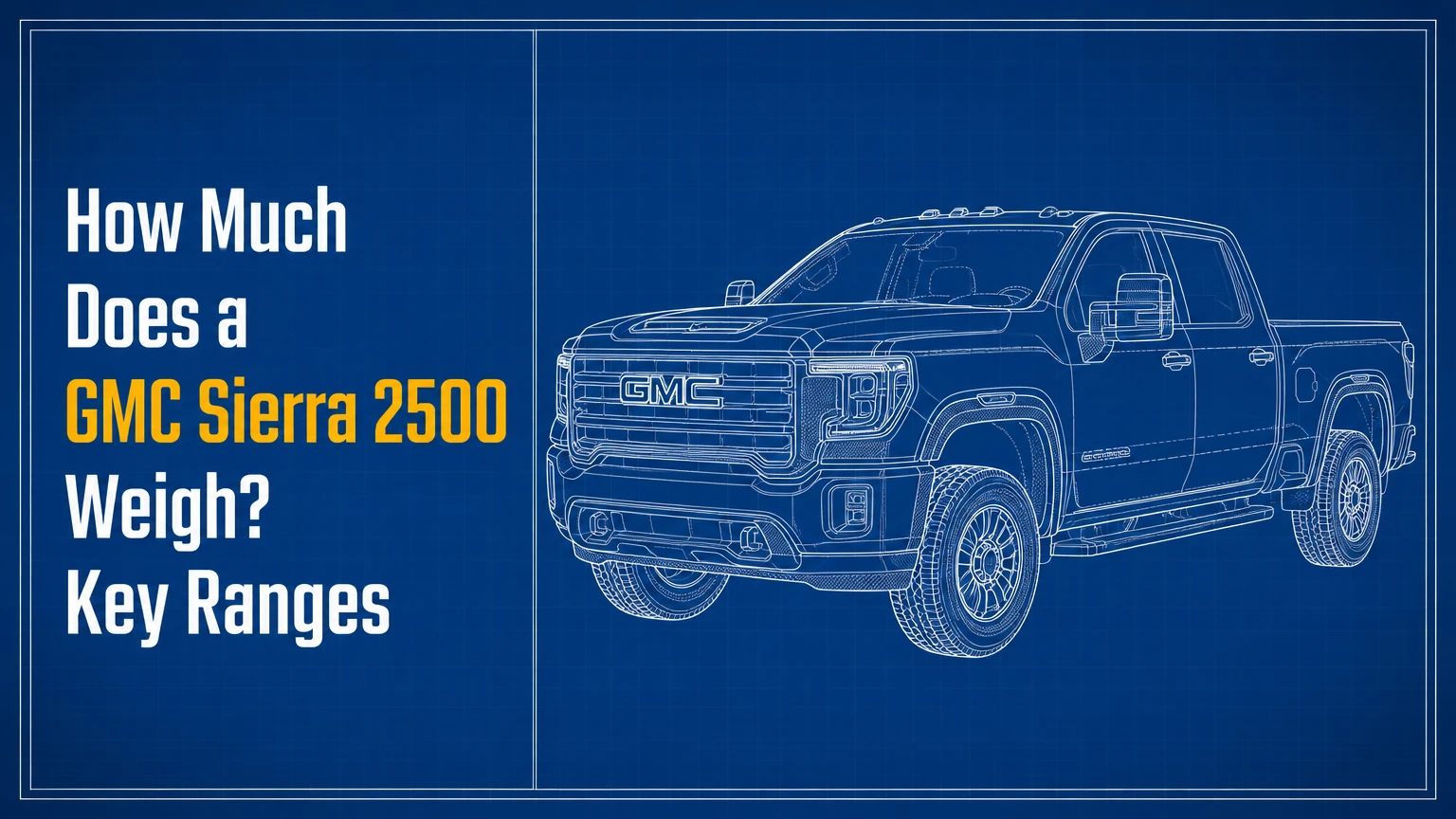
A GMC Sierra 2500 HD weighs approximately 6,267-8,353 pounds at the curb, depending on cab, bed, drivetrain, engine, and trim. Its GVWR typically ranges from 10,000-11,550 pounds, while the exact curb weight and available payload belong to the individual truck, not simply the Sierra 2500 model name.
Key Facts at a Glance
- A representative GMC Sierra 2500 HD curb-weight range is 6,267-8,353 pounds.
- A representative Sierra 2500 HD GVWR range is 10,000-11,550 pounds.
- A gasoline engine usually weighs less than the 6.6L Duramax diesel, leaving more payload capacity in a comparable truck.
- Four-wheel drive, crew-cab dimensions, luxury equipment, larger wheels, and off-road hardware increase curb weight.
- Payload equals GVWR minus the truck’s actual loaded scale weight, not necessarily the brochure’s base curb weight.
- The driver-door certification label and a certified scale provide more reliable numbers than a generic internet specification.
How Much Does a GMC Sierra 2500 Weigh?
A GMC Sierra 2500 HD weighs about 6,267 pounds in a light, regular-cab, two-wheel-drive gas configuration and can approach 8,353 pounds in a heavily equipped crew-cab, four-wheel-drive diesel configuration. Those figures describe representative empty curb weights, not every model-year combination.
Curb weight normally includes standard equipment, operating fluids, and a full fuel tank, but excludes passengers, cargo, trailer tongue weight, and many dealer-installed accessories. GMC changes published weights when it changes wheel sizes, suspension hardware, seating, safety equipment, fuel capacity, or powertrain calibration.
The answer therefore requires four identifiers: model year, cab, bed, drivetrain, and engine. Trim matters too. A 2026 Sierra 2500 Denali Ultimate cannot be assumed to weigh the same as a 2024 Sierra 2500 Pro, even when both have a crew cab and diesel engine.
| Representative configuration | Engine | Drivetrain | Approximate curb weight |
|---|---|---|---|
| Regular Cab, long bed, Pro | 6.6L gas V8 | 2WD | 6,267 lb |
| Double Cab, long bed | 6.6L gas V8 | 4WD | 7,022 lb |
| Crew Cab, short bed | 6.6L gas V8 | 4WD | 7,019 lb |
| Crew Cab, AT4 | 6.6L gas V8 | 4WD | 7,378 lb |
| Crew Cab, Denali Ultimate | 6.6L Duramax V8 | 4WD | 8,353 lb |
These are useful comparison points, not substitutes for the truck’s certification label. GMC’s online configurator, owner documentation, and vehicle label should control when a published dealer specification conflicts with another source.
What Is the Difference Between Curb Weight, GVWR, and Payload?
Curb weight is the truck’s empty operating weight, GVWR is its maximum permitted loaded vehicle weight, and payload is the remaining capacity after accounting for the actual truck weight. These three numbers answer different questions and should never be treated as interchangeable.
GVWR means Gross Vehicle Weight Rating. It is the maximum loaded weight of the Sierra 2500 itself, including occupants, fuel, cargo, accessories, hitch equipment, and trailer tongue weight. GVWR is assigned by the manufacturer and printed on the certification label.
Payload is the weight the truck can carry in the cab and bed, plus hitch-related load. A basic estimate is:
Payload = GVWR – actual curb weight
For example, a Sierra 2500 with a 10,450-pound GVWR and a 7,022-pound scale weight has approximately 3,428 pounds of theoretical remaining capacity before occupants, cargo, and tongue weight are added. Published payload figures may differ because manufacturers use specific test configurations and may include an allowance for occupants.
The tire and loading label is more useful than a marketing maximum. It often states the combined weight of occupants and cargo allowed in that particular truck. That figure already reflects the factory configuration.
Why the Published Payload Table May Not Add Up
Some online Sierra 2500 tables contain arithmetic errors because the displayed payload figure does not equal GVWR minus the displayed curb weight. For example, 10,000 minus 6,267 equals 3,733 pounds, not 3,689 pounds, and 10,450 minus 7,022 equals 3,428 pounds, not 3,384 pounds.
That discrepancy does not necessarily mean the truck is mislabeled. The table may use a different certified curb weight, an occupant allowance, or a different option package. Buyers should calculate from the actual door-label payload and scale reading rather than reverse-engineering a dealer table.
Which Sierra 2500 Configurations Weigh the Least?
The lightest Sierra 2500 configurations generally combine a regular cab, long bed, gasoline V8, two-wheel drive, basic work trim, and smaller wheels. The heaviest typically combine a crew cab, four-wheel drive, Duramax diesel, luxury trim, large wheels, and off-road equipment.
| Weight-increasing choice | Typical added weight | Main hardware or cause | Payload effect |
|---|---|---|---|
| 2WD to 4WD | 300-400 lb | Transfer case, front differential, driveshafts | Reduces available capacity |
| Gas V8 to Duramax diesel | 700-800 lb | Diesel engine, transmission, emissions equipment | Usually lowers payload |
| Work trim to luxury trim | 200-350 lb | Seats, glass, sound insulation, wheels | Lowers remaining payload |
| Regular cab to crew cab | 300-600 lb | Additional structure, seats, doors, interior | Lowers remaining payload |
| Short bed to long bed | 100-250 lb | Longer bed and supporting structure | Slightly lowers remaining payload |
The ranges above are typical configuration differences, not universal GMC specifications. A specific option can shift the result. For instance, an optional snowplow package, running boards, steel bumper, tonneau cover, winch, or service body changes the truck’s actual weight after it leaves the factory.
Does the Diesel Engine Make the Truck Heavier?
Yes. A GMC Sierra 2500 HD with the 6.6L Duramax diesel commonly weighs several hundred pounds more than a comparable gas truck, with a typical difference of about 700-800 pounds. The added mass comes from the engine, Allison automatic transmission, cooling system, turbocharger, emissions equipment, diesel fuel-system components, and exhaust hardware.
The diesel’s higher torque and exhaust-braking capability can make heavy towing more controlled, especially on long grades. The weight penalty remains important for truck campers, fifth-wheel pin weight, and dense bed cargo because every diesel pound consumes payload capacity.
A diesel 2500 is therefore not automatically the better hauling truck. The engine may improve trailer performance while reducing the legal weight available in the cab and bed. This is one of the most important counterintuitive rules in heavy-duty truck selection.
How Do You Find the Exact Weight of a Sierra 2500?
The exact weight of a GMC Sierra 2500 comes from a certified scale, while the door label supplies the truck’s rated limits. A dealer specification can estimate the number, but only a scale captures fuel level, accessories, tools, passengers, and other equipment on the actual vehicle.
Use this process:
- Read the driver-door labels. Record GVWR, front GAWR, rear GAWR, tire size, tire pressure, and the combined occupant-and-cargo limit.
- Remove temporary cargo. Take out tools, coolers, spare materials, trailer equipment, and personal items if measuring empty weight.
- Fill the fuel tank. A full tank matches the usual curb-weight convention more closely than a nearly empty tank.
- Visit a certified truck scale. CAT Scale locations commonly provide individual steer-axle, drive-axle, and gross readings.
- Weigh the truck in its working configuration. Keep the camper shell, toolbox, bumper, winch, steps, bedliner, and permanent accessories installed.
- Repeat while hitched if towing. Record steer axle, drive axle, trailer axle, and total combined weight.
A practical scale session usually takes 10-20 minutes and often costs approximately $15-$20 for an initial weigh, although prices vary by location and reweigh policy. The scale ticket gives the number needed for a real payload calculation.
How Much Payload Can a Sierra 2500 Carry?
A GMC Sierra 2500 HD can carry roughly 3,100-3,700 pounds in representative configurations, but the exact usable payload depends on the certified label, actual truck weight, axle ratings, tires, and the weight of passengers and accessories.
| Representative configuration | GVWR | Displayed curb weight | GVWR minus displayed weight |
|---|---|---|---|
| Regular Cab 2WD gas | 10,000 lb | 6,267 lb | 3,733 lb |
| Double Cab 4WD gas | 10,450 lb | 7,022 lb | 3,428 lb |
| Crew Cab 4WD gas | 10,450 lb | 7,019 lb | 3,431 lb |
| Crew Cab AT4 gas | 10,750 lb | 7,378 lb | 3,372 lb |
| Crew Cab Denali Ultimate diesel | 11,550 lb | 8,353 lb | 3,197 lb |
Payload is consumed by more than bed contents. Four 200-pound adults use 800 pounds, a 250-pound toolbox uses another 250 pounds, and a 2,000-pound trailer tongue weight uses another 2,000 pounds. That example consumes 3,050 pounds before adding loose cargo.
A heavy truck camper can create a similar problem. The camper’s advertised dry weight may exclude batteries, propane, water, tie-downs, jacks, bedding, food, and personal equipment. Weigh the complete loaded combination.
How Does Weight Affect Towing?
Truck weight affects towing through GVWR, axle ratings, tire capacity, hitch limits, and GCWR. A Sierra 2500 can have enough engine power to pull a trailer while still exceeding its payload, rear-axle, or tire limit because trailer tongue weight rests on the truck.
Representative Sierra 2500 GCWR figures are approximately 24,500-26,000 pounds, depending on engine, axle ratio, drivetrain, cab, and configuration. GCWR includes the loaded truck and loaded trailer together. It is not the same as trailer tow rating.
Typical tongue-weight planning uses:
- 10-15% of loaded trailer weight for a conventional travel trailer.
- 15-25% of loaded trailer weight for a fifth-wheel or gooseneck.
- The actual percentage depends on trailer design, loading, hitch position, and axle placement.
A 14,000-pound conventional trailer can place about 1,400-2,100 pounds on the truck. A 16,000-pound fifth-wheel can place approximately 2,400-4,000 pounds on the truck. The second example can exceed a Sierra 2500’s available payload even when the truck’s advertised tow rating appears sufficient.
The safer calculation is:
Actual truck weight + occupants + cargo + hitch load ≤ GVWR
Then verify:
Actual steer-axle weight ≤ front GAWR
Actual drive-axle weight ≤ rear GAWR
Actual combined weight ≤ GCWR
Each tire load ≤ its rated capacity
Is a Sierra 2500 Heavier Than a Sierra 1500?
Yes. A Sierra 2500 HD is generally several hundred to more than 1,000 pounds heavier than a comparable Sierra 1500 because it uses a stronger frame, heavier axles, larger brakes, higher-capacity suspension, and heavier-duty towing equipment.
| Truck choice | Typical role | Weight tendency | Payload or towing trade-off |
|---|---|---|---|
| Sierra 1500 | Daily driving and light towing | Lightest | Better ride and fuel economy |
| Sierra 2500 gas | Workloads and moderate-heavy towing | Mid-range | More payload than equivalent diesel |
| Sierra 2500 diesel | Heavy trailer towing | Heavy | Strong torque, less payload |
| Sierra 3500 single rear wheel | High pin weight and payload | Heavier than 2500 | More capacity, firmer unloaded ride |
| Sierra 3500 dual rear wheel | Very heavy fifth-wheel towing | Heaviest | Highest stability and rear-axle capacity |
The Sierra 1500 is usually the better choice when the truck spends most of its time unloaded and towing remains within its ratings. The Sierra 3500 is preferable when a camper, gooseneck, or fifth-wheel consumes most of a 2500’s payload.
A Sierra 2500 is not automatically the middle-ground answer. The correct choice depends on loaded pin weight and axle loading, not the trailer’s empty brochure weight.
Does a 10,000-Pound GVWR Change Registration or Licensing?
A 10,000-pound GVWR can affect registration fees, insurance classification, parking rules, and commercial requirements, but no single nationwide rule automatically makes every Sierra 2500 a commercial vehicle or requires a CDL. State law, vehicle use, plate type, declared weight, and combined ratings determine the result.
The often-repeated 26,000-pound CDL rule is incomplete. Federal commercial-driver rules commonly use a combination threshold of more than 26,000 pounds in specified commercial combinations, but state exemptions and noncommercial recreational-vehicle rules vary. A personal-use truck and a contractor’s truck may receive different treatment in the same state.
Before registering or towing commercially, check:
- State department of motor vehicles rules.
- Federal Motor Carrier Safety Administration requirements.
- Declared combined gross vehicle weight rating.
- Whether the truck operates for compensation or business purposes.
- Trailer registration and brake requirements.
- Insurance classification and required endorsements.
A local DMV or qualified transportation attorney is more reliable than a dealership’s general statement, particularly when an LLC, commercial plates, or interstate travel is involved.
What Problems Appear When a Sierra 2500 Is Overloaded?
Overloading a Sierra 2500 can cause rear suspension sag, reduced steering control, tire overheating, longer stopping distances, premature brake wear, and drivetrain or transmission heat. A truck can look level and still exceed a rear-axle or tire rating.
| Symptom | Likely weight problem | Immediate response |
|---|---|---|
| Rear-end sag | Excessive payload or tongue weight | Stop and weigh each axle |
| Steering wander | Front axle unloaded by hitch leverage | Reduce tongue load and redistribute cargo |
| Tire sidewall bulging | Tire load or pressure problem | Stop, inspect, and follow label pressure |
| Brake fade | Excessive mass or downhill heat | Slow down, use proper lower gear, inspect brakes |
| High transmission temperature | GCWR or grade exceeded | Reduce speed, downshift, and shed load |
| Headlight aim rises | Rear suspension overloaded | Remove weight and correct load distribution |
The correct remedy is not always an airbag kit. Supplemental airbags can reduce visible sag, but they do not increase GVWR, GAWR, tire capacity, hitch rating, or GCWR. The certification limits remain unchanged.
What Is the Most Common Loading Mistake?
The most common mistake is using a trailer’s dry weight instead of its loaded weight. Water, propane, batteries, food, tools, generators, and camping equipment can add hundreds or thousands of pounds before the trailer reaches a campsite.
A second mistake is counting only bed cargo and forgetting tongue weight. A trailer tongue is payload because its downward force is carried by the truck’s hitch and frame. A third mistake is checking gross weight while ignoring axle distribution; a truck can remain below GVWR while exceeding its rear GAWR.
Which Sierra 2500 Configuration Fits Each Use?
The best Sierra 2500 configuration depends on whether the limiting load is bed cargo, trailer weight, pin weight, or daily usability. A regular-cab gas truck generally maximizes payload, while a crew-cab Duramax improves long-distance heavy-trailer performance but sacrifices some carrying capacity.
| Use case | Recommended configuration | Reason | Limitation |
|---|---|---|---|
| Gravel, tools, and service equipment | Regular Cab, 2WD, gas, Pro | Lowest curb weight and lower purchase cost | Fewer seats and less traction |
| Family towing and mixed use | Crew Cab, 4WD, gas or diesel | Passenger room and drivetrain choice | Higher curb weight |
| Fifth-wheel over 14,000 lb | Crew Cab, Duramax, 4WD | Torque, exhaust braking, towing stability | Pin weight may consume payload |
| Truck camper | Lightest gas configuration with high label payload | Maximizes bed capacity | Verify loaded camper weight |
| Off-road travel | Crew Cab AT4 or AT4X | Factory off-road hardware and traction | Added equipment reduces payload |
| Maximum pin weight | Sierra 3500, often dual rear wheel | Higher axle and payload capacity | Larger dimensions and harsher unloaded ride |
For contractors, a 2WD gas Pro can provide the most payload headroom. For a heavy fifth-wheel, the Duramax may be easier to drive on grades, but the payload label must still accommodate passengers and pin weight. For a slide-in camper, select based on wet camper weight rather than engine prestige.
What Should You Verify Before Loading or Hitching?
Verify the door-label payload, axle ratings, tire ratings, hitch rating, scale weights, trailer loaded weight, and local legal requirements before loading or hitching a Sierra 2500. A complete check takes longer than reading a brochure but prevents the most expensive category of weight mistake.
Use this checklist:
- Photograph the certification and tire labels.
- Record front and rear GAWR.
- Weigh the empty truck in its permanent configuration.
- Weigh passengers, tools, fuel cans, and accessories.
- Estimate trailer tongue or fifth-wheel pin weight from loaded trailer weight.
- Weigh the hitched combination by axle.
- Compare each result with GVWR, GAWR, GCWR, tire, and hitch limits.
- Reweigh after moving cargo or adding equipment.
Expert rule of thumb: leave measurable margin instead of targeting the rating exactly. Scale readings vary with fuel, water, cargo placement, and equipment, while a load near the limit leaves little room for an unplanned passenger or tool.
Another practitioner rule: weigh the rear axle first when evaluating a camper or fifth-wheel. Rear-axle overload commonly occurs before the truck reaches its advertised maximum combined weight.
A final practical rule: treat aftermarket steel bumpers, winches, steps, and service bodies as permanent payload consumers. A 600-pound accessory package removes 600 pounds from capacity whether the bed is empty or full.
Frequently Asked Questions
How much does a GMC Sierra 2500 Duramax weigh?
A GMC Sierra 2500 HD Duramax commonly weighs about 7,500-8,350 pounds at the curb, depending on cab, bed, drivetrain, trim, wheels, and equipment. A crew-cab, four-wheel-drive Denali or Denali Ultimate generally occupies the upper end of that range, while a lighter configuration weighs less.
How much does a GMC Sierra 2500 weigh with a full tank?
A GMC Sierra 2500’s published curb weight generally assumes a full fuel tank and operating fluids, although manufacturer test conventions can vary by model year. Diesel fuel weighs about 7 pounds per gallon, so a partially empty tank can change scale weight by several hundred pounds in a large HD truck.
Can a Sierra 2500 carry a 4,000-pound truck camper?
A Sierra 2500 can carry a 4,000-pound camper only if the camper’s real loaded weight, passengers, tie-downs, water, propane, batteries, and gear remain within the door-label payload, rear GAWR, tire ratings, and GVWR. A listed dry camper weight is insufficient for this decision.
Does 4WD add weight to a Sierra 2500?
Four-wheel drive typically adds approximately 300-400 pounds to a Sierra 2500 compared with a similar two-wheel-drive truck. The added transfer case, front differential, front driveshaft, axle components, and related hardware increase curb weight and reduce the payload remaining under the same GVWR.
Is the Sierra 2500 good for a 16,000-pound fifth-wheel?
A Sierra 2500 may tow a 16,000-pound fifth-wheel within its GCWR and tow-rating limits, but the fifth-wheel’s pin weight can approach 2,400-4,000 pounds. That pin load, combined with passengers and cargo, may exceed the truck’s payload or rear-axle rating, making a Sierra 3500 the more suitable choice.
Where is the Sierra 2500 weight rating located?
The Sierra 2500’s GVWR, GAWR, tire information, and occupant-cargo limit are located on certification and tire-information labels attached to the driver-side door or door pillar. The owner’s manual explains the ratings, but the label on the individual truck controls its specific certified limits.
The Bottom Line
The answer to how much does a GMC Sierra 2500 weigh is approximately 6,267-8,353 pounds empty, with the lightest figures associated with regular-cab, two-wheel-drive gas trucks and the heaviest figures associated with crew-cab, four-wheel-drive diesel luxury models. Use the door label and a certified scale for the final answer, then check payload, axle, tire, hitch, and combined ratings before carrying or towing.