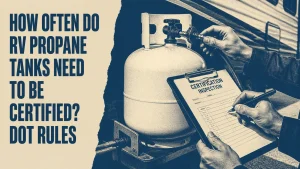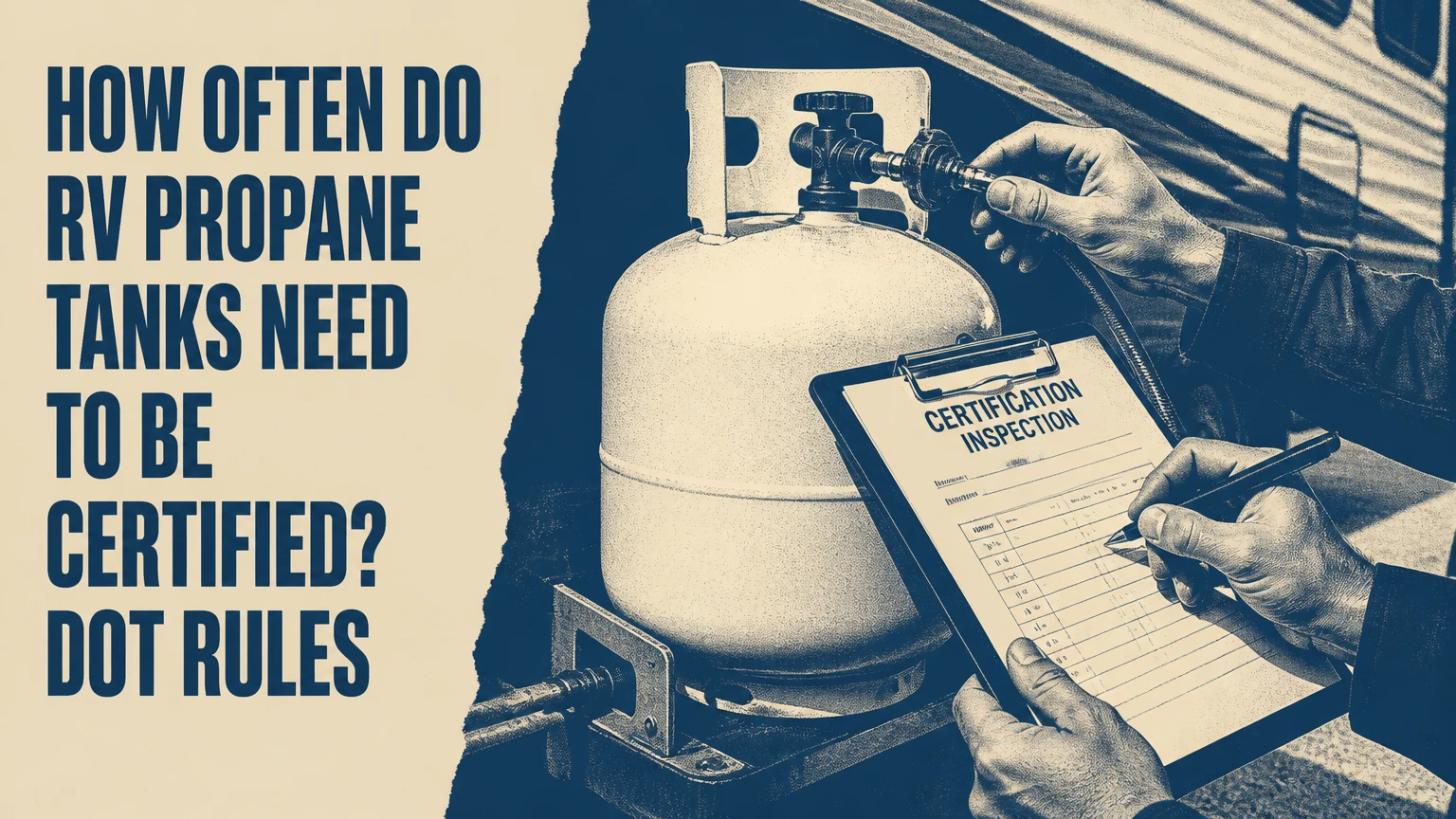
In the United States, a portable RV propane cylinder generally needs its first requalification 12 years after manufacture, then every 5 years after a standard external visual inspection. An approved proof-pressure or volumetric method can provide a longer interval when the cylinder specification and authorized procedure allow it. Permanently mounted ASME motorhome tanks do not follow the DOT cylinder requalification schedule.
Key Facts at a Glance
- A U.S. DOT propane cylinder usually reaches its first requalification date 12 years after manufacture.
- An external visual inspection normally extends a qualified cylinder for 5 years.
- A proof-pressure test can qualify an eligible cylinder for 10 years.
- A volumetric expansion test may qualify an eligible cylinder for 10 or 12 years, depending on the cylinder specification and applicable regulation.
- A permanently mounted ASME motorhome tank has no routine DOT requalification date, but damage, corrosion, leaks, and serviceability still require inspection.
- A propane dealer may refuse to fill a cylinder with an expired date, unacceptable corrosion, damaged fittings, or other unsafe conditions.
What Does RV Propane Requalification Mean?
RV propane requalification is the formal inspection or test that determines whether a refillable high-pressure cylinder remains suitable for service. “Recertification” is the common consumer term; U.S. hazardous-materials regulations generally use “requalification” for the process.
A portable propane cylinder contains liquefied petroleum gas under pressure. The pressure changes with temperature, while the steel or aluminum shell can deteriorate through corrosion, dents, fire exposure, gouges, failed welds, or valve damage. Requalification checks whether the container can continue storing and, where applicable, transporting propane safely.
The governing framework for portable cylinders is found primarily in 49 CFR Parts 172 and 180, administered by the U.S. Department of Transportation and the Pipeline and Hazardous Materials Safety Administration. The regulation states, “No person may offer or transport a cylinder for transportation unless it has been requalified,” subject to the regulation’s requirements and exceptions.
A refill attendant also has a separate safety duty. A cylinder can have a current date and still be rejected because visible damage makes it unsafe to fill.
How Often Do RV Propane Tanks Need to Be Certified?
A U.S. portable RV propane cylinder normally requires initial requalification 12 years after its manufacture date. After that first requalification, an external visual inspection generally lasts 5 years, while an approved pressure or volumetric method may permit a longer period for an eligible cylinder.
The exact answer depends on four facts: the cylinder standard, the country where it is being filled or transported, the date stamped on the cylinder, and the requalification method used. A 20-pound barbecue cylinder and a 40-pound aluminum RV cylinder can therefore have the same basic federal schedule but different replacement economics.
The date is not calculated from the day you purchased the RV. It is calculated from the cylinder’s manufacture marking, unless a valid later requalification marking controls the next interval.
U.S. Requalification Intervals
| Cylinder situation | First interval | Common later interval | Controlling detail |
|---|---|---|---|
| DOT cylinder, ordinary U.S. rule | 12 years | 5 years | External visual requalification |
| Eligible DOT cylinder, proof pressure | 12 years | 10 years | Authorized proof-pressure procedure |
| Eligible DOT cylinder, volumetric expansion | 12 years | 10 or 12 years | Cylinder specification and method |
| Damaged or corroded cylinder | No safe grace period | No automatic extension | Inspection can require rejection |
A visual inspection is the usual choice because it costs less and is available at more propane facilities. Pressure and volumetric testing require equipment, trained personnel, and a cylinder that is eligible for that method.
Does Canada Use the Same Schedule?
Canada commonly applies a 10-year initial requalification period to refillable propane cylinders, followed by a recurring requalification interval determined by the applicable Canadian requirements and test method. Canadian provinces and territories can also impose operating, filling, or inspection practices that affect what a retailer accepts.
Transport Canada administers the Canadian transportation framework, while provincial authorities and propane suppliers influence local service practice. A U.S.-marked cylinder traveling into Canada can face a practical acceptance issue even when its owner believes the U.S. date remains valid.
For cross-border travel, verify the cylinder marking with a Canadian propane supplier before departure. Do not assume that a U.S. visual requalification mark guarantees acceptance at every Canadian refill location.
Is Your RV Propane Container a DOT Cylinder or an ASME Tank?
A removable cylinder attached to a trailer, fifth-wheel, truck camper, or exterior RV rack is usually a DOT cylinder. A tank permanently mounted to a motorhome chassis is usually an ASME tank, and the two containers follow different regulatory systems.
The name “tank” causes much of the confusion. In everyday RV language, owners call both containers tanks, but the stamped specification determines the inspection regime.
| Attribute | DOT cylinder | ASME motorhome tank |
|---|---|---|
| Typical RV | Travel trailer, fifth wheel, truck camper | Class A, Class B, Class C motorhome |
| Mounting | Removable from bracket or compartment | Permanently attached to chassis |
| Common sizes | 20, 30, and 40 pounds | Approximately 20-80 gallons water capacity |
| Main standard | U.S. DOT or Transport Canada cylinder specification | ASME pressure-vessel construction |
| Routine date rule | Initial and recurring requalification | No routine DOT requalification date |
| Filling control | Date, condition, valve, and markings | Condition, leak checks, fill equipment, and tank integrity |
An ASME tank is not made compliant by stamping a DOT cylinder requalification date onto it. Conversely, a DOT cylinder does not become exempt merely because it is carried on an RV.
How Can You Identify the Difference?
Look for a removable collar, foot ring, and cylinder specification on a portable container. An ASME motorhome tank is usually a horizontal vessel mounted under the vehicle, connected to fixed piping and a permanently installed fill valve.
The vehicle’s owner manual, propane-system label, or chassis documentation can confirm the design standard. When uncertainty remains, photograph the data plate and ask an RV propane technician or licensed propane supplier before scheduling testing.
How Do You Read the Date and Requalification Mark?
The original manufacture date usually appears as month and year, such as 06-15 for June 2015. A U.S. cylinder with that marking normally reaches its first 12-year requalification point in June 2027, although the filling company makes the final acceptance decision.
A later requalification mark records the inspection date and method. The mark may appear on the collar, handle, or an authorized decal, depending on the cylinder and the requalifier’s procedure.
| Marking or term | Meaning | Example or unit | Owner’s use |
|---|---|---|---|
| Manufacture date | Original production month and year | 06-15 | Calculate first U.S. 12-year interval |
| Requalification date | Month and year of later test | 04-27 | Calculate the next authorized interval |
| E | External visual inspection | 04-27 E | Usually 5 years |
| S | Proof-pressure requalification | 04-27 S | Often 10 years for eligible cylinders |
| TW | Tare weight | TW 28.0 lb | Empty cylinder weight |
| WC | Water capacity | WC 47.6 lb | Maximum water capacity reference |
| OPD | Overfill prevention device | Float-style valve | Required on many small cylinders |
A mark such as “04 ABC 27 E” may identify the month, requalifier identification number, year, and method. The exact layout varies, so the method letter and date should be interpreted together rather than read as a universal expiration format.
TW is not the propane capacity. WC is also not the number of pounds of propane you should add. Filling limits are established from the cylinder’s approved capacity and applicable filling procedure.
Which Requalification Method Should You Use?
External visual inspection is usually the best choice for a sound RV cylinder because it is inexpensive, quick, and widely available. Proof-pressure or volumetric testing can make financial sense for an expensive 30-pound or 40-pound cylinder, but only if the cylinder is eligible and a qualified facility offers the service.
The test method does not rescue a cylinder with severe pitting, a large dent, fire exposure, damaged threads, or an unreadable specification. A qualified requalifier can reject a container regardless of its previous date.
| Method | Typical service time | Typical consumer cost | Common interval |
|---|---|---|---|
| External visual inspection | 10-30 minutes | $5-$30 | 5 years |
| Proof-pressure test | Same day to 2 days | $30-$75 | 10 years when authorized |
| Volumetric expansion test | 1-3 days | $40-$100 | 10 or 12 years when authorized |
| Replacement cylinder | Immediate purchase | $50-$150+ | New initial interval, subject to marking |
The figures are typical retail ranges, not federally fixed prices. Rural shops, commercial cylinder facilities, and mobile services may charge substantially different amounts.
The U.S. Code of Federal Regulations, rather than a shop’s advertised price, controls which interval the requalification mark can establish. Ask the facility which method it will apply and what interval it will mark before leaving the cylinder.
What Happens During a Visual Inspection?
A trained requalifier first verifies the cylinder identity and removes it from service if the shell or fittings show unsafe damage. The technician then examines the container, valve assembly, protective collar, foot ring, markings, and evidence of leakage before recording the authorized requalification.
Owners should not purge, disassemble, sandblast, or repaint a propane cylinder before professional evaluation. Residual vapor can remain hazardous, and unauthorized work can obscure defects or markings.
Typical Inspection Sequence
- Confirm the cylinder specification and date. The technician checks the stamped standard, manufacture date, capacity, and prior requalification mark.
- Make the cylinder safe for handling. The cylinder is emptied or otherwise handled under the facility’s approved propane procedures.
- Inspect the shell. The technician looks for corrosion, deep pits, dents, gouges, bulges, fire damage, and questionable repairs.
- Check the collar and foot ring. Welds and protective components must remain structurally sound.
- Examine the valve and fittings. The valve, OPD where fitted, relief device, threads, and seals are checked for damage or leakage.
- Record the result. A passing cylinder receives the permitted marking or decal, while a rejected cylinder is removed from refill service.
You will know the process succeeded when the cylinder has a legible authorized requalification mark and the technician confirms the next due date. A sticker without an identifiable authorized requalifier is not automatically proof of compliance.
Can a Propane Dealer Refill an Expired RV Cylinder?
A propane dealer generally must refuse an expired portable cylinder because filling and transporting an out-of-date cylinder can violate applicable hazardous-materials requirements. A dealer can also refuse a current cylinder with dangerous corrosion, damaged valves, missing required markings, or a suspected leak.
The refusal is not necessarily evidence that the cylinder is permanently unusable. The owner can take an eligible cylinder to a facility with an authorized requalifier, then return it for filling after it passes.
Do not pressure an attendant to “top it off” or move the cylinder between stores while full. Propane vendors may apply stricter policies than the minimum federal schedule, especially when staff cannot verify a foreign marking or the cylinder’s condition.
What Does RV Propane Requalification Cost?
Typical visual requalification costs $5-$30 per cylinder, while pressure or volumetric testing commonly costs $30-$100. Replacement usually costs $50-$150 or more, depending on whether the cylinder is a standard 20-pound steel model, a 30-pound RV cylinder, a 40-pound cylinder, or a lightweight aluminum model.
| Owner situation | Typical option | Typical cost | Practical result |
|---|---|---|---|
| Two standard 20-pound cylinders, good condition | Visual requalification | $10-$60 total | Retain both cylinders for about 5 years |
| One 30-pound steel cylinder | Visual requalification | $5-$30 | Usually cheaper than replacement |
| One 40-pound aluminum cylinder | Requalification | $20-$100 | Often preserves an expensive specialty cylinder |
| Heavily rusted 20-pound cylinder | Replacement or exchange | $20-$80 | Avoid testing a likely reject |
| Full-time traveler near expiry | New cylinder set | $100-$300+ | Reduces roadside service uncertainty |
Call first. Many propane retailers fill cylinders but do not perform requalification, and many exchange cages do not handle larger RV cylinders.
Should You Requalify, Exchange, or Replace the Cylinder?
Requalify a sound, expensive, or nonstandard RV cylinder. Exchange a standard 20-pound cylinder when convenience matters more than retaining the original container, and replace any cylinder with serious corrosion, a damaged collar, unreadable markings, or a failed inspection.
| Choice | Best use case | Main advantage | Main limitation |
|---|---|---|---|
| Requalify existing cylinder | 30-pound, 40-pound, aluminum, good shell | Preserves fit and capacity | Requires a qualified facility |
| Exchange cylinder | Standard 20-pound, occasional use | Fast retail availability | May receive a different condition or brand |
| Buy new cylinder | Damaged or badly corroded container | Fresh shell and current manufacture date | Highest initial cost |
| Use an ASME tank | Permanently mounted motorhome system | No DOT cylinder requalification cycle | Repairs require RV propane service |
A tank exchange is rarely a direct equivalent for a 30-pound or 40-pound RV cylinder. Exchange programs commonly center on standardized 20-pound barbecue cylinders, while trailer owners may need a specific height, diameter, valve orientation, or mounting footprint.
An exchange operator remains responsible for the cylinder it supplies. The owner should still inspect the replacement for heavy rust, damaged valves, and missing markings before connecting it.
What Problems Can Cause Rejection?
A current date does not override physical damage. The most common rejection causes are deep rust, bulging, severe dents, fire exposure, damaged valve threads, a missing collar or foot ring, unreadable markings, and evidence of unauthorized repair.
Corrosion and Paint
Light surface oxidation is not the same as deep pitting. Do not hide corrosion under paint before inspection, because a coating can conceal the shell condition and prevent an accurate evaluation.
Use a light-colored coating only when the cylinder manufacturer and qualified technician permit repainting. Dark colors can increase solar heat absorption, and paint should never cover the collar markings, pressure-relief components, valve, or required labels.
Dents, Gouges, and Fire Exposure
A dent can create localized stress even when the cylinder does not leak. A cylinder exposed to a vehicle fire, campfire, or intense radiant heat requires professional evaluation and may be condemned.
Never straighten a dent, weld a patch, replace a valve, or drill a cylinder yourself. Those actions can compromise the pressure vessel and invalidate its approved status.
Missing or Unclear Markings
A missing manufacture date or cylinder specification creates an identification problem, not an automatic new certification date. A qualified cylinder facility must determine whether the container can be legally identified and tested.
Photograph all markings before the cylinder becomes dirty or corroded. The images help a technician identify the model and determine whether a specialized procedure is available.
How Should You Prepare Before the Requalification Visit?
Call a propane distributor, cylinder test facility, RV service center, or fire-equipment shop and ask whether it has an authorized cylinder requalifier. Confirm that the shop accepts the cylinder’s size, material, specification, and valve type.
Bring the cylinder in the condition requested by the facility. Do not transport a leaking cylinder, and do not place a loose cylinder inside a hot passenger compartment.
Use this checklist:
- Photograph the collar and every stamped marking.
- Record whether the cylinder is steel or aluminum.
- Identify the size, such as 20, 30, or 40 pounds.
- Ask for the inspection price and method.
- Ask whether the cylinder must be empty.
- Confirm the expected turnaround time.
- Check the RV bracket, hold-down strap, pigtail, regulator, and hose separately.
The cylinder date is only one part of the propane system. A current cylinder connected to cracked pigtails or a damaged regulator still creates a service hazard.
What Changes for Different RV Owners?
Travel-trailer and fifth-wheel owners with 30-pound or 40-pound cylinders usually save money by requalifying sound containers rather than exchanging them. Their larger cylinders are less interchangeable, and replacement costs can exceed several years of visual inspection fees.
Casual RV users with common 20-pound cylinders may prefer exchange programs when local requalification costs approach replacement cost. The trade-off is reduced control over the replacement cylinder’s age, condition, brand, and remaining capacity.
Motorhome owners with ASME tanks should focus on corrosion protection, valve and regulator maintenance, fill-valve condition, and professional leak checks. The absence of a routine DOT requalification date does not exempt an ASME tank from safe-operation requirements.
Full-time travelers should address a cylinder within roughly 6-12 months of its next date before an extended trip. Remote fuel stops may not have the equipment or authorization to requalify a specialty cylinder.
What Is the Most Important Practical Rule?
The most important practical rule is to verify the cylinder type and date before the propane supply becomes essential. An owner who discovers an expired cylinder at a campground may face a refill refusal, a long drive to a qualified facility, or an expensive replacement.
A second practitioner rule is to inspect the shell every time the cylinder is removed from its bracket. Road spray and trapped moisture can corrode the bottom ring faster than the visible upper shell.
A third rule is to treat a requalification mark as permission to use a sound cylinder, not as a warranty. The owner remains responsible for noticing new damage, odor, frost around a fitting, or a regulator problem between inspection dates.
Frequently Asked Questions
Can I use an RV propane cylinder after its date expires?
You should not plan to refill or transport an expired portable DOT cylinder as though it were current. Take the cylinder to an authorized requalifier, or replace it if condition, markings, or testing eligibility make requalification impractical. A dealer may refuse service immediately after checking the date.
Do new RV propane cylinders need certification?
A new DOT cylinder does not normally need an additional owner-arranged certification before its first service period, because the manufacturer supplies it under the applicable specification. The original manufacture date still controls the first requalification deadline, so a cylinder sitting in inventory may have fewer than 12 calendar years remaining.
Do propane cylinders need requalification when they are empty?
An empty DOT cylinder does not escape its requalification requirement. The date applies to the cylinder, not the amount of propane inside it. An empty cylinder can also retain vapor, so owners should not assume that “empty” means safe to cut, drill, weld, or place in ordinary waste.
Can I cross into Canada with U.S. RV propane cylinders?
You can encounter different acceptance rules when carrying U.S. cylinders into Canada, where a 10-year initial interval is commonly applied. Confirm the date, specification, and current Transport Canada or provincial requirements with a propane supplier before travel, especially when the cylinder is near its U.S. deadline.
How often should an ASME RV tank be inspected?
An ASME motorhome tank has no routine DOT cylinder requalification interval, but it should be checked during regular RV service and whenever corrosion, impact, leakage, or fill-system damage appears. A qualified RV propane technician should evaluate suspected defects rather than treating the absence of a date as a safety clearance.
Is an OPD valve the same as certification?
An OPD valve is an overfill prevention device, not a cylinder requalification. The valve helps limit liquid filling in many small cylinders, while requalification evaluates the pressure vessel and its serviceability. A working OPD cannot extend an expired cylinder’s legal service interval.
The Bottom Line
For the common U.S. portable RV propane cylinder, plan on first requalification 12 years after manufacture and recurring requalification every 5 years after a visual inspection. Eligible cylinders can receive longer intervals through approved pressure or volumetric methods. Permanently mounted ASME motorhome tanks follow a different regime and do not receive routine DOT cylinder expiration dates.
Check the collar, identify the standard, inspect the shell, and contact a qualified facility before the next refill. When the exact question is “how often do rv propane tanks need to be certified,” the decisive distinction is whether the RV uses a removable DOT cylinder or a permanently mounted ASME tank.