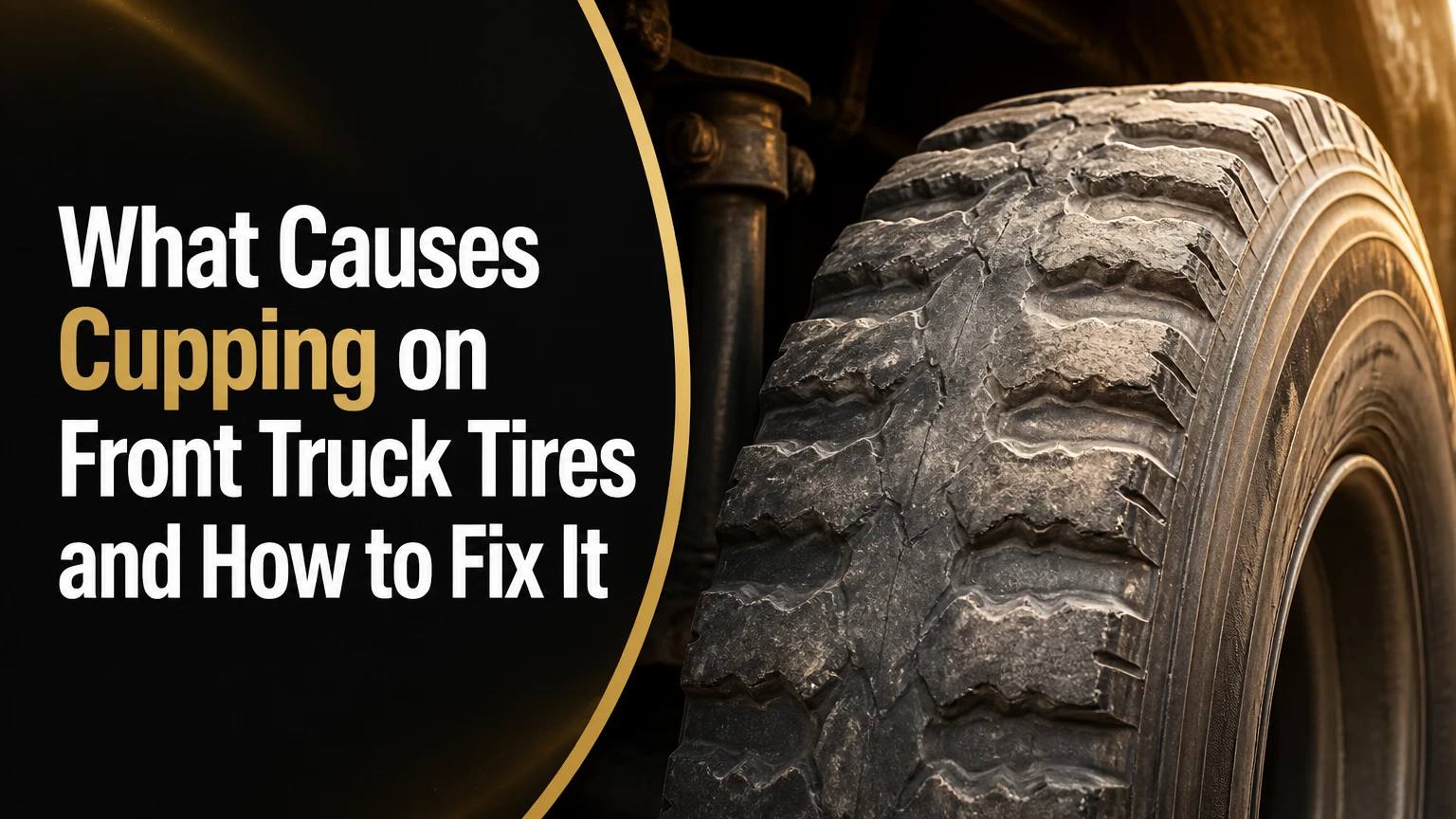
Cupping on front truck tires is caused by repeated loss of firm road contact, usually from worn shocks, loose suspension parts, wheel imbalance, bent wheels, misalignment, incorrect inflation, or excessive load. The tire repeatedly bounces or scrubs instead of rolling evenly, removing rubber in regularly spaced scoops around the tread.
Key Facts at a Glance
- Tire cupping creates alternating high and low tread spots, often spaced several inches apart around the circumference.
- Worn shocks or struts are the most common mechanical cause because they fail to control spring rebound.
- Wheel imbalance can produce cupping, but balancing alone will not cure wear caused by loose steering or suspension components.
- Toe misalignment usually creates feathering or diagonal scrub, while camber and pressure problems often produce edge wear alongside cupping.
- A cupped tire cannot be restored by alignment or balancing; those services prevent further damage, but the damaged tread remains.
- A steer tire with exposed cords, bulges, severe vibration, or tread below the applicable legal limit requires immediate professional evaluation.
What Does Front-Tire Cupping Look Like?
Front-tire cupping looks like a repeating series of hollow scoops across the tread, with each depression separated by a raised tread section. Running a hand across the tread often reveals a washboard texture that is easier to feel than to see, especially on an all-terrain or commercial steer tire.
Cupping is also called scalloping, chop, or choppy wear. The depressions may affect the full tread width, one shoulder, or alternating tread blocks. The pattern commonly repeats every few inches, although spacing varies with tire diameter, suspension frequency, speed, tread design, and the original mechanical fault.
Cupped tires often produce a rhythmic hum, growl, or “womp-womp” that increases with vehicle speed. The sound can continue while coasting because the damaged tread, rather than the engine or brakes, is generating the noise.
| Wear pattern | Physical clue | Most likely first checks |
|---|---|---|
| Cupping or scalloping | Repeating concave dips around circumference | Shocks, balance, runout, wheel bearings |
| Feathering | Tread blocks feel sharp in one direction | Toe alignment, tie rods, steering play |
| One-edge wear | Inner or outer shoulder is visibly lower | Camber, ride height, bent axle parts |
| Center wear | Center ribs are smooth or shallow | Excessive inflation, light load pattern |
| Both-edge wear | Shoulders wear faster than center | Underinflation, overload, low pressure |
| Flat spotting | One broad section is worn flat | Locked brake, emergency stop, storage, tire defect |
Cupping differs from ordinary uneven wear because the damage repeats rhythmically. A tire with uniform shoulder wear may have a pressure or alignment problem, but a tire with alternating scoops usually has a dynamic contact problem that deserves a suspension and wheel inspection.
Why Does Cupping Happen on Front Truck Tires?
Front truck tire cupping occurs when a steer tire repeatedly changes its contact force against the pavement. A spring, tire, or wheel assembly moves vertically or laterally, while a weak damper fails to control that movement; each contact change scrubs rubber from recurring tread locations.
A healthy tire remains loaded against the road while the suspension absorbs bumps. When a shock absorber loses damping, the spring rebounds several times after a pothole instead of settling quickly. During each rebound, part of the tread unloads or skips, then strikes the pavement again with a concentrated force.
The tread does not wear randomly. Tire rotation and suspension oscillation create repeating contact events, so the same tread zones receive repeated impact and slip. A small initial depression can then amplify vibration, producing progressively deeper scallops.
Bridgestone’s consumer tire guidance describes cupping as a pattern associated with “irregular wear caused by a bouncing tire,” which accurately summarizes the central mechanism. The phrase does not identify the failed component; diagnosis still requires separating suspension, wheel, alignment, and pressure causes.
Why are the front tires especially vulnerable?
Steer tires respond to steering input, braking force, road crown, and suspension movement, while drive tires primarily transmit propulsion through the rear axle. A truck’s front axle also carries the engine and steering hardware on many platforms, increasing the consequences of tire deflection and looseness.
Front tires can cup after a single severe pothole if the impact bends a wheel, damages a tire belt, or loosens a tie-rod end. More commonly, the initiating defect develops gradually, and the driver notices noise only after several thousand miles of repeated wear.
Which Suspension Parts Cause Cupping?
Worn shocks or struts are the leading suspension-related cause of front-tire cupping, but loose ball joints, control-arm bushings, tie-rod ends, wheel bearings, and damaged springs can create similar tire movement. The correct repair depends on which component permits vertical bounce or changes wheel alignment under load.
| Suspected component | Failure effect | Typical confirming clue | Repair priority |
|---|---|---|---|
| Front shock absorber | Excess rebound after bumps | Oil leakage, repeated bounce, poor control | High |
| Strut assembly | Wheel oscillation and altered geometry | Weak damping, damaged mount, uneven ride | High |
| Ball joint | Knuckle movement and alignment change | Play during loaded inspection | Immediate if excessive |
| Tie-rod end | Toe changes while steering | Steering looseness, feathering, wandering | Immediate if loose |
| Control-arm bushing | Arm shifts during braking or bumps | Cracking, separation, fore-aft movement | High |
| Wheel bearing | Hub wobble and runout | Play, growl, heat, rough rotation | Immediate if loose |
| Coil or leaf spring | Ride height and load instability | Sag, breakage, uneven axle height | High |
A leaking shock is strong evidence of failure, but a dry shock is not proof of good damping. Internal valving can deteriorate without an external leak, and a basic bounce test may miss a weakness that appears only at highway speed or under a loaded truck.
A technician should inspect steering and suspension play with the vehicle supported according to the manufacturer’s procedure. Do not place any part of your body beneath an unsupported truck, and do not treat a pry-bar observation as a substitute for a qualified safety inspection.
Can Imbalance or a Bent Wheel Cause Cupping?
Wheel imbalance and radial runout can cause front-tire cupping because both create once-per-revolution changes in vertical load. An imbalance generally produces a speed-related vibration, while a bent wheel, out-of-round tire, or hub runout produces a measurable geometric variation even when balancing weights appear correct.
Dynamic imbalance can also create lateral movement, which may combine with toe or steering looseness. Mud packed inside an off-road wheel can dislodge a balancing weight or add an uneven mass, making a previously smooth assembly vibrate.
| Diagnostic trigger | Common symptom | Recommended test | Typical U.S. service cost |
|---|---|---|---|
| Static imbalance | Vertical shake at 45-70 mph | Spin balance with measured correction | $20-$50 per wheel |
| Dynamic imbalance | Steering-wheel shimmy or lateral vibration | Road-force or dynamic balance | $25-$75 per wheel |
| Bent steel or alloy wheel | Persistent vibration after balancing | Dial-indicator runout measurement | $75-$250 repair or replacement |
| Tire radial-force variation | Speed-specific shake with balanced weights | Road-force balancer | $25-$75 test |
| Hub or bearing runout | Wobble, growl, or play | Hub measurement and bearing inspection | $150-$600 typical repair |
Balancing is a sensible early test because it is quick and inexpensive. It is not a complete diagnosis. If the tire cups again after balancing, the shop should inspect runout, shock performance, steering play, alignment angles, and tire pressure rather than repeatedly adding weights.
How Do Alignment and Pressure Create Cupping?
Incorrect toe, camber, inflation pressure, or axle geometry can intensify cupping by forcing the tread to slide across the road while it bounces. Alignment commonly determines where the wear appears, while suspension or wheel problems often determine why the wear repeats.
Excessive toe-in or toe-out makes the front tires scrub sideways, producing feathered tread blocks that can become scalloped when damping is poor. Excessive positive or negative camber concentrates load on one shoulder and may produce shoulder cupping rather than full-width cupping.
Underinflation allows greater sidewall and tread deflection. The larger, less stable contact patch can increase heat and scrub, especially under heavy cargo, towing, or a snowplow. Overinflation usually creates center wear and a harsher ride, but it can also reduce the tire’s ability to absorb irregular road contact.
Use the cold inflation pressure on the vehicle placard or fleet specification, not the maximum pressure molded into the sidewall. The sidewall maximum is a tire limit, not necessarily the correct operating pressure for the truck.
How Can You Diagnose the Root Cause?
Diagnose front-tire cupping by recording the wear location and vibration conditions, then checking pressure, wheel balance, runout, bearings, suspension play, and alignment in that order. Replacing the tire before finding the initiating defect risks repeating the same failure on the replacement.
Step 1: Confirm the tread pattern
Park on level ground, set the parking brake, and inspect the entire circumference of both steer tires. Feel the tread in both directions with a gloved hand. Alternating ridges and valleys support a cupping diagnosis; sharp block edges point more strongly toward feathering.
Step 2: Measure cold inflation pressure
Check pressure before driving, using a calibrated gauge. Record all steer-axle readings and compare them with the truck placard, door label, axle-load chart, or fleet tire specification.
Step 3: Identify the vibration speed
Note whether the steering wheel shakes at a narrow speed range, whether the vibration changes under braking, and whether the noise remains while coasting. A speed-specific shake suggests balance or runout, while braking-related movement raises suspicion of bushings, bearings, or brake components.
Step 4: Inspect the wheel and tire
Look for missing weights, impact damage, bent flanges, bulges, belt separation, and embedded objects. A tire with a bulge or belt distortion should not be tested at highway speed.
Step 5: Test suspension and steering play
A technician should inspect ball joints, tie rods, idler or pitman components, control-arm bushings, shocks, strut mounts, and wheel bearings. A visual check for shock oil is useful, but it cannot certify internal damping performance.
Step 6: Measure balance and runout
Request dynamic balancing and radial and lateral runout measurements when the pattern or vibration persists. Road-force balancing can identify tire and wheel assemblies that balance normally but exert excessive force variation.
Step 7: Perform a complete alignment
Check toe, camber, caster, thrust angle, ride height, and axle position. Alignment should follow mechanical repairs, because worn joints can make alignment readings unstable or allow the angles to change during driving.
A practical diagnostic rule is to fix looseness before alignment, and correct alignment before installing replacement tires. Alignment cannot compensate for a loose tie rod, and a balanced wheel cannot compensate for a damaged shock.
Is It Safe to Drive on Cupped Tires?
Cupped tires are not automatically unsafe at the first sign of scalloping, but severe cupping reduces predictable grip and can indicate a failing steering or suspension component. Drive slowly to a tire shop only when the tire has adequate tread, no structural damage, and no severe vibration; otherwise arrange towing.
Stop driving and seek immediate inspection if the truck has a bulge, exposed cords, sudden pressure loss, belt separation, violent steering shake, wheel looseness, or a tire that is rubbing the suspension. Cupping itself cannot be repaired by shaving tread, balancing, or rotating the tire.
For U.S. commercial vehicles, federal rules generally require at least 4/32 inch tread on front steer tires when measured in a major groove, while non-steer tires commonly use a 2/32-inch threshold. State rules, vehicle class, and company policy can impose stricter requirements, so a fleet should follow current Federal Motor Carrier Safety Administration rules and its maintenance program.
Can Cupped Tires Be Repaired?
Cupped tires cannot be repaired because the missing tread rubber cannot be restored and the underlying tread structure may already have uneven stiffness. Balancing, alignment, shock replacement, and rotation can stop additional cupping, but they do not make a scalloped tire smooth again.
A lightly cupped tire may remain serviceable if a qualified tire professional finds no structural damage, the tread remains above the applicable limit, and the vibration is controlled. The tire may continue to generate noise, and moving it to another axle can transfer the problem rather than solve it.
Replace the tire when cupping is deep, the tread has exposed belts, the carcass has a bulge, the tire cannot maintain balance, or steering vibration remains after mechanical correction. Replace tires in axle pairs when required by the vehicle or tire manufacturer, and match size, load range, construction, and intended service.
What happens if you replace only the tire?
Replacing one tire can create uneven tread depth and handling response across the steer axle. On a commercial truck, the fleet’s tire policy may require matching tread depth and casing characteristics, while a pickup may permit more flexibility within the manufacturer’s limits.
The shop should identify and repair the cause before mounting new rubber. A new steer tire installed on a truck with a failed shock can begin developing the same scallops within a few thousand miles.
What Does Cupping Repair Cost?
Typical U.S. repair costs range from $20-$75 for balancing, $100-$250 for a light-truck alignment, and $250-$1,200 for paired shock or strut replacement. Tire replacement adds approximately $150-$350 for many pickup-truck steer tires and $400-$800 for a commercial semi-truck steer tire.
| Repair or service | Typical price | Typical time | Important limitation |
|---|---|---|---|
| Dynamic wheel balance | $20-$50 per wheel | 20-40 minutes | Does not repair loose suspension |
| Road-force balance | $25-$75 per wheel | 30-60 minutes | May identify force variation |
| Pickup front alignment | $100-$250 | 1-2 hours | Requires sound steering parts |
| Pair of front shocks | $250-$600 | 1.5-3 hours | Price varies by access and model |
| Pair of front struts | $500-$1,200 | 2-4 hours | May require spring compression |
| Ball joint replacement | $200-$500 per side | 2-4 hours | Rust and press-fit design affect labor |
| Pickup steer tire | $150-$350 each | 30-60 minutes | Size and load range change price |
| Semi-truck steer tire | $400-$800 each | 45-90 minutes | Brand, casing, and service location matter |
These are typical planning figures, not guaranteed quotes. Alignment cost rises when seized adjusters, bent components, aftermarket lift kits, or damaged axle parts prevent normal adjustment.
How Do You Prevent Front-Tire Cupping?
Prevent front-tire cupping with correct cold pressure, timely rotation, periodic balance checks, prompt suspension repairs, and alignment after impacts or steering work. The vehicle owner’s manual, tire load table, and fleet maintenance specification take priority over generic mileage intervals.
| Preventive action | Light truck guideline | Commercial truck guideline | Trigger for earlier service |
|---|---|---|---|
| Pressure check | Weekly and before towing | Daily or every pre-trip | Temperature change, load change |
| Tire rotation | About 5,000-8,000 miles | Follow fleet tire program | Irregular wear appears |
| Alignment inspection | Annually or after impact | At scheduled chassis service | Pulling, steering change, curb strike |
| Balance check | At vibration or tire installation | At tire installation or complaint | Weight loss, mud, new vibration |
| Shock inspection | Every oil service | At preventive maintenance | Bounce, leak, cupping |
| Tread inspection | Monthly | Every pre-trip | Noise, scallops, feathering |
Rotation is not universally appropriate for every truck. Directional tires, staggered sizes, dual-wheel arrangements, and commercial axle policies restrict movement, so use the tire maker’s approved pattern rather than applying a generic front-to-back rule.
What Changes for Pickups, Work Trucks, and Semis?
Pickup trucks, work trucks, and semi-trucks develop similar cupping mechanisms, but axle loads, tire construction, suspension design, and maintenance intervals change the diagnostic priority. A leveling kit, snowplow, heavy bumper, or frequent overload can alter front ride height and alignment enough to accelerate wear.
Pickup trucks
Inspect shocks, upper and lower ball joints, tie rods, wheel bearings, and alignment after pothole impacts or suspension modifications. A pickup used for towing may need pressure adjustment for the actual axle load, but pressure must remain within the vehicle and tire manufacturer’s specifications.
Off-road and work trucks
Clean mud from the inner wheel before balancing. Rocks can damage steering components, while repeated impacts can bend a wheel or disturb alignment. Inspect the inner shoulder because work-truck cupping can remain hidden until substantial tread has disappeared.
Semi-trucks
Steer tires carry a safety-sensitive axle and commonly require a 4/32-inch minimum tread threshold under U.S. commercial rules. Fleets should document cold pressure, tread depth, balance, wheel-end condition, and alignment findings rather than relying on a tire thumper, which cannot reliably detect a small pressure loss.
What Are the Most Common Diagnostic Mistakes?
The most expensive mistake is installing new tires before repairing the mechanical cause. A premium tire does not resist a failed shock, loose tie rod, bent wheel, or incorrect toe angle indefinitely.
- Balancing repeatedly without measuring runout: Ask for radial and lateral runout when a balanced tire still shakes.
- Assuming a dry shock works correctly: Internal valving can fail without visible fluid.
- Using the sidewall pressure as the operating pressure: Use the vehicle placard or load-based specification.
- Calling every repeating wear pattern cupping: Feathering, flat spotting, and shoulder wear require different checks.
- Rotating a damaged tire to hide the noise: Rotation changes the symptom location but does not restore tread.
- Driving after a new vibration begins: Sudden vibration can indicate a loose wheel, separated belt, or wheel-end failure.
A useful practitioner rule is to compare both front tires, not only the loudest one. Similar scalloping on both steer tires suggests a shared condition such as damping, pressure, or alignment; one-sided scalloping raises suspicion of a localized wheel, bearing, tire, or suspension fault.
When Should You Replace the Tires?
Replace front truck tires when cupping is severe enough to cause persistent vibration, when structural damage is present, or when remaining tread reaches the applicable legal or manufacturer limit. Mild scalloping may be monitored only after a professional confirms the tire’s casing and tread are sound.
Replacement should follow root-cause correction. The service sequence is:
- Identify the cupping pattern.
- Check pressure and tire condition.
- Repair loose or damaged wheel-end and suspension parts.
- Measure balance and wheel-tire runout.
- Correct alignment.
- Replace tires that cannot safely remain in service.
- Recheck pressure, torque, and wear after the first 500-1,000 miles.
A tire shop may recommend replacing both steer tires because matched tread depth improves steering balance. Follow the tire manufacturer’s guidance when tread depths differ substantially or when one tire has suffered structural damage.
FAQ
Can bad shocks cause cupping without leaking?
Yes. A shock absorber can lose internal damping capacity while its housing remains dry. External oil confirms a leak, but the absence of oil does not confirm proper operation. Repeated bouncing after a bump, poor control over rough pavement, and matching scallops on both front tires support a damping-related diagnosis.
Does low tire pressure cause scalloped wear?
Low pressure can contribute to scalloping by increasing sidewall flex, tread distortion, heat, and scrub. Low pressure alone more commonly causes accelerated shoulder wear, while cupping usually indicates a combined problem involving damping, imbalance, runout, or alignment. Check pressure cold against the vehicle’s specified value.
Will rotating cupped tires make the noise go away?
Rotation may change the noise location or temporarily make the sound less noticeable, but it does not remove the uneven tread. Rotation is preventive when performed before severe wear develops. A tire that is already deeply scalloped should be inspected for structural damage and replaced if vibration or safety concerns remain.
Can a wheel bearing cause front-tire cupping?
A worn wheel bearing can contribute to cupping by allowing hub movement and changing wheel runout. Bearing failure may also produce a growling noise that resembles tire noise. A technician should check bearing play, roughness, temperature, and hub runout instead of diagnosing the sound from inside the cab alone.
Is cupping covered by a tire warranty?
Tire warranties commonly exclude wear caused by improper inflation, misalignment, mechanical defects, overloading, road hazards, or poor maintenance. Coverage depends on the tire brand, mileage policy, inspection records, and evidence of a manufacturing defect. Keep alignment, rotation, pressure, and repair records before requesting a warranty evaluation.
Can cupping cause a blowout?
Cupping itself is a tread-wear pattern, not automatically a blowout condition. The mechanical defect behind it, severe heat, impact damage, belt separation, low pressure, or exposed cords can create a serious failure risk. Stop using a tire with a bulge, cord exposure, rapid pressure loss, or sudden vibration and obtain a professional inspection.
The Bottom Line
The answer to “what causes cupping on front truck tires” is usually uncontrolled tire movement, combined with wheel, alignment, pressure, or load problems. Start with the tread pattern and cold pressure, then inspect shocks, steering joints, wheel bearings, balance, runout, and alignment before buying replacement tires. Correcting the root cause protects the next set of front truck tires.