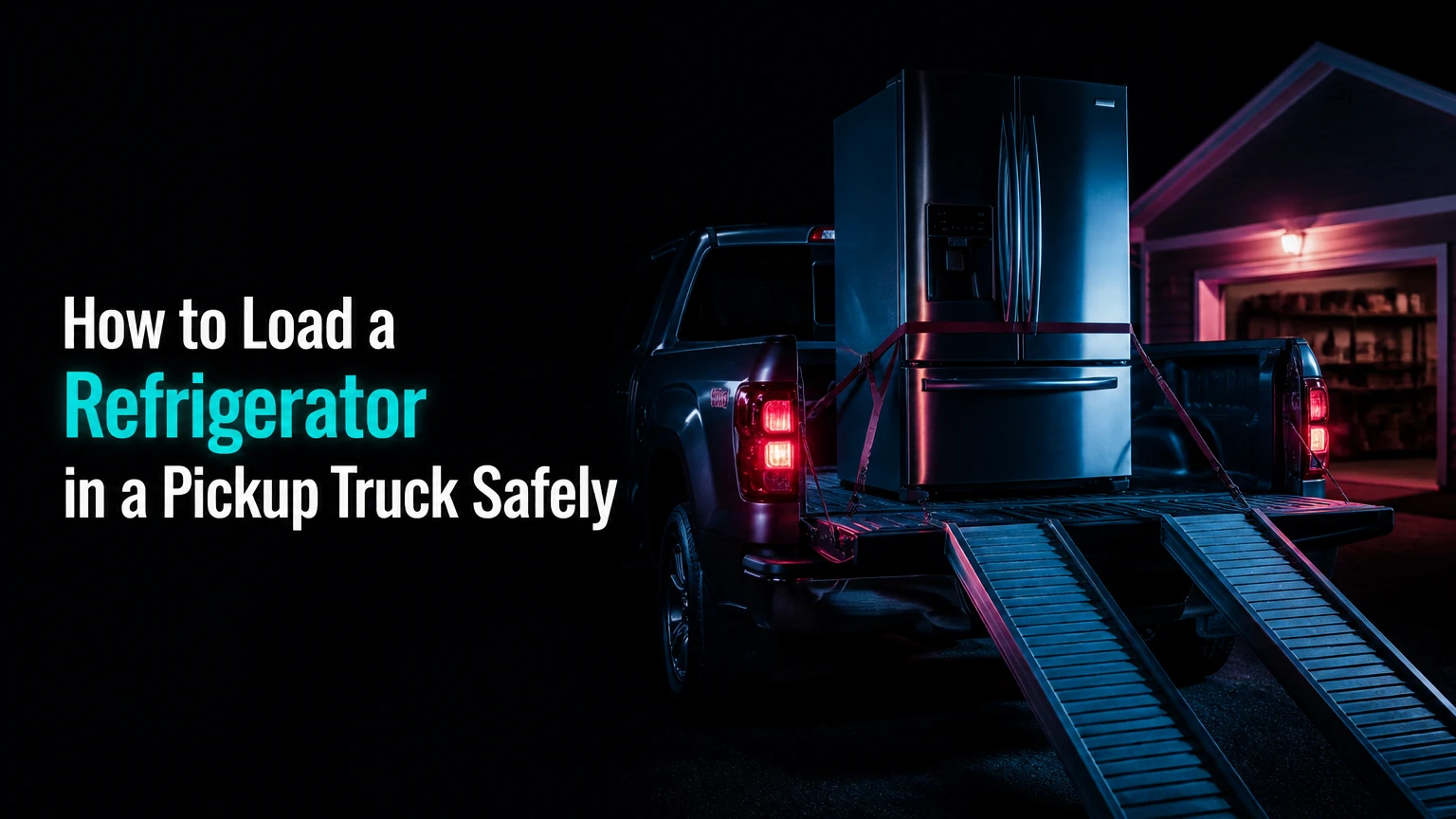
To load a refrigerator in a pickup truck, empty and defrost the appliance, move it with an appliance dolly, keep it as upright as possible, place it against the cab-side bed wall, and secure it with rated tie-downs. Verify the refrigerator’s weight, truck payload, bed dimensions, and manufacturer transport instructions before lifting.
Key Facts at a Glance
- An upright refrigerator usually needs two or more capable adults, an appliance dolly, and two rated ratchet straps.
- A short tilt onto a dolly is normally different from transporting a refrigerator on its side for the entire trip.
- The refrigerator must not exceed the pickup truck’s remaining payload or the rated capacity of the tailgate, ramps, anchors, or dolly.
- A typical household refrigerator weighs 150-350 pounds; large French-door and commercial models can weigh 400 pounds or more.
- The compressor oil does not automatically cause permanent damage after every tilt, but premature startup after transport can cause poor cooling or compressor noise.
- The owner’s installation manual provides the final instruction for side selection, defrosting, door removal, and waiting time before reconnection.
What Do You Need Before Loading a Refrigerator?
A refrigerator move normally requires 30-60 minutes of preparation, 30-90 minutes for loading, and another 20-60 minutes for unloading and positioning. Typical equipment costs range from $25-$80 for a dolly and moving blankets, while a powered lift-gate service commonly costs $100-$250 locally.
Before You Start
| Requirement | Typical specification | Why it matters |
|---|---|---|
| Appliance dolly | 600-800 lb rated capacity | Supports heavy refrigerators and provides a control strap |
| Ratchet straps | 2 straps, 1,000 lb or greater WLL each | Holds the appliance during braking and cornering |
| Moving blankets | 2-4 blankets, 72 x 80 inches | Prevents dents and paint damage |
| Edge protection | 4-6 blanket folds or strap sleeves | Stops straps from cutting into corners |
| Helpers | 2-3 adults, 4 for oversized models | Controls the refrigerator over the tailgate |
| Ramp or lift gate | 1,000 lb or greater rated capacity | Reduces the dangerous vertical lift |
| Truck payload | Refrigerator weight plus passengers and equipment | Prevents suspension, tire, and braking overload |
Check the refrigerator’s shipping or installation documentation first. Many manufacturers require an appliance to remain upright, while some permit side transport for a limited period and specify a particular side. A generic moving rule cannot replace a model-specific instruction.
Measure the appliance at its widest and deepest points, including handles. Compare those dimensions with the pickup bed between the wheel wells, the bed length, the tailgate opening, and the height of the bed rails. Remove refrigerator doors only when the manual permits it and the doorway or bed geometry requires that step.
How Do You Prepare the Refrigerator for Transport?
Prepare the refrigerator by disconnecting power, removing food and loose components, shutting off water, draining accessible lines, and drying the interior. Preparation prevents water leaks, drawer movement, door opening, mold growth, and damage from ice or glass shelves.
Step 1: Empty, Defrost, and Dry the Appliance
- Unplug the refrigerator at least several hours before loading. A full manual defrost can require 12-24 hours; a frost-free unit may need less time.
- Remove food, ice, water filters, shelves, bins, and detachable door racks.
- Shut off the refrigerator’s water supply and disconnect the line using the appliance’s installation instructions.
- Drain accessible water from the line, filter housing, ice maker, and dispenser tray.
- Wipe the interior, gasket, drain pan, and floor beneath the appliance until dry.
- Tape or wrap shelves and drawers separately rather than relying on tape to hold heavy glass in place.
You will know preparation is complete when no water drips from the rear tubing, no shelf can slide inside the cabinet, and the doors close without loose contents pressing against them.
The common mistake is taping every shelf in its installed position. Heavy glass can break against the cabinet during vibration, so removable components should travel separately in padded cartons.
Step 2: Protect Doors, Finish, and Cooling Components
Close the refrigerator doors and secure them with wide painter’s tape or a soft strap around the cabinet. Do not place adhesive tape directly on finished stainless steel, painted surfaces, rubber gaskets, or control panels unless the manufacturer permits it.
Wrap the cabinet with moving blankets, then use stretch film around the blankets. Stretch film should hold the blankets in place, not compress the doors or block ventilation openings. Never wrap a running refrigerator, and remove the protective layers before reconnecting power.
Protect the rear machinery from impact with a blanket or a rigid barrier that does not press against the compressor, condenser tubing, power cord, or water connection. Do not use the rear coil as a handhold. Refrigerant tubing and electrical connections are vulnerable to bending.
You will know the exterior is protected when the straps contact padding rather than the finish, the doors cannot swing open, and the power cord cannot drag under the cabinet.
How Should You Move a Refrigerator to the Pickup?
Move the refrigerator with an appliance dolly centered under the cabinet, secured with the dolly strap, and tilted only as much as necessary to roll over a level surface. A brief controlled tilt during handling does not carry the same risk as leaving the appliance tilted during transport.
Step 3: Load the Appliance Dolly
Position the dolly behind the refrigerator with its toe plate fully under the cabinet base. Keep the dolly centered so the wheels do not pull sideways against the refrigerator.
Wrap the dolly strap around the cabinet’s strong middle section, below the doors and above the lower grille. Avoid crushing the water dispenser, handles, control panel, hinges, or thin sheet-metal doors. Tighten the strap until the cabinet cannot slide, but do not deform the body.
Two adults should control the refrigerator while one person operates the dolly. Tilt the appliance toward the dolly wheels gradually, commonly about 30-45 degrees for a standard appliance dolly. Move slowly over thresholds and keep the refrigerator balanced over the axle.
You will know the dolly setup is stable when the refrigerator remains centered without an adult holding its full weight and the strap stays below the door line.
The common mistake is pulling the refrigerator backward by its doors. Push or pull from the cabinet frame and use the manufacturer-approved handholds.
Step 4: Choose a Safe Bed-Loading Method
Use a powered lift gate, forklift, loading ramp, or professional appliance lift whenever available. Lifting a 250-pound refrigerator over a tailgate creates a fall and crush hazard because the load is tall, awkward, and difficult to control from the ground.
If no equipment is available, use at least two strong adults and a third person to direct the operation. Keep the tailgate fully supported and verify that the tailgate, ramp, dolly, and bed anchors have adequate ratings. Do not improvise with loose boards, wet plywood, or a ramp that ends above the bed.
Roll the dolly straight to the tailgate. Keep one person on the ground controlling the wheels, while the helpers inside the bed control the cabinet’s upper frame. Lift the base only enough to cross the tailgate gap, then roll the refrigerator forward.
Stop immediately if the dolly wheels leave the ramp, the cabinet begins to rotate, or any helper loses a secure grip. A refrigerator that starts falling cannot be safely caught by hand.
Where Should a Refrigerator Sit in a Pickup Bed?
Place the refrigerator upright and close to the cab-side bulkhead, with its broadest stable face aligned with the direction of travel. The bulkhead limits forward movement during hard braking, but the refrigerator still needs independent straps and padding.
Step 5: Position the Refrigerator
Set the refrigerator on a level section of the bed, not on the tailgate or an unsupported ramp. Keep the unit centered between the wheel wells when possible, and leave enough room for straps to reach approved anchors.
Place the cabinet against padded blocking at the front of the bed. Do not allow the doors or handles to bear against the bulkhead. Keep the refrigerator away from the bed edge, where a high center of gravity and side wind can increase rollover movement.
Confirm that the refrigerator height does not create an overhead clearance problem. If the appliance extends above the bed rails, use additional restraint and drive more slowly, particularly in crosswinds. An open pickup bed exposes tall cargo to aerodynamic forces that an enclosed moving van would reduce.
Check the truck’s payload placard, tire pressures, axle ratings, and suspension condition. A 400-pound refrigerator may be within total payload while still creating excessive rear-axle loading if placed at the tailgate.
Which Tie-Downs Secure a Refrigerator Best?
Two properly rated ratchet straps are generally better than bungee cords or light cam-buckle straps for a full-size refrigerator. Strap working load limit must match the cargo weight and anchor capacity; strap width alone does not prove that a tie-down is safe.
Step 6: Strap the Cabinet Correctly
Use two independent restraint paths whenever the pickup bed provides suitable anchors:
- Place the first strap around the upper third of the cabinet, above the center of mass but below fragile doors and controls.
- Place the second strap around the lower half, below the doors and above the base.
- Route each strap to opposing bed anchors so the refrigerator cannot tip forward, backward, or sideways.
- Add soft sleeves or folded blankets wherever webbing contacts a corner.
- Tighten the ratchets until the padding compresses slightly and the cabinet has minimal movement.
- Close and lock the ratchet handles, then secure loose strap tails.
Do not run a strap across a glass door, dispenser, handle, hinge, condenser grille, or thin removable panel. Do not rely on the dolly strap after the refrigerator reaches the truck bed. The dolly strap holds the appliance during rolling; the truck tie-downs hold it during transit.
You will know the restraint is adequate when the refrigerator does not shift perceptibly during controlled hand pressure, every strap remains seated, and the anchor points do not bend or pull out.
Inspect the load after the first 5-10 miles, then at each fuel stop or every 50 miles. Vibration can settle blankets and reduce strap tension. Stop in a safe location before retightening.
Tie-Down Options Compared
| Tie-down method | Typical rating or behavior | Suitable use | Main failure |
|---|---|---|---|
| 1-inch ratchet strap | 1,000-3,333 lb WLL, model dependent | Full-size refrigerator with rated anchors | Edge cuts or over-tightening |
| 2-inch ratchet strap | 3,333-5,000 lb WLL, model dependent | Heavy commercial or oversized appliance | Excessive force on cabinet |
| Cam-buckle strap | 300-1,500 lb WLL, model dependent | Light secondary stabilization | Slippage under vibration |
| Bungee cord | Elastic, not a cargo restraint | Holding a loose blanket | Stretching and release |
| Rope | Rating varies widely and knots reduce strength | Temporary light positioning | Knot failure and loosening |
Working load limit is the relevant specification, not the strap’s breaking strength. The Federal Motor Carrier Safety Administration uses working-load-limit principles for cargo securement, although private household moves may not be regulated identically to commercial interstate freight. The practical rule remains the same: use intact equipment whose marked WLL exceeds the expected restraint demand.
Upright or on Its Side: Which Transport Method Is Safer?
Upright transport is the safer default because it reduces stress on the compressor, tubing, door structure, and cabinet. Side transport is a backup only when the owner’s manual permits it, the correct side is identified, and the refrigerator can be returned upright before operation.
| Transport position | Typical handling risk | Startup waiting period | Best use |
|---|---|---|---|
| Fully upright | Lowest refrigeration-system risk | 1-4 hours, manual dependent | Preferred pickup-bed method |
| Brief dolly tilt | Moderate handling risk, short duration | Follow manual, often 1-4 hours | Moving over thresholds |
| Side transport | Higher oil and tubing risk | Commonly 12-24 hours, manual dependent | Space-limited emergency move |
| Back or door face | High door and coil damage risk | No waiting period fixes structural damage | Avoid |
| Roof or front face | Severe cabinet and control damage risk | Not a valid method | Never use |
The compressor contains oil that lubricates moving parts. Tilting can move oil through refrigeration tubing, but a short tilt does not automatically create an “oil log” or permanent compressor failure. The main operational error is reconnecting power immediately after a substantial tilt or side transport, before fluids have returned to their intended locations.
If side transport is unavoidable, consult the model’s manual or manufacturer support before moving it. Keep the compressor and tubing from bearing the cabinet’s full weight, pad the side, prevent door pressure, and return the unit upright as soon as possible.
An honest limitation matters here: upright positioning does not eliminate all risk. A loose refrigerator can still fall, a truck can overload its rear axle, and a hard impact can damage a compressor even when the cabinet remains vertical.
How Much Weight Can a Pickup Carry?
A pickup’s usable payload equals the manufacturer’s rated payload minus passengers, fuel, tools, accessories, and cargo already loaded. A refrigerator weighing 250 pounds may fit within a truck’s payload while exceeding a weak tailgate, ramp, dolly, or bed-anchor rating.
| Refrigerator type | Typical weight | Typical width | Pickup-bed concern |
|---|---|---|---|
| Compact refrigerator | 40-100 lb | 18-24 in | Easy to strap, unstable if unblocked |
| Top-freezer model | 150-250 lb | 28-33 in | Usually fits between wheel wells |
| Side-by-side model | 220-350 lb | 32-36 in | High center of gravity |
| French-door model | 250-450 lb | 33-36 in | Door and rear-axle loading |
| Commercial refrigerator | 300-700 lb | 30-54 in | Often needs lift-gate or forklift |
Use the refrigerator’s actual data-plate or manual weight when available. Do not estimate a commercial unit from household-appliance figures. A full refrigerator should be emptied before weighing or moving because food, glass containers, and ice add unpredictable mass.
The truck’s payload label is usually found on the driver-side doorjamb. Tire load ratings and rear axle ratings also matter because a refrigerator positioned near the tailgate creates more leverage than the same refrigerator placed near the cab.
What Are the Most Common Loading Mistakes?
The most common refrigerator-loading failures involve poor lifting geometry, weak restraint, wrong strap placement, and immediate startup after transport. Each failure has a different correction, so retightening a strap cannot repair a bent hinge or damaged refrigerant tube.
| Mistake | Likely consequence | Corrective action |
|---|---|---|
| Solo tailgate lift | Crush or fall injury | Use a ramp, lift gate, or additional helpers |
| Strap across doors | Bent doors or broken seals | Route around the cabinet frame |
| Bungees used as restraints | Cargo movement | Replace with rated ratchet straps |
| Cabinet left on tailgate | Tailgate or appliance failure | Move fully onto the bed floor |
| No corner protection | Cut webbing | Add sleeves or folded blankets |
| Power restored immediately | Clicking, poor cooling, compressor stress | Unplug and wait per manual |
| Loose interior shelves | Broken glass or damaged liner | Remove and pad separately |
| Side transport without instructions | Tubing or oil-related problems | Consult manual and allow settling time |
A practitioner rule of thumb is to restrain the upper and lower cabinet separately. One strap can stop forward movement while allowing rotation, whereas two separated restraint heights control both sliding and tipping.
Another counterintuitive point is that tighter is not always safer. Excessive ratchet force can crush foam insulation, dent sheet metal, distort a door frame, or overload a factory bed anchor. Tight enough to prevent movement is safer than maximum possible tension.
How Long Should a Refrigerator Stand Before Plugging In?
Let an upright refrigerator stand level for at least 1-4 hours after a short, mostly upright move, unless the manufacturer specifies another period. After side transport or a prolonged steep tilt, 12-24 hours is a common manufacturer-style precaution, but the exact waiting time belongs to the appliance documentation.
Set the refrigerator upright on a level floor before connecting power. Inspect the cord, tubing, condenser area, door seals, leveling feet, and cabinet for impact damage. Reconnect the water supply only after the appliance operates normally and the connection remains dry.
If the refrigerator was on its side for several hours and the manual is unavailable, waiting 24 hours upright is a conservative household practice. Waiting longer cannot repair a crushed tube, leaking refrigerant line, damaged compressor mount, or bent door.
The refrigerator may take 12-24 hours to reach normal food-safe temperatures after startup. The U.S. Food and Drug Administration advises keeping a refrigerator at or below 40°F and a freezer at 0°F. Use an appliance thermometer rather than judging temperature by touch.
What If the Refrigerator Makes Clicking Sounds or Stays Warm?
Unplug a refrigerator that clicks repeatedly, smells electrical, trips a breaker, leaks refrigerant or oil, or remains warm after the normal cooldown period. A brief startup click can be normal, but repeated clicking with no compressor operation can indicate a relay, overload, wiring, or compressor problem.
Troubleshooting After the Move
- Disconnect power and wait for the model’s recommended upright settling period.
- Check that the outlet has power and that the refrigerator is level.
- Inspect the rear for crushed tubing, a disconnected fan, loose wiring, or a blocked condenser.
- Confirm that the doors seal and that transport tape or blankets are removed.
- Reconnect power and monitor compressor operation, fan noise, temperature, and leaks.
- Call an appliance technician if clicking repeats, the compressor becomes excessively hot, or the unit does not cool within 12-24 hours.
Do not repeatedly power-cycle a refrigerator that is clicking. Repeated attempts can overheat the compressor-start circuit. Do not puncture tubing or attempt to recharge refrigerant without certified service equipment and the required legal qualifications.
How Do Situations Change the Loading Method?
Different refrigerator designs and transport conditions change the safest loading sequence, but the central requirements remain cabinet support, rated restraint, and manufacturer-specific settling guidance.
French-Door and Side-by-Side Refrigerators
French-door models often weigh more than 250 pounds and have vulnerable handles, drawer fronts, water dispensers, and multiple doors. Remove detachable handles or doors only when the service instructions permit it, and label wiring harnesses and hinge parts for reassembly.
Compact Refrigerators
A compact unit weighs less but can slide more easily because its narrow base provides limited stability. Block the base on both sides, keep the unit upright, and use a strap around the cabinet rather than around the door.
Wet Weather or Rough Roads
Delay loading during heavy rain when possible. Wet blankets and bed surfaces reduce friction, and water can enter exposed controls or rear components. If travel cannot wait, use a waterproof cargo cover that does not press against the cabinet or allow water to pool around the compressor.
Drive below the posted limit when the refrigerator rises above the bed rails, and reduce speed further on rough pavement, sharp turns, and crosswind-exposed roads. Securement controls movement, but it does not make top-heavy cargo behave like low cargo.
Long-Distance Transport
Inspect straps more frequently on a long trip, carry spare rated straps and padding, and avoid leaving the refrigerator in direct sun for prolonged stops. A parked appliance can heat internally, but heat alone does not replace the required upright settling period after transport.
How Much Does Refrigerator Pickup-Truck Transport Cost?
A do-it-yourself refrigerator move typically costs $25-$100 for equipment, while professional local transport commonly costs $150-$400 before stairs, long carries, door removal, or lift-gate surcharges. The refrigerator’s weight, access conditions, distance, and required equipment determine the final price.
| Service or item | Typical U.S. cost | Typical time | Best fit |
|---|---|---|---|
| Appliance dolly rental | $15-$35 per day | 1 day | Level access and two helpers |
| Moving blankets and straps | $25-$80 purchase | 30-60 minutes | DIY pickup-bed move |
| Portable loading ramp | $40-$100 per day | 1 day | Tailgate access with safe grade |
| Lift-gate delivery | $100-$250 surcharge | 15-30 minutes | Heavy or tall refrigerator |
| Local appliance movers | $150-$400 | 1-3 hours | Stairs, narrow doors, no helpers |
| Commercial moving service | $400-$900 | Half to full day | Oversized units or complex access |
Rental prices vary by city and season, so these figures are typical planning ranges rather than guaranteed quotes. Ask whether the rental company states a working load limit, provides wheel straps, and permits use over a pickup tailgate.
Frequently Asked Questions
Can I Lay a Refrigerator Flat in a Pickup Truck?
You can lay some refrigerators on a specified side if the manufacturer permits that position, but upright transport is safer. Never place a refrigerator on its doors or back without explicit instructions, because door seals, hinges, controls, rear tubing, and condenser components can be damaged by cabinet weight.
Can One Person Load a Refrigerator?
One person should not lift a full-size refrigerator over a pickup tailgate. A solo operator can move a compact refrigerator with a properly rated dolly and ramp only when the load remains controlled, the path is level, and no manual lifting over a gap is required.
Should I Remove Refrigerator Doors Before Transport?
Remove refrigerator doors only when doorway clearance or bed dimensions require it and the manufacturer provides removal instructions. Door removal can reduce width, but it introduces wiring, hinge, alignment, and water-line risks that require careful labeling and reinstallation.
Do I Need to Cover a Refrigerator in a Pickup Bed?
Cover a refrigerator with moving blankets and a weather-resistant cargo cover when rain, road spray, or debris is possible. Do not seal a wet appliance in plastic for a long period, and do not cover ventilation openings while the refrigerator is operating.
Can I Use Rope Instead of Ratchet Straps?
Rope can be difficult to tension consistently and can loosen when knots settle or become wet. Use marked ratchet straps with a stated working load limit for the primary restraint, and use rope only for temporary positioning when the refrigerator is not moving.
The Bottom Line
To load a refrigerator in a pickup truck safely, defrost and dry it, protect the cabinet, use a rated appliance dolly, load with a ramp or enough helpers, keep the unit upright against the padded cab-side bulkhead, and secure the upper and lower cabinet with independent ratchet straps. Check the payload, anchors, tailgate, and manufacturer instructions before departure, then let the refrigerator stand upright before reconnecting power.