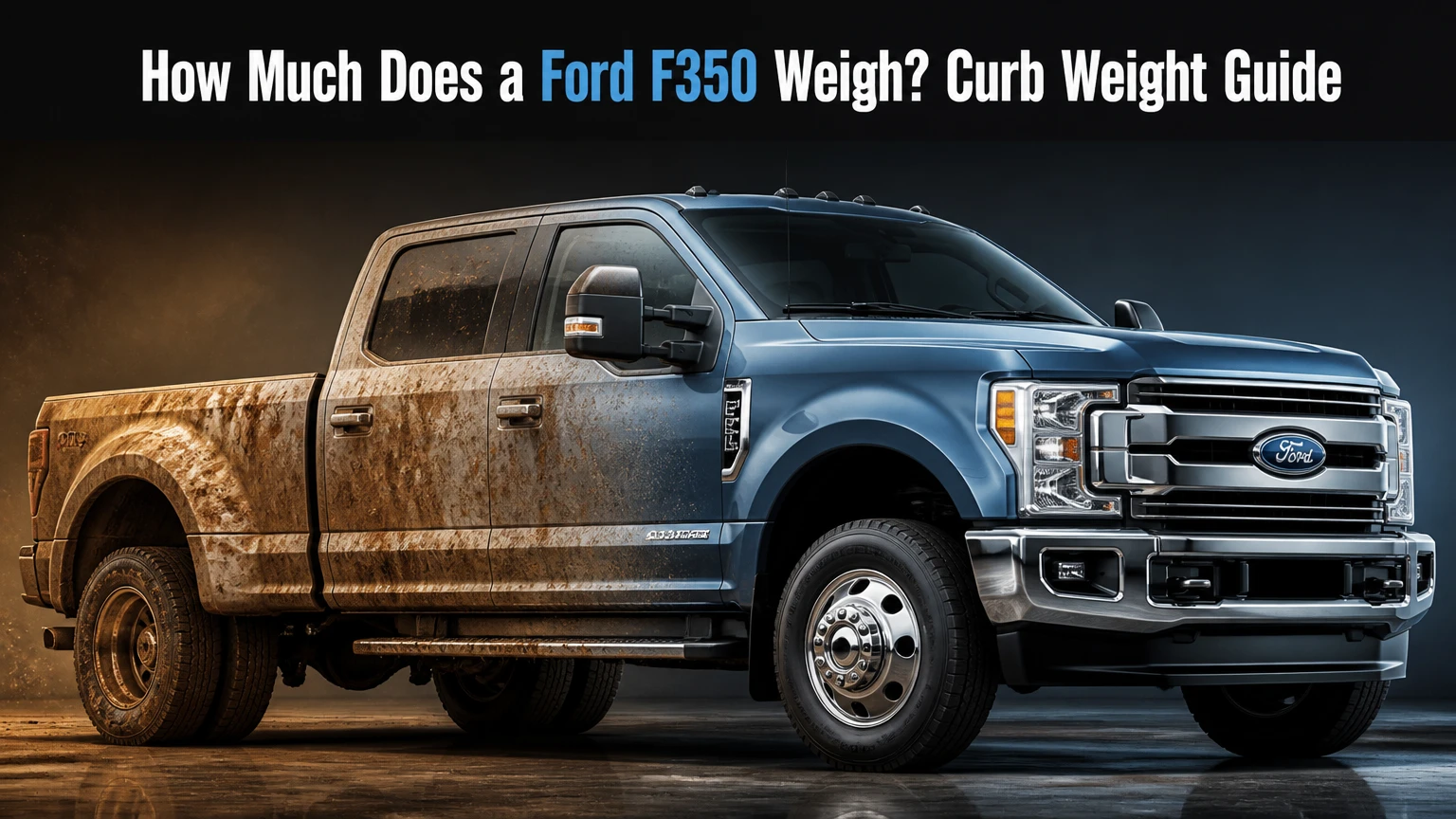
A Ford F-350 typically weighs about 5,800-8,100 pounds at the curb, depending on cab, bed, engine, drivetrain, trim, and rear-wheel configuration. A gas-powered regular-cab F-350 is usually the lightest, while a Crew Cab 4×4 with a diesel engine and dual rear wheels can exceed 8,000 pounds. The exact truck weight comes from its door label or certified scale.
Key Facts at a Glance
- A Ford F-350’s typical curb-weight range is approximately 5,800-8,100+ pounds.
- A diesel F-350 usually weighs about 800-1,000 pounds more than a comparable gasoline truck.
- A dual-rear-wheel F-350 generally weighs more than a single-rear-wheel model because of its wider axle, extra wheels, tires, and related equipment.
- Curb weight is not the same as GVWR, payload, shipping weight, or actual loaded weight.
- The driver-door Tire and Loading Information label provides the most useful payload figure for a specific truck.
- A trailer’s tongue or fifth-wheel pin weight counts against payload even when the trailer is within the truck’s maximum tow rating.
How Much Does a Ford F350 Weigh?
A Ford F-350 weighs approximately 5,800-8,100 pounds before passengers and cargo, with the lowest figures applying to lighter gas-powered configurations and the highest figures applying to diesel Crew Cab 4×4 dually trucks. Ford does not assign one universal weight to the F-350 nameplate because every cab, engine, axle, bed, trim, and option changes mass.
The term “weigh” usually means curb weight in a vehicle specification search. Curb weight generally describes the truck with standard operating fluids and fuel, but without occupants or cargo. Published figures can still differ because manufacturers, dealers, and registration agencies use different equipment assumptions.
A practical planning estimate is more useful than a false single number. Use 5,800-6,800 pounds for many gas single-rear-wheel trucks, 6,200-7,400 pounds for many gas dually configurations, and 6,500-8,100 pounds for diesel models. Confirm the specific vehicle before calculating payload or trailer capacity.
What Do the Different Weight Terms Mean?
The Ford F-350’s curb weight describes the empty truck, GVWR describes its legal maximum loaded weight, and payload describes how much weight remains available for people, equipment, and trailer load. These values answer different questions and cannot be substituted for one another.
| Term | Meaning | F-350 example |
|---|---|---|
| Curb weight | Empty truck with operating fluids and no occupants or cargo | 6,900 lb |
| GVWR | Maximum permitted loaded truck weight | 11,000-14,000 lb |
| Payload | Occupants, cargo, hitch equipment, and trailer load carried by the truck | 4,100 lb on a specific label |
| GAWR | Maximum permitted load on a front or rear axle | 5,200 lb front, 9,000 lb rear |
| Gross combined weight | Truck and trailer together | Rating varies by configuration |
The payload formula is:
Available payload = GVWR – actual truck weight
For a towing calculation, the more useful formula is:
Remaining payload = door-label payload – occupants – accessories – cargo – hitch or pin weight
Ford’s door label is more important than a dealer’s generic brochure table. A dealer listing may show a base curb weight, while the label accounts for the truck’s installed options.
Which Ford F-350 Configuration Weighs the Most?
A diesel Crew Cab 4×4 dually usually weighs the most, often around 7,000-8,100 pounds before passengers and cargo. A gas Regular Cab 4×2 with a shorter bed generally weighs the least, often near 5,800-6,300 pounds, although exact trim equipment can move either estimate.
The largest changes come from the powertrain and chassis configuration. Diesel hardware includes a heavier engine and additional emissions equipment, while four-wheel drive adds a transfer case, front axle components, driveshaft parts, and related hardware. A dually adds a wider rear axle and two additional wheel-and-tire assemblies.
Typical F-350 Curb Weight by Engine
The following figures are planning ranges for recent Super Duty configurations, including 2026-style engine choices. They are not VIN-specific certification values, and Ford equipment guides should control a purchase or compliance decision.
| Engine and configuration | Typical SRW curb weight | Typical DRW curb weight | Main weight effect |
|---|---|---|---|
| 6.8L gasoline V8 | 5,850-6,780 lb | 6,200-7,390 lb | Lightest powertrain family |
| 7.3L gasoline V8 | 6,070-7,030 lb | 6,310-7,390 lb | Larger gas engine adds equipment mass |
| 6.7L Power Stroke diesel | 6,550-7,730 lb | 6,990-8,130 lb | Heavy engine and emissions hardware |
| 6.7L High Output diesel | 6,570-7,690 lb | 7,010-8,090 lb | Similar diesel mass, different output hardware |
Gasoline and diesel comparisons must use the same cab, bed, drive system, and trim. Comparing a gas Regular Cab 4×2 with a diesel Crew Cab 4×4 exaggerates the engine difference because several independent weight changes occur at once.
How Much Does Cab and Bed Choice Change Weight?
A Regular Cab F-350 is typically 300-500 pounds lighter than a similarly equipped Crew Cab, while a SuperCab usually falls between them. A long bed can weigh modestly more than a standard bed, and a four-door cab adds steel, glass, seats, safety equipment, and interior components.
| Body choice | Typical relative effect | Common use |
|---|---|---|
| Regular Cab, 4×2 | Lightest baseline | Commercial work and fleet service |
| SuperCab, 4×2 or 4×4 | About 150-350 lb above Regular Cab | Occasional rear-seat use |
| Crew Cab, 4×4 | About 300-700 lb above Regular Cab | Family, recreation, and towing |
| Crew Cab long bed | About 50-200 lb above comparable shorter bed | Fifth wheels and long cargo |
Trim also matters. Leather seating, power running boards, larger wheels, advanced driver-assistance equipment, sunroofs, skid plates, auxiliary fuel tanks, and dealer-installed accessories can remove hundreds of pounds from available payload.
How Much Does a Ford F-350 Diesel Dually Weigh?
A Ford F-350 diesel dually commonly weighs about 7,000-8,100 pounds at the curb, with a High Output diesel Crew Cab 4×4 near the upper end. A gas dually can weigh roughly 6,200-7,400 pounds, so the diesel powertrain often creates a difference of several hundred pounds even before the trailer is connected.
Dual-rear-wheel trucks carry four rear tires instead of two and use a wider rear axle. The added tire, wheel, axle, and fender hardware improves lateral stability and rear-load capacity, but the extra mass reduces the payload available under the truck’s GVWR.
A dually is not automatically legal for every heavy trailer. The owner must still check the door-label payload, rear GAWR, tire ratings, hitch rating, and gross combined rating. Stability and legal carrying capacity are related, but they are not identical.
F-350 SRW Versus DRW
An F-350 SRW is usually lighter, narrower, easier to park, and less expensive to maintain. An F-350 DRW is usually more stable with a heavy fifth-wheel pin or concentrated bed load, but it carries six tires and needs more clearance in parking spaces and narrow lanes.
| Consideration | F-350 SRW | F-350 DRW |
|---|---|---|
| Typical curb weight | 5,850-7,730 lb | 6,200-8,130 lb |
| Rear tires | 2 | 4 |
| Total tires | 4 | 6 |
| Parking width | Lower | Higher |
| Heavy fifth-wheel stability | Adequate to moderate | Stronger under high pin weight |
| Tire replacement cost | Four tires | Six tires |
For a slide-in camper, payload often matters more than engine prestige. A lighter gas SRW can leave more capacity for the camper, passengers, water, tools, and food than a luxurious diesel SRW.
How Do You Find the Exact Weight of Your Ford F-350?
The exact payload and maximum loaded weight for a Ford F-350 come from the driver-door labels, Ford’s VIN-specific information, and a certified scale ticket. A generic online specification cannot account for every option installed on an individual truck.
Use this verification sequence:
- Open the driver’s door. Locate the Tire and Loading Information label and the vehicle certification label.
- Record the payload statement. The label gives the combined maximum weight of occupants and cargo.
- Record GVWR and axle ratings. Note the front and rear GAWR values, then compare them with tire and wheel ratings.
- List all added weight. Include passengers, tools, bed liners, tonneau covers, winches, bumpers, camper equipment, fuel, and hitch hardware.
- Add trailer load. Count the trailer tongue weight for a bumper pull or the fifth-wheel pin weight for a fifth wheel.
- Use a public scale. Weigh the complete combination, then obtain separate front-axle, rear-axle, and trailer readings when possible.
A scale reading is the best answer when a truck is modified or loaded. A 100-gallon auxiliary fuel tank, steel service body, winch, and slide-in camper can change real operating weight enough to invalidate a brochure estimate.
How Does F-350 Weight Affect Payload and Towing?
A heavier Ford F-350 has less payload remaining under the same GVWR, even if its engine increases the truck’s tow rating. Diesel torque may improve trailer performance, but the diesel engine’s weight consumes payload before passengers, tools, hitch equipment, or pin weight are added.
Consider a truck with a 4,200-pound door-label payload:
| Load item | Weight | Payload remaining |
|---|---|---|
| Starting payload | 4,200 lb | 4,200 lb |
| Four occupants | 600 lb | 3,600 lb |
| Toolbox and tools | 250 lb | 3,350 lb |
| Fifth-wheel hitch | 200 lb | 3,150 lb |
| Trailer pin weight | 2,800 lb | 350 lb |
The truck may have a maximum tow rating well above the trailer’s total weight, yet the combination can approach its payload limit. Fifth-wheel pin weight commonly represents about 15-25% of loaded trailer weight, while a conventional travel-trailer tongue commonly represents about 10-15%.
The payload number must also satisfy the rear axle and tire limits. A truck can remain below GVWR while exceeding rear GAWR if much of the load sits behind the axle.
What Is the Payload Versus Towing Mistake?
The most common F-350 weight mistake is treating maximum towing capacity as permission to load any trailer that weighs less than that figure. Maximum towing describes a tested truck-trailer combination under specified conditions, while payload controls the weight placed on the truck itself.
Airbags, helper springs, and stiffer shocks can improve ride height or handling. They do not increase the certified GVWR, GAWR, tire rating, or door-label payload. A level-looking truck can still be overloaded.
Is a Gas or Diesel F-350 Better for Payload?
A gas F-350 generally provides more payload than a similarly equipped diesel F-350 because the gasoline powertrain weighs less. A diesel F-350 is usually the better tool for frequent heavy towing, long grades, high annual mileage under load, or drivers who value exhaust-braking control.
| Use case | Better starting configuration | Reason |
|---|---|---|
| Heavy slide-in camper | 7.3L gas SRW | Lower powertrain weight preserves payload |
| Fifth wheel above 15,000 lb | 6.7L diesel DRW | Pin-weight margin and stability matter |
| Local equipment hauling | 6.8L or 7.3L gas | Lower purchase and maintenance burden |
| Frequent mountain towing | 6.7L diesel | Torque and exhaust brake reduce drivetrain strain |
| Daily unloaded driving | Gas SRW | Lower mass, cost, and tire expense |
The diesel choice is not automatically superior. A diesel F-350 with a large fifth-wheel hitch and a loaded Crew Cab can have less practical payload than a gas truck with the same GVWR.
How Does the F-350 Compare With Other Heavy-Duty Trucks?
Ford F-350, Ram 3500, and Chevrolet Silverado 3500 HD curb weights overlap heavily because engine, cab, drivetrain, trim, and axle configuration dominate the result. The right comparison is the specific door-label payload and axle rating, not the brand’s lightest published configuration.
| Truck | Typical light configuration | Typical diesel dually range | Key comparison |
|---|---|---|---|
| Ford F-350 | About 5,800-6,800 lb | About 7,000-8,100 lb | Aluminum body and broad configuration range |
| Ram 3500 | About 6,000-6,900 lb | About 7,200-8,200 lb | Cummins diesel and varied cab choices |
| Chevrolet Silverado 3500 HD | About 5,900-6,900 lb | About 7,000-8,200 lb | Comparable heavy-duty chassis choices |
| GMC Sierra 3500 HD | About 5,900-6,900 lb | About 7,000-8,200 lb | Similar platform relationship to Silverado |
These are typical planning ranges, not a substitute for manufacturer certification data. Two trucks with the same model year and diesel badge can differ substantially because one has four-wheel drive, premium trim, a long bed, a snowplow package, or commercial equipment.
The practical winner is the truck that leaves sufficient payload and axle margin for the actual load. A lighter truck with insufficient rear-axle capacity is a worse choice than a heavier dually with a verified reserve.
What Extra Equipment Makes an F-350 Heavier?
Factory and aftermarket equipment can add 100-1,000 pounds to a Ford F-350, depending on the parts installed. The largest real-world additions include service bodies, snowplows, campers, auxiliary fuel tanks, steel bumpers, winches, generators, and fifth-wheel hardware.
| Equipment | Typical added weight | Payload consequence |
|---|---|---|
| Fifth-wheel hitch | 150-250 lb | Reduces available payload directly |
| Heavy steel bumper and winch | 250-500 lb | Often loads the front axle |
| Snowplow | 700-1,000 lb | May require front-axle and seasonal calculations |
| Slide-in camper | 1,500-4,000+ lb | Uses payload, rear axle, and tire capacity |
| Service body and tools | 800-2,000+ lb | Can consume most commercial payload |
| Auxiliary fuel tank | 300-800 lb when filled | Fuel weight changes with volume |
Fuel is part of real operating weight. Diesel weighs approximately 7 pounds per gallon, so a 50-gallon tank contains roughly 350 pounds of fuel before the tank itself is counted. Water, propane, food, and personal equipment can add another 300-800 pounds to a recreational setup.
What Are the Common F-350 Weight Problems?
The most common problems involve inaccurate listing weights, overlooked accessories, and trailer loads calculated from unloaded brochure figures. Correcting the problem requires removing weight, redistributing the load, selecting a higher-capacity configuration, or choosing a lighter trailer.
- Using shipping weight as curb weight: Shipping figures may exclude fuel or equipment. Use the door label and scale.
- Ignoring pin weight: Fifth-wheel pin weight transfers directly into the truck bed and rear axle.
- Counting only passengers: A family trip also includes luggage, coolers, tools, hitch hardware, and fluids.
- Assuming a dually solves every limit: A dually improves stability, but GVWR and axle ratings still apply.
- Trusting suspension upgrades: Airbags can reduce visible sag without changing legal capacity.
- Forgetting front-axle loading: A snowplow, winch, or heavy bumper can exceed front GAWR while total GVWR remains acceptable.
- Using dry trailer weight: Water, propane, batteries, cargo, and dealer-installed options increase the trailer’s loaded weight.
A truck that squats noticeably, develops poor steering response, or causes tire sidewall bulging needs an immediate load review. Do not use increased spring pressure as proof that the load is compliant.
Should You Buy an F-350 for Your Load?
Buy an F-350 when the required payload, rear-axle capacity, or trailer pin weight exceeds a lighter pickup’s practical margin. Choose SRW for moderate loads and everyday maneuverability, gas for payload-focused work, and DRW when a heavy fifth wheel or concentrated cargo requires greater rear stability.
Use these decision rules:
- For a camper: Start with the loaded camper weight, then add passengers, water, propane, gear, and tie-down hardware. Compare the total with the door-label payload.
- For a fifth wheel: Estimate loaded pin weight at 15-25% of trailer weight, then include the hitch and every passenger.
- For a bumper-pull trailer: Estimate tongue weight at 10-15%, but verify the actual loaded trailer at a scale.
- For commercial equipment: Check front and rear axle weights separately because tools and machinery often sit unevenly.
- For a used truck: Inspect modifications and weigh the truck in its normal operating condition before purchase.
An F-350 is not ideal for every owner. A gas F-350 can be expensive and cumbersome for light commuting, while a diesel dually adds tire, parking, fuel, and maintenance costs that may not benefit an unloaded driver.
FAQ
Is an F-350 heavier than an F-250?
A comparable F-350 can weigh slightly more than an F-250 because of its suspension, axle, wheel, tire, or dual-rear-wheel equipment, but the difference is not fixed. Engine, cab, drivetrain, trim, and options can make an F-250 heavier than a lightly equipped F-350.
How much does a Ford F-350 Crew Cab weigh?
A Ford F-350 Crew Cab typically weighs about 6,100-7,700 pounds as an SRW truck and about 6,300-8,100 pounds as a dually. Gasoline models occupy the lower portion of those ranges, while diesel 4×4 Crew Cab configurations occupy the upper portion.
How many kilograms does an F-350 weigh?
A 5,800-pound Ford F-350 weighs approximately 2,631 kilograms, while an 8,100-pound truck weighs approximately 3,674 kilograms. Convert pounds to kilograms by multiplying by 0.453592. A specific truck’s label or scale reading remains the authoritative value.
Can an F-350 tow a 20,000-pound trailer?
Some Ford F-350 configurations can tow a 20,000-pound trailer, but the answer depends on hitch type, axle ratio, drivetrain, cab, trailer configuration, and payload. A fifth-wheel with a 4,000-pound pin weight may exceed the truck’s available payload even when the published tow rating exceeds 20,000 pounds.
Where can I weigh my Ford F-350?
Certified public truck scales, commercial grain scales, and some recycling or agricultural facilities can weigh an F-350. Request separate axle readings, weigh the truck with normal fuel and occupants, and weigh the complete trailer combination when evaluating towing capacity.
The Bottom Line
A Ford F-350 weighs roughly 5,800-8,100+ pounds at the curb, but the correct answer for a particular truck is printed on its labels or measured on a scale. Gas, SRW, Regular Cab models are usually lightest; diesel, DRW, Crew Cab, 4×4 models are usually heaviest. For how much does a Ford F350 weigh, use the range for planning, then verify payload, GVWR, GAWR, tires, and trailer pin weight before carrying or towing.