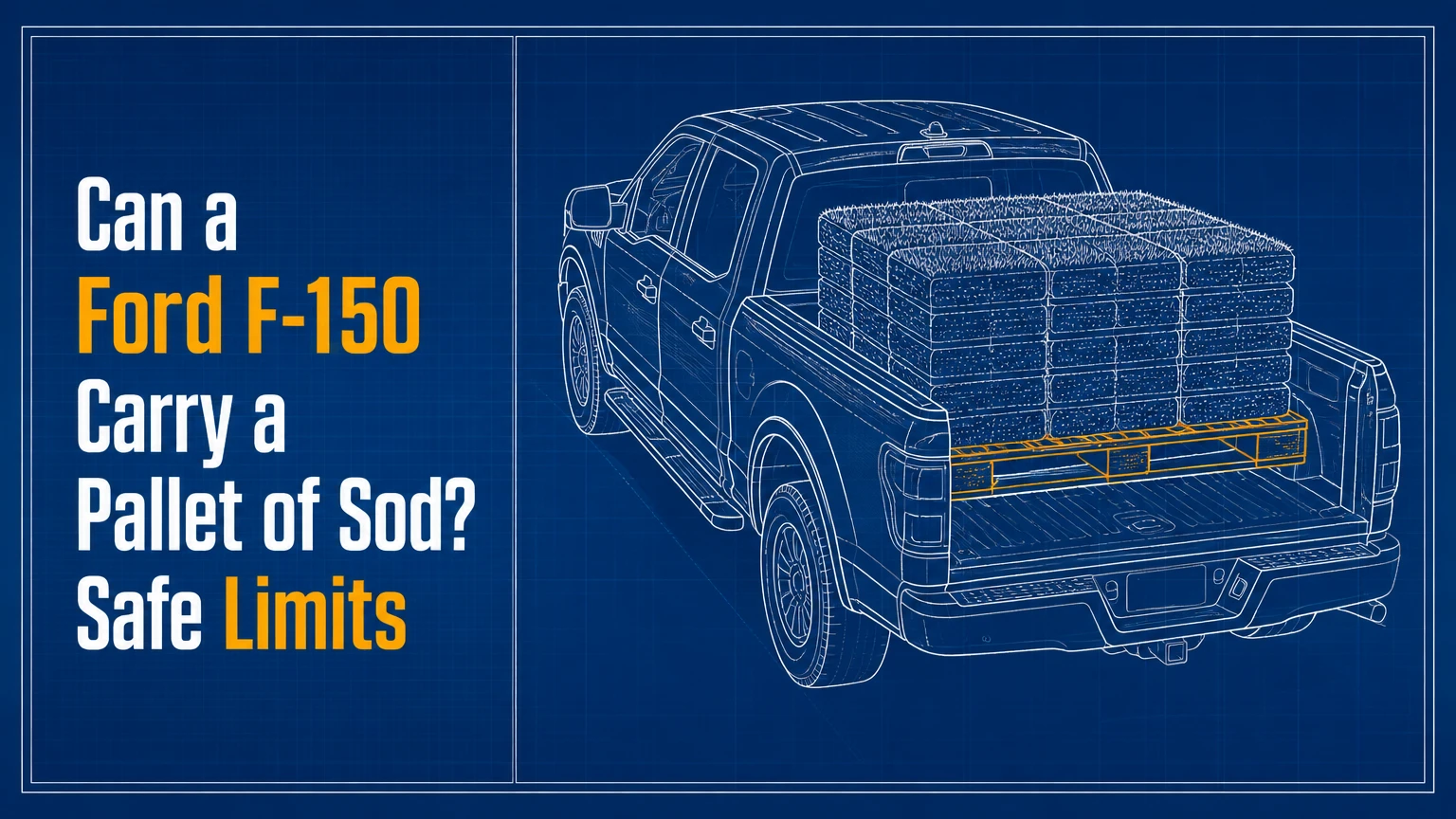
A Ford F-150 usually should not carry a full pallet of sod in its bed. A typical pallet weighs about 1,500-3,000 pounds before accounting for the driver, passengers, tools, and accessories, while many crew-cab F-150s have only 1,300-1,800 pounds of available payload. Only a specific high-payload truck with enough remaining door-sticker capacity may legally carry a dry pallet.
Key facts at a glance
A pallet of sod commonly weighs 1,500-3,000 pounds and can exceed 3,500 pounds when saturated.
F-150 payload is the yellow Tire and Loading Information label’s available cargo allowance, not the truck’s advertised maximum.
Driver, passengers, bedliners, tonneau covers, toolboxes, fuel, and cargo all consume payload.
A trailer transfers most sod weight to its own axles, but its tongue weight still counts against F-150 payload.
A half-pallet of approximately 700-1,300 pounds is usually the safer self-hauling option, subject to the truck’s label.
Commercial delivery is normally the best choice for wet sod, a full pallet, highway travel, or precise placement at the job site.
Can a Ford F-150 Carry a Pallet of Sod?
A Ford F-150 can carry a pallet of sod only when the exact loaded weight remains below the truck’s payload rating and axle limits. For most modern SuperCrew trucks, a full pallet leaves too little capacity or exceeds the rating entirely, so the practical answer is no. A half pallet, trailer, or delivery truck is safer.
The decisive number is on the yellow label inside the driver’s door jamb. Ford describes that limit with the wording, “The combined weight of occupants and cargo should never exceed” the stated value. That figure applies to the particular truck, including its engine, cab, drivetrain, wheels, options, and factory equipment.
The advertised maximum payload for an F-150 applies to a narrowly specified configuration, often a regular-cab 4×2 with limited equipment. It does not transfer to a Lariat SuperCrew 4×4 simply because both vehicles carry the F-150 name. A pallet also creates a concentrated load behind the rear axle, which makes the handling risk greater than the scale weight alone suggests.
How Much Does a Pallet of Sod Weigh?
A pallet of sod typically weighs 1,500-3,000 pounds, while freshly irrigated or rain-soaked sod can reach 3,500-4,000 pounds. Cool-season fescue and bluegrass often occupy the lower portion of the range, whereas thick warm-season varieties such as St. Augustine and zoysia can be substantially heavier.
Sod suppliers do not use one universal pallet specification. A pallet may cover approximately 400-500 square feet, but slab dimensions, roll size, soil depth, pallet construction, and moisture content change the total. Ask the supplier for the loaded pallet weight for the exact grass variety and order size.
| Sod condition or type | Typical coverage | Typical pallet weight | F-150 bed implication |
|---|---|---|---|
| Dry fescue or bluegrass | 450-500 sq. ft. | 1,500-2,000 lb | Exceeds many crew-cab payload labels |
| Normal-moisture Bermuda | 450-500 sq. ft. | 2,000-2,600 lb | Usually too heavy for a standard F-150 |
| Normal-moisture St. Augustine | 400-450 sq. ft. | 2,500-3,000 lb | Overloads most F-150 beds |
| Wet zoysia or thick warm-season sod | 400-500 sq. ft. | 3,000-3,500 lb | Requires commercial transport in most cases |
| Saturated pallet after rain | 400-500 sq. ft. | 3,500-4,000+ lb | Unsafe for an F-150 bed |
Water is the frequently missed variable. Soil and roots retain water, so a pallet that was loaded safely at the farm can become heavier after irrigation or rain. A supplier’s dry estimate is not a safe substitute for the actual loaded weight on collection day.
What Is the F-150 Payload Limit?
The F-150 payload limit equals the vehicle’s GVWR minus its actual empty weight, but the owner should use the door-jamb payload label rather than calculate from brochure numbers. GVWR includes the truck, occupants, fuel, accessories, and cargo; the remaining allowance is the usable payload for the trip.
Ford’s advertised figures have reached roughly 2,000-3,300 pounds in selected F-150 configurations across different model years. A luxury SuperCrew 4×4 can have far less available payload because four-wheel drive, larger wheels, a panoramic roof, power seats, and other equipment increase curb weight.
| F-150 configuration | Typical payload pattern | Full sod pallet result | Main reason |
|---|---|---|---|
| SuperCrew 4×4, Lariat or higher trim | 1,300-1,600 lb | No | High curb weight and passenger capacity |
| SuperCrew 4×4, XLT or STX | 1,500-1,900 lb | Usually no | Pallet weight consumes nearly all capacity |
| SuperCab or regular cab, 4×2 | 1,800-2,400 lb | Sometimes, only if label allows | Lower curb weight can increase payload |
| Regular cab or SuperCab with HDPP | 2,600-3,200 lb in selected years | Possible with dry, verified load | Heavy-duty springs, tires, wheels, and rating |
| Any F-150 with passengers and equipment | Subtract all occupants and cargo | Capacity decreases | Payload is a combined limit |
These ranges are typical configuration patterns, not substitutes for the vehicle label. Model year, engine, wheelbase, axle ratio, cab, drivetrain, trim, and options can move the actual number by hundreds of pounds.
How Do You Calculate Remaining Payload?
Subtract every occupant and item carried by the truck from the yellow-label payload number. For example, an F-150 labeled for 1,650 pounds with a 190-pound driver, 120 pounds of tools, 80 pounds of fuel and equipment, and a 1,100-pound half pallet has only 160 pounds of remaining payload.
Use this worksheet before loading:
- Record the yellow-label payload.
- Subtract the driver and every passenger.
- Subtract tools, ramps, coolers, tie-downs, bed cover, toolbox, and other accessories.
- Subtract the pallet, sod, and wooden pallet itself.
- Leave a conservative reserve instead of operating at the exact limit.
A scale ticket from a certified public scale provides the best confirmation. Weigh the truck before loading, then weigh it again with the sod, keeping the front axle, rear axle, and total vehicle weights below their respective ratings.
Why Is a Pallet in the Bed More Difficult Than Its Weight Suggests?
A pallet placed behind the F-150’s rear axle increases rear-axle loading and can reduce weight on the front steering axle. The result can include suspension bottoming, longer braking distances, vague steering, tire overload, tailgate damage, and reduced control during an emergency maneuver.
The pallet’s footprint matters. A common pallet is approximately 4 by 4 feet and may be stacked 3-4 feet high. A forklift operator must reach into the bed, and the load can end up near the tailgate when the bed is short or the forks cannot place it far enough forward.
The rear axle acts as a pivot. The farther the pallet sits behind that axle, the greater the leverage on the rear suspension and the greater the front-axle unloading effect. A centered load placed near the axle is mechanically preferable, but good placement cannot make an overweight truck legal or safe.
Practitioner rule: A suspension helper spring does not increase the F-150’s GVWR, rear-axle rating, tire capacity, or braking capacity. It may reduce visible squat while leaving the underlying overload unchanged.
Do not allow a forklift to place a full pallet on the tailgate, tailgate cables, or bed sides. Those components help contain cargo; they are not designed to support several thousand pounds concentrated at the rear edge.
Can You Haul a Half Pallet of Sod in an F-150?
Most F-150 owners can haul a half pallet more safely than a full pallet, provided the calculated load remains below the door-sticker payload and axle limits. A half pallet commonly weighs 700-1,300 pounds, but wet St. Augustine or thick-cut sod can exceed that range.
Request a split order before the forklift loads the truck. Depending on the supplier’s slab or roll format, half a pallet may cover approximately 200-250 square feet. The supplier should confirm the number of pieces, total estimated weight, and whether the split load can be mechanically separated without damaging the sod.
How Should You Load a Half Pallet?
Load the half pallet low, centered over or slightly forward of the rear axle, then secure it with rated tie-downs attached to the factory bed anchors. A tarp can protect the bed from soil, but it must not cover lights, obscure the license plate, or create loose material that can escape.
Follow this sequence:
- Verify capacity. Read the payload label and calculate the remaining allowance.
- Check moisture. Ask whether the sod was irrigated or exposed to rain in the previous 24-48 hours.
- Prepare the bed. Use a heavy tarp and remove loose objects that could shift.
- Request a split load. Confirm the estimated pounds before the forklift enters the bed.
- Place the load forward. Keep the stack away from the tailgate and distribute it across the bed floor.
- Secure the stack. Use two or more appropriately rated straps across the load, following the strap manufacturer’s instructions.
- Inspect before driving. Check tire sidewall condition, suspension clearance, tailgate position, and strap tension.
- Drive conservatively. Avoid sudden braking, abrupt lane changes, steep shoulders, and unnecessary highway speed.
- Unload promptly. Install the sod the same day, preferably within 6-24 hours of harvest.
You will know the load is positioned acceptably when the tailgate and suspension remain properly supported, the tires retain normal clearance, the steering feels normal, and the straps prevent movement. These observations do not replace weight verification.
Is a Trailer Better Than Carrying Sod in the Bed?
A properly rated tandem-axle utility trailer is usually better than putting a full pallet in the F-150 bed because the trailer carries most of the cargo on its own axles. The F-150 still carries the trailer tongue weight, so the combined payload calculation must include the driver, passengers, equipment, trailer tongue, and hitch hardware.
A 2,500-pound sod load may create approximately 250-375 pounds of tongue weight when loaded correctly at 10-15 percent. Add a 1,000-pound empty trailer, and the F-150 may be towing 3,500 pounds while carrying 350-525 pounds on the truck. The truck’s payload and hitch receiver limits both matter.
| Transport method | Typical capacity or cost | Main F-150 load | Best use |
|---|---|---|---|
| Half pallet in bed | 700-1,300 lb sod | Full sod weight | Short trips with verified payload |
| Tandem utility trailer | 3,500-7,000 lb GVWR | 10-15% tongue weight | Full dry pallet and suitable truck |
| Commercial sod delivery | $75-$200 local typical fee | Delivery truck’s cargo | Wet loads and forklift placement |
| F-250 or similar 3/4-ton truck | Often 2,500+ lb payload | Full pallet in bed, label permitting | Repeated contractor hauling |
| Split trips | Two half loads | 700-1,300 lb per trip | Owners without trailer access |
Check the trailer’s GVWR, empty weight, tire rating, axle rating, coupler, safety chains, breakaway system, lights, and the F-150’s maximum loaded trailer and tongue ratings. A trailer with a 3,500-pound axle rating may be unsuitable if its empty weight plus sod exceeds that rating.
Counterintuitive point: Moving sod from the bed to a trailer does not eliminate payload. A 400-pound tongue load still occupies 400 pounds of the F-150’s payload allowance, even when the remaining 2,600 pounds sits on trailer axles.
Should You Pay for Sod Delivery?
Commercial delivery is the safest and often the lowest-risk choice for a full pallet, wet material, long-distance travel, or a job requiring forklift placement. Typical local delivery charges are approximately $75-$200, while a utility trailer rental may cost about $30-$100 per day before fuel, deposits, and damage waivers.
Delivery also solves placement. Sod suppliers may use a truck-mounted or piggyback forklift to place pallets near the prepared lawn, reducing hand-carrying and preventing a customer from improvising with an overloaded pickup.
| Decision factor | F-150 half pallet | Tandem trailer | Commercial delivery |
|---|---|---|---|
| Typical direct cost | $0 extra | $30-$100 rental | $75-$200 local |
| Full pallet in one trip | No | Usually | Yes |
| Wet sod suitability | Low | Moderate to high | High |
| Forklift placement | No | Usually at supplier only | Often available |
| Payload complexity | Bed and axle limits | Tongue, trailer, and truck limits | Supplier manages cargo rating |
| Driver skill requirement | Basic pickup driving | Hitching, braking, backing | Normal site access needed |
A delivery truck also has limitations. Narrow gates, steep driveways, soft ground, overhead branches, and insufficient turning space may prevent a forklift from reaching the lawn. Confirm the delivery vehicle’s dimensions and placement policy before ordering.
Can an HDPP F-150 Carry a Full Pallet?
A selected F-150 equipped with the Heavy-Duty Payload Package may carry a dry pallet if the actual pallet weight plus all occupants and equipment stays below the yellow-label payload and axle ratings. HDPP is an exception, not a blanket approval, and wet sod can still exceed the available capacity.
HDPP availability varies by model year and configuration. The package has generally been associated with lower-weight cab configurations, heavy-duty tires, suspension components, wheels, and other equipment intended to support a higher payload. A package name in a sales listing does not prove the capacity of a particular used truck.
Before relying on HDPP:
- Photograph the yellow payload label.
- Obtain the supplier’s loaded pallet weight.
- Weigh the truck and pallet at a public scale.
- Check the rear axle rating and tire load index.
- Include the pallet, driver, passengers, fuel, tools, and tie-downs.
- Reject the load if the sod is wet and the margin disappears.
The relevant legal and mechanical limit is the vehicle’s certified rating, not whether the truck appears level after loading. Airbags, helper springs, aftermarket wheels, and higher-load tires do not automatically raise the factory rating.
What Happens If the Sod Is Wet or the Truck Is Already Overloaded?
Wet sod can add hundreds of pounds, making a previously marginal F-150 load unsafe. If the truck squats severely, the headlights point upward, the front steering feels light, the tires rub, or the suspension contacts the bump stops, stop driving and remove cargo in a safe location.
Do not continue onto an interstate to save a trip. Contact the supplier and request unloading or removal of enough sod to bring the truck within its ratings. If the load has shifted, do not climb onto an unstable stack or stand behind a pallet while machinery is operating.
Common failure modes include:
| Failure mode | Immediate consequence | Safer correction |
|---|---|---|
| Using brochure payload | Overweight crew-cab configuration | Use the yellow door label |
| Loading at the tailgate | Rear leverage and tailgate damage | Place cargo near the axle |
| Ignoring water weight | Payload changes after irrigation | Weigh or choose delivery |
| Counting only the sod | Occupants and tools consume capacity | Complete a full payload worksheet |
| Using a trailer without tongue calculation | Truck payload overload | Include 10-15% tongue weight |
| Driving a wet load at highway speed | Longer braking and unstable handling | Unload, split, or arrange delivery |
A tailgate that will not close is not proof that the truck can carry the load. A level-looking truck is not proof either. The scale and manufacturer ratings control.
How Long Can Sod Wait Before Installation?
Fresh sod should generally be installed within 6-24 hours after harvest, with hot, sunny weather shortening the practical window. Keep pallets shaded, avoid covering them with airtight plastic, and water the installed lawn according to the supplier’s instructions rather than delaying transport for convenience.
A full pallet commonly covers 400-500 square feet. Two prepared DIY workers may install that quantity in approximately 1.5-2.5 hours, but soil preparation, edging, irrigation, cuts, and carrying distance can double the project time.
Order delivery for the morning of installation when possible. Prepare the soil, irrigation, wheelbarrow route, and starter fertilizer before the sod arrives. Do not let a second trip cause the first pallet to sit in direct sun or heat.
Which Transport Method Should You Choose?
Choose a half-pallet bed load for a short trip when the F-150 has clear payload margin and the sod is not unusually wet. Choose a rated tandem trailer for a full dry pallet when the truck’s tongue, towing, axle, and payload limits all work together. Choose delivery for wet sod, highway travel, difficult access, or any uncertain rating.
Weekend Homeowner
A weekend homeowner should usually pay for delivery if ordering one full pallet. The $75-$200 local fee is normally less than the cost of suspension, tire, tailgate, or brake damage, and forklift placement can reduce manual handling.
Budget-Conscious Homeowner
A budget-conscious owner can request two half-pallet trips if the door-sticker calculation leaves a safe margin. A tandem trailer may cost less than delivery, but only when the owner can verify trailer capacity and safely back, secure, and brake the combination.
Landscape Contractor
A contractor moving sod regularly should use a 3/4-ton truck, commercial dump trailer, or dedicated landscape trailer selected for the loaded pallet weight. Repeatedly operating an F-150 near its limit increases downtime risk and reduces useful capacity for tools, soil, edging, and workers.
FAQ
Will a 5.5-foot F-150 bed fit a pallet of sod?
A 5.5-foot F-150 bed can physically accept a roughly 4-by-4-foot pallet, but physical fit does not establish safe payload or axle loading. The pallet may leave little room for forward placement, and a tall stack can obstruct the rear view. Confirm dimensions and weight with the sod supplier before loading.
Can an F-150 carry 500 square feet of sod?
An F-150 can carry 500 square feet only if the loaded pallet weight is below the specific truck’s remaining payload. That quantity often represents a full pallet weighing 1,500-3,000 pounds, so many SuperCrew configurations cannot transport it in the bed. Coverage area is not a weight rating.
Can a Ford F-250 carry a pallet of sod?
Many Ford F-250 configurations can carry a pallet of sod, but the same door-label and axle-checking process still applies. Heavy trim, diesel engines, passengers, tools, and wet sod reduce available capacity. A scale ticket remains the most reliable confirmation for a full pallet.
Can I transport sod after it rains?
Transporting sod after rain is risky because retained water can raise a pallet’s weight to 3,000-4,000 pounds or more. Ask the supplier for a current loaded estimate, then choose delivery or a suitable trailer when the truck-bed payload margin is uncertain. Do not rely on the dry published weight.
How many pallets can an F-150 tow?
An F-150 can tow only the number of pallets whose combined cargo, trailer weight, tongue weight, occupants, and equipment remain within the truck’s towing, payload, axle, tire, and hitch ratings. For sod, one full pallet can already create a 2,500-4,000-pound trailer load, so a second pallet is rarely appropriate without a verified commercial setup.
Does a tarp protect sod during transport?
A tarp protects the F-150 bed from soil and moisture but does not reduce sod weight or secure an unstable pallet. Use rated straps attached to approved anchor points, keep the load below the bed sides, maintain visibility and lighting, and install the sod promptly after transport.
The Bottom Line
Can a Ford F-150 carry a pallet of sod? Most F-150s should not carry a full pallet in the bed because the sod commonly weighs 1,500-3,000 pounds, wet loads can exceed 3,500 pounds, and crew-cab payload labels are often below those figures. Read the yellow label, calculate every occupant and accessory, and use a half pallet, properly rated trailer, or commercial delivery when the numbers do not leave a clear margin.