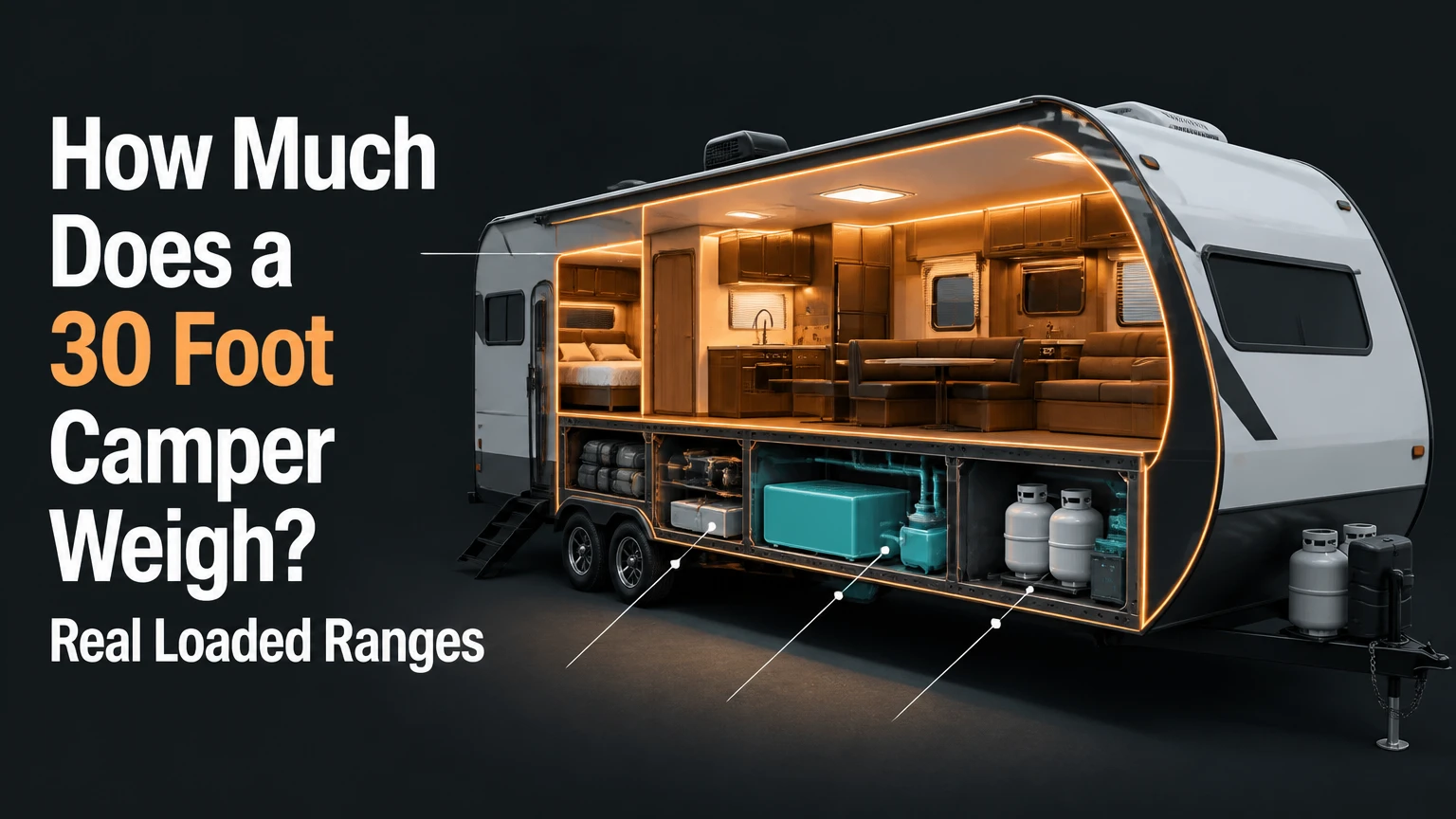
A 30-foot camper typically weighs 5,000-8,000 pounds empty and 7,000-11,000 pounds ready for travel, but the type determines the useful range. A travel trailer often reaches 7,500-9,500 pounds loaded, while a fifth wheel commonly reaches 10,000-12,500 pounds; a 30-foot motorhome can fall anywhere from 12,000 to 25,000 pounds.
Key Facts at a Glance
- A 30-foot travel trailer commonly weighs 5,200-7,200 pounds unloaded and 7,500-9,500 pounds at its loaded rating.
- A 30-foot fifth wheel commonly weighs 7,500-9,500 pounds empty and has a 10,000-12,500-pound GVWR.
- A full 50-gallon freshwater tank adds approximately 417 pounds before people, food, tools, or clothing are loaded.
- A travel trailer normally places about 10%-15% of its loaded weight on the hitch, while a fifth wheel typically places 15%-25% on the truck.
- A camper’s GVWR, axle ratings, tire ratings, and tow-vehicle payload limit matter more than its advertised dry weight.
- A CAT Scale weighing normally costs about $15-$25 and can establish actual axle, trailer, and hitch weights.
How Much Does a 30 Foot Camper Weigh?
A 30-foot camper weighs approximately 5,000-8,000 pounds empty and 7,000-11,000 pounds loaded when the term camper means a towable RV. The lower end usually describes a conventional travel trailer with modest equipment, while the upper end includes slide-outs, larger tanks, heavier construction, batteries, generators, and substantial personal cargo.
Length alone does not determine weight. A 30-foot aluminum trailer can weigh less than a shorter toy hauler, and a fifth wheel has a heavier frame and front structure than many bumper-pull trailers. Manufacturer options also change the starting figure.
“Dry weight” is not a universal shopping number. One manufacturer may include factory-installed options and exclude propane, while another may publish a base model without a battery or dealer-installed equipment. Treat the specification as a starting point, not a scale reading.
Typical Weight by 30-Foot Camper Type
| Camper type | Typical empty weight | Typical loaded weight or GVWR | Main weight variable |
|---|---|---|---|
| Conventional travel trailer | 5,200-7,200 lb | 7,500-9,500 lb | Slide-outs and cargo |
| Airstream or aluminum trailer | 6,000-6,500 lb | 7,600-8,800 lb | Aluminum shell and options |
| Fifth wheel | 7,500-9,500 lb | 10,000-12,500 lb | Pin weight and frame |
| Toy hauler trailer | 7,000-8,500 lb | 10,500-13,000 lb | Garage cargo and ramp structure |
| Class C motorhome | 12,000-16,000 lb | 14,000-20,000 lb | Chassis and onboard equipment |
| Class A motorhome | 18,000-25,000 lb | 20,000-30,000 lb | Diesel or gasoline chassis |
The first four rows describe towable campers. Class A and Class C motorhomes belong in a separate category because the engine, transmission, cab, drivetrain, and motorhome body are part of the vehicle’s weight.
What Do UVW, Dry Weight, CCC, and GVWR Mean?
UVW is the manufacturer’s stated unloaded vehicle weight, CCC is the allowable cargo capacity, and GVWR is the maximum permitted loaded weight. In practical terms, a camper’s available loading room is usually calculated as GVWR minus the actual unloaded weight, although published labels and equipment definitions must be checked carefully.
| Term | Meaning | Calculation or example | Why it matters |
|---|---|---|---|
| UVW | Unloaded Vehicle Weight | Example: 6,350 lb | Starting trailer weight |
| Dry weight | Marketing term for an unloaded configuration | Example: 6,100 lb base model | May exclude options or battery |
| CCC | Cargo Carrying Capacity | Example: 2,150 lb | Space for water, gear, people, and propane |
| GVWR | Maximum loaded vehicle weight | 8,500 lb maximum | Must never be exceeded |
| GAWR | Gross Axle Weight Rating | 4,250 lb per axle | Limits individual axles |
| Tongue weight | Load carried by a travel-trailer hitch | 900 lb on a 7,500-lb trailer | Reduces truck payload |
| Pin weight | Load carried by a fifth-wheel hitch | 1,800 lb on a 10,000-lb fifth wheel | Uses truck-bed payload |
A label may list GVWR and CCC more reliably than an online brochure. The Federal Motor Vehicle Safety Standard tire and loading label uses the warning, “The combined weight of occupants and cargo should never exceed XXX kg or XXX lbs.” That figure applies to the tow vehicle, not automatically to the trailer.
A common mistake is to add the brochure’s dry weight to the listed CCC and assume the result is exact. Factory options, propane cylinders, batteries, and dealer-installed accessories can alter the unloaded baseline before the owner adds anything.
How Does Camper Cargo Change the Loaded Weight?
A 30-foot camper can gain 1,000-1,500 pounds of personal cargo during normal travel, and water alone can add hundreds of pounds. The largest predictable additions are freshwater, propane, batteries, tools, food, clothing, outdoor equipment, and recreational vehicles carried in a toy-hauler garage.
| Added item | Typical quantity | Approximate added weight | Calculation |
|---|---|---|---|
| Freshwater | 50 gal | 417 lb | 50 × 8.34 lb |
| Propane | Two 20-lb cylinders | 74 lb full | About 37 lb each full |
| Group 27 battery | One battery | 55-75 lb | Battery plus tray |
| Lead-acid batteries | Two batteries | 110-150 lb | 55-75 lb each |
| Slide-out | One slide | 400-800 lb | Construction dependent |
| Camping cargo | Food, tools, clothing | 1,000-1,500 lb | Typical owner load |
| Portable generator | One unit | 80-150 lb | Model dependent |
| Motorcycle | One unit | 350-600 lb | Plus tie-down equipment |
| ATV | One unit | 500-900 lb | Plus fuel and accessories |
Water weight is easy to underestimate. A 30-gallon tank adds approximately 250 pounds, and a 100-gallon tank adds approximately 834 pounds. Owners traveling between full-hookup campgrounds may carry only a few gallons, while boondockers can approach the tank’s full capacity.
Cargo placement changes axle and hitch loading, not merely the total. A tool chest placed behind a travel-trailer axle can reduce tongue weight and increase sway risk, while the same tool chest near the front can increase hitch load without changing the trailer’s total weight.
Which 30-Foot Campers Are Heaviest?
Among common towable designs, toy haulers and fifth wheels are usually the heaviest 30-foot campers. Toy haulers need a reinforced garage, ramp door, tie-down structure, and suspension capacity; fifth wheels require a substantial front cap and frame around the over-bed hitch.
| Design | Typical loaded rating | Typical hitch or pin percentage | Typical tow-vehicle demand |
|---|---|---|---|
| Lightweight travel trailer | 6,500-8,000 lb | 10%-15% | 650-1,200 lb payload |
| Large travel trailer | 8,000-9,500 lb | 10%-15% | 800-1,425 lb payload |
| Fifth wheel | 10,000-12,500 lb | 15%-25% | 1,500-3,125 lb payload |
| Toy hauler | 10,500-13,000 lb | 10%-20% | 1,050-2,600 lb payload |
| Class C motorhome | 14,000-20,000 lb | Not applicable | Chassis payload and axle limits |
The advertised length can also be misleading. A “30-foot” travel trailer may measure 30 feet from hitch to rear wall, whereas a fifth wheel’s living-box length and overall length may be reported differently. Compare manufacturer dimensions and ratings rather than using length as a proxy for mass.
A 30-foot Airstream is often lighter than a similarly sized laminated travel trailer, but aluminum construction does not make every Airstream easy to tow. Its GVWR, tongue weight, aerodynamic profile, and tow-vehicle payload still determine compatibility.
How Much Hitch Weight Does a 30-Foot Camper Put on a Truck?
A 30-foot travel trailer usually places 10%-15% of its loaded weight on the hitch, while a fifth wheel usually places 15%-25% on the truck’s fifth-wheel pin. A 9,000-pound travel trailer may therefore impose 900-1,350 pounds on the receiver, while a 12,000-pound fifth wheel may impose 1,800-3,000 pounds in the truck bed.
These percentages are setup targets, not substitutes for weighing. Actual distribution changes with water level, cargo placement, propane, bicycles, generators, and the location of the trailer axles. Manufacturer guidance and a properly configured hitch take priority over a generic percentage.
The truck must carry more than the hitch load. Payload also includes the driver, passengers, pets, toolboxes, tonneau equipment, weight-distribution hitch, fifth-wheel hitch, and cargo in the bed. A truck with 2,000 pounds of available payload and a 1,300-pound trailer tongue leaves only 700 pounds for all of those occupants and accessories.
Why Tow Rating Alone Is Not Enough
Tow rating describes the maximum trailer weight under specified conditions, but payload rating controls whether the truck can carry the hitch load and occupants. A half-ton truck may advertise a 12,000-pound maximum tow rating yet have only 1,700 pounds of actual door-sticker payload after options.
For example, consider a travel trailer with a loaded weight of 8,500 pounds and a 13% tongue weight. The hitch carries about 1,105 pounds. Add a 120-pound weight-distribution hitch, two 180-pound adults, a 70-pound dog, and 150 pounds of bed cargo, and the truck carries 1,625 pounds before any extra passengers.
That calculation leaves little margin on a 1,700-pound payload sticker. A 3/4-ton or 1-ton truck may provide a safer margin, but the exact answer still depends on its door label, axle ratings, tires, hitch, engine, cab, and factory configuration.
What Truck Can Tow a 30-Foot Camper?
A properly equipped half-ton can sometimes tow a lightweight 30-foot travel trailer, but many large travel trailers require a 3/4-ton truck for payload margin. A 30-foot fifth wheel generally needs a heavy-duty 3/4-ton or 1-ton pickup, and a 30-foot toy hauler often requires a 1-ton truck when the garage is loaded.
Use the following matching sequence before comparing truck badges:
- Find the camper’s actual GVWR and published hitch or pin-weight rating.
- Estimate the loaded trailer weight, including water, propane, batteries, and cargo.
- Calculate expected tongue or pin weight from the loaded estimate.
- Read the tow vehicle’s yellow certification label for actual available payload.
- Subtract occupants, pets, hitch hardware, bed cargo, and accessories.
- Verify the truck’s maximum conventional or fifth-wheel rating, receiver rating, axle ratings, and tire capacity.
- Weigh the combination after loading it for a real trip.
The correct result is not “the truck can pull the camper.” The correct result is that every applicable rating remains within its limit, with adequate braking, cooling, suspension, and handling reserve.
Travel Trailer or Fifth Wheel: Which 30-Foot Camper Fits Better?
A travel trailer is usually less expensive and compatible with more tow vehicles, while a fifth wheel normally offers better directional stability and a larger interior for the same approximate living length. A fifth wheel also transfers a substantial percentage of its weight into the truck bed, so its higher stability comes with a greater payload requirement.
| Decision factor | Travel trailer | Fifth wheel | Practical consequence |
|---|---|---|---|
| Typical loaded weight | 7,500-9,500 lb | 10,000-12,500 lb | Fifth wheel needs more truck |
| Hitch location | Rear receiver | Truck bed | Different payload distribution |
| Typical hitch load | 10%-15% | 15%-25% | Fifth wheel uses more truck payload |
| Stability | Sensitive to setup and wind | Generally more stable | Fifth wheel suits long-distance towing |
| Turning radius | Wider trailer swing | Tighter articulation | Fifth wheel needs bed clearance |
| Truck requirement | Half-ton to 3/4-ton | 3/4-ton to 1-ton | Verify actual payload |
| Typical new price | $35,000-$65,000 | $55,000-$90,000 | Fifth wheel costs more typically |
“Zero sway” is an inaccurate description of fifth-wheel towing. A fifth wheel can yaw, roll, or become unstable if overloaded, improperly loaded, affected by tire failure, or driven too fast. Its hitch geometry reduces common trailer-sway behavior, but it does not eliminate the need for speed control, tire maintenance, and correct loading.
A weight-distribution hitch with integrated sway control is commonly used for heavier travel trailers when the truck and receiver manufacturer permit it. It cannot compensate for an overloaded truck, underinflated tires, poor trailer balance, or a trailer that exceeds its ratings.
How Do You Weigh a 30-Foot Camper Accurately?
A CAT Scale can establish a 30-foot camper’s actual loaded weight in about 15-30 minutes, usually for approximately $15-$25. Weigh the fully equipped combination, then weigh the truck alone with the same occupants and cargo; the difference identifies the load carried by the truck, and the trailer axle reading helps determine total trailer weight.
CAT Scale Procedure
- Load the camper for travel. Add normal water, propane, batteries, food, clothing, tools, pets, and recreational equipment.
- Weigh the combination. Position the truck’s front axle on one platform, rear axle on another, and trailer axles on the third platform.
- Record each axle reading. Keep the printed ticket or digital report.
- Weigh the truck alone. Disconnect the trailer and return with the same passengers, fuel, hitch equipment, and bed cargo.
- Calculate truck-carried trailer weight. Subtract the truck-only weight from the combined truck weight.
- Calculate trailer weight. Add the resulting tongue or pin weight to the trailer-axle weight from the combination weighing.
- Compare every value. Check total weight against GVWR, truck axle weights against GAWR, and tire loads against tire capacity.
The exact subtraction depends on the scale’s displayed categories. For a conventional trailer, truck axle weight increases by roughly the tongue weight. For a fifth wheel, the increase appears through the pickup’s rear axle and total truck weight.
Weighing only the trailer axles is incomplete. A trailer can remain below its axle rating while imposing too much tongue weight on the tow vehicle, and a truck can remain within its total payload while exceeding a rear-axle or tire limit.
What Happens When a 30-Foot Camper Is Overloaded?
An overloaded 30-foot camper can exceed its tires, axles, brakes, suspension, or frame before the driver notices a problem. Excess weight also lengthens stopping distance, increases sway or poor tracking, raises tire temperature, and reduces the tow vehicle’s ability to control the combination during emergency maneuvers.
Watch for these failure patterns:
- Rear-end sag: Excess tongue or pin weight compresses the rear suspension and reduces front-axle loading.
- Trailer sway: Low tongue percentage, crosswinds, abrupt steering, or worn tires can initiate oscillation.
- Hot tires: Overloaded or underinflated tires generate heat and may fail at highway speed.
- Brake fade: Heavy loads produce more heat on descents, especially when trailer brakes are poorly adjusted.
- Poor acceleration: A gasoline truck near its combined rating may struggle on grades or in headwinds.
- Axle overload: The total camper may appear acceptable while one axle exceeds its GAWR.
- Clearance loss: Sag can reduce receiver, jack, tailpipe, and rear-bumper clearance.
The immediate correction for sway is to reduce speed smoothly without abrupt steering or braking, then inspect loading and tire pressure. Do not move heavy cargo rearward to solve a sagging rear suspension, because rearward cargo often reduces tongue weight and worsens sway.
Expert Loading Rules
Keep dense cargo low and close to the camper’s axle group unless the manufacturer specifies another location. Place enough weight forward to maintain the recommended hitch percentage, but never use cargo placement to exceed the tongue-weight limit.
Inflate tires to the pressure specified for the actual load and confirm the tire’s load range. The maximum pressure molded into the sidewall is not always the correct operating pressure when the vehicle manufacturer specifies a lower value.
Leave a reserve instead of treating the GVWR as a target. A practical 5%-10% margin can accommodate measurement variation and unexpected cargo, although the legal limit remains the published rating.
Which 30-Foot Camper Is Best for Different Uses?
A lightweight travel trailer is usually the most practical choice for weekend campers, a fifth wheel is better suited to long-distance touring with a compatible heavy-duty truck, and a toy hauler fits owners who transport motorcycles, ATVs, or bulky equipment. The best category changes with payload, storage, campsite access, and how much cargo travels onboard.
| User situation | Suitable category | Typical loaded weight | Minimum planning priority |
|---|---|---|---|
| Weekend trips, two adults | Lightweight travel trailer | 6,500-8,000 lb | Half-ton payload margin |
| Full-time living | Fifth wheel | 10,000-12,500 lb | Rear axle and pin capacity |
| Motorcycle transport | Toy hauler | 10,500-13,000 lb | Garage cargo and pin change |
| Frequent mountain travel | Travel trailer or fifth wheel | 8,000-12,500 lb | Brakes, cooling, gearing |
| Family camping with gear | Large travel trailer | 8,000-9,500 lb | CCC and tongue weight |
| Self-contained motorhome travel | Class C motorhome | 14,000-20,000 lb | Chassis GVWR and CCC |
A lightweight fiberglass trailer may reduce the tow-vehicle requirement, but its lower dry weight does not guarantee a low loaded tongue weight. A family carrying full water, bicycles, a generator, and outdoor furniture can erase much of the advertised advantage.
Toy hauler pin or tongue loading can change substantially between an empty garage and a garage carrying an ATV. Weigh the configuration used for travel, not the empty showroom configuration.
What Should You Check on a Camper Weight Label?
Check GVWR, UVW, CCC, GAWR, tire size, tire load range, and the manufacturer’s actual hitch-weight specification before buying a 30-foot camper. The most useful label is the one attached to the specific unit, because brochures may describe a base model that differs from the stocked camper at a dealership.
Confirm these details:
- Unit-specific UVW: Include installed options, air conditioners, awnings, slide-outs, and appliances.
- GVWR: Confirm the maximum permitted loaded camper weight.
- CCC: Check whether water, propane, and personal cargo are included in the calculation.
- Axle ratings: Compare each axle’s rating with measured axle weight.
- Tire ratings: Verify load capacity at the intended cold inflation pressure.
- Hitch rating: Match receiver, ball mount, coupler, and weight-distribution components.
- Truck payload: Use the door-jamb certification label, not a generic online maximum.
- Combined rating: Check the tow vehicle’s GCWR when the manufacturer provides one.
A dealer’s statement that a truck “pulls it fine” is not a weight certification. Ask for the actual label, calculate the loaded condition, and obtain a scale ticket after purchase.
FAQ About 30-Foot Camper Weight
Can a 1500-Series Truck Tow a 30-Foot Camper?
A 1500-series truck can tow some lightweight 30-foot travel trailers, but payload often becomes the limiting factor before engine tow rating. Check the truck’s door-sticker payload, subtract passengers and hitch equipment, then reserve capacity for the trailer’s loaded tongue weight. A 30-foot fifth wheel generally exceeds the practical payload of many half-ton trucks.
How Much Does a 30-Foot Camper Weigh With Water?
A 30-foot camper gains approximately 8.34 pounds for every gallon of freshwater. A 50-gallon tank adds about 417 pounds, while a 100-gallon tank adds about 834 pounds. Black and gray tank contents also add weight, but those tanks are normally empty or partially empty during towing unless the camping situation requires otherwise.
Is a 30-Foot Camper Hard to Tow?
A 30-foot camper requires more careful setup than a shorter trailer because its length increases wind exposure, turning swing, backing difficulty, and sensitivity to loading errors. A properly matched truck, correctly adjusted brakes, suitable tires, and a weight-distribution hitch with sway control can make a travel trailer manageable, but equipment cannot legalize an overloaded combination.
Does a Slide-Out Add Weight to a Camper?
A slide-out typically adds about 400-800 pounds, depending on its width, mechanism, flooring, furniture, and construction. Multiple slide-outs can add more than 1,000 pounds before personal cargo is loaded. Slide-outs also change how weight is distributed across the camper, so the unit-specific UVW and CAT-scale result matter more than a category average.
Should I Tow With a Full Freshwater Tank?
Tow with a full freshwater tank only when the destination, manufacturer guidance, and ratings justify it. The tank can add 417 pounds at 50 gallons, which may consume a large share of CCC and increase tongue or axle load. Many campers can travel with a partial tank and fill near the campsite, reducing weight and fuel consumption.
The Bottom Line
How much does a 30 foot camper weigh? A towable model usually weighs 5,000-8,000 pounds empty and 7,000-11,000 pounds loaded, but a fifth wheel or toy hauler can exceed 12,000 pounds, while a motorhome may weigh twice as much. Use the specific camper’s GVWR, truck payload, axle ratings, tire limits, and CAT-scale measurements before towing.