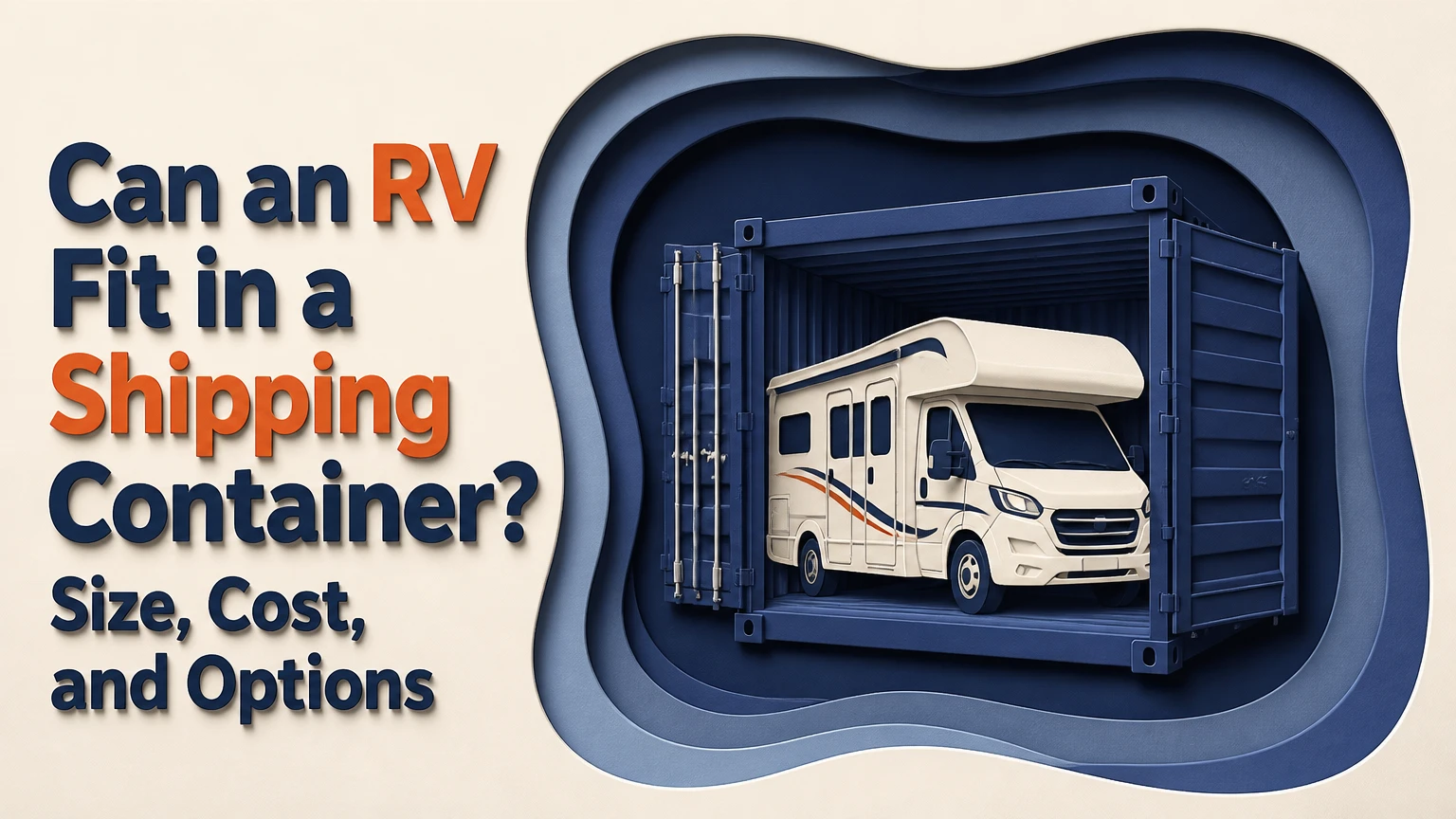
An RV can fit in a shipping container only when its loaded height, width, length, and weight clear the container door and internal limits. Small teardrop trailers, pop-up campers, and some low-roof campervans may fit, while most Class A, Class C, and full-height travel trailers are too tall or wide for a standard container.
Key Facts at a Glance
- A 40-foot high-cube container typically has an internal height near 8 feet 10 inches, but its door opening is usually about 8 feet 5 inches high.
- The RV must clear the door opening, not merely the container’s advertised interior dimensions.
- A 40-foot container typically provides about 39 feet 5 inches of internal length, enough for most small trailers and vans.
- Standard container width is about 7 feet 8 inches inside, leaving little practical tolerance for mirrors, awnings, body flex, or angled loading.
- Most Class A motorhomes and many Class C motorhomes require RoRo, flat-rack, or breakbulk transport instead.
- Container shipping commonly costs about $2,500-$9,000 before route-specific taxes, port charges, customs, and inland trucking.
What Determines Whether an RV Fits?
The decisive test is a four-way dimensional comparison: RV loaded height against door height, RV loaded width against door width, RV length against internal length, and RV shipping weight against the container and handling equipment limits. The smallest clearance usually controls the decision.
Measure the RV in its actual transport condition. Include the tallest roof appliance, antenna, solar-panel hardware, air-conditioner shroud, roof rack, ladder, spare tire, fender flare, mirrors, and awning hardware. Measure with the suspension at normal transport height and with the tires inflated to the manufacturer’s approved rolling pressure.
A container’s door dimensions are more restrictive than its internal dimensions. For example, a high-cube container may have approximately 8 feet 10 inches of internal height while the door opening measures approximately 8 feet 5 inches. The door header can therefore stop an RV that appears to fit on paper.
Practical clearance rules
Container manufacturers publish nominal dimensions, not a guaranteed loading envelope. Floor irregularities, door seals, corner posts, ramp height, and the RV’s approach angle consume space during loading.
Use these planning rules:
- Leave at least 2 inches of measured clearance where the freight forwarder and loading contractor approve that tolerance.
- Use more clearance when the RV enters under its own suspension, because tire deflection and steering corrections change the vehicle’s envelope.
- Treat any fit with less than 1 inch of clearance as a specialist loading project, not a routine booking.
- Confirm dimensions from the specific container, because age, manufacturer, door hardware, and floor repairs alter usable space.
- Ask the loader to verify the ramp transition before transport. A vehicle can clear the header while its rear overhang contacts the floor or ramp.
Which Container Dimensions Matter Most?
The container door opening is the first constraint, internal width is usually the second, and internal length is the least difficult constraint for a small RV. A 40-foot high-cube container generally offers the best chance because it adds roughly 1 foot of internal height over a standard container.
| Container type | Internal length | Internal width | Internal height | Typical door opening |
|---|---|---|---|---|
| 20-foot standard | 19 ft 4 in | 7 ft 8 in | 7 ft 10 in | 7 ft 8 in wide x 7 ft 5 in high |
| 40-foot standard | 39 ft 5 in | 7 ft 8 in | 7 ft 10 in | 7 ft 8 in wide x 7 ft 5 in high |
| 40-foot high cube | 39 ft 5 in | 7 ft 8 in | 8 ft 10 in | 7 ft 8 in wide x 8 ft 5 in high |
| 45-foot high cube | 44 ft 5 in | 7 ft 8 in | 8 ft 10 in | 7 ft 8 in wide x 8 ft 5 in high |
The figures are typical nominal dimensions. A freight forwarder must confirm the exact container’s certified dimensions, maximum cargo weight, floor condition, and loading method before booking.
Width deserves special attention. A vehicle listed as 7 feet 6 inches wide may have only 2 inches per side before accounting for mirrors, sidewall bulge, wheel movement, and the container’s vertical corner posts. Removing mirrors can help, but it does not make an oversized body compliant.
Which RV Types Usually Fit?
Small towables and low-profile campervans have the highest probability of fitting a 40-foot high-cube container. Full-height motorhomes, fifth wheels, and most conventional travel trailers usually exceed the door height, door width, or both.
| RV type | Typical exterior height | Typical exterior width | Container likelihood | Main limitation |
|---|---|---|---|---|
| Teardrop trailer | 5 ft 6 in-7 ft | 6 ft 6 in-7 ft | High | Confirm roof vent and fender width |
| Pop-up camper | 4 ft 6 in-6 ft closed | 6 ft 6 in-7 ft 4 in | High | Closed travel height must be verified |
| Small fiberglass trailer | 7 ft-8 ft | 6 ft 8 in-7 ft 6 in | Possible | Door clearance may be under 1 inch |
| Low-roof campervan | 7 ft-8 ft 6 in | 6 ft 6 in-7 ft 2 in | Possible | Roof equipment and mirrors |
| High-roof campervan | 8 ft 6 in-10 ft | 6 ft 8 in-7 ft 4 in | Uncommon | Door header and roof air conditioner |
| Class C motorhome | 10 ft-12 ft | 8 ft-8 ft 6 in | Very unlikely | Excessive height and width |
| Class A motorhome | 11 ft-13 ft 6 in | 8 ft 4 in-8 ft 6 in | No | Exceeds container envelope |
| Fifth-wheel trailer | 12 ft-13 ft 6 in | 8 ft-8 ft 6 in | No | Height, pin box, and width |
These are typical ranges, not model-specific approvals. A low-profile Class B conversion can fit where a factory high-roof van cannot, while a small fiberglass trailer can fail because its air conditioner adds 6-10 inches.
A 20-foot container is usually suitable only for very short teardrops, compact motorcycles, or disassembled campers. Its usable length of roughly 19 feet 4 inches excludes many trailers once the loading ramp and tie-down arrangement are considered.
Can Height Be Reduced Safely?
RV height can sometimes be reduced by removing approved accessories, lowering air suspension, or using a specialist transport method, but tire deflation and substitute wheels are not universal solutions. The vehicle must remain stable, steerable, and structurally supported throughout loading and unloading.
Remove only equipment that the manufacturer or qualified technician identifies as transport-removable. Common candidates include detachable antennas, solar-panel brackets, roof racks, awning arms, mirrors, and removable air-conditioner shrouds. Removing an entire roof air conditioner may require refrigerant recovery, electrical isolation, weatherproofing, and professional reinstallation.
Do not deflate tires below the manufacturer’s minimum rolling pressure merely to gain clearance. A tire with inadequate pressure can unseat, damage its sidewall, or shift under winch loads. Temporary transport wheels or “dolly” wheels require a rated axle system, correct hub fitment, adequate brake clearance, and written approval from the loading contractor.
Suspension compression is another hidden risk. A motorhome may enter the container with its roof clear, then rise when the winch tension changes or the tires cross the container floor lip. Measure the highest point at the exact suspension position used for loading.
How Is an RV Loaded and Secured?
A containerized RV is normally loaded with a winch, controlled steering, wheel chocks, and chassis-level restraints rather than driven deep into the container. Loading requires a level approach, a rated ramp or dock, trained spotters, and a written plan for removing the RV at the destination.
Step 1: Verify the vehicle and container measurements
Record length, maximum width, maximum height, gross vehicle weight, axle weights, wheelbase, ground clearance, and rear overhang. Photograph the measuring points and send the dimensional sheet to the freight forwarder.
Checkpoint: The forwarder confirms the actual door opening and accepts the measurement sheet in writing.
Common mistake: Measuring the manufacturer’s “shipping height” while leaving a roof appliance, antenna, or suspension component installed.
Step 2: Confirm container payload and floor condition
A container may have a high rated maximum payload, but the port chassis, crane, road route, and loading equipment can impose lower limits. Check the floor for damaged boards, protruding fasteners, contamination, and weak areas before placing an RV inside.
Checkpoint: The container number, tare weight, maximum gross weight, and floor condition are documented.
Common mistake: Assuming a 40-foot container can accept any RV that fits physically.
Step 3: Prepare the RV for international transport
Drain fresh, grey, and black tanks completely, disconnect propane cylinders, secure loose interior objects, and remove food, plants, firearms, hazardous materials, and undeclared goods. Fuel limits vary by carrier, port, insurer, and destination, so obtain the written requirement instead of assuming that one-quarter of a tank is always acceptable.
Checkpoint: Tanks are empty, propane is removed, and the forwarder provides dangerous-goods instructions.
Common mistake: Leaving wastewater, pressurized cylinders, or aerosol products inside the vehicle.
Step 4: Remove approved protruding equipment
Fold or remove mirrors, awning arms, antennas, ladders, and other vulnerable items if the clearance plan requires it. Label fasteners, photograph wiring, and protect exposed mounting holes with temporary weatherproof covers.
Checkpoint: The measured transport envelope matches the container plan.
Common mistake: Removing a component without planning how it will be protected, stored, or reinstalled at destination.
Step 5: Align the loading equipment
Position the container square to the ramp or dock. A side-to-side angle can make a vehicle that is technically narrow contact the door posts, while a steep ramp can reduce underside clearance.
Checkpoint: The approach is centered, level enough for controlled winching, and free of overhead obstructions.
Common mistake: Using a short ramp that creates a sharp breakover angle at the container threshold.
Step 6: Winch the RV into position
Use a winch and attachment points rated for the load. Guide the wheels with spotters who remain outside pinch points, and keep the steering centered unless the loading plan specifies a correction.
Checkpoint: The RV passes the door without contact and reaches the planned axle position.
Common mistake: Driving inside and discovering that there is no safe room to open the door or exit the cab.
Step 7: Chock every wheel
Use purpose-rated chocks or properly sized timber blocking at the front and rear of each wheel. Blocking must resist longitudinal movement without relying on fragile interior trim or unsecured loose wood.
Checkpoint: The vehicle cannot roll when winch tension is released.
Common mistake: Chocking only the front axle or placing blocks against the tire sidewall at an unsafe angle.
Step 8: Lash the chassis or approved axle points
Use restraints rated for the calculated load and attach them to manufacturer-approved chassis or axle points. Container lashing rings are designed for cargo restraint, but their permitted working load depends on the container and ring condition, so the loading contractor must select the pattern.
Checkpoint: Restraints prevent forward, rearward, and lateral movement without crushing brake lines, suspension components, or body panels.
Common mistake: Hooking straps to a bumper, tow ball, stabilizer jack, or thin body bracket.
Step 9: Isolate electrical and movable systems
Disconnect chassis and house batteries when required by the carrier. Close windows, lock cabinets, secure slide-outs, retract steps, release refrigerator contents, and protect glass from loose equipment.
Checkpoint: No movable component can deploy or strike the container during handling.
Common mistake: Leaving slide-outs extended because the RV was measured in camping configuration.
Step 10: Photograph and seal the shipment
Photograph all four sides, the roof, odometer, fuel level, battery connections, tie-downs, chocks, and container seal. Record the seal number on the bill of lading and retain copies for the insurer and customs broker.
Checkpoint: The condition and restraint arrangement are independently documented.
Common mistake: Treating a sealed container as proof that the cargo was loaded correctly.
What Does Containerized RV Shipping Cost?
Typical containerized RV shipping costs range from $2,500-$4,500 on shorter domestic or territorial routes and from $4,500-$9,000 or more internationally. The quoted ocean freight is rarely the complete cost because loading, drayage, customs, inspections, insurance, and destination delivery may be separate.
| Shipping scenario | Typical transport range | Typical transit time | Common extra charges |
|---|---|---|---|
| Mainland USA to Hawaii | $2,500-$4,500 | 10-21 days | Loading, port handling, inland delivery |
| Mainland USA to Puerto Rico | $2,500-$4,500 | 7-18 days | Documentation, terminal fees, customs |
| North America to Europe | $4,500-$9,000+ | 10-20 ocean days | Drayage, VAT, destination handling |
| North America to Australia | $5,000-$10,000+ | 20-40 ocean days | Quarantine, inspection, port delivery |
| Shared container for a small trailer | $2,000-$6,000 | 2-6 weeks total | Consolidation and stripping fees |
These ranges are typical planning figures, not tariff quotes. A destination with limited container equipment can cost more than a longer ocean route, and a non-running RV can add forklift, winch, or crane charges.
Request an itemized estimate covering origin pickup, container booking, stuffing, port fees, ocean freight, customs documentation, destination unloading, storage, and final delivery. Ask whether cargo insurance covers the RV itself, personal property, roof equipment, and damage caused during loading.
How Long Does Transport Take?
A transatlantic sailing commonly takes 10-20 days on the water, while a transpacific sailing commonly takes 20-40 days. Door-to-door delivery usually takes longer because origin preparation, port receiving, customs clearance, inspections, and destination trucking can add 7-14 days or more.
Sailing time is not the same as total possession time. Port congestion, missed cutoffs, container availability, customs holds, quarantine inspections, and weather can extend the schedule. A forwarder should provide both the estimated sailing duration and the cargo cutoff date.
Is Container Shipping Better Than RoRo?
Container shipping is better for a small RV that fits securely and needs weather protection, while RoRo is usually better for a large motorhome that cannot enter a container. RoRo means Roll-on/Roll-off, and the vehicle is driven or towed onto a vessel’s vehicle deck rather than enclosed in a box.
| Decision factor | Container shipping | RoRo shipping | Practical winner |
|---|---|---|---|
| Maximum RV size | Usually under 8 ft 5 in high and 7 ft 8 in wide | Handles most road-legal RV sizes | RoRo for large RVs |
| Weather exposure | Enclosed steel container | Vehicle deck exposure varies | Container |
| Personal cargo | Often restricted by carrier and customs | Usually prohibited | Container, if approved |
| Loading method | Winch, ramp, chocks, lashing | Drive-on or tow-on | RoRo |
| Port availability | Broad container network | Specialized vehicle ports | Container |
| Handling complexity | High stuffing and stripping work | Lower vehicle loading complexity | RoRo |
| Damage and theft profile | Locked enclosure, fewer touches after sealing | More vehicle handling and open access | Depends on insurance |
| Typical price | $2,500-$9,000+ | Route and vehicle-size dependent | Quote required |
RoRo is not automatically less safe. A professional carrier secures vehicles on a vessel deck, while an improvised container loading job can damage suspension, tires, doors, or roof equipment. Compare the carrier’s insurance, port procedures, prohibited cargo policy, and claims process rather than choosing by method name alone.
What Cargo, Customs, and Insurance Rules Apply?
Personal belongings inside an RV are permitted only when the carrier, customs authority, and insurer approve them in writing. Many vehicle carriers require the RV to be empty, and customs agencies can inspect or reject undeclared goods even when the container is sealed.
Create a detailed inventory with photographs, serial numbers, and estimated values. Do not pack lithium batteries, fuel containers, propane cylinders, firearms, food, plants, chemicals, or pressurized equipment unless the forwarder confirms the applicable dangerous-goods process.
Insurance requires equal care. A standard marine cargo policy may exclude personal effects, mechanical failure, pre-existing damage, inadequate preparation, or loss caused by owner-loaded cargo. Ask whether the policy covers loading damage, water intrusion, theft, total loss, and the declared replacement value.
What Are the Common Failure Points?
The most common failures occur before sailing, especially when the owner measures the RV’s body instead of its highest installed equipment or checks internal container height instead of door height. A second recurring failure is inadequate ramp geometry, which can make the rear of a long vehicle strike the container floor.
The roof clears the interior but hits the header
Back the RV out under controlled winch tension. Do not force the vehicle forward, raise the roof against the steel header, or remove container door seals without the loader’s approval. Recheck the highest point, approach angle, and suspension position.
The body is too wide at the door posts
Remove only approved exterior equipment and remeasure the widest fixed body point. If the body itself exceeds the opening, a different container cannot solve the problem because standard containers generally share similar widths.
The rear overhang contacts the floor
Change the ramp angle or use a dock-height loading arrangement. Do not lift an occupied RV by vulnerable body panels, stabilizer jacks, or the bumper.
The RV moves after the winch is released
Stop unloading or vessel handling and inspect the chocks, restraint angles, anchor points, and floor condition. Replace damaged restraints and use a documented lashing plan before movement continues.
Customs rejects the shipment
The usual causes include undeclared goods, residual liquids, propane, batteries, contaminated undercarriages, or inaccurate vehicle documents. Work through the customs broker rather than attempting to open or alter the sealed container independently.
What If the RV Is Too Large for a Container?
An oversized RV should usually move by RoRo, flat-rack container, or breakbulk service instead of being forced into a standard box. Flat-rack service can accept cargo wider or taller than a closed container, but the RV remains exposed and may require special permits, crane handling, and weather protection.
| Alternative | Suitable RV | Loading method | Main trade-off |
|---|---|---|---|
| RoRo vessel | Class A, Class C, large trailers | Drive or tow onto vehicle deck | Less enclosed protection |
| Flat rack | Oversize campervan or trailer | Crane, ramp, or specialized equipment | Higher handling and exposure |
| Breakbulk cargo | Very large or non-running RV | Crane or project cargo gear | Highest planning complexity |
| Land transport to another port | Any road-legal RV | Heavy-haul truck | Adds permits and inland mileage |
| Sell and replace locally | High-cost or restricted shipment | No international vehicle movement | Loss of familiar vehicle and equipment |
RoRo is usually the most practical overseas choice for a running Class A or Class C motorhome. Flat-rack or breakbulk transport becomes more relevant when the RV is non-running, exceptionally wide, or being shipped with specialized equipment.
Which RV Owners Should Choose Container Shipping?
A small-trailer owner should choose container shipping when the trailer’s measured height and width clear the actual door with documented tolerance and the shipment needs enclosed protection. A low-roof campervan owner may also benefit, but roof equipment often changes the answer by several inches.
Choose a container when:
- The RV is a teardrop, pop-up, or low-profile fiberglass trailer.
- The transport height is below approximately 8 feet 3 inches for a high-cube door, subject to confirmed dimensions.
- The body width is comfortably below 7 feet 8 inches.
- The RV and approved cargo fit within the container payload.
- The carrier permits the intended personal property.
- The origin and destination have suitable stuffing and stripping contractors.
Choose RoRo when:
- The RV exceeds the container door height or width.
- The vehicle is a Class A or typical Class C motorhome.
- Removing equipment would compromise the vehicle or void safety requirements.
- The RV must remain operational with its normal wheels and suspension.
- A specialist vehicle port serves the route more reliably than a container port.
Measurement Worksheet Before You Request Quotes
Record these values in inches, then send the worksheet and photographs to at least two freight forwarders:
| Measurement or document | Your value | Why the carrier needs it |
|---|---|---|
| Maximum loaded height | ______ in | Door-header clearance |
| Maximum body width | ______ in | Door-post and side clearance |
| Overall length | ______ in | Container floor position |
| Gross vehicle weight | ______ lb | Payload and equipment selection |
| Front axle weight | ______ lb | Floor and restraint planning |
| Rear axle weight | ______ lb | Floor and restraint planning |
| Roof equipment removed | Yes/No | Confirms transport envelope |
| Propane disconnected | Yes/No | Dangerous-goods compliance |
| Tanks drained | Yes/No | Customs and leakage control |
| Battery disconnected | Yes/No | Carrier and fire-safety requirements |
The carrier should return the exact container dimensions, permitted clearance, loading plan, restraint method, cargo policy, insurance terms, and a complete charge sheet. A verbal “it should fit” is not a dimensional approval.
FAQ
Can a regular car fit in the same container as a small RV?
A regular car may fit beside a small RV only when the combined length, width, height, axle loads, and lashing space remain within the container plan. A 40-foot container has roughly 39 feet 5 inches of internal length, but two vehicles need clearance and separate restraints, so shared loading requires a professional stuffing calculation.
Can I ship an RV with the propane tanks attached?
Most carriers require propane cylinders to be disconnected and removed before ocean transport. Rules vary by vessel operator, port, and destination, and a cylinder that appears empty can still contain residual gas. Obtain written dangerous-goods instructions and keep the cylinders out of the container unless the carrier approves them.
Can I drive the RV into the container myself?
Driving an RV into a container is generally unsafe because the driver may have no safe exit once the vehicle passes the door. Professional loaders commonly use a winch, external spotters, controlled steering, and a ramp or dock designed for the vehicle’s weight and approach angle.
Does a high-cube container fit a Sprinter campervan?
A high-roof Sprinter campervan may fit only after measuring its roof equipment, mirrors, suspension height, and body width against the specific container door. The van’s roof may be near the 8-foot-5-inch nominal high-cube opening before an air conditioner, fan, rack, or solar hardware is counted.
Is a 40-foot container always better than a 20-foot container?
A 40-foot container provides substantially more length, but both standard and high-cube containers generally have similar internal widths. The 40-foot option helps a long trailer or campervan, yet it cannot solve a vehicle that is too tall or too wide for the door.
Does container shipping protect an RV from all damage?
A sealed container reduces exposure to rain, salt spray, theft, and handling by other vehicles, but it does not eliminate loading damage, condensation, shifting cargo, vibration, or customs inspection. Correct chocking, chassis restraint, moisture control, insurance, and photographic documentation remain necessary.
The Bottom Line
Can an RV fit in a shipping container? Yes, when the RV’s loaded dimensions clear the actual container door and the loading contractor approves the weight, ramp, and restraint plan. Small trailers and selected low-profile campervans are realistic candidates; most Class A, Class C, fifth-wheel, and full-height travel trailers are not. Measure the highest and widest points, verify a specific 40-foot high-cube container, obtain written loading approval, and compare RoRo before booking.