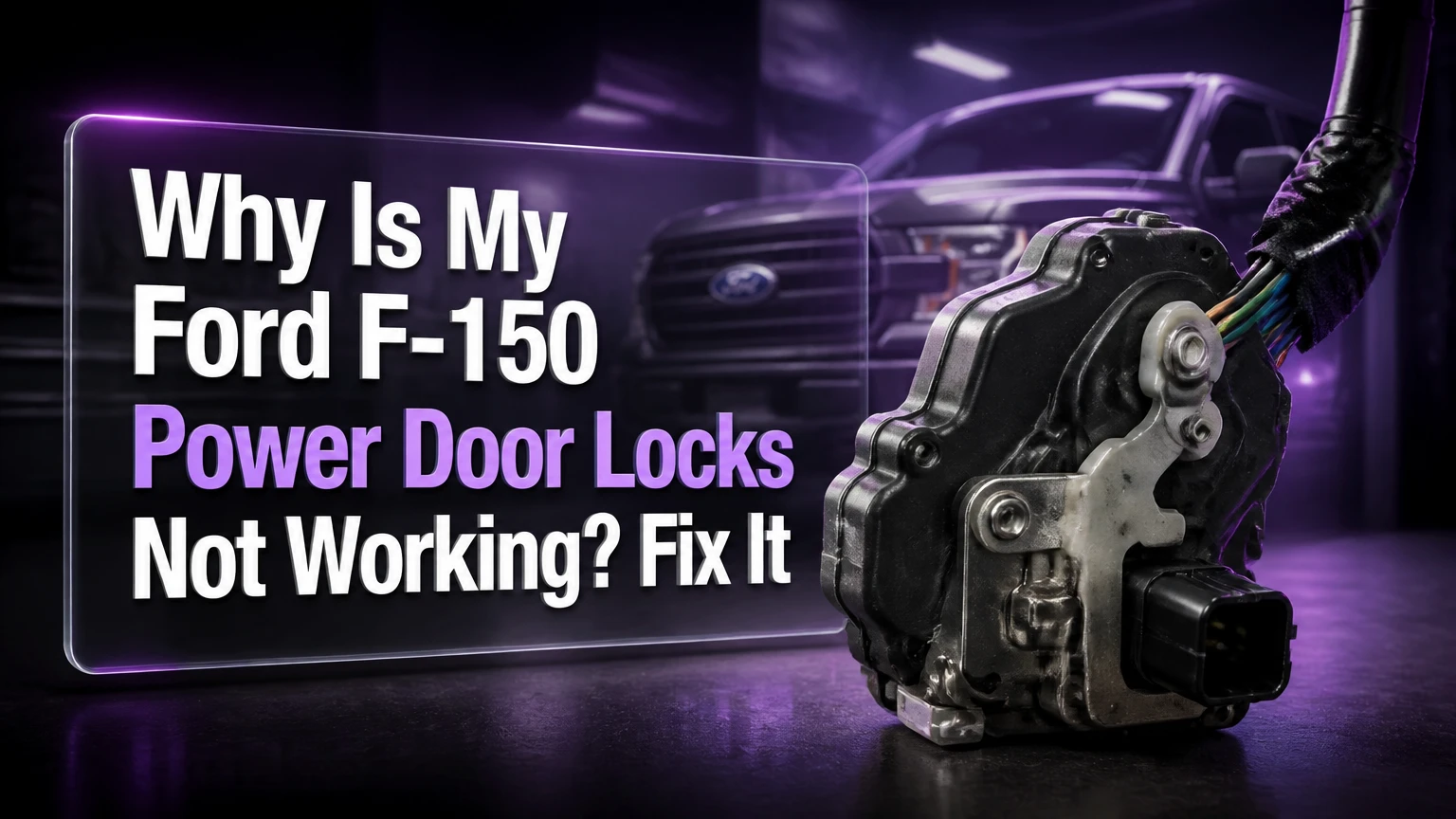
Ford F-150 power door locks usually stop working because of a failed fuse, weak vehicle or key-fob battery, broken door-jamb wiring, a defective lock actuator, or a control-module fault. The failure pattern identifies the likely area: one dead door points toward its actuator or wiring, while every door failing together points toward shared power, communication, or control components.
Key Facts at a Glance
- A single F-150 door that clicks but does not move usually has a worn actuator or restricted latch.
- All F-150 doors failing simultaneously require a fuse, battery, ground, network, or BCM diagnosis before parts are replaced.
- A door-boot wire can break inside its insulation, so a visual inspection alone cannot clear the harness.
- A door-lock actuator receives a brief, polarity-reversing electrical pulse rather than constant 12-volt power.
- Fuse locations and fuse assignments vary by F-150 model year, cab configuration, and trim level; the owner’s manual is the authority.
- Typical professional repair costs range from about $20 for a fuse to $650 or more for a programmed body control module.
What Does the Failure Pattern Tell You?
The number of affected doors is the fastest diagnostic split. Ford F-150 power locks use shared body electronics, but each door also has its own actuator, connector, latch mechanism, and portions of the wiring harness.
| Symptom pattern | Most likely area | First test | Typical repair |
|---|---|---|---|
| One door fails, other doors work | Actuator, connector, latch, or door wiring | Operate switch while listening at that door | $150-$450 actuator or wiring repair |
| All doors fail at once | Fuse, battery, ground, BCM, or network | Test vehicle voltage and lock-related fuse | $20-$650 depending on cause |
| Locks work only with door open | Broken flexing wire in door boot | Move door while operating lock | $100-$350 harness repair |
| Remote fails, switches work | Key-fob battery or remote issue | Test second programmed fob | $3-$250 remote repair |
| Switches fail, remote works | Master switch or switch circuit | Compare remote and interior controls | $100-$300 switch repair |
| Lock clicks but remains stationary | Actuator gear or mechanical latch | Check for voltage pulse and binding | $150-$450 actuator or latch |
A failed actuator is more probable when only one door is affected. A shared electrical fault becomes more probable when the front and rear doors fail together, especially if the interior lights, horn, windows, or remote functions also behave abnormally.
Why Does Only One Door Fail?
One failed door usually indicates a local fault rather than a BCM failure. The actuator may receive power but lack enough mechanical force because its motor is worn, its plastic reduction gears are stripped, or the latch is contaminated or mechanically seized.
Door wiring deserves equal attention on older or heavily used trucks. The harness bends every time the door opens, and copper strands can fracture beneath intact insulation. An intermittent lock that works when the door is partly open is a strong wiring clue.
A child-safety lock does not normally disable the exterior power lock actuator. It affects interior door opening, so do not confuse a child lock with a power-lock failure.
Could the Key Fob or Truck Battery Be the Problem?
A weak key-fob battery can prevent remote locking while the interior switches continue to work. A weak truck battery can disable or disrupt several body functions, particularly after cold weather, extended storage, or repeated short trips.
Test the simplest control paths first:
- Press the lock and unlock buttons on a second programmed fob.
- Replace the original fob’s coin-cell battery with the specified CR2032 or CR2450 type, depending on the fob.
- Operate the interior lock switch with the ignition off and on.
- Check whether the panic button, remote start, horn, and other remote functions respond.
- Measure truck-battery voltage after the vehicle rests for at least 30 minutes.
| Battery condition | Resting voltage | Diagnostic meaning | Action |
|---|---|---|---|
| Fully charged 12-volt battery | 12.6-12.8 V | Normal starting voltage | Continue lock diagnosis |
| Partially discharged battery | 12.2-12.5 V | Body electronics may still operate | Charge and retest |
| Severely discharged battery | Below 12.2 V | Module behavior may become unreliable | Charge or test battery |
| Engine running | 13.5-14.8 V typical | Alternator is charging | Investigate if voltage is outside range |
Battery voltage does not prove that the lock circuit is healthy. A battery can show acceptable resting voltage while a corroded ground or loose terminal causes voltage drop under load.
How Should You Check the Fuse?
Check the fuse using the F-150 owner’s manual for the exact model year, because Ford changes fuse-panel locations and circuit assignments between generations. Many trucks have a passenger-compartment fuse panel near the passenger footwell, but the manual and fuse-panel label should override any generic location guide.
Use a 12-volt test light or a digital multimeter:
- Turn the ignition off unless the manual specifies otherwise.
- Identify the fuse labeled for door locks, central locking, body electronics, or a related module.
- Touch the test-light probe to both exposed test points on top of the fuse.
- A powered circuit should illuminate the tester on both sides.
- With a multimeter, remove the fuse and check continuity across its blades.
- Replace the fuse only with the same amperage rating.
| Fuse result | Meaning | Next action | Do not do this |
|---|---|---|---|
| Power on both test points | Fuse is likely intact | Continue to switch or actuator testing | Do not replace it randomly |
| Power on one test point | Fuse is blown | Find the reason before repeated replacement | Do not install a larger fuse |
| No power on either point | Circuit may be inactive or upstream power is missing | Check manual, battery, and feed circuit | Do not condemn the BCM yet |
| New fuse blows immediately | Short circuit or failed component | Stop and isolate the circuit | Do not keep inserting fuses |
A fuse is a circuit protector, not the usual root cause. If a replacement fails immediately, suspect a shorted harness, damaged actuator, water intrusion, or module fault.
What Does the Lock Sound Mean?
A click, buzz, or whir from one door suggests that the switch command and at least part of the electrical path are functioning. The actuator can still be defective, because the motor may spin while stripped gears fail to move the latch.
Silence does not prove that the actuator is unpowered. The fault may be inside the switch, connector, wiring, fuse, ground, BCM output, or actuator itself. Noise is a useful screening clue, not a conclusive test.
How Do You Test an F-150 Door-Lock Actuator?
Test the actuator at its connector with a wiring diagram and a digital multimeter. The actuator normally receives a short pulse, and the polarity reverses between lock and unlock commands, so a meter may show a rapidly changing or brief voltage reading rather than a steady 12 volts.
A practical sequence is:
- Remove the door panel according to the model-specific repair procedure.
- Identify the actuator connector and avoid probing terminals in a way that spreads them.
- Back-probe the appropriate motor wires while a helper operates lock and unlock.
- Look for a brief near-battery-voltage pulse in one direction and reversed polarity in the other.
- Wiggle the connector and door harness during the test.
- If the pulse reaches the actuator but the mechanism does not move, remove and replace the actuator or latch assembly.
- If no pulse reaches the connector, trace the wiring and control output upstream.
You will know the electrical test is meaningful when the meter responds consistently to both lock and unlock commands and changes as the door harness moves. A test light can confirm a stronger pulse, but a multimeter records voltage more clearly.
Do not connect battery power directly to unknown terminals. Some F-150 door assemblies integrate position sensors or control electronics, and an incorrect jumper can damage a module.
How Should You Inspect the Door-Boot Wiring?
Inspect the rubber accordion boot between the F-150 door and body, then test for continuity while flexing the harness. Broken wires often hide inside the insulation, especially near the connector where repeated bending concentrates stress.
Disconnect the battery when connector removal or terminal repair could affect an airbag circuit, and wait according to Ford’s service procedure. Then inspect for:
- Green corrosion on terminals
- Pulled or partially backed-out connector pins
- Cracked insulation
- Stretched wires
- Previous repairs made with twist connectors or electrical tape
- Lock operation that changes when the door moves
A durable repair uses the correct wire gauge, staggered splices, sealed heat-shrink tubing, and enough slack to restore the harness’s original bend radius. A solderless sealed butt connector can also be appropriate when installed with the correct crimping tool.
Why Do F-150 Locks Work Only Sometimes?
Intermittent F-150 locks usually result from a fractured door-jamb wire, corroded connector, failing switch, or actuator motor with worn internal brushes. Temperature and door position can change the symptom because copper strands, terminals, and motor components respond differently to movement and resistance.
Voltage-drop testing is more useful than a simple continuity check for intermittent faults. A wire can pass a low-current continuity test while failing when the actuator demands current, so test under commanded operation whenever possible.
When Is the BCM Involved?
The Body Control Module becomes a serious suspect only after power, grounds, fuses, switches, wiring, and actuator circuits test correctly. A BCM fault often affects more than door locks, such as interior lighting, horn operation, alarm behavior, remote functions, or communication with other body modules.
Scan the truck for body-network diagnostic trouble codes with a scan tool that can access Ford body modules, not only generic engine emissions codes. Codes related to lost communication, door-lock outputs, or module voltage can direct testing, but a code alone does not prove that the BCM needs replacement.
Water intrusion is an important edge case. Check the passenger footwell, cowl area, door seals, carpet underside, and module connectors for moisture or corrosion before installing a replacement module.
| BCM evidence | Strength of evidence | Required confirmation | Likely next step |
|---|---|---|---|
| Locks alone fail | Weak | Circuit and actuator tests | Continue local diagnosis |
| Locks and interior lights fail | Moderate | Battery, grounds, fuses, scan data | Test shared body circuits |
| Multiple body systems fail | Stronger | Module communication scan | Inspect power, ground, and moisture |
| Water or green connector corrosion | Strong physical clue | Connector and harness inspection | Repair leak and corrosion |
| Correct outputs absent after all tests | Strong | Ford-capable scan tool and wiring diagram | Professional module diagnosis |
BCM replacement may require configuration or programming with Ford service equipment or an equivalent professional system. It is rarely the correct first purchase.
What Will an F-150 Lock Repair Cost?
Typical United States repair costs range from $20-$80 for a fuse or battery-related fix, $100-$300 for a switch or wiring repair, and $150-$450 for a single actuator. BCM replacement can reach $400-$900 after parts, labor, diagnostic time, and programming.
| Repair | Typical parts cost | Typical labor time | Typical total cost |
|---|---|---|---|
| Key-fob coin-cell battery | $3-$10 | 5-10 minutes | $3-$20 |
| Door-lock fuse | $2-$15 | 10-20 minutes | $20-$80 |
| Master lock switch | $70-$220 | 0.5-1.0 hour | $130-$350 |
| Door-lock actuator | $60-$250 | 1-2 hours | $180-$550 |
| Door-boot harness repair | $20-$100 | 1-3 hours | $150-$450 |
| BCM diagnosis or replacement | $250-$700 | 2-4 hours plus programming | $400-$900 |
Labor varies by cab style, trim, corrosion, access, and whether Ford sells the actuator separately or as part of a latch assembly. Dealer pricing is often higher than an independent shop, while the cheapest aftermarket actuator can have inconsistent gear noise, connector fit, or service life.
Should You Buy an OEM or Aftermarket Actuator?
OEM Motorcraft parts usually provide the most predictable fit, connector design, actuator speed, and noise level. Quality aftermarket parts cost less and can be sensible for an older work truck, but brand quality varies more than the packaging suggests.
| Decision factor | OEM Motorcraft | Premium aftermarket | Lowest-cost aftermarket |
|---|---|---|---|
| Typical actuator price | $150-$300 | $60-$160 | $35-$90 |
| Expected fit consistency | High | Moderate to high | Variable |
| Warranty period | 1-3 years typical | 1-3 years typical | 90 days-1 year |
| Installation risk | Low | Moderate | Higher |
| Best use | Long-term ownership | Budget-conscious repair | Temporary or low-value truck |
Choose OEM when access is difficult, the truck is kept long term, or a return visit would cost more than the price difference. Choose a reputable aftermarket part when the supplier lists exact year, cab, body, and connector compatibility and offers a practical warranty.
An actuator replacement is not a good solution for a lock that has no power pulse. Test first.
What Common Mistakes Make the Diagnosis Worse?
The most expensive mistake is replacing an actuator before confirming the electrical command. A new actuator cannot correct a broken boot wire, blown fuse, poor ground, failed switch, or BCM output fault.
Avoid these specific errors:
- Installing a larger fuse: A 20-amp fuse cannot safely replace a 15-amp fuse; the harness can overheat before the fuse opens.
- Treating sound as proof: A clicking motor can have stripped gears, but a silent motor can also have a mechanical jam.
- Using thick grease inside the latch: Heavy grease can trap dust and slow the linkage; use a manufacturer-approved latch lubricant in a small amount.
- Taping flexing wires: Electrical tape alone does not restore strain relief and commonly fails where the door bends.
- Ignoring the vehicle battery: Low voltage can create misleading body-module symptoms.
- Forcing a locked door: Excessive pulling can bend rods, break clips, or damage the latch.
A frozen latch is another possibility in below-freezing weather. Warm the door safely, avoid pouring boiling water into the latch, and distinguish a frozen mechanical mechanism from an electrical failure that affects every door.
When Should You Stop DIY Testing?
Stop DIY work when the truck has airbag connectors near the repair area, water-damaged modules, repeated fuse failure, melted wiring, or a locked door that prevents safe access. A professional technician can use a Ford-compatible scan tool, wiring diagrams, current testing, and module-output commands that generic code readers cannot provide.
A locksmith may be the fastest option when the truck is locked and the key is unavailable. An automotive repair shop is better suited to actuator, harness, fuse, and BCM diagnosis, while a Ford dealer is often best for module configuration and security-related programming.
Never leave a truck unsecured while testing. If one door remains locked, park in a secure location and avoid disconnecting the battery until you know the alarm and mechanical key behavior.
Frequently Asked Questions
Can a dead car battery stop Ford F-150 door locks?
Yes. A fully discharged truck battery prevents the electric actuators and body modules from operating, while a weak battery can cause intermittent or erratic body-electronics behavior. Restore battery voltage first, then retest the locks before replacing fuses, switches, actuators, or the BCM.
Why does the key work but the power lock does not?
The mechanical key operates the lock cylinder and linkage without relying on the electric actuator. If the key works but the power lock does not, the mechanical latch may be healthy while the actuator, wiring, switch, fuse, or control circuit has failed.
Can a bad door actuator drain the battery?
A failed actuator can contribute to battery drain if its motor or control circuit remains energized, although a stuck relay, module wake-up fault, or aftermarket accessory may be more likely. Measure parasitic draw after the truck enters sleep mode and isolate the door-lock circuit before condemning the actuator.
Do Ford F-150 door locks have a relay?
Some F-150 generations use relays or relay-controlled body circuits, while newer configurations integrate switching functions within body modules. Do not assume a removable door-lock relay exists or has the same location across model years; use the wiring diagram for the specific truck.
Can a locksmith fix power door locks?
A locksmith can often handle lockouts, mechanical cylinders, and some actuator-related repairs, but BCM communication faults, wiring diagnosis, and module programming may require an automotive technician or Ford dealer. Ask what electrical diagnostic equipment the provider uses before scheduling the repair.
Is it safe to drive with one power door lock broken?
Driving may be possible if the door closes, latches, and can be secured manually, but a door that will not latch or cannot be secured is unsafe. Repair the condition promptly, especially when the affected door carries a passenger or the truck is used for work-site travel.
The Bottom Line
Why is my Ford F-150 power door locks not working? Start by determining whether one door or every door is affected, then test the key fob, truck battery, correct fuse, door switch, door-boot wiring, and actuator voltage in that order. Replace an actuator only when a confirmed power pulse reaches it and the mechanism still fails. Treat the BCM as a later diagnosis, particularly when other body systems or water intrusion are present.