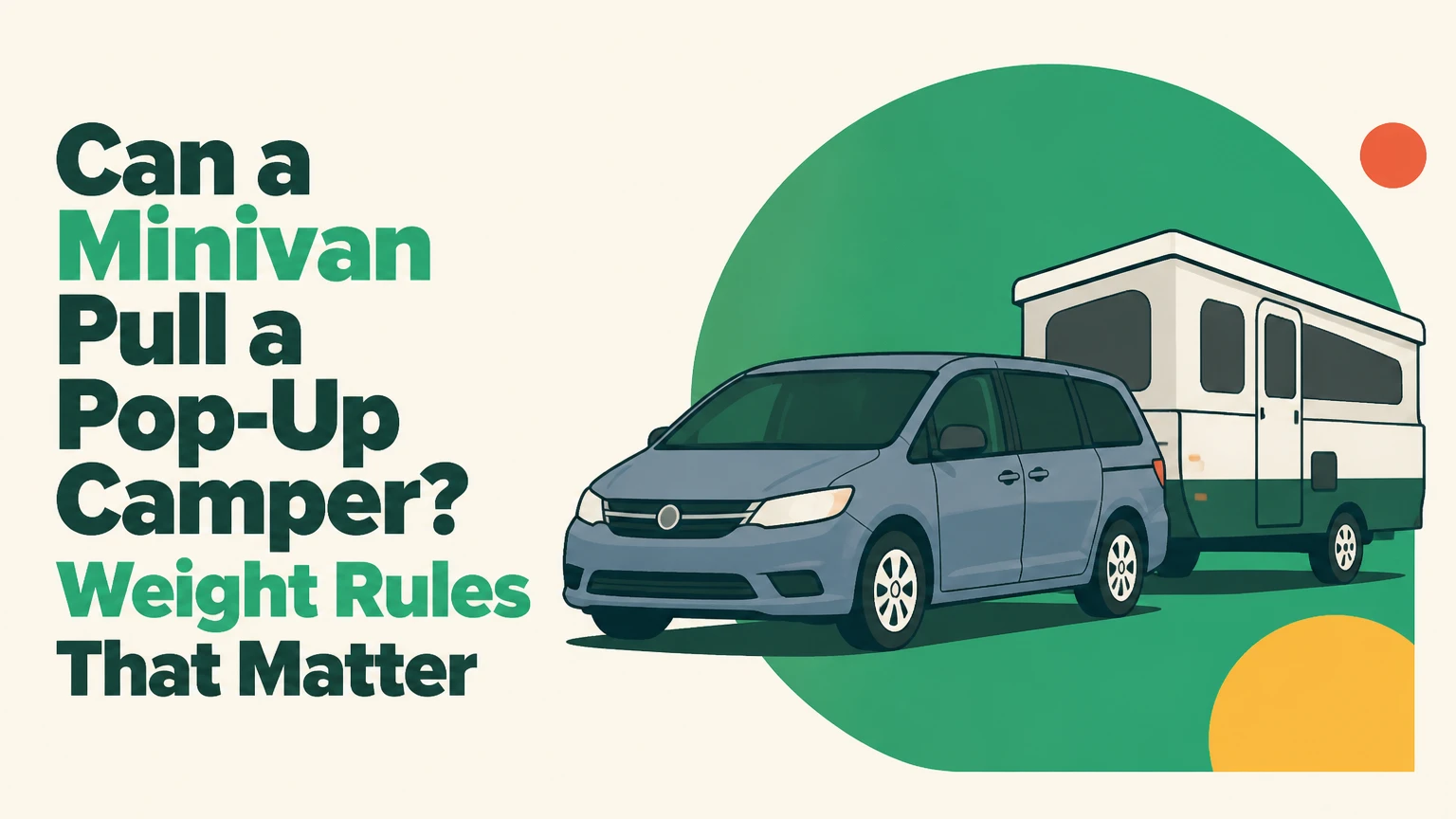
Yes, a minivan can pull a pop-up camper when the camper’s actual loaded weight, tongue weight, and the combined vehicle load remain within the minivan’s published limits. Most properly equipped modern minivans tow about 3,500 pounds, but payload, rear-axle capacity, hitch ratings, brakes, and the specific vehicle manual determine whether a particular pairing is safe.
Key facts at a glance
A pop-up camper’s loaded weight, not its dry weight, must stay below the minivan’s tow rating.
Passengers, luggage, cargo, and trailer tongue weight all consume the minivan’s payload.
A practical target is to keep the camper’s loaded weight meaningfully below the maximum rating, especially for mountain travel.
Trailer tongue weight commonly targets 10-15% of loaded trailer weight, unless the vehicle or trailer manufacturer specifies otherwise.
A camper over the applicable brake threshold may require trailer brakes under state or provincial law, and brake assistance is valuable even when not legally mandatory.
The door-jamb certification label and owner’s manual outrank dealer estimates, online tables, and the camper’s brochure.
Can a minivan pull a pop-up camper safely?
A minivan can pull a pop-up camper safely if the complete combination passes four checks: tow rating, payload, hitch rating, and axle or tire limits. A 2,500-pound camper may be acceptable for one minivan with two occupants but unsuitable for the same van carrying seven passengers, luggage, bicycles, and a loaded roof box.
The low profile of a folding camper usually creates less aerodynamic drag than a full-height travel trailer. That reduces crosswind exposure and often limits the fuel-economy penalty, but it does not eliminate trailer sway, longer stopping distances, transmission heat, or the need for correct loading.
The National Highway Traffic Safety Administration describes towing as something that affects “handling, braking, and fuel economy.” That concise warning explains why a tow rating alone is insufficient. A minivan may pull the trailer up a hill while still exceeding its payload or rear-axle rating.
What towing capacity do minivans have?
Many current North American minivans offer a maximum tow rating near 3,500 pounds when equipped as specified by the manufacturer. The rating is not universal across every trim: model year, engine, drivetrain, cooling equipment, wheels, tires, hitch hardware, and regional specifications can change the limit.
| Minivan example | Common maximum rating | Powertrain example | Verification point |
|---|---|---|---|
| Chrysler Pacifica | Up to 3,600 lb | 3.6L V6 gasoline | Confirm exact year, trim, and factory hitch equipment |
| Honda Odyssey | Up to 3,500 lb | 3.5L V6 gasoline | Check the owner’s manual and installed hitch label |
| Toyota Sienna | Up to 3,500 lb | 2.5L four-cylinder hybrid | Verify hybrid-system and drivetrain requirements |
| Kia Carnival | Up to 3,500 lb | 3.5L V6 gasoline | Confirm regional tow rating and vehicle certification label |
These figures are model-family examples, not permission to tow a 3,500-pound trailer automatically. A vehicle’s maximum tow rating may assume only a driver, while real families add hundreds of pounds inside the cabin.
How do you calculate whether the camper fits?
Calculate the loaded trailer weight, tongue weight, and remaining vehicle payload before considering the trip. The most useful calculation is:
Remaining payload = vehicle-payload rating – passengers – luggage and accessories – trailer tongue weight
For the trailer, use the camper’s actual ready-to-camp weight whenever possible. Start with the camper’s certified unloaded or shipping weight, then add battery, propane, water, food, bedding, cookware, tools, firewood, bicycles, and aftermarket accessories. The trailer’s GVWR is the maximum permitted loaded trailer weight, not a target that every tow vehicle can automatically handle.
For example, assume a minivan has a 1,600-pound payload rating. Two adults and two children weigh 570 pounds, luggage weighs 180 pounds, and a cooler plus hitch-mounted carrier adds 90 pounds. A 2,600-pound loaded camper with 13% tongue weight contributes approximately 338 pounds.
1,600 – 570 – 180 – 90 – 338 = 422 pounds remaining
That combination may pass the arithmetic, but the owner still must check the rear axle, receiver rating, tire load ratings, gross combined weight rating, and local brake rules.
Which camper weights fit a minivan?
A camper with a loaded GVWR between approximately 1,500 and 2,800 pounds is usually easier to match to a minivan than a trailer near the vehicle’s maximum rating. The best match depends on occupants and cargo, because a larger family can use most of the vehicle’s payload before adding tongue weight.
| Camper type | Typical loaded GVWR | Typical tongue weight at 12% | Minivan suitability |
|---|---|---|---|
| Micro pop-up, 8-foot box | 1,200-1,800 lb | 145-215 lb | Strongest fit for five or more occupants |
| Standard canvas pop-up, 10-foot box | 2,200-2,800 lb | 265-335 lb | Usually suitable for a lightly loaded family |
| A-frame camper | 2,000-2,800 lb | 240-335 lb | Suitable when receiver and payload limits allow |
| Large pop-up with slide-out | 2,800-3,500 lb | 335-420 lb | Marginal for fully occupied minivans |
Dry weight is not a safe substitute for loaded weight. A camper advertised at 2,400 pounds may gain 300-600 pounds through water, propane, battery, kitchen supplies, bedding, and personal equipment. Weigh the combination at a certified public scale before a long trip.
What is a safe tongue-weight range?
A loaded pop-up camper commonly needs tongue weight around 10-15% of its loaded trailer weight, with roughly 12-13% providing a useful starting point for stable conventional trailers. The trailer manufacturer’s instructions and the tow vehicle’s receiver limits control the final number.
Too little tongue weight can cause oscillating sway because the trailer’s center of mass sits too far behind its axle. Too much tongue weight overloads the hitch, rear axle, rear tires, and suspension. A 2,600-pound trailer at 12% produces about 312 pounds on the hitch, and that entire load counts against minivan payload.
Measure tongue weight with a properly rated scale or have a trailer dealer weigh it. Do not estimate by looking at suspension squat alone. A level-looking vehicle can still exceed an axle or receiver limit, while a small amount of normal squat does not automatically indicate a dangerous setup.
Which minivans are best suited to a pop-up camper?
A minivan with a factory tow package, adequate payload, strong tires, and a 3,500-pound rating is generally better suited than an identically rated van fitted only with an aftermarket receiver. Factory equipment may include wiring, cooling provisions, software calibration, or a specific hitch design that an accessory receiver does not replicate.
| Decision factor | Better setup | Riskier setup | Why it matters |
|---|---|---|---|
| Tow rating | 3,500 lb factory-rated configuration | 2,000 lb base configuration | Leaves capacity for loaded trailer weight |
| Payload | 1,600-1,800 lb label rating | 1,200-1,400 lb label rating | Accommodates passengers and tongue weight |
| Drivetrain | AWD for wet grades and gravel | FWD on loose, steep surfaces | Reduces traction limitations, not weight limits |
| Cooling | Factory tow provisions | Unknown aftermarket additions | Helps manage heat during sustained grades |
| Brakes | Trailer brake-compatible wiring | Four-pin lighting only | Provides trailer braking where required or advisable |
| Clearance | Receiver with adequate departure angle | Low receiver on steep approaches | Prevents hitch and frame contact with pavement |
The Honda Odyssey, Toyota Sienna, Chrysler Pacifica, and Kia Carnival can all be viable examples when their exact configurations permit the intended load. Model reputation cannot replace the VIN-specific manual and certification label.
What changes with hybrid and AWD minivans?
Hybrid minivans can tow within their published limits, but the owner’s manual determines whether special procedures, speed limits, or equipment restrictions apply. Electric-motor torque can make low-speed acceleration feel strong, yet a hybrid’s immediate response does not increase its certified tow rating or reduce trailer braking requirements.
AWD improves traction on wet pavement, gravel, and slippery campground grades, but AWD does not increase payload, hitch capacity, rear-axle rating, or stopping capability. A fully occupied AWD minivan can still be overloaded by a moderate camper.
How should you hitch and inspect a pop-up camper?
Hitching a pop-up camper takes about 15-25 minutes after practice, while a first installation of the receiver, wiring, and brake controller commonly takes 2-4 shop hours. Use the correct ball diameter and rating, lock the coupler, cross the safety chains, connect lighting, and test every safety system before moving.
- Confirm the ratings. Match the receiver, ball mount, hitch ball, coupler, safety chains, tires, and wiring to the trailer’s loaded weight.
- Align the coupler. Use a spotter when possible, lower the coupler fully onto the ball, close the latch, and insert its retaining pin.
- Attach the chains. Cross the chains below the tongue so they can support it if the coupler separates. Do not attach them to a removable plastic bumper panel.
- Connect the wiring. Plug in the four-way or seven-way connector and check running lights, turn signals, brake lights, and electric brake operation.
- Connect the breakaway cable. Attach the cable to a permanent hitch point separate from the safety-chain connection where possible. Never loop it around the coupler.
- Raise the equipment. Retract the tongue jack, remove wheel chocks, secure the jack handle, and close all camper latches.
- Check the tires. Set cold pressure according to the tire placard or manufacturer specification, inspect for cracking, and verify the trailer’s load range.
- Recheck after a short drive. Stop after 10-15 minutes, feel for abnormal hub heat without touching a potentially hot brake component, and inspect the coupler and straps.
You will know the setup is ready when the vehicle and camper lights work, the coupler latch is pinned, the chains have slack for turning, the jack is fully raised, and the trailer brakes respond without locking immediately.
When are trailer brakes required?
Trailer-brake requirements vary by state, province, trailer weight, and equipment type, so the relevant transportation authority and owner’s manual determine legality. Electric brakes with a proportional brake controller are common on heavier pop-up campers, while some lighter trailers use surge brakes.
Legal minimums are not the same as a good operating threshold. A 2,500-pound camper can increase stopping demand substantially on a mountain descent, particularly when the minivan carries four adults and camping equipment. A brake controller should be adjusted on level pavement so the trailer contributes firmly without skidding.
A four-pin connector generally provides lighting only. A seven-way connector commonly supports electric trailer brakes and auxiliary circuits, but the connector alone does not prove that a brake controller or functioning brake assemblies are installed.
Do minivans need a weight-distribution hitch?
Most small pop-up campers do not need a weight-distribution hitch, and many minivan manufacturers prohibit or restrict weight-distribution systems. A weight-distribution hitch transfers some tongue load toward the front axle, but it does not increase the vehicle’s tow rating, payload, receiver rating, or braking capacity.
Use one only when the minivan manufacturer and hitch manufacturer explicitly permit it, and only at the specified tongue-weight range. Do not use spring bars to hide an overloaded rear axle or compensate for a trailer that is too heavy.
A properly loaded small camper should remain stable without aggressive hitch hardware. If the rear suspension sags severely, first remove cargo, recalculate payload, and measure tongue weight.
How should you drive a minivan with a camper?
Drive at a moderate speed, increase following distance, use the transmission’s tow mode when provided, and control downhill speed with appropriate lower gears rather than repeated hard braking. Trailer handling changes most during emergency maneuvers, crosswinds, descents, and tight campground turns.
Allow at least four seconds of following distance in dry conditions and more in rain or traffic. Slow before curves and turns, because a pop-up camper’s tires track inside the minivan’s rear wheels and can strike a curb.
On a descent, select a lower gear before speed builds. If the brake pedal becomes soft, braking distance increases, or smoke or burning odor appears, stop in a safe location and allow the system to cool. Do not continue downhill while attempting to solve brake fade with a higher controller gain.
Can a minivan tow a pop-up camper in the mountains?
A minivan can tow a suitable pop-up camper in mountainous areas, but the combination needs additional thermal and braking margin. Long climbs increase engine and transmission heat, while descents expose an overloaded or poorly braked combination to brake fade.
Before mountain travel, inspect coolant level, engine oil, transmission-fluid condition where applicable, tire pressure, wheel bearings, and trailer brakes. Keep the camper below its GVWR and avoid starting a trip at the minivan’s maximum combined weight.
Mountain grades also expose weak loading decisions. A camper that feels stable on flat highways may sway during a downhill curve when its tongue weight is too low or its tires are underinflated.
What equipment and installation cost should you expect?
Typical North American costs range from about $350 to $900 for a receiver, wiring, brake controller, and professional installation, excluding repairs to an older camper. A factory tow package may cost more at purchase but can integrate better with the vehicle’s electrical and cooling systems.
| Equipment | Typical parts cost | Typical labor time | Purpose |
|---|---|---|---|
| Class III receiver | $150-$300 | 1-2 hours | Provides the rated coupling point |
| Four-way lighting harness | $50-$150 | 1-2 hours | Powers basic trailer lights |
| Seven-way harness | $100-$250 | 1.5-3 hours | Supports lighting and brake circuits |
| Electric brake controller | $100-$300 | 1-2 hours | Modulates trailer electric brakes |
| Transmission or powertrain cooler | $250-$500 installed | 2-4 hours | May assist sustained-load cooling where approved |
| Weight scale visit | $15-$40 | 30-60 minutes | Confirms actual axle and trailer weights |
A transmission cooler is not a universal fix. Install only equipment approved for the specific minivan, because modern transmissions, cooling circuits, and hybrid systems differ substantially.
What mistakes make a minivan and camper unsafe?
The most common errors are using dry weight, ignoring payload, omitting trailer brakes, and moving heavy equipment behind the camper axle. These mistakes can create an overloaded rear axle or unstable trailer even when the advertised camper weight appears below the tow rating.
- Using brochure dry weight: Add battery, propane, water, food, and equipment before comparing the camper with the tow rating.
- Forgetting tongue weight: Subtract the measured tongue load from vehicle payload along with every passenger and item inside the minivan.
- Filling the rear cargo area: Heavy coolers and tools behind the rear axle increase axle load more than the same weight near the middle row.
- Assuming a hitch equals a tow package: An aftermarket receiver does not create factory cooling, software, or manufacturer approval.
- Adding air springs to solve overload: Suspension aids can reduce visible sag, but they do not increase tires, axles, brakes, payload, or GVWR.
- Driving too fast because the camper is low: A low profile reduces drag, not momentum or stopping distance.
One counterintuitive rule matters: moving luggage from the minivan into the camper can improve vehicle payload, but it does not reduce the trailer’s loaded weight. The transfer is useful only if the camper remains under GVWR and its axle and tongue loads stay correct.
How do you fix trailer sway, squat, or brake fade?
Trailer sway requires reducing speed smoothly without sudden steering or panic braking, while severe squat or brake fade requires stopping safely and finding the overload or equipment fault before continuing. Never accelerate, sharply steer, or manually rearrange cargo while the combination is moving.
| Symptom | Likely cause | Safe response |
|---|---|---|
| Trailer oscillates side to side | Low tongue weight, excess rear loading, crosswind | Hold steering steady, release accelerator, apply trailer brake manually if equipped, stop and rebalance |
| Minivan rear sits very low | Excess payload or tongue weight | Stop, weigh the combination, remove cargo, and verify axle ratings |
| Steering feels light | Rear overload or improper load transfer | Stop and correct loading before driving farther |
| Brake pedal becomes soft | Brake fade or overheated vehicle brakes | Stop safely, cool the brakes, inspect trailer braking, and avoid repeated hard braking |
| Hitch scrapes on campground entry | Low receiver or steep approach angle | Use a slower diagonal approach only if clearance is adequate; otherwise choose another route |
| Transmission hunts between gears | Heavy grade, excessive speed, no tow mode | Reduce speed, select tow mode or a lower gear, and monitor temperature warnings |
If sway continues after correct loading and tire inflation, inspect wheel alignment, suspension components, coupler fit, and trailer bearings. A sway-control device cannot correct an overloaded or poorly balanced camper.
Which trailer alternatives may be better?
A smaller A-frame, teardrop trailer, or tent trailer may be better than a large canvas pop-up when the minivan carries a full passenger load. A larger SUV or pickup becomes the better tool when the desired camper approaches the minivan’s limits, requires substantial water and gear, or will travel frequently through steep terrain.
| Alternative | Typical loaded weight | Main advantage | Main limitation |
|---|---|---|---|
| Small tent trailer | 900-1,500 lb | Lowest towing demand | Limited weather protection and storage |
| Compact A-frame | 2,000-2,800 lb | Hard walls and quick setup | Higher tongue weight than some micro pop-ups |
| Small teardrop | 1,500-2,500 lb | Simple towing and sealed cabin | Less interior sleeping and seating space |
| Midsize travel trailer | 3,000-5,000 lb | More amenities and storage | Often exceeds minivan payload or tow limits |
| Midsize SUV | 3,500-5,000 lb | Greater ground clearance in some models | Less cabin cargo flexibility |
| Half-ton pickup | 7,000-12,000 lb | Broad trailer margin and payload | Higher operating cost and less enclosed cargo space |
A minivan is a poor choice for a trailer that requires constant operation at its maximum rating. It is also a poor choice when the family needs every seat, carries bikes and sports equipment, and expects a full water tank for remote camping.
Which setup fits each type of traveler?
A couple with light gear can usually choose a 1,500-2,400-pound loaded camper, while a family of four should target a larger payload margin and a family of five or more should prioritize a micro pop-up. The more people inside the minivan, the less trailer tongue weight and cargo capacity remain available.
Couple or solo traveler
A 1,500-2,400-pound loaded A-frame, teardrop, or micro pop-up provides the simplest match. The Toyota Sienna, Honda Odyssey, Chrysler Pacifica, and Kia Carnival can all work in suitable configurations, but the buyer should preserve at least several hundred pounds of combined payload and trailer margin.
Family of four
A 2,200-2,800-pound loaded camper can be practical when passengers, luggage, and tongue weight fit the certification label. Pack dense gear low and near the camper axle, keep the minivan cargo area organized, and select a trailer with brakes when required or when its weight makes braking assistance sensible.
Family of five or more
Choose an ultra-light camper with a loaded GVWR near 1,800-2,200 pounds unless the minivan has unusually high available payload. Seven occupants can consume 900-1,200 pounds before luggage, leaving little capacity for a 300-pound tongue load.
FAQ
Can a minivan tow a pop-up camper without a factory tow package?
A minivan may tow a light camper without a factory tow package only when the owner’s manual permits the configuration and the installed receiver, wiring, tires, cooling system, and brakes meet the required specifications. An aftermarket hitch cannot raise the vehicle’s certified capacity, so verify the exact vehicle before installation.
How fast should you drive while towing a pop-up camper?
Use the lower of the minivan manufacturer’s, camper manufacturer’s, tire, or local legal speed limit. A practical starting point is 55-65 mph on North American highways, with lower speeds in rain, crosswinds, construction zones, or when the trailer begins to feel unstable.
Can a front-wheel-drive minivan pull a camper up a boat ramp?
A front-wheel-drive minivan may pull a light camper on a dry, moderate-grade ramp, but traction can deteriorate when tongue weight unloads the front axle or the surface is wet gravel. AWD improves traction but does not change payload, tow rating, braking, or axle limits.
Should water tanks be full when towing?
Carry only the water needed for the route unless the camper manufacturer specifically permits a different practice. Water weighs approximately 8.3 pounds per US gallon, so a 20-gallon tank adds about 166 pounds before the tank’s location changes tongue or axle loading.
Can a minivan tow a pop-up camper with bicycles?
A minivan can carry bicycles while towing if the combined vehicle payload, receiver capacity, rear-axle rating, trailer GVWR, and tongue weight remain compliant. A hitch-mounted bike rack adds rear overhang and leverage, so measure its actual weight and keep bikes secured without obstructing trailer lights.
Is a pop-up camper easier to tow than a travel trailer?
A pop-up camper is generally easier to tow because its folded height and frontal area are lower, but its compact size does not guarantee lower weight or better stability. A loaded pop-up still needs correct tongue weight, functioning brakes, safe tires, and adequate vehicle payload.
The Bottom Line
Can a minivan pull a pop-up camper? Yes, when the exact minivan, trailer, passengers, cargo, hitch, brakes, and axle loads fit their published limits. Use loaded camper weight rather than dry weight, subtract tongue weight from payload, weigh the combination, and preserve margin for hills, weather, and emergency braking. A small, properly equipped pop-up is usually a sound minivan match; a fully loaded camper near 3,500 pounds often is not.