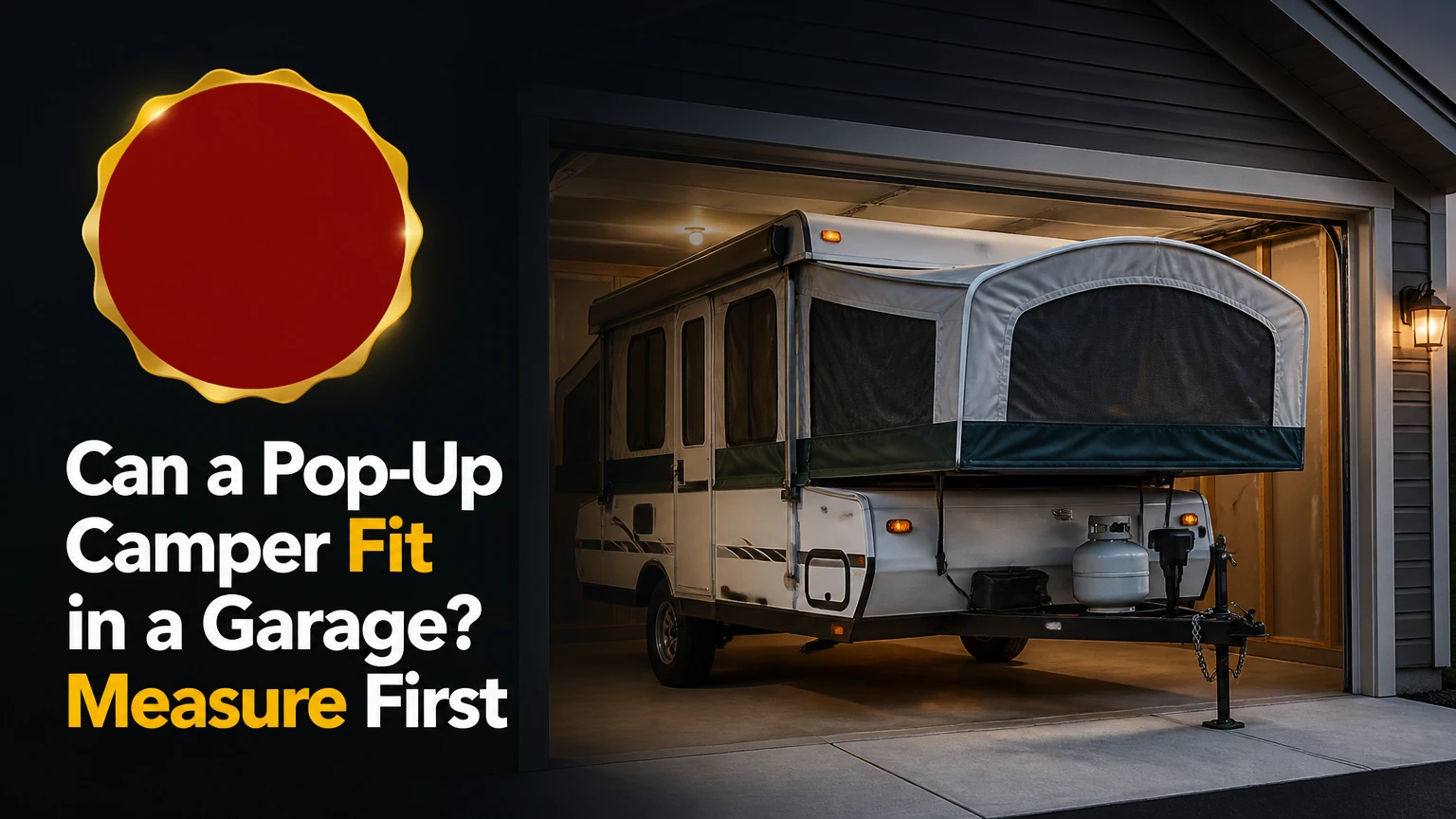
Yes, a pop-up camper can fit in many residential garages because its closed height commonly measures about 4.5-5.5 feet. Fit depends on the lowest garage-door obstruction, the camper’s complete hitch-to-rear length, its width, and available maneuvering space. A rooftop air conditioner, spare tire, or cargo rack can change the result.
Key facts at a glance
A nominal 7-foot garage door provides 84 inches only at its stated opening, not necessarily at every point of the entry path.
A soft-sided pop-up camper commonly measures 54-66 inches high when closed, excluding some roof accessories.
A “10-foot box” camper may require approximately 15-16 feet of floor length after adding the tongue and rear equipment.
A rooftop air conditioner typically adds about 10-14 inches above the folded roof.
Measure the camper in its actual storage configuration, including tires, spare tire, hitch, propane cylinder, rack, and air conditioner.
A safe fit needs clearance, not a contact-free scrape; a practical target is at least 3 inches at the lowest fixed obstruction.
What Is a Pop-Up Camper?
A pop-up camper is a towable recreational vehicle with a rigid lower box and a roof that lowers for transport. Crank, cable, spring-assisted, or electric lifting systems raise the roof at the campsite, while canvas or vinyl walls and sliding bunk ends create the sleeping area.
The folded profile makes a pop-up camper substantially shorter than a conventional travel trailer. That difference is the main reason a tent trailer can enter a residential garage that cannot accept a 7-foot-tall caravan.
A pop-up camper is not automatically garage-compatible. A folding roof solves the height problem, but it does not solve a 19-foot length, an 8-foot width, a low garage header, or a central garage-door opener rail.
Can a Pop-Up Camper Fit Through a Standard Garage Door?
Most soft-sided pop-up campers can clear a standard 7-foot garage door when their roof-mounted equipment is included in the measurement. The garage door’s lowest point, the floor transition, and the trailer’s approach angle matter more than the advertised closed height.
A nominal 84-inch opening can lose usable clearance where the door curves onto its horizontal tracks. Weather seals, framing, a raised threshold, and the opener mechanism can also reduce the available path. Measure the opening with the door fully open and identify the lowest point along the entire route.
A camper measuring 60 inches closed leaves 24 inches below an 84-inch opening in a simple calculation. That margin can disappear when a 12-inch air-conditioner shroud, roof rack, or uneven driveway changes the effective height.
Garage Door Clearance Comparison
| Garage feature | Nominal value | Practical measurement concern | Recommended action |
|---|---|---|---|
| Standard residential door | 7 feet, 84 inches | Header and weather seal may reduce opening | Measure lowest point |
| Taller residential door | 8 feet, 96 inches | Tracks and opener still obstruct | Measure full entry path |
| Compact camper closed height | 54-57 inches | Accessories may be excluded | Add every roof accessory |
| Typical soft-sided camper | 58-66 inches | AC can add 10-14 inches | Maintain 3-inch margin |
| A-frame camper | 60-72 inches | Hard roof geometry varies | Use exact model specification |
| Garage threshold | 1-3 inches above floor | Trailer angle changes at entry | Measure from the approach side |
What Dimensions Matter Besides Height?
A garage fit requires four dimensions: total length, maximum width, closed height, and turning or backing clearance. The most common buying mistake is comparing a camper’s box length with the garage depth.
Manufacturers often describe a folding camper by its box size, such as 8, 10, or 12 feet. The box measurement excludes some combination of the A-frame tongue, coupler, propane tank, spare tire, rear bumper, and storage rack. Use the overall exterior length from the coupler to the rearmost fixed component.
Width also matters. A typical pop-up camper body may measure 7-7.5 feet wide, while a single garage door may provide only 8-9 feet of clear opening. Mirrors, wheel guides, shelves, and wall storage can make a nominally wide-enough bay difficult to use.
Typical Closed Camper Dimensions
| Camper type | Closed box length | Overall length, typical | Closed height | Exterior width |
|---|---|---|---|---|
| Mini 8-foot box | 8 feet | 11-13 feet | 52-57 inches | 78-84 inches |
| Standard 10-foot box | 10 feet | 14-16 feet | 54-60 inches | 84-90 inches |
| Large 12-foot box | 12 feet | 17-19 feet | 58-63 inches | 88-90 inches |
| A-frame camper | Not box-rated consistently | 16-19 feet | 60-72 inches | 84-90 inches |
| Toy-hauler pop-up | 14-18 feet | 21-23 feet | 66-72 inches | 90-96 inches |
These are typical planning ranges, not substitutes for a model-year specification sheet. Older Coleman, Fleetwood, Jayco, Forest River, and Coachmen campers can differ from current models with similar box labels.
How Deep Must the Garage Be?
A garage should be longer than the camper’s complete storage length by at least 12-24 inches, unless a manufacturer-approved storage arrangement provides another solution. A 20-foot-deep garage may accept a 15-foot trailer comfortably, while a 19-foot trailer can leave no usable walking or door clearance.
Measure from the closed garage door plane to the nearest rear obstruction. Include drywall, shelving, a workbench, a water heater, and any space needed to walk around the trailer. If the tow vehicle remains in the same bay, measure the combined vehicle and trailer arrangement rather than the trailer alone.
Diagonal parking can sometimes fit a slightly longer trailer, but it requires usable bay width and enough turning room outside the garage. Do not rely on a diagonal fit if the tongue, spare tire, or rear corner would block the garage door, another vehicle, or a fire egress route.
Garage Depth Planning
| Garage configuration | Typical interior depth | Camper length that usually fits comfortably | Main limitation |
|---|---|---|---|
| Small single-car garage | 18-20 feet | 11-15 feet | Narrow opening and side storage |
| Standard two-car garage | 20-24 feet | 14-19 feet | Shared vehicle and storage space |
| Older detached garage | 18-20 feet | 11-16 feet | Door framing and uneven floor |
| Deep modern garage | 24-30 feet | 17-23 feet | Width and maneuvering still matter |
| Same bay with vehicle | 20-24 feet | Usually under 14 feet | Combined length exceeds depth |
How Do You Measure a Camper for Garage Storage?
Measure the garage first, then measure the camper in its actual folded configuration, and compare the smallest garage clearance with the largest camper dimension. Record height, length, width, and approach conditions in inches so small differences cannot hide inside rounded feet.
Step 1: Measure the Garage Door Opening
Open the door completely and measure from the concrete floor to the lowest point of the opening. Check both sides and the center, because tracks, seals, and framing may not be perfectly level.
Measure the driveway slope at the threshold. A trailer entering uphill or downhill can temporarily present a higher roof corner than its level parked height.
Step 2: Measure the Interior Depth and Width
Measure usable depth from the door plane to the closest permanent obstruction. Then measure the clear width between walls, not the nominal door size.
Mark shelves, cabinets, floor drains, posts, and parked vehicles on a simple floor plan. A 90-inch-wide camper needs more than 90 inches if the tow vehicle must be aligned inside the bay.
Step 3: Measure the Camper Fully Equipped
Measure from the coupler to the rear spare tire or rack, across the widest body or accessory, and from the ground to the highest fixed roof component. Repeat the height measurement with the camper level.
Include the propane cylinder, battery box, jack, stabilizer hardware, roof air conditioner, solar panel, awning case, roof rack, and vent covers. Manufacturer dry dimensions may omit equipment that owners add later.
Step 4: Add a Clearance Margin
Subtract the camper’s maximum measured height from the garage’s lowest measured opening. A positive difference of 3 inches or more is a sensible target for a straight, level entry.
A one-inch difference is not a usable margin. Tire pressure, uneven concrete, a replacement roof seal, or a slightly different approach angle can consume it.
Step 5: Mark the Floor
Use painter’s tape to mark the camper’s full footprint, including the tongue and rear equipment. Confirm that the garage door closes, the walking route remains usable, and no shelf or vehicle conflicts with the marked area.
Step 6: Perform a Slow Test Entry
Use a spotter, keep the trailer centered, and stop immediately if the spotter loses sight of the highest point. Confirm the clearance at the door before backing farther into the garage.
You will know the measurement is reliable when the real camper enters with its actual accessories installed, the garage door operates normally, and the trailer remains clear after the tow vehicle is disconnected.
Which Camper Types Fit in a Garage Most Easily?
Mini and standard soft-sided pop-up campers usually offer the easiest garage fit because their closed height often stays below 5 feet and their overall length remains below 16 feet. A-frame campers can fit by height, but their hard folding roofs may create a taller and less predictable profile.
Camper Type Decision Table
| Type | Garage-fit strength | Typical storage issue | Typical new-price range, U.S. market |
|---|---|---|---|
| Mini soft-sided | 11-13-foot overall length | Limited interior storage | $10,000-$16,000 |
| Standard soft-sided | 14-16-foot overall length | Roof AC may reduce margin | $14,000-$25,000 |
| Large soft-sided | 17-19-foot overall length | Garage depth becomes restrictive | $20,000-$32,000 |
| A-frame | Hard walls and no canvas drying | Closed height can reach 72 inches | $18,000-$35,000 |
| Toy-hauler pop-up | 21-23-foot overall length | Often too long for standard bays | $25,000-$45,000 |
Prices vary by country, model year, options, taxes, and dealer preparation. A single global price table in Bangladeshi taka is not a dependable buying guide because import duties, exchange rates, and local availability can dominate the final cost.
What Add-Ons Cause Garage Fit Problems?
Roof air conditioners, solar panels, roof racks, vent covers, and replacement roof hardware cause many failed garage entries because product listings often quote the camper’s basic folded shell rather than its equipped height. The roof AC is usually the largest single height increase.
A rooftop air conditioner commonly adds 10-14 inches, although the exact increase depends on the unit and shroud. A camper that is 58 inches high without equipment can approach 72 inches with AC, leaving only 12 inches at a nominal 7-foot opening before other conditions are considered.
The garage-door opener rail or arm can create a second obstruction after the camper clears the header. Check the opener rail, trolley, emergency-release cord, lights, and hanging storage hooks.
Accessory Height Risks
| Accessory | Typical added height | Fitment risk | Measurement rule |
|---|---|---|---|
| Rooftop AC shroud | 10-14 inches | High | Measure installed unit |
| Solar panel | 1-3 inches | Moderate | Include brackets and wiring |
| Roof rack | 3-8 inches | Moderate | Measure loaded and empty |
| Vent cover | 2-4 inches | Low-moderate | Check highest cover |
| Spare tire carrier | 0 inches height, added length | Length risk | Measure rear-most point |
| Propane cylinder | 0-4 inches, model-dependent | Tongue clearance | Include jack position |
Can You Keep a Vehicle in the Same Garage Bay?
A pop-up camper can share a garage with a vehicle only when the combined layout leaves safe door, walking, and equipment access. In practice, a trailer may fit in a two-car garage while still preventing a car from using the remaining bay because the tongue sweeps into the vehicle’s space.
Measure the vehicle with mirrors folded or extended according to how it will actually be parked. Include the trailer’s tongue, wheel fenders, side clearance, and the space required to open doors.
A camper stored in one bay and a compact car in the other is more realistic in a garage at least 20 feet wide. A full-size pickup, large SUV, or deep storage cabinet can eliminate that option even when the trailer itself fits.
Is Garage Storage Better Than Outdoor Storage?
Indoor garage storage generally protects a pop-up camper from ultraviolet exposure, rain, snow, and wind, but it does not automatically prevent mold, corrosion, battery damage, or rodent infestation. The best storage location is dry, ventilated, secure, and compatible with the owner’s available space.
Canvas and vinyl last longer when shielded from direct sunlight, yet a damp camper sealed inside a garage can develop mildew faster than a covered camper with airflow. Dry the tenting completely before lowering the roof, and open the camper periodically if the storage conditions allow.
Commercial storage costs vary widely by location and season. A typical outdoor RV lot may charge about $50-$200 per month, while enclosed storage commonly costs more. Compare those fees with the value of a garage bay and the cost of canvas, roof, or water damage.
Storage Option Comparison
| Storage method | Typical monthly cost | Weather protection | Main maintenance requirement |
|---|---|---|---|
| Home garage | $0 direct fee | High | Ventilation and rodent control |
| Home driveway cover | $0-$300 equipment cost | Moderate | UV-resistant cover and drying |
| Outdoor RV lot | $50-$200 | Low-moderate | Cover, tire care, pest checks |
| Covered RV storage | $75-$250 | Moderate-high | Access scheduling |
| Enclosed commercial unit | $150-$500 | High | Confirm door height and insurance |
How Should You Prepare a Pop-Up Camper for Storage?
Prepare the camper by drying the canvas, removing food, disconnecting or maintaining the battery, protecting the tires, and controlling rodents before lowering the roof. Storage preparation usually takes 30-90 minutes after the camper is clean and dry.
Use these steps:
- Dry the tenting completely. A wet canvas roof or bunk end can develop mildew within days in a closed environment.
- Remove food and scented materials. Empty the refrigerator, pantry, trash, and pet supplies.
- Clean the floor and seals. Crumbs attract rodents, while dirt can damage roof seals during folding.
- Maintain the battery correctly. Follow the battery manufacturer’s charging instructions, or remove the battery if the camper’s system permits it.
- Protect the tires. Inflate them to the manufacturer’s cold pressure and use approved tire covers away from sunlight.
- Block rodent access. Inspect cable openings, plumbing penetrations, and wheel wells; use traps or exclusion methods that are safe around children and pets.
- Leave controlled airflow. Do not seal a damp interior inside an airtight cover or storage compartment.
Never assume a garage is rodent-proof. Mice can enter through small building gaps and damage canvas, wiring, insulation, and propane-system components.
What If the Camper Is Too Tall or Long?
If a pop-up camper is too tall, first remove nonessential accessories only when the manufacturer permits removal and the change remains safe for towing. If the camper is too long, rearrange storage, use a deeper bay, or choose a shorter model rather than forcing an unsafe angle.
Lowering the tongue jack to tilt a trailer during entry is not a universal fix. It can change the trailer’s ground clearance, load the coupler or jack improperly, and cause the rear of the camper to contact the floor or door. Use that technique only if the trailer manufacturer or a qualified RV technician confirms it is safe.
Do not install smaller storage wheels or substitute trailer tires without checking load rating, hub fit, brake clearance, and manufacturer approval. Wheels and tires rated for indoor movement may not be legal or safe for road towing.
A longer trailer may fit diagonally in a wide garage, but the diagonal arrangement can block a side door, overload a corner, or leave the hitch too close to the garage door. Treat diagonal parking as a measured layout, not a guaranteed workaround.
What Mistakes Damage Campers During Garage Storage?
The most expensive errors usually come from measuring only one dimension, ignoring installed accessories, or moving the trailer without a spotter. A camper can clear the door at the center while its roof edge, awning case, or rear spare tire strikes an obstruction.
Common failures include:
- Using the advertised box length: Add the hitch, jack, propane tank, bumper, and spare tire.
- Ignoring the roof AC: Measure the highest installed component, not the bare roof.
- Measuring the door while it is partially open: Fully open the door and inspect the lowest track or seal.
- Backing without a spotter: A camera may not show the roof corner or side clearance.
- Unhitching before stabilizing: Set the parking brake, chock both sides as appropriate, and follow the trailer manual before disconnecting.
- Storing a damp camper: Dry canvas and bedding before folding the roof.
- Opening the camper inside the garage: Many roofs need more vertical and side clearance when raised than when closed, and canvas can contact shelves or the opener rail.
The practitioner rule is simple: measure the stored configuration, test the real route, and preserve a visible margin.
What Garage Size Should You Choose?
A standard 20-foot-deep, two-car garage usually suits a mini or standard pop-up camper, while a 24-foot-deep garage provides better flexibility for a large 12-foot-box camper. Garage width, door placement, and stored household equipment can matter more than nominal depth.
Use this planning guide:
- 18-foot garage: Target an overall camper length of 14 feet or less.
- 20-foot garage: Target 15-17 feet, leaving room for the door and walking path.
- 22-foot garage: Often suitable for 17-19 feet if the bay is unobstructed.
- 24-foot or deeper garage: Better for large pop-ups, A-frames, and selected toy-hauler models.
- 7-foot door: Verify equipped height and seek at least 3 inches of measured clearance.
- 8-foot door: More forgiving, but still check the opener rail and roof accessories.
These targets describe storage comfort, not absolute physical limits. A skilled layout can improve use of space, while a shelf or water heater can reduce it substantially.
Is a Pop-Up Camper Worth Storing in a Garage?
Garage storage is worthwhile when the bay remains usable, the trailer fits with a measurable margin, and the owner can keep the camper dry and accessible. Indoor storage reduces UV and weather exposure, but sacrificing a parking space may cost more in convenience than outdoor storage fees.
Garage storage is a strong choice for owners who camp seasonally, have a short or standard trailer, and want to reduce canvas aging. It is a weaker choice for owners with a 21-foot toy-hauler, a narrow single bay, or frequent need for the garage as a workshop.
A pop-up camper is not a good candidate for indoor storage if its roof AC leaves almost no clearance, the garage floor cannot support its tires and jack, or the stored trailer blocks an emergency exit. Fit is only one part of the decision.
FAQ
Can a 10-foot pop-up camper fit in an 18-foot garage?
A 10-foot-box pop-up camper may fit in an 18-foot garage if its total coupler-to-rear length is about 14-16 feet and at least 12 inches remain behind the trailer. Measure the garage door plane, rear wall, spare tire, and tongue jack because the box label does not represent the complete footprint.
Will a pop-up camper fit beside an SUV?
A pop-up camper can fit beside an SUV in a two-car garage when the combined widths leave clearance for mirrors, doors, and trailer movement. Measure both vehicles at their widest points, then add storage access and a practical side walkway rather than comparing the trailer width with the empty bay alone.
Can you open a pop-up camper inside a garage?
You can open a pop-up camper inside a garage only when the raised roof, bunk ends, canvas, lights, and lifting mechanism have adequate clearance. A garage that accepts the folded camper may not accommodate the expanded roof because the opener rail, ceiling, shelving, or side walls can interfere.
Do pop-up campers need to be covered indoors?
A pop-up camper usually does not need an exterior cover indoors, and an impermeable cover can trap moisture. Clean and dry the canvas, keep the garage ventilated, and use a breathable interior or roof cover only if it does not press against damp fabric or obstruct inspection.
How much clearance should a garage-stored camper have?
Plan for at least 3 inches above the highest camper component and 12-24 inches of spare length where possible. More clearance is preferable when the driveway slopes, the garage floor is uneven, or the trailer enters at an angle because those conditions can change the effective height.
Can an A-frame camper fit through a 7-foot door?
Many A-frame campers can pass through a 7-foot door, but their closed height commonly approaches 60-72 inches, making model-specific measurement essential. Check the manufacturer’s equipped height, roof latches, air conditioner, vent covers, and the garage door’s lowest point before purchase.
The Bottom Line
Can a pop up camper fit in a garage? Usually, yes, especially when the camper has a 54-66-inch closed height and a 14-16-foot overall length. Confirm the actual door opening, total trailer footprint, width, accessories, and garage depth before buying, then keep at least 3 inches of height clearance and enough space to maneuver safely.