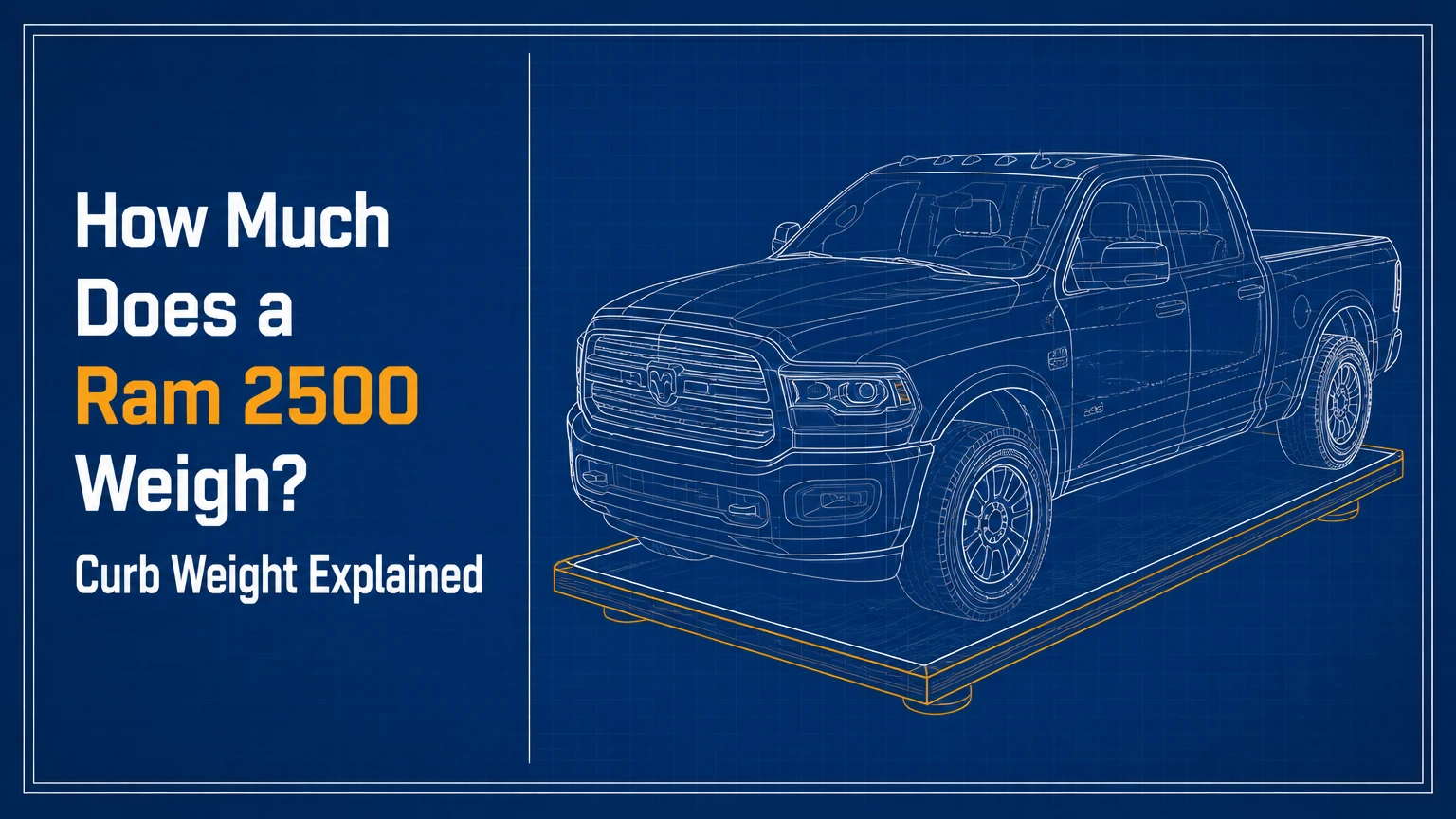
A Ram 2500 weighs approximately 6,001-8,137 pounds at the curb, depending on engine, cab, bed, trim, drivetrain, and equipment. The truck’s GVWR generally falls between 10,000 and 11,040 pounds, while the exact curb weight and payload belong to the individual configuration and VIN-specific certification label.
Key Facts at a Glance
- A Ram 2500’s published curb-weight range is approximately 6,001-8,137 pounds.
- A Ram 2500’s typical published GVWR range is 10,000-11,040 pounds.
- A gasoline Ram 2500 usually weighs less than an equivalent Cummins diesel model.
- The 6.7L Cummins diesel can reduce available payload because its powertrain adds substantial front-axle weight.
- Payload equals GVWR minus the truck’s actual ready-to-drive weight, not the maximum weight of another trim.
- The driver-side certification label provides the authoritative occupant-and-cargo limit for a particular truck.
How Much Does a Ram 2500 Weigh Empty?
An empty Ram 2500 weighs about 6,001-8,137 pounds, using the industry curb-weight range published for recent configurations. The lightest examples are typically two-wheel-drive, gasoline-powered work trucks, while the heaviest examples are four-wheel-drive luxury models with a Mega Cab, diesel engine, long equipment list, and factory accessories.
“Empty” has a specific meaning here. Curb weight normally includes fuel and standard operating fluids but excludes passengers, cargo, dealer-installed equipment, and aftermarket accessories. A truck with a full tank, floor mats, running boards, spray-in bedliner, tonneau cover, and hitch may weigh substantially more than its advertised base curb weight.
The broad range does not mean every Ram 2500 can weigh any number within it. A Regular Cab Tradesman and a Limited Mega Cab are different physical vehicles with different axle loads, suspension configurations, dimensions, and payload ratings.
Ram 2500 Weight by Typical Configuration
| Configuration | Typical curb-weight range | Main weight effect | Typical GVWR range |
|---|---|---|---|
| Regular Cab, gas, 4×2 | 6,001-6,300 lb | Lightest body and drivetrain | 10,000-10,700 lb |
| Regular Cab, gas, 4×4 | 6,300-6,680 lb | Front axle and transfer case add mass | 10,000-10,700 lb |
| Crew Cab, gas, 4×2 | 6,400-6,800 lb | Rear doors and passenger structure add weight | 10,000-10,900 lb |
| Crew Cab, diesel, 4×4 | 7,300-7,900 lb | Cummins engine and four-wheel drive add mass | 10,000-11,040 lb |
| Mega Cab, diesel, 4×4 | 7,700-8,137 lb | Largest cab and heaviest powertrain combination | 10,000-11,040 lb |
These are useful planning ranges, not substitutes for a scale ticket. Model year, tire package, optional seating, wheel design, bed length, fuel level, and installed accessories can move the actual number by hundreds of pounds.
What Is the Difference Between Curb Weight, GVWR, and Payload?
Curb weight is the truck’s ready-to-drive weight without people or cargo. GVWR is the manufacturer’s maximum permitted loaded weight, and payload is the weight available for occupants, cargo, accessories, and applicable trailer load transferred to the truck.
The basic relationship is:
Payload capacity = GVWR – actual truck weight
For example, a Ram 2500 with a 10,000-pound GVWR and a 7,150-pound scale weight has roughly 2,850 pounds of remaining payload before adding people or equipment. A brochure’s maximum payload figure may be higher because it describes a lighter configuration, not the specific truck in a driveway.
| Metric | Meaning | Ram 2500 example | What counts toward it |
|---|---|---|---|
| Curb weight | Ready-to-drive truck without occupants or cargo | 7,150 lb | Fuel, fluids, standard equipment |
| GVWR | Maximum loaded weight allowed by manufacturer | 10,000 lb | Truck, people, cargo, accessories, tongue load |
| Payload | Remaining capacity below GVWR | 2,850 lb | Occupants, bed load, hitch, camper, tongue weight |
| GCWR | Maximum combined truck-and-trailer weight | Configuration-specific | Loaded truck plus loaded trailer |
| GAWR | Maximum front or rear axle load | Label-specific | Weight carried by each axle |
The certification label is more important than a generic internet table. Ram, like other manufacturers, assigns ratings to a specific build based on suspension, tires, axle hardware, wheelbase, and powertrain.
Why Does the Door Label Matter More Than a Brochure?
The door label matters because the label identifies the exact GVWR, axle ratings, tire requirements, and occupant-and-cargo limit assigned to that vehicle. A brochure maximum can describe a Regular Cab gas truck, whereas a diesel Mega Cab may have several hundred fewer pounds of practical payload.
Open the driver-side door and inspect the certification label on the door jamb or B-pillar. Look for:
- GVWR
- Front and rear GAWR
- Tire size and cold inflation pressure
- Combined weight of occupants and cargo, where shown
- Vehicle identification information that confirms the label belongs to that truck
Ram’s official specifications and owner documentation provide model-family guidance, but the certification label controls the vehicle’s stated ratings. The National Highway Traffic Safety Administration also treats the manufacturer’s certification label as the reference point for federally required vehicle weight and tire information.
How Much Does a Gas Ram 2500 Weigh?
A gas-powered Ram 2500 commonly weighs about 6,001-6,800 pounds, depending on cab, bed, four-wheel drive, trim, and equipment. The 6.4L HEMI V8 is lighter than the 6.7L Cummins diesel, so an otherwise similar gasoline truck normally retains more payload below the same GVWR.
A gas truck is often the better payload choice for a service body, dense bed cargo, or a camper that approaches the truck’s limit. Lower curb weight does not automatically make it the better tow vehicle, because trailer weight, gearing, axle ratings, cooling capacity, and GCWR also determine suitability.
The gas engine’s published torque is lower than the diesel’s, which matters on steep grades and during frequent heavy towing. For occasional towing, construction use, or daily driving, the lower purchase price and lower front-end weight can matter more than maximum diesel torque.
How Much Does a Diesel Ram 2500 Weigh?
A diesel Ram 2500 commonly weighs about 7,300-8,137 pounds, with the highest figures usually associated with four-wheel-drive Crew Cab or Mega Cab luxury configurations. The 6.7L Cummins Turbo Diesel adds a large amount of engine and emissions-system mass, much of it over the front axle.
The diesel’s extra weight reduces payload mathematically when GVWR remains similar. A 10,000-pound-GVWR diesel that weighs 7,700 pounds has only 2,300 pounds before occupants, hitch hardware, and cargo, even if a lighter gas model in the same family has more than 3,000 pounds available.
Diesel weight is not wasted weight for every use. The Cummins powertrain provides substantially greater low-speed torque, an exhaust brake, and stronger performance during sustained trailer work. The trade-off appears when a buyer installs a fifth-wheel hitch, a truck camper, a large toolbox, and four adults in the same truck.
Gas Versus Diesel Ram 2500 Weight
| Attribute | 6.4L HEMI gas | 6.7L Cummins diesel |
|---|---|---|
| Typical curb-weight range | 6,001-6,800 lb | 7,300-8,137 lb |
| Typical weight difference | Baseline | Approximately 700-1,000 lb heavier |
| Published torque example | 429 lb-ft | Up to 1,075 lb-ft in recent specifications |
| Payload tendency | Higher in comparable builds | Lower because of added curb weight |
| Best fit | Daily use, work payload, occasional towing | Frequent heavy towing, grades, long trailer trips |
The exact difference varies by model year and body style. Comparing a gas Regular Cab with a diesel Mega Cab exaggerates the engine effect because the cab, drivetrain, wheelbase, and trim also change.
Which Ram 2500 Cab and Bed Configuration Weighs the Most?
The Mega Cab four-wheel-drive diesel generally weighs the most, while a Regular Cab gas truck with two-wheel drive generally weighs the least. A Crew Cab adds rear seating and body structure, and an eight-foot bed changes wheelbase and body mass compared with a shorter bed.
| Cab and bed layout | Relative curb weight | Typical use | Payload consequence |
|---|---|---|---|
| Regular Cab, 8-foot bed | Lowest, often 6,001-6,680 lb | Fleet work and equipment hauling | Usually highest available payload |
| Crew Cab, 6-foot-4-inch bed | Middle, often 6,400-7,900 lb | Family use and general towing | Moderate payload after passengers |
| Crew Cab, 8-foot bed | Higher than short-bed Crew Cab | Long cargo and fifth-wheel preparation | More body weight and wheelbase |
| Mega Cab, 6-foot-4-inch bed | Highest, often 7,700-8,137 lb | Passenger space and heavy towing | Often the lowest payload in comparable trim |
The common assumption that a longer bed always creates the largest weight penalty is incomplete. The engine, drivetrain, cab, luxury equipment, and four-wheel-drive hardware can outweigh the bed-length difference.
What Is the GVWR and Payload of a Ram 2500?
A Ram 2500 typically has a 10,000-11,040-pound GVWR, while maximum published payload can approach roughly 3,900 pounds in a light gas configuration. Actual payload is often lower, especially in diesel, four-wheel-drive, Mega Cab, Limited, and heavily optioned trucks.
GVWR is not the same as curb weight and not the same as towing capacity. A truck can have a 20,000-pound trailer rating while carrying only about 2,000 pounds of people, hitch, cargo, and trailer tongue weight before reaching its payload limit.
Use the manufacturer’s label and a scale for a loaded decision. Do not subtract an assumed internet curb weight from GVWR when a camper or fifth-wheel purchase depends on a few hundred pounds.
Worked Payload Example
Suppose a Ram 2500 has:
- Door-label GVWR: 10,000 pounds
- Actual empty scale weight: 7,420 pounds
- Two adults: 360 pounds
- Fuel, tools, and personal gear: 240 pounds
- Fifth-wheel hitch: 180 pounds
The remaining payload is:
10,000 – 7,420 – 360 – 240 – 180 = 1,800 pounds
A fifth-wheel pin weight of 2,000 pounds would exceed that remaining capacity, even if the trailer’s total weight stayed below the truck’s advertised maximum towing rating.
How Much Can a Ram 2500 Tow?
A properly equipped Ram 2500 can tow up to approximately 20,000 pounds in certain configurations, but the maximum applies only to a specific engine, axle ratio, cab, drivetrain, hitch, and trailer setup. Towing capacity is not a universal rating for every Ram 2500.
Conventional trailer tongue weight commonly represents 10-15% of loaded trailer weight. Fifth-wheel or gooseneck pin weight commonly represents about 15-25%, and both loads count against truck payload because they press down on the truck.
For example, a 16,000-pound conventional trailer may place 1,600-2,400 pounds on the hitch. Add four passengers, a bed toolbox, a weight-distribution hitch, and camping equipment, and payload can become the limiting factor before the advertised trailer rating does.
Towing Limits That Must Agree
| Limit | Example value | Why it matters |
|---|---|---|
| Truck GVWR | 10,000 lb | Limits total truck weight |
| Rear GAWR | Label-specific, often near 6,000 lb | Controls rear axle loading |
| Payload | 2,500 lb after actual weighing | Limits people, gear, hitch, and tongue load |
| Trailer rating | Up to 20,000 lb on selected builds | Limits trailer weight under specified conditions |
| GCWR | Configuration-specific | Limits combined loaded truck and trailer |
The practical towing limit is the lowest applicable limit after every load is counted. A trailer can be within the tow rating while the truck is over GVWR or rear GAWR.
How Do You Find the Exact Weight of a Ram 2500?
Find the exact weight of a Ram 2500 by weighing the truck on a certified public scale with the intended fuel level, occupants, accessories, and cargo. The door label establishes legal ratings, while a scale ticket establishes the truck’s current operating weight.
Use this process:
- Read the door label. Record GVWR, front GAWR, rear GAWR, tire size, and occupant-and-cargo information.
- Remove temporary cargo. Decide whether the measurement represents an empty truck, a travel-ready truck, or a work setup.
- Visit a CAT Scale or equivalent certified scale. Weigh the truck with occupants and normal equipment.
- Record front axle, rear axle, and total weight. Total weight alone can hide a rear-axle overload.
- Weigh the trailer combination if towing. Record truck-and-trailer total and axle positions.
- Compare every number with the label. Check GVWR, both GAWRs, tire ratings, and applicable GCWR.
- Repeat after loading. A camper, fifth-wheel hitch, water tank, generator, or tool chest can materially change the result.
A typical CAT Scale weighing takes about 10-20 minutes and costs approximately $15-$20 for the first pass, with a lower fee for a reweigh, although prices vary by location and operator.
Expert Insight: Measure Axles, Not Only Total Weight
A Ram 2500 can remain below total GVWR while exceeding its rear GAWR. This occurs when a heavy camper, fifth-wheel pin, or concentrated tool load shifts weight rearward, so axle-by-axle scale readings provide more useful information than a single total number.
Can a Ram 2500 Carry a Truck Camper?
A Ram 2500 can carry a truck camper when the camper’s wet, ready-to-travel weight remains within the truck’s available payload and axle limits. The calculation must include water, propane, batteries, tie-downs, passengers, food, clothing, and any suspension or bed accessories.
Truck campers often gain several hundred pounds after the brochure measurement. A listed 2,400-pound camper may weigh 2,800-3,200 pounds after a full freshwater tank, propane cylinders, batteries, jacks, and personal equipment are added.
Diesel Mega Cab models require particular caution because their higher curb weight can leave less payload than a lighter gas Regular Cab. A camper dealer’s dry weight is a starting point, not a certification that the truck is suitable.
Ram 2500 Versus Ram 3500: Which Is Heavier?
A Ram 3500 is not automatically dramatically heavier than a Ram 2500, because the two trucks can share engines, cabs, beds, and much of the body structure. The Ram 3500 usually provides higher GVWR, payload, axle, and fifth-wheel capacity through suspension and chassis differences.
| Decision factor | Ram 2500 | Ram 3500 single rear wheel | Practical consequence |
|---|---|---|---|
| Typical GVWR class | 10,000-11,040 lb | Often above 11,000 lb | More legal payload headroom |
| Rear suspension | Coil or heavy-duty configuration, model-dependent | Heavier rear spring configuration | Better support for pin weight |
| Empty weight | Approximately 6,001-8,137 lb | Similar body-dependent range | Weight difference may be modest |
| Camper suitability | Moderate to high, configuration-dependent | Higher for dense campers | More capacity margin |
| Registration considerations | Often near 10,000 lb GVWR | Frequently higher GVWR | Verify local commercial rules |
Choose the Ram 3500 when the planned payload repeatedly approaches the Ram 2500’s label limit. Choosing a 2500 because its empty weight is slightly lower does not solve a payload shortage.
What Happens If a Ram 2500 Is Overloaded?
An overloaded Ram 2500 can exceed tire, axle, suspension, braking, or frame limits, which may increase stopping distance, steering instability, tire temperature, suspension sag, and component wear. Rear-end sag alone does not prove the truck is overloaded, but it is a reason to weigh the axles immediately.
Common warning signs include:
- Rear tires visibly squatting or approaching sidewall deflection
- Steering that feels light or wanders under trailer load
- Longer stopping distance or repeated brake fade
- Trailer sway caused by poor distribution or insufficient tongue weight
- High transmission or engine temperatures on grades
- Uneven tire wear, especially on the rear axle
- Headlights aimed upward after loading
Do not correct a rating problem with helper springs, air bags, heavier tires, or aftermarket shocks. Those parts may improve ride height or control, but they do not increase the manufacturer’s GVWR or axle rating.
Expert Insight: Air Bags Correct Attitude, Not Capacity
Air bags can reduce visible sag, but they do not create additional payload. If a loaded Ram 2500 exceeds its certification label or axle rating, air pressure changes the suspension position without changing the legal and structural limit.
Common Ram 2500 Weight Mistakes
The most expensive weight errors usually come from comparing the wrong specifications. A buyer may compare a light gas Regular Cab’s maximum payload with a diesel Mega Cab’s actual configuration, then purchase a camper or trailer based on the larger number.
Avoid these mistakes:
- Using dry trailer weight. Add water, propane, batteries, food, tools, and personal cargo.
- Ignoring hitch hardware. A fifth-wheel hitch can weigh about 150-250 pounds before the trailer is attached.
- Counting tongue weight only as trailer weight. Tongue weight occupies truck payload.
- Assuming diesel means higher payload. Diesel usually improves torque and towing performance while reducing available payload.
- Using curb weight from a dealer listing. Dealer specifications may omit options, fuel, accessories, or measurement conditions.
- Checking GVWR but not GAWR. Axle limits can be reached before the total truck limit.
- Treating a suspension upgrade as a rating upgrade. Hardware does not rewrite the door label.
Which Ram 2500 Configuration Fits Each Use?
A gas Regular Cab Ram 2500 generally fits commercial payload work, a Crew Cab gas model fits mixed daily and recreational use, and a diesel Crew Cab or Mega Cab fits frequent heavy towing. The correct choice depends on loaded payload and axle requirements rather than curb weight alone.
| Use case | Suitable starting configuration | Why it fits | Main limitation |
|---|---|---|---|
| Service body and tools | Regular Cab, gas, 4×2 | Lowest curb weight and high payload potential | Limited rear-seat space |
| Family daily driver | Crew Cab, gas, 4×4 | Passenger room and lower powertrain weight | Lower towing torque than diesel |
| Frequent heavy trailer towing | Crew Cab, Cummins diesel, 4×4 | High torque and exhaust braking | Reduced payload and higher purchase cost |
| Large fifth-wheel | Crew Cab or Mega Cab diesel | Strong trailer performance and longer-trip comfort | Pin weight may exceed payload |
| Truck camper | Light gas build with documented payload | More capacity for camper and supplies | Camper wet weight must be measured |
What Is a Ram 2500 Not Good For?
A Ram 2500 is not automatically suitable for every large fifth-wheel, horse trailer, or slide-in camper. A heavy luxury diesel can have less remaining payload than a lighter lower-trim truck, and a trailer’s pin weight can consume the available capacity quickly.
For a planned trailer, calculate loaded pin or tongue weight before selecting the truck. For a planned camper, obtain the camper’s wet scale weight and compare it with the truck’s remaining payload and rear GAWR.
Frequently Asked Questions
Does a full fuel tank change Ram 2500 weight?
Yes. A full tank adds roughly 150-250 pounds compared with a nearly empty tank, depending on tank size and fuel density. Curb-weight figures generally include fuel and standard fluids, but a scale measurement changes with fuel level, so record the fuel condition when comparing tickets.
Is a Ram 2500 over 10,000 pounds?
A Ram 2500 can have a GVWR between approximately 10,000 and 11,040 pounds, but its empty curb weight is usually lower, around 6,001-8,137 pounds. GVWR is the maximum loaded rating, not the truck’s ordinary parked weight. Check the driver-side certification label for the exact figure.
Does four-wheel drive add weight to a Ram 2500?
Yes. Four-wheel drive adds a transfer case, front differential, driveshaft, hardware, and related components. A 4×4 Ram 2500 commonly weighs several hundred pounds more than a comparable 4×2 truck, although the exact difference varies by engine, cab, trim, and equipment.
Can I increase a Ram 2500’s payload with aftermarket parts?
Aftermarket springs, air bags, wheels, tires, and brakes can improve control or durability, but they do not generally increase the factory GVWR, GAWR, or door-label payload. Use those components to manage a compliant load, not to justify exceeding the manufacturer’s certified ratings.
Why does my Ram 2500 weigh more than the published number?
Published numbers may describe base curb weight, shipping weight, or a different cab, engine, drivetrain, and option package. Fuel, passengers, running boards, a bedliner, tonneau cover, hitch, toolbox, spare tire, and dealer-installed equipment also increase scale weight.
Should I buy a Ram 3500 instead?
Buy a Ram 3500 when the planned camper, fifth-wheel pin weight, passengers, and equipment leave little margin under a Ram 2500’s payload or rear GAWR. If the loaded Ram 2500 remains comfortably below every rating, a 2500 may provide adequate capacity and a more suitable ride.
The Bottom Line
The answer to how much does a Ram 2500 weigh is approximately 6,001-8,137 pounds at the curb, with the heaviest configurations using a Cummins diesel, four-wheel drive, Mega Cab body, and high-content trim. For a real loading or towing decision, ignore the broad range after initial research: read the door label, weigh the truck and axles, include every passenger and accessory, then compare the result with GVWR, GAWR, payload, and GCWR.