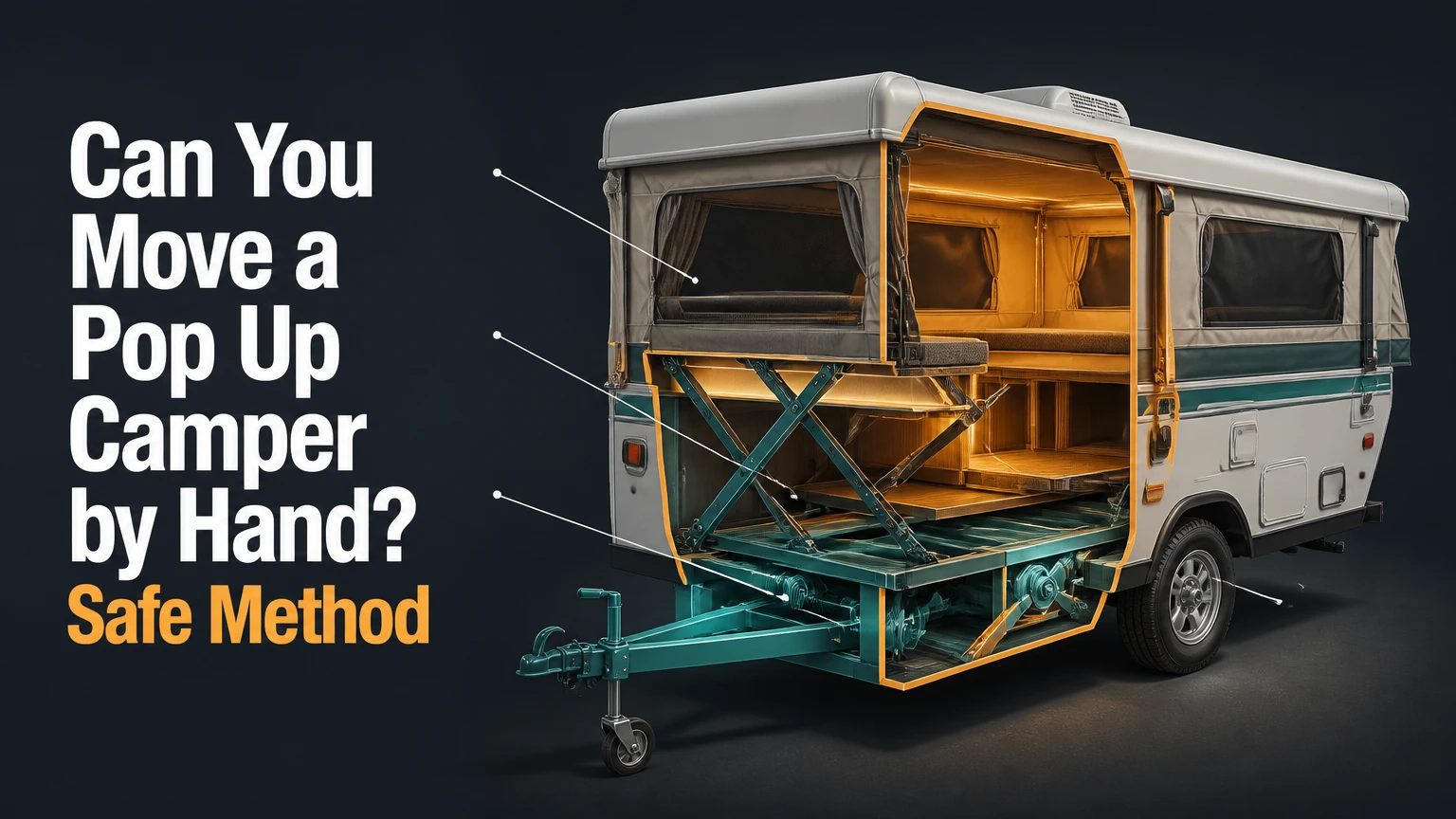
Yes, you can move a pop-up camper by hand when the camper is light, the tires and bearings are sound, and the route is level with a firm surface. A small unloaded camper may move with two adults, while a heavier or loaded camper usually needs a tongue-weight-rated trailer dolly, a winch, or a powered mover.
Key Facts at a Glance
- A pop-up camper’s typical tongue weight is about 10%-15% of its loaded trailer weight.
- A hand dolly supports the coupler and tongue weight, not the camper’s entire trailer weight.
- Flat concrete is substantially easier to cross than grass, loose gravel, sand, or mud.
- A disconnected camper may have no tow-vehicle braking system, so a slope can create a runaway trailer.
- A dolly’s rated capacity must exceed the measured tongue weight, with the manufacturer’s instructions controlling the final limit.
- Chocks must remain installed until the camper is secured, and they must be replaced before the dolly is removed.
Can You Move a Pop-Up Camper by Hand?
A pop-up camper can be moved manually for short repositioning tasks, such as aligning it in a garage or shifting it on a level storage pad. Manual movement becomes impractical when the camper is heavily loaded, the ground is soft, the route is narrow, or the trailer must travel downhill without a mechanical stopping method.
The most important distinction is between moving the tongue and pushing the whole trailer. A coupler-mounted dolly lifts or supports the front of the trailer, allowing the camper’s own tires to roll. It does not eliminate rolling resistance, tire drag, bearing problems, or downhill momentum.
A typical 1,200-pound loaded pop-up may have 120-180 pounds of tongue weight. A 2,500-pound loaded camper may place 250-375 pounds on the tongue. Those figures can exceed the comfortable lifting ability of one adult, even though the trailer’s full weight remains on its axle.
When Is Manual Movement Reasonable?
Manual movement is reasonable when all of the following conditions apply:
- The route is level or has only a negligible grade.
- The surface is concrete, asphalt, or compacted hard ground.
- The camper’s tires hold air and roll without dragging.
- The coupler, tongue jack, dolly, and frame are rated for the load.
- At least one person can control the tongue while another controls the wheels or chocks.
- The destination can be secured immediately.
A 1%-2% driveway grade can still produce dangerous momentum, particularly when the trailer is pointed downhill. There is no universal “safe” slope percentage because tire condition, surface grip, trailer weight, dolly design, and stopping space all change the result.
What Determines How Hard a Pop-Up Camper Is to Move?
Camper weight, tongue weight, terrain, wheel condition, and direction of travel determine manual effort. A lightweight trailer on smooth concrete can be manageable, but the same trailer can become difficult on wet grass because the dolly wheel sinks and the tires deform against the ground.
Weight and Tongue Weight
Use the camper’s loaded trailer weight, not only its advertised dry weight. Water, propane, batteries, bedding, food, and camping equipment can add 200-600 pounds to a small trailer.
The expected tongue-weight range is:
[ \text{Tongue weight} = \text{loaded trailer weight} \times 0.10\text{ to }0.15 ]
| Loaded camper weight | Typical tongue weight | Practical manual assessment |
|---|---|---|
| 900 pounds | 90-135 pounds | Two adults may reposition it on level concrete |
| 1,200 pounds | 120-180 pounds | Heavy-duty dolly preferred for solo control |
| 1,800 pounds | 180-270 pounds | Use a rated ratchet dolly or powered aid |
| 2,500 pounds | 250-375 pounds | Avoid pure muscle movement, especially solo |
| 3,000 pounds | 300-450 pounds | Use a powered mover, winch, or tow vehicle |
Tongue weight is not a lifting target if the jack or dolly carries it, but it remains a steering and control load. A small jack caster may support the load while sinking into soil or twisting sideways.
Surface, Grade, and Tire Resistance
Rolling resistance rises when tires sink, deform, or encounter obstacles. A dry concrete slab offers predictable rolling, while wet lawn can combine soil deformation with poor traction.
| Surface | Typical manual difficulty | Recommended wheel or aid | Main failure risk |
|---|---|---|---|
| Smooth concrete | Low for 900-1,500 pounds | Solid or pneumatic dolly tire | Runaway on a grade |
| Asphalt driveway | Low to moderate | Pneumatic tire, 8-12 inches | Dolly tire marks or soft asphalt |
| Compacted gravel | Moderate to high | Wide pneumatic tires | Caster deflection and rutting |
| Dry grass | High | Wide tire plus 2×6 boards | Wheel sink and loss of traction |
| Wet grass or mud | Very high | Winch or powered mover | Trailer sliding sideways |
| Sand | Very high | Tow vehicle or track mover | Tire and dolly sinkage |
| Sloped concrete | High risk | Locked ratchet dolly or winch | Uncontrolled downhill movement |
The caster wheel size matters more than many owners expect. A narrow 5-inch caster can sink where a 10-inch pneumatic wheel continues rolling, but a larger wheel does not make an unsafe slope safe.
Wheel, Bearing, and Brake Condition
Inspect the trailer before applying force. A seized wheel bearing, underinflated tire, dragging electric brake, or bent axle can make a light camper feel impossibly heavy.
Check the tire sidewalls for cracking, verify cold inflation against the trailer or tire specification, and confirm that both wheels rotate freely. Do not rely on a tongue dolly to compensate for a dragging axle or damaged wheel.
Which Tool Should You Use?
A trailer dolly is the usual choice for a level, firm route, while a ratchet, winch, or powered mover becomes preferable as weight, distance, slope, or surface difficulty increases. Tool capacity refers to the manufacturer’s stated trailer or tongue rating, so the product manual must be checked before purchase.
| Method or tool | Typical purchase cost | Typical rating or use | Suitable route |
|---|---|---|---|
| Two-person manual push | $0 | 900-1,500 pounds on level ground | Concrete or asphalt |
| Basic hand trailer dolly | $60-$150 | Often 600-1,000 pounds of tongue load, depending on model | Short, flat hard-surface moves |
| Heavy-duty ratchet dolly | $200-$450 | Model-specific, often used for 1,000-2,500-pound trailers | Firm surfaces and controlled slight grades |
| Chain-drive trailer mover | $300-$700 | Model-specific mechanical advantage | Precise garage positioning |
| Manual winch and anchor | $80-$250 | Determined by line pull and anchor | Slopes or straight-line positioning |
| Battery-powered trailer mover | $600-$2,000 | Model-specific trailer weight | Frequent or solo repositioning |
Hand Dolly
A basic hand dolly is suitable when the tongue load is within its rating and the surface is hard. Pneumatic tires usually perform better than small rigid casters on cracks, gravel, and threshold lips.
A dolly handle can swing sharply if the trailer pivots or a wheel strikes an obstruction. Keep hands on the handle, keep feet away from the tires, and move at walking speed. Never use a dolly that lacks a secure coupler connection or has a bent handle.
Ratchet or Chain-Drive Dolly
A ratchet or chain-drive dolly adds mechanical advantage and can provide controlled incremental movement. Some models include a brake or locking mechanism, but that feature does not automatically make every slope safe.
The practical advantage is stopping control. The operator can crank a few inches, lock the mechanism, inspect alignment, and continue. That precision helps when placing a camper between a wall and a garage door, but it does not replace wheel chocks or a properly anchored winch.
Winch or Powered Mover
A winch is often safer than pushing when the route slopes toward a building or when one person must work alone. The anchor must be rated, immovable relative to the trailer, and aligned with the intended path.
A battery-powered mover is the better long-term solution for frequent repositioning. It costs more and still requires chocks, a clear route, and a safe stopping plan, but it reduces back strain and gives better directional control than human pushing.
How Do You Move a Pop-Up Camper by Hand Safely?
To move a pop-up camper by hand, inspect and chock the trailer, disconnect it correctly, attach a rated moving device, clear the route, remove chocks only under control, move slowly, and secure the camper before detaching the tool. A simple level-surface move usually takes 10-20 minutes when the equipment is ready.
Before You Start
| Requirement | Typical specification |
|---|---|
| People | Two adults for a light camper, three for difficult positioning |
| Time | 10-20 minutes for setup and a short move |
| Chocks | Four heavy-duty rubber or molded chocks |
| Moving aid | Tongue dolly rated above measured tongue load |
| Route protection | Two or more 2×6 boards, traction mats, or steel plates |
| Personal protection | Closed-toe footwear and work gloves |
| Inspection | Tire pressure, wheel rotation, coupler, jack, and frame |
Do not attempt the procedure if the route ends at an open slope, a public roadway, a drop-off, or a location where the trailer cannot be chocked immediately.
Step 1: Measure the Load and Inspect the Route
Confirm the camper’s loaded weight from a scale ticket, manufacturer information, or a conservative estimate. Walk the entire route and identify cracks, drainage channels, wet patches, loose gravel, slopes, overhead obstructions, and the final chocking position.
You will know the route is prepared when every person can describe the travel direction, stopping location, and emergency command. A common mistake is checking only the first few feet and discovering a sideways slope near the garage.
Step 2: Chock Both Sides of the Wheels
Place chocks tightly against the front and rear of the tires before disconnecting the tow vehicle. If the trailer is on any grade, use chocks on both sides of both tires and add a secondary restraint such as a winch or vehicle connection.
The chocks should touch the tread firmly without requiring the trailer to roll into them. A common mistake is using one lightweight plastic wedge on the downhill side, which may slide on smooth concrete.
Step 3: Disconnect the Tow Vehicle Correctly
Set the tow vehicle’s parking brake, keep the trailer chocked, unplug the 7-pin connector, and disconnect the safety chains. Disconnect the breakaway cable from the tow vehicle only after the tow vehicle is secure and separated from the trailer.
The breakaway system is an emergency braking device, not a parking brake. Follow the trailer and brake-controller manufacturer’s instructions because some electric-brake systems may require a charged battery and a working breakaway switch during handling.
Step 4: Lower the Tongue Onto a Rated Dolly
Raise the coupler clear of the hitch ball with the tongue jack, move the tow vehicle away, and position the dolly under the coupler. Lower the coupler fully onto the dolly ball or attachment point, close the latch, and install the retaining pin or safety feature.
You will know the connection is secure when the coupler cannot lift off the dolly ball and the dolly remains aligned with the tongue. A common mistake is moving with the coupler resting loosely on a jack head rather than locked to the dolly.
Step 5: Prepare Soft Ground and Obstacles
Lay boards or traction mats across grass, gravel, or a shallow threshold. Use boards wide enough to support the dolly tire without allowing the tire to roll off, and place enough length to cover the full travel path.
A typical 2×6 board is useful for a short straight move, but a wider 2×8 or purpose-built mat gives better lateral stability. A common mistake is placing a single board only beneath the starting point, leaving the dolly to sink after the first rotation.
Step 6: Remove Chocks Only With Control
Stand at the dolly handle with both hands, keep the trailer aligned, and have a second person remove the chocks on command. If the trailer can roll downhill, connect the winch or engage the dolly’s verified locking mechanism before removing any chock.
You will know the trailer is controlled when it remains stationary after the chocks are removed. A common mistake is relying on body weight to stop a moving camper, which can cause a crush injury or a fall.
Step 7: Move at Walking Speed and Rechock
Push or pull through the dolly handle and the steel tongue, never through aluminum siding, plastic body panels, roof hardware, stabilizer jacks, or the canvas. Use short movements, stop at every obstacle, and communicate with one person giving commands.
Reinstall the chocks as soon as the camper reaches its final location, then lower stabilizers if appropriate and keep the dolly attached until the trailer is stable. The move is complete only when the camper cannot roll and the coupler is safely supported.
What Should You Never Do?
Never push a pop-up camper by its roof, plastic end cap, canvas, stabilizer jack, or thin exterior skin. Those parts are not designed to transmit horizontal force and can crack, bend, tear, or pull away from the frame.
Never place a person downhill from an unsecured camper. A disconnected trailer can gain momentum faster than an adult can react, even on a driveway that appears nearly flat.
Never exceed the dolly’s rating, lift a tongue with an improvised jack point, or use a vehicle bumper as a winch anchor without confirming its structural rating. Manufacturer capacity labels and instructions take priority over generic internet limits.
An expert rule of thumb is to plan for the worst surface on the route, not the average surface. A camper that rolls easily across 30 feet of concrete may fail at the final 4 feet of wet lawn.
How Do You Move a Pop-Up Camper on Grass, Gravel, or a Slope?
Grass and gravel require wide pneumatic wheels, boards, or traction mats, while a slope requires positive mechanical restraint. Pure pushing is appropriate only for a short, level route with predictable traction and enough people to control the trailer.
For grass, reduce wheel sinkage with boards and avoid wet ground. For gravel, remove loose stones from the path and use a dolly with larger pneumatic tires. For a slope, position the trailer so the winch controls travel toward the destination rather than attempting to hold it by hand.
Situational Method Table
| Situation | Preferred method | Minimum control measure | Stop-work condition |
|---|---|---|---|
| Level concrete, 1,200-pound camper | Two-person push or dolly | Four chocks and clear commands | Wheel drag or unexpected pivot |
| Flat lawn, 1,200-pound camper | Dolly over boards | Wide pneumatic tire | Board shifts or caster sinks |
| Compact gravel, 1,800-pound camper | Ratchet dolly | Chocks plus slow incremental cranking | Dolly wheel cuts into gravel |
| Downhill driveway | Winch or powered mover | Rated anchor and secondary chocks | Brake or anchor cannot hold |
| Narrow garage entry | Chain-drive dolly | Spotter at each side | Less than 12 inches of clearance |
| Wet soil or sand | Tow vehicle or powered track mover | Recovery plan and solid anchor | Trailer begins sliding sideways |
Do not treat a narrow driveway as merely a steering problem. It is also a clearance, hand-placement, and escape-route problem.
How Much Does Manual Camper Movement Cost?
Manual movement costs $0 when two adults reposition a light camper on level concrete, $60-$150 for a basic dolly, and approximately $200-$700 for a ratchet or chain-drive unit. A winch, boards, chocks, or traction mats can add another $80-$300, excluding professional labor.
| Approach | Equipment cost | Typical setup time | Best financial use |
|---|---|---|---|
| Muscle power | $0 | 5-10 minutes | One occasional level move |
| Basic dolly | $60-$150 | 10-15 minutes | Lightweight storage positioning |
| Ratchet dolly | $200-$450 | 10-20 minutes | Repeated precise movement |
| Winch system | $80-$250 | 20-45 minutes | Controlled straight-line movement |
| Powered mover | $600-$2,000 | 15-30 minutes | Frequent solo repositioning |
| Professional repositioning | Often $100-$400 locally | 30-90 minutes | Heavy, sloped, or obstructed routes |
Prices are typical retail or service ranges and vary by region, rating, brand, and installation. A cheap dolly is a poor bargain if its wheels sink, its coupler does not fit, or its rating does not cover the measured tongue load.
What Are the Best Alternatives to Pushing?
The best alternative depends on the route: a tow vehicle is simplest for long or rough movement, a winch controls a slope, and a powered trailer mover reduces repeated physical effort. Manual pushing remains the least expensive method, but it provides the weakest braking margin.
A tow vehicle should be used whenever the camper must cross soft terrain, travel more than a short storage distance, or move near traffic. A powered mover is useful for level garage placement but still needs a reliable parking and chocking procedure.
Manual Movement Versus Alternatives
| Option | Typical control | Terrain capability | Typical cost | Main limitation |
|---|---|---|---|---|
| Two-person push | Low | Level hard ground | $0 | No mechanical braking |
| Hand dolly | Moderate | Concrete and firm asphalt | $60-$150 | Limited on soft ground |
| Ratchet dolly | High incremental control | Firm ground, minor grade | $200-$450 | Slow and model-dependent |
| Winch | High along one line | Slopes and straight paths | $80-$250 | Requires rated anchor |
| Powered mover | High steering control | Firm ground, some uneven surfaces | $600-$2,000 | Battery and traction limits |
| Tow vehicle | Highest overall | Roads, gravel, grass, and long routes | Existing vehicle cost | Requires hitching space |
An honest limitation matters: a manual dolly is not a replacement for a tow vehicle in mud, deep sand, or a steep driveway. It is a positioning tool for controlled, low-speed movement.
What Problems Can Occur During a Manual Move?
The most common failures are wheel sinkage, dolly detachment, unexpected trailer pivoting, tire drag, and uncontrolled downhill movement. Each problem indicates that the route or equipment has exceeded the manual method’s control margin.
Dolly Wheel Sinks
Stop immediately if the caster or tire sinks into grass or gravel. Rechock the trailer, place a board or traction mat under the wheel, and reduce the route’s soft section rather than forcing the handle downward.
Trailer Pivots Sideways
A sideways pivot usually results from uneven resistance, a misaligned dolly, or one tire entering a rut. Rechock, realign the dolly with the trailer centerline, and use a spotter at the rear corners.
Coupler Lifts Off
If the coupler rises or shifts on the dolly ball, stop and chock the wheels. Reconnect the latch and retaining pin, then inspect the coupler for wear. Do not continue while holding the tongue down manually.
Wheel Will Not Roll
A locked or dragging wheel can indicate a failed bearing, seized brake, low tire, or axle damage. Do not increase pushing force. Jack and inspect the wheel using proper support, or have a trailer technician diagnose it.
Camper Starts Rolling
Do not try to catch a moving camper. Move laterally away from its path, warn others, and let the chocks, winch, or mechanical lock stop it. Afterward, inspect the dolly, coupler, tires, frame, and chocks before attempting recovery.
A practitioner’s rule is simple: if the operator must lean forward to keep the camper moving or backward to keep it stopped, the method is already outside a comfortable safety margin.
Can One Person Move a Pop-Up Camper?
One person can move a lightweight pop-up camper on level concrete with a properly fitted dolly, but solo movement is unsuitable when the camper is heavy, the route is sloped, or the destination requires tight turning. A second adult is valuable as a spotter and emergency chock operator, even when the dolly provides propulsion.
Solo operators should use a winch or powered mover if any downhill travel is involved. The person must remain beside the handle, not between the trailer and a wall, vehicle, or fixed object.
Two-person communication should use clear commands such as “stop,” “forward,” “left,” and “chock.” Avoid simultaneous steering instructions from multiple people because conflicting commands cause abrupt pivots.
How Do You Choose the Right Method?
Choose based on loaded weight, tongue weight, terrain, grade, distance, and whether a person can escape the trailer’s path. The safest low-cost method is a rated pneumatic-tire dolly on level hard ground; the safest method for a slope is a rated winch or powered mover with positive restraint.
| Camper and route profile | Recommended choice | Why |
|---|---|---|
| Under 1,200 pounds, level concrete | Two-person push or basic dolly | Low rolling resistance and short distance |
| 1,200-1,800 pounds, level asphalt | Heavy-duty pneumatic dolly | Supports tongue load with better wheel travel |
| 1,800-2,500 pounds, tight garage | Ratchet or chain-drive dolly | Incremental steering and positioning |
| Any weight on a downhill route | Winch or powered mover | Positive restraint reduces runaway risk |
| Any weight on wet grass or sand | Tow vehicle or track-capable mover | Human force cannot prevent sinkage reliably |
| Frequent solo garage repositioning | Battery-powered mover | Repeatable steering with less strain |
Check the trailer manufacturer’s owner’s manual, dolly manual, and tire information before relying on generic weight ranges. The actual loaded weight and equipment rating matter more than the camper’s model name.
FAQ
Can You Push a Pop-Up Camper Without a Dolly?
You can push a very light pop-up camper without a dolly only on a level, firm surface with at least two capable adults and a clear escape route. The tongue may still be heavy, and the frame offers limited handholds. A dolly is safer because it supports the coupler and improves steering.
Can You Move a Pop-Up Camper With the Roof Raised?
A raised roof increases the camper’s height and can increase wind exposure, but the main concern is clearance and structural loading. Keep the roof lowered for storage movement unless the manufacturer specifically permits movement while raised, and avoid pushing on roof components or lift arms.
Should You Remove the Battery Before Moving the Camper?
Remove or secure loose batteries, propane cylinders, cargo, and interior equipment according to the owner’s manual before manual repositioning. A battery can add 40-80 pounds near the tongue, changing tongue weight, while unsecured cargo can shift and affect balance during turning.
How Far Can You Move a Camper by Hand?
A practical manual distance is usually 10-50 feet on a hard, level surface. Longer movement increases fatigue, tire heating, steering errors, and the chance that a small obstruction becomes a control problem. Use a tow vehicle or powered mover for distances beyond storage positioning.
Can a Pop-Up Camper Roll Backward?
A pop-up camper can roll backward when disconnected, especially on a grade or when the wheels are not chocked. Trailer brakes may not operate as a parking brake after separation from the tow vehicle. Chock both sides of the tires and use a winch or lockable mover on slopes.
Do You Need Trailer Brakes When Moving a Camper by Hand?
Trailer brakes do not replace chocks or a mechanical restraint during hand movement. Some pop-up campers have electric brakes, while others do not, and brake operation depends on the trailer battery, breakaway system, and controller. Verify the equipment before treating brakes as part of the stopping plan.
The Bottom Line
Can you move a pop up camper by hand? Yes, when the loaded trailer is light enough, the route is level and firm, and the tongue is controlled by a properly rated dolly or by multiple adults. Use boards on soft ground, a winch or powered mover on slopes, and chocks before disconnecting or releasing any equipment. If the camper starts to roll, pivots unexpectedly, sinks, or requires more force than planned, stop and change the method rather than pushing harder.