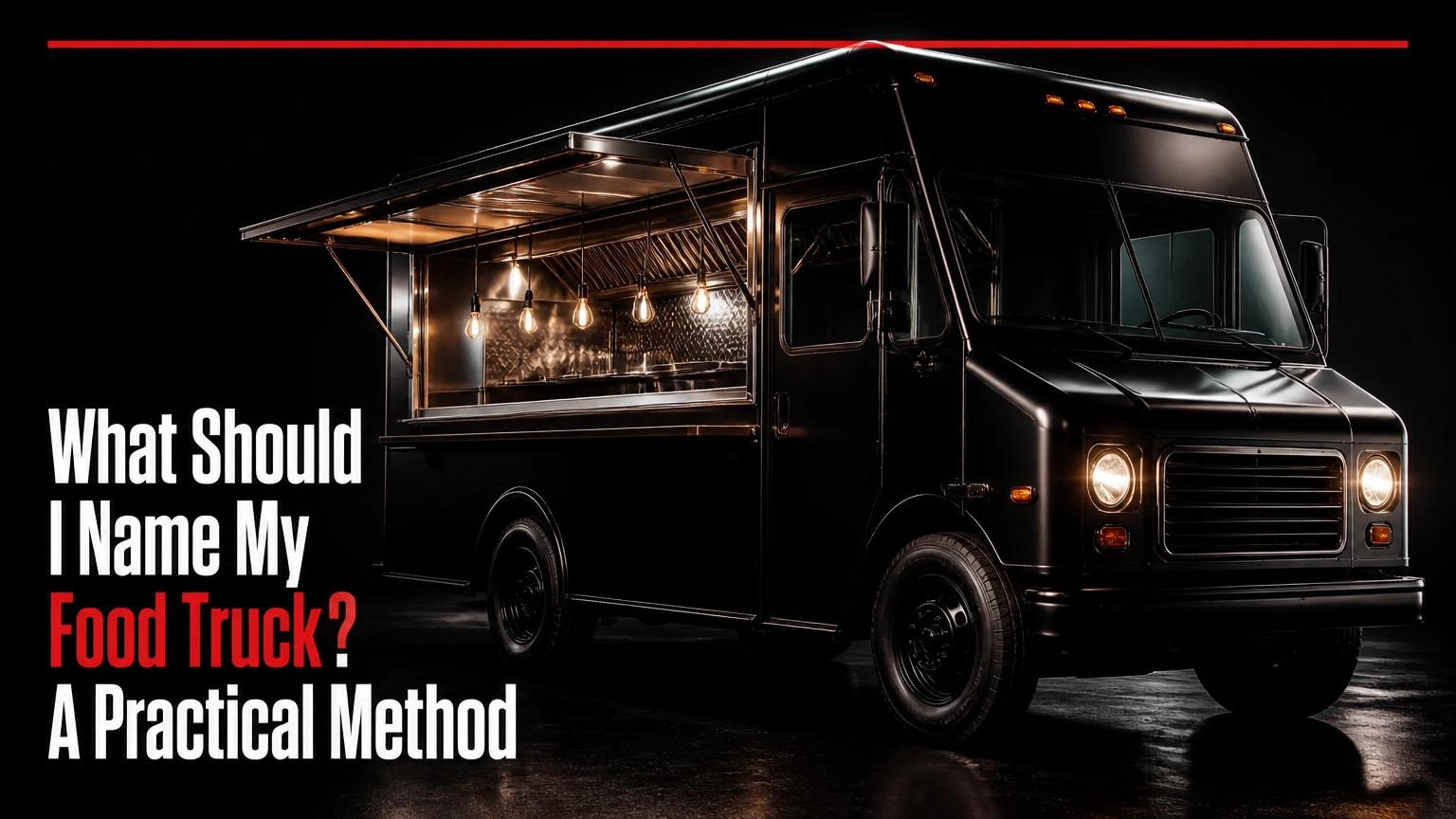
The best food truck name is short, easy to pronounce, distinctive in local search, and clear about your food or experience. Choose a name that passes four tests: customers understand it quickly, remember it after one hearing, can spell it online, and you can use it without creating legal or brand confusion.
Key Facts at a Glance
- A food truck name should usually contain three words or fewer, although a longer founder or heritage name can work with a short descriptor.
- A descriptive tagline can explain the cuisine without forcing the legal brand name to become overly literal.
- A typical naming project takes 7 focused days for selection and 15-30 days for broader legal, domain, and social vetting.
- The USPTO trademark search identifies possible conflicts, but search results do not replace a likelihood-of-confusion assessment by a trademark professional.
- A .com domain commonly costs about $10-$20 per year, while a DBA filing often costs approximately $20-$150 depending on location.
- The strongest name is not always the cleverest name. It is the name customers can recall, search, pronounce, and associate with one clear food experience.
What Makes a Food Truck Name Effective?
A strong food truck name connects a verbal brand identifier with a clear customer promise. The identifier creates memorability, while a descriptor such as “Oaxacan Street Food” or “Smash Burgers and Fries” explains the menu when the name alone is not sufficiently clear.
Food trucks need names that work in three environments: a vehicle viewed from a distance, a spoken recommendation, and a small digital listing. A name that looks excellent on a wrap can fail when a customer types it into Google Maps, while a highly searchable literal name can be impossible to protect or expand.
The practical target is a name with one dominant idea. “Cedar Smoke BBQ” communicates place, cooking method, and cuisine. “Velocity Eats” has more flexibility, but requires a descriptor and repeated exposure before customers know what they are buying.
The Four-Part Name Formula
| Component | Recommended specification | Example |
|---|---|---|
| Core identifier | 1-3 memorable words | Cedar Smoke |
| Cuisine signal | 1-4 descriptive words | Korean Fried Chicken |
| Audience or occasion | 1 concrete use case | Late-Night Tacos |
| Brand personality | 1 visible emotional cue | Mama Jo’s |
A food truck can use a compact public-facing architecture: Cedar Smoke as the brand, Texas-style barbecue as the descriptor, and cedarsmokebbq.com as the domain. That structure preserves future menu flexibility while giving customers immediate context.
How Should You Brainstorm Food Truck Names?
Start with a 50-word vocabulary bank, then combine words according to your cuisine, audience, location, and operating model. Brainstorming works better when the words describe real brand assets, such as ingredients, cooking methods, family history, neighborhood references, service occasions, and sensory qualities.
Write five columns before generating names:
- Food: bao, brisket, arepa, ramen, churro, oyster.
- Technique: fired, rolled, grilled, smoked, pressed, battered.
- Movement: roaming, rolling, route, curb, wagon, mobile.
- Place: river, market, avenue, harbor, mesa, district.
- Feeling: communal, spicy, bright, midnight, handmade, generous.
Generate at least 50 raw combinations without judging them. Then use formulas such as:
- Technique + food: Pressed Panini, Ember Tacos.
- Place + food: Harbor Bao, Mesa Arepas.
- Movement + cuisine: Roaming Ramen, Rolling Kerala.
- Founder + specialty: Rosa’s Birria, Malik’s Jerk.
- Unexpected contrast: Tiny Feast, Slow Rush Coffee.
Puns can improve recall, but they should not obscure the menu. “Wok This Way” is memorable for an Asian-food concept, whereas “Wok Around the Clock” may imply late-night service that the business cannot consistently provide.
Which Naming Style Fits Your Business?
| Naming style | Customer understanding | Typical legal distinctiveness | Menu flexibility | Strongest use |
|---|---|---|---|---|
| Literal, such as The Burger Bus | High within 2 seconds | Low to moderate | Low | Single-cuisine lunch truck |
| Punny, such as Wok This Way | Moderate within 3 seconds | Moderate | Moderate | Social festivals and casual audiences |
| Founder-led, such as Mama Rossi’s Pasta | Moderate within 4 seconds | Moderate to high | Moderate | Family recipes and personal storytelling |
| Geographic, such as Bay Area Bites | High for local relevance | Low to moderate | Moderate | Regional events and local loyalty |
| Abstract, such as Curb Orbit | Low without a descriptor | Moderate to high | High | Multi-truck or franchise plans |
The table describes practical tendencies, not legal guarantees. A descriptive name may be difficult to register as a trademark, while a distinctive name can still conflict with an earlier mark in a related food-service category.
What Should I Name My Food Truck?
Choose a name that identifies your strongest food promise without locking the business into a narrow menu or location. For most first-time operators, the best pattern is a distinctive two-word brand paired with a plain-language cuisine descriptor.
Use this decision guide:
| Business situation | Recommended naming pattern | Example | Reason |
|---|---|---|---|
| One specialty, such as grilled cheese | Direct specialty plus motion word | Melt Route | Immediate menu recognition |
| Broad menu within one cuisine | Distinctive brand plus cuisine descriptor | Juniper Kitchen, Latin Street Food | Supports menu additions |
| Family or heritage concept | Founder or family name plus dish | Ana’s Arepas | Builds an authentic origin story |
| Premium chef-led truck | Ingredient or technique plus restrained noun | Ember & Salt | Signals craft and higher price |
| Planned expansion to catering | Flexible brand plus service descriptor | Common Table Mobile Kitchen | Works beyond the vehicle |
Avoid selecting a name solely because a generator produced it. Business-name generators can provide combinations, but they cannot judge pronunciation, cultural meaning, trademark similarity, local reputation, or whether the name fits a 12-foot truck wrap.
Should the Cuisine Be in the Name?
Include the cuisine in the name when customers must decide quickly and the menu is unlikely to change. Omit it from the core name when the business may add catering, packaged goods, multiple cuisines, or additional vehicles.
A useful compromise is the descriptive lockup:
Juniper Kitchen
Seasonal Bowls and Flatbreads
The brand remains flexible, while the descriptor answers the immediate customer question. A descriptor can change later without replacing the entire identity, although any registered business name, signage, permits, and customer-facing listings still require consistent updates.
How Do You Test a Food Truck Name?
Test each finalist with distance, speech, search, visual, and audience checks before paying for design or registration. A name should score at least 4 out of 5 on each core test, with legal availability treated as a pass-or-fail requirement rather than an average score.
| Test | Method | Pass condition | Failure signal |
|---|---|---|---|
| Billboard test | View a text mockup from 50 feet | Read correctly in 3 seconds | Thin letters or ambiguous wording |
| Telephone test | Say the name once in a noisy setting | 4 of 5 listeners spell it correctly | Repeated explanations |
| Search test | Ask 5 people to find it online | 4 find the intended result first | Dominant unrelated businesses |
| Menu test | Show name without description for 5 seconds | 4 of 5 identify the food category | Brand feels disconnected |
| Expansion test | Add two plausible future menu items | Both sound natural under the name | Name becomes inaccurate |
Run the telephone test with people who do not already know the concept. Friends and family often correct for your intended spelling because they have heard the backstory; strangers reveal what customers will actually type.
How Long Should a Food Truck Name Be?
Aim for one to three words and approximately 8-20 letters in the core brand, because short names fit truck signage, social handles, menu headers, and spoken recommendations more reliably. A longer name can work when the phrase has strong rhythm or a meaningful founder story.
Count the descriptor separately. “Mango House Caribbean Kitchen” has four words, but “Mango House” remains the memorable brand and “Caribbean Kitchen” explains the offer.
Does the Name Work on a Truck Wrap?
A usable truck name remains legible when printed in a high-contrast design with a minimum practical letter height of about 8-12 inches on the main side panel. The exact size depends on viewing distance, vehicle layout, typeface, and installation quality.
Create three rough mockups:
- A horizontal side-panel version at 50 feet.
- A square social-avatar version at 1080 by 1080 pixels.
- A delivery-app or map-listing version at roughly 100 pixels wide.
Do not approve a name that depends on cursive lettering, punctuation, unusual capitalization, or a visual joke customers cannot read from a moving car.
How Do You Check a Food Truck Name Legally?
Search the USPTO trademark database, state business registry, county DBA records, domain providers, social platforms, and local map listings in that order. A clear business-registry result does not prove trademark safety, because company registration and trademark rights answer different legal questions.
The United States Patent and Trademark Office defines a trademark as “a word, phrase, symbol, design, or combination of these things that identifies your goods or services.” The USPTO also warns that trademark conflicts depend on the relatedness of goods and services and the likelihood that consumers could be confused.
Use this clearance sequence:
- Search the exact name in the USPTO Trademark Search system.
- Search similar spellings, singular and plural forms, sound-alikes, and translations.
- Review live marks connected with restaurants, mobile food services, catering, beverages, and packaged foods.
- Search your state Secretary of State database and county fictitious-name records.
- Search Google Maps, Yelp, Instagram, TikTok, Facebook, and event directories.
- Check the domain and reserve the closest consistent version.
- Ask a trademark attorney to review the candidates before filing or investing in a wrap.
The USPTO’s current standard trademark application fee is generally $350 per class, subject to the application requirements and possible additional fees. The commonly repeated $250-$350 range is outdated for the base fee. A federal application also does not guarantee registration.
What Is the Difference Between a DBA and a Trademark?
A DBA allows a business to operate publicly under a name, while a trademark identifies the source of goods or services and may provide broader rights. A DBA filing usually has local or state scope and does not automatically prevent another business from using a similar name elsewhere.
| Protection or asset | Typical cost | Typical timing | What it does not prove |
|---|---|---|---|
| County or state DBA | $20-$150 | 1 day-6 weeks | Trademark ownership |
| State entity registration | $50-$500 | Same day-4 weeks | Nationwide exclusivity |
| .com domain | $10-$20 per year | 5-15 minutes | Trademark clearance |
| Federal trademark application | $350 per class base fee | Months to more than 1 year | Guaranteed registration |
| Social handle reservation | $0 on major platforms | 5-30 minutes | Exclusive brand rights |
Fees and processing times vary by jurisdiction, filing basis, application quality, and office workload. Treat these figures as typical planning ranges, not quotes.
Which Food Truck Name Strategy Is Best?
A literal name wins for immediate comprehension, a distinctive hybrid wins for most independent operators, and an abstract name wins only when the owner can support sustained branding. The right choice depends on menu stability, marketing budget, expansion plans, and the need for protectable intellectual property.
| Strategy | Best customer outcome | Main risk | Typical marketing burden | Recommended decision |
|---|---|---|---|---|
| Literal | Menu understood in 2 seconds | Low distinctiveness | Low | Choose for one narrow specialty |
| Punny | Recall after one social exposure | Translation or taste mismatch | Medium | Choose when humor fits the audience |
| Founder-led | Personal trust and story | Owner dependence | Medium | Choose for heritage recipes |
| Geographic | Local recognition in 1 market | Limits relocation | Low to medium | Choose for a fixed regional route |
| Abstract | Strong future flexibility | Food category unclear | High | Choose for a scalable brand system |
A counterintuitive practitioner rule is that adding a generic word does not necessarily make a risky name safer. “The Taco Company” may sound different from “Taco Company,” but the dominant wording remains highly descriptive and difficult to distinguish.
Another rule: check the spoken name before the logo. Design can improve legibility, but design cannot reliably fix a confusing pronunciation, an unintended double meaning, or a search result dominated by another company.
What Costs and Time Should You Expect?
Budget approximately $10-$20 for a domain, $20-$150 for a typical DBA, $350 per class for the USPTO base application fee, and potentially hundreds to several thousand dollars for professional trademark advice. A focused selection can take 7 days, while thorough clearance and registration decisions commonly extend to 15-30 days or longer.
| Naming task | Typical effort | Typical cost | Completion checkpoint |
|---|---|---|---|
| Concept worksheet | 60-90 minutes | $0-$50 | Cuisine, audience, and tone documented |
| 50-name brainstorm | 2-4 hours | $0-$100 | At least 10 viable candidates remain |
| Customer testing | 1-2 days | $0-$100 | 20 target customers rank finalists |
| Digital checks | 2-4 hours | $10-$100 | Domain and handles reserved |
| Preliminary legal search | 1-3 days | $0-$500 | Conflicting live marks identified |
| Final registration decisions | 1-4 weeks | $20-$350 per filing | DBA and trademark strategy selected |
Do not spend $5,000 on a truck wrap before checking the name. Reprinting signage after a conflict is more expensive than a careful search, even when the original name feels emotionally perfect.
What Mistakes Make a Food Truck Name Fail?
The most expensive naming mistakes are narrow menu promises, confusing similarity, difficult spelling, accidental cultural references, and premature design investment. Each failure can be detected before launch with a short test.
The Menu Trap
“Strictly Sliders” creates a problem if sales data later supports tacos, bowls, or catering. Use “slider” in the descriptor or product line when the specialty is central but future expansion remains plausible.
The Copycat Problem
A name does not need to be identical to create customer confusion. Similar sound, appearance, meaning, or food-service context can matter, especially when both businesses operate in the same city.
The Localization Problem
A phrase that works in English may sound offensive, childish, or nonsensical in Spanish, Mandarin, Arabic, French, or the language associated with the cuisine. Ask a fluent speaker who is outside the founding team to review the name and proposed slogan.
The Handle Problem
A taken Instagram handle is not automatically a reason to abandon a name, but an inconsistent digital identity can split discovery signals. Prefer a short modifier such as “eat,” “get,” “go,” or the city abbreviation, then use the same modifier everywhere.
The Design Problem
An ornate script can make a name unreadable on a truck, while a clever icon can hide the cuisine. Test black text on white, white text on a dark background, and the actual vehicle color before approving the wrap.
How Can You Choose Between Three Finalists?
Choose the finalist with the highest weighted score after removing any candidate with a serious legal conflict. Give clarity and distinctiveness the greatest weight, because a beautiful name that customers cannot search or pronounce creates recurring acquisition costs.
Score each finalist from 1 to 5:
| Criterion | Weight | Scoring question |
|---|---|---|
| Food clarity | 25% | Can a stranger identify the offer in 3 seconds? |
| Memorability | 20% | Can the person recall it after 10 minutes? |
| Searchability | 20% | Does the intended result appear first locally? |
| Legal distinctiveness | 20% | Are similar live marks absent in related classes? |
| Expansion fit | 10% | Can two future products fit naturally? |
| Visual usability | 5% | Does the name work at 50 feet and 100 pixels? |
Multiply each score by its weight, then compare totals. A candidate scoring 5 for humor but 2 for spelling should not beat a clear, distinctive name merely because the brainstorming group laughed more.
Run a blind poll with 20 people from the target demographic. Show only the name, a one-line menu descriptor, and three questions: what food do you expect, how would you spell it, and which name would you tell a friend?
Which Name Fits Your Food Truck Business Model?
For a Chef-Led Gourmet Truck
Choose an ingredient, technique, or restrained hospitality name such as Foraged & Fired, Ember Table, or Salt Orchard. Pair the name with a direct descriptor so customers understand the price and menu category without requiring a story.
Avoid names that imply luxury if service is designed for rapid, disposable-plate transactions. Premium language raises expectations for ingredients, presentation, waiting time, and price.
For a Weekend or Part-Time Operator
Choose a high-clarity name such as Loaded Fries Co., Sizzling Skewers, or The Kettle Corn Cart. Festival customers often decide while walking, so a descriptive name can reduce the explanation required at the point of sale.
Do not include a neighborhood if the truck may operate at regional fairs. A broad service area can make a local-sounding name restrictive.
For a Franchise or Multi-Truck Plan
Choose a distinctive core name that can support city, cuisine, catering, and product modifiers. Curb Bite, Roam Kitchen, and Velo Eats have expansion potential, but each needs a prominent descriptor during the first stage of customer acquisition.
Reserve the core trademark, domain, and social naming system before launching multiple locations. A scalable name becomes costly to change after uniforms, packaging, reviews, and local listings accumulate.
What Should You Do After Selecting the Name?
Secure the digital identity, document the legal search, register the required local name, and apply the chosen name consistently across every customer touchpoint. The launch sequence matters because inconsistent spellings can divide reviews, map listings, social mentions, and direct traffic.
Use this seven-day workflow:
- Day 1: Define cuisine, audience, price level, personality, service area, and expansion plans.
- Day 2: Generate 50 words and 30 combinations.
- Day 3: Remove names that fail spelling, menu, cultural, or distance tests.
- Day 4: Select three finalists and run the blind customer poll.
- Day 5: Search USPTO records, state registries, local listings, domains, and handles.
- Day 6: Obtain legal advice if a similar mark or established local business appears.
- Day 7: Reserve the domain and handles, file the appropriate DBA, and approve the visual lockup.
Keep a dated record of searches, screenshots, rejected names, and registration documents. That file helps explain your decision later and gives a professional adviser a clearer starting point.
FAQ
Should My Food Truck Name Include My City?
Include the city when local identity drives demand and relocation is unlikely. A city name can support local recall and event marketing, but it can restrict expansion, catering outside the region, or a second truck in another market. Use the city in a descriptor or tagline when you want local relevance without making it the core brand.
Can I Use a Famous Food Phrase in My Truck Name?
A common food phrase may be usable descriptively, but a famous phrase associated with another restaurant, product, song, or organization can create legal and reputational risk. Search exact wording, sound-alikes, related food-service marks, and local businesses before using it. A trademark professional should review close conflicts.
Is a Food Truck Name Generator Worth Using?
A generator is useful for producing raw combinations quickly, but it cannot establish availability or customer fit. Use one after defining the cuisine and brand personality, then test every suggestion for pronunciation, search results, cultural meaning, domain consistency, and future menu flexibility.
Should I Use My Personal Name?
Use a personal name when the founder’s story, recipes, or visible presence drives trust. A personal name is less suitable when the owner wants to sell the business, operate anonymously, or build a brand that can expand beyond one chef. Pair a surname with a clear food descriptor when the cuisine is not obvious.
What If My Best Food Truck Name Is Already Taken?
Reject the name if an active local food business or related live trademark creates likely confusion, even when a domain remains available. If only the domain is taken, consider one consistent modifier such as “eat,” “go,” or “kitchen,” rather than adding random numbers, punctuation, or different words across platforms.
Do I Need a Trademark Before Opening?
A federal trademark is not always required before opening, but legal clearance should happen before signage, packaging, uniforms, and advertising become expensive. Local registration, common-law use, and federal trademark rights differ in scope. A food truck planning multiple markets should address trademark strategy earlier than a temporary single-event vendor.
The Bottom Line
The answer to what should I name my food truck is a distinctive, pronounceable core name supported by a clear cuisine descriptor and verified across legal, local, digital, and visual channels. Generate 50 candidates, reduce them to three, test each with strangers, complete the USPTO and local searches, and select the name that customers can remember and find without explanation.