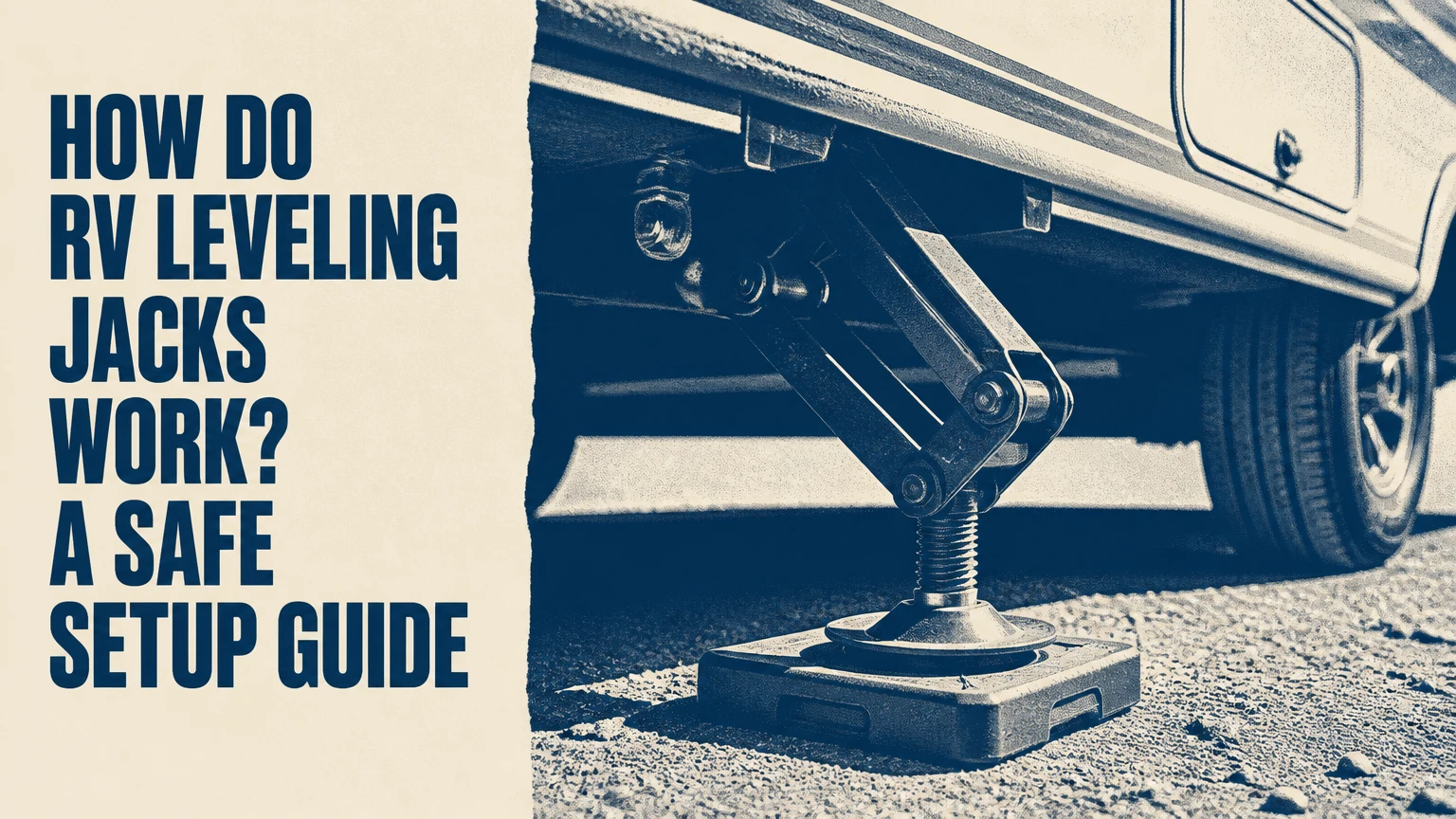
RV leveling jacks use hydraulic cylinders, electric screw drives, or manual lead screws to transfer part of an RV’s weight from its tires and suspension to supported ground. The jacks extend at selected corners, raise the low side or end within their travel limits, and stabilize the chassis after the RV reaches a level position.
Key Facts at a Glance
- True RV leveling jacks can lift designated portions of the chassis; light-duty stabilizer jacks usually cannot.
- Hydraulic systems commonly operate at approximately 2,000-3,500 psi and level large motorhomes in about 60-90 seconds.
- Automatic electric systems typically take 2-4 minutes and add less weight than hydraulic equipment.
- A jack rating is not permission to lift any corner indefinitely; the RV frame, mounting brackets, tires, and axle loading also limit safe operation.
- Leveling blocks spread pressure on soft ground and reduce the extension required from each jack.
- The parking brake, wheel chocks, battery voltage, jack pads, and manufacturer sequence are safety controls, not optional conveniences.
What Are RV Leveling Jacks?
RV leveling jacks are load-bearing supports attached to the vehicle frame or chassis that adjust the RV’s height at selected points. Their primary job is to correct side-to-side and front-to-back tilt, while their secondary job is to reduce movement after the RV is parked.
The term covers several different products. A Class A motorhome may use four hydraulic rams connected to a pump and control manifold. A fifth wheel may use electric landing gear at the front and electric rear stabilizing jacks. A travel trailer often has scissor stabilizers that reduce bounce but are not intended to raise the trailer body.
Leveling Jacks Versus Stabilizer Jacks
A leveling jack is designed to perform controlled lifting within the vehicle manufacturer’s approved lifting points. A stabilizer jack is designed mainly to resist suspension movement and frame vibration after the tires or landing gear already carry the appropriate load.
This distinction prevents a common and expensive mistake: using a thin trailer stabilizer to lift a low corner. The screw, arm, bracket, or frame rail can bend before the jack reaches its advertised static rating. The etrailer guidance commonly cited for scissor jacks also distinguishes support and stabilization from lifting a fully loaded trailer.
A tongue jack is different again. It supports and adjusts the trailer coupler height, but it is not a substitute for rear stabilizers or a four-point leveling system.
How Do RV Leveling Jacks Work?
RV leveling jacks work by converting motor torque or hydraulic pressure into vertical force at carefully selected frame points. A control panel or manual operator identifies the low corners, extends the appropriate jacks until the chassis reaches level, and then applies enough remaining support to control rocking without unloading the tires unnecessarily.
The physical process has three parts: force generation, force transmission, and ground reaction. A hydraulic pump pressurizes fluid, an electric motor rotates a screw, or a hand crank turns a lead screw. The jack foot then pushes against a pad or block, and the ground pushes back with an equal opposing force.
The chassis receives that force through a mounting bracket. Because the frame distributes the load along its rails and crossmembers, the jack does not merely lift the nearest wall. It changes the load carried by tires, axles, suspension components, and other jacks.
Why Does the Low Side Rise?
The low side rises because the extended jack creates an upward reaction force beneath the frame. Raising the low side first reduces lateral roll, after which the front or rear pair corrects the remaining longitudinal angle.
Automatic systems use position sensors, pressure changes, accelerometers, or combinations of those inputs. A sensor can report level at the chassis while the floor, countertop, or refrigerator remains slightly different because the RV structure flexes under changing loads.
What Does Hydraulic Pressure Have to Do With Capacity?
Hydraulic lifting force is approximately the system pressure multiplied by the piston area. A 3-inch-diameter piston has about 7.1 square inches of area, so 2,500 psi produces roughly 17,700 pounds of theoretical piston force before friction, geometry, relief-valve settings, and structural limits are considered.
That calculation does not establish a safe RV lifting capacity. Manufacturers must account for bracket strength, cylinder alignment, frame loading, hose ratings, and the amount of weight remaining on the tires. Hydraulic RV systems often use 2,000-3,500 psi, but the owner’s manual controls operation.
What Types of RV Leveling Jacks Are Available?
Hydraulic, electric, and manual RV leveling jacks differ in power source, speed, weight, maintenance, and suitability for a particular chassis. Hydraulic systems fit heavy motorhomes, electric systems suit many medium-size coaches and fifth wheels, and manual systems offer low-cost stabilization or limited leveling for lighter trailers.
| System type | Typical mechanism | Typical capacity or rating | Typical setup time |
|---|---|---|---|
| Hydraulic | 12-volt pump, reservoir, cylinders | 7,000-24,000 lb jack rating | 60-90 seconds |
| Electric screw | 12-volt motor, worm gear or ball screw | 2,500-5,000 lb jack rating | 2-4 minutes |
| Manual scissor | Hand crank, lead screw, folding arms | 5,000-7,500 lb static rating | 10-20 minutes |
| Landing gear | Dual electric or manual screw legs | 2,000-8,000 lb per leg, model-dependent | 2-5 minutes |
The ratings in the table are typical product ranges, not universal safe lifting values. A loaded RV can weigh more than its empty shipping specification, and the manufacturer’s gross vehicle weight rating, gross axle weight rating, and approved jack points take precedence.
How Do Hydraulic Leveling Systems Work?
Hydraulic RV leveling systems use a 12-volt electric motor to drive a pump that sends pressurized fluid through valves and hoses to steel cylinders. Opening a valve extends a selected ram; reversing the pump or opening return valves retracts the ram into a central reservoir.
Hydraulics provide high force in a compact cylinder, which explains their widespread use on Class A motorhomes and heavier Class C vehicles. Typical complete systems add approximately 150-250 pounds and may cost $2,500-$5,500 for equipment, with professional installation often adding $1,000-$2,000.
Hydraulic systems need fluid-level checks, hose inspection, cylinder-seal inspection, and clean electrical connections. A leaking hose can lower a jack rapidly, while an internal cylinder bypass can let one corner drift down over hours or days.
How Do Electric RV Leveling Systems Work?
Electric RV leveling systems use a dedicated 12-volt motor at each leg. The motor turns a worm gear, acme screw, or ball screw that extends a telescoping tube or folding leg, converting rotation into linear movement without hydraulic fluid.
Electric systems generally weigh less than hydraulics, often adding about 80-130 pounds for a complete system, and typical equipment prices range from $1,200-$3,000. Individual motors may draw 15-30 amps under heavy load, so corroded grounds, undersized wiring, or a weak battery can cause control-board errors.
Electric screw systems are practical for many fifth wheels and medium trailers, but they can stall when a leg is overloaded or extended against an excessive slope. A motor that continues running after the foot contacts the ground can damage the gearbox or shear a drive component.
How Do Manual RV Jacks Work?
Manual RV jacks use a hand crank or socket to rotate a lead screw. The screw’s mechanical advantage lets a person create substantial extension force slowly, although the operator receives no automatic level measurement or overload protection.
A four-jack manual set commonly costs $100-$300 and weighs roughly 30-50 pounds. A cordless drill can reduce setup time, but an impact driver can apply enough torque to strip a screw, deform a bracket, or overextend a leg before the operator notices.
Manual scissor jacks are best for stabilizing a trailer and making small corrections on a prepared site. They are poor choices for lifting a loaded RV several inches on a steep slope unless the specific manufacturer explicitly rates them for that operation.
How Should You Level an RV?
Level an RV by securing the vehicle, measuring both axes, correcting the low side with tire or jack blocks, deploying approved leveling jacks in the manufacturer’s sequence, and verifying the result before extending slides. A typical motorhome setup takes 5-10 minutes, while a manual trailer setup takes 10-20 minutes.
Step 1: Choose and Inspect the Site
Park on the firmest practical area, away from holes, drainage channels, soft shoulders, and edges that can collapse. Walk the intended tire and jack locations before committing the RV, because a level reading is useless if a jack foot will settle into mud overnight.
Check overhead branches, utility covers, underground service indicators, and the clearance needed for slide-outs. A site that requires more jack travel than the system allows is unsuitable even if the parking surface initially appears firm.
Step 2: Secure the RV Before Measuring
Place the transmission in Park or the approved parking gear, engage the parking brake on a motorhome, and install wheel chocks before operating any leveling system. A trailer should remain coupled to the tow vehicle until the manufacturer’s unhitching procedure says otherwise.
The parking brake interlock found on many Lippert and other motorhome systems prevents operation when the brake signal is absent. The interlock is a safety feature, not evidence that every system has identical wiring or operating logic.
Step 3: Measure Side-to-Side and Front-to-Back
Use a small bubble level on the floor, countertop, refrigerator shelf, or a location recommended by the RV manufacturer. Measure side-to-side first, then front-to-back, because correcting one axis can alter the other.
Electronic systems may display a level condition using internal sensors, but sensor calibration matters. If the coach feels level while the refrigerator shelf is visibly tilted, recalibrate according to the system manual rather than repeatedly extending random jacks.
Step 4: Reduce the Slope With Blocks
Place interlocking plastic blocks or pressure-treated wood under the low-side tires when the slope is substantial. Build a wide, stable ramp rather than a narrow stack, and keep every block centered beneath the tire tread.
Use separate jack pads under jack feet. A pad distributes point pressure across asphalt, gravel, sand, or soil, while a tire ramp changes the starting height and reduces the amount of jack extension needed.
Step 5: Level the Low Side First
Extend the jacks on the low side or use the automatic side-to-side function, following the exact sequence for the installed system. Keep the tires carrying meaningful contact with the ground unless the manufacturer specifies a different procedure for that chassis.
You will know the correction is working when the side-to-side bubble moves toward center without a tire visibly unloading. Stop if the frame twists, a jack foot slides, a bracket bends, or the control panel reports excessive travel.
Step 6: Correct the Front-to-Back Angle
Adjust the front or rear pair after the lateral angle is close. Fifth wheels usually use landing gear for front height and rear stabilizers for support, while motorhomes commonly use front and rear hydraulic or electric pairs.
You will know the longitudinal correction is complete when the selected reference level is centered and doors, slides, and interior fixtures operate without binding. Do not chase a perfect reading by lifting one corner far above the other.
Step 7: Stabilize and Recheck
Apply only the additional jack pressure needed to remove rocking. Walk inside, recheck the level, and inspect the feet after several minutes because asphalt, soil, and stacked blocks can settle under sustained load.
Extend slides only after leveling unless the RV manufacturer specifies a different sequence. Slide mechanisms shift hundreds of pounds, and deploying a heavy slide on an unlevel chassis can change the reading or increase structural stress.
Can RV Leveling Jacks Lift the Tires Off the Ground?
RV leveling jacks should not routinely lift the drive or trailer tires clear of the ground. Removing tire contact can reduce parking-brake traction, alter axle loading, allow movement, and place forces into the frame and jack brackets that the system was not designed to absorb.
A small amount of tire unloading can occur during normal leveling, especially on a steep site, but visible wheel separation is a stop condition for most recreational setups. Use tire blocks first, retract the jacks, and choose a flatter site if the wheels begin to leave the surface.
Never use leveling jacks as a substitute for a vehicle lift. They do not provide the redundant support, lateral restraint, or controlled access required for work beneath an RV.
Which RV Leveling System Is Best for Each Situation?
Hydraulic leveling is usually the best choice for a heavy motorhome, electric leveling suits many fifth wheels and medium coaches, and manual jacks are the economical choice when the RV needs stabilization rather than repeated chassis lifting. The right choice depends on weight, frame design, slope, frequency of use, and installation support.
| Decision factor | Hydraulic | Electric | Manual |
|---|---|---|---|
| Typical equipment cost | $2,500-$5,500 | $1,200-$3,000 | $100-$300 |
| Typical installed weight | 150-250 lb | 80-130 lb | 30-50 lb |
| Typical operating time | 60-90 seconds | 2-4 minutes | 10-20 minutes |
| Common RV application | Class A, large Class C | Fifth wheel, medium coach | Travel trailer stabilization |
| Main maintenance | Fluid, hoses, seals | Motors, gears, wiring | Screws, pins, rust |
| Power requirement | 12-volt pump, high current | 12-volt motors, 15-30 A each | None, unless using a drill |
Hydraulic systems cost more and add weight, but their high force and centralized control suit heavy chassis. Electric systems avoid hydraulic leaks and often simplify installation, but voltage drop and motor overload become more important. Manual systems have few electrical failure points, yet they provide the least repeatable control.
What Are the Alternatives to Permanent Leveling Jacks?
Alternatives include tire ramps, drive-on leveling blocks, landing gear, adjustable campsite supports, and a different parking position. A ramp corrects height under the tires before the RV’s stabilizers deploy, which is often safer than asking a light-duty jack to make a large lift.
Portable bottle or scissor jacks may be appropriate for emergency tire or suspension work when placed at approved lifting points. They are not automatically approved for leveling an occupied RV, because their foot area, side stability, and lifting geometry may be unsuitable.
How Much Do RV Leveling Jacks Cost?
A complete manual setup typically costs $100-$300, an electric system $1,200-$3,000, and a hydraulic system $2,500-$5,500 before installation. Professional hydraulic installation commonly adds $1,000-$2,000, while electric installation varies with frame brackets, wiring, controls, and labor access.
| Purchase scenario | Equipment range | Installation range | Typical total |
|---|---|---|---|
| Four manual stabilizers | $100-$300 | $0-$500 | $100-$800 |
| Four-point electric system | $1,200-$3,000 | $500-$1,500 | $1,700-$4,500 |
| Four-point hydraulic system | $2,500-$5,500 | $1,000-$2,000 | $3,500-$7,500 |
| Six-point fifth-wheel electric system | $2,000-$4,500 | $800-$2,000 | $2,800-$6,500 |
The most expensive installation error is choosing a system by advertised jack capacity without confirming frame compatibility. A qualified RV technician should verify mounting points, axle weights, wiring protection, hydraulic routing, and the manufacturer’s installation manual before drilling or welding.
What Happens When the System Reaches Its Limit?
A leveling system reaches its practical limit when jack stroke, ground firmness, frame geometry, or sensor travel cannot correct the site without unsafe wheel unloading. An error code may indicate excessive slope, low voltage, a limit switch, a communication fault, or a mechanical obstruction rather than a defective jack.
Why Won’t the Leveling Jacks Turn On?
Check the parking brake, ignition or transmission condition, battery voltage under load, main fuse, chassis and house-battery disconnects, and control-panel connections. Many systems will not start below approximately 12.0 volts, although the exact threshold depends on the controller and the voltage measured at its terminals.
A static battery reading can mislead you. If voltage collapses when the pump or motor starts, inspect battery state of charge, cable size, grounds, terminals, and solenoid connections before replacing the control board.
Why Does One Hydraulic Jack Drift Down?
A hydraulic jack that retracts slowly while the other jacks remain extended may have an internal cylinder seal bypass, a valve problem, contaminated fluid, or an external leak. Clean the cylinder and fittings, mark the position, and determine whether fluid appears outside the system.
Do not place any part of your body beneath an unsupported RV while investigating. Seal replacement and valve diagnosis require pressure-safe procedures, and a jack that drifts can move without warning.
Why Do Electric Jacks Stall or Click?
Electric jacks commonly stall because of low voltage, excessive load, damaged gears, a bent leg, an obstructed foot, or a poor ground. Listen for the motor, inspect the leg for side loading, and measure voltage at the motor during operation rather than relying only on the battery display.
Repeatedly holding the switch after a leg stops can overheat the motor and damage the gearbox. Retract the system, reduce the slope with blocks, and obtain the model-specific fault procedure if the problem returns.
Why Do Hydraulic Jacks Pop or Move Unevenly?
Air in hydraulic lines can cause uneven motion, spongy response, or popping sounds, while low fluid or a restricted return path can slow retraction. Some manufacturer procedures call for cycling the jacks several times to purge air, but the exact method must match the system manual.
Check fluid only with the jacks in the manufacturer-specified position. Lippert and HWH documentation uses different reservoirs, controls, and procedures, so do not assume that a fluid level or bleeding method from one system applies to another.
What Maintenance Do RV Leveling Jacks Need?
Hydraulic systems need periodic inspection of fluid level, hoses, fittings, pump wiring, cylinder shafts, and seals. Electric and manual systems need clean, lubricated screw mechanisms, protected electrical connections, straight brackets, and feet that move freely without binding.
| Component | Inspection interval | Failure sign | Appropriate action |
|---|---|---|---|
| Hydraulic reservoir | Before each trip | Low fluid or foaming | Find leak source; use specified fluid |
| Hydraulic hose | Monthly during use | Wet fitting, abrasion | Depressurize safely; replace damaged hose |
| Electric motor wiring | Every 3 months | Heat, corrosion, voltage drop | Clean terminals; verify ground and fuse |
| Screw or gear mechanism | Every 3-6 months | Binding or grinding | Clean and lubricate per manual |
| Jack foot and pad | Every setup | Sinking, tilt, cracked block | Retract and rebuild stable support |
Keep jack shafts clean before retraction. Grit carried into a seal or screw mechanism accelerates wear, while grease placed on a component that the manufacturer specifies as dry can attract abrasive dust.
Common Expert Rules That Prevent Damage
A jack pad and a tire block solve different problems. The pad spreads pressure under the jack foot; the tire block changes the RV’s starting height and preserves jack travel. Using one without the other can leave a heavy coach unstable on a steep or soft site.
A higher capacity number can hide a weaker installation. The cylinder may produce thousands of pounds of force, but a thin frame flange or poorly positioned bracket can fail first. System compatibility and approved lift points matter more than the largest number printed on a retailer’s page.
Leveling accuracy is not the same as occupant comfort. A chassis sensor may declare level while a countertop feels tilted because the floor structure flexes. Use the manufacturer’s calibration point, then prioritize safe tire contact and structural behavior over chasing a bubble by lifting a corner excessively.
FAQ
Can RV leveling jacks damage the frame?
RV leveling jacks can damage the frame when operators lift from unapproved points, exceed jack travel, raise a wheel unnecessarily, or use stabilizers as lifting devices. Frame damage may appear as bent brackets, cracked welds, distorted rails, sticking slides, or doors that no longer align after leveling.
Should the refrigerator be perfectly level?
An absorption refrigerator should be operated close to level because prolonged operation while significantly off-level can damage its cooling unit. The refrigerator does not require laboratory-perfect leveling, but the RV should be positioned within the refrigerator manufacturer’s permitted range, which is more important than a visually perfect floor.
Do RV leveling jacks use the house battery?
Most motorized RV leveling systems use 12-volt power from the chassis battery, house battery, or both, depending on the RV’s wiring design. The owner’s manual and wiring diagram identify the source. Shore power can support voltage through the converter, but it does not repair a weak battery or corroded ground.
How long do RV leveling jacks last?
Hydraulic and electric leveling jacks can last many years when protected from road salt, dirt, overload, and water intrusion. Service life depends more on cycles, storage conditions, frame alignment, and maintenance than on a fixed calendar limit. Replace worn seals, screws, motors, or brackets before a minor fault becomes a load-bearing failure.
Can I level a travel trailer with stabilizer jacks?
Most travel-trailer stabilizer jacks should not perform major leveling lifts. Level the trailer primarily with the tow vehicle, tire ramps, or approved leveling blocks, then lower stabilizers until they contact firm pads and remove movement. Confirm the specific jack’s rating and purpose before lifting any trailer corner.
Is automatic leveling worth the cost?
Automatic leveling is worth considering when an owner frequently moves a heavy motorhome or fifth wheel and values fast, repeatable setup. Manual systems remain better value for occasional camping on prepared sites. Automation cannot overcome a severe slope, soft ground, poor battery voltage, or an RV that exceeds its approved leveling geometry.
The Bottom Line
RV leveling jacks work by applying controlled upward force at approved chassis points until the RV reaches a safe, usable orientation. Hydraulic jacks provide the greatest force, electric systems offer lighter automated operation, and manual jacks provide economical stabilization with limited lifting ability.
The safest setup keeps the tires supported, uses blocks and pads on questionable ground, follows the system’s sequence, and verifies level after the RV settles. Understanding how do RV leveling jacks work helps you choose the correct equipment, recognize a genuine fault, and stop before a campsite problem becomes frame, tire, or jack damage.