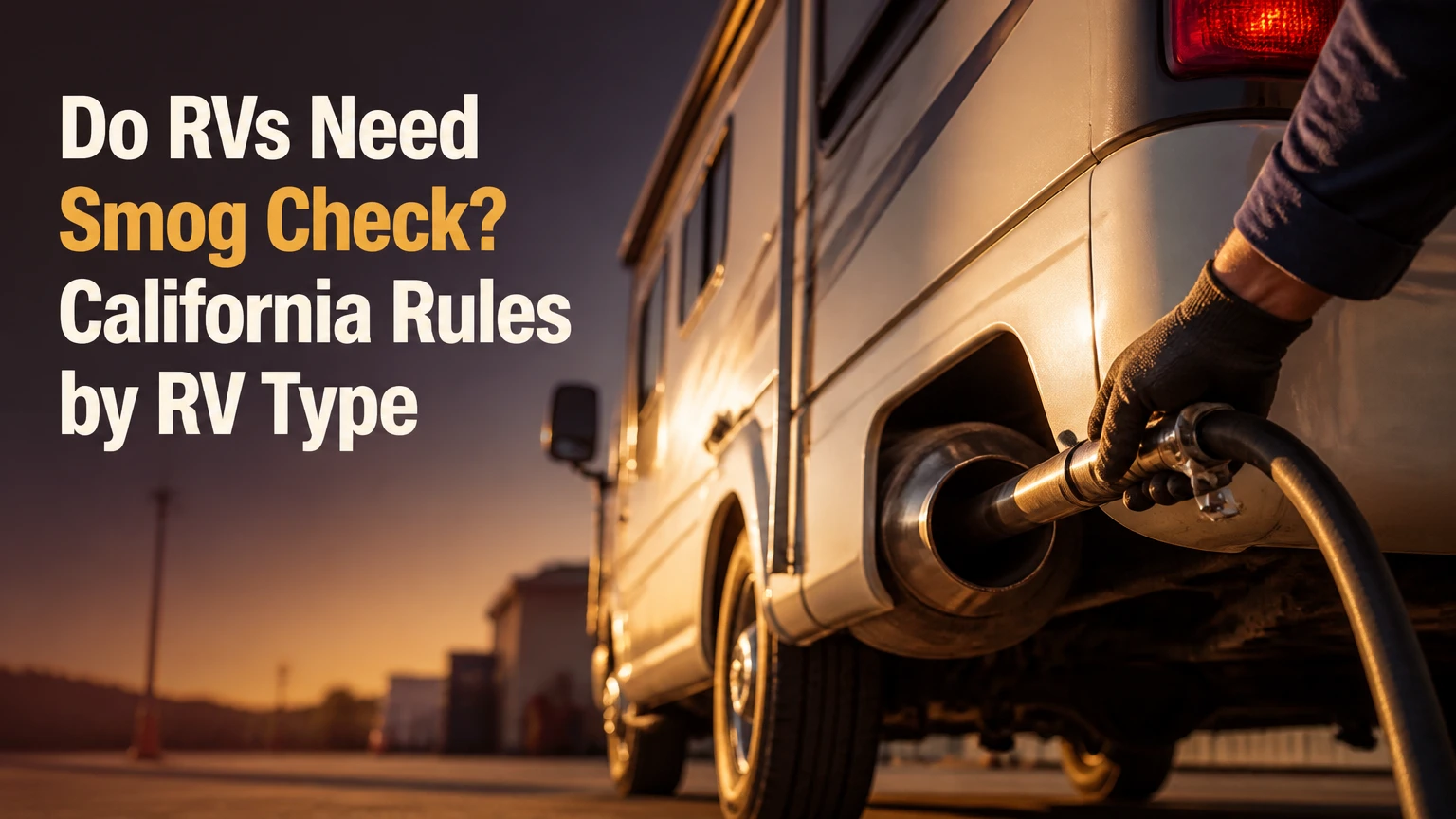
Whether an RV needs a smog check depends on its registration state, vehicle type, fuel, model year, and gross vehicle weight rating (GVWR). In California, towable RVs generally have no engine to test, while motorhomes can require a Bureau of Automotive Repair (BAR) Smog Check or a separate California Air Resources Board (CARB) emissions program.
Key Facts at a Glance
- A travel trailer or fifth wheel does not receive a motor-vehicle smog inspection because it has no engine or emissions control system.
- A gasoline Class A, B, or C motorhome may need a California BAR Smog Check at registration renewal.
- California diesel rules use both model year and GVWR, with 14,000 pounds serving as an important threshold for BAR testing.
- A registration renewal notice is the controlling practical instruction for a California vehicle owner, but it does not replace checking the vehicle’s legal classification.
- A dead or disconnected chassis battery can reset OBD readiness monitors and cause a gasoline motorhome to fail or require more drive cycles.
- A large motorhome may need an RV-capable station because passenger-car facilities often cannot access a rear engine, doghouse, or tall chassis safely.
Do RVs Need Smog Check?
Motorized RVs may need emissions testing, but towable RVs normally do not. The decisive distinction is whether the RV is a self-propelled motor vehicle with an emissions-equipped engine, not whether the vehicle is used for recreation.
California uses several overlapping categories. A gasoline motorhome commonly enters the BAR Smog Check program, a light-duty diesel motorhome may be covered according to model year and GVWR, and a heavy-duty diesel motorhome may fall under CARB rules rather than the ordinary biennial inspection. Other states use different thresholds, inspection frequencies, or no emissions program at all.
The California Department of Motor Vehicles describes the ordinary requirement as a smog inspection needed “every other year” for applicable vehicles. That renewal rule is not a universal RV rule. Registration class, fuel, weight, and local enforcement determine the result.
Motorhome or towable: which category applies?
The RV category determines whether an onboard powertrain is subject to an emissions inspection. Class A, Class B, and Class C vehicles are motorhomes because the living body and engine share one self-propelled vehicle; travel trailers and fifth wheels are separate towable units.
| RV type | Has its own road engine? | Typical California emissions treatment | Main detail to verify |
|---|---|---|---|
| Travel trailer | No | No motor-vehicle smog test | Tow vehicle is tested separately |
| Fifth wheel | No | No motor-vehicle smog test | Pickup emissions rules apply independently |
| Class B camper van | Yes | BAR rules commonly apply | Fuel, year, and GVWR |
| Class C motorhome | Yes | BAR rules commonly apply | Chassis emissions category |
| Class A motorhome | Yes | BAR or another applicable program | Engine access and GVWR |
A truck camper creates a frequent mistake. The camper itself is not tested, but the pickup carrying it must comply with the pickup’s registration and emissions rules.
How California Determines the Required Test
California determines an RV’s emissions obligation from the registered vehicle record, engine fuel, model year, GVWR, and applicable program. The most useful first step is to read the renewal notice, then confirm the classification with the DMV or a qualified emissions station before paying for an appointment.
Which California agency handles the inspection?
The California Bureau of Automotive Repair administers the consumer Smog Check program, while CARB administers statewide air-quality regulations such as Clean Truck Check. The two programs are related to emissions, but they are not interchangeable certificates.
A BAR station generally connects diagnostic equipment, inspects emissions hardware, and follows the inspection procedure assigned to that vehicle. A CARB credentialed tester submits heavy-duty compliance data through the applicable CARB system. A station advertising ordinary passenger-car smog tests may not handle a large diesel motorhome.
California decision table
The table below is a practical screening guide, not a substitute for the DMV renewal notice or current agency determination.
| Vehicle configuration | Common California program | Model-year or weight condition | Typical frequency |
|---|---|---|---|
| Towable RV | No RV emissions test | Any year and trailer weight | None for the trailer |
| Gasoline motorhome | BAR Smog Check | Generally 1976 and newer vehicles when required by DMV | Commonly every 2 years |
| Diesel motorhome, lighter class | BAR Smog Check may apply | Commonly 1998 and newer, GVWR 14,000 pounds or less | Commonly every 2 years |
| Diesel motorhome, heavier class | Separate CARB or heavy-duty treatment may apply | GVWR above 14,000 pounds | Verify current CARB classification |
| Historic motorhome | Possible age exemption | California rules can depend on fuel and model year | Verify before assuming exemption |
The 14,000-pound figure is a screening threshold frequently used in California diesel rules. It is not permission to ignore a notice, because a motorhome’s legal classification and the current CARB program can change the required action.
What Does an RV Smog Check Test?
An RV smog inspection checks the engine’s emissions controls, diagnostic system, and exhaust output against the vehicle’s applicable standards. Gasoline motorhomes commonly receive an OBD scan and visual inspection, while older vehicles or diesel configurations can receive additional exhaust or smoke testing.
What happens at a gasoline motorhome appointment?
A California gasoline motorhome inspection usually includes these components:
- OBD scan: The technician checks diagnostic trouble codes and emissions monitor readiness through the OBD-II connector when the vehicle supports that procedure.
- Malfunction indicator check: The Check Engine Light must illuminate during the key-on bulb check and remain off when the engine runs normally.
- Visual inspection: The technician looks for disconnected, altered, missing, or visibly damaged emissions equipment, including catalytic converters and evaporative-system components.
- Fuel-cap or evaporative inspection: Applicable vehicles can receive a gas-cap inspection or related evaporative-system check.
- Exhaust measurement: Older gasoline vehicles may require a tailpipe analyzer rather than the same OBD process used by newer vehicles.
A failed OBD monitor is different from a stored fault code. A monitor can be incomplete because the battery was disconnected, even when the engine has no current mechanical problem.
Do diesel RVs receive the same inspection?
Diesel RVs do not always receive the same inspection as gasoline motorhomes. Depending on model year, GVWR, engine design, and California program status, a diesel vehicle can receive an OBD-based inspection, a smoke-opacity test, or a CARB compliance test outside the ordinary BAR appointment.
| Test component | Gasoline motorhome | Diesel motorhome | Typical failure trigger |
|---|---|---|---|
| OBD readiness | Common on newer chassis | Common on electronically controlled chassis | Incomplete monitors |
| Check Engine Light | Evaluated | Evaluated when applicable | Active emissions fault |
| Visual equipment check | Common | Common | Missing or altered equipment |
| Gas-cap inspection | Possible | Usually not the central diesel test | Leaking cap or evaporative fault |
| Tailpipe or opacity test | Older gasoline vehicles | Older diesel designs | Excess emissions or visible smoke |
An opacity test measures smoke density, not the same pollutants measured by a gasoline tailpipe analyzer. A clean-running diesel can still fail if its emissions hardware, diagnostic system, or smoke level violates the applicable procedure.
How Often Must a California RV Be Tested?
A California motorhome subject to the BAR program is commonly tested every two years during registration renewal, although initial registration, ownership transfer, and special DMV instructions can create additional requirements. Heavy-duty diesel compliance may follow a different CARB schedule, so owners should not apply the biennial rule automatically.
California’s age rules also vary by fuel and program. Gasoline vehicles from older model years may qualify for permanent or program-specific exemptions, while diesel exemptions depend on the applicable regulation and vehicle category. A heavy vehicle is not automatically exempt because it is old.
What document tells you to test?
The California DMV renewal notice is the fastest practical indicator. It may state that a smog certificate is required, identify a STAR station, or show that the DMV already has an electronic certificate.
The notice can be incomplete for unusual motorhomes, especially after an engine, chassis, title, or registration-class change. When the notice conflicts with the vehicle’s physical configuration, ask the DMV or BAR before testing. Keep the Vehicle Inspection Report (VIR), invoice, and repair records after the appointment.
What Does an RV Smog Check Cost?
A typical California gasoline RV smog check costs about $45-$120 before unusual repair work, with large motorhomes often priced higher because access takes longer. A mobile or specialized diesel emissions visit can cost approximately $100-$250 or more, depending on location, equipment, travel, and the required CARB or opacity procedure.
Prices are not fixed statewide. California stations set labor prices, and a Class A motorhome can require two technicians, extended setup, or a larger bay.
| Service situation | Typical price range | Typical duration | Why the price changes |
|---|---|---|---|
| Small gasoline Class B | $45-$90 | 20-35 minutes | Passenger-van access |
| Class C gasoline motorhome | $70-$130 | 30-60 minutes | Doghouse or chassis access |
| Large Class A gasoline motorhome | $90-$160 | 40-75 minutes | Rear or underfloor access |
| Diesel mobile visit | $100-$250 or more | 30-90 minutes | Travel and specialized equipment |
| Repair after failure | $100-$2,000 or more | 1 hour to several days | Code, parts, labor, and diagnosis |
The inspection fee does not include catalytic converters, oxygen sensors, diesel particulate filters, exhaust repairs, diagnostic labor, or registration penalties. Obtain a written price before arrival, especially when the station must inspect a rear-mounted engine.
How Should You Prepare a Motorhome?
Prepare a motorhome by confirming the correct station, checking the Check Engine Light, restoring OBD readiness after battery loss, and warming the engine before testing. Preparation usually takes 30-60 minutes when no repair is needed, but a recently reset computer can require several driving cycles and 50-100 miles.
Use this preparation sequence
- Read the DMV notice. Confirm the due date, required certificate, and any STAR-station instruction.
- Call an RV-capable station. Give the technician the year, fuel, GVWR, chassis, and engine location. Confirm bay height, ramp capacity, and connector access.
- Inspect the warning lights. Do not test with an active Check Engine Light. A loose gas cap can trigger an evaporative fault, but clearing the code immediately can create incomplete monitors.
- Check battery history. If the chassis battery was dead or disconnected, use a scan tool to verify monitor readiness before booking.
- Complete a mixed drive cycle. Drive at steady highway speed and through normal stop-and-go conditions, following the manufacturer’s drive-cycle requirements.
- Warm the vehicle. A 20-30 minute drive before arrival can bring the engine and catalytic converter to operating temperature, but warming does not repair an emissions fault.
- Bring records. Carry registration, the renewal notice, previous VIR, repair invoices, and any exemption documentation.
You will know the preparation worked when the warning light is off, required monitors show ready, the engine reaches normal temperature, and the selected station confirms it can physically perform the inspection.
What Causes a Motorhome to Fail?
A motorhome commonly fails because of an active emissions fault, incomplete OBD monitors, altered emissions equipment, excessive exhaust smoke, or an inspection station using the wrong procedure. Mechanical reliability alone does not predict emissions-test success because a vehicle can drive normally while storing an emissions code.
The most common failure points
- Battery reset: Disconnected power erases readiness data. Driving only a few miles afterward often leaves monitors incomplete.
- Active Check Engine Light: The vehicle can fail even when the warning concerns a small evaporative leak.
- Modified exhaust: Removed catalytic converters, incorrect diesel exhaust components, or disconnected EGR hardware can fail visual inspection.
- Aging sensors: Oxygen sensors, mass-airflow sensors, and diesel NOx sensors can produce codes before drivability declines.
- Access problems: The test may be refused when the station cannot reach the engine, VIN, OBD port, or emissions label safely.
- Smoke or opacity: Poor injection, turbocharger faults, intake restrictions, and disabled particulate controls can increase visible emissions.
- Improper code clearing: Clearing codes shortly before inspection may turn a known fault into an incomplete-monitor failure.
A pretest scan can identify readiness problems before the official inspection, but ask the shop whether the service is a formal submission or a diagnostic check. A diagnostic scan does not guarantee passage.
Are Heavy-Duty Diesel RVs Exempt From Clean Truck Check?
Heavy-duty diesel motorhomes require careful classification under California’s Clean Truck Check program, but the claim that every diesel RV over 14,000 pounds automatically needs an annual test is too broad. CARB rules and exemptions can depend on whether the vehicle is registered as a motorhome, its operation, and the current program phase.
CARB’s Clean Truck Check program generally addresses heavy-duty vehicles operating on California roads, with onboard diagnostic and emissions requirements designed for vehicles above the light-duty range. However, recreational vehicles registered as motorhomes have been treated differently in CARB guidance than commercial trucks in some program contexts.
Owners should verify three facts directly:
- The exact DMV body type and registration classification.
- The vehicle’s GVWR and fuel type.
- Whether the current CARB Clean Truck Check rule or exemption applies to that registered motorhome.
Do not pay a mobile tester solely because an online summary says “over 14,000 pounds equals annual testing.” Ask the tester to identify the CARB rule, exemption, testing frequency, and portal record that apply to the specific VIN.
How does Clean Truck Check differ from BAR Smog Check?
BAR Smog Check is a consumer vehicle inspection tied to California registration and emissions certification. Clean Truck Check is a CARB heavy-duty emissions compliance program that can involve portal registration, testing data, compliance fees, and credentialed testers.
| Attribute | BAR Smog Check | CARB Clean Truck Check |
|---|---|---|
| Primary agency | Bureau of Automotive Repair | California Air Resources Board |
| Common vehicle scope | Applicable cars, trucks, and motorhomes | Covered heavy-duty vehicles |
| Main data path | BAR test station to DMV | CARB portal and credentialed tester |
| Typical evidence | Smog certificate and VIR | Compliance record or submitted test data |
| Correct action | Use an authorized station | Verify CARB coverage and exemption |
The programs should not be conflated. A BAR pass may not satisfy a separate CARB obligation, and a CARB submission may not replace a DMV-requested Smog Check.
What If the RV Is Registered Outside California?
An RV registered outside California usually follows the registration state’s emissions and safety rules, even when it travels through California. California travel alone does not normally convert an out-of-state motorhome into a California-registered vehicle, although residency, business use, and registration timing can create separate legal issues.
| Registration situation | First authority to check | Likely practical question |
|---|---|---|
| California motorhome renewal | California DMV | Is a Smog Check certificate due? |
| Nevada-registered RV | Nevada DMV and local county program | Does the registration county require emissions testing? |
| Arizona-registered RV | Arizona MVD and emissions county | Is the vehicle based in a testing area? |
| Oregon-registered RV | Oregon DMV | Does the address fall inside an emissions area? |
| Relocation to California | California DMV | Is California registration now required? |
State programs differ substantially. Some test only in designated counties, some exclude older or heavier vehicles, and some focus on passenger vehicles rather than recreational chassis. Use the agency for the registration jurisdiction, not a California shop’s generic answer.
Can Planned Non-Operation Avoid the Requirement?
California Planned Non-Operation (PNO) can prevent ordinary registration renewal charges for a vehicle that will not be operated or parked on public roads during the declared period, but PNO is not a way to drive an unregistered motorhome to a campground. The owner must return the vehicle to active registration before lawful road use.
PNO is relevant when a motorhome remains stored for most of the year. It does not erase needed repairs, establish an emissions exemption, or authorize travel while the vehicle is nonoperational. Confirm deadlines and reactivation requirements with the California DMV.
Frequently Asked Questions
Do Class A, Class B, and Class C motorhomes all follow the same rule?
No. Class designation describes the motorhome body and living layout, not the emissions obligation. A gasoline Class B van, a gasoline Class C on a truck chassis, and a diesel Class A can have different testing requirements because fuel, model year, GVWR, engine controls, and registration classification differ.
Do diesel RVs need a smog check in every state?
No. Diesel RV requirements vary by state and county. California, Nevada, Arizona, Oregon, and other jurisdictions use different inspection scopes and geographic boundaries. A diesel motorhome’s fuel does not create a nationwide exemption or nationwide testing duty, so check the agency responsible for the registration address.
Can a motorhome pass with the Check Engine Light on?
Normally, no. An illuminated malfunction indicator signals an emissions-related fault under standard OBD procedures, and the vehicle can fail even if the engine feels normal. Repair the cause, complete the required drive cycle, and confirm monitor readiness before presenting the motorhome for an official inspection.
Does a safety inspection replace an emissions inspection?
No. A safety inspection evaluates items such as brakes, lights, tires, steering, or equipment under that jurisdiction’s rules. A smog inspection evaluates emissions controls and exhaust performance. Some states combine both services, but a passing safety inspection alone does not prove emissions compliance.
Can I tow a motorhome to a smog station after registration expires?
The answer depends on California registration status, temporary operating authority, insurance, and local enforcement. Do not assume an expired registration allows an owner to drive directly to testing. Ask the DMV about a permitted trip or restore the required registration status before moving the vehicle on public roads.
The Bottom Line
Do RVs need smog check? Towable RVs generally do not, because the trailer has no engine, but motorhomes can require emissions testing. For California motorhomes, identify the fuel, model year, GVWR, registration class, and renewal-notice instruction before choosing between a BAR Smog Check and any applicable CARB heavy-duty process.
The safest workflow is simple: read the DMV notice, verify the vehicle classification, call an RV-capable station, check OBD readiness, and confirm the correct agency’s requirement. Large diesel motorhomes deserve separate verification because a 14,000-pound threshold does not, by itself, prove that annual Clean Truck Check testing applies.