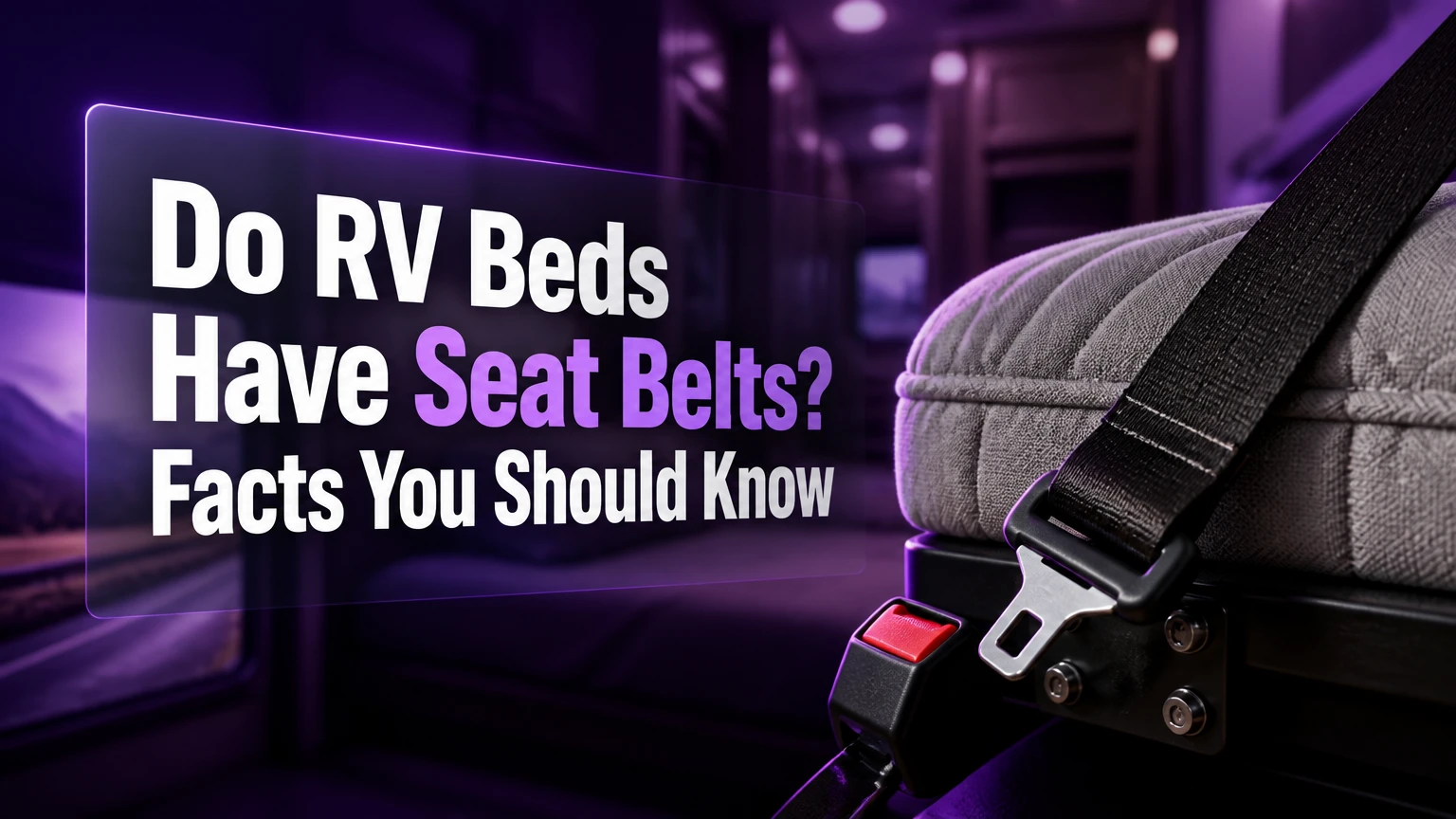
RV beds generally do not have seat belts because they are sleeping surfaces, not designated passenger seats. A motorhome may contain a sofa or dinette that converts into a bed, but occupants may ride there only when the furniture is locked in its approved travel-seat position and its belts, anchorages, and seating direction meet the vehicle manufacturer’s instructions and applicable law.
Key Facts at a Glance
A flat RV bed is not a legal substitute for a designated passenger seat while the vehicle is moving.
A convertible sofa or dinette can be a travel seat only in its locked seating configuration.
Seat belts must connect to a structure designed to manage crash loads, not merely to thin plywood or decorative furniture.
Federal Motor Vehicle Safety Standards do not automatically certify every aftermarket RV belt kit.
Motorhome belt laws vary by jurisdiction, vehicle class, model year, and seating position.
Occupants of a towed travel trailer generally should not ride in the trailer while it is moving.
Can Passengers Ride in an RV Bed?
Passengers should not ride in an RV bed while the motorhome is moving. Lying down, sitting sideways on a mattress, or wearing a belt across a sleeping position exposes the body to uncontrolled movement during braking or a crash, and a mattress does not provide the head, hip, shoulder, and pelvic support expected from a crash-tested travel seat.
The National Highway Traffic Safety Administration states that “seat belts are the best defense against impaired, aggressive, and distracted drivers,” but a belt only works properly when it is used with a compatible seating position. NHTSA’s general safety advice does not convert a bed into a certified seating location.
A convertible bed creates a different situation. When a sofa or dinette is returned to the manufacturer-specified seating position, its cushions, frame, belts, and anchorages may form a passenger station. The bed function must be reversed completely, and every locking mechanism must engage before travel.
What Is the Difference Between a Bed and a Travel Seat?
An RV travel seat has a defined seating direction, supporting structure, restraint geometry, and attachment points. An RV bed has a horizontal sleeping surface and normally lacks the geometry needed to keep an occupant positioned during a collision.
| Feature | Approved travel seat | Flat RV bed | Parked sleeping area |
|---|---|---|---|
| Body position | Upright, specified direction | Horizontal | Horizontal |
| Restraint location | Belt beside or across seat | Usually absent | Not intended for travel |
| Cushion support | Fixed or locked seat cushions | Mattress or folded cushions | Mattress or cushions |
| Travel status | Permitted when instructions allow | Not permitted | Permitted only while parked |
| Crash design | Vehicle or seat-frame structure | No passenger restraint geometry | No crash-use designation |
The practical rule is simple: if the owner’s manual calls a location a bed, use it as a bed only when parked. If the manual identifies the same furniture as a belted passenger seat, use the belt only in the specified upright configuration.
How Do Convertible RV Sofas and Dinettes Work?
Convertible RV sofas and dinettes work as travel seats only when their frames lock into an upright configuration and their restraints remain correctly routed. The furniture may later transform into a bed, but the transformation does not make the bed position a belted passenger station.
Jackknife Sofas
A jackknife sofa folds or pivots forward so the seat and back cushions form a flat sleeping surface. Some factory-installed units have two or three lap belts positioned for passengers when the sofa is upright, but belt count and approval depend on the specific RV and seat design.
A jackknife sofa is not automatically safe because it has a metal frame. The frame, belt attachments, cushion retention, and vehicle structure must work together. A loose aftermarket belt attached to a sofa hinge can pull the hinge apart or allow excessive occupant movement.
Tri-Fold Sofas
A tri-fold sofa uses hinged cushion sections that unfold into a mattress-like surface. Belt placement varies widely. Some belts emerge from the seating crease, while others attach to a separate travel-seat frame beneath the cushions.
Owners should verify three details before use:
- The sofa is fully folded into its travel position.
- The frame lock or latch is visibly engaged.
- The belt webbing is free of the folding mechanism and crosses the occupant’s pelvis or chest correctly.
A comfortable tri-fold bed is not evidence of crash suitability. Comfort and restraint performance are separate design objectives.
Convertible Dinettes
A convertible dinette lowers or removes its table so bench cushions fill the center gap. The benches may be designated passenger seats while upright, but the table-down bed configuration is not a travel position unless the manufacturer specifically says otherwise.
Forward-facing dinette seats are generally preferable to side-facing positions because occupant movement and belt geometry are easier to manage. Children still need a legally appropriate child restraint and a compatible belt path. A lap belt alone may not provide the upper-body restraint required by a particular child-safety seat.
Power Lift Beds and Drop-Down Beds
Power lift beds and drop-down beds should be treated as sleeping-only equipment. Their tracks, lift motors, overhead clearance, and moving joints are not a substitute for a fixed passenger-seat structure.
A seat belt attached to a lift-bed frame creates a particularly dangerous failure mode. The bed can move, collapse, or transfer crash forces through components designed for lifting rather than occupant restraint.
What Makes an RV Seat Belt Legally Usable?
An RV seat belt is legally usable only when the vehicle, seating position, restraint, and installation comply with the applicable federal and local requirements. There is no universal rule that every RV belt must be a three-point belt, nor does the phrase “FMVSS-approved kit” alone prove that an aftermarket installation is compliant.
In the United States, relevant rules can include 49 CFR 571.208, the Federal Motor Vehicle Safety Standard for occupant crash protection, 49 CFR 571.209 for seat-belt assemblies, state occupant-restraint statutes, and motorhome certification requirements. Applicability changes with vehicle type, gross vehicle weight, manufacture date, and whether the seat was installed by the vehicle manufacturer or modified later.
Federal standards also do not mean that every seating location in every RV must have identical equipment. A Class A motorhome, Class B camper van, and Class C motorhome can have different chassis, certification histories, and seat designs.
Is a Three-Point Belt Always Required?
A three-point belt is not automatically required at every RV passenger position. The governing requirement depends on the vehicle’s certification and the applicable rule for that seating position, while state law may impose separate use requirements.
Three-point belts generally provide better upper-body restraint than lap belts, especially for forward-facing occupants. However, a poorly engineered three-point retrofit can be less trustworthy than a factory-installed lap belt if the shoulder anchor, retractor, seat structure, or belt path cannot withstand crash loads.
| Restraint type | Main components | Typical application | Key limitation |
|---|---|---|---|
| Lap belt | Pelvic webbing and buckle | Older dinettes, specified bench seats | Does not restrain the torso |
| Three-point belt | Lap belt, shoulder belt, retractor | Forward-facing automotive-style seat | Requires suitable upper anchor |
| Integrated seat belt | Belt attached to engineered seat frame | Certified specialty RV seating | Frame and floor must be approved together |
| Child restraint system | Harness, booster, or infant seat | Children within stated limits | Requires compatible belt or anchors |
The safe choice is not the belt with the highest marketing specification. It is the restraint system the RV manufacturer or qualified vehicle engineer designed for that seat.
How Should an RV Seat Belt Be Anchored?
An RV seat belt should be anchored to a structure engineered to carry occupant crash loads, normally a certified seat frame, reinforced vehicle structure, or chassis-connected system specified by the manufacturer. Bolting a belt through plywood, thin cabinetry, or an unreinforced sofa base is not an adequate installation.
The commonly repeated advice to “bolt directly to the chassis” is incomplete. A belt anchor may need a specific load path through the seat frame and floor, and a direct chassis connection can create poor belt geometry or interfere with fuel, brake, electrical, or suspension components. The correct design is vehicle-specific.
What Should a Professional Installer Verify?
A qualified installer should verify the following before drilling or fitting hardware:
- The vehicle identification number, model year, chassis, and body manufacturer.
- The owner’s manual, body-builder manual, and any seat-belt installation instructions.
- Seating direction, occupant capacity, belt count, and weight limits.
- The steel structure around the proposed anchor point.
- Hardware grade, bolt diameter, backing plates, corrosion protection, and torque values.
- Clearance from tanks, wiring, brake lines, wheel wells, and moving furniture.
- Retractor angle, webbing path, buckle access, and shoulder-belt height.
- Whether the completed modification affects the manufacturer’s certification or insurance coverage.
The United Kingdom’s MOT inspection manual, for example, checks seat-belt security, condition, operation, and anchorage. That inspection framework illustrates an important principle, but it is not a substitute for the law where the RV is registered.
Why Is Plywood-Only Mounting Unsafe?
Plywood-only mounting is unsafe because wood can split, crush, or pull through under a sudden occupant load. A steel backing plate can distribute force, but a plate alone cannot correct a weak frame, an unsuitable belt angle, or an anchor point that was never designed for restraint loads.
Do not copy a generic online drilling diagram into an unknown RV floor. The floor may contain concealed tanks or wiring, and the metal beneath may not connect to a load-bearing structure.
Which RV Seating Option Provides the Best Protection?
Factory-installed, forward-facing seating with a properly fitted three-point belt generally provides the strongest everyday protection for an adult passenger. A certified integrated seat can also work well, while a lap-belt dinette may be acceptable only where the manufacturer designed and approved that position.
| Seating option | Belt arrangement | Typical passenger use | Decision impact |
|---|---|---|---|
| Cab seat | Three-point belt, automotive retractor | Driver or front passenger | Usually the strongest documented option |
| Forward-facing sofa seat | Lap or three-point belt | Adult passenger, manual permitting | Check frame and belt certification |
| Side-facing sofa | Often lap belt or no belt | Model-specific only | Avoid unless explicitly approved |
| Dinette bench | Lap or three-point belt | Adults or compatible child restraints | Check seating direction and belt path |
| Flat bed | No approved travel restraint | Sleeping while parked | Never use as a travel seat |
| Drop-down bed | No travel restraint | Sleeping while parked | Keep raised and secured during travel |
A factory three-point belt does not eliminate the need to read the manual. Occupant limits, seat location, and child-restraint instructions can still restrict use.
Are Lap Belts Safe in an RV?
Lap belts can reduce ejection and help restrain the pelvis, but they do not provide the upper-body control of a three-point belt. A lap belt must sit low across the hips, remain snug, and be used only in a seat designed for that restraint.
Lap belts should never be routed across the abdomen or worn with the belt behind the back. A passenger who cannot sit upright with knees and hips supported may not fit the belt correctly.
Integrated five-point harnesses are not automatically better for ordinary RV travel. Racing-style harnesses require compatible seats, anti-submarine geometry, head support, and installation engineering. Adding a harness to a recreational vehicle seat without that system can create a false sense of protection.
Can Children Ride on an RV Sofa or Dinette?
Children can ride on an RV sofa or dinette only when the seating position, belt system, child restraint, and local law are compatible. A child should not ride on a flat bed, in a side-facing position that the manufacturer excludes, or in a car seat secured with a belt path the car-seat maker does not permit.
Before travel, confirm:
- The child restraint is approved for the child’s height and weight.
- The belt path is allowed by the child-restraint manufacturer.
- The RV seat faces the required direction.
- A top tether anchor is present when the restraint requires one.
- The belt is long enough to achieve a tight installation.
- The state or province permits that seating position.
A motorhome dinette can look similar to a minivan bench but have a very different structure. Never assume that a car seat is safe because its belt buckle fits.
Can People Ride in a Travel Trailer?
People generally should not ride in a towed travel trailer, fifth-wheel trailer, or camper while it is moving. Trailer occupants face unpredictable movement, limited crash protection, weak restraint options, and a risk of separation or rollover that ordinary passenger seats are not designed to manage.
A motorhome carries occupants inside the vehicle’s passenger compartment, where designated seats and restraints may be available. A travel trailer is cargo being towed, not a passenger compartment. Jurisdictions can vary, so owners should check local law, but a legal exception does not necessarily make the arrangement safe.
This distinction matters when a floor plan shows a bed with a belt or a rear lounge with seating. The location may be intended for parked use, staging, or storage rather than highway travel.
What Does an RV Seat-Belt Retrofit Cost?
A professional RV seat-belt retrofit typically costs about $500-$2,500 per seating position or seating group when structural reinforcement, engineering review, and furniture changes are required. A simple replacement of an existing manufacturer-specified belt may cost roughly $150-$350, while a certified convertible sofa can cost approximately $1,200-$3,500.
These are typical market ranges, not a legal price schedule. Labor commonly takes 2-8 hours, but concealed tanks, floor access, custom upholstery, and structural inspection can extend the job.
| Project type | Typical parts cost | Typical labor time | Main uncertainty |
|---|---|---|---|
| Existing belt replacement | $50-$180 | 1-2 hours | Correct belt and buckle fit |
| Factory-style lap-belt repair | $150-$350 | 2-4 hours | Anchor and frame condition |
| Three-point retrofit | $400-$1,500 | 4-8 hours | Upper anchor structure |
| Certified belted sofa | $1,200-$3,500 | 3-8 hours | Furniture and vehicle integration |
| Engineered custom seat | $2,000-$6,000+ | 8-20 hours | Certification and structural design |
The cheapest kit is often the wrong comparison. The relevant cost includes inspection, reinforcement, compatible furniture, documentation, and any required certification.
Can You Add Belts to an Older RV?
You can sometimes add belts to an older RV, but an aftermarket installation should begin with a structural assessment rather than a hardware purchase. Older motorhomes may have deteriorated seat frames, undocumented body construction, narrow floors, or seating positions that were never intended for passengers.
The strongest retrofit candidate is a fixed, forward-facing seat with accessible steel structure and an identified load path. A loose side-facing couch, folding bed frame, or cabinet-mounted bench is a poor candidate.
A Safer Retrofit Process
- Identify the vehicle. Record the VIN, chassis manufacturer, model year, body manufacturer, and seating position.
- Find the documentation. Obtain the owner’s manual, body-builder information, and any original belt or seat specifications.
- Inspect the structure. Expose enough of the anchor area to identify steel members, frame thickness, corrosion, and obstructions.
- Select a compatible system. Match the belt, retractor, buckle, seat frame, and anchor hardware as one system.
- Use a qualified installer. Require a written description of anchor points, hardware, torque values, and load path.
- Check the finished geometry. Confirm that the webbing lies flat, the buckle is reachable, and the retractor locks when sharply pulled.
- Document the modification. Keep invoices, photographs, parts numbers, and installer notes for inspection and insurance questions.
Do not perform a restrained-occupant crash test at home. Static pulling by hand cannot reproduce crash loads or validate a design.
What Are the Most Common RV Belt Mistakes?
The most common RV belt mistakes involve using a correct-looking belt in the wrong seat, direction, or structure. Four failures deserve particular attention because they can remain hidden until a crash.
| Mistake | Why it fails | Safer correction | Inspection trigger |
|---|---|---|---|
| Belt bolted to plywood | Wood can split or crush | Verify steel load path | Any floor-only anchor |
| Belt used on a flat bed | Body position is uncontrolled | Convert furniture to locked seat | Mattress or table-down mode |
| Side-facing retrofit | Head and torso loads differ | Use only manufacturer-approved position | New belt on a lateral couch |
| Belt trapped in hinge | Webbing can cut or jam | Route outside moving joints | Sofa conversion difficulty |
| Retractor tilted | Locking mechanism may not work | Set specified mounting angle | Belt will not extend |
| Twisted webbing | Load spreads over less area | Untwist across the entire belt | Fold or half-turn visible |
A seat belt that will not pull out may have a tilted emergency-locking retractor, a locked mechanism, or webbing trapped under a cushion. Return the seat to its upright position, inspect the routing, and replace damaged hardware instead of forcing the belt.
A belt that was involved in a collision should generally be replaced or evaluated according to the vehicle and restraint manufacturer’s instructions. Webbing can suffer internal damage without obvious cuts.
What Should You Inspect Before Buying a Used RV?
A used-RV buyer should treat every belt as unverified until the belt, anchor, seat frame, and owner documentation agree. Visual presence is not proof that the seating position is approved for travel.
Use this checklist during inspection:
- Count belts and compare the count with the stated passenger capacity.
- Identify each belt’s seating direction.
- Look for original labels, certification markings, and intact fasteners.
- Check webbing for cuts, fraying, mildew, burns, and chemical damage.
- Pull the belt slowly, then sharply, to check extension and emergency locking.
- Confirm that buckles latch and release without sticking.
- Inspect under cushions for bent frames, cracked welds, rust, and loose bolts.
- Operate every sofa, dinette, and bed latch.
- Check whether the manual designates the location for travel.
- Ask whether the RV has sustained a crash, flood, fire, or structural repair.
- Obtain a professional inspection when belts appear aftermarket or undocumented.
An RV advertised as sleeping eight may legally provide far fewer travel positions. Sleeping capacity and belted passenger capacity are different specifications.
What Should You Do Before Driving?
Before driving, place every occupant in a designated travel seat, lock all convertible furniture in its travel position, and secure loose objects. Verify that no person is lying on a bed, sitting on a counter, or using a belt attached to furniture that remains partially folded.
The driver should confirm that each passenger can sit upright with the belt low across the hips or correctly across the shoulder and chest. Children require a separate restraint check. The driver should also secure cabinet doors, appliances, tables, and lift beds because unrestrained interior objects can become projectiles.
What Is an RV Bed’s Safe Use Case?
An RV bed is safe for sleeping when the vehicle is fully parked, stabilized as appropriate, and not moving. An RV bed is not intended for emergency seating during a short driveway maneuver, a slow campground transfer, or a traffic jam.
Low speed does not remove collision risk. A sudden stop at 15 miles per hour can still throw an unrestrained person into furniture, glass, or another occupant.
Frequently Asked Questions
Do all motorhomes have seat belts for every sleeping position?
No. Motorhomes may have fewer belted positions than beds. The manufacturer’s passenger-capacity statement, owner’s manual, and actual restraint hardware determine which locations are intended for travel. A floor plan can show six sleeping places but only four approved passenger seats.
Can someone sit on a bed if the RV has no seat belts?
No. The absence of a belt does not create permission to ride there. A person should move to a designated seat with a functioning restraint before the vehicle travels, even for a short distance inside a campground or parking area.
Are RV seat belts different from car seat belts?
RV seat belts can use similar webbing, buckles, and retractors, but the surrounding seat and anchor structure may differ substantially from a passenger car. An automotive belt cannot be transferred safely to an RV without verifying the mounting geometry, load path, and vehicle-specific requirements.
Can a belt be installed on a side-facing RV couch?
Only if the RV manufacturer or a qualified engineer specifically approves that seating position and restraint arrangement. Side-facing seats present different occupant-motion and head-injury concerns, so a generic lap-belt installation should not be treated as equivalent to a forward-facing seat.
Should an RV belt be replaced after a crash?
A crash-involved belt should be replaced or professionally evaluated under the restraint manufacturer’s instructions. Replace any belt with cut, frayed, burned, contaminated, or stretched webbing, and inspect the anchor structure for deformation or cracking.
What if the RV owner’s manual is missing?
Contact the RV body manufacturer, chassis manufacturer, or an authorized service center using the VIN and model information. Until the seating position is documented, use only clearly identified original travel seats and do not rely on an aftermarket belt’s packaging as proof of approval.
The Bottom Line
Do RV beds have seat belts? Some convertible RV sofas and dinettes may have belts when configured as upright, manufacturer-approved travel seats, but a flat bed is not a safe or ordinarily legal passenger position while driving. Use designated seats, follow the RV manual and local law, and require structural documentation before approving any retrofit.