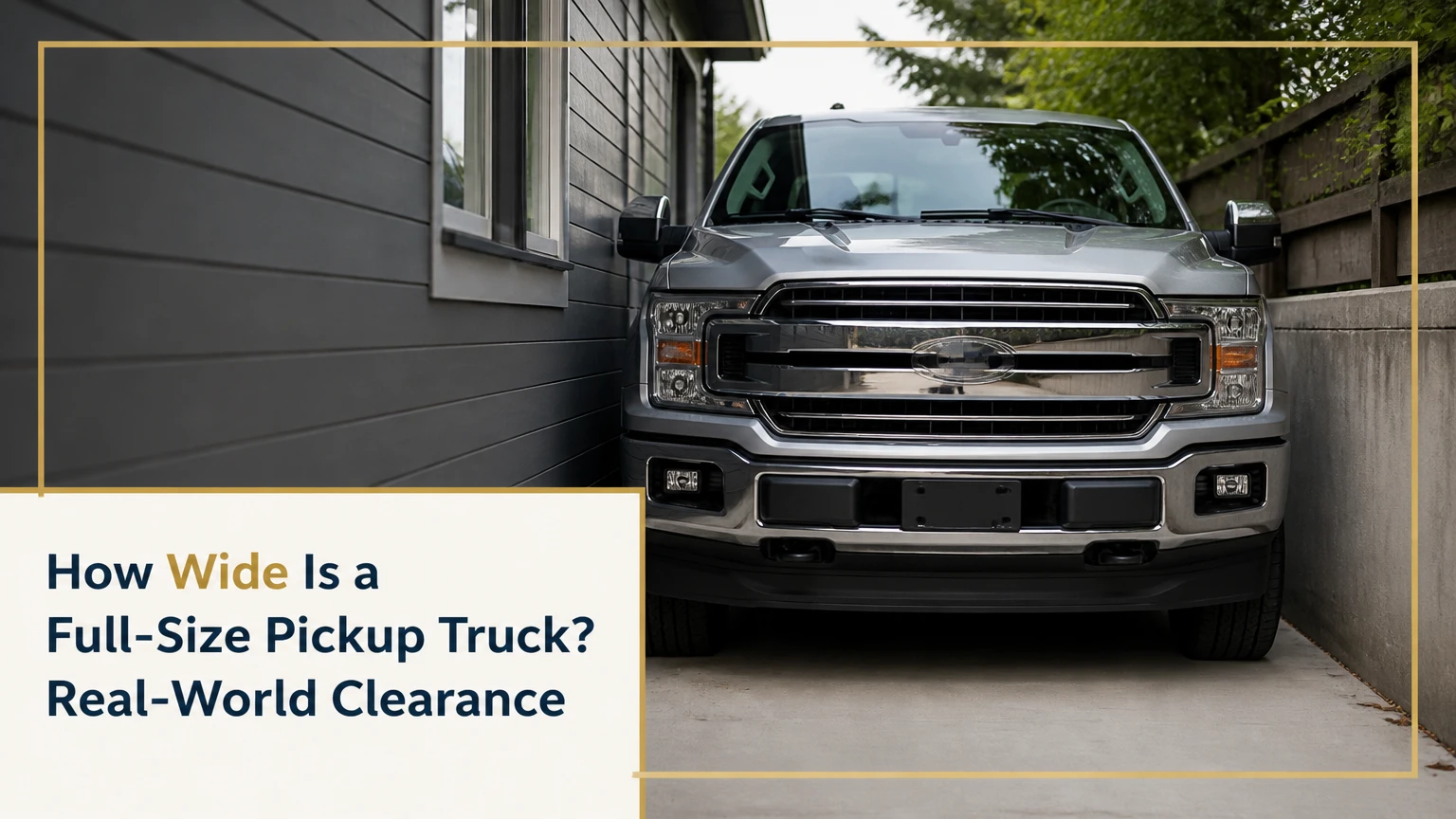
A full-size pickup truck is typically about 80-83 inches wide without mirrors, or 6 feet 8 inches to 6 feet 11 inches. With standard side mirrors extended, the operating width commonly reaches 96-105 inches. Heavy-duty tow mirrors, fender flares, dual rear wheels, tires, and off-road equipment can make the usable footprint substantially wider.
Key facts at a glance
A standard half-ton full-size pickup usually measures approximately 80-83 inches across the body, excluding mirrors.
Extended standard mirrors commonly increase total width to approximately 95-98 inches.
Heavy-duty single-rear-wheel trucks often measure approximately 81-85 inches without mirrors.
A dually pickup can measure about 96 inches or more across its rear fenders.
An 8-foot garage door opening may be only 96 inches wide before weather seals and framing reduce usable clearance.
Published width varies by cab, trim, tire, wheel, flare, mirror, and measurement convention.
How Wide Is a Full-Size Pickup Truck?
A full-size pickup truck is usually 79.9-83 inches wide without its mirrors and about 95-105 inches wide with ordinary mirrors extended. The narrower figure describes the body or outside sheet metal, while the larger figure describes the space the driver must manage on the road, in a garage entrance, or beside another vehicle.
The category includes light-duty half-ton models such as the Ford F-150, Chevrolet Silverado 1500, Ram 1500, Toyota Tundra, and GMC Sierra 1500. A truck’s classification does not produce one universal width. A basic work-truck trim and an off-road trim of the same model can differ because of tire size, fender flares, suspension components, and wheel design.
For planning, use 82 inches for the body of a conventional full-size truck and 98 inches for extended standard mirrors unless the manufacturer publishes a more precise dimension for the exact configuration. That planning rule is safer than using a best-case 79.9-inch specification.
Which Width Does the Specification Mean?
Vehicle width has several meanings, and confusing them causes most garage and parking mistakes. The manufacturer’s exterior-width figure, the body’s widest point, the folded-mirror dimension, the extended-mirror dimension, and track width answer different questions.
Body width without mirrors
Body width is the maximum lateral measurement across the truck’s exterior body, normally including the widest fenders, doors, or factory flare surfaces but excluding side mirrors. This measurement is useful for lane position, parking-stall body clearance, and federal lighting classification.
Body width does not necessarily equal the width between the tires. A fender can extend beyond the tire, while an aftermarket wheel and tire can extend beyond the original fender. A lifted truck with wider wheels may therefore occupy more space than its factory body specification suggests.
Width with mirrors folded
Folded-mirror width is the truck’s footprint with the side mirrors tucked toward the doors. Typical full-size pickups measure approximately 82-87 inches in this configuration, although the exact number depends on the mirror housing and whether the manufacturer measures to the housing, glass, or outer signal assembly.
Folded mirrors improve garage-entry clearance but do not solve every problem. The truck body still has to pass through the opening, and a narrow garage can prevent occupants from opening the doors after the vehicle is parked.
Width with mirrors extended
Extended-mirror width is the practical driving envelope. Standard mirrors on half-ton trucks commonly produce a total width of 95-98 inches. Heavy-duty towing mirrors can reach roughly 103-107 inches when extended, depending on the model and mirror position.
The extended measurement matters at drive-throughs, parking-garage columns, narrow construction lanes, and two-way residential streets. A mirror can strike an obstruction even when the body and tires have adequate clearance.
What is track width?
Track width is the distance between the centerlines of the left and right tires on the same axle. Track width describes the wheel stance, not the exterior body width, and it cannot tell you whether a truck will fit through a garage door.
The Society of Automotive Engineers and vehicle manufacturers publish track measurements for engineering and comparison purposes. Track width affects suspension geometry, tire placement, and handling characteristics, but body overhangs, mirrors, door edges, and fender flares determine many real-world clearance events.
Why Do Full-Size Trucks Cluster Near 80 Inches?
Full-size trucks cluster near 80 inches partly because U.S. lighting rules apply to vehicles at least 80 inches wide under the federal vehicle-lighting standard. Federal Motor Vehicle Safety Standard No. 108 describes the relevant category as vehicles “80 inches or more in overall width,” which triggers required clearance and identification lamps.
That rule does not mean every manufacturer deliberately targets a legally permitted 79.9-inch boundary. Some models exceed 80 inches and use the required lighting. Overall width also depends on the regulatory measurement method, body configuration, and equipment, so a manufacturer’s consumer specification should not be treated as a universal legal calculation.
The width also reflects packaging. A full-size pickup needs room for a wide frame, suspension, engine or battery system, crash structure, front occupants, and a cargo box broad enough to carry common building materials. A wider stance can improve lateral stability, but width alone does not determine towing safety, rollover resistance, or payload.
A common cargo claim needs precision. Many full-size beds provide roughly 50-51 inches between the rear wheelhouses, which allows a 48-inch-wide plywood sheet to lie between them. A standard 4-by-8-foot sheet generally requires the tailgate down or a diagonal arrangement because most pickup beds are shorter than 8 feet.
How Wide Are Common Full-Size Trucks?
Common half-ton full-size pickups generally fall between 80 and 83 inches wide without mirrors, but exact figures vary by year and trim. Ford, Chevrolet, Ram, Toyota, and GMC publish dimensions for specific configurations, and those figures should take priority over a generic category average.
| Example truck or configuration | Approximate width without mirrors | Typical extended-mirror width | Main caveat |
|---|---|---|---|
| Ford F-150 standard body | 79.9-80.0 in | 95-97 in | Tremor, Raptor, and tire packages differ |
| Chevrolet Silverado 1500 | About 81.2 in | About 97.5 in | Trail Boss flares and tires can add width |
| Ram 1500 | About 82.1 in | About 97 in | Mirror style varies by trim and towing package |
| Toyota Tundra | About 80.2-82.5 in | Approximately 96-99 in | CrewMax and off-road equipment vary |
| GMC Sierra 1500 | About 81.2 in | Approximately 97-99 in | AT4 equipment can change body clearance |
| Ford F-150 Lightning | Approximately 79.9-80 in body | Approximately 96-98 in | Battery packaging does not automatically mean 86.6-inch body width |
The Ford F-150 Lightning illustrates why search summaries require verification. Some online listings report a much larger number that may represent a mirror, flare, or measurement error rather than the body width. Ford’s official specification for the exact model year and trim is the appropriate reference.
Are heavy-duty trucks wider?
Heavy-duty single-rear-wheel pickups are commonly about 81-85 inches wide without mirrors, while their extended towing mirrors often reach approximately 103-107 inches. Ford Super Duty, Chevrolet Silverado HD, GMC Sierra HD, and Ram Heavy Duty trucks can exceed the dimensions of half-ton models even when they have one tire on each side at the rear axle.
| Truck class | Body width, typical | Extended mirror width, typical | Clearance implication |
|---|---|---|---|
| Half-ton, standard trim | 80-83 in | 95-98 in | Body fits many large spaces; mirrors need attention |
| Three-quarter-ton SRW | 81-84 in | 103-106 in | Towing mirrors often determine route width |
| One-ton SRW | 82-85 in | 103-107 in | More difficult in garages and parking decks |
| One-ton DRW dually | 96-97 in rear fenders | 108-112 in | Rear body often remains wide with mirrors folded |
| Wide off-road variant | 86-89 in | 96-101 in | Fender flares and tires exceed standard pickup limits |
A dually is a separate physical category. Dual rear wheels and broad rear fenders can make the rear of the truck approximately 96 inches wide before mirrors, so folding the mirrors does not make a standard 8-foot opening practical.
Will a Full-Size Truck Fit an 8-Foot Garage?
A full-size pickup can pass through an 8-foot garage opening only with limited margin, and its mirrors normally need to be folded. A nominal 96-inch door is not a 96-inch usable opening because tracks, framing, rubber seals, uneven pavement, and mirror movement reduce the safe clearance.
For a truck body measuring 82 inches, the theoretical opening margin at a perfect 96-inch door is 14 inches total, or 7 inches per side. At a 98-inch mirror width, the mirrors are already wider than the nominal door. A driver must fold them before entry, then confirm that the body’s widest point clears the jamb.
Garage interior width creates a second constraint. A 114-inch bay leaves 32 inches between an 82-inch truck body and the walls, or about 16 inches per side if the truck is perfectly centered. That space may be insufficient to open a door comfortably, especially when shelving, bicycles, storage cabinets, or a wall-mounted charger occupies one side.
What garage measurements matter?
Measure the narrowest opening, not the advertised door size. Record the clear width between the inside faces of the side seals, the height of the opening, the interior bay width, and the distance from the parked truck to obstructions.
| Measurement point | Example value | Why it matters | Recommended action |
|---|---|---|---|
| Garage door clear opening | 94-96 in | Weather seals reduce nominal width | Measure between seals |
| Truck body width | 82 in | Determines jamb clearance | Add at least 6 in total margin |
| Extended mirror width | 97 in | Usually exceeds an 8-foot opening | Fold mirrors before entry |
| Interior bay width | 114 in | Controls door-opening space | Check both sides after parking |
| Wall cabinet projection | 18 in | Reduces usable bay width | Include the deepest obstruction |
| Approach width | 108 in | Controls turning alignment | Measure before the door threshold |
A practical rule is to seek at least 4-6 inches of clearance per side at the narrowest fixed obstruction, not merely at the center of the door. Less clearance can work for an experienced driver, but it leaves little room for a crooked approach, snow, ice, or a mirror that fails to fold fully.
How Should You Measure Your Route?
Measure a truck route in four stages: the entrance, the interior, the approach angle, and the destination. A tape measure, a helper, masking tape, and the exact truck’s dimensional sheet are sufficient; no specialized device is required.
Step 1: Measure the narrowest entrance
Measure between the garage-door weather seals at several heights, then measure between the rigid jambs. Use the smaller result. Repeat the measurement with the door fully open because a damaged seal or protruding track can reduce clearance above the floor.
Mark the centerline of the opening with tape. A centered truck provides equal side margins, while entering at an angle can bring one mirror or front corner close to the jamb before the body reaches the opening.
Step 2: Measure interior door clearance
Measure the bay from wall to wall, then subtract shelves, posts, cabinets, stored equipment, and any vehicle already parked there. Compare the remaining width with the truck body, not the mirror width, because mirrors should be folded inside.
Open the truck doors while parked in the intended position. A body that technically fits can still fail the daily-use test if the driver’s door opens only 12 inches or the tailgate cannot be lowered.
Step 3: Check the driveway approach
A sharply angled driveway can create a clearance problem even when the straight opening is wide enough. The front wheels follow a larger turning path than the rear wheels, while the rear wheels cut inside the front path during a turn.
Use a helper outside the truck and place temporary cones at the jambs. Drive at walking speed with the mirrors folded, stop if the helper loses sight of a corner, and repeat the maneuver in both directions if the truck will enter and exit through different angles.
Step 4: Check the destination
Measure the spaces used after leaving home, including parking stalls, charging bays, loading areas, car washes, and drive-through lanes. A 96-inch parking stall leaves only 7 inches per side around an 82-inch body before considering door swings, neighboring vehicles, or inaccurate centering.
Do not rely on a backup camera to judge the entire width. Cameras show selected fields of view and may hide a mirror, tire, flare, or low concrete post.
What Changes Width in Real Use?
Factory width is only a starting point. Tires, wheels, fender flares, tow mirrors, running boards, suspension modifications, and snowplows can change the truck’s effective envelope by several inches.
| Equipment or modification | Typical added footprint | Affected area | Practical consequence |
|---|---|---|---|
| Standard all-terrain tires | 0-2 in total | Tire sidewalls | May reduce body-to-post margin |
| Aggressive aftermarket wheels | 2-6 in total | Track and fender edge | Can place tires beyond factory flares |
| Factory off-road flares | 2-6 in total | Front and rear fenders | Body may exceed 80 inches |
| Extended towing mirrors | 6-12 in total versus folded mirrors | Door and mirror line | Can exceed 104 inches |
| Running boards | 2-4 in each side | Lower doors | Strike posts before tires do |
| Snowplow or front accessory | 6-18 in front width | Front corners | Changes entrance alignment |
| Dually rear fenders | Approximately 14-18 in over SRW rear | Rear axle | Folding mirrors does not narrow the hips |
Tow mirrors create a particularly deceptive problem. Many extend outward and telescope forward or rearward, so the driver may remember the folded width while the truck remains in the wider towing position. Retract and fold the mirrors after trailer use, then confirm their locked position before entering a narrow space.
A tire’s sidewall can be the widest point near the ground. This matters at concrete bollards and narrow gates, where the mirror appears clear but the rear tire or flare clips the obstacle during a turn.
Why Does Off-Tracking Matter?
A long-wheelbase pickup’s rear wheels follow a tighter path than its front wheels during a turn, a behavior called off-tracking. The rear quarter panel and rear tire can therefore contact a post after the front corner has cleared it.
The largest risk occurs when turning into a narrow garage or parking aisle. Enter slowly, keep the outside front corner away from the obstacle, and monitor the inside rear tire with a spotter. Backing does not eliminate off-tracking; it reverses the driver’s visual references and can make the rear corner harder to judge.
Parking sensors and a 360-degree camera reduce uncertainty but do not replace direct observation. Sensor coverage varies, and many systems do not detect thin poles, open doors, low curbs, or objects outside the programmed warning zone.
How Does a Full-Size Truck Compare With Other Pickups?
A full-size pickup is wider and roomier than a compact or midsize truck, while a dually is substantially wider than both. The appropriate size depends on payload, towing, passenger space, bed requirements, and the narrowest place the vehicle must regularly pass.
| Pickup category | Typical body width | Typical mirror width | Typical best use |
|---|---|---|---|
| Compact unibody, Ford Maverick | 72-73 in | 83-87 in | Urban commuting and light home projects |
| Midsize, Ford Ranger or Toyota Tacoma | 75-77 in | 85-92 in | Camping, trails, and moderate towing |
| Full-size half-ton | 80-83 in | 95-98 in | Family use, work, and travel trailers |
| Heavy-duty SRW | 81-85 in | 103-107 in | High payload and larger conventional trailers |
| Heavy-duty DRW | 96-97 in rear | 108-112 in | Fifth-wheel and high-capacity towing |
A midsize truck can be the better choice for an urban owner who rarely carries wide sheet goods and faces a 90-inch parking-garage lane. A full-size truck makes more sense when front-seat width, rear-seat room, payload, or trailer capacity matters more than easy maneuvering.
A dually is not a sensible substitute for a half-ton merely because it provides more towing capacity. Its rear-fender width can consume an entire standard parking space, and many residential garages, automated washes, and narrow loading areas cannot accommodate it.
What Parking and Car-Wash Limits Should You Expect?
A full-size pickup usually fits a standard parking stall by body width, but the available door and mirror clearance can be poor. A 96-inch-wide stall leaves approximately 7 inches per side around an 82-inch body, while a 108-inch stall leaves about 13 inches per side.
Drive-through lanes vary by operator and location. Many commercial lanes are built around roughly 9 feet of width, or 108 inches, but signs and physical barriers control the actual restriction. A mirror width near 98 inches leaves only 5 inches per side in a 108-inch lane.
Automatic car washes set their own limits, often around 84-90 inches, and some prohibit lifted vehicles, dual rear wheels, oversized tires, or protruding accessories. Check the posted limit before entering, fold mirrors only if the operator permits it, and remove or retract equipment that extends beyond the body.
Parking garages introduce height and turning-radius problems in addition to width. A half-ton truck may clear a height sign but still fail at a ramp wall, ticket machine, payment island, or tight column turn. Measure the turning path, not only the parking bay.
What Are the Most Common Width Mistakes?
The most common width mistake is treating the manufacturer’s body figure as the truck’s complete operating width. A specification such as 79.9 inches excludes the mirrors, while a driver navigating a lane must account for the mirror housings and the truck’s turning path.
- Using the nominal garage-door size: An advertised 96-inch door may have a smaller clear opening after seals and jambs are installed. Measure the opening at floor level and at mirror height.
- Leaving tow mirrors extended: Towing mirrors can make a heavy-duty truck more than 104 inches wide. Retract and fold them before entering a residential garage.
- Ignoring aftermarket tires: A tire with a wider section and negative wheel offset can extend beyond the original fender. Measure the modified vehicle, not the stock brochure.
- Checking only the front bumper: Rear fenders and tires follow a different turn path. Use cones and a spotter to evaluate both axles.
- Assuming cameras show every obstacle: Low posts and side objects can remain outside the camera’s view. Use mirrors, sensors, and direct observation together.
- Measuring only the parking stall: Door opening, neighboring vehicles, charging equipment, and concrete columns often create the actual restriction.
An experienced installer’s rule of thumb is to add a 2-3-inch measurement buffer beyond the truck’s widest fixed point for repeatable daily use. That buffer is not a legal requirement, but it compensates for imperfect centering and changing conditions.
Which Truck Width Fits Each Buyer?
A buyer with a narrow garage should prioritize a half-ton configuration with power-folding standard mirrors, factory tires, and no wide fender flares. A buyer towing a large fifth-wheel should accept the width of a heavy-duty truck or dually and plan outdoor storage instead of forcing the vehicle into a residential bay.
| Buyer situation | Practical width target | Suitable configuration | Avoid |
|---|---|---|---|
| 90-96 in garage opening | 80-82 in body | Half-ton, folding mirrors | Dually and extended tow mirrors |
| 108-114 in garage bay | 80-83 in body | Half-ton or narrow HD SRW | Wide flares and deep-offset wheels |
| Urban parking garage | 75-80 in body | Compact or midsize pickup | Widebody off-road trims |
| Travel-trailer owner | 80-84 in body | Half-ton or HD SRW | Assuming mirror width equals body width |
| Fifth-wheel owner | 96 in rear possible | HD dually | Standard residential parking |
| Off-road buyer | 86-89 in possible | Raptor, RHO, or similar | Narrow trail and wash assumptions |
A half-ton is usually the best compromise for families, contractors, and travel-trailer owners who need full-size cabin space but still use ordinary parking facilities. Widebody performance models provide tire and suspension clearance, yet they are poor choices for narrow garages and crowded city structures.
An honest limitation matters here: no generic width range can certify fit. Model year, cab, axle, mirror package, tire specification, factory flare, and aftermarket changes can alter the result. Obtain the exact vehicle’s dimensional sheet and verify the physical route before signing a purchase contract.
FAQ
Do truck mirrors count toward vehicle width?
Mirrors count toward the space a driver must clear, even when a manufacturer lists body width separately. Regulations and specifications may use a defined measurement that excludes mirrors, but garage doors, parking posts, and drive-through barriers interact with the complete mirror envelope.
Is an 80-inch-wide truck too wide for a normal lane?
An 80-inch body is legal and ordinary for U.S. highway use, where lane widths commonly exceed the vehicle’s body width substantially. The driver should still account for mirrors, adjacent traffic, construction barriers, and trailer position because the operating envelope can approach 100 inches.
Which full-size pickup is narrowest?
The narrowest full-size pickup depends on model year and configuration, but standard Ford F-150 and some Toyota Tundra configurations are near 80 inches without mirrors. Compare the exact trim’s published width, because off-road flares, tires, and towing mirrors can change the result more than the model name suggests.
Will a full-size pickup fit in a 9-foot garage?
A full-size pickup usually fits a 9-foot, or 108-inch, garage bay by body width, but interior door clearance may remain tight. An 82-inch body leaves 26 inches total before accounting for cabinets, posts, or imperfect centering, so measure the parked door swing as well as the entrance.
How wide is a full-size pickup with towing mirrors?
A full-size pickup with extended heavy-duty towing mirrors is typically about 103-107 inches wide. The exact figure depends on mirror type and extension position, so owners should measure the truck with the mirrors fully deployed rather than use the standard half-ton estimate of 95-98 inches.
Do wider tires make a truck wider?
Wider tires can make a truck wider when the sidewalls or tread extend beyond the factory fenders. Wheel offset also changes the result. Measure from the outermost left tire or flare to the outermost right tire on level ground after modifications, then add a small operating margin.
The Bottom Line
How wide is a full-size pickup truck? Plan on approximately 80-83 inches without mirrors and 95-98 inches with standard mirrors extended. Heavy-duty tow mirrors, widebody off-road trims, and dually rear fenders can increase those figures to 103-112 inches. For a garage, measure the exact truck and the narrowest physical opening, fold the mirrors, check door-opening space, and test the approach with a spotter before purchase.