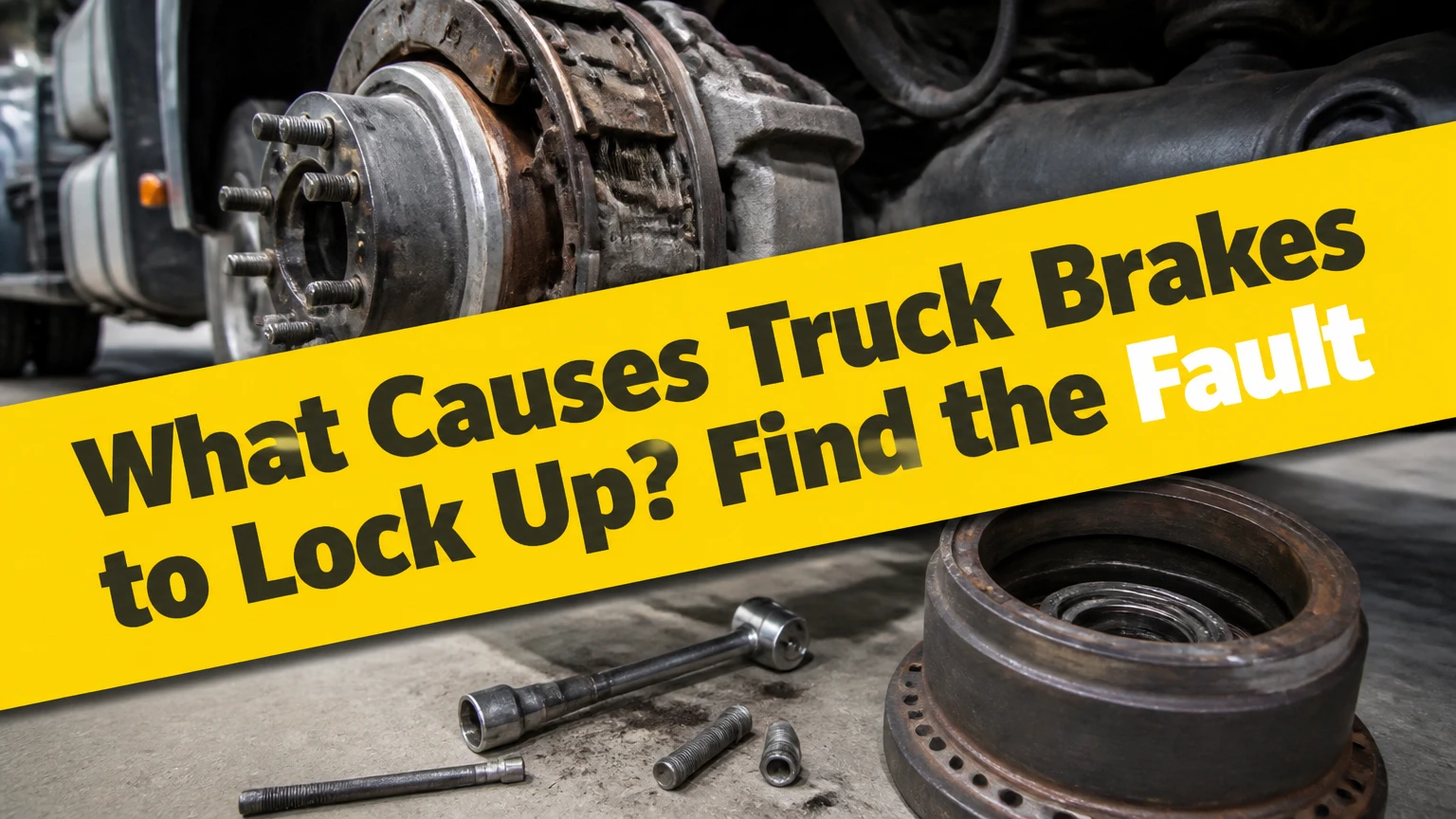
Truck brakes lock up when a wheel stops rotating because brake force exceeds available tire traction, or when a brake component remains mechanically applied after pedal pressure is released. Common causes include excessive braking on a slippery surface, failed ABS control, ice or contamination in air valves, seized S-cam hardware, defective slack adjustment, broken return springs, and automatic spring-brake application from low air pressure.
Key Facts at a Glance
- A locked truck wheel slides instead of rotating, which reduces steering control and can create a tire flat spot within seconds.
- A defective ABS sensor usually removes anti-lock protection; it does not automatically clamp the brake by itself.
- Low air pressure normally causes spring brakes to apply as a safety response, while trapped service air can keep foundation brakes applied.
- A single hot wheel usually indicates a local foundation-brake, bearing, or actuator problem rather than a whole-truck ABS failure.
- Pushrod stroke limits, brake adjustment, air pressure, and brake temperature must be checked against the vehicle manufacturer’s specifications.
- A driver should stop safely, secure the vehicle, and obtain qualified assistance rather than force a locked brake to release.
What Does Truck Brake Lockup Mean?
Truck brake lockup means one or more wheels stop rotating while the vehicle still has forward or rearward momentum. The tire then slides over the pavement, causing a flat spot, reduced directional control, and potentially unstable trailer movement. Lockup differs from brake drag, where the wheel still turns but the brake remains partially applied and overheats.
A truck can experience two related but different events. A traction lockup occurs when the driver or brake controller applies more braking force than the tire-road interface can transmit. A mechanical lockup occurs when air pressure, spring force, or seized hardware keeps the foundation brake applied even after the commanded braking force changes.
The location matters. A steer-axle lockup can prevent the driver from steering around an obstacle. A drive-axle lockup can destabilize the tractor and promote a jackknife, especially on a split-friction surface. A trailer-axle lockup can swing the trailer and increase the risk of a combination-vehicle loss of control.
What is the difference between lockup and brake drag?
Brake drag leaves some wheel rotation; lockup stops rotation. Drag commonly produces a hot drum or rotor, a burning odor, accelerated lining wear, and a vehicle that pulls toward one side. Continued drag can expand the drum, damage seals, fade the lining, and eventually progress to intermittent lockup.
A wheel that is too hot to approach safely is not proof of a specific failed part. Heat can come from an over-adjusted brake, seized cam bushing, sticking caliper, failing wheel bearing, or a tire with severe underinflation. Temperature identifies urgency, not the final diagnosis.
How Does a Truck Air Brake System Apply Braking Force?
A conventional truck air brake system stores compressed air, meters service pressure through a foot valve, moves brake chambers, and converts pushrod travel into friction at each wheel. The compressor commonly maintains reservoir pressure in a manufacturer-defined operating band, often around 100-125 psi, but gauge readings alone cannot prove that every circuit works correctly.
During service braking, the compressor supplies reservoirs, the foot valve sends control pressure, and relay valves deliver air rapidly to the brake chambers. A chamber diaphragm moves a pushrod. On an S-cam foundation brake, the pushrod rotates a slack adjuster and camshaft, forcing the shoes against the drum. On an air disc brake, the actuator moves a mechanism that clamps pads against a rotor.
Parking and emergency braking use a different force path. Spring brakes apply when powerful mechanical springs are released by loss of air pressure. That fail-safe design can create an apparently locked wheel when pressure is insufficient, a brake chamber is damaged, or an emergency circuit loses pressure.
Which air-system faults cause lockup?
Air-system faults cause lockup when service pressure becomes trapped at a chamber, an emergency spring applies, or a valve delivers pressure incorrectly. Typical causes include a sticking relay valve, blocked exhaust port, damaged quick-release valve, contaminated air dryer, leaking or disconnected trailer emergency line, and a failed brake chamber.
Water in the air system is especially troublesome in freezing conditions. If the air dryer does not remove moisture, ice can obstruct a valve’s exhaust path, leaving service air trapped after pedal release. Oil contamination can swell seals and make relay or modulator valves slow to release.
Low pressure requires careful interpretation. A low reservoir reading does not mean service brakes have excessive pressure; it can cause spring brakes to apply automatically. Federal commercial-vehicle rules generally require low-air warning action well before reservoir pressure becomes unsafe, and exact spring-brake application pressure depends on the chamber and vehicle design.
Can low air pressure lock truck brakes?
Low air pressure can apply spring brakes and immobilize a truck, but it does not normally increase service-brake clamping force. The spring-brake section applies as air pressure falls, while service-brake performance may become weak or delayed. A pressure gauge below the vehicle’s specified operating range requires immediate attention.
A driver should not repeatedly pump the pedal to “test” a low-air system. Each application consumes reservoir air. The correct response is to follow the carrier’s emergency procedure, stop in a safe location, monitor both gauges, and arrange inspection if pressure does not recover or continues falling.
Can a tractor-trailer brake lock because of a trailer air-line problem?
Yes. A disconnected, leaking, or incorrectly connected trailer emergency line can remove the pressure that holds trailer spring brakes released. A failed tractor protection valve, trailer relay valve, or gladhand seal can produce a trailer-only application or prevent normal release.
The red emergency line and blue service line have different functions, although color conventions and coupling arrangements must still be verified on the specific equipment. A driver should never crawl beneath a vehicle or manipulate fittings beside moving traffic to release a brake. Secure the combination and call qualified roadside personnel.
Which Mechanical Failures Hold a Brake Applied?
Mechanical failures hold a truck brake applied when the shoes, pads, camshaft, adjuster, or actuator cannot return to its released position. Seized S-cam bushings, damaged rollers, broken shoe return springs, corroded hardware, contaminated linings, over-adjustment, and a failed brake chamber are common foundation-brake causes.
On drum brakes, the S-cam must rotate smoothly and the shoes must move away from the drum after air vents. Corrosion can swell the lining away from the shoe table, a condition often called rust jacking, until the lining contacts the drum continuously. A broken return spring removes the force that retracts the shoe assembly.
Automatic slack adjusters also require diagnosis rather than repeated tightening. An adjuster that is out of adjustment may result from worn cam bushings, incorrect installation, a damaged clevis, insufficient chamber stroke, or a failed internal mechanism. Manually tightening an automatic slack adjuster can conceal the underlying fault and damage the adjuster.
Why do truck brakes lock after the driver releases the pedal?
Truck brakes lock after pedal release when air cannot exhaust, a spring brake applies, or the foundation brake cannot mechanically retract. The most useful clues are the affected wheel, air-gauge behavior, pushrod position, brake temperature, and whether the condition changes after the vehicle cools.
A single locked wheel points toward local hardware or chamber trouble. Multiple wheels on one trailer suggest an air-distribution or emergency-circuit problem. All brakes remaining applied after a pedal release require immediate professional diagnosis because a stuck control valve or low-pressure spring application may affect the entire combination.
Can overheating cause a truck brake to lock?
Overheating can cause temporary or permanent lockup through thermal expansion, lubricant failure, and component distortion. A dragging brake creates heat, heat expands the drum or rotor and related parts, and the tighter clearance creates more drag. This feedback loop can end with a wheel that will not rotate.
There is no universal drum-temperature lockup threshold. Infrared readings vary with ambient temperature, braking history, measurement location, paint, and cooling airflow. A measurement above approximately 300°F may indicate significant heat in many operating situations, but a manufacturer’s service limit and axle-to-axle comparison are more useful than a single universal number.
Can Over-Braking Lock a Healthy Truck Brake?
Hard braking can lock a properly functioning wheel when tire traction is lower than the braking force. Wet pavement, ice, gravel, oil, uneven pavement, worn tread, incorrect inflation, and a lightly loaded axle all reduce the available traction margin.
Load transfer changes the problem during a stop. As the tractor decelerates, weight shifts toward the steer axle and away from the drive and trailer axles. An unloaded or lightly loaded trailer can therefore lock sooner than a heavily loaded axle, particularly when brake torque is poorly balanced or the road has different friction on each side.
ABS reduces this risk by monitoring wheel speed and modulating brake pressure during a developing slide. The system cannot create traction, shorten every stop, or repair defective foundation brakes. The FMCSA Commercial Driver’s License Manual explains the limitation directly: “ABS is an addition to your normal brakes. It does not decrease or increase your normal braking capability.”
What happens when a truck wheel locks?
A locked wheel stops rotating while the truck continues moving, so the tire slides and rapidly develops a flat spot. Steering response becomes unreliable because a sliding tire cannot generate normal lateral force. A locked tire can also produce smoke, vibration, a loud rhythmic thump, and a damaged casing.
| Locked location | Primary loss of control | Typical visible consequence | Immediate concern |
|---|---|---|---|
| Steer axle | Directional control | Front tire flat spot or smoke | Inability to steer around hazards |
| Tractor drive axle | Yaw stability | Rear tire marks or jackknife motion | Tractor rotation and lane departure |
| Trailer axle | Trailer tracking | Trailer swing or tire smoke | Sway, lane encroachment, rollover risk |
| One side only | Uneven braking force | Pulling or yaw toward one side | Split-friction instability |
Do Drum and Air Disc Brakes Fail Differently?
S-cam drum brakes have more exposed mechanical interfaces that can bind, including cams, rollers, bushings, shoe hardware, and return springs. Air disc brakes generally reject rust-jacking problems associated with drum shoes and dissipate heat effectively, but caliper slides, pad guides, actuators, rotors, and electronic controls can still stick or overheat.
Neither design is immune to lockup. Air disc brakes are not automatically safer when maintenance is poor, and drum brakes are not automatically defective because a wheel drags. Brake balance, ABS compatibility, lining or pad friction, axle loading, and inspection quality determine actual behavior.
| Brake design | Common lockup mechanism | Typical diagnostic clue | Maintenance trade-off |
|---|---|---|---|
| S-cam drum | Seized cam, rust-jacked lining, broken spring | Pushrod moves but shoe remains applied | Lower parts cost, more hardware inspection |
| Air disc | Sticking caliper, seized pad guide, actuator fault | Uneven pad wear or hot rotor | Better heat control, higher component cost |
| Spring-brake chamber | Loss of holding air or chamber failure | Parking brake will not release | Fail-safe immobilization, hazardous manual work |
| Trailer drum system | Relay or emergency-valve fault | Several trailer wheels affected | Air-line diagnosis required before parts replacement |
Which measurements matter during diagnosis?
No single pressure, temperature, or stroke number proves a lockup cause. Technicians should compare measured values with the axle manufacturer’s specifications, chamber type, brake design, and applicable inspection rules.
| Measurement | Typical reference point | Why it matters | Important limitation |
|---|---|---|---|
| Reservoir pressure | Often 100-125 psi operating range | Shows compressor and storage performance | Gauge pressure does not confirm delivery at a chamber |
| Low-air warning | Commonly required before 60 psi | Signals unsafe reserve depletion | Warning pressure is not spring-brake application pressure |
| Spring-brake application | Often approximately 20-45 psi | Identifies fail-safe parking action | Exact value varies by chamber and vehicle |
| Type 30 service stroke | Often near 2 inches maximum, design-specific | Indicates adjustment and actuator travel | Legal limit depends on chamber and jurisdiction |
| Drum or rotor surface | Compare corresponding wheels | Finds abnormal heat | Infrared readings are location-sensitive |
| Governor cut-out | Commonly near 120-135 psi | Tests compressor regulation | Vehicle specifications control the final value |
The AI Overview’s claim that every Type 30 chamber has a universal 1.5-2.0-inch standard is unsafe. Stroke limits differ by chamber design and regulatory category, so a technician must use the applicable CVSA, FMCSA, manufacturer, or jurisdictional specification.
What Should a Driver Do During a Lockup?
A driver should control the vehicle, stop in the safest available location, avoid touching hot components, and request qualified inspection. The driver should not crawl beneath the vehicle, strike a drum, disconnect air lines, or release a spring brake without the equipment, training, and secure conditions required by the manufacturer and applicable safety procedures.
Use this observation sequence after the vehicle is secure:
- Identify the affected section. Determine whether the steer axle, tractor drive axle, trailer, or one wheel is involved.
- Read both air gauges. Record the pressure and whether it is falling, recovering, or stable.
- Check warning lamps. Note ABS, low-air, or brake-system alerts before cycling the ignition.
- Look without contact. Check for smoke, tire marks, unusual tilt, damaged hoses, and visible air leaks.
- Allow cooling time. Hot drums, rotors, tires, and wheel ends can cause severe burns or ignite nearby material.
- Arrange a brake inspection. Tell the technician the wheel position, air readings, warning lights, load condition, weather, and whether the brake released after cooling.
Caging a spring brake is not a normal roadside release procedure. A compressed spring inside a brake chamber stores dangerous energy, and caging the chamber removes braking capacity at that wheel. Only trained personnel following the exact chamber and vehicle procedure should perform that work.
How Much Does Truck Brake Lockup Repair Cost?
Typical commercial-truck lockup diagnosis costs about $100-$250, while common repairs range from approximately $150 for a sensor or valve-related service to more than $1,500 for multiple foundation-brake components, wheel-end damage, or roadside recovery. Regional labor rates, parts availability, axle design, and secondary tire damage create wide variation.
| Repair or service | Typical parts and labor cost | Typical shop time | What changes the price |
|---|---|---|---|
| ABS sensor replacement | $150-$350 | 1-2 hours | Sensor corrosion and harness damage |
| Relay or quick-release valve | $200-$600 | 1-3 hours | Access, contamination, air-line repairs |
| S-cam bushing or hardware repair | $300-$700 per wheel | 2-4 hours | Axle removal and worn camshaft |
| Brake shoes and drum, one axle | $400-$900 | 2-4 hours | Drum condition and lining specification |
| Air dryer service or replacement | $350-$700 | 1.5-3 hours | Cartridge versus complete assembly |
| Flat-spotted tire replacement | $400-$1,200 per tire | 0.5-1.5 hours | Tire size, casing value, and retread status |
| Emergency roadside service | $250-$600 base fee | 1-3 hours | Mileage, after-hours rates, and parts |
A sensor code alone should not trigger an ABS sensor replacement. The technician should inspect sensor wiring, tone rings, wheel-end play, modulator operation, and the air-gap condition because a damaged tone ring or bearing can produce the same warning.
How Can Fleets Prevent Brake Lockup?
Fleets prevent truck brake lockup with documented air-system maintenance, correct brake adjustment, compatible friction materials, wheel-end inspections, and prompt ABS fault repair. Preventive maintenance must address the cause of drag, not merely reset a warning light or tighten an adjuster.
| Prevention task | Typical interval or trigger | Verification method | Failure prevented |
|---|---|---|---|
| Drain and inspect reservoirs | Per manufacturer schedule | Check water and oil contamination | Frozen or contaminated valves |
| Service air dryer | Commonly annual or mileage-based | Confirm cartridge and purge operation | Moisture-related sticking |
| Lubricate S-cam hardware | Manufacturer interval, often 90 days in severe service | Confirm grease reaches bushings | Cam seizure and drag |
| Measure chamber stroke | Every brake inspection | Compare with legal specification | Overstroke and poor application |
| Inspect linings and drums | Pre-trip plus scheduled inspection | Check thickness, cracks, contamination | Rust jacking and friction imbalance |
| Test ABS warning system | Every pre-trip | Lamp sequence and fault scan | Undetected loss of anti-lock control |
| Compare wheel temperatures | After repeated braking events | Infrared or calibrated inspection | Localized drag and bearing faults |
Mixing brake lining compounds on one axle can create uneven torque, but friction material compatibility is broader than matching a brand name. The technician must verify the lining rating, drum condition, axle position, brake balance, and the vehicle manufacturer’s approved combination.
Grease contamination is another preventable failure. Lubricant belongs at specified pivot and cam points, not on the friction surface. A contaminated lining generally requires replacement or approved treatment according to the manufacturer, not repeated hard braking to “burn the grease off.”
What Are the Most Common Diagnostic Mistakes?
The most common diagnostic mistake is blaming ABS for every lockup. A failed wheel-speed sensor usually disables anti-lock modulation at that wheel or axle, while the foundation brake can continue operating conventionally; a mechanically seized brake can lock whether ABS is healthy or not.
Another mistake is releasing a hot brake without finding the source. Cooling may temporarily restore wheel rotation, but a seized bushing, over-adjusted brake, failing bearing, or trapped air condition remains and can cause a second lockup.
Experienced technicians also avoid these shortcuts:
- Do not manually tighten an automatic slack adjuster repeatedly. Measure stroke and inspect the linkage first.
- Do not compare one pressure reading with a universal chart. Test application and release pressure at the relevant chamber.
- Do not diagnose by temperature alone. Compare paired wheels and inspect bearings, tires, drums, rotors, and friction surfaces.
- Do not assume a trailer lockup is a trailer brake-shoe failure. Several affected wheels point toward the emergency circuit, relay valve, or air-line connection.
- Do not continue after a flat spot appears. Tire casing damage can worsen, and vibration can damage suspension and wheel-end components.
FAQ About Truck Brake Lockup
Can a bad ABS sensor make truck brakes lock up?
A bad ABS sensor normally causes loss of anti-lock control rather than directly applying the brake. The affected wheel may lock during an emergency stop because the system cannot detect its deceleration, but a continuously locked wheel requires inspection of the foundation brake, air modulator, wiring, tone ring, and wheel end.
Why does one truck brake get hot?
One hot truck brake usually has a local fault, such as a seized S-cam bushing, sticking caliper, over-adjusted brake, damaged return spring, contaminated lining, failing chamber, or wheel-bearing problem. Compare the wheel with the opposite axle position, but do not touch the drum or rotor until it has cooled.
Can cold weather cause trailer brakes to lock?
Cold weather can cause trailer brakes to remain applied when moisture freezes in an air valve, exhaust port, or line. The air dryer, reservoirs, relay valves, gladhand seals, and emergency line should be inspected. Pouring boiling water on brake components can cause thermal damage and does not remove the underlying moisture.
Can a bad slack adjuster cause a wheel lockup?
A defective or incorrectly installed slack adjuster can cause excessive stroke, poor release, or incorrect shoe clearance. Repeated manual adjustment can hide worn cam bushings or linkage faults. A qualified inspection should measure stroke, verify automatic adjustment, and inspect the entire foundation brake.
Is it safe to drive with a locked truck brake after it releases?
No. A brake that releases after cooling or air-pressure recovery can lock again without warning. The event may also have flat-spotted the tire, overheated the wheel end, damaged the lining, or weakened the drum. The truck should receive a documented brake and tire inspection before returning to service.
Does ABS stop every truck brake lockup?
ABS reduces wheel lock during hard braking by modulating pressure, but ABS cannot overcome ice, defective foundation hardware, severe brake imbalance, poor tires, or a failed sensor and modulator. ABS also does not replace correct adjustment, air-system maintenance, or a driver’s need to control speed for road conditions.
The Bottom Line
The answer to what causes truck brakes to lock up is a mismatch between braking force and tire traction, an air system that fails to release or applies spring brakes, or foundation hardware that binds. Identify the affected axle, record air pressure and warning lights, avoid hot components and improvised release methods, and have a qualified technician inspect the brake, air circuit, ABS components, tire, and wheel end before the truck moves again.