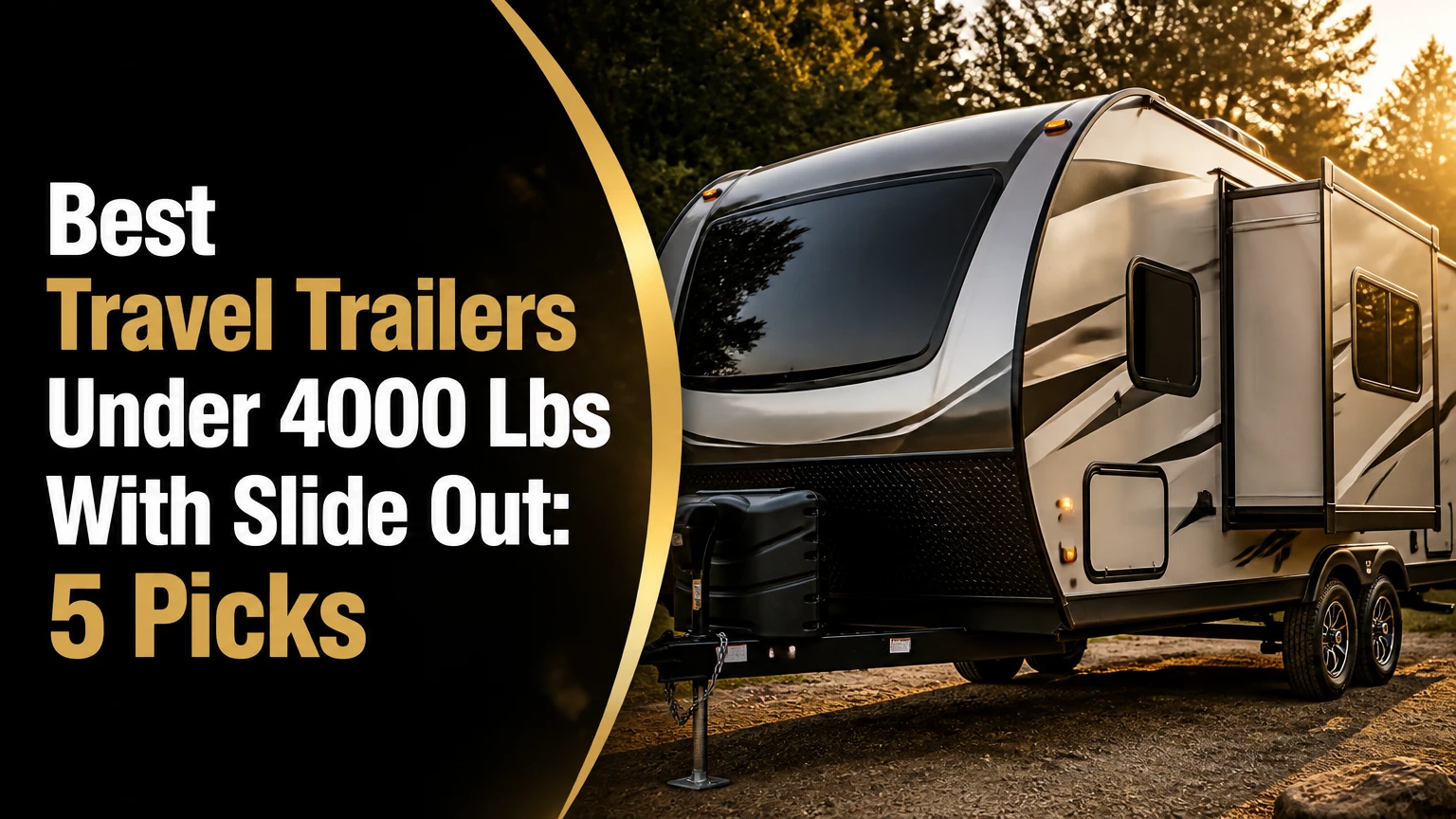
The best travel trailers under 4000 lbs with slide out are the Jayco Jay Feather Micro 166FBS, Coachmen Apex Nano 194BHS, Lance 1575, Forest River Rockwood Geo Pro G19FD, and Forest River E-Pro E19FBS, subject to model-year specifications. The Jayco is the strongest couples layout, while the Apex serves families; however, loaded GVWR and vehicle payload matter more than advertised dry weight.
Key Facts at a Glance
A trailer listed below 4,000 pounds by UVW can exceed 4,000 pounds when equipped and loaded.
A 10%-15% loaded tongue weight is a practical stability target for most conventional travel trailers.
A slide-out increases usable living space but reduces cargo capacity and adds seals, wiring, motors, and adjustment points.
The tow vehicle must satisfy trailer weight, tongue weight, receiver rating, payload, axle ratings, and frontal-area limits.
Jayco Jay Feather Micro 166FBS is generally the best couples layout; Coachmen Apex Nano 194BHS is generally the better bunkhouse layout.
Always use the trailer’s certification label and the specific model-year owner’s manual before purchasing.
Which Travel Trailers Under 4000 lbs With Slide Out Are Best?
The Jayco Jay Feather Micro 166FBS is the best overall choice for couples who prioritize a permanent bed and open living area. The Coachmen Apex Nano 194BHS is the better family choice because it combines bunks with a slide, while the Lance 1575 is the stronger premium used-market option for buyers who value construction and weather resistance.
The phrase “under 4,000 pounds” needs a precise definition. Manufacturers commonly advertise unloaded vehicle weight, or UVW, which can exclude dealer-installed equipment and some fluids. A trailer’s loaded weight can rise by several hundred pounds after adding propane, a battery, food, clothing, cookware, freshwater, camping chairs, and a weight-distribution hitch.
The recommendations below therefore use a screening rule: the listed model or model family commonly has a model-year UVW below 4,000 pounds and includes a slide-out. Specifications change. A 2024 floor plan can differ materially from a 2026 version.
| Model or family | Best for | Typical UVW range by model year | Typical GVWR range | Layout feature |
|---|---|---|---|---|
| Jayco Jay Feather Micro 166FBS | Couples | 3,700-4,000 lb | 4,995-5,500 lb | Front queen bed, sofa slide |
| Coachmen Apex Nano 194BHS | Small families | 3,600-3,950 lb | 4,800-5,500 lb | Bunks, dinette slide |
| Lance 1575 | Premium construction | 3,300-3,700 lb | 4,500-5,000 lb | U-dinette slide |
| Rockwood Geo Pro G19FD | Couples, short trips | 3,300-3,700 lb | 4,400-4,900 lb | Front bed, dinette slide |
| Forest River E-Pro E19FBS | Couples, flexible use | 3,600-3,950 lb | 4,700-5,200 lb | Murphy bed, dinette slide |
The ranges are screening figures, not a substitute for a weight label. Some trim packages, awnings, solar equipment, air conditioners, and dealer options can push UVW over 4,000 pounds.
How Were the Lightweight Slide-Out Trailers Chosen?
The selection criteria were usable layout, verified weight margin, realistic towability, construction, service complexity, and suitability for a defined camping style. A trailer did not qualify merely because an older brochure showed a low dry weight.
A useful shortlist must answer six practical questions:
- Does the specific model-year UVW leave at least 500 pounds below the buyer’s comfortable loaded limit?
- Does the tow vehicle have enough payload for passengers, cargo, hitch weight, and accessories?
- Does the slide create meaningful floor area rather than only moving a small sofa?
- Can the buyer access the refrigerator, bathroom, and bed with the slide retracted?
- Are replacement parts and service available near the buyer?
- Does the layout match the number of people sleeping inside?
The 500-pound margin is a practitioner rule of thumb, not a federal requirement. It gives the owner room for options and gear while avoiding constant operation at the trailer’s maximum rating.
Best Overall: Jayco Jay Feather Micro 166FBS
The Jayco Jay Feather Micro 166FBS is the strongest all-around choice for two travelers who want a permanent queen bed, a separate bathroom, and a sofa or living-room slide in a compact towable package. Its main limitation is that a low advertised UVW can conceal a relatively tight payload margin after options and personal equipment.
The 166FBS floor plan targets couples rather than families. The front bed remains available without converting a dinette every night, and the slide expands the central seating area when the trailer is parked. That arrangement usually feels more residential than a fixed-wall trailer of similar exterior length.
Jayco’s Jay Feather Micro line has used lightweight wall construction and compact appliances to control mass. Buyers should inspect the actual build sheet for an Azdel or alternative composite-wall specification because construction details can vary by year and package.
| Evaluation point | Jay Feather Micro 166FBS |
|---|---|
| Typical sleeping capacity | 2-3 people |
| Bed arrangement | Permanent queen or queen-size front bed |
| Slide purpose | Sofa or living-area expansion |
| Typical UVW | 3,700-4,000 lb |
| Typical hitch weight | 400-550 lb before loading |
| Main strength | Permanent bed with open lounge |
| Main drawback | Limited payload margin on heavily optioned units |
Choose this trailer if two adults want a permanent bed and frequent campground hookups. Skip it if four or more people need dedicated sleeping spaces, if the vehicle has low payload, or if most trips involve rough forest roads where slide mechanisms and body flex receive more abuse.
Best Bunkhouse: Coachmen Apex Nano 194BHS
The Coachmen Apex Nano 194BHS is the best fit for a family with one or two children because the bunk beds preserve sleeping capacity while the dinette slide opens the center aisle. The trade-off is a higher loaded weight, more concentrated tongue weight, and less storage than a couples-only floor plan.
The bunkhouse arrangement avoids turning the dinette into a child’s bed every evening. The main slide typically carries the dinette, while the bathroom and kitchen remain on the fixed wall. That configuration helps traffic flow when the slide is extended.
A family should calculate weight with the bunk area occupied by bedding and clothing. Four bicycles, a large cooler, outdoor cooking equipment, and full freshwater can consume the remaining cargo capacity quickly.
| Evaluation point | Apex Nano 194BHS |
|---|---|
| Typical sleeping capacity | 5-7 people |
| Bed arrangement | Queen bed plus double bunks and dinette |
| Slide purpose | Dinette and living-room expansion |
| Typical UVW | 3,600-3,950 lb |
| Typical hitch weight | 450-600 lb before loading |
| Main strength | Dedicated bunks in a compact body |
| Main drawback | Family cargo can exceed practical payload quickly |
Choose this trailer if children need fixed beds and most camping occurs at serviced sites. Skip it if two adults want maximum storage, if your SUV payload is below approximately 1,500 pounds, or if you routinely tow with full freshwater.
Best Premium Construction: Lance 1575
The Lance 1575 is the best premium option for couples who will pay more for a carefully engineered compact trailer, stronger insulation, and a permanent slide-assisted lounge. The Lance is not the cheapest option, and its premium construction does not eliminate the need to inspect seals, roof penetrations, tires, and appliances.
Lance trailers are widely associated with aluminum framing, laminated construction, and more developed insulation than entry-level compact trailers. The 1575’s U-shaped dinette slide creates a large central living area, but the floor plan remains sized for two people rather than a large family.
The Lance 1575 is particularly attractive on the used market because buyers often seek its construction quality and winter-oriented features. Used examples require specialist inspection because water damage can hide behind laminated walls even when the interior looks clean.
| Evaluation point | Lance 1575 |
|---|---|
| Typical sleeping capacity | 2-3 people |
| Bed arrangement | Front queen bed and U-shaped dinette |
| Slide purpose | Large dinette expansion |
| Typical UVW | 3,300-3,700 lb |
| Typical GVWR | 4,500-5,000 lb |
| Main strength | Insulation and structural refinement |
| Main drawback | Higher purchase and repair cost |
Choose this trailer if cold-weather comfort, long ownership, and finish quality outrank purchase price. Skip it if you want the lowest-cost first trailer or if local service does not support Lance-specific components.
Best Compact Value Layout: Rockwood Geo Pro G19FD
The Forest River Rockwood Geo Pro G19FD is a strong value-oriented couples trailer when its model-year weight label remains below the buyer’s target. Its slide expands the dinette, but the interior and storage systems remain compact enough that two adults must pack carefully.
The G19FD commonly combines a front bed, a side dinette slide, a compact kitchen, and a dry bathroom. The floor plan works well for weekend trips because the bathroom does not require converting the lounge. Some model years and packages include solar, inverter, outdoor equipment, or upgraded appliances that materially alter the delivered weight.
Rockwood’s large production volume can make used parts and dealer familiarity easier to find than for low-volume brands. Build consistency still deserves inspection, particularly around roof sealant, slide corners, window frames, and plumbing penetrations.
| Evaluation point | Rockwood Geo Pro G19FD |
|---|---|
| Typical sleeping capacity | 2-3 people |
| Bed arrangement | Front bed and convertible dinette |
| Slide purpose | Dinette expansion |
| Typical UVW | 3,300-3,700 lb |
| Typical hitch weight | 400-520 lb before loading |
| Main strength | Compact dry-bath floor plan |
| Main drawback | Small storage and variable payload |
Choose this trailer if you want a compact couples layout and broad dealer familiarity. Skip it if you need a walk-around bed, a large pantry, or substantial boondocking water capacity.
Best Murphy-Bed Alternative: Forest River E-Pro E19FBS
The Forest River E-Pro E19FBS is the best choice for buyers who want a daytime sofa or lounge without giving up a full sleeping surface at night. The Murphy-bed mechanism improves daytime circulation, but setup requires clearing the bed area and accepting a more mechanically complex interior.
Murphy-bed trailers can feel larger during the day than their exterior dimensions suggest. The slide generally carries the dinette, and the bed folds against the wall or sofa zone when not in use. That feature suits owners who work, read, or spend rainy days inside.
The E-Pro family overlaps technically with Geo Pro products, but equipment, graphics, dealer packages, and model-year ratings differ. Confirm the certification label rather than assuming two similarly named floor plans have the same payload.
| Evaluation point | E-Pro E19FBS |
|---|---|
| Typical sleeping capacity | 2-3 people |
| Bed arrangement | Murphy bed and sofa |
| Slide purpose | Dinette or lounge expansion |
| Typical UVW | 3,600-3,950 lb |
| Typical GVWR | 4,700-5,200 lb |
| Main strength | Walkable daytime floor plan |
| Main drawback | Bed conversion and reduced wall storage |
Choose this trailer if daytime floor space matters more than instant bed access. Skip it if you want a permanent bed ready at all times or if repeated daily conversions would become irritating.
What Weight Numbers Actually Determine Towability?
GVWR, not dry weight, is the safest starting point for trailer capacity planning because GVWR represents the maximum permitted loaded trailer weight. UVW describes a particular factory configuration, while cargo-carrying capacity is the difference between GVWR and the trailer’s measured or listed empty weight.
| Metric | Meaning | Typical compact slide-out value | How to use it |
|---|---|---|---|
| UVW | Factory weight before ordinary camping cargo | 3,300-4,000 lb | Compare model-year configurations |
| GVWR | Maximum loaded trailer weight | 4,500-5,500 lb | Use for conservative towing math |
| CCC | GVWR minus UVW and listed equipment | 600-1,300 lb | Reserve for water, food, and gear |
| Tongue weight | Downward load on hitch ball | 10%-15% of loaded trailer | Check vehicle payload and receiver |
| Freshwater capacity | Water carried while traveling | 20-45 gallons | Add 167-375 lb when full |
One gallon of freshwater weighs approximately 8.34 pounds. A 40-gallon tank therefore adds about 334 pounds before containers, hoses, and gear are counted.
Consider a trailer with a 3,800-pound UVW and a 5,000-pound GVWR. Two propane cylinders and a battery may add approximately 100 pounds, while food, clothing, cookware, chairs, tools, and fluids can add another 500-800 pounds. A realistic travel weight may reach 4,500-4,700 pounds.
At 12% tongue weight, that loaded trailer places 540-564 pounds on the vehicle. The vehicle payload must still carry passengers, luggage, pets, the weight-distribution hitch, and any bed or roof cargo.
Can a Midsize SUV Tow One Safely?
A midsize SUV can tow a compact slide-out trailer safely only when its payload rating and rear-axle rating support the loaded tongue weight, occupants, and cargo. A tow rating of 5,000 pounds alone does not prove compatibility because manufacturers also limit payload, frontal area, tongue weight, and sometimes trailer length.
Use the vehicle’s door-jamb certification label. Subtract the weights of every occupant, pet, accessory, and item carried in the SUV from the stated payload. The remainder must cover the actual loaded tongue weight and hitch equipment.
| Vehicle rating or condition | Example value | Decision implication |
|---|---|---|
| SUV maximum tow rating | 5,000 lb | Not the only limiting number |
| SUV door-label payload | 1,550 lb | Includes passengers and tongue load |
| Four occupants and luggage | 700 lb | Leaves 850 lb before tongue weight |
| Loaded trailer tongue weight | 550 lb | Leaves 300 lb payload margin |
| Receiver maximum tongue rating | 600 lb | Nearly at limit in the example |
Expert towing guidance from the Recreational Vehicle Industry Association consistently directs buyers to follow the vehicle manufacturer’s ratings rather than rely on a generic tow number. The practical lesson is simple: weigh the combination at a certified scale after loading it.
A weight-distribution hitch can improve handling on compatible vehicles, but it does not create payload capacity. Some unibody SUVs have restrictions on weight-distribution systems, so the owner’s manual controls.
How Do Lightweight Trailer Slide-Outs Work?
Lightweight travel trailer slide-outs usually use electric rack, cable, or rail mechanisms rather than large hydraulic assemblies. The motor turns a gear, cable drum, or drive shaft that moves the slide room across rollers or supports while perimeter seals close the opening.
Electric Rack Systems
Lippert Schwintek in-wall systems place slim drive motors and gear tracks near the vertical slide walls. They save interior space and weight, but unequal motor counts, low voltage, misalignment, or excessive friction can make the room move crookedly.
Cable-Driven Systems
Cable slides use cables and pulleys to pull the room in both directions. Cable tension and pulley alignment matter, and a broken cable can leave the room partially extended. Manual retraction procedures vary by manufacturer.
Rail and Rack Systems
External or under-floor rack systems use rails, toothed bars, or drive shafts. They may tolerate different loads than in-wall systems, but the owner still needs the exact controller reset and manual override procedure for that trailer.
A slide-out is not automatically safer because it uses a particular brand of mechanism. Installation quality, frame alignment, battery voltage, seal condition, and maintenance have greater practical influence than the system name alone.
How Should You Operate a Travel Trailer Slide-Out?
Operate a travel trailer slide-out only after leveling the trailer, stabilizing it, checking clearance, and providing adequate 12-volt power. The complete inspection usually takes 5-10 minutes, and the most important success factor is preventing the room from moving against an obstruction.
- Park on a stable surface. Chock the wheels, disconnect the tow vehicle if appropriate, and level the trailer according to the owner’s manual.
- Deploy stabilizers. Stabilizer jacks reduce movement, but they are not designed to lift the entire trailer or correct major leveling errors.
- Inspect both sides. Check for branches, posts, awnings, utility pedestals, and neighboring vehicles.
- Clear the interior path. Move rugs, cabinet doors, seat cushions, and loose objects away from the slide floor and walls.
- Check power. Connect shore power or confirm a healthy house battery. A resting battery near 12.4 volts is only a rough indicator; voltage can sag under motor load.
- Hold the switch continuously. Follow the owner’s manual and keep the switch engaged until the room reaches its intended end position.
- Listen and inspect. Stop if the room jerks, tilts, grinds, or leaves an uneven seal. Do not treat a motor click as proof of correct adjustment.
- Check seals. Confirm that the wiper and bulb seals lie evenly around the room without folding inward.
The common mistake is operating a slide while the trailer is badly out of level or while the battery is weak. The result can be motor synchronization loss, controller faults, gear wear, or a compressed seal that admits water.
Is a Slide-Out Worth the Added Complexity?
A slide-out is worthwhile when interior floor space affects comfort during extended stays, but a fixed-wall trailer is often better for low-maintenance ownership, rough-road travel, and maximum cargo capacity. The decision depends on how many hours occupants spend inside and how much mechanical risk they accept.
| Factor | Slide-out trailer | Fixed-wall trailer | Better choice |
|---|---|---|---|
| Parked lounge width | Commonly 9-11.5 ft across expanded area | Commonly 7-8 ft | Slide-out |
| Cargo capacity | Often 600-1,000 lb in this class | Often 900-1,400 lb | Fixed-wall |
| Water-entry points | Slide seals plus roof and wall penetrations | Roof and wall penetrations | Fixed-wall |
| Interior repair parts | Motors, controllers, gears, seals | Fewer moving components | Fixed-wall |
| Rainy-day livability | More seating and aisle space | More compact | Slide-out |
| Rough-road tolerance | Requires careful alignment checks | Fewer alignment concerns | Fixed-wall |
| Weight margin | Slide hardware consumes capacity | More capacity for equipment | Fixed-wall |
The counterintuitive point is that a slide can make a small trailer feel much larger without increasing its legal carrying capacity. Owners gain floor area but may lose the payload needed for full water tanks, outdoor equipment, and extended off-grid stays.
What Does Ownership Cost?
A new compact slide-out trailer typically costs about $24,000-$42,000 before taxes, registration, dealer fees, and accessories, while a used two-to-five-year-old example commonly falls around $14,000-$26,000. A realistic first-year budget should also include hitch equipment, inspection, battery, brake controller, wheel service, and insurance.
| Ownership item | Typical new cost | Typical used cost | Timing |
|---|---|---|---|
| Trailer purchase | $24,000-$42,000 | $14,000-$26,000 | Once |
| Pre-purchase inspection | $250-$600 | $250-$600 | Before purchase |
| Weight-distribution hitch | $500-$1,400 | $500-$1,400 | Once |
| Battery and propane setup | $250-$900 | $150-$700 | Once or replacement |
| Annual service | $400-$900 | $500-$1,200 | Every year |
| Slide motor or controller repair | $300-$1,500 | $300-$1,500 | As needed |
Prices vary by region, season, brand, and dealer preparation. A roof inspection and moisture scan are inexpensive compared with replacing a delaminated wall or water-damaged slide floor.
The 6-12 week factory-order timeframe sometimes cited for custom configurations is not universal. Dealer stock may be immediate, while popular floor plans, shipping delays, and model-year changeovers can extend delivery substantially.
What Problems Should Buyers Inspect?
The most expensive compact trailer problems are usually water intrusion, overloaded running gear, misaligned slide rooms, and neglected tires rather than a visibly worn sofa. Examine the trailer with a flashlight, moisture meter, tire gauge, and the complete service history.
Inspect these areas:
- Slide roof and corners: Look for cracked sealant, soft flooring, staining, and separated trim.
- Interior wall edges: Press gently around windows, the slide opening, and lower cabinets for softness.
- Tires: Check DOT date codes, sidewall cracking, uneven wear, and load range.
- Frame and suspension: Inspect welds, spring hangers, equalizers, and evidence of impact.
- Brakes and bearings: Confirm brake operation and ask when bearings were last serviced.
- Roof: Examine every penetration, air-conditioner gasket, vent, skylight, and lap-sealant joint.
- Appliances: Test refrigerator operation on available power sources, furnace ignition, water pump, water heater, and air conditioner.
- Slide movement: Extend and retract it several times while watching for racking, noise, or seal displacement.
A dry interior does not prove a dry wall. Laminated panels can conceal moisture until delamination becomes visible.
How Do You Troubleshoot a Failed Slide-Out?
A slide-out that moves unevenly usually has a synchronization, obstruction, alignment, low-voltage, or controller problem, while a completely inactive slide often has a fuse, circuit breaker, switch, wiring, or motor fault. Stop operating the switch when the room binds because repeated attempts can damage gears and seals.
| Symptom | Likely cause | Safe first action | Escalate when |
|---|---|---|---|
| One side leads | Motor synchronization or obstruction | Retract only if manual permits | Room remains crooked |
| No movement | Fuse, breaker, switch, or low voltage | Check fuse and battery condition | Fuse fails again |
| Grinding sound | Gear or rail damage | Stop immediately | Any metal shavings appear |
| Water at floor | Failed seal or roof leak | Dry area and inspect sealant | Wood feels soft |
| Stops halfway | Controller, motor, or excessive load | Check obstruction and voltage | Controller fault persists |
Some Schwintek systems can resynchronize after a complete retract cycle with the switch held briefly, but the correct duration and procedure depend on the controller and owner’s manual. Do not apply a universal “hold for five seconds” rule to every slide system.
A 30-amp fuse or inline breaker may protect some installations, but ratings vary. Replace a fuse only with the specified rating. A larger fuse can turn a wiring fault into a fire risk.
Which Camping Situations Change the Recommendation?
Camping duration, climate, road surface, and access to hookups change the best trailer choice more than a feature list does. Slide-outs suit campground-based trips and longer indoor stays, while fixed-wall or simpler trailers suit remote travel and owners who prioritize low system complexity.
For winter camping, the Lance 1575 deserves priority among these options because insulation, heated tanks, furnace ducting, and window design matter more than slide size. Verify the actual package, because a nominally insulated trailer may still have vulnerable plumbing or an unprotected slide floor.
For boondocking, choose the lightest layout with the largest practical battery, solar, and water capacity rather than automatically selecting the largest interior. A full freshwater tank can consume much of the weight margin, and slide motors need reliable 12-volt power.
For mountain towing, use the loaded combination weight and expect reduced performance at altitude. Turbocharged engines generally retain power better than naturally aspirated engines, but the vehicle’s cooling, transmission, and braking specifications remain controlling.
For frequent rough-road travel, the Lance may offer stronger construction, but no conventional slide-out trailer is a substitute for a purpose-built off-road camper. Repeated frame flex can accelerate alignment and seal problems.
Which Should You Pick?
Choose the Jayco for two adults
Select the Jay Feather Micro 166FBS when a permanent bed and comfortable lounge matter most. Confirm that the loaded tongue weight fits the SUV payload after passengers and luggage are included.
Choose the Apex for a family
Select the Apex Nano 194BHS when dedicated bunks prevent nightly bed conversion. Weigh the loaded trailer with family gear because the bunkhouse layout can encourage more cargo than the payload allows.
Choose the Lance for premium ownership
Select the Lance 1575 when insulation, construction, and long-term finish quality justify a higher price. Require a moisture inspection on used units.
Choose the Geo Pro for compact value
Select the Rockwood Geo Pro G19FD for a dry bath, broad dealer familiarity, and a straightforward couples floor plan. Confirm options and cargo capacity on the individual unit.
Choose the E-Pro for daytime space
Select the E-Pro E19FBS when a Murphy bed creates useful daytime room. Avoid it if converting the bed every night conflicts with your camping routine.
Frequently Asked Questions
Can a trailer with a 4,000-pound dry weight be towed by a 4,000-pound SUV?
No. A 4,000-pound dry trailer can weigh 4,700-5,000 pounds after propane, battery, water, food, clothing, and equipment are added. The SUV must also carry passengers and receive the trailer’s tongue weight within its payload, axle, receiver, and braking limits.
What is a safe tongue weight for a small travel trailer?
A loaded tongue weight of approximately 10%-15% of the loaded trailer weight is a common stability target for conventional travel trailers. A 4,600-pound loaded trailer would therefore place about 460-690 pounds on the hitch, before accounting for hitch hardware and vehicle cargo.
Are slide-outs more likely to leak?
Slide-outs add seals and a large wall opening, so they create additional water-entry and maintenance points compared with fixed-wall trailers. They do not inevitably leak. Regular seal inspection, roof maintenance, correct leveling, and prompt repair reduce the risk.
Can you use a slide-out without shore power?
Usually yes, if the trailer has a healthy 12-volt battery and the slide system is designed for battery operation. Motor current can be substantial, so a weak battery may cause voltage sag, controller faults, or uneven movement. Check the owner’s manual before using an inverter or generator.
Should freshwater be full while towing?
Usually no, unless the destination lacks reliable water or the owner’s manual requires it. Freshwater adds 8.34 pounds per gallon, so a 40-gallon tank contributes roughly 334 pounds, reducing cargo margin and increasing trailer weight.
Is the Lance 1575 better than the Jayco Jay Feather Micro 166FBS?
The Lance 1575 is generally better for buyers prioritizing insulation, construction, and premium used value, while the Jayco Jay Feather Micro 166FBS offers a more contemporary couples layout and broader mainstream availability. Condition, model year, payload, and service history should decide between two used examples.
The Bottom Line
The best travel trailers under 4000 lbs with slide out are not selected by dry weight alone. Choose the Jayco Jay Feather Micro 166FBS for two adults, the Coachmen Apex Nano 194BHS for a small family, the Lance 1575 for premium construction, the Geo Pro G19FD for compact value, or the E-Pro E19FBS for Murphy-bed flexibility. Before signing, verify the certification labels, calculate loaded tongue weight, inspect for moisture, and weigh the finished combination.