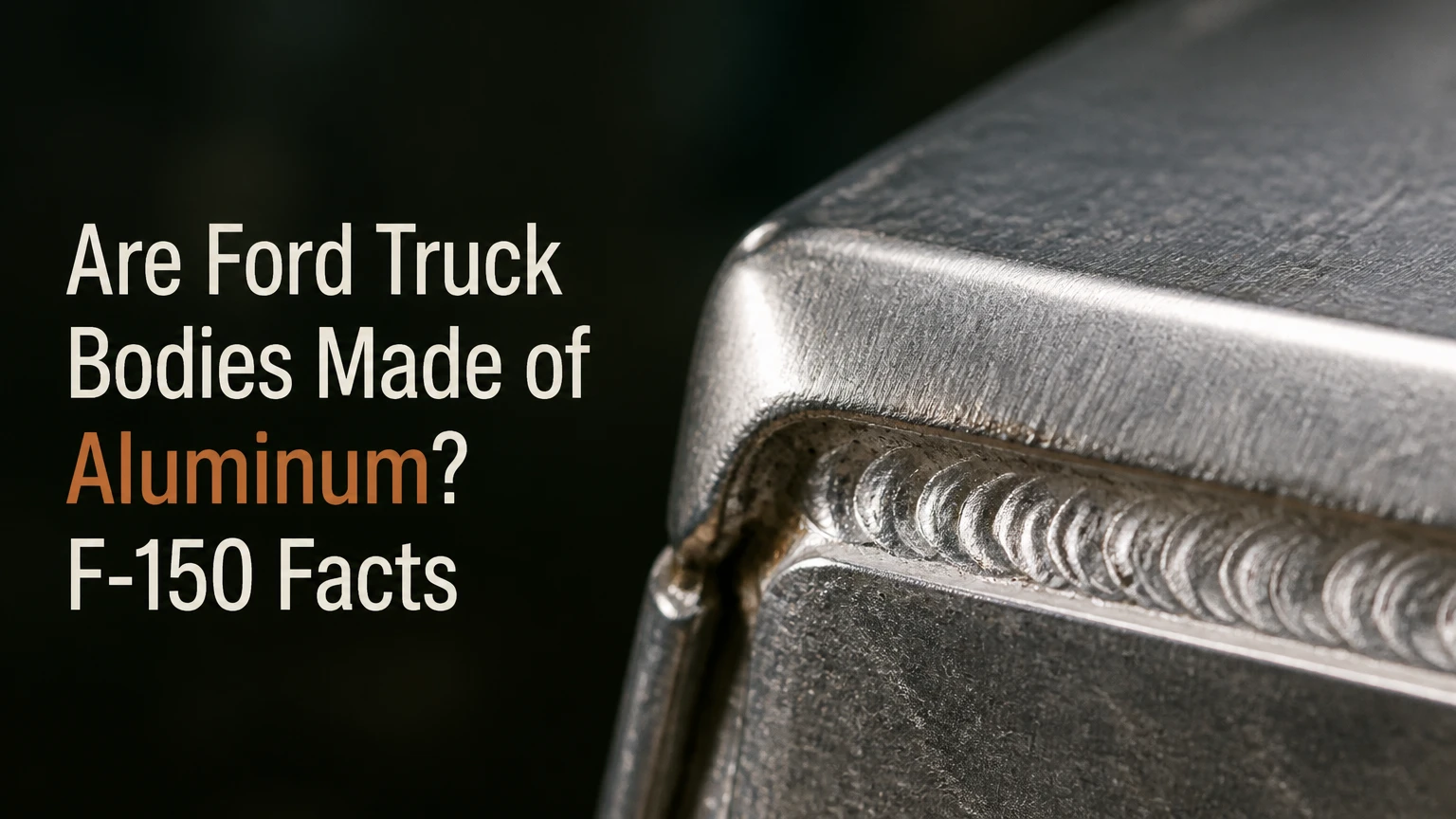
Yes, Ford truck bodies are made of aluminum on the full-size F-150 from the 2015 model year onward and on the F-250, F-350, and F-450 Super Duty from 2017 onward. Ford uses aluminum for the cab, cargo bed, and many exterior panels, while the main ladder frame remains high-strength steel. Smaller Ford pickups, including the Ranger and Maverick, use different, predominantly steel body architectures.
Key Facts at a Glance
- The Ford F-150 changed to an aluminum-intensive body for the 2015 model year.
- Ford Super Duty models adopted aluminum cabs and beds for 2017.
- The F-150 and Super Duty frames remain fully boxed, high-strength steel structures.
- Aluminum weighs about one-third as much as steel by volume, so Ford uses thicker sheet in many panels.
- Aluminum does not rust like iron-based steel, but it can corrode, especially near contaminated repairs or incompatible hardware.
- Aluminum collision repair requires dedicated tools, procedures, and technician training.
Which Ford Trucks Have Aluminum Bodies?
The Ford F-150 has an aluminum-intensive cab, bed, and exterior body beginning with the 2015 model year, and the F-250, F-350, and F-450 Super Duty received the same broad construction strategy for 2017. The Ford F-150 Lightning also uses an aluminum body, while the Raptor retains the F-150’s aluminum body strategy with additional reinforced components.
“Aluminum body” describes the body shell and panels, not every truck component. Engines, transmissions, suspension parts, fasteners, axles, bumpers, and frames can still be steel, cast iron, or other materials.
| Ford pickup | Aluminum body start | Cab and bed | Main frame |
|---|---|---|---|
| F-150 | 2015 | Aluminum-intensive | High-strength steel |
| F-150 Raptor | 2017 for second generation | Aluminum-intensive with reinforced structures | High-strength steel |
| F-150 Lightning | 2022 | Aluminum-intensive | High-strength steel |
| F-250, F-350, F-450 Super Duty | 2017 | Aluminum-intensive, heavier-gauge areas | High-strength steel |
The exact alloy, panel gauge, reinforcement design, and component material vary by generation and location. A parts catalog or vehicle repair manual is more reliable than assuming every visible part on a particular trim is aluminum.
Which Parts Are Aluminum?
Ford primarily uses aluminum for the F-150 and Super Duty cab panels, doors, hood, roof components, fenders, pickup box, tailgate, and other exterior panels. The body-in-white also includes aluminum structural sections, reinforcements, and closures, but the material mix differs between generations and crash zones.
The pickup bed is aluminum, but its floor, crossmembers, reinforcements, tie-downs, and mounting hardware are not necessarily made from the same alloy. A steel accessory mounted to an aluminum bed can create a corrosion problem if moisture and road salt bridge the two metals.
What Is Not Aluminum?
The principal exceptions are the frame and many heavy-load mechanical components. The F-150’s boxed frame uses high-strength steel because steel provides high stiffness, fatigue performance, and established manufacturing advantages at the required loads.
| Component | Typical Ford material | Why the material is used |
|---|---|---|
| Ladder frame | High-strength steel | Rigidity, fatigue resistance, and load support |
| Cab outer panels | 6000-series aluminum alloys | Low mass and corrosion resistance |
| Pickup bed panels | Aluminum alloys | Weight reduction and corrosion resistance |
| Axles and differential housings | Steel or cast iron | High load and wear resistance |
| Suspension arms and brackets | Steel, aluminum, or cast components | Location-specific strength and stiffness |
| Engine and transmission | Cast iron, steel, and aluminum mix | Heat, wear, mass, and manufacturing requirements |
The phrase “all-aluminum truck” is therefore imprecise. Ford’s full-size pickups have aluminum-intensive bodies attached to steel chassis systems.
Is the Ford Truck Frame Aluminum or Steel?
The Ford F-150 and Super Duty truck frames are steel, not aluminum. The body is isolated from the frame with coatings, adhesives, bushings, and other measures that reduce direct contact between dissimilar metals and limit galvanic corrosion.
A steel frame is not evidence that the truck has a steel body. The frame carries suspension loads, powertrain forces, towing loads, and cab and bed mounting loads. Ford can reduce body mass while retaining steel in the chassis where high stiffness and predictable fatigue behavior matter most.
Ford’s 2015 F-150 launch materials reported a weight reduction of up to 700 pounds compared with the previous model, depending on configuration. Ford’s 2017 Super Duty launch described an approximate 350-pound reduction, partly because Ford reinvested some savings into a heavier frame, larger axles, and other capability equipment.
Why Did Ford Keep a Steel Frame?
Steel provides a practical stiffness-to-cost balance for a ladder chassis. Aluminum has lower density, but an aluminum frame would require different sections, joining methods, corrosion controls, and fatigue engineering, so replacing the body material did not require replacing the entire truck architecture.
The counterintuitive point is that the saved mass did not simply disappear from the vehicle. Ford used some of the weight budget for stronger chassis and towing hardware, which means actual scale weight depends on cab style, engine, drivetrain, bed length, options, and model year.
How Does Ford Build an Aluminum Truck Body?
Ford forms aluminum sheet in stamping presses, joins panels with self-piercing rivets and structural adhesives, applies corrosion protection, and cures the painted body through controlled oven processes. The assembly sequence differs by plant and generation, and aluminum bodies can still use selected welds and conventional mechanical fasteners.
Aluminum cannot be handled exactly like mild steel. Ford’s body plants use dedicated material handling, joining equipment, adhesive application, and quality-control procedures because aluminum’s surface chemistry and electrical behavior differ from steel.
The Main Manufacturing Stages
- Stamping: Presses form aluminum sheet into doors, hoods, fenders, cab panels, and bed sections. Thicker sheet can provide the required dent and crash performance without returning to steel’s mass.
- Mechanical joining: Self-piercing rivets penetrate and lock layered sheets without requiring a conventional predrilled hole. Robots place large numbers of rivets at controlled locations.
- Adhesive bonding: Structural adhesives join seams, distribute loads, seal joints, and reduce water intrusion. Adhesive does not replace every other joining method.
- Welding and inspection: Ford uses joining methods appropriate to the alloy, thickness, and location. Automated inspection checks gaps, fastener placement, adhesive coverage, and dimensional accuracy.
- Coating and painting: E-coat, primers, paint, and sealers protect the body. The paint oven cures coatings and adhesives, but the simplified claim that the oven “tempers” every aluminum panel is misleading because final alloy properties depend on alloy condition and manufacturing history.
- Frame marriage: The completed body mounts to the steel chassis through designed interfaces, bushings, coatings, and isolators.
An important repair rule follows from the factory process: a technician should duplicate the approved joining method, adhesive specification, rivet type, and corrosion protection procedure rather than substitute a generic steel-body repair.
Is Aluminum Better Than Steel for a Truck?
Aluminum is better for reducing body mass and resisting conventional iron-oxide rust, while steel remains advantageous for stiffness, abrasion resistance, repair familiarity, and some chassis applications. The better material depends on whether the owner prioritizes payload, salt exposure, repair access, low-cost modifications, or impact resistance.
Aluminum is not automatically stronger than steel. Ford compensates for aluminum’s lower stiffness and strength in some applications with alloy selection, thicker gauges, formed shapes, reinforcements, and engineered joints.
| Ownership factor | Aluminum-intensive Ford body | Traditional steel body |
|---|---|---|
| Density | About 2.7 g/cm³ | About 7.8 g/cm³ |
| Body mass | Up to 700 pounds less on selected 2015 F-150 configurations | Higher baseline mass |
| Iron-oxide rust | Does not form conventional red rust | Can rust through after coating damage |
| Dent behavior | Thicker panels can resist some dings; sharp creases may require replacement | Thin panels can dent easily; some steel panels are more repairable |
| Collision repair | Requires aluminum-capable tools and procedures | More shops have standard steel capability |
| Accessory compatibility | Needs isolation from steel hardware | Steel accessories are generally simpler to mount |
| Chassis material | High-strength steel frame | Usually steel frame |
The Aluminum Association reported that Ford’s aluminum-intensive F-150 became the first pickup to receive a five-star overall safety rating from the National Highway Traffic Safety Administration in the relevant 2015 testing context. Safety results apply to the tested vehicle and equipment, not to aluminum as an automatic guarantee.
Do Aluminum Ford Trucks Rust?
Aluminum Ford trucks do not rust in the same way steel trucks do, but they are not corrosion-proof. Aluminum naturally forms a thin oxide film, yet road salt, trapped moisture, paint damage, steel contamination, and direct contact with dissimilar metals can produce pitting, galvanic corrosion, or paint blistering.
Ford protects aluminum body assemblies with primers, coatings, sealers, adhesives, and isolation methods. Those controls work best when the factory finish remains intact and replacement parts are installed according to Ford’s procedure.
Common Corrosion Sources
- A steel toolbox sits directly on an aluminum bed rail.
- A ladder rack uses bare steel brackets without rubber or polymer isolators.
- A repair shop sands steel and aluminum in the same uncontrolled area.
- A damaged seam allows salty water behind a panel.
- An aftermarket fastener removes coating and leaves bare metal exposed.
- A stone chip reaches the panel and remains wet under road salt.
Paint bubbling around a hood edge, door seam, fender flange, or pickup-bed joint deserves prompt inspection. Bubbling can result from corrosion, poor surface preparation, contamination, defective coating, or an incompatible prior repair, so visual diagnosis alone cannot identify the cause.
How Can Owners Prevent Galvanic Corrosion?
Use approved isolator tape, rubber washers, plastic spacers, compatible fasteners, and sealed mounting points wherever steel accessories meet aluminum. Keep drain holes open, rinse salt from bed seams and underbody areas, and repair chipped coatings before moisture reaches the joint.
Do not grind, drill, or weld aluminum body panels casually. Aluminum dust and steel particles have different contamination risks, and a repair that looks sound externally can fail when corrosion develops beneath the paint.
Are Aluminum Ford Trucks More Expensive to Repair?
Aluminum Ford trucks can cost more to repair after moderate or severe collision damage because the shop may need dedicated tools, separate work areas, technician training, replacement rivets, structural adhesives, and additional corrosion-control steps. A bolt-on hood or fender can be straightforward, while a damaged cab or bed structure can require substantially more labor.
Repair prices vary by region, insurance labor rate, parts availability, damage location, and whether the shop is part of Ford’s Certified Collision Network. A universal 20-50 percent aluminum labor surcharge is not a dependable rule because shops bill different operations and local rates.
| Repair situation | Typical operational effect | Typical timeframe |
|---|---|---|
| Bolt-on hood replacement | Remove, align, refinish, and reinstall | 1-3 working days |
| Door or fender replacement | Panel replacement with paint blending | 2-5 working days |
| Pickup-bed side damage | May require approved panel repair or replacement | 5-15 working days |
| Cab structural damage | Measuring, sectioning, riveting, bonding, and refinishing | 2-4 weeks |
| Steel frame damage | Dedicated frame measurement and straightening | 1-3 weeks, damage dependent |
| Unavailable specialty part | Vehicle waits for supply | Variable, often several weeks |
The body shop should have aluminum-specific equipment, including rivet tools, welders appropriate to the repair, dust-control practices, clean surfaces, and Ford repair information. The absence of a separate aluminum work area is a warning sign when bare panels are being prepared.
Can Any Body Shop Repair an Aluminum F-150?
A general body shop can sometimes perform minor bolt-on repairs, but major aluminum structural work should go to an aluminum-certified or Ford-network shop. The shop must know which parts are repairable, where sectioning is permitted, how to remove self-piercing rivets, and how to restore corrosion protection.
Insurance approval does not guarantee technical competence. Ask whether the facility has a separate aluminum repair area, dedicated tools, trained technicians, and access to the current Ford collision-repair procedures.
Does Aluminum Improve Payload and Towing?
Aluminum body construction can increase available payload because the truck carries less body mass, but it does not automatically increase the legally rated towing capacity. Ford uses weight savings for payload, larger axles, stronger frames, equipment, or improved fuel economy, depending on the configuration.
Payload is calculated from the truck’s certified gross vehicle weight rating minus the actual equipped vehicle weight. Towing depends on engine, transmission, axle ratio, cooling system, hitch rating, tires, wheelbase, cab, bed, and trailer package.
| Configuration factor | Effect on payload | Effect on towing |
|---|---|---|
| Aluminum body | Usually increases weight margin | Indirect benefit only |
| Max Trailer Tow package | Little direct payload change | Raises approved trailer capability |
| Crew cab and long bed | Adds curb weight | Can reduce payload and change rating |
| Diesel engine | Adds substantial mass | Often increases torque and tow rating |
| 4×4 system | Adds drivetrain weight | May reduce payload |
| Heavy aftermarket equipment | Consumes payload | Can reduce remaining tongue-weight capacity |
Never use the body material as a substitute for the door-jamb payload label or the owner’s manual. A toolbox, slide-in camper, passengers, hitch weight, and bed cargo all count against the available payload.
Which Ford Pickups Still Use More Steel?
The Ford Ranger and Ford Maverick use predominantly steel body architectures rather than copying the F-150’s aluminum-intensive construction. Ford has changed materials across generations and components, so a specific trim or replacement panel should be verified through the vehicle identification number and parts information.
| Ford model | General body architecture | Full-size aluminum transition |
|---|---|---|
| F-150 | Aluminum-intensive body | 2015 |
| Super Duty | Aluminum-intensive body | 2017 |
| Ranger | Predominantly steel architecture | No F-150-style changeover |
| Maverick | Predominantly steel architecture | No F-150-style changeover |
| Older F-150 | Predominantly steel body | Before 2015 |
An older F-150 is not automatically aluminum because Ford used aluminum components before 2015, including selected hoods and tailgates on some vehicles. The model year and component matter.
What Problems Should Owners Watch For?
Owners should inspect aluminum Ford trucks for paint blistering, seam corrosion, damaged bed rails, incompatible accessories, and repairs that lack factory-style rivets or sealers. The most serious problems often begin at a joint, fastener hole, flange, or repaired edge rather than in the middle of an undamaged panel.
Expert Inspection Rules
- Check interfaces first: Inspect bed rails, cab corners, door hems, hood edges, and fender flanges because moisture and dissimilar materials collect there.
- Treat new bubbling as a repair question: Paint failure may indicate contamination or an earlier repair, not merely age-related corrosion.
- Inspect accessories after every winter: Remove or loosen toolbox and rack mounts enough to check trapped salt and damaged isolators.
- Do not judge structural condition by panel appearance: A straight aluminum bedside can hide bent mounting points, crushed reinforcements, or damaged frame interfaces.
- Use the correct fastener system: A hardware-store bolt can create a corrosion path even when the accessory appears securely mounted.
Aluminum’s lack of red rust can create false confidence. White powder, gray pitting, paint lifting, and bubbling around hardware are meaningful warning signs.
Who Should Buy an Aluminum Ford Truck?
An aluminum Ford truck is a strong choice for buyers who want a lighter full-size pickup, operate in snow or coastal regions, or carry frequent payload while accepting specialized collision repair. The design is less attractive for owners who perform extensive unisolated metal fabrication or live far from qualified repair facilities.
Worksite and Fleet Owners
The weight reduction can preserve several hundred pounds of payload capacity before passengers and equipment are added. Aluminum also avoids steel body panels rusting through, but bed abrasion still requires protective coatings, liners, and inspection.
Snow-Belt and Coastal Drivers
Aluminum reduces conventional body rot, especially on exposed doors, fenders, and bed panels. It does not eliminate underbody corrosion because the steel frame, suspension, brake components, fasteners, and exhaust system remain exposed to salt.
Remote or Budget-Conscious Buyers
Repair-network access matters more than the word aluminum on the window sticker. Before buying, identify a nearby shop with aluminum tools, trained technicians, and the ability to source Ford-approved repair materials.
Heavy Upfit Buyers
Toolboxes, ladder racks, winches, flatbeds, and service bodies require an installation plan that accounts for load paths and galvanic isolation. Do not drill through a body panel or attach steel hardware without checking Ford’s instructions and using suitable isolators.
The Bottom Line
Ford truck bodies are made of aluminum on the F-150 from 2015 onward and on Super Duty F-250, F-350, and F-450 trucks from 2017 onward. Ford uses aluminum for major body panels, cabs, and beds, but the frames remain high-strength steel. The result is lower body mass and better resistance to conventional rust, with higher repair complexity and stricter accessory-installation requirements.
For a precise answer on any individual pickup, verify the model year, trim, VIN-specific parts information, and damaged component. “Aluminum body” identifies the construction strategy, not every material in the truck.
Frequently Asked Questions
Is the F-150 bed really aluminum?
Yes, modern Ford F-150 pickup beds use aluminum-intensive construction, beginning with the 2015 model year. The bed includes aluminum panels and structures, but its mounting hardware, reinforcements, tie-down components, and the steel frame beneath it may use other materials. A bed liner protects against abrasion but does not replace corrosion isolation.
Is the Ford F-150 aluminum body weaker than steel?
No, an aluminum F-150 is not automatically weaker than a steel-bodied truck. Ford uses 6000-series aluminum alloys, formed shapes, thicker sheet in selected areas, reinforcements, rivets, and structural adhesives to meet strength and crash requirements. Safety still depends on the complete vehicle design, not the panel material alone.
Will a magnet stick to an aluminum Ford truck?
A normal magnet will not strongly stick to an aluminum body panel, but it can stick to nearby steel components, fasteners, reinforcements, or the frame. A magnet test is therefore useful only as a rough screening method. It cannot identify every layer or confirm the repair quality of a panel.
Does an aluminum Ford truck need less maintenance?
Aluminum body panels need less protection from conventional red rust, but the truck still requires washing, drain-hole maintenance, paint-chip repair, underbody inspection, and accessory checks. Steel frames, brake lines, suspension parts, exhaust components, and fasteners can corrode in salt environments even when the body panels remain intact.
Does aluminum lower insurance costs?
Aluminum construction does not guarantee lower insurance premiums. Insurance pricing depends on vehicle value, location, driver history, theft risk, claims data, repair severity, and insurer policy. Aluminum collision procedures may increase the cost of some repairs, so buyers should compare insurance quotes for the exact model and trim before purchasing.