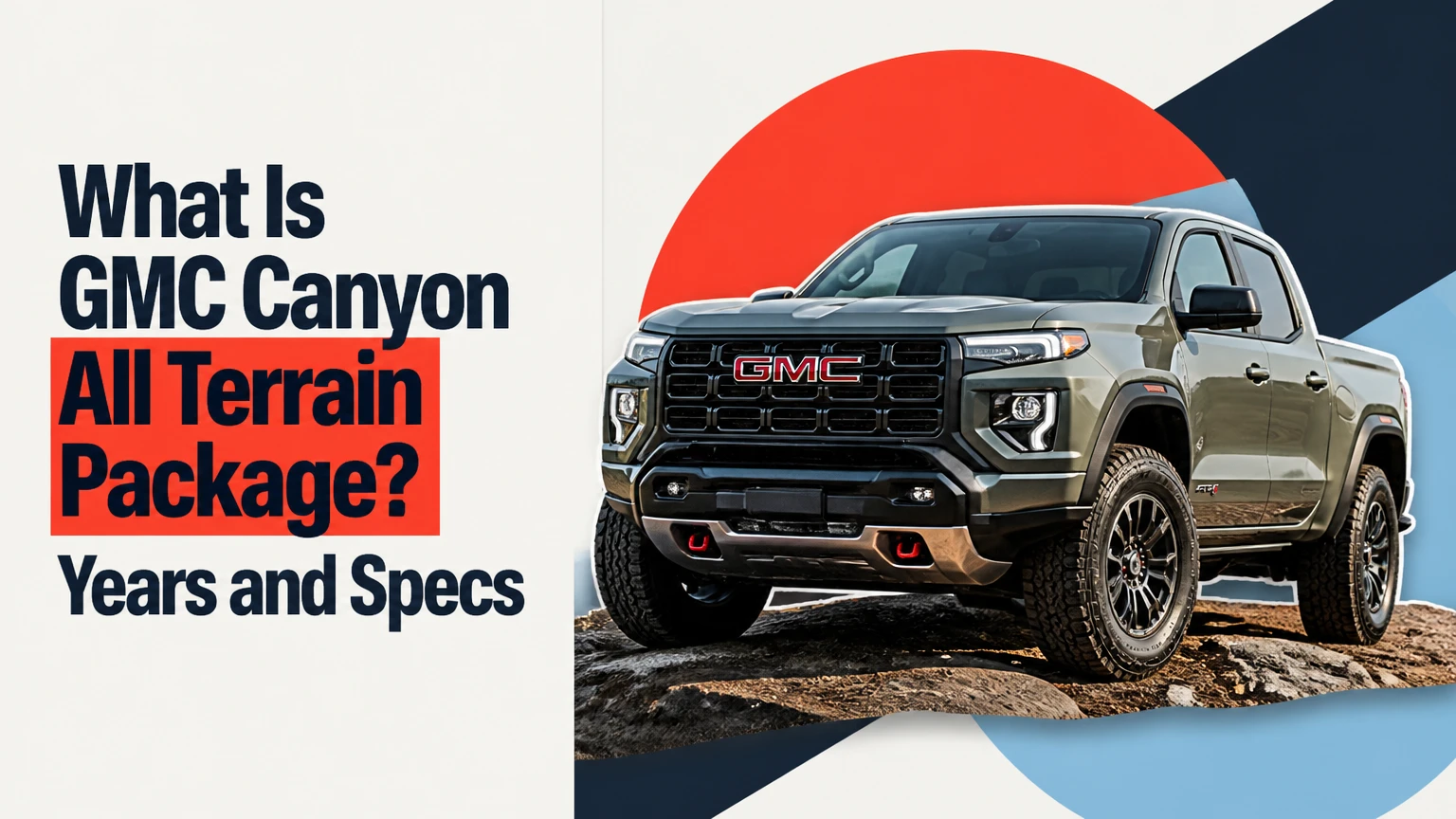
The GMC Canyon All Terrain package was a factory off-road appearance and equipment package for the second-generation midsize pickup, first offered with the SLE trim for 2015. GMC later made All Terrain a standalone trim, then replaced the name with AT4 in 2021; its hardware centered on an automatic-locking rear differential, Z71-tuned suspension, four-wheel-drive protection, and distinctive 17-inch wheels.
Key Facts at a Glance
- GMC offered the All Terrain package on the 2015-2017 Canyon, primarily as an SLE-based option.
- GMC sold All Terrain as a separate Canyon trim from approximately 2018 through 2020.
- The Eaton G80 automatic-locking rear differential helped transfer torque when one rear wheel lost traction.
- Available engines included a 3.6-liter V6 gasoline engine and a 2.8-liter Duramax turbo-diesel.
- Properly equipped Canyons could tow up to 7,700 pounds, but the exact limit depends on engine, drivetrain, cab, axle ratio, and trailering equipment.
- The All Terrain name gave way to the Canyon AT4 for 2021, while the AT4X became the more specialized off-road model in 2023.
What Is the GMC Canyon All Terrain Package?
The GMC Canyon All Terrain package combined off-road-oriented chassis equipment with appearance upgrades and additional cabin features. The package was not a standalone model throughout its entire life: 2015-2017 trucks generally carried the SLE trim with the All Terrain option, while later trucks used All Terrain as a distinct trim designation.
The package targeted drivers who wanted more trail traction and a tougher appearance than a standard Canyon without buying a dedicated rock-crawling truck. Its automatic rear locker, off-road shock tuning, available four-wheel drive, and underbody protection improved performance on gravel, mud, snow, and uneven access roads.
The package did not turn every Canyon into a high-clearance crawler. Ground clearance, approach angles, tire size, suspension travel, and the absence of a front locker limited its performance on large rocks, deep ruts, and steep ledges.
Was All Terrain a Package or a Trim?
All Terrain was both, depending on the model year. GMC introduced it as an SLE package for the 2015 Canyon, expanded its equipment during the second-generation production run, and used All Terrain as a dedicated trim around 2018-2020.
That distinction matters when searching listings. A seller may describe an SLE with the All Terrain package simply as an “All Terrain,” even though the door label, build sheet, or original window sticker identifies the truck differently. The VIN-based equipment list is more reliable than a used-car advertisement.
How Does the All Terrain Equipment Work?
The GMC Canyon All Terrain system uses a rear automatic locker, suspension calibration, traction-control software, and physical protection rather than a single off-road device. The G80 differential addresses wheel slip at the rear axle, while four-wheel drive sends power to the front axle when the selected drive mode and road conditions require it.
What Does the G80 Rear Differential Do?
The Eaton G80 automatic-locking rear differential mechanically locks the rear axle when sufficient wheel-speed difference and torque conditions indicate that one wheel is spinning. Both rear wheels can then receive useful torque, allowing the Canyon to climb a muddy incline or cross a diagonal rut more effectively than an open differential.
The G80 is automatic, not a driver-commanded electronic locker. It may need some wheel-speed difference to engage, and it can disengage when traction equalizes. Drivers should therefore avoid treating it like a competition-style locker that remains locked at every moment.
A G80 rear axle improves low-speed traction, but it cannot overcome poor tires, inadequate clearance, excessive speed, or a front axle suspended in the air. Controlled throttle is safer than aggressively spinning a tire to force engagement.
What Does Z71 Suspension Tuning Change?
Z71 off-road suspension calibration uses shock absorbers tuned for rougher surfaces than the standard street setup. The adjustment controls body movement and repeated impacts over washboard roads, shallow potholes, and trail undulations, but it does not provide the long-travel suspension or high-clearance geometry of a modern AT4X.
The unladen ride can feel firmer than an SLT or Denali. That is a normal trade-off, not automatically evidence of worn shocks. A used truck that continues bouncing after a bump, leaks oil from a damper, or clunks over repeated impacts needs suspension inspection.
What Does Transfer-Case Protection Cover?
On four-wheel-drive versions, underbody protection helps shield the transfer case and nearby driveline components from rocks, ruts, and trail debris. The shield reduces puncture risk, but it is not an invitation to drag the truck across large obstacles.
Inspect the skid plate for deep bends, torn fasteners, fresh welds, and oil marks. Severe impact can damage a transfer case internally even when the exterior housing remains intact.
Which Features Came With Each Configuration?
All Terrain equipment changed by year, body style, drivetrain, and option package. The table below describes the common second-generation configuration, but a VIN build sheet should confirm any individual truck.
| Configuration | Typical years | Main equipment | Buying significance |
|---|---|---|---|
| SLE with All Terrain package | 2015-2017 | G80 rear locker, Z71 suspension tuning, 17-inch Dark Argent wheels, appearance upgrades | Package content varies by options and drivetrain |
| All Terrain trim | 2018-2020 | Package-style appearance, off-road suspension, available 4WD and G80 axle | Easier to identify, but trim equipment still varies |
| All Terrain X | 2017-2020 | Wrangler DuraTrac tires, black assist steps, all-weather floor liners | More trail-oriented tires and convenience equipment |
| Canyon AT4 | 2021-2022, then current generation | Factory lift, off-road tuning, 4WD, all-terrain tires, terrain-focused equipment | Modern successor with more clearance |
| Canyon AT4X | 2023-present | Multimatic DSSV dampers, electronic lockers, 33-inch tires on current models | Designed for advanced off-road use |
What Did the Exterior and Interior Include?
Common exterior identifiers included 17-inch Dark Argent cast-aluminum wheels, a dark grille treatment, body-color bumper details, and front recovery hooks. Exact bumper, grille, wheel, and mirror finishes can differ by model year and other appearance packages.
The cabin commonly used Jet Black cloth with contrasting blue stitching, carbon-fiber-look trim, and heated front bucket seats. Leather-appointed seating was available on certain configurations rather than universal across every All Terrain truck.
| Equipment area | Common All Terrain specification | What to verify |
|---|---|---|
| Wheels | 17-inch Dark Argent cast aluminum | Original wheels versus aftermarket replacements |
| Standard tire format | P255/65R17 all-terrain tire | Brand, remaining tread, load rating, and date code |
| Seat material | Jet Black cloth, leather available | Factory upholstery versus replacement covers |
| Front seats | Heated bucket seats on equipped trucks | Functional heating elements and switches |
| Exterior details | Dark grille, body-color bumper, recovery hooks | Model-year equipment and collision repairs |
| All Terrain X additions | DuraTrac tires, black assist steps, floor liners | Whether the X package is factory or dealer-added |
Which Engines and Capability Numbers Apply?
The GMC Canyon All Terrain could use either the 3.6-liter gasoline V6 or the 2.8-liter Duramax turbo-diesel, depending on year and configuration. The V6 prioritized power and simpler gasoline operation, while the diesel delivered substantially more low-speed torque and often the highest tow rating.
| Powertrain | Typical output | Typical maximum towing | Best use |
|---|---|---|---|
| 3.6L V6, early second generation | 305 hp, 269 lb-ft | Up to about 7,000 lb | Daily driving and moderate towing |
| 3.6L V6, later calibration | 308 hp, 275 lb-ft | Up to about 7,000 lb | General-purpose ownership |
| 2.8L Duramax diesel | 181 hp, 369 lb-ft | Up to 7,700 lb | Heavy trailers and long-distance hauling |
| Modern 2.7L turbo gasoline successor | 310 hp, 430 lb-ft | Up to 7,700 lb in specified configurations | Newer AT4 towing and utility use |
General Motors’ published maximum ratings assume the correct cab, bed, axle ratio, transmission, drivetrain, cooling equipment, and trailering package. A 7,700-pound headline figure does not apply automatically to every All Terrain Canyon.
Payload also varies substantially. A typical second-generation Canyon may show roughly 1,400-1,550 pounds of payload, but the yellow certification label on the driver-door pillar controls the actual truck. Tongue weight, passengers, tools, bed cargo, and accessories all reduce available payload.
Is the Diesel Better Than the V6?
The Duramax diesel is better for frequent heavy towing because its 369 lb-ft of torque arrives at low engine speed, reducing the need for high-rpm acceleration. The V6 is usually the more straightforward choice for short trips, lower purchase cost, and owners who do not regularly pull near the truck’s maximum rating.
Diesel ownership brings additional considerations, including diesel fuel-system repairs, emissions equipment, glow plugs, and potentially higher maintenance costs. For a commuter that rarely tows, the V6 can offer a better total-cost balance even when its peak tow rating is lower.
How Should You Use Four-Wheel Drive?
Use two-wheel drive on dry pavement, four-high on loose or slippery surfaces at appropriate speeds, and four-low only for controlled, low-speed work that requires maximum wheel torque. Stop completely, select Neutral, and follow the owner’s manual procedure before engaging four-low.
A practical operating sequence is:
- Reduce speed before entering mud, loose gravel, or snow.
- Select four-high before traction becomes severely compromised.
- Keep the wheels pointed as straight as practical during engagement.
- Stop and select Neutral before requesting four-low.
- Use four-low for steep descents, deep ruts, or slow obstacle work.
- Disengage low range before returning to normal road speeds.
Do not use part-time four-wheel drive on dry, high-traction pavement for extended distances. Driveline wind-up can make turning difficult and place stress on transfer-case, axle, and tire components.
Is the Canyon All Terrain Good Off-Road?
The Canyon All Terrain is well suited to forest roads, muddy access tracks, snow-covered roads, boat ramps, hunting trails, and moderate ruts. Its G80 differential provides a meaningful advantage when one rear tire loses traction, while the midsize body fits narrower trails than a full-size pickup.
The package is less suitable for technical rock crawling, deep mud, repeated high-speed desert impacts, or obstacles that require maximum breakover and approach angles. The factory suspension lift and advanced electronic lockers found on newer AT4X trucks give those models a clear advantage.
An experienced off-road driver can take an All Terrain farther than a novice, but technique does not eliminate clearance limits. Tire pressure, recovery equipment, spotter communication, and a conservative line often matter more than a trim badge.
All Terrain vs Z71, AT4, and AT4X
The legacy All Terrain is an earlier package and trim strategy, while AT4 and AT4X are newer GMC off-road families. The comparison is most useful when shopping across model years, because “All Terrain” does not mean the same hardware as “AT4X.”
| Model | Position | Distinctive hardware | Suitable terrain |
|---|---|---|---|
| Canyon SLE | Standard utility trim | Conventional suspension, optional 4WD | Pavement, gravel, light snow |
| Canyon All Terrain | Legacy off-road package or trim | G80 locker, Z71 tuning, 17-inch all-terrain setup | Forest roads, mud, moderate trails |
| Canyon AT4 | Modern off-road trim | Factory lift, wider stance, 31-inch tires, 2-speed transfer case | Rough trails and deeper ruts |
| Canyon AT4X | Extreme off-road trim | DSSV spool-valve dampers, electronic lockers, 33-inch tires | Technical trails and rock obstacles |
| Chevrolet Colorado ZR2 | Chevrolet performance counterpart | Multimatic dampers, larger tires, specialized off-road geometry | High-demand off-road driving |
The 2021 AT4 transition aligned the Canyon with GMC’s broader AT4 branding. The AT4X, introduced for the current generation, added more specialized suspension and locking hardware rather than merely changing exterior trim.
Is All Terrain the Same as AT4?
All Terrain is not the same as AT4. The older name generally describes a second-generation Canyon package or trim with a G80 rear locker and Z71-oriented equipment, whereas AT4 is the newer factory off-road trim with greater clearance and more modern chassis calibration.
A 2020 All Terrain and a 2021 AT4 may look conceptually related, but they should not be assumed to have identical suspension height, tire dimensions, transfer-case controls, or electronic terrain systems.
What Does a Used All Terrain Canyon Cost?
A typical well-maintained 2015-2020 Canyon All Terrain sells for approximately $18,000-$28,000 in the used market, although mileage, accident history, diesel availability, cab configuration, region, and dealer markup can move the price outside that range. Prices change quickly, so a current VIN-specific market search is necessary.
| Ownership item | Typical amount or interval | Main price variable |
|---|---|---|
| Used 2015-2020 purchase price | $18,000-$28,000 | Mileage, diesel, 4WD, condition |
| Four all-terrain replacement tires | $800-$1,300 | Brand, size, installation |
| Four shock absorbers | $600-$1,200 installed | Part quality and labor rate |
| Rear differential service | $150-$300 | Fluid, labor, regional shop rate |
| Transfer-case service | $150-$300 | Fluid specification and access |
| Pre-purchase inspection | $150-$300 | Location and inspection depth |
The original package premium was commonly reported around $2,300-$3,000, depending on equipment and seating configuration. That new-vehicle figure should not be used as a direct used-market value because depreciation, mileage, and condition dominate resale pricing.
Factory shocks may remain serviceable beyond 60,000 miles, but rough roads, heavy loads, salt, and aftermarket lifts can shorten their useful life. Tire life varies even more: 45,000-50,000 miles is a typical highway-oriented expectation, not a guarantee for aggressive tread used on rocky trails.
What Should You Inspect Before Buying One?
A used Canyon All Terrain requires a mechanical inspection, not just a trim-equipment check. Confirm the VIN, drivetrain, axle code, trailering equipment, factory wheels, differential operation, and door-label payload before negotiating.
Check these areas:
- Rear axle: Listen for persistent whine, grinding, or sharp clunks during acceleration and tight turns.
- G80 operation: Verify that traction improves during a controlled low-speed test on a safe loose surface.
- 4WD system: Confirm two-high, four-high, and four-low engagement without warning lights.
- Transfer case: Inspect the shield, housing, fluid leaks, wiring, and shift actuator.
- Suspension: Look for leaking shocks, uneven tire wear, bent control arms, and damaged mounts.
- Frame and recovery points: Search for crushed metal, fresh undercoating, and weld repairs.
- Diesel system: Review maintenance records for emissions components, fuel-system work, and cooling-system service.
- Tires: Match all four tire sizes and inspect date codes, sidewalls, puncture repairs, and tread depth.
A counterintuitive buying rule is that a clean, unmodified SLE All Terrain can be safer than a heavily modified example advertised as a more capable trail truck. Lift kits, oversized tires, altered gearing, and improvised wiring can create alignment, braking, transmission, and insurance problems.
What Problems and Operating Mistakes Matter?
The most expensive All Terrain problems often result from neglected driveline service or prior off-road impacts rather than the package itself. Rear-axle noise, 4WD warning lights, bent suspension components, and mismatched tires deserve attention before purchase.
Rear-Axle Noise
A clunk during a tight turn can result from worn differential components, incorrect fluid, tire scrub, or normal locker behavior under certain conditions. Persistent chatter, grinding, metal on the drain-plug magnet, or a rising-pitch whine requires professional diagnosis.
Use the fluid specification in the vehicle’s service information. Do not add limited-slip friction modifier automatically, because the G80’s mechanical design does not function like every clutch-type limited-slip differential.
Service 4WD Warning
A Service 4WD message can involve the transfer-case encoder motor, wiring, position feedback, control module, or mechanical damage. Mud and road salt can corrode connectors, but replacing an actuator without scanning the system can waste money.
A proper diagnosis begins with a scan tool capable of reading four-wheel-drive control-module codes. Inspect the harness and connectors, then verify transfer-case position before authorizing parts.
Mismatched Tires
Four-wheel-drive systems need tires with matching overall diameter and similar tread wear. One significantly smaller tire can rotate at a different speed, increasing driveline stress and confusing traction-control logic.
Replace tires as a matched set when tread differences are large. Tire circumference matters more than brand loyalty.
Expert Rules for Better Ownership
- Do not confuse traction with clearance. The G80 can keep the rear axle moving, but it cannot prevent the differential housing or frame from contacting a rock.
- Use the door label for payload. Brochure payload is a maximum for a specific configuration; accessories and passengers consume that capacity immediately.
- Inspect modifications before admiring them. A non-factory lift can hide bent components, incorrect driveline angles, and uneven tire wear.
- Engage four-wheel drive early. Selecting four-high before a muddy climb is less stressful than trying to shift systems after the truck is already immobilized.
- Treat the All Terrain X tires as a trade-off. DuraTrac-style tread improves loose-surface grip but can add noise, reduce wet-road refinement, and wear faster under aggressive use.
Who Should Choose the All Terrain Package?
The best match is a buyer seeking a used midsize pickup for daily driving, moderate trails, winter conditions, and occasional towing. A 2016-2019 V6 truck often offers the broadest balance of purchase price, gasoline maintenance, road comfort, and trail usability.
A diesel All Terrain suits an owner who regularly hauls a substantial trailer or travels long highway distances. A newer AT4 is the better choice when extra clearance, current safety technology, and factory off-road geometry justify a higher purchase price.
A technical-trail driver should move directly to an AT4X, Colorado ZR2, or similarly equipped vehicle. The legacy All Terrain lacks the front and rear electronic locking capability, suspension travel, and tire clearance intended for repeated severe obstacles.
FAQ
Can a GMC Canyon All Terrain tow 7,700 pounds?
Some diesel-equipped, properly optioned GMC Canyon models can tow up to 7,700 pounds. The rating does not apply to every All Terrain truck, because engine, cab, bed, axle ratio, transmission, cooling equipment, drivetrain, and trailering package all affect the certified limit.
Does every All Terrain Canyon have four-wheel drive?
No. GMC sold All Terrain equipment with different drivetrain configurations, and a trim name does not prove that four-wheel drive is present. Check the transfer-case controls, underbody hardware, VIN build sheet, and vehicle identification label before assuming a truck has four-wheel drive.
What does the X mean on All Terrain X?
The X package added more aggressive equipment, commonly including Goodyear Wrangler DuraTrac tires, black round assist steps, and all-weather floor liners. It primarily improved tire performance and utility appearance; it did not give the Canyon the full suspension and locker hardware of an AT4X.
Is the GMC Canyon All Terrain reliable?
Reliability depends more on maintenance, drivetrain configuration, mileage, and off-road history than on the All Terrain badge. Inspect the rear differential, transfer case, suspension, frame, wiring, and diesel emissions system, and obtain service records before treating a low asking price as a bargain.
Can you lift an All Terrain Canyon?
A lift is possible, but the parts must match the truck’s suspension, drivetrain, wheel offset, brake lines, alignment requirements, and intended tire size. A poorly designed lift can create driveline vibration, premature ball-joint wear, rubbing, and reduced braking performance.
Is the All Terrain package still available new?
The All Terrain name is no longer the current Canyon off-road designation. GMC replaced it with AT4 for the newer lineup, and the AT4X provides a more specialized high-capability option. Used listings from the second-generation Canyon are therefore the primary source for the original package.
The Bottom Line
The GMC Canyon All Terrain package is a second-generation off-road-oriented package and trim, not a single identical specification across every year. Its defining equipment includes the G80 automatic rear locker, Z71-tuned suspension, all-terrain tires, distinctive styling, and available four-wheel drive. It is a strong choice for moderate trails, snow, utility work, and used-truck value, but the modern AT4 and AT4X provide greater clearance and more advanced hardware. Verify the exact VIN, drivetrain, axle rating, payload label, and factory options before buying any GMC Canyon All Terrain.