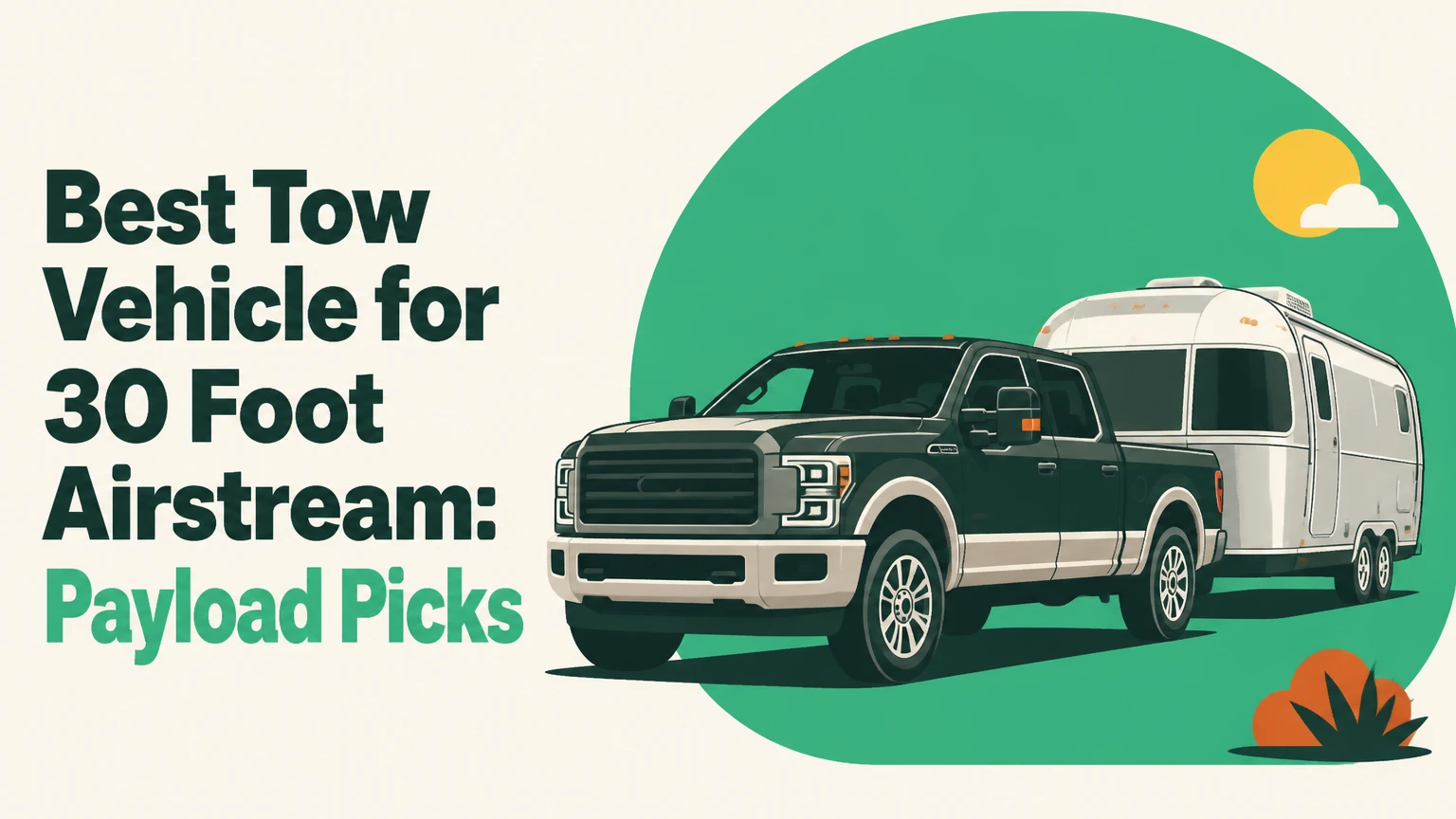
The best tow vehicle for a 30-foot Airstream is usually a properly configured ¾-ton or 1-ton pickup, with the Ford F-350 SRW as the strongest all-around choice for many owners. A diesel is valuable for frequent mountain travel, while a heavy-duty gas truck often delivers more usable payload at a lower purchase and maintenance cost.
Key Facts at a Glance
- A loaded 30-foot Airstream commonly requires approximately 1,100-1,300 pounds of available tongue-weight capacity before passengers, cargo, and hitch hardware are counted.
- The truck’s yellow or white payload certification label is more important than its advertised maximum tow rating.
- A diesel engine can reduce payload because the engine and emissions hardware weigh several hundred pounds more than a gas powertrain.
- A Ford F-350 SRW or Ram 3500 usually provides a larger payload margin than a similarly equipped F-250 or Ram 2500.
- A 30-foot trailer benefits from a long-wheelbase crew-cab pickup, especially in crosswinds, passing situations, and emergency maneuvers.
- A weight-distribution hitch, correctly adjusted trailer brakes, properly rated tires, and a scale check are part of the tow system, not optional accessories.
What Is the Best Tow Vehicle for a 30-Foot Airstream?
The best overall choice is a Ford F-350 SRW Crew Cab with either the 7.3-liter gas V8 or 6.7-liter Power Stroke diesel, selected from an actual truck with sufficient door-sticker payload. The F-350 gives owners more payload headroom than many luxury-trim F-250 diesels without requiring the wider stance of a dual-rear-wheel truck.
That recommendation changes with use. A Sierra 2500HD Duramax is a strong daily-driver alternative, a Ram 3500 Cummins offers excellent long-haul torque and a comfortable 2500-style ride in some configurations, and a Ford F-250 7.3-liter gas truck can be the value choice when terrain is moderate. The right answer is therefore a specific configuration, not merely a badge.
Our Top Picks
- Best overall: Ford F-350 SRW Crew Cab, 7.3-liter gas or 6.7-liter diesel
- Best daily-driving HD truck: GMC Sierra 2500HD Duramax
- Best long-distance diesel: Ram 3500 Cummins
- Best value: Ford F-250 7.3-liter gas
- Best for maximum payload and full-time travel: Ford F-350 or Ram 3500 DRW
How Much Truck Does a 30-Foot Airstream Need?
A 30-foot Airstream typically needs at least a genuine ¾-ton pickup, but a 1-ton SRW truck is often the better match because real payload, not maximum tow rating, sets the limit. Airstream models such as the Classic, Flying Cloud, Globetrotter, and International have different unloaded weights, GVWRs, and published hitch loads.
Typical 30-foot Airstream GVWR falls around 8,800-10,000 pounds, depending on model and year. Advertised hitch weight may be approximately 900-1,100 pounds, but a travel-ready trailer can place 1,200 pounds or more on the receiver after propane, batteries, clothing, food, water, tools, and outdoor equipment are loaded.
The Payload Calculation
Use the truck’s door-jamb payload label, not a brochure maximum:
Available payload after hookup = certified truck payload – loaded tongue weight – hitch hardware – passengers – in-cab cargo – bed cargo.
For example, a truck with 2,850 pounds of labeled payload might carry a 1,250-pound loaded tongue, 100-pound weight-distribution hitch, 500 pounds of occupants, and 200 pounds of tools and luggage. The remaining margin is only 800 pounds.
That margin must also respect the truck’s rear gross axle weight rating, tire capacity, receiver rating, and gross vehicle weight rating. A truck can remain below its advertised tow rating while exceeding its payload or rear-axle limit.
Typical Weight Targets
| Item | Typical 30-foot value | Why it matters |
|---|---|---|
| Trailer GVWR | 8,800-10,000 lb | Maximum legal trailer weight |
| Loaded tongue weight | 1,100-1,300 lb | Uses truck payload and rear-axle capacity |
| Weight-distribution hitch | 75-120 lb | Counts as truck payload |
| Two adults and children | 300-650 lb | Must be deducted from payload |
| Truck cargo and tools | 150-500 lb | Often underestimated |
| Recommended payload margin | 500-1,000 lb | Preserves capacity for travel variation |
Airstream’s owner documentation and federal certification labels provide the controlling values for a particular trailer. The Recreational Vehicle Industry Association also treats cargo carrying capacity as configuration-specific, which is why published averages cannot replace a loaded weighing.
Which Heavy-Duty Truck Is Best?
The Ford F-350 SRW is the best broad recommendation, the GMC Sierra 2500HD is the best polished daily-use alternative, and the Ram 3500 is the better Ram choice than the Ram 2500 when a Cummins diesel is selected. All three can tow a 30-foot Airstream comfortably when payload, axle ratings, tires, and hitch setup are verified.
1. Ford F-350 SRW: Best Overall
The Ford F-350 SRW earns the top position because its higher-rated springs, axles, and chassis usually provide more usable payload than a comparable F-250, while its dimensions remain close to a conventional pickup. Typical payload spans roughly 3,000-4,500 pounds for gas configurations and about 2,800-4,000 pounds for diesel configurations, although trim and options can change those figures substantially.
The 7.3-liter gas V8 costs less, weighs less, and often leaves more payload for passengers and cargo. The 6.7-liter Power Stroke diesel supplies strong low-speed torque and an exhaust brake that helps control speed on long descents. Ford’s Super Duty towing technology, including trailer-specific camera views and available steering assistance, can reduce workload during setup and maneuvering.
The limitation is ride quality and price. An F-350 with stiff rear springs can feel abrupt when unloaded, and a highly optioned diesel Lariat or King Ranch can approach or exceed $80,000 before accessories.
Choose this if: you want one truck for mountain trips, family cargo, and long-term ownership.
Skip it if: daily parking, fuel cost, or low purchase price matters more than reserve capacity.
2. GMC Sierra 2500HD: Best Daily-Driving Diesel
The GMC Sierra 2500HD with the 6.6-liter Duramax diesel is a strong choice for owners who want a stable HD truck with a more manageable daily-driving feel. Typical diesel payload is often around 2,800-3,500 pounds, but the door label remains decisive because crew-cab luxury options reduce capacity.
The Duramax produces substantial torque, and the Allison transmission, integrated trailer brake controller, tow-haul calibration, and exhaust-braking modes suit a heavy travel trailer. The independent front suspension can provide a smoother steering feel than some solid-front-axle competitors, although suspension architecture alone does not determine trailer stability.
The GMC’s drawback is configuration sensitivity. A heavy Denali with 4WD, a crew cab, a sunroof, and large wheels can have materially less payload than a lower-trim truck with the same engine. Its available payload may still work, but buyers must inspect the label before negotiating.
Choose this if: the truck will also serve as a family vehicle and you value quiet highway manners.
Skip it if: you need the largest possible payload from a single-rear-wheel diesel truck.
3. Ram 3500: Best for Cummins Long-Haul Use
The Ram 3500 is the appropriate Ram baseline for a diesel 30-foot Airstream because it avoids much of the payload penalty associated with a loaded Ram 2500 Cummins. Depending on trim, drivetrain, and rear suspension, a Ram 3500 diesel may provide roughly 3,000-4,500 pounds of payload, while many Ram 2500 diesel trucks leave closer to 1,900-2,500 pounds.
The 6.7-liter Cummins offers strong torque, widespread service familiarity, and effective exhaust braking. The Ram’s interior and long-distance seating are competitive, and the 3500 can be ordered as an SRW or DRW truck for different payload requirements.
The drawback is operating cost. Diesel maintenance, diesel exhaust fluid, fuel-system repairs, and the purchase premium matter more for owners who drive only a few weekends each year. Coil-spring rear suspension on some 2500 models can improve unloaded comfort, but comfort does not compensate for an insufficient payload label.
Choose this if: you travel long distances, tow frequently, and prefer Cummins power.
Skip it if: annual mileage is low and a gas HD truck provides enough payload.
4. Ford F-250 7.3-Liter Gas: Best Value
The Ford F-250 with the 7.3-liter gas V8 is often the most financially rational truck for a 30-foot Airstream used on weekends and ordinary highways. Typical payload can land around 3,000-4,000 pounds, and the lighter engine may preserve more capacity than a diesel in the same cab and trim.
The gas engine accepts regular gasoline in many operating conditions, avoids diesel exhaust fluid, and generally costs less to purchase and maintain. It will pull an 8,800-10,000-pound trailer, but it may use 8-11 mpg while towing and run at high rpm on long grades.
Gas power is not a safety defect. The trade-off is speed and noise on steep terrain, not an inability to tow within the ratings.
Choose this if: you travel fewer than roughly 10,000 towing miles annually and want lower ownership cost.
Skip it if: you routinely cross high mountain passes or want strong downhill engine braking.
Heavy-Duty Comparison
| Truck configuration | Typical payload | Towing experience | Typical purchase position | Main limitation |
|---|---|---|---|---|
| Ford F-350 SRW 7.3 gas | 3,000-4,500 lb | High-revving uphill, stable downhill with trailer brakes | Lower than diesel | Fuel consumption and engine noise |
| Ford F-350 SRW 6.7 diesel | 2,800-4,000 lb | Strong grades and excellent downhill control | High | Diesel price and maintenance |
| GMC Sierra 2500HD 6.6 Duramax | 2,800-3,500 lb | Smooth highway towing and effective braking | High | Luxury trims can lose payload |
| Ram 3500 6.7 Cummins SRW | 3,000-4,500 lb | Strong torque and long-haul capability | High | Diesel ownership expense |
| Ram 2500 6.7 Cummins | 1,900-2,500 lb | Adequate power, limited payload margin | Medium-high | Payload can disappear quickly |
| Chevrolet Silverado 2500HD 6.6 gas | 3,000-4,000 lb | Capable budget HD towing | Moderate | High-rpm mountain operation |
Is Gas or Diesel Better for a 30-Foot Airstream?
Gas is better for lower annual mileage and maximum value; diesel is better for frequent mountain towing, heavy cargo, and long-distance use. A diesel’s exhaust brake and torque improve control, but a gas engine can provide greater payload and lower ownership costs when the trailer remains within its ratings.
The common mistake is treating diesel as automatically safer. A fully loaded luxury diesel may have less payload than a gas truck with the same wheelbase, and insufficient payload is a more immediate problem than slower hill climbing.
| Consideration | Heavy-duty gas | Heavy-duty diesel |
|---|---|---|
| Typical towing fuel economy | 8-11 mpg | 10-14 mpg |
| Purchase premium | $0 baseline | Often $8,000-$12,000 |
| Payload effect | Usually more available | Engine weight reduces payload |
| Mountain descent control | Trailer brakes and service brakes | Exhaust brake plus trailer brakes |
| Short-trip suitability | Strong | Less favorable for repeated short trips |
| Maintenance complexity | Lower | Higher, with DEF and emissions hardware |
| Best annual use | Occasional or moderate towing | Frequent, long-distance towing |
Ford, General Motors, and Ram all publish towing guides that require users to account for passengers, cargo, options, tongue weight, axle ratings, and hitch limits. The manufacturer’s maximum tow figure is therefore a ceiling for a particular test configuration, not a promise that every showroom truck can carry a 1,300-pound hitch load.
Can a Half-Ton Truck or SUV Tow a 30-Foot Airstream?
Some half-ton trucks can technically tow a 30-foot Airstream, but they are usually a poor default because payload, rear-axle capacity, wheelbase, and suspension margin become restrictive first. Large SUVs such as the Ford Expedition MAX or Lincoln Navigator can approach 8,700 pounds of tow rating in selected configurations, yet their family payload may leave little capacity for a heavy tongue.
A half-ton may work when the specific Airstream has a lower GVWR, the truck has a high payload label, the occupants and cargo are light, and travel is mostly flat. The same truck becomes a weak choice with full fresh-water tanks, bicycles, a generator, four adults, and mountain travel.
A long trailer also creates aerodynamic and directional loads that a tow-rating chart does not fully communicate. A 30-foot aluminum trailer is tall and broad, so crosswinds and passing trucks can produce steering corrections even when the scale weights are legal.
Practitioner rule: for a 30-foot Airstream, select a half-ton only after a loaded scale calculation proves compliance with GVWR, rear GAWR, tire capacity, receiver rating, and trailer GVWR. Otherwise, use an HD pickup.
How Do You Verify Payload Before Buying?
Verify payload in six steps, and complete the calculation on the exact truck before signing a purchase contract. The process usually takes 45-90 minutes if a public truck scale is nearby and prevents a costly mismatch between advertised towing capacity and real carrying capacity.
- Record the Airstream’s ratings. Write down trailer GVWR, dry hitch weight, cargo carrying capacity, axle ratings, and tire ratings from the certification label and owner documentation.
- Estimate travel-ready tongue weight. Use 12-15% of loaded trailer weight as a planning range. At 9,500 pounds, that equals 1,140-1,425 pounds.
- Inspect the truck payload label. Photograph the label inside the driver’s door. Do not accept a salesperson’s estimate based on the model family.
- Subtract every truck load. Include passengers, child seats, bed covers, toolbox, firewood, hitch head, spring bars, generator, pets, and aftermarket bumpers.
- Check each axle separately. Compare front and rear scale weights with the truck’s GAWR and tire maximums. The rear axle usually becomes the limiting point.
- Weigh the complete combination. Use separate passes for truck alone, truck with trailer attached, and trailer axles. Reweigh after redistributing cargo.
A truck with a 3,000-pound payload label and a 1,300-pound tongue load does not have 1,700 pounds available for the family if a 100-pound hitch and 650 pounds of occupants are also aboard. The remaining capacity is 950 pounds before bed cargo.
Weight-Distribution Hitch Setup
A properly rated weight-distribution hitch transfers some tongue load toward the truck’s front axle and the trailer axles. It does not increase the truck’s GVWR, rear GAWR, tire rating, receiver rating, or trailer GVWR.
Blue Ox SwayPro, Equal-i-zer, Hensley Arrow, and ProPride 3P are distinct products with different adjustment methods and prices. A conventional hitch with integrated friction or cam sway control may cost approximately $600-$1,200, while ProPride and Hensley systems commonly cost roughly $2,500-$4,000.
The most expensive hitch cannot correct an overloaded truck. Set spring-bar tension according to the hitch manufacturer’s procedure, verify front-axle restoration, and confirm that the trailer remains level.
What Changes for Mountain, Winter, and Full-Time Travel?
Mountain travel favors a diesel HD truck with an exhaust brake, while full-time travel favors an F-350, Ram 3500, or dual-rear-wheel truck with substantial payload reserve. Flat-terrain vacation travel can justify a gas F-250 or F-350 when the scale calculation leaves adequate margin.
For repeated 6-7% grades, engine braking reduces reliance on service brakes during descents, but drivers must still select an appropriate gear and monitor speed. The trailer brake controller must be adjusted so the trailer contributes braking without locking its tires.
Winter travel adds tire and traction considerations. Four-wheel drive helps a heavy truck launch on snow, but it does not shorten stopping distance on ice, and the trailer still needs properly matched tires with adequate load range.
A dually is usually unnecessary for a lightly loaded 30-foot Airstream, but it becomes attractive when the truck carries a large camper, substantial tools, multiple generators, or full-time living supplies. The cost is width, parking difficulty, tire expense, and a rougher unloaded experience.
What Commonly Goes Wrong?
Most towing problems arise from incorrect loading, inadequate payload, poor hitch adjustment, or neglected trailer brakes rather than a lack of engine power. The driver should stop and diagnose any sway, repeated porpoising, tire overheating, or steering lightness before continuing.
- Persistent sway: Reduce speed smoothly, avoid abrupt steering, and apply the trailer brake controller manually rather than making a hard truck-brake application. Recheck tongue weight, tire pressures, hitch setup, and cargo distribution.
- Porpoising over bumps: Inspect spring-bar tension, trailer attitude, shock absorbers, and tongue-weight percentage. Too little tongue weight can make a long trailer unstable.
- Light steering: Excessive weight transfer from the truck’s front axle can make steering vague. Reconfigure the weight-distribution hitch and confirm front-axle restoration on a scale.
- Hot trailer tires: Check inflation against the tire sidewall and trailer manufacturer guidance, inspect bearings and brakes, and verify that the trailer is not above its axle rating.
- Rear suspension sag: Sag indicates a load or setup issue, not a reason to install air bags blindly. Air bags can level the truck but do not add legal payload or axle capacity.
- Brake fade on descents: Slow before the grade, select a lower gear, activate the exhaust brake when equipped, and maintain correctly adjusted electric trailer brakes.
The Federal Motor Carrier Safety Administration defines gross vehicle weight rating as the value specified by the manufacturer, and that rating remains binding even when suspension upgrades make a truck appear level. Appearance is not a weight certification.
Which Used Truck Is Sensible?
A used Ford F-250 or F-350, Chevrolet Silverado 2500HD, GMC Sierra 2500HD, or Ram 3500 can tow a 30-foot Airstream effectively when its door label and maintenance records support the load. A used HD gas truck from the late 2010s or newer often offers the best price-to-capacity ratio.
Check for transmission service, frame corrosion, trailer-brake wiring, receiver damage, uneven tire wear, aftermarket tuners, overloaded suspension components, and evidence of commercial towing. Diesel trucks require additional inspection of emissions systems, turbocharger operation, injector performance, and diesel exhaust fluid equipment.
Avoid buying a used truck solely because it has a larger engine. A heavily optioned diesel with 2,200 pounds of payload can be less suitable than a gas truck with 3,500 pounds.
Which Should You Pick?
Occasional Vacationer
Choose a Ford F-250 or F-350 7.3-liter gas truck if annual towing is moderate, routes are mostly rolling terrain, and payload exceeds the loaded calculation by at least 500 pounds. This configuration avoids a substantial diesel premium while retaining HD wheelbase, brakes, tires, and receiver strength.
Mountain Traveler
Choose a Ford F-350 SRW diesel, GMC Sierra 2500HD Duramax, or Ram 3500 Cummins when the route includes frequent mountain grades. Select the truck with the highest verified payload among comparable trims, because exhaust braking cannot compensate for an overloaded rear axle.
Full-Time Airstream Owner
Choose an F-350 or Ram 3500, and consider DRW when the truck carries substantial residential cargo or a truck camper. Full-time owners accumulate tools, spare parts, food, water, bicycles, and seasonal equipment faster than initial calculations predict.
Daily Driver With Family
Choose the GMC Sierra 2500HD or Ford F-350 SRW in a moderate trim if the truck must also handle school runs, parking garages, and family road trips. Avoid assuming a luxury trim is harmless because leather, large wheels, and panoramic roofs reduce payload.
FAQ
Is an F-250 enough for a 30-foot Airstream?
An F-250 can be enough when its door-sticker payload exceeds the complete loaded calculation, including a 1,100-1,300-pound tongue weight, hitch, passengers, and cargo. Gas F-250 configurations often provide more usable payload than luxury diesel versions, so the exact truck matters more than the F-250 nameplate.
Does a 30-foot Airstream need a diesel?
A 30-foot Airstream does not require a diesel engine. Diesel becomes worthwhile for frequent mountain towing, high annual mileage, heavy cargo, and drivers who value exhaust braking, while a 7.3-liter Ford or 6.6-liter GM gas truck can provide adequate capacity at lower cost.
What wheelbase is best for a 30-foot travel trailer?
A long-wheelbase crew-cab pickup is generally preferable, although manufacturers do not publish one universal minimum wheelbase for every trailer. Longer wheelbase improves directional resistance, but correct tongue weight, tire pressure, sway control, and speed remain more important than wheelbase alone.
Should the Airstream be weighed with full water tanks?
Weigh the Airstream in the condition used for travel, including normal propane, batteries, food, water, tools, and outdoor equipment. Fresh water weighs approximately 8.3 pounds per gallon, so carrying 40 gallons adds about 332 pounds and can alter both total weight and tongue distribution.
Is four-wheel drive necessary for towing an Airstream?
Four-wheel drive is useful for wet boat ramps, snow-covered campsites, and loose launch surfaces, but it does not increase the truck’s payload and adds weight that can reduce available capacity. Two-wheel drive is sufficient for many paved routes when traction conditions are predictable.
What is the safest trailer tongue-weight percentage?
A practical planning range is approximately 12-15% of loaded trailer weight, subject to the Airstream manufacturer’s guidance and actual scale results. At 9,500 pounds loaded, that range equals 1,140-1,425 pounds, which explains why a 30-foot trailer can quickly consume a truck’s payload.
The Bottom Line
The best tow vehicle for 30 foot Airstream ownership is usually a Ford F-350 SRW, with gas power for value and diesel power for frequent mountain or long-distance towing. The GMC Sierra 2500HD and Ram 3500 are credible alternatives, while a Ram 2500 diesel, half-ton truck, or large SUV requires especially careful payload verification. Buy the exact truck whose certification label leaves room for the loaded tongue weight, hitch, people, and cargo, then confirm the complete combination at a public scale.