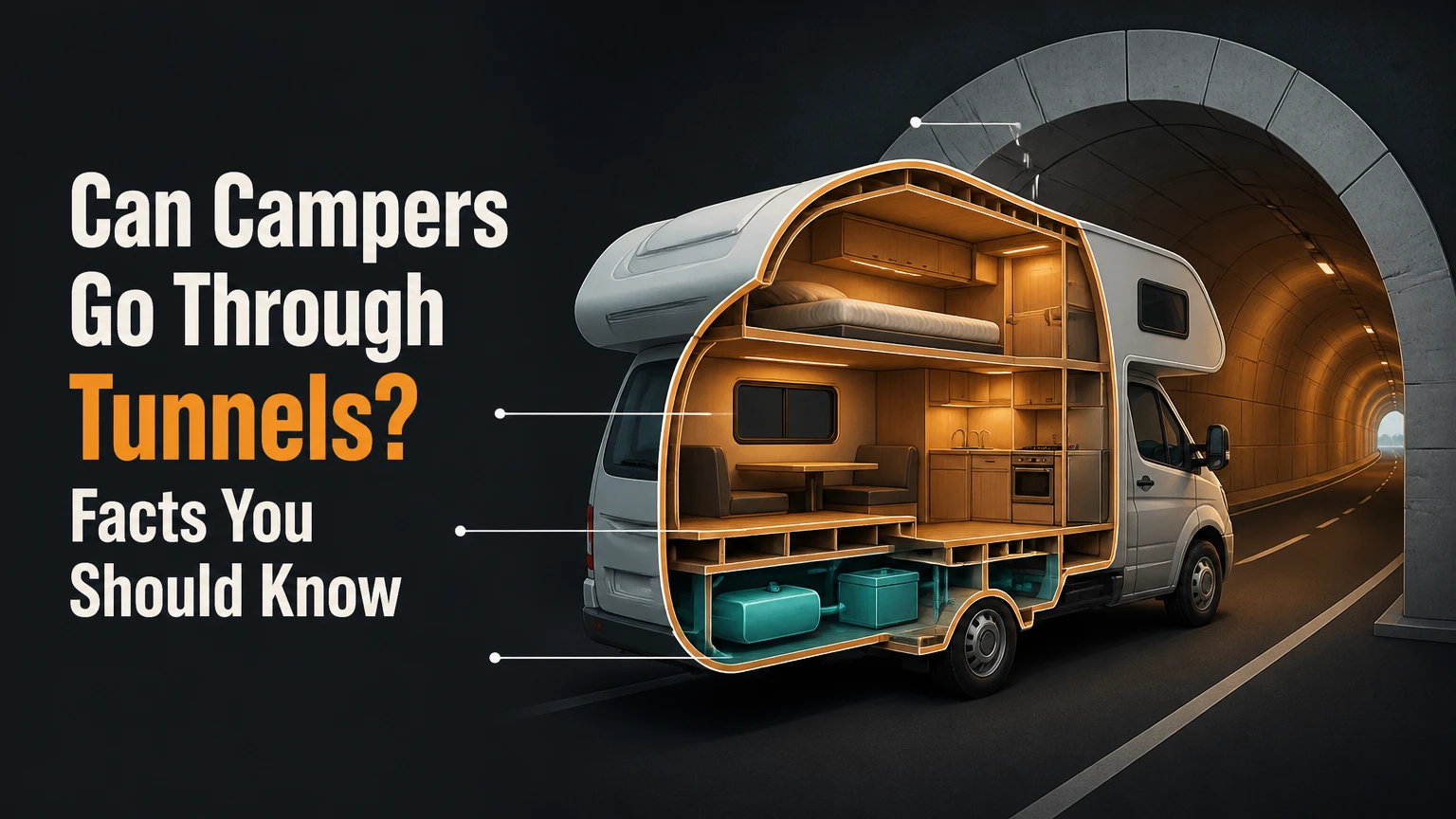
Campers can go through most highway tunnels when their measured height, width, length, weight, and hazardous-material load comply with the tunnel operator’s rules. A recreational vehicle is not automatically exempt from tunnel restrictions, and propane regulations vary by tunnel, state, country, and operator. Verify the exact route before departure.
Key Facts at a Glance
- A camper may be physically short enough for a tunnel but legally prohibited because of propane or another regulated material.
- The posted clearance is not always the safest usable clearance because signs, lights, fans, lane controls, pavement changes, and vehicle movement reduce margin.
- The common 13 feet 6 inches figure is a commercial vehicle height benchmark in parts of the United States, not a universal minimum tunnel height.
- Measure a fully loaded camper from pavement to its highest fixed or flexible roof fitting, including air conditioners, vent covers, antennas, and satellite equipment.
- Propane rules are tunnel-specific. Some facilities prohibit propane, some limit container size or quantity, and others require valves to be closed.
- A standard passenger-car navigation app usually does not understand RV height or propane restrictions.
Can Campers Go Through Tunnels?
Yes, most campers can use ordinary road tunnels if the vehicle fits the published envelope and satisfies the tunnel’s safety rules. The controlling authority may be a state department of transportation, turnpike agency, bridge and tunnel authority, national park, port authority, or municipal transportation department.
A tunnel restriction can involve more than the concrete opening. Operators may regulate recreational vehicles because a disabled, over-height, or hazardous-material-carrying vehicle is harder to evacuate from an enclosed corridor. A tunnel may therefore reject a camper that would physically fit but carries a prohibited propane configuration.
The safest answer is route-specific: identify every tunnel, open its current vehicle restriction page, and compare the published limits with the camper’s travel-ready specifications. Do not infer permission from another RV driver’s experience because rules and vehicle configurations differ.
What does tunnel clearance mean?
Tunnel clearance is the legal and physical compatibility between a vehicle and the tunnel’s usable passage. It includes vertical clearance, lane width, vehicle width, length, axle weight, gross vehicle weight, turning geometry, and sometimes the vehicle’s hazardous-material payload.
A rectangular clearance sign normally gives a height at a particular roadway point. It does not necessarily describe every location beneath an arched roof, nor does it guarantee that a tall roof accessory will miss a hanging fixture. Highway agencies may use clearance signs based on engineering surveys, but drivers remain responsible for operating a vehicle that fits.
Why is the sign not a complete safety guarantee?
A clearance sign can change after resurfacing, construction, impact damage, or installation of temporary equipment. Suspension compression, tire pressure, road dips, braking, and trailer articulation can also change the vehicle’s highest point relative to the roof.
Practitioner rule: treat the published clearance as a legal limit, not as a target with zero margin. If a camper’s measured height is close to the sign, choose another route or obtain written guidance from the tunnel operator.
Which Camper Dimensions Matter Most?
Height is usually the first screening measurement, but width, weight, length, and turning behavior can independently prevent tunnel access. A camper that clears the roof may still exceed a lane, axle, toll-plaza, curve, or vehicle-class restriction.
| Camper attribute | What to measure | Typical issue |
|---|---|---|
| Height | Pavement to highest roof equipment | Air-conditioner shroud or vent cover exceeds brochure height |
| Width | Widest mirrors, awnings, slide-outs retracted | Narrow lane or shoulder leaves little lateral margin |
| Length | Entire combination, including hitch | Tunnel approach cannot accommodate the turning path |
| Weight | Gross vehicle and axle loads | Local bridge or tunnel limit is lower than the vehicle rating |
| Propane | Container size and total quantity | Tunnel bans gas or limits cylinders |
| Ground clearance | Lowest underbody component | Steep approach scrapes tanks, steps, or hitch hardware |
Is 13 feet 6 inches safe for every tunnel?
No. A 13-foot-6-inch camper is not automatically safe or legal in every tunnel. The 13 feet 6 inches figure is widely used as a maximum legal height for certain commercial vehicles on designated U.S. routes, but secondary roads, older tunnels, park roads, and approaches can have lower limits.
A tunnel sign of 13 feet 6 inches also does not mean a vehicle measured at exactly 13 feet 6 inches has a practical operating margin. Measurement uncertainty, pavement overlays, roof curvature, and dynamic movement matter. A camper close to the limit should be rerouted unless the operator confirms the clearance and operating conditions.
How should you measure a camper’s true height?
Measure the fully loaded vehicle on level pavement, with normal fuel, water, luggage, passengers, and travel equipment. Measure a trailer while connected to the tow vehicle because hitch height and suspension position affect the combination.
Use a straightedge, laser distance tool, or tape measure from the pavement to the highest point. Check both sides and the centerline, then repeat after adjusting tire pressures to the manufacturer’s travel specification. Record the result in feet and inches and place it where the driver can see it.
Include these commonly missed items:
- Rooftop air conditioners and protective shrouds.
- MaxxAir-style vent covers and solar panels.
- Satellite dishes, antennas, and raised roof racks.
- Open or damaged slide toppers.
- Lifted suspension, replacement tires, and temporary cargo.
- Bicycle racks or kayaks mounted above the roofline.
A six-inch buffer can be a useful personal planning margin, but it does not legally convert an over-height vehicle into a compliant one. Never subtract a fixed amount from the sign and assume the remaining number is safe.
Does Propane Stop Campers From Using Tunnels?
Propane can stop a camper from using a tunnel, but no universal propane rule applies to all tunnels. The operator may prohibit propane entirely, limit cylinder capacity, regulate aggregate quantity, require valves to be closed, or apply a rule only to certain vehicle categories.
Liquefied petroleum gas is heavier than air, so a leak can collect in low areas where ventilation is poor. That risk explains some restrictions, but tunnel geometry alone does not determine the rule. An underwater tunnel does not automatically ban propane, and a mountain tunnel does not automatically permit it.
The correct source is the current tunnel operator, not a general RV forum, an old travel article, or a rule from a different state.
| Propane rule type | Typical requirement | Driver action |
|---|---|---|
| Complete prohibition | No propane containers or gas systems permitted | Select a bypass before the restricted approach |
| Container limit | Each cylinder must remain below a stated size | Confirm cylinder label and operator threshold |
| Aggregate limit | Total propane quantity is capped | Add every cylinder and permanently mounted tank |
| Valve shutdown | Gas may remain aboard if valves are closed | Shut the source valves before the inspection point |
| Vehicle-specific rule | Limits apply to buses, commercial vehicles, or RVs | Ask the operator whether the camper classification qualifies |
Must you turn off propane before entering?
Turn off propane only when the tunnel operator requires it, and complete the shutdown before entering the controlled area. Close the main service valve or cylinder valves as directed, stop appliances that can use gas, and confirm that the refrigerator is not set to automatic gas operation.
An absorption refrigerator in “Auto” mode can attempt to relight its burner after the propane supply closes. Use the manufacturer’s electric, battery, or off setting when the facility’s instructions require appliances to be shut down. Do not improvise inside the tunnel or stop in a travel lane to adjust valves.
Do not disconnect, remove, or vent a propane system at the roadside. If the operator requires removal or a quantity that the camper cannot meet, take the bypass.
Are propane cylinders measured by pounds or gallons?
Tunnel rules may use cylinder capacity, water capacity, propane weight, liquid volume, or the number of containers. A “20-pound cylinder” describes its approximate propane capacity, while the stamped cylinder data and the operator’s wording control compliance.
Permanently mounted ASME tanks and portable DOT cylinders may be treated differently. Photograph the data plate before travel, total the relevant capacities, and ask the tunnel authority how it applies the rule to the specific camper.
Do Different Tunnel Types Treat Campers Differently?
Tunnel type can influence operational risk, but the legal rule comes from the facility’s published restrictions. Urban, underwater, mountain, and park tunnels may have different ventilation systems, lane widths, emergency access, grades, and clearance profiles.
| Tunnel setting | Common operating characteristic | Camper concern |
|---|---|---|
| Urban road tunnel | Dense traffic and limited stopping space | Missed bypass, lane control, or HazMat restriction |
| Underwater tunnel | Long enclosed section and low central grade | Propane policy and emergency evacuation |
| Mountain tunnel | Curved approach and rock or concrete arch | Low side clearance and oversized-vehicle escort |
| Historic park tunnel | Older geometry and narrow lanes | Height, width, one-way control, or escort |
| Modern motorway tunnel | Engineered lanes and active monitoring | Vehicle class, dangerous-goods, or weight rules |
An arched tunnel creates a clearance envelope rather than a constant rectangular opening. The center of a lane may be higher than the edge, while signs, cameras, lighting, ventilation equipment, or structural ribs can reduce usable space.
Never move toward the center of a tunnel lane unless road markings, traffic control, and the operator permit it. Lane positioning is not a substitute for adequate clearance.
Can Each Camper Type Use a Tunnel?
Class B campervans usually have the fewest clearance problems, while tall Class A motorhomes, fifth-wheels, and modified trailers require the most route checking. Vehicle type predicts risk, but the measured dimensions and tunnel rules decide access.
| Camper type | Typical travel height | Main tunnel concern |
|---|---|---|
| Class B campervan | 7-10 feet | Roof equipment, propane status, urban restrictions |
| Truck camper | 9-12 feet | Pickup and camper height, width, rear overhang |
| Class C motorhome | 10-12 feet | Cab-over profile, roof air conditioner, width |
| Travel trailer | 10-13 feet | Combination length, sway, propane cylinders |
| Fifth-wheel trailer | 12-13 feet 6 inches | Tall front cap, arch clearance, route geometry |
| Class A motorhome | 11-14 feet | Roof equipment, weight, air suspension, width |
Can fifth-wheels go through tunnels?
Fifth-wheels can use tunnels when their measured height, width, length, weight, and propane load comply with the facility’s rules. Their elevated front cap makes them particularly sensitive to arched roofs, low fixtures, and clearance changes near lane edges.
Measure the fifth-wheel while connected to the tow vehicle and in its normal travel attitude. Check the truck-trailer combination, not merely the trailer manufacturer’s listed height.
Are Class B campervans usually easier?
Class B campervans are often easier to route because many remain below 10 feet, but they are not exempt from tunnel restrictions. A compact van carrying a propane cylinder can still violate a zero-propane rule, and a commercial or urban tunnel can impose separate vehicle restrictions.
An all-electric camper may eliminate a propane issue, but it does not eliminate height, width, weight, or hazardous-material rules for other cargo.
How Do You Check a Tunnel Before Leaving?
Check the route in four stages: measure the camper, inventory regulated materials, identify every tunnel, and confirm the operator’s current instructions. A reliable check usually takes 15-30 minutes for a familiar route and longer when several authorities control the corridor.
Step 1: Record the travel-ready measurements
Write down height, width, total length, gross vehicle weight, axle weights if available, and propane container details. Include the tow vehicle for a trailer or fifth-wheel combination.
Step 2: Identify every tunnel and authority
Review the route at a zoom level that reveals tunnels, park roads, toll facilities, and urban approaches. Record the tunnel name, road number, direction of travel, and operator.
Step 3: Verify primary-source restrictions
Use the tunnel authority, state Department of Transportation, turnpike agency, or National Park Service page. Check the publication date, construction notices, seasonal restrictions, and emergency closures.
Step 4: Confirm unusual cases by phone
Call when the vehicle is near a limit, carries propane, uses a commercial-size tank, exceeds ordinary RV dimensions, or travels through a historic tunnel. Ask for the restriction in writing or save the operator’s official page as a PDF.
Step 5: Program the correct route profile
Use an RV navigation system that accepts height, length, width, and weight. RV LIFE Trip Wizard, Garmin RV products, and CoPilot RV can improve dimensional routing, but no consumer app should be treated as the final authority for propane or dangerous-goods rules.
Step 6: Prepare before the approach
If shutdown or inspection is required, stop only at the designated area. Close valves, select the correct refrigerator setting, secure loose equipment, and follow the attendant’s instructions before entering the tunnel queue.
Which Tunnel Examples Need Extra Checking?
Named examples are useful warnings, not permanent permissions. Tunnel rules change with construction, security policy, vehicle classification, and local enforcement, so confirm each example directly before travel.
| Facility or area | Why RV travelers check it | Verification priority |
|---|---|---|
| Holland Tunnel, New York and New Jersey | Port Authority restrictions can affect hazardous materials and vehicle types | Port Authority current rules |
| Lincoln Tunnel, New York and New Jersey | Urban tunnel and regulated-material controls | Port Authority current rules |
| Baltimore Harbor and Fort McHenry tunnels | Maryland tunnel restrictions may address propane and vehicle dimensions | Maryland Transportation Authority |
| Chesapeake Bay Bridge-Tunnel | Inspection and propane procedures can apply before passage | CBBT official instructions |
| Zion-Mount Carmel Tunnel, Utah | Oversized vehicles may need timed traffic control or an escort | National Park Service |
| Boston-area tunnels | Massachusetts facility rules vary by tunnel and vehicle | MassDOT or facility operator |
The National Park Service gives a concrete example of special handling at Zion-Mount Carmel Tunnel: “Vehicles over 11 feet 4 inches in height and/or 7 feet 10 inches in width require an escort.” That threshold is specific to the park’s tunnel procedure, not a national RV standard.
A tunnel operator may also prohibit a vehicle because the driver cannot safely pass an inspection point, turn within the approach, or maintain required lane control. The approach can be the limiting section.
Is a Tunnel Better Than an Open-Air Bypass?
A tunnel is usually the fastest route when the camper clearly complies with the operator’s dimensions and material rules. An open-air bypass is the better choice when the vehicle is close to the limit, the propane rule is unclear, or the alternative adds a manageable amount of time.
| Decision factor | Tunnel route | Open-air bypass |
|---|---|---|
| Travel time | Often 5-30 minutes shorter in dense corridors | Often 15-90 minutes longer in urban traffic |
| Clearance risk | Enclosed roof and side obstacles | Usually no overhead tunnel envelope |
| Propane compliance | May require a ban, limit, or valve shutdown | Usually avoids tunnel-specific propane rules |
| Weather exposure | Protected from crosswinds and rain | Bridges can experience strong crosswinds |
| Cost | May include a tunnel or toll charge | May include bridge, beltway, or fuel costs |
| Failure consequence | Limited stopping space and forced reroute | More opportunities to pull over and reassess |
Do not choose a bridge automatically. High-profile bridges can create crosswind hazards for travel trailers and fifth-wheels, especially with empty tanks, high-sided vehicles, or gusts above 25-30 mph. Compare the full route, not only the presence of a tunnel.
What Mistakes Cause Tunnel Problems?
Most camper tunnel incidents begin with incorrect measurements, stale route information, or a misunderstood propane rule. The following errors are preventable because each has a simple verification step.
Mistake 1: Trusting the brochure height
Manufacturers may list an unloaded or base-model dimension. Aftermarket equipment can add several inches.
Fix: Measure the completed camper in travel condition and repeat after modifications.
Mistake 2: Reading only the tunnel entrance sign
The entrance sign may show the lowest known clearance, but a restriction can also concern width, weight, propane, or vehicle class.
Fix: Read the operator’s full vehicle policy and approach instructions.
Mistake 3: Assuming closed valves make every propane load legal
Valve shutdown does not override a complete prohibition or a container-size limit. A sealed cylinder can remain prohibited.
Fix: Match the exact rule wording to container type, capacity, and total quantity.
Mistake 4: Leaving the refrigerator on automatic
The appliance may attempt a gas restart after the valve closes.
Fix: Select electric, battery, or off mode before the controlled approach, following the appliance manual.
Mistake 5: Using a car navigation profile
Passenger-car routing can send a tall RV through low-clearance roads or restricted tunnels.
Fix: Enter the full RV dimensions, then verify the route against primary sources.
Mistake 6: Ignoring temporary conditions
Construction scaffolding, lane shifts, temporary signs, and resurfacing can reduce the normal envelope.
Fix: Check travel advisories on the day of departure and call the operator when clearance is close.
What Should You Do if the Camper Is Too Tall?
Do not enter, reverse, or attempt a last-second lane change after reaching a low-clearance warning. Continue only to a safe decision point, follow the signed oversized-vehicle route, or contact the operator or police authority for instructions.
If a warning appears unexpectedly:
- Reduce speed without abrupt braking.
- Activate hazard lights only when appropriate and legal.
- Keep the vehicle clear of the travel lane if a safe turnout exists.
- Do not rely on another driver’s hand signal.
- Photograph the sign and note the road direction.
- Report inaccurate or damaged clearance signage to the road authority.
Never deflate tires, lower suspension, remove roof equipment, or ask passengers to alter the vehicle at a tunnel entrance unless an authorized professional directs the action. Those improvised measures can damage the camper and create a traffic hazard.
What Is the Best Source for Tunnel Rules?
The tunnel operator’s current page is the strongest source for access rules, followed by the controlling transportation agency and an official travel advisory. RV blogs and navigation databases are useful discovery tools, but they can preserve outdated restrictions.
Use this source hierarchy:
| Source | Best use | Limitation |
|---|---|---|
| Tunnel operator | Propane, escort, vehicle-class, and inspection rules | May require searching a separate page |
| State DOT or toll agency | Clearance, closures, and route restrictions | May not explain RV appliances |
| National Park Service | Park tunnel escorts and seasonal access | Applies only to federal park facilities |
| RV navigation system | Preliminary dimensional route planning | May miss HazMat-specific rules |
| RV forum or blog | Practical trip reports | Dates and vehicle details may be outdated |
FAQ
Can a camper with no propane use any tunnel?
No. Removing propane resolves only one possible restriction. The camper must still meet height, width, length, weight, vehicle-class, and route-access requirements, and some tunnels restrict oversized recreational vehicles regardless of fuel system.
Can you carry a spare propane cylinder through a tunnel?
A spare cylinder may be treated differently from a permanently installed tank, but the distinction depends on the operator’s rules. Check the cylinder size, total quantity, storage position, and valve requirements before travel. Never assume a small spare cylinder is acceptable merely because the camper’s built-in system is allowed.
Do tunnels inspect RVs for propane?
Some facilities use inspection stations, signs, or attendants, while others rely on posted rules and enforcement. A tunnel’s inspection practice does not define the legal requirement. The driver remains responsible for confirming compliance before entering the restricted approach.
Are campers allowed in European or Canadian tunnels?
Many are, but North American assumptions do not transfer internationally. European and Canadian tunnels can apply vehicle-height, dangerous-goods, seasonal, toll, or lane restrictions under national and regional rules. Check the road authority for each country and tunnel, especially when carrying LPG cylinders.
Can a trailer reverse out of a tunnel entrance?
Reversing a trailer or fifth-wheel at a tunnel entrance is unsafe unless traffic-control personnel direct it. A long combination may block lanes or strike barriers while turning. Plan the route before departure and use the signed oversized-vehicle bypass instead of depending on a recovery maneuver.
How much clearance should a camper have below a tunnel sign?
No universal safety margin replaces the posted legal limit. As a practical planning rule, avoid routes where the measured height is within several inches of the published clearance, because pavement, equipment, measurement error, and suspension movement can consume that margin. Obtain operator confirmation or choose a bypass.
The Bottom Line
Can campers go through tunnels? Yes, most can, but permission depends on the specific tunnel and the camper’s complete travel-ready profile. Measure the rig, verify height and width, calculate weight and propane capacity, check the tunnel operator’s current rules, and prepare an open-air bypass whenever clearance or hazardous-material compliance is uncertain.