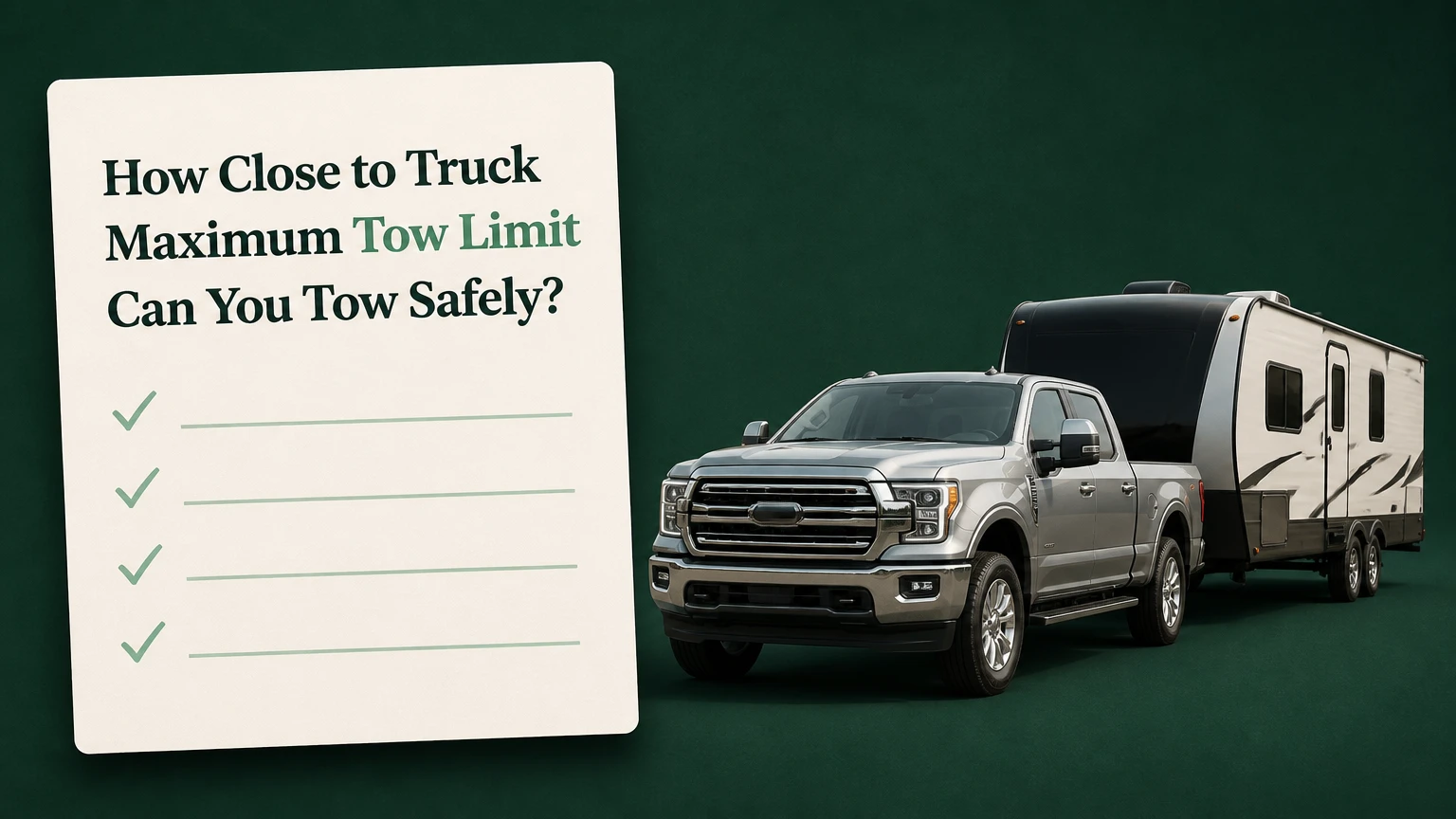
You can legally tow up to a truck’s published maximum tow rating only when the complete combination also stays within its GVWR, GCWR, axle, tire, hitch, and trailer-brake ratings. For predictable handling and reserve capacity, a practical target is 75%-80% of the truck’s maximum tow rating, with less capacity used for mountains, heat, wind, heavy traffic, or inexperienced drivers.
Key Facts at a Glance
- The 80% towing guideline is a conservative operating target, not a universal law or manufacturer requirement.
- Payload capacity limits the truck’s passengers, cargo, accessories, and trailer tongue weight together.
- A truck’s maximum tow rating cannot override its GVWR, GCWR, rear axle rating, tire rating, hitch rating, or trailer-brake rating.
- A conventional travel trailer normally needs approximately 10%-15% of its loaded weight on the hitch.
- Fifth-wheel and gooseneck pin weight commonly falls near 15%-25% of loaded trailer weight.
- Airbags, helper springs, and heavier shocks can improve ride height, but they do not increase the truck’s factory ratings.
How Close to Truck Maximum Tow Limit Can You Tow?
A sensible target is 75%-80% of the truck’s maximum tow rating for ordinary recreational towing, provided every other rating remains compliant. A capable heavy-duty truck on a short, flat route may operate closer to 90%, while a half-ton truck towing a tall trailer through heat, wind, or mountain grades may need to remain near 60%-70%.
The percentage is only a screening tool. The final limit is the lowest result produced by the manufacturer’s tow rating, payload calculation, GCWR calculation, rear axle rating, tire capacity, hitch rating, and trailer equipment. A 10,000-pound tow rating does not guarantee that a truck carrying five adults can pull a 10,000-pound trailer.
The Society of Automotive Engineers standard SAE J2807 uses standardized testing for acceleration, grade performance, braking, cooling, and handling. That testing does not make every real-world trip identical to the rating test. Trailer height, frontal area, temperature, road grade, cargo distribution, and driver control change the workload.
What does the 80% rule actually mean?
The 80% rule means treating 80% of the published tow rating as a planning ceiling, rather than assuming the rating is a comfortable everyday target. For a truck rated to tow 10,000 pounds, 80% equals 8,000 pounds of loaded trailer weight.
The rule is useful because tow ratings are maximum values under defined conditions. It is not a substitute for the door-label ratings. A truck with a 10,000-pound tow rating and only 1,400 pounds of available payload could be limited to a trailer near 9,000 pounds by tongue weight, even before passengers or cargo are added.
Is towing at 100% of the rating illegal?
Towing at 100% of a published rating is not automatically illegal, but it leaves no unused rating margin and may still violate another limit. Local law can impose separate requirements for trailer brakes, mirrors, lighting, registration, speed, safety chains, and commercial operation.
The important distinction is between a maximum rating and a recommended operating target. The manufacturer establishes the maximum under specified conditions; the 75%-80% target is a risk-management practice that preserves some capacity for gusts, grades, emergency maneuvers, and measurement uncertainty.
Which Truck Ratings Actually Limit the Trailer?
The lowest applicable rating controls the combination. Maximum trailer weight is only one number, and the truck’s payload, rear axle, tires, hitch, and combined weight often become limiting factors first.
| Rating | What it includes | Where to find it | Why it limits towing |
|---|---|---|---|
| GVWR | Truck, occupants, fuel, cargo, hitch load | Door certification label | Tongue or pin weight counts as truck payload |
| GCWR | Loaded truck plus loaded trailer | Owner’s manual or towing guide | Limits total combined mass |
| Payload | Occupants, cargo, accessories, tongue or pin weight | Tire and loading information label | Often reaches its limit before tow rating |
| GAWR | Maximum front or rear axle load | Door label and axle documentation | Rear axle carries most conventional hitch load |
| Tire rating | Maximum load per tire at specified pressure | Tire sidewall and placard | Tire capacity cannot be exceeded by suspension upgrades |
| Hitch rating | Maximum trailer and tongue load for that receiver | Hitch label or manufacturer data | Receiver and ball mount may have lower limits |
Does maximum tow capacity include passengers and cargo?
Maximum tow capacity usually refers to the trailer’s maximum loaded weight under a specific truck configuration, but passengers and cargo still consume payload and contribute to GCWR. The exact assumptions vary by manufacturer, model year, axle ratio, cab, bed length, drivetrain, cooling package, and tow package.
Some published tow ratings use a nominal driver and required equipment in the test configuration. The rating does not mean a truck can carry a full passenger cabin and cargo without reducing the available trailer weight. Use the exact truck’s certification label and towing guide, not a generic model-family maximum.
Why does payload often limit towing first?
Payload limits towing first because a conventional trailer transfers approximately 10%-15% of its loaded weight onto the truck. A 9,000-pound trailer can place 900-1,350 pounds on the hitch before adding passengers, tools, a canopy, a generator, or a weight-distribution hitch.
For a fifth wheel, pin weight often reaches 1,350-2,250 pounds on a 9,000-pound trailer. That load sits in the bed and is carried largely by the rear axle, so a high tow rating can coexist with insufficient payload.
How Do You Calculate the Real Trailer Limit?
Calculate the practical trailer limit by subtracting all truck payload occupants and cargo from the truck’s rated payload, then dividing the remaining payload by the expected tongue-weight percentage. Cross-check that result against GCWR, axle ratings, tires, hitch capacity, and the manufacturer’s maximum tow rating.
Use this process before buying or loading a trailer:
- Record the truck’s ratings. Write down GVWR, front and rear GAWR, payload, GCWR, hitch rating, tire capacity, and maximum tow rating.
- List truck payload. Include every occupant, fuel, luggage, tools, bed cargo, bed cover, running boards, auxiliary battery, cooler, and hitch hardware.
- Reserve hitch load. Estimate 10%-15% of loaded trailer weight for a conventional trailer, or 15%-25% for a fifth wheel or gooseneck.
- Calculate the payload result. Divide remaining payload by the expected hitch-load percentage.
- Check combined weight. Add the loaded truck and loaded trailer and compare the result with GCWR.
- Confirm scale weights. Weigh the complete rig, preferably with separate front axle, rear axle, and trailer axle readings.
| Truck payload after occupants and cargo | Tongue-weight assumption | Payload-based trailer ceiling | Practical planning target |
|---|---|---|---|
| 1,000 lb | 15% | 6,667 lb | 5,300-5,800 lb |
| 1,400 lb | 15% | 9,333 lb | 7,500-8,000 lb |
| 1,800 lb | 12% | 15,000 lb | Lowest other rating applies |
| 2,400 lb | 20% pin weight | 12,000 lb | 9,600-10,800 lb |
These are calculation examples, not vehicle-specific approvals. The 1,400-pound example allows 1,400 pounds for tongue weight only if all occupants and cargo have already been removed from the payload figure. A hitch cannot make payload disappear.
What trailer weight should you use?
Use the trailer’s actual loaded weight, not its dry weight or brochure shipping weight. Add water, propane, batteries, food, clothing, tools, spare parts, bicycles, firewood, and personal equipment before comparing the trailer with the truck’s ratings.
A practical RV loading estimate often adds 800-2,000 pounds to dry weight, although a minimalist utility trailer may add far less. Travel trailers with large fresh-water tanks can gain approximately 8.3 pounds per gallon of water, before accounting for propane and equipment.
| Added item | Typical quantity | Approximate added weight | Measurement note |
|---|---|---|---|
| Fresh water | 40-80 gallons | 332-664 lb | Water weighs about 8.3 lb per gallon |
| Propane | Two 20-pound cylinders | 70-80 lb full | Cylinder tare weight is additional |
| Lead-acid batteries | One or two units | 60-140 lb | Lithium systems usually weigh less |
| Food, clothing, tools | Weekend or family load | 250-700 lb | Weigh packed bins for accuracy |
| Generator and fuel | One portable generator | 80-180 lb | Fuel weight changes during travel |
| Bikes, rack, outdoor gear | Two to four bikes | 100-250 lb | Rear storage can affect tongue weight |
What Tongue Weight and Axle Load Should You Target?
A conventional bumper-pull trailer usually needs 10%-15% of its loaded weight on the tongue, with many travel trailers behaving best near 12%-13%. A lower percentage can increase sway, while excessive tongue weight consumes payload and overloads the rear axle.
Weight-distribution hitches transfer part of the hitch load toward the truck’s front axle and the trailer axles. They do not reduce the trailer’s actual weight or erase tongue weight from the truck’s GVWR calculation. Follow the truck and hitch manufacturer’s instructions for setup and allowable use.
Fifth-wheel and gooseneck trailers commonly place approximately 15%-25% of loaded weight over the truck’s hitch. Their central coupling location often improves stability compared with a rear receiver, but the higher pin load can exceed bed, rear axle, tire, or payload ratings.
Which towing setup provides the most usable margin?
No hitch type creates a universal safe percentage. A properly matched fifth wheel or gooseneck can provide better directional stability, but a bumper pull with correct loading, suitable brakes, and a properly adjusted weight-distribution system can also tow predictably.
| Setup | Typical load location | Main control advantage | Main limiting factor |
|---|---|---|---|
| Fixed receiver hitch | Behind rear axle | Simple coupling and lower hardware weight | Rear-axle leverage and sway sensitivity |
| Weight-distribution hitch | Rear receiver with spring bars | Restores front-axle load and controls some sway | Correct adjustment and manufacturer approval |
| Fifth-wheel hitch | Bed above or slightly forward of rear axle | Shorter leverage arm and stable coupling | High pin weight and reduced bed payload |
| Gooseneck hitch | Bed ball near rear axle | Tight turning radius and strong central coupling | Pin load, bed structure, and rear-axle capacity |
A weight-distribution hitch is not automatically required for every trailer above 5,000 pounds. The actual requirement depends on the truck, receiver, trailer, hitch instructions, and local rules. Some vehicles prohibit WDH use, especially certain unibody SUVs and vehicles with independent rear structures.
When Should You Use Less Than 80%?
Use less than 80% when the route includes sustained grades, high altitude, strong crosswinds, extreme heat, heavy traffic, poor pavement, or repeated stops. Reduce the target further when the driver lacks towing experience or the trailer has a tall, broad profile that creates substantial aerodynamic drag.
Internal-combustion engines lose power with altitude because thinner air reduces available oxygen. The exact loss varies by engine, turbocharger, temperature, and calibration, so a fixed “3% per 1,000 feet” rule is only a rough estimate, not a universal engineering value.
Electric trucks face a different constraint. Trailer drag can reduce range substantially, and long grades may require more frequent charging stops even when the weight remains below the tow rating. Battery temperature, state of charge, and charging access matter as much as the nominal trailer limit.
| Operating condition | More conservative target | Main concern | Useful preparation |
|---|---|---|---|
| Flat route, mild weather | 75%-85% | Normal reserve and handling | Verify loaded weights |
| Mountain grades above 5% | 60%-75% | Cooling, braking, power | Plan lower gears and descent speeds |
| Strong crosswind | 60%-75% | Trailer sway and steering correction | Reduce speed and secure loading |
| Hot weather above 95°F | 60%-75% | Engine, transmission, and tire heat | Inspect cooling and tire pressure |
| Dense traffic or urban route | 60%-75% | Repeated braking and acceleration | Confirm trailer brake operation |
| Snow, ice, or wet pavement | Below 70% | Traction and stopping control | Delay travel when conditions deteriorate |
The percentage does not replace route-specific judgment. A 7,500-pound enclosed trailer can be harder to control than a 9,000-pound low flatbed because frontal area and side wind produce larger aerodynamic forces.
Is Fifth-Wheel Towing Safer Near the Maximum?
Fifth-wheel towing is often more stable near a truck’s limit because the hitch sits over or ahead of the rear axle, reducing the rearward leverage of the trailer. Fifth-wheel towing is not automatically safer when pin weight, rear GAWR, tires, bed payload, or braking capacity are exceeded.
The coupling location reduces some sway leverage, but it does not change the trailer’s mass. A 12,000-pound fifth wheel with 2,400 pounds of pin weight can overload a truck rated for 2,000 pounds of available payload even if the truck’s brochure lists a much higher maximum trailer weight.
Fifth-wheel and gooseneck systems also require clearance checks, correct hitch installation, adequate turning clearance, and a truck bed compatible with the hitch. A short-bed truck may need a sliding fifth-wheel hitch or a pin box designed for additional cab clearance.
What Equipment Helps, and What Does Not?
Trailer brakes, correct tires, a functional brake controller, properly adjusted weight distribution, and a sway-control system can improve control. Airbags, helper springs, and upgraded shocks can reduce squat or improve ride quality, but they cannot legally or mechanically raise GVWR, GAWR, GCWR, tire capacity, or the factory tow rating.
| Equipment | Typical purchase range | Typical installation time | What it changes |
|---|---|---|---|
| Electric trailer brake controller | $150-$400 | 30-90 minutes | Brake command and proportional braking |
| Weight-distribution hitch | $350-$900 | 1-2 hours | Axle-load distribution and setup geometry |
| Sway-control component | $50-$600 | 30-90 minutes | Resistance to some trailer yaw |
| Rear air springs | $400-$800 | 2-4 hours | Ride height and suspension support |
| CAT Scale weighing | $15-$25 per pass | 10-20 minutes | Actual axle and combination weights |
| Tire replacement | $500-$1,600 per set | 1-3 hours | Load capacity only when correctly rated |
A trailer brake controller cannot compensate for under-rated tires. Air springs cannot compensate for an overloaded rear axle. A larger radiator cannot convert a light-duty truck into a higher-rated configuration.
The practitioner rule is simple: improve control equipment only after confirming the ratings. Upgrades should solve a diagnosed handling or braking issue, not disguise an overloaded combination.
How Do You Verify the Setup at a CAT Scale?
Verify the combination at a public truck scale after loading the truck and trailer exactly as they will travel. Obtain a first pass with the truck and trailer connected, then compare the front axle, rear axle, trailer axle group, and total weight with the manufacturer’s limits.
At many CAT Scale locations, one certified weigh costs roughly $15-$25, although prices vary by location and additional reweighs may cost less. Keep the scale ticket with the measured axle weights, because total combination weight alone can hide a rear-axle overload.
A useful weighing sequence is:
- Weigh the complete connected rig.
- Weigh the truck alone if the facility allows a practical second position.
- Compare truck weight with GVWR and each axle with GAWR.
- Compare the trailer axle group with its GAWR and tire ratings.
- Adjust cargo or tongue weight if one axle is overloaded.
- Reweigh after changes.
A level truck is not proof of a compliant load. A truck can appear visually level while its rear axle or tires carry more than their rated load.
What Problems Appear Near the Tow Limit?
Near-limit towing commonly exposes insufficient tongue weight, overloaded tires, weak trailer brakes, cooling limitations, and poor cargo distribution. Warning symptoms require reducing speed and stopping safely, because suspension aids and electronic driving modes cannot restore an exceeded rating.
| Symptom | Likely cause | Immediate response | Corrective check |
|---|---|---|---|
| Trailer oscillates side to side | Low tongue weight, speed, crosswind | Ease off accelerator, avoid sharp steering | Rebalance cargo and verify 10%-15% tongue load |
| Rear suspension bottoms out | Excess tongue or pin weight | Stop before suspension damage occurs | Weigh rear axle and inspect payload |
| Brake fade or soft pedal | Overheated truck or trailer brakes | Slow safely and allow cooling | Adjust trailer brakes and inspect fluid |
| Rising coolant or transmission temperature | Sustained grade, heat, inadequate cooling | Reduce load demand and stop if warning appears | Check fluid, cooling system, and service limits |
| Tire heat or sidewall damage | Underinflation, overload, aged tire | Stop and inspect all tires | Set cold pressure to placard and verify load index |
| Front steering feels light | Rear hitch load or poor WDH adjustment | Reduce speed immediately | Restore front axle load according to instructions |
A transmission temperature of 220°F, or 104°C, should not be treated as a universal failure threshold. Temperature limits differ by transmission, sensor location, fluid, ambient conditions, and manufacturer guidance; the owner’s manual and warning system take priority.
Trailer sway is not fixed by accelerating aggressively or braking the truck alone. Maintain a steady steering posture, reduce speed gradually, and never use a sway-control device as permission to exceed the trailer or truck ratings.
How Should Different Drivers Set Their Target?
A weekend driver should usually plan below 70%-75% when towing a tall camper or utility trailer, because unfamiliarity with sway recovery and braking increases risk. An experienced RVer with a properly matched half-ton truck may target 75%-80%, while an HD truck owner may operate near 85%-90% only after confirming every axle and equipment rating.
| Driver and truck situation | Planning target | Preferred trailer type | Required verification |
|---|---|---|---|
| New driver, midsize pickup | 60%-70% | Low-profile utility trailer | Practice braking and turning unloaded |
| Weekend half-ton camper use | 65%-75% | Lightweight travel trailer | Payload and tongue-weight scale check |
| Frequent half-ton RVer | 75%-80% | Properly matched travel trailer | WDH setup and CAT Scale ticket |
| HD 2500 or 3500 owner | 80%-90% | Fifth wheel or gooseneck when rated | Pin weight, rear axle, tires, and brakes |
| Commercial operation | Manufacturer and legal limits | Commercial trailer configuration | Regulatory inspection and documented weights |
Heavy-duty trucks generally provide more reserve in payload, cooling, brakes, tires, and axle capacity. They still can be overloaded by a large fifth wheel, dense cargo, or an incorrectly distributed load.
What Are the Most Common Calculation Mistakes?
The most common mistake is using the trailer’s dry weight as its travel weight. The second is subtracting only passengers from payload while ignoring the hitch, accessories, tools, fuel, and cargo already carried in the truck.
Other errors include:
- Using the highest tow rating from a brochure instead of the exact cab, bed, engine, axle, and package.
- Treating a weight-distribution hitch as a way to remove tongue weight from GVWR.
- Measuring tongue weight while the trailer is empty, then loading cargo behind the axle.
- Ignoring tire age, inflation pressure, load index, or the trailer’s axle rating.
- Assuming airbags increase legal capacity.
- Relying on a visual squat check instead of separate axle-scale readings.
- Forgetting that a full water tank can add hundreds of pounds.
- Counting only static weight and ignoring wind, grades, braking, and road surface.
A counterintuitive loading fact matters here: moving cargo rearward can reduce tongue weight enough to increase sway, while moving the same cargo forward can overload the truck’s payload. Cargo placement must satisfy both stability and axle limits.
FAQ
How much below towing capacity should I stay?
For routine recreational towing, plan for approximately 20% below the published maximum, which equals an 80% target. Use a larger margin when towing in mountains, heat, wind, traffic, snow, or with a tall trailer. The final limit remains the lowest applicable payload, axle, tire, hitch, GCWR, or tow-rating value.
Can I tow a trailer that matches my truck’s exact tow rating?
You can tow at the exact tow rating only if the loaded combination stays within every other manufacturer and legal limit. Passengers and cargo reduce available payload, while trailer tongue weight counts against the truck. A trailer matching the brochure maximum may exceed GVWR or rear GAWR in ordinary travel conditions.
Do airbags increase a truck’s towing capacity?
Airbags do not increase a truck’s GVWR, GCWR, GAWR, tire rating, hitch rating, or maximum tow rating. Air springs can reduce rear sag and improve ride height when the load is already within the ratings. They cannot correct overloaded tires, brakes, axles, or a trailer that exceeds the manufacturer’s limits.
Do I need a weight-distribution hitch for a 5,000-pound trailer?
You need a weight-distribution hitch when the truck, receiver, trailer, hitch manufacturer, or local rule requires one, not because 5,000 pounds is a universal threshold. Many receiver and trailer instructions specify a weight or tongue-load range for WDH use. Follow those instructions and verify that the vehicle is approved for the system.
Is a heavier truck always safer for maximum towing?
A heavier truck is not automatically safer, but a properly matched HD truck usually offers more payload, axle, tire, braking, and cooling reserve than a similarly rated light-duty truck. The fifth-wheel pin weight, trailer brakes, cargo distribution, and route still determine whether the complete combination is compliant and controllable.
How often should I weigh my truck and trailer?
Weigh the rig once after its first complete loading, then reweigh after major changes such as adding batteries, water, a generator, a motorcycle, or a new hitch. Seasonal RV users should check again when cargo or passengers change. A CAT Scale ticket provides more reliable information than a level-looking suspension.
The Bottom Line
How close to truck maximum tow limit can you tow depends on the lowest limit in the complete truck-and-trailer system, not the highest number in a brochure. Use 75%-80% of the published tow rating as a practical starting target, reduce it for difficult routes, calculate payload and tongue weight, and confirm the loaded front axle, rear axle, trailer axles, tires, GVWR, and GCWR at a scale.