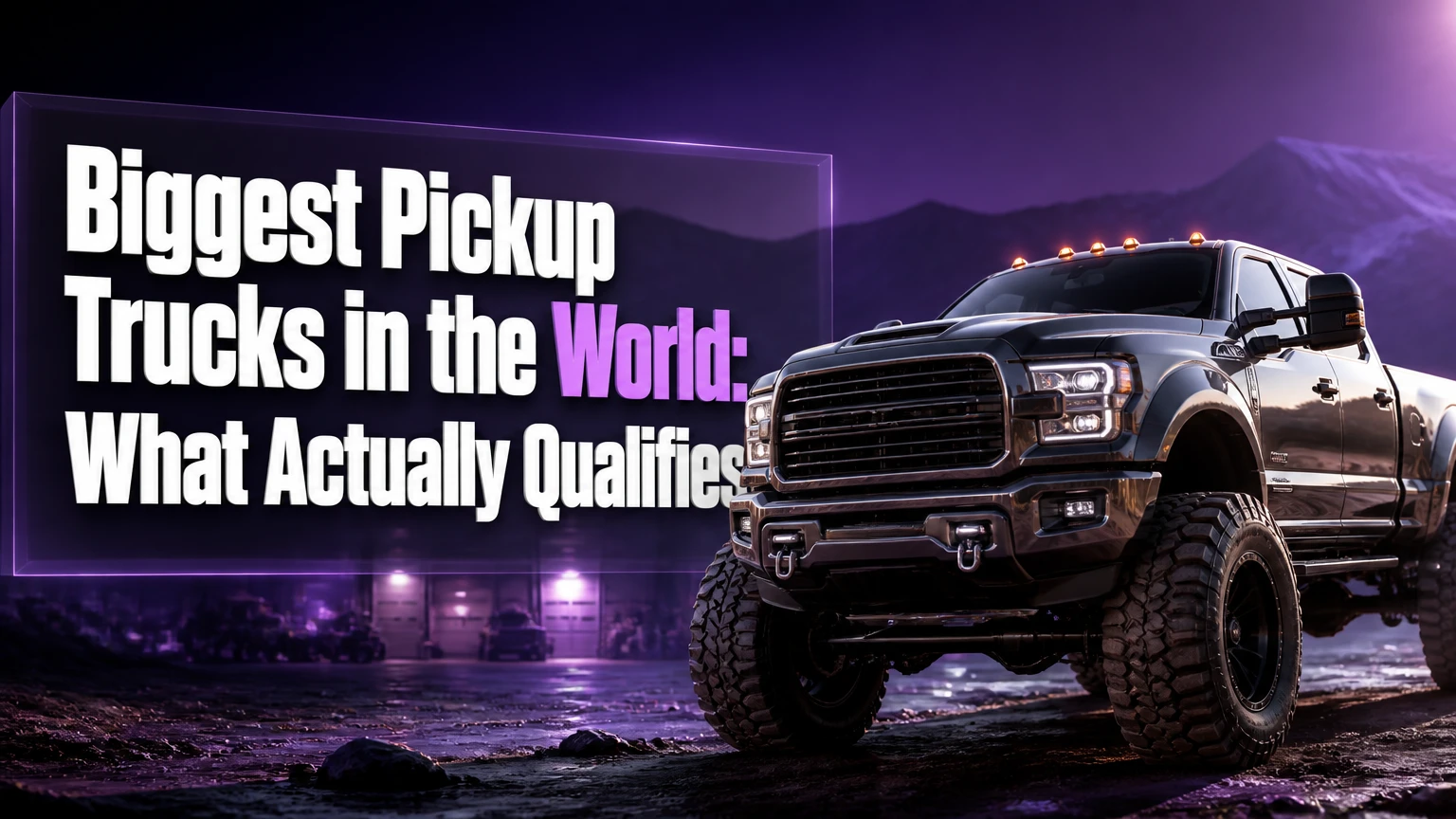
The biggest pickup trucks in the world are usually medium-duty commercial trucks fitted with pickup beds, led by the International CXT, Ford F-750 conversions, Freightliner SportChassis models, and custom 6×6 builds. These trucks can exceed 22 feet in length, weigh more than 11,000 pounds empty, and carry GVWR ratings from roughly 19,500 to 37,000 pounds.
Key Facts at a Glance
- The International CXT is the defining factory-built extreme pickup, based on International’s 7300 severe-service chassis.
- Ford F-650 and F-750 pickup conversions combine commercial truck frames with familiar Super Duty-style cabs.
- A pickup bed does not make a truck light-duty; GVWR, axle ratings, brakes, and registration determine its operating class.
- Typical giant pickup conversions measure 22-26 feet long, 8-9 feet wide, and 8.5-10 feet tall.
- Completed medium-duty pickup conversions commonly cost $150,000-$350,000, while one-off 6×6 builds can exceed $500,000.
- A truck above 26,000 pounds GVWR may require a CDL or special registration, depending on jurisdiction and use.
Which Trucks Qualify as the Biggest Pickup Trucks in the World?
The term “biggest pickup truck” needs a working definition because manufacturers do not use it as a formal vehicle category. For this guide, a giant pickup is a commercial Class 5, Class 6, or Class 7 truck chassis equipped with a pickup-style cargo box for private, recreational, promotional, or specialty use.
The decisive measurements are GVWR, chassis size, axle capacity, and overall dimensions. A modified Ford F-450 may look enormous beside a half-ton pickup, but it does not occupy the same category as an International CXT or a Ford F-750 conversion.
GVWR provides the clearest classification
Gross vehicle weight rating is the maximum permitted combined weight of the truck, passengers, fuel, cargo, and trailer tongue load. In the United States, the Federal Highway Administration generally places Class 5 at 16,001-19,500 pounds GVWR, Class 6 at 19,501-26,000 pounds, and Class 7 at 26,001-33,000 pounds, although manufacturer and regulatory terminology can vary.
The distinction matters because an empty truck may weigh 12,000 pounds while carrying a GVWR above 26,000 pounds. Licensing, insurance, registration, and commercial inspection requirements often follow the rating on the certification label, not the truck’s actual weight on a particular trip.
Typical dimensions and capabilities
The following figures describe common configurations, not a universal specification. Wheelbase, fuel tanks, sleeper compartments, bed length, lift axles, and body equipment can change every measurement.
| Vehicle category | Typical length | Typical width and height | Typical GVWR |
|---|---|---|---|
| International CXT | 22-25 feet | 8.0-8.5 feet, 9-10 feet high | 25,999-54,000 pounds, configuration-dependent |
| Ford F-650 conversion | 22-25 feet | 8.0-8.5 feet, 8.5-10 feet high | 20,000-29,000 pounds |
| Ford F-750 conversion | 23-27 feet | 8.0-8.5 feet, 9-10 feet high | 26,000-37,000 pounds |
| Freightliner SportChassis P4XL | 25-30 feet | 8.0-8.5 feet, 10-12 feet high with sleeper | 26,000-33,000 pounds |
| Chevrolet Silverado 6500 conversion | 22-26 feet | 8.0-8.5 feet, 8.5-10 feet high | 22,000-23,500 pounds |
| Custom 6×6 pickup | 20-30 feet | 7.5-9 feet, 8-12 feet high | Builder-specific |
What Makes These Trucks So Large?
The largest pickup-style trucks use straight-rail commercial frames, high-capacity axles, commercial suspension components, and braking systems designed for vocational duty. Their pickup beds are often an upfitter’s body installation rather than a factory-designed part of the original truck.
A medium-duty truck also places the cab higher above the road. That creates greater ground clearance and room for a large engine, transmission, cooling package, and front axle, but it raises the step-in height and makes ordinary parking infrastructure difficult to use.
Chassis and suspension
Commercial frames use thick steel rails designed to resist bending under repeated loading. Leaf springs are common, although air suspension appears on luxury haulers and some rear axles. An unloaded leaf-spring truck can ride sharply because the suspension is tuned for cargo weight rather than an empty passenger cabin.
Commercial air suspension can improve ride quality, but air bags do not turn a 30,000-pound truck into a car. The steering ratio, turning circle, tire size, cab height, and braking response remain fundamentally commercial.
Engines and transmissions
Engine choice varies by model year. The International CXT used the 7.6-liter International DT466 inline-six diesel in period specifications, while modern Ford F-650 and F-750 trucks may use a 6.7-liter Power Stroke V8 diesel or a 7.3-liter gasoline V8, depending on configuration and model year.
The Chevrolet Silverado 6500 HD uses a 6.6-liter Duramax turbo-diesel in current configurations. Allison automatic transmissions are common in medium-duty applications because their calibration and torque capacity suit frequent heavy hauling.
The AI Overview’s broad description of all giant pickups as diesel-powered is too general. Some current medium-duty Ford trucks offer gasoline power, and custom builders can install different engines, transmissions, and axle combinations.
Brakes, axles, and air systems
Many Class 6 and Class 7 trucks use hydraulic or air-over-hydraulic brakes, while heavier commercial specifications can use full air brakes. A buyer must verify the exact system rather than infer it from the truck’s appearance.
A full air-brake system needs a compressor, storage tanks, valves, lines, and a governor. The system adds stopping capacity and commercial serviceability, but drivers need training because pedal feel and pressure management differ from passenger vehicles.
Rear axles may be single-drive, tandem-drive, or part of a custom 6×6 arrangement. More driven axles increase traction and weight, while also adding differentials, driveshafts, tires, maintenance points, and parasitic loss.
The Largest Factory and Converted Pickup-Style Trucks
The International CXT is the clearest answer for a factory-produced extreme pickup, while the Ford F-750 and Freightliner SportChassis are more practical examples of commercial chassis adapted for private ownership. Custom 6×6 trucks can be physically larger, but they are not standardized production vehicles and cannot be ranked reliably without builder documentation.
1. International CXT: Best for maximum factory-built presence
The International CXT is the most recognizable factory extreme pickup because International built it on a 7300-series commercial chassis and offered a pickup-style body rather than merely selling a cab-and-chassis truck to an aftermarket converter.
Period CXT specifications included a DT466 diesel, a very tall cab, commercial axles, and a GVWR near the upper end of the medium-duty range in common consumer configurations. Some descriptions report higher chassis ratings for related configurations, so buyers should use the individual certification label and VIN record rather than assume every CXT has the same rating.
The CXT is roughly 22-25 feet long and may exceed 9 feet in height. Its bed can carry recreational equipment or substantial cargo, but the truck’s real attraction is its industrial scale. A normal residential garage, automated car wash, narrow fuel island, and many drive-through lanes are unsuitable.
The main drawback is age. Production ended years ago, so condition, parts sourcing, air-system health, tire age, and prior vocational use matter more than the odometer. An International dealer may support the commercial drivetrain, but body trim and unusual interior components can require specialty fabrication.
Choose the CXT if: you want the strongest factory identity and collector appeal.
Skip it if: you need a modern warranty, easy parking, or predictable passenger-car insurance.
2. Ford F-750 Conversion: Best for commercial support
A Ford F-750 conversion is often the most rational giant pickup because the underlying truck has broad commercial dealer support, modern safety systems, and multiple wheelbase and powertrain choices. Upfitters can install a steel or aluminum pickup box, gooseneck equipment, utility body, or custom recreational platform.
The F-750 occupies Class 6 or Class 7 territory depending on its rating. Current examples can reach 37,000 pounds GVWR, which is materially higher than the 26,000-pound threshold often used in U.S. CDL discussions. A lower-rated configuration may avoid some requirements, but registration law still depends on state, vehicle use, and whether the truck is operated commercially.
Ford’s available powertrains vary by year. The 6.7-liter Power Stroke diesel suits heavy towing, while the 7.3-liter gasoline V8 can reduce acquisition complexity for buyers who do not accumulate commercial mileage. A qualified upfitter must calculate rear axle capacity, bed weight, center of gravity, lighting, mudguards, and trailer connections.
Choose the F-750 if: service access, towing stability, and a new build matter most.
Skip it if: the truck will spend most of its time in urban parking lots or short residential trips.
3. Freightliner SportChassis P4XL: Best for luxury hauling
The Freightliner SportChassis P4XL is a luxury pickup conversion based on the Freightliner M2 106 platform. It targets owners who want a large trailer hauler with a premium interior, air suspension, sleeper-style accommodations, and commercial-grade durability.
The P4XL can exceed 25 feet before an optional trailer is attached, and some configurations include a substantial rear living area. Its cabin is more refined than a basic work-truck interior, but the vehicle remains wide, tall, and mechanically closer to a medium-duty truck than to a luxury SUV.
A SportChassis usually costs more than a bare F-750 chassis because the finished product includes specialized bodywork, interior materials, suspension upgrades, electrical systems, and recreational equipment. Used prices vary sharply with age, mileage, generator condition, interior wear, and drivetrain maintenance.
Choose the P4XL if: you tow a large fifth-wheel or want a luxury hauler.
Skip it if: you want a short-bed pickup that fits standard parking spaces.
4. Chevrolet Silverado 6500 HD Conversion: Best for a newer GM platform
The Chevrolet Silverado 6500 HD is a commercial cab-and-chassis truck, not a factory pickup in the same sense as a Silverado 1500. An upfitter must install a pickup box or specialty body, and that conversion determines much of the final appearance, payload arrangement, and cost.
The 6.6-liter Duramax diesel and Allison automatic transmission provide familiar GM commercial-truck hardware. The truck’s GVWR can reach approximately 23,500 pounds in published configurations, keeping many examples below 26,001 pounds, although the exact rating must be checked on the door label.
The Silverado 6500 can be easier to explain to buyers who already use GM fleet products, but its bed conversions are less standardized than ordinary Silverado accessories. A custom bed may also reduce available payload because the body, toolboxes, spare tires, and hitch equipment consume capacity.
Choose it if: you want current GM powertrain support and a tailored commercial build.
Skip it if: you expect a factory-integrated pickup bed or broad used-market selection.
5. Custom 6×6 Pickup: Best for specialized off-road use
Custom 6×6 pickups add a third axle and a second driven rear axle, usually by stretching a frame, adding transfer-case hardware, and engineering new suspension and brake systems. Examples include modified heavy trucks, expedition vehicles, and bespoke builds based on Peterbilt, Kenworth, or military-derived platforms.
A 6×6 is not automatically larger than a CXT or F-750. Hennessey’s Mammoth 6×6 and VelociRaptor 6×6 are extreme modified pickups, but their underlying platforms differ from Class 6 and Class 7 commercial trucks. Their visual width and length may be dramatic while their GVWR remains below a medium-duty CXT.
Custom builds can cost $350,000-$500,000 or more. Parts compatibility, driveline angles, tire replacement, axle synchronization, and registration paperwork deserve more scrutiny than the marketing name. Builder documentation should include axle ratings, brake certification, structural drawings, and a final weight ticket.
Choose a 6×6 if: terrain access and engineering uniqueness justify high operating costs.
Skip it if: you need easy parts sourcing, standardized resale values, or simple inspections.
How Do the Biggest Pickup Trucks Compare?
The Ford F-750 offers the best balance of modern support and heavy-duty capacity, the International CXT delivers the strongest factory-built identity, and the SportChassis provides the most complete luxury-hauler package. Custom 6×6 trucks lead only when traction, ground clearance, or visual impact outweigh cost and mechanical complexity.
| Model or category | Primary powertrain | Typical GVWR | Typical completed price | Best use |
|---|---|---|---|---|
| International CXT | 7.6L DT466 diesel | 25,999-54,000 lb | $90,000-$180,000 used | Collector ownership and promotional display |
| Ford F-650 conversion | 6.7L diesel or 7.3L gasoline | 20,000-29,000 lb | $120,000-$250,000 | Heavy towing with manageable service access |
| Ford F-750 conversion | 6.7L Power Stroke diesel | 26,000-37,000 lb | $150,000-$300,000 | Large trailers and commercial hauling |
| Freightliner P4XL | 8.9L-class diesel, model-dependent | 26,000-33,000 lb | $180,000-$350,000 | Luxury fifth-wheel hauling |
| Silverado 6500 conversion | 6.6L Duramax diesel | Up to about 23,500 lb | $130,000-$275,000 | Newer GM-based custom builds |
| Custom 6×6 | Builder-specific diesel | Builder-specific | $350,000-$500,000+ | Expedition travel and off-road work |
Which is the largest factory-built pickup?
The International CXT is the strongest candidate for the largest factory-produced consumer pickup because it was sold as a pickup-style vehicle on an International 7300 commercial chassis. The phrase “largest” remains configuration-dependent, since a high-GVWR F-750 or a sleeper-equipped SportChassis can exceed the CXT in rating, length, or total mass.
A useful distinction separates “largest pickup sold to consumers” from “largest truck with a pickup bed.” The first favors recognizable factory products such as the CXT. The second could include one-off mining, military, expedition, and semi-truck conversions that have no consistent production specification.
Which truck is best for towing?
The Ford F-750 and Freightliner SportChassis are usually better towing platforms than an old CXT when the buyer needs modern brakes, a documented hitch installation, current tires, and repeatable service. Trailer weight alone does not determine suitability; tongue weight, rear axle rating, wheelbase, braking compatibility, and combined weight rating also control the safe setup.
A long-wheelbase truck improves directional stability but increases turning space. A pickup bed conversion must preserve enough rear-axle capacity for the trailer pin or tongue load, which can consume several thousand pounds before cargo is added.
Which truck is easiest to maintain?
A current Ford F-650 or F-750 is usually the easiest to maintain because commercial Ford dealers, fleet parts suppliers, and diagnostic support are widespread. The International CXT has a serviceable commercial drivetrain, but model-specific body components and aged emissions or air-system parts can complicate ownership.
The maintenance budget should include commercial tires, air-brake inspection, diesel exhaust fluid, diesel particulate filter service, wheel-end checks, suspension bushings, and annual registration. Six tires can become ten or twelve on a multi-axle truck, and a complete replacement may cost several thousand dollars.
How Much Do the Biggest Pickup Trucks Cost?
The biggest pickup trucks cost approximately $90,000-$180,000 for older used extreme models, $120,000-$300,000 for modern completed F-650, F-750, or Silverado conversions, and $350,000-$500,000 or more for bespoke 6×6 builds. The purchase price excludes commercial insurance, storage, fuel, tires, registration, and conversion engineering.
| Purchase stage | Typical price | Typical lead time | Main cost driver |
|---|---|---|---|
| Used International CXT | $90,000-$180,000 | 1-8 weeks | Condition and collector demand |
| New medium-duty chassis | $75,000-$120,000 | 3-9 months | Engine, wheelbase, axle rating |
| Pickup-bed conversion | $35,000-$125,000 | 3-9 months | Bed, paint, wiring, hitch, engineering |
| Finished SportChassis | $180,000-$350,000 | 1-6 months used | Interior and recreational equipment |
| Bespoke 6×6 | $350,000-$500,000+ | 9-24 months | Axles, fabrication, testing, certification |
A cheap chassis can become an expensive project. Buyers should obtain a written upfit quote that identifies bed weight, final curb weight, axle loads, hitch rating, electrical work, lighting compliance, tire specification, and responsibility for inspection approval.
Fuel costs are also substantial. A typical medium-duty diesel pickup conversion may return 6-10 mpg, while a gasoline F-650 can perform worse under heavy load. A 60-150-gallon fuel capacity improves range but increases parked weight and replacement cost.
Do You Need a CDL to Drive One?
A CDL may be required when a truck’s GVWR or combination rating exceeds the applicable threshold, but the answer depends on jurisdiction, vehicle use, and whether the truck is personal or commercial. In the United States, a vehicle over 26,000 pounds GVWR commonly triggers Class B CDL rules, while a combination with a trailer can trigger Class A requirements.
Personal-use exemptions exist in some states, particularly for recreational vehicles, but they are not universal. A private owner should verify requirements with the state motor-vehicle agency and state patrol before purchase, then confirm insurance eligibility in writing.
The important mistake is checking only the scale weight. A Ford F-750 rated at 33,000 pounds may require different licensing even when it is empty. The rating plate, manufacturer’s certificate, registration class, and trailer rating all need review.
Commercial insurance can also be mandatory or strongly advisable. Many ordinary auto policies exclude vehicles above a weight limit, vehicles titled as commercial trucks, or trucks used for business advertising, hauling, or paid transportation.
Where Do These Giant Pickups Work and Fail?
The biggest pickup trucks work well for heavy trailers, equipment transport, mobile displays, rural properties, and expedition bodies. They work poorly as ordinary commuter vehicles because their dimensions exceed many garages, parking structures, fuel lanes, drive-throughs, and residential streets.
A 25-foot truck can occupy two parking spaces lengthwise, while an 8.5-foot width leaves little clearance in a standard parking bay. Height is equally restrictive: a 9.5-foot truck cannot enter a garage marked for 8 feet, and roof-mounted equipment can add another 12-20 inches.
These vehicles also need turning-room planning. Measure the truck’s wheelbase, bumper-to-bumper length, mirror width, rear overhang, and turning circle, then compare them with the driveway entrance rather than the driveway’s straight-line length.
What are the main ownership problems?
The main ownership problems are harsh unloaded ride quality, expensive tires, air-system leaks, diesel emissions faults, difficult parking, and insurance restrictions. These are predictable engineering consequences of commercial hardware, not unusual defects.
Short-trip use is particularly hard on modern diesel systems. Repeated low-temperature operation can interrupt diesel particulate filter regeneration and increase the risk of derate conditions, so owners should follow the manufacturer’s regeneration guidance and schedule longer operating cycles when appropriate.
Common failure points include:
- Air pressure loss: inspect glad-hand fittings, tanks, valves, hoses, and compressor-governor operation rather than repeatedly adding air.
- Unloaded suspension bounce: verify ride height and suspension condition before changing air pressure; incorrect adjustment can affect driveline angles and braking.
- Overloaded rear axle: weigh the completed truck with passengers, tools, fuel, and trailer pin weight.
- Incorrect tire selection: use load-range and speed ratings that match axle loads, not merely the original chassis catalog.
- Unapproved bed installation: require the upfitter to document frame drilling, body mounts, lighting, mudguards, and center-of-gravity calculations.
A practitioner rule matters here: never judge a medium-duty pickup by its bed size alone. The bed may hold less practical payload than expected after the heavy conversion, fuel tanks, suspension equipment, generator, and trailer hardware are installed.
What Are Better Alternatives for Most Drivers?
The Ford F-450, Ford F-550, Chevrolet Silverado 5500 HD, Ram 5500, and GMC Sierra 5500 are better alternatives when the objective is heavy towing without Class 7 dimensions. These trucks retain commercial frames and high payload ratings while offering more manageable wheelbases, lower purchase costs, and broader residential usability.
| Alternative | Typical GVWR | Typical use | Approximate completed price |
|---|---|---|---|
| Ford F-450 pickup | 14,000-16,000 lb | Fifth-wheel and gooseneck towing | $80,000-$120,000 |
| Ford F-550 | 17,500-19,500 lb | Service bodies and heavy trailers | $75,000-$150,000 |
| Ram 5500 | 19,500-22,000 lb | Chassis-cab towing and vocational work | $80,000-$160,000 |
| Silverado 5500 HD | 17,500-19,500 lb | GM fleet and equipment hauling | $75,000-$145,000 |
| GMC Sierra 3500 HD | Up to about 14,000 lb | Private towing and daily use | $70,000-$110,000 |
A smaller chassis may produce a better real-world result because it fits the owner’s storage, licensing, budget, and service constraints. A truck that cannot enter the intended campground or driveway has less practical capability than a smaller truck that can be used every week.
How Should You Choose Among Them?
Choose the Ford F-750 for documented heavy towing and commercial service access, the International CXT for collector value, the Freightliner P4XL for luxury trailer travel, the Silverado 6500 for a newer GM-based build, and a custom 6×6 only for specialized terrain or expedition requirements.
For a commercial hauler
Select a Ford F-750 with a documented GVWR, axle configuration, integrated hitch, and service history. Confirm the combined weight rating against the trailer’s loaded weight, then resolve CDL, DOT, and insurance requirements before signing an order.
For a collector
Select an International CXT after a commercial-truck inspection. Examine frame repairs, brake performance, air leaks, tire dates, transmission operation, 4×4 or axle engagement, and the availability of body-specific parts.
For a luxury traveler
Select a Freightliner SportChassis P4XL when the fifth-wheel, sleeper, and interior are central to the purchase. Inspect generator hours, HVAC systems, slide mechanisms, air suspension, water systems, and the truck’s ability to fit the planned storage facility.
For an off-road expedition
Select a custom 6×6 only when a builder supplies engineering records and post-build support. Verify approach and departure angles, axle load distribution, recovery points, spare-tire logistics, driveline warranty, and access to replacement tires in the regions you plan to visit.
FAQ
Can a pickup bed be installed on any medium-duty truck?
A pickup bed can be installed on many medium-duty cab-and-chassis trucks, but the conversion requires structural, electrical, lighting, suspension, and weight analysis. The bed must fit the frame width, body-mount locations, rear-axle clearance, fuel-system layout, and intended hitch load. Registration authorities may also require inspection or certification.
Are giant pickup trucks legal on normal roads?
Giant pickup trucks are generally road-legal when properly titled, registered, insured, equipped, and operated under applicable weight and dimension rules. Legal road use does not guarantee practical access to every road. Height restrictions, bridge limits, axle-weight rules, local parking regulations, and commercial restrictions can still prevent access.
How much can a Class 6 pickup tow?
A Class 6 pickup may tow roughly 20,000-30,000 pounds in common configurations, but the legal and safe limit depends on the truck’s GCWR, hitch rating, rear-axle rating, trailer brakes, tire capacity, and pin or tongue weight. The lowest applicable rating controls the combination.
Are International CXT parts still available?
Many drivetrain and chassis components for the International CXT can be sourced through commercial truck channels, but trim, body, interior, and specialty conversion parts may be difficult or expensive. A pre-purchase inspection should identify obsolete components, custom wiring, unusual tires, and previous owner modifications.
Can these trucks be used as daily drivers?
The biggest pickup trucks can be driven daily, but they are inefficient for routine commuting because of 6-10 mpg fuel economy, commercial tires, high entry steps, wide mirrors, large turning circles, and limited parking access. A daily driver should have a clearly available storage location and a route without restrictive height or weight limits.
Is a 6×6 pickup always the biggest option?
A 6×6 pickup is not always the biggest option. A three-axle custom truck may have greater traction but a lower GVWR, shorter length, or smaller engine than an International CXT, Ford F-750, or Freightliner SportChassis. Compare certified dimensions and ratings instead of counting axles.
The Bottom Line
The biggest pickup trucks in the world are commercial medium-duty trucks converted into pickup-style vehicles, not simply oversized versions of conventional half-ton pickups. The International CXT is the defining factory extreme pickup, the Ford F-750 is the most supportable heavy-duty platform, the Freightliner SportChassis P4XL is the strongest luxury-hauler choice, and custom 6×6 trucks serve specialized expedition purposes.
For most owners, the best decision is not the physically largest truck. It is the smallest platform that meets the loaded trailer, payload, storage, licensing, insurance, and service requirements.