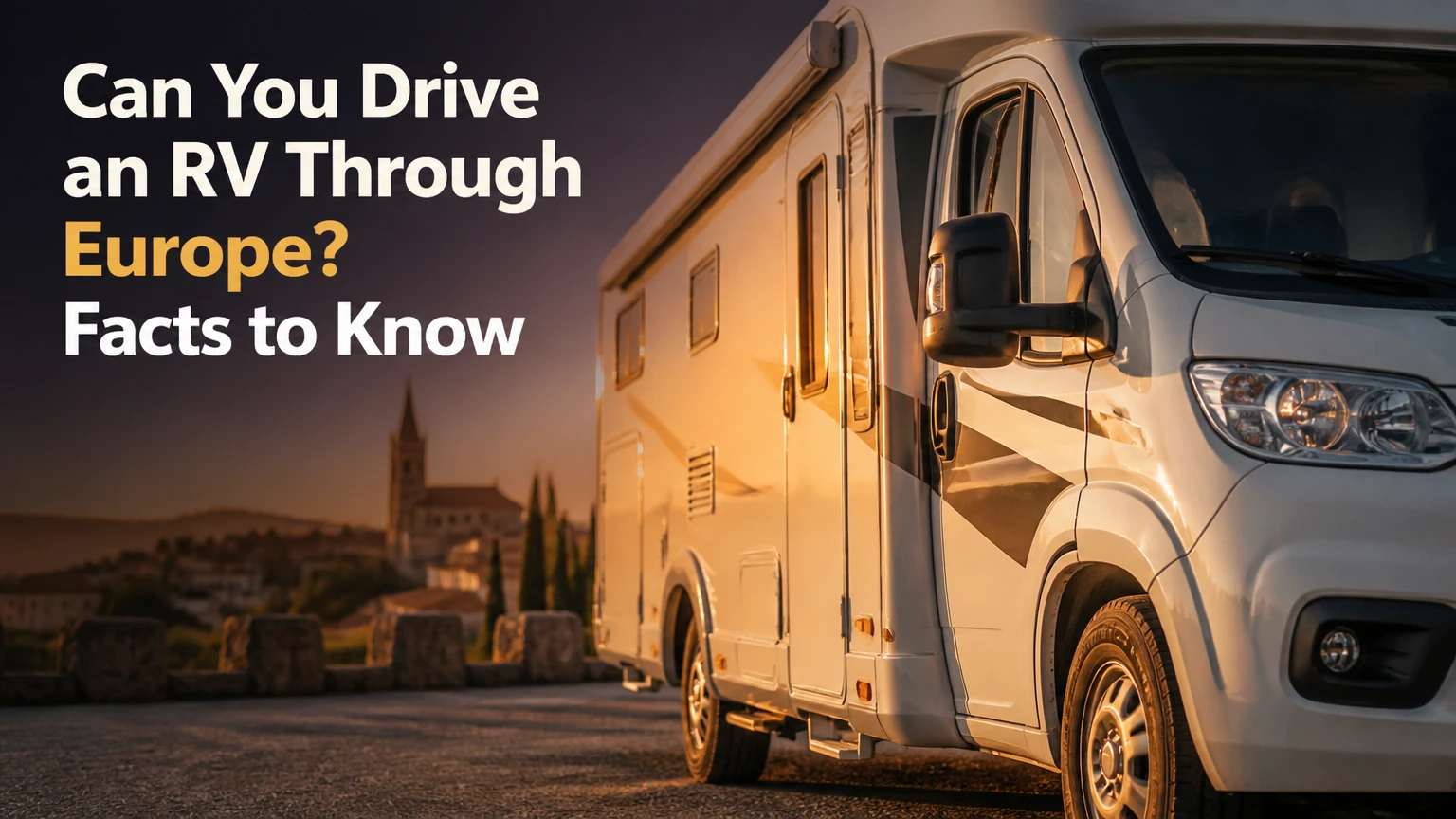
Yes, you can drive an RV through Europe, provided the vehicle, driver, insurance, border permissions, and overnight stops comply with each country’s rules. Europe uses motorhomes, campervans, aires, Stellplätze, and formal campsites extensively, but narrow roads, toll systems, city restrictions, and local camping laws require more planning than a normal car trip.
Key Facts at a Glance
- A motorhome under 3,500 kg usually falls within ordinary car-licence limits, but the licence category and issue date can change the result.
- Schengen removes routine passport checks between participating countries, but it does not remove visa limits, driving laws, tolls, or vehicle insurance requirements.
- Typical motorhome rental prices range from €70-€120 per day in shoulder season and €100-€250 in peak summer, before fuel and campsite charges.
- Aires and Stellplätze commonly cost €10-€20 per night, while serviced campsites often cost €20-€60 or more.
- A standard car-navigation app can ignore height, width, weight, and length restrictions; an RV-specific routing profile is safer.
- Norway and Sweden permit some forms of responsible outdoor camping, but neither country gives motorhomes unlimited permission to park anywhere.
What Does Driving an RV Through Europe Involve?
Driving an RV through Europe means taking a campervan or motorhome across several national road systems while using vehicle-specific overnight infrastructure. The trip can combine Schengen countries such as France, Germany, Italy, Austria, and Spain, although each country retains separate rules for tolls, emissions zones, speed limits, parking, and waste disposal.
The practical difference from an ordinary road trip is that the vehicle is simultaneously transport, accommodation, and a regulated heavy object. A 7.5-metre motorhome may be legal on a road yet unusable in a medieval town, unable to turn inside a fuel station, or prohibited from a bridge because of axle weight.
The European Commission explains that EU driving-licence rules establish mutual recognition, but national authorities still apply local traffic rules. That distinction matters: a valid licence does not guarantee access to every road, city centre, ferry, or campsite.
Can a Rental RV Cross European Borders?
A rental RV can cross many European borders, but the rental agreement must explicitly permit the countries on your itinerary. Rental companies may restrict travel outside the pickup country, require written authorization, charge a cross-border fee, or exclude ferries and eastern European destinations from standard insurance.
Before paying a deposit, ask for written confirmation covering:
- Every country and territory on the route
- Cross-border insurance validity
- Breakdown assistance outside the pickup country
- Ferry transport and vehicle repatriation
- Damage excess and windshield, roof, tyre, and underbody cover
- Border fees, environmental stickers, and toll devices
- Any mileage, duration, or one-way return restriction
A rented UK-registered RV entering the European Union can also require proof of insurance, vehicle documents, and a UK identifier. A rental company may hold the registration document, so obtain an authorized copy before departure.
Which RV Size Works Best in Europe?
A compact campervan between 5 and 6 metres is usually the easiest European choice because it fits more car parks, ferry lanes, village streets, and ordinary campsites. Larger motorhomes provide beds, storage, and bathrooms, but every extra metre increases turning space, route restrictions, ferry cost, and parking difficulty.
| RV type | Typical length | Typical width | Common weight | Best European use |
|---|---|---|---|---|
| Converted campervan | 4.8-6.0 m | 1.9-2.1 m | 2,500-3,500 kg | Cities, mountain roads, couples |
| Low-profile motorhome | 5.9-7.5 m | 2.1-2.3 m | 3,000-3,850 kg | Families, mixed touring |
| Overcab motorhome | 6.3-7.5 m | 2.3-2.4 m | 3,300-4,250 kg | Four to six sleepers |
| A-class motorhome | 6.5-9.0 m | 2.3-2.5 m | 3,500-7,500 kg | Long stays, campsite living |
The 3,500 kg figure is important, but it is not a universal dividing line for every legal issue. It can affect licence requirements, toll classification, speed limits, ferry pricing, parking restrictions, and access to some roads.
Which Driving Licence Does an RV Need?
A normal category B licence commonly covers a motorhome with a maximum authorized mass of up to 3,500 kg. A vehicle above that limit may require C1 or another higher category, although older licence entitlements, national rules, and the vehicle’s registration category can change the answer.
Check the maximum authorized mass on the registration document, not the vehicle’s current scale weight. A motorhome marked at 3,500 kg can still be overloaded when passengers, water, gas bottles, bicycles, luggage, and food are added.
| Vehicle situation | Likely licence issue | Practical check |
|---|---|---|
| 2,800 kg campervan | Category B commonly sufficient | Confirm national licence validity |
| 3,500 kg motorhome | Category B commonly sufficient | Calculate payload before loading |
| 3,501-7,500 kg motorhome | C1 often required | Check licence entitlement and expiry |
| Motorhome towing a trailer | Combined-mass rules apply | Check B, B96, BE, or C1E limits |
An International Driving Permit is not automatically required for every visitor. The requirement depends on the driver’s licence country, licence format, destination, and bilateral arrangements. The UK government, for example, directs drivers to check the specific country because different European states can require different IDP versions.
Carry the physical licence even when an IDP is recommended. An IDP translates licence information; it does not replace the underlying licence.
Which Documents and Insurance Are Required?
The core document set is a valid driving licence, passport or national identity card, vehicle registration document, insurance evidence, rental authorization, and any required visa or residence documentation. Non-EU travelers should separately verify immigration rules because Schengen access and vehicle access are different questions.
For a rented motorhome, carry:
- Passport or identity card for every traveler
- Driving licence and, where applicable, IDP
- Rental contract and cross-border permission
- Registration certificate or certified rental copy
- Insurance certificate and emergency number
- Breakdown policy and roadside-assistance instructions
- Pet passport, microchip record, and rabies documents if traveling with an animal
- Health insurance and any required visa evidence
The European Health Insurance Card can provide access to necessary state healthcare for eligible travelers, but it is not a substitute for travel insurance. Neither document covers every private clinic, repatriation, cancellation, or vehicle recovery cost.
What Equipment Should an RV Carry?
European road equipment requirements vary by country and sometimes by vehicle type. A warning triangle, reflective vest, first-aid kit, spare bulbs, headlamp converters or beam adjustment, and a fire extinguisher are sensible baseline equipment, even when a particular item is not mandatory everywhere.
Ask the rental company to demonstrate:
- Warning triangle and reflective vests
- Gas shutoff valves and carbon-monoxide alarm
- Awning, levelling blocks, and electrical hookup
- Fresh-water hose and waste-water hose
- Toilet cassette chemicals and dump procedure
- Tyre-pressure monitoring and spare-wheel or repair kit
- Vehicle height, width, length, and maximum weight
The vehicle’s actual height, including roof equipment, must be written on the dashboard. A low bridge sign is not a suggestion. A 2.85-metre motorhome cannot safely use a 2.70-metre clearance.
How Much Does an RV Trip Through Europe Cost?
A two-person European RV trip typically costs about €150-€300 per day before international flights, depending on rental season, fuel consumption, tolls, campsite standards, and the number of driving kilometres. A family using a large peak-season motorhome and coastal campsites can exceed €350 per day.
| Cost category | Typical low range | Typical high range | Main driver |
|---|---|---|---|
| Campervan rental per day | €70-€120 | €180-€250 | May-September demand |
| Campsite per night | €20-€35 | €60-€90+ | Coast, pool, electricity |
| Aire or Stellplatz | €5-€10 | €20-€30 | Services and location |
| Diesel per litre | €1.60 | €2.10+ | Country and fuel market |
| Motorway toll per 500 km | €20 | €100+ | Vehicle class and route |
| Ferry crossing | €80 | €400+ | Length, season, passengers |
These figures are planning ranges, not fixed tariffs. Campervans often consume 8-11 litres of diesel per 100 km, while larger motorhomes commonly use 10-15 litres. At €1.85 per litre, 2,000 kilometres therefore costs roughly €296-€555 in diesel.
Budget separately for security deposits, cleaning fees, bedding, gas, laundry, campsite electricity, attraction parking, public transport, and city-centre park-and-ride. Rental pricing can look inexpensive until a €1,500-€2,500 deposit and mileage charge are added.
Where Can You Camp or Park Overnight?
Motorhomes can stay overnight at licensed campsites, municipal motorhome areas, private farm sites, and designated parking areas where local signs permit sleeping. Europe has no single continent-wide right to occupy a parking place overnight, so a legal daytime parking space may prohibit camping after dark.
| Overnight option | Typical price | Usual facilities | Best use |
|---|---|---|---|
| Full-service campsite | €25-€60 | Toilets, showers, electricity, wastewater | Families and longer stays |
| Premium coastal campsite | €45-€90+ | Pool, restaurant, activities | Summer beach trips |
| French camping-car aire | €5-€20 | Water, dump point, limited power | Transit and short stops |
| German Stellplatz | €8-€25 | Parking, electricity, water, dump point | Town visits and touring |
| Private farm stop | €10-€35 | Basic parking, local products | Rural routes |
Park4Night and Campercontact are useful discovery tools, but user-submitted listings can be outdated or legally ambiguous. Confirm the current sign, municipal website, and arrival conditions before relying on a listing, especially where a review says “quiet” rather than explicitly confirming overnight permission.
Is Wild Camping Legal in Europe?
Wild camping is country-specific and condition-specific, not a general European freedom. Norway and Sweden allow some responsible camping under access-to-nature principles, while France, Germany, Italy, Spain, and many Alpine regions apply local restrictions or prohibit overnight motorhome occupation outside designated places.
Norway’s right of access generally concerns uncultivated land and temporary tent camping, not unlimited motorhome parking. Sweden’s allemansrätten also requires consideration for landowners, homes, crops, wildlife, fire risk, and local signs. A motorhome may need to remain on a public road or designated parking area rather than entering private land.
In practice, use a designated site when:
- A sign prohibits overnight parking or camping
- You deploy chairs, an awning, levelling blocks, or outdoor equipment
- You discharge water or use a generator
- You are within a protected landscape or national park
- Local fire, beach, forestry, or seasonal rules apply
The safest rule is simple: park legally, keep the vehicle self-contained, leave no trace, and treat “no camping” signs as applying to motorhomes even when ordinary parking is allowed.
How Do Tolls, Vignettes, and Ferries Work?
European tolls use several systems, including distance-based toll booths, electronic toll accounts, digital vignettes, and vehicle-specific classifications. Austria, Switzerland, Slovenia, Slovakia, Hungary, and other countries use vignette systems on some roads, while France, Italy, Spain, Portugal, and Croatia commonly use toll roads or electronic payment arrangements.
| Country or region | Common road charge | RV issue to check |
|---|---|---|
| France | Distance tolls, electronic lanes | Class may depend on height |
| Italy | Ticket-based motorway tolls | Avoid restricted urban ZTL routes |
| Austria | Vignette under 3,500 kg | Higher-weight vehicles use GO toll |
| Switzerland | Annual motorway vignette | Heavy vehicles may use separate fee |
| Slovenia | E-vignette under 3,500 kg | Match registration plate correctly |
| Norway | Automatic toll cameras | Register payment and vehicle details |
Buy toll products only through official government or operator portals where possible. A wrongly entered registration number can invalidate a digital vignette even when payment succeeded.
Ferries deserve the same attention as tolls. Measure total vehicle length, height, trailer length, and passenger count accurately, because a 6-metre booking can become a 7-metre fare after a rear bicycle rack.
Can an RV Enter European City Centres?
An RV can enter some European city centres, but historic districts frequently impose height limits, weight limits, pedestrian zones, ZTL access controls, and low-emission requirements. Italy’s Zona a Traffico Limitato and France’s Crit’Air system are common sources of avoidable fines.
Do not drive a large motorhome into a historic centre to “look for parking.” Instead:
- Find a legal suburban campsite or motorhome area.
- Confirm whether the site has a height and weight limit.
- Use rail, tram, metro, or a local bus.
- Check whether a low-emission sticker applies to the RV.
- Enter the centre only after confirming the exact permitted route.
A ZTL camera can issue a fine without a police stop. Rental companies may forward the notice and add an administration fee, so the eventual charge can include both the original penalty and the rental processing cost.
How Should You Plan the Route?
Plan the route around vehicle dimensions, legal overnight stops, and realistic driving days rather than drawing a line between famous cities. A useful first itinerary allows 150-250 kilometres or approximately 3-5 driving hours on mixed European roads, because fuel stops, border delays, mountain gradients, and campsite check-in consume time.
Step 1: Choose a Single Regional Loop
Limit a first trip to one connected region, such as northern France and Belgium, the Alps, or northern Spain and Portugal. Crossing six countries in ten days creates more toll decisions and driving fatigue than sightseeing time.
Step 2: Record the RV’s Restrictions
Write down maximum height, width, length, weight, axle load, fuel type, and low-emission category. Enter those values into a motorhome navigation system such as Garmin Camper or CoPilot GPS.
Step 3: Reserve Fixed-Date Nights
Book ferries, popular coastal campsites, and major festivals first. In July and August, sought-after Mediterranean campsites can fill six to nine months ahead, while inland aires usually provide more flexible short-stay capacity.
Step 4: Verify Every Border
Check visa eligibility, passport validity, rental authorization, insurance territory, toll requirements, and pet rules for each country. Schengen’s internal border controls do not eliminate possible temporary checks or customs rules at non-Schengen crossings.
Step 5: Build Service Stops Into the Map
Schedule fresh-water filling, toilet emptying, laundry, groceries, and fuel before the tanks or supplies become urgent. A typical two-person motorhome may need fresh-water replenishment every one to three days, depending on shower use and tank size.
Step 6: Keep a Recovery Option
Save the rental company’s 24-hour number, roadside-assistance number, vehicle registration, and coordinates of the nearest safe stopping place. If a warning light appears, stop safely before investigating on a narrow shoulder.
How Do You Manage Water and Waste?
Motorhome water systems require a designated fresh-water tap, grey-water drain, and black-water cassette or fixed-tank disposal point. Emptying any tank onto a road, drain, riverbank, beach, or natural ground is illegal or environmentally harmful and can attract a fine.
A practical service routine is:
- Fill fresh water at a marked potable-water point.
- Empty the toilet cassette before it becomes difficult to handle.
- Drain grey water only over a proper grate.
- Use approved toilet chemicals compatible with the rental system.
- Rinse hoses separately from drinking-water equipment.
- Close caps and secure the cassette before driving.
The waste point may be inconveniently located, especially at busy campsites. Service the vehicle during daylight, wear gloves, and never assume that a storm drain is a legal dump point.
What Are the Most Expensive Mistakes?
The most expensive RV mistakes involve access violations, overloaded vehicles, unapproved borders, and preventable damage. Each error combines a direct charge with lost time, which can make a cheap trip substantially more expensive.
Using Car Navigation
A car route may send a motorhome beneath a low bridge or through a weight-restricted lane. Use RV dimensions and verify the final kilometres manually because local closures can defeat even specialist routing.
Assuming 3,500 kg Means Unlimited Access
A category B licence may permit the vehicle, but a 3,500 kg motorhome can still face different tolls, speed limits, ferry tariffs, or road signs. Weigh the loaded vehicle before a long trip.
Treating an App Review as a Legal Guarantee
Park4Night comments describe experiences, not legislation. A site marked “quiet overnight” can become prohibited after a municipal rule change or seasonal enforcement operation.
Booking the Wrong Ferry Class
Rental guests often forget the bicycle rack, roof box, or rear storage box when declaring length. Measure the complete vehicle and retain the booking confirmation.
Arriving Without a Service Plan
A full toilet cassette or empty water tank turns an otherwise attractive remote stop into an urgent detour. Identify the next two service points on every multi-day route.
Which European RV Trip Suits Each Traveler?
First-time travelers usually benefit from a compact campervan in France, Germany, the Netherlands, or northern Spain, where established campsites and motorhome areas make short touring days manageable. Families often need a larger site with showers, electricity, playgrounds, and a fixed reservation rather than a remote parking area.
| Traveler profile | Recommended vehicle | Suitable region | Main reason |
|---|---|---|---|
| Couple, first trip | 5.0-6.0 m campervan | France or Germany | Easier roads and many stopovers |
| Family of four | 6.0-7.5 m low-profile RV | French Atlantic or Italian lakes | Facilities and predictable pitches |
| Mountain traveler | 5.0-6.5 m motorhome | Austria or Norway | Narrow-road manoeuvrability |
| Long-stay traveler | 6.5-8.5 m A-class RV | Spain or Portugal | Larger living and storage space |
| Wild-nature traveler | Compact self-contained van | Norway or Sweden | More legal outdoor-access options |
A large RV is not automatically better for a long vacation. It is better when interior space, separate beds, and onboard storage outweigh difficult urban access and higher ferry or toll charges.
What Is the Honest Limitation of RV Travel?
An RV does not provide unrestricted freedom. The vehicle still needs legal parking, suitable road geometry, fuel, water, waste services, insurance, and enough payload for the people and equipment onboard.
RV travel is a poor choice for a city-intensive itinerary covering London, Paris, Rome, Florence, and Amsterdam in one week. A train-based trip with short hotel stays is usually faster and less stressful in dense historic areas, while the RV becomes more valuable for coastlines, rural regions, national parks, and multi-night stops.
The strongest practical compromise is often a mixed itinerary: use the motorhome for rural and coastal travel, then park outside a city and use public transport. That approach preserves the vehicle’s accommodation value without forcing it into streets designed centuries before motor traffic.
Frequently Asked Questions
Can Americans Drive a Motorhome in Europe?
U.S. travelers can often drive a European motorhome using a valid state driver’s licence, but the vehicle’s weight and the destination country determine whether an IDP or additional licence category is needed. An IDP is especially useful when the original licence is not written in a widely recognized Latin script. Confirm requirements with each embassy and rental company.
Can You Take an RV From the UK to France?
You can take an RV from the UK to France by ferry or the Channel Tunnel, subject to passport, insurance, rental, and vehicle-document requirements. UK travelers must also check the Schengen 90-days-in-180 rule, while the rental contract must authorize travel in France and any onward countries.
How Many Hours Should You Drive an RV Each Day?
Plan approximately 3-5 driving hours per day, often covering 150-250 kilometres on mixed roads. Mountain routes, city approaches, fuel stops, ferry schedules, and service-point detours reduce the distance a motorhome can comfortably cover compared with a passenger car.
Is Europe Safe for RV Travel?
Europe is generally practical for RV travel, but vehicle security requires ordinary precautions. Lock doors, avoid displaying valuables, use reputable campsites in major cities, and do not rely on an isolated overnight location simply because an app lists it. Check current local travel advisories for border regions and severe weather.
Can You Bring a Dog in a European RV?
You can bring a dog across many European borders with the required microchip, rabies vaccination, and pet passport or animal-health certificate. Some countries impose tapeworm-treatment timing, leash rules, muzzle requirements, or restrictions on campsites and public transport, so verify the complete route rather than only the entry country.
What Is the Best First European RV Route?
A first European RV route should cover one compact region for seven to fourteen days, such as northern France and Belgium, Germany’s Rhine and Bavaria, or northern Spain. These areas combine established campsites, service infrastructure, and manageable distances without requiring a traveler to learn several unrelated toll systems at once.
The Bottom Line
Yes, you can drive an RV through Europe, and a well-chosen motorhome can make rural, coastal, and multi-country travel efficient. The decisive facts are the vehicle’s maximum authorized mass and dimensions, rental border permission, Schengen or visa status, local toll system, legal overnight location, and waste-disposal plan. For a first journey, choose a compact RV, restrict the route to one region, verify every rule through official sources, and use campsites or designated aires instead of assuming that any quiet parking space is legal.