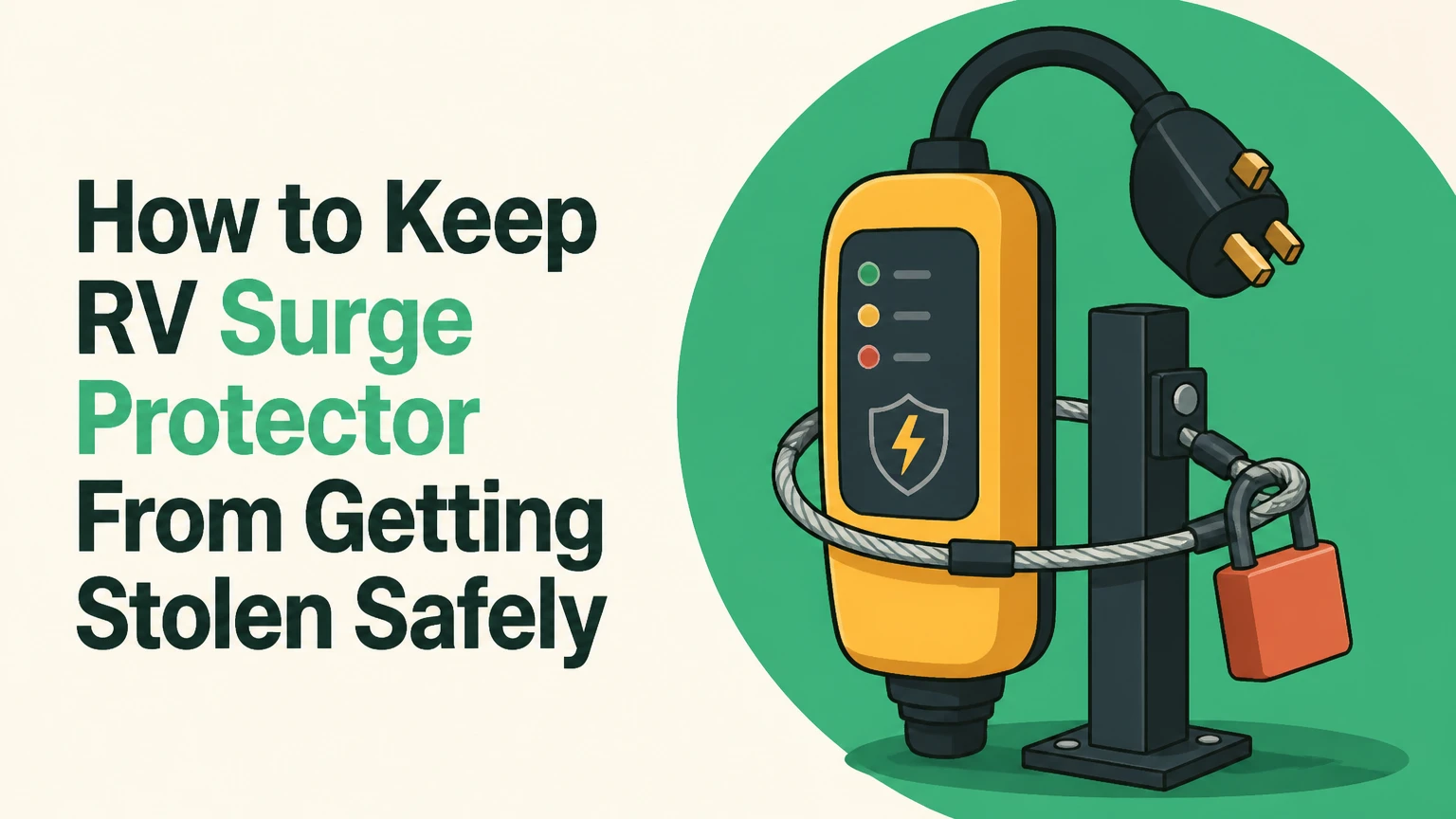
The most reliable way to keep an RV surge protector from getting stolen is to secure the portable unit to a substantial campground structure with a 3/8-inch vinyl-coated steel cable and weather-resistant padlock, then reduce its visibility. For near-total theft resistance, install a compatible hardwired EMS inside the RV’s locked electrical compartment through a qualified RV technician.
Key Facts
A portable RV surge protector remains exposed because it connects between the pedestal and shore-power cord.
A 3/8-inch braided steel cable provides a stronger deterrent than thin luggage cables, but no portable lock is bolt-cutter-proof.
A locking enclosure protects the plug connection and weather seal, but only if it fits the pedestal and cord.
A hardwired EMS is normally inaccessible from outside the RV, although installation requires work on high-amperage circuits.
A locked storage bay can hide a portable unit when the shore cord and bay design permit safe routing.
Zip ties discourage casual removal but do not provide meaningful resistance against cutting tools.
Why Are Portable RV Surge Protectors Easy Targets?
Portable RV surge protectors are easy targets because they are visible, detachable, and often worth approximately $150-$450. The device hangs directly from a campground pedestal, usually beside a recognizable shore-power cord, so a thief can remove it without entering the RV.
An RV surge protector primarily limits transient voltage spikes. A higher-grade electrical management system, or EMS, also monitors conditions such as low voltage, open neutral, open ground, and reverse polarity, then disconnects the RV when a dangerous condition appears. Those monitoring functions make many EMS units more expensive than basic plug-in surge devices.
The security problem is mechanical rather than electrical. A protector can be electrically excellent and still be physically vulnerable if its molded security eye is left unrestrained. The best solution depends on whether the unit is portable, installed inside a locked bay, or hardwired into the RV.
What Does an RV EMS Protect?
An RV EMS can protect connected appliances from selected electrical faults, but it cannot correct every campground power problem. Surge suppression addresses short-duration voltage spikes, while EMS monitoring can disconnect power during sustained low voltage, excessive voltage, polarity faults, or missing grounding conditions.
The exact protections vary by model. Progressive Industries, Southwire Surge Guard, and Hughes Autoformers publish different specifications for joule ratings, response behavior, display functions, and fault codes, so the owner’s manual controls the final interpretation.
An EMS also cannot prevent theft, repair damaged pedestal wiring, or make an undersized extension cord safe. Physical security must be designed separately.
How to Keep RV Surge Protector From Getting Stolen
Use a layered method: attach the portable EMS to a solid pedestal structure, protect the plug seam with a compatible enclosure, hide brand markings where practical, and remove the unit when the RV is unattended for an extended period. The strongest portable setup takes about 2-5 minutes after the equipment is sized correctly.
A cable is a deterrent, not an absolute guarantee. A determined thief with time, tools, and no witnesses may cut a portable cable or attack the pedestal hardware. Security improves when the cable has minimal slack, the lock body is difficult to reach, and the device is not visible from a public road.
Before You Start
| Requirement | Typical specification | Why it matters |
|---|---|---|
| Steel security cable | 3/8-inch diameter, 4-6 feet long | Fits most security eyes and reaches a pedestal post |
| Cable coating | Vinyl or PVC exterior | Reduces scratches and weather exposure |
| Padlock | Outdoor brass or marine-grade body, 5-7 mm shackle | Resists rain better than an indoor combination lock |
| Locking enclosure | 30-amp or 50-amp compatible | Prevents plug separation and limits access |
| Setup time | 2-5 minutes | Covers cable, lock, and connection inspection |
| Typical cost | $20-$75 | Covers cable, padlock, and basic enclosure |
Confirm the protector’s amperage before buying hardware. A 30-amp RV plug and a 50-amp RV plug have different dimensions, conductor arrangements, and enclosure requirements. Measure the molded security eye as well, because some models use a narrow opening that will not accept a thick cable end.
Step 1: Inspect the Protector and Pedestal
Turn off the pedestal breaker before connecting or disconnecting shore power. Check the EMS housing, plug blades, security eye, and display for cracks, heat discoloration, looseness, or water intrusion.
Choose the strongest fixed anchor available. A steel pedestal post or structural frame is preferable to a plastic cover, removable breaker-box door, thin decorative rail, or campground sign. Do not drill, bend, or permanently modify campground property.
You will know this step worked when the chosen anchor cannot be lifted, unscrewed, or separated by hand. The common mistake is selecting an anchor that looks solid but is only a removable plastic shell.
Step 2: Thread a Steel Cable Through the Security Eye
Pass the cable through the protector’s molded security loop before connecting the device to the pedestal. Wrap the cable around the pedestal’s structural post or frame, then bring both ends together at the lock.
Use the shortest cable length that permits a clean connection. A typical 4-foot cable works for a nearby post; a 6-foot cable may be needed when the post sits behind the receptacle. Avoid laying the cable on the ground, where a thief can gain leverage with bolt cutters.
You will know it worked when the cable remains tight and the protector cannot be rotated far enough to strike the pavement. The common mistake is using a 1/8-inch luggage cable because it is convenient. Thin cables can be cut quickly and communicate little resistance.
Step 3: Add the Padlock or Locking Enclosure
Close the cable loop with a weather-resistant padlock, or place a compatible locking box over the plug connection before locking the cable. A locking enclosure can prevent someone from unplugging the EMS and may shield the connection from rain, but it does not replace the anchor cable unless the enclosure itself attaches securely to a fixed structure.
Keep the lock body off the ground and position the keyway downward or sideways. Avoid forcing the pedestal cover closed around an oversized 50-amp plug, since pressure can damage the cord or leave the breaker box unsecured.
You will know it worked when the shore-power connection is fully seated, the pedestal door closes without crushing the cable, and the lock cannot be reached easily with a hacksaw. The common mistake is buying a box designed for a 30-amp connector when the RV uses a 50-amp configuration.
Step 4: Remove Slack and Conceal the Target
Pull the cable tight enough to prevent the EMS from swinging, while leaving no sharp bend at the protector’s security eye. Turn the display toward the RV, cover bright branding where it does not obstruct fault indicators, and keep the setup away from direct public sight when campground rules allow.
Do not cover ventilation openings, warning labels, or the screen if you need to monitor a fault. Concealment reduces opportunity; it does not justify hiding an overheating connection.
You will know it worked when the unit sits close to the pedestal, the cable has no loop large enough for a tool, and the cord remains free of tension. The common mistake is cinching everything so tightly that rainwater drains toward the receptacle or the shore cord bears the unit’s weight.
Step 5: Test the Electrical Connection
Turn on the pedestal breaker only after the shore-power plug and EMS are connected correctly. Read the EMS display or indicator sequence, wait through the model’s startup delay, and verify that the RV receives power without a fault code.
The protector should remain accessible for inspection. A hidden device that cannot be checked for heat, moisture, or a fault is poorly secured.
You will know it worked when the EMS reports acceptable voltage and wiring status, the RV transfer equipment operates normally, and the cable does not pull on either plug. The common mistake is treating a power-on light as proof that every wiring condition is safe. Read the fault code definitions in the specific manual.
Which RV Surge Protector Security Method Fits Your Setup?
A hardwired EMS offers the strongest theft protection, while a portable cable-and-lock system offers the best flexibility and lowest entry cost. A locked storage bay occupies the middle position when the RV’s cord hatch allows a safe route without pinching, overheating, or exposing the unit to water.
| Security method | Typical cost | Setup or installation time | Theft resistance | Best use |
|---|---|---|---|---|
| 3/8-inch cable and padlock | $20-$45 | 2-4 minutes | Moderate deterrence | Frequent campground changes |
| Locking plug enclosure | $25-$75 | 3-6 minutes | Moderate to high at plug seam | Exposed pedestal connections |
| Locked storage-bay placement | $0-$40 | 5-15 minutes | High if cord routing is safe | RVs with suitable cable hatches |
| Hardwired EMS | $250-$600 installed | 1-3 hours | Very high from outside | Full-time or stationary RV use |
| Remove when unattended | $0 | 1-3 minutes | Highest while stored inside | Overnight or remote campsite absence |
The hardwired price range is a typical market estimate for equipment and professional labor, not a universal quote. Labor increases when the electrical bay is crowded, the RV has a transfer switch, or the existing shore cord cannot be accessed without removing panels.
Is a Hardwired EMS Better Than a Portable Unit?
A hardwired EMS is better for theft prevention because the device is mounted inside the RV and cannot be unplugged from the pedestal. A portable EMS is better when owners change RVs, share equipment, rent vehicles, or want to inspect the device independently.
| Decision factor | Portable EMS | Hardwired EMS |
|---|---|---|
| Theft exposure | Outside at pedestal | Inside electrical compartment |
| Transfer to another RV | Usually 5-10 minutes | Requires rewiring or new equipment |
| Typical purchase price | $150-$450 | $200-$500 |
| Typical professional installation | $0 | $100-$300 |
| Inspection access | Immediate at pedestal | Requires opening service panel |
| Weather exposure | Rain, sun, condensation | Lower when mounted correctly |
| Replacement after RV sale | Simple | Usually remains with RV |
A hardwired EMS is not automatically safer if installed incorrectly. Loose terminals, incorrect conductor identification, inadequate enclosure space, or bypassing a transfer switch can create fire, shock, or equipment hazards.
Can a Portable Unit Stay Inside a Locked Storage Bay?
A portable EMS can stay inside a locked storage bay only when the shore-power cord can enter without being pinched and the bay remains dry, ventilated, and electrically suitable. The arrangement must preserve the cord’s bend radius and avoid routing through a sharp metal edge.
Some RVs have a cable hatch near the electrical bay. Owners can pass the shore cord through that opening, connect the portable EMS inside, and route the protected connection toward the RV’s inlet or transfer equipment, but the exact arrangement varies by coach design.
Never place an EMS in a compartment containing fuel vapors, batteries without proper separation, wet gear, or excessive heat. Never close a door against a cord unless the manufacturer designed the hatch for that purpose.
What Cable, Lock, and Box Should You Choose?
Choose a 3/8-inch vinyl-coated braided steel cable, a weather-rated brass or marine padlock, and a 30-amp or 50-amp locking enclosure matched to the connector. The security eye, pedestal shape, cable length, and plug clearance matter more than a recognizable brand name.
| Component | Recommended choice | Avoid | Selection checkpoint |
|---|---|---|---|
| Security cable | 3/8-inch braided steel, 4-6 feet | 1/8-inch luggage cable | Cable passes through molded eye |
| Lock body | Brass, stainless, or marine-rated | Indoor zinc lock | Keyway remains accessible |
| Shackle | 5-7 mm hardened shackle | Long exposed shackle | Tool access is restricted |
| Cable coating | Vinyl or PVC | Bare steel indoors-only cable | No sharp edge contacts RV |
| Enclosure | Matching 30-amp or 50-amp model | Universal box with forced fit | Pedestal door closes normally |
| Cable routing | Tight loop around structural post | Loose ground-level loop | EMS cannot swing freely |
A long shackle can defeat a good lock because it gives bolt cutters more room. A compact lock with a protected shackle is usually harder to attack, although no portable design defeats every tool.
Industrial zip ties have limited value. UV-rated ties can hold a cable against a pedestal and signal that the equipment is intentionally secured, but a thief can cut them with ordinary shears. Use them as organization aids, never as the primary lock.
What If the Campground Pedestal Has No Anchor?
When a pedestal lacks a suitable anchor, use the RV’s locked storage bay or remove the portable EMS whenever the campsite is unattended. Do not lock equipment to a loose plastic cover, a utility handle, another camper’s property, or a campground component that staff may need to remove.
A purpose-built pedestal lock box can help when its design attaches to the receptacle or shore cord rather than relying on a weak cover. Ask campground management before using any device that blocks breaker access, extends outside the electrical enclosure, or contacts a shared utility structure.
For a short lunch stop, bringing the EMS inside is more dependable than leaving a cable loop around an uncertain post. For multi-week stays, a hardwired unit may justify its cost if the RV is compatible.
How Should You Maintain the Anti-Theft Setup?
Inspect the cable, padlock, enclosure, and pedestal connection at every campsite change, then lubricate the lock before storage and after prolonged rain. A dry graphite product is appropriate for many key cylinders, while a manufacturer-approved corrosion inhibitor can protect exposed metal surfaces; avoid flooding electrical contacts with lubricant.
| Maintenance action | Frequency | Replacement threshold |
|---|---|---|
| Inspect cable strands | Every hookup | Any broken, flattened, or kinked section |
| Check padlock operation | Every hookup | Key binds after cleaning and lubrication |
| Clean connector blades | Every 5-10 trips | Pitting, dark heat marks, or looseness |
| Inspect enclosure seal | Monthly during use | Cracked gasket or broken latch |
| Lubricate lock cylinder | Every 1-3 months outdoors | Corrosion prevents smooth key rotation |
| Review EMS fault history | Each connection | Repeated unexplained faults |
Do not use a jammed lock as a reason to spray lubricant onto the EMS plug. Disconnect power first, isolate the lock, and replace a lock that remains unreliable. A security device that cannot be opened safely can delay emergency power disconnection.
An expert rule of thumb is to replace a cable after visible strand damage rather than waiting for complete failure. Partial damage reduces load capacity and creates sharp wires that can cut hands or scratch the RV.
Common Mistakes and How to Fix Them
Using a Thin Cable
A thin luggage cable is quiet and convenient but offers limited resistance to cutters. Replace it with a 3/8-inch braided steel cable and position the lock where a tool cannot get a straight bite.
Locking to the Pedestal Door
A breaker-box door may lift off, bend, or remain removable even when it appears heavy. Move the cable to a structural post or use a storage-bay solution.
Leaving the EMS Hanging
The EMS should not hang from the shore cord because weight and wind can stress the plug. Support the unit with a tight cable loop while leaving the electrical connection seated without lateral force.
Blocking Breaker Access
A locking box that prevents campground staff from reaching the breaker creates a maintenance problem and may violate site rules. Reposition the enclosure or remove it when staff need access.
Hiding Fault Indicators
Turning the display inward reduces visibility to thieves but can also hide a dangerous fault from the owner. Keep the screen readable from the RV side and inspect it after storms or utility interruptions.
Cutting Into the Shore Cord Improperly
Cutting a shore cord without identifying conductors, disconnecting all sources, and following the EMS wiring diagram can cause shock, fire, or reverse polarity. Have a qualified RV electrician install a hardwired unit when the work involves the main service conductors.
What Should You Do After an EMS Is Stolen?
After an RV surge protector is stolen, turn off the pedestal breaker, photograph the empty connection and any cut cable, notify campground management, and file a police report before replacing the device. Do not reconnect the RV directly to an unfamiliar pedestal until the pedestal wiring has been tested.
Record the EMS serial number, receipt, photographs, and model before theft occurs. Check whether the campsite, homeowners, renters, or RV insurance policy covers detached accessories, because coverage and deductibles differ.
A replacement plan should include a temporary plug-in tester only as a diagnostic aid, not as an equivalent substitute for an EMS. A basic surge protector may lack low-voltage disconnect, reverse-polarity detection, or neutral monitoring.
Which Option Is Best for Different RV Owners?
Weekend campers generally benefit from a portable EMS secured with a 3/8-inch cable and compact outdoor lock. Full-time RVers and owners who stay at long-term sites usually gain more from a hardwired EMS because repeated setup disappears and the device remains inside the coach.
| RV situation | Recommended method | Typical added cost | Main limitation |
|---|---|---|---|
| Weekend camping, frequent moves | Portable EMS plus cable lock | $20-$45 | Portable unit remains visible |
| Full-time RV living | Hardwired EMS | $300-$600 installed | Less transferable |
| Rental or borrowed RV | Portable unit, remove nightly | $0-$45 | Requires consistent routine |
| Long-term seasonal site | Hardwired or locked bay | $0-$600 | Installation may need approval |
| Remote campsite with no anchor | Locked bay or remove unit | $0-$40 | Depends on cord-hatch design |
| Winter storage | Remove and store indoors | $0 | No pedestal protection while disconnected |
The budget choice is usually the locked storage bay, provided the electrical layout supports it. The safest professional choice is a hardwired EMS installed by someone familiar with RV transfer switches, shore-power inlets, generators, and inverter feeds.
FAQ
Can I use a chain instead of a security cable?
A chain can secure an RV EMS if it passes through the molded security eye and has links too large for common bolt cutters, but chain weight and sharp edges may damage the housing or pedestal. A vinyl-coated braided cable is usually easier to route and less abrasive, while a hardened chain can provide stronger resistance in some installations.
Should I unplug the surge protector at night?
Unplug the portable EMS when the RV is unattended for a long period, especially at isolated sites or when the cable cannot attach to a substantial anchor. During normal overnight occupancy, a properly secured and inspected device can remain connected, provided campground rules permit the lock and the connection stays dry.
Does a surge protector lock box fit every RV pedestal?
No. Lock boxes differ by connector type, cord diameter, pedestal-door clearance, and latch geometry. A 30-amp enclosure may not fit a 50-amp plug, and a large EMS housing may prevent the breaker door from closing. Measure the plug and confirm the enclosure’s dimensions before purchase.
Can I insure an RV surge protector against theft?
Possibly, but coverage depends on the policy’s definition of RV equipment, accessory limits, deductible, and whether the unit was permanently installed. Keep the invoice, serial number, photographs, and police report. A hardwired EMS may be treated differently from a detachable portable device.
Is a GPS tracker worth adding to an EMS?
A GPS tracker can help locate stolen equipment but usually cannot prevent removal, and many small trackers require charging or cellular service. A tracker is a secondary recovery measure. A concealed tracker should not obstruct ventilation, expose the EMS to battery leakage, or create a connection inside the pedestal.
The Bottom Line
To keep an RV surge protector from getting stolen, secure a portable unit with a tight 3/8-inch steel cable and outdoor-rated padlock, use a correctly sized locking enclosure, and keep the setup visible enough for inspection but inconspicuous from public areas. If theft risk, long-term use, or repeated setup outweighs portability, install a hardwired EMS inside the RV through a qualified technician.