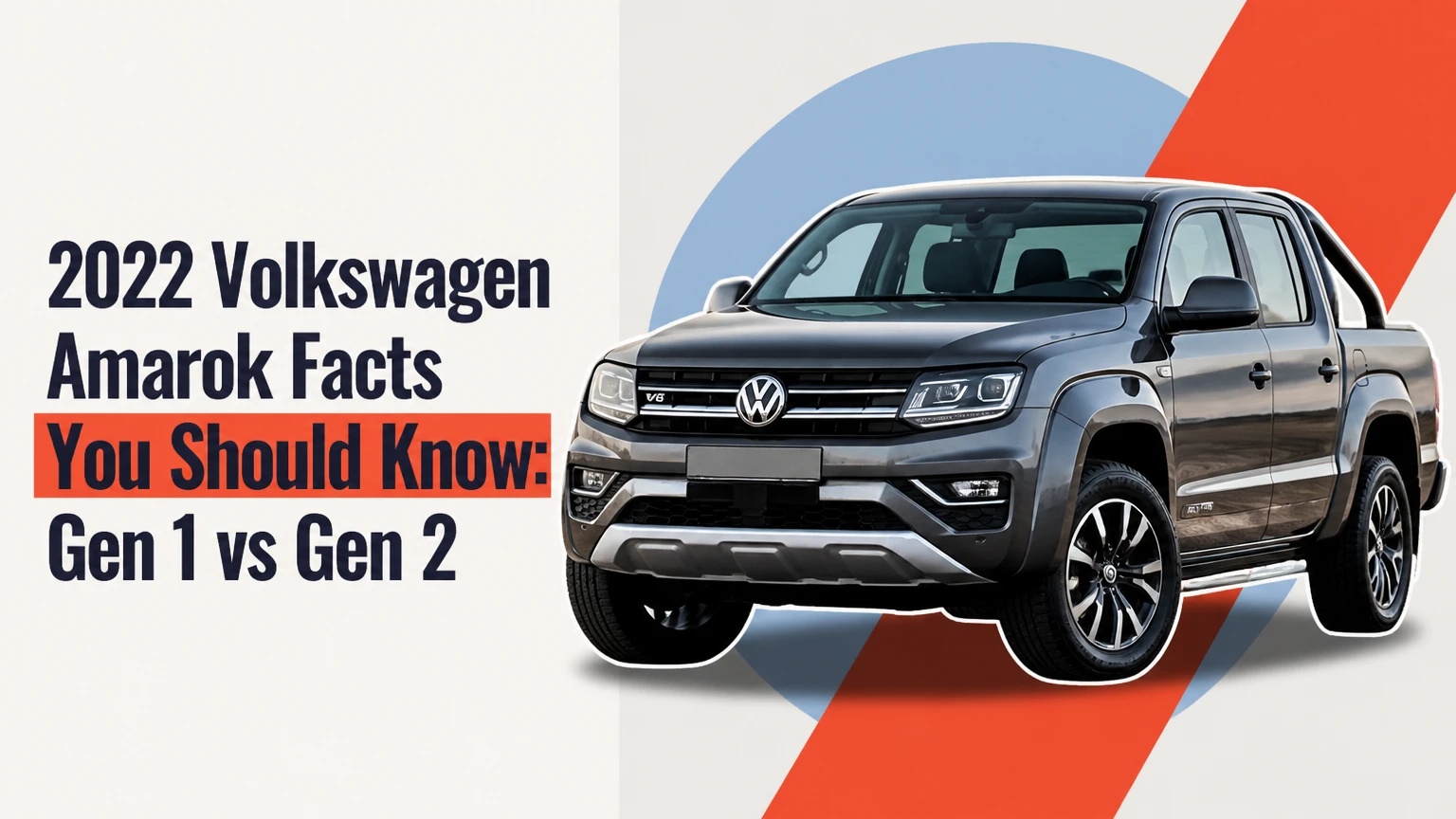
The 2022 Volkswagen Amarok is a split-year pickup: most examples are the final first-generation model, while the second-generation Amarok was revealed and ordered in 2022 for later delivery. Gen 1 offers a distinctive V6 diesel and permanent 4MOTION, whereas Gen 2 uses Ford’s T6.2 platform with newer safety technology and larger displays.
Key facts at a glance
A 2022 registration does not identify the Amarok generation; check the body, dashboard, engine, and VIN.
The first-generation Amarok V6 produces up to 190kW and 580Nm, with a 3,500kg braked towing rating in relevant Australian specifications.
Gen 1 automatic V6 models use permanent 4MOTION with a Torsen centre differential and a 40:60 nominal torque split.
The second-generation Amarok is built in South Africa on Ford’s Ranger-derived T6.2 architecture and is commonly sold as a MY23 vehicle.
Gen 1 usually drives more like a car, but Gen 2 generally provides stronger active safety and a more current cabin.
Payload, airbags, engine output, pricing, and trim names vary by country, drivetrain, and factory option.
What Does a 2022 Amarok Actually Mean?
A 2022 Amarok can mean either a first-generation Amarok built or registered during the model’s final run, or a second-generation vehicle revealed and ordered during calendar 2022. The registration year alone is insufficient because manufacturers, dealers, and used-car websites use build year, model year, compliance date, and delivery date differently.
The first-generation Amarok began production in 2010 and remained on sale in several markets through 2022. Volkswagen Commercial Vehicles developed that vehicle independently, with production associated primarily with Argentina and, in earlier periods, Germany. Its defining traits are the longitudinal engine layout, a relatively wide cargo bed, and the optional 3.0-litre turbo-diesel V6.
The second-generation Amarok arrived later as a 2023 model in Australia and other markets. Ford manufactures it in Silverton, South Africa, alongside the Ford Ranger. Volkswagen’s 2022 reveal described the new pickup as “a Volkswagen through and through,” while the underlying T6.2 architecture, engines, and many electronic systems create an important Ford connection.
How can you identify Gen 1 or Gen 2?
The easiest visual test is the cabin. Gen 1 has a conventional horizontal dashboard, physical climate controls, and a small central infotainment screen. Gen 2 has a large portrait-oriented central display, a digital instrument panel on many grades, and a more upright dashboard with Ford-derived switchgear.
| Identification point | Gen 1 Amarok | Gen 2 Amarok |
|---|---|---|
| Common Australian model timing | 2010-2022 | MY23 onward, revealed in 2022 |
| Production association | Argentina, earlier Germany | Silverton, South Africa |
| Dashboard | Horizontal layout, physical controls | Portrait screen, digital interface |
| Platform identity | Volkswagen-developed pickup architecture | Ford T6.2, Ranger-related |
| Typical V6 | 3.0-litre TDI diesel | 3.0-litre turbo-diesel V6 in selected markets |
| Four-wheel drive | Permanent or selectable, depending on version | Selectable system, with 4A on some V6 models |
Check the VIN, compliance plate, engine code, factory build sheet, and original sale invoice before comparing equipment. A dealer advertisement that labels a late Gen 1 as “new shape” is not reliable evidence.
Which First-Generation Trims Were Available in 2022?
First-generation Amarok trim names were market-specific, but Australian examples commonly included Core, Life, Highline, Ultimate, Aventura, and Walkinshaw-developed W580 derivatives. A European or South African Amarok with the same registration year may use different names, engines, transmissions, and safety equipment.
The V6 range is the most sought-after part of the used market. The 2.0-litre TDI remains useful for fleet work and lighter towing, but buyers who regularly pull a heavy caravan generally prefer the V6’s broader torque delivery. Trim level does not guarantee engine specification, so verify the engine badge and VIN rather than relying on a seller’s title.
| Gen 1 grade or edition | Typical engine | Distinctive equipment | Best-fit use |
|---|---|---|---|
| Core | 2.0-litre TDI or detuned V6 | Cloth trim, basic wheels, work-focused cabin | Fleet and trade use |
| Life | 2.0-litre TDI or V6 | More convenience equipment, durable floor finishes | Mixed work and personal use |
| Highline | 3.0-litre V6 in many Australian examples | Bi-Xenon lights, smartphone integration, upgraded trim | Long-distance towing |
| Ultimate or Aventura | 3.0-litre V6 | Nappa leather, 20-inch wheels, ErgoComfort seats | Highway and luxury use |
| W580 | 3.0-litre V6 | Walkinshaw suspension, wider track, side-exit exhaust | Performance-oriented road use |
| W580S or W580X | 3.0-litre V6 | More aggressive styling, lifted or off-road hardware | Enthusiast and trail driving |
Volkswagen’s Aventura specification is not automatically the same in every country. Some markets used Ultimate, others used Aventura, and special editions could alter suspension, wheel, tyre, and payload figures.
What made the W580 different?
The W580 was engineered with Walkinshaw Performance in Australia, not merely dressed with dealer accessories. Changes included revised suspension tuning, a wider stance, distinctive bodywork, and a louder exhaust arrangement. The W580X added a more overt off-road focus, but neither version should be treated as a factory Ford Ranger Raptor equivalent.
A W580’s larger wheels and altered suspension can reduce ride comfort, tyre sidewall protection, or available payload compared with a standard V6. Confirm the compliance-plate mass ratings before fitting a canopy, steel bar, winch, drawer system, and caravan simultaneously.
How Does the 2022 Amarok Four-Wheel Drive System Work?
The 2022 Amarok’s four-wheel-drive behaviour depends on generation, engine, and transmission. Gen 1 automatic V6 models use permanent 4MOTION with a Torsen centre differential and a nominal 40:60 front-to-rear torque split, while manual and some four-cylinder versions use a selectable system intended for loose surfaces.
Permanent 4MOTION allows the automatic V6 to remain in all-wheel drive on dry roads, wet bitumen, gravel, and towing routes without binding the driveline. The Torsen differential responds mechanically to changing resistance at each axle. That arrangement is one reason the Gen 1 V6 feels composed during rain-soaked towing.
Selectable systems normally provide 2H, 4H, and 4L. Drivers should not use locked 4H or 4L on high-grip pavement because driveline wind-up can occur when the front and rear axles rotate at different average speeds.
Gen 2 changes the formula. Depending on engine and market, the vehicle offers selectable 4×4 modes and, on some V6 versions, a 4A automatic mode that permits all-wheel-drive-style road use. Confirm the exact transfer-case modes in the owner’s manual.
What does Off-Road mode change?
Off-Road mode modifies throttle calibration, ABS intervention, hill-descent control, and traction-management behaviour. On loose gravel, permitting more wheel slip can help a tyre build a small wedge of material in front of it during braking, while softened throttle response reduces unwanted lurches.
Off-Road mode does not increase ground clearance, create a locking differential, or make road tyres suitable for mud. Approach speed, tyre pressure, underbody protection, and recovery equipment remain more important than the button itself.
What Are the Important 2022 Amarok Specifications?
The strongest Australian Gen 1 V6 versions produce 190kW and 580Nm, with a temporary overboost function that can raise output to about 200kW for approximately 10 seconds under defined conditions. The headline figures apply to particular TDI550 and TDI580 configurations, not every 2022 Amarok worldwide.
| Specification | Gen 1 V6 typical Australian figure | Practical meaning |
|---|---|---|
| Engine | 2,967cc turbo-diesel V6 | Strong low-speed towing response |
| Maximum power | 190kW, up to about 200kW overboost | Rapid overtaking when loaded |
| Maximum torque | 580Nm from about 1,400rpm | Less downshifting on hills |
| Braked towing capacity | 3,500kg | Requires correct towbar and mass calculations |
| Payload | Approximately 900-1,000kg | Varies with trim and accessories |
| 0-100km/h | Approximately 7.8 seconds | Quick for a diesel dual-cab |
| Cargo width between arches | About 1,222mm | Accepts a Euro pallet flat in relevant versions |
| Typical real-world fuel use | 9.0-11.0L/100km | Higher with heavy trailers or urban driving |
The Euro-pallet claim concerns width between the wheel arches, not unlimited bed length or payload. A pallet, tailgate, tie-downs, and cargo mass still need to remain within the vehicle’s dimensions and gross vehicle mass.
A 3,500kg tow rating also does not mean every combination can tow 3,500kg legally. Gross combined mass, towball download, axle loads, passengers, accessories, and cargo in the tray all reduce the available margin.
How does the Gen 2 specification differ?
Gen 2 introduces a more contemporary electrical architecture, a 10-inch or 12-inch central screen depending on trim, and a digital driver display on many versions. Australian launch grades included Life, Style, PanAmericana, and Aventura, with equipment ranging from LED lighting to Matrix LED headlights, a 360-degree camera, all-terrain tyres, and premium audio.
| Gen 2 trim | Screen or display | Notable equipment | Typical positioning |
|---|---|---|---|
| Life | 10-inch centre screen | LED headlights, core driver assistance | Entry dual-cab |
| Style | 12-inch centre screen | Matrix LEDs, 360-degree camera | Family and touring |
| PanAmericana | 12-inch centre screen | All-terrain tyres, sports bar, leather trim | Off-road touring |
| Aventura | 12-inch centre screen | 21-inch wheels, premium audio, luxury trim | Road-focused flagship |
Gen 2’s equipment list is more modern, but a large display does not automatically improve reliability or ergonomics. Physical buttons, software updates, camera cleanliness, and screen response deserve a test drive.
Is the 2022 Amarok Safe Enough for Family Use?
The Gen 2 Amarok is generally the stronger family choice because it offers a newer active-safety suite, including autonomous emergency braking and lane-support functions on applicable grades. Many late Gen 1 V6 models lack some of those features and may not provide rear curtain airbags, so buyers must check the exact variant rather than assume all 2022 Amaroks share one safety rating.
ANCAP testing and equipment applicability change over time. A five-star rating for one generation or derivative cannot be transferred automatically to another vehicle with a different engine, production date, or standard-equipment list.
Inspect the rear seat for curtain-airbag coverage, top-tether locations, child-seat compatibility, blind-spot monitoring, adaptive cruise control, and rear cross-traffic alert. A family buyer should prioritise those features above leather upholstery or 20-inch wheels.
The Gen 1’s strong stability and permanent AWD remain valuable in rain, but handling competence cannot compensate for missing collision-avoidance hardware. That is the central safety trade-off between the two generations.
What Does a 2022 Amarok Cost to Own?
Used Australian Gen 1 pricing varies substantially with kilometres, engine, service history, W580 status, accident history, and market demand. Typical historical used-market ranges are approximately AUD $45,000-$52,000 for a base V6, $55,000-$62,000 for a Highline, and $70,000-$85,000 or more for premium W580 and Aventura examples.
Those figures are indicative ranges, not a current valuation. Compare similar odometer readings and ask whether the advertised price includes registration, dealer warranty, accessories, and finance-related fees.
| Ownership item | Typical figure or range | What changes the cost |
|---|---|---|
| Base Gen 1 V6 used price | AUD $45,000-$52,000 | Mileage, condition, dealer margin |
| Highline V6 used price | AUD $55,000-$62,000 | Service history and option pack |
| W580 or Aventura used price | AUD $70,000-$85,000+ | Limited supply and modifications |
| Gen 1 service pack | About AUD $1,800 for 3 years | Dealer, inclusions, timing, consumables |
| Gen 2 scheduled service | About AUD $329 per visit in early capped plans | Market and servicing program |
| Typical diesel consumption | 9.0-11.0L/100km | Trailer weight, tyres, traffic, payload |
Volkswagen Australia’s Gen 2 capped-price servicing was reported at about $329 per visit for the initial five-year schedule, while older Gen 1 servicing can be more expensive and less predictable outside a service plan. Get a written quote for the next major service before buying.
Insurance, tyres, brakes, diesel particulate filter use, and suspension modifications can outweigh small differences in fuel economy. A W580 with oversized tyres may cost more to maintain than a standard Highline even when both use the same V6.
Which Is Better, Gen 1 or Gen 2?
Gen 1 is the better choice for distinctive V6 performance, permanent all-wheel drive, and a more settled road feel. Gen 2 is the better choice for current safety systems, cabin technology, available low-range functionality, and a newer ownership experience.
| Decision factor | Gen 1 V6 | Gen 2 V6 or equivalent | Better choice |
|---|---|---|---|
| Engine response | 190kW, 580Nm, 8-speed auto | 3.0-litre V6, 10-speed auto in relevant markets | Gen 1 character, Gen 2 gearing |
| Road drivetrain | Permanent 4MOTION, 40:60 nominal split | 4A on selected V6 versions | Gen 1 for simple wet-road use |
| Low-range capability | Configuration-dependent, absent on many automatic V6 models | Available through selectable 4×4 on applicable versions | Gen 2 off-road hardware |
| Central display | About 6.5-8.0 inches in many examples | 10 or 12 inches | Gen 2 |
| Active safety | Variant-dependent, often less comprehensive | More current AEB and lane-support suite | Gen 2 |
| Ride and steering | Car-like, controlled on sealed roads | More truck-like in standard versions | Gen 1 |
| Towing rating | Up to 3,500kg in relevant specifications | Up to 3,500kg in relevant specifications | Draw |
| Used purchase complexity | Age, V6 faults, incomplete history | Newer software and platform complexity | Depends on inspection |
The Ford Ranger relationship is real but incomplete. Gen 2 shares platform engineering and several components with the Ranger, yet Volkswagen changes the body, interior, calibration, suspension settings, trim structure, and equipment. Calling Gen 2 “only a Ranger” misses the meaningful differences; calling it unrelated is also inaccurate.
Which Amarok suits a heavy-towing owner?
A late Gen 1 V6 Highline suits a buyer who values relaxed torque, permanent 4MOTION, and sealed-road towing stability. A Gen 2 V6 suits a buyer who needs newer safety equipment, more sophisticated tow-assistance technology, or low-range control for difficult launch ramps and tracks.
Calculate the complete combination before choosing. For example, a 3,500kg trailer, 350kg towball download, four adults, 80kg of luggage, a canopy, and a bull bar can exceed practical payload or axle limits even when the tow rating appears adequate.
Which Amarok suits a family?
Choose a Gen 2 Style or PanAmericana after verifying the local safety specification. Choose a Gen 1 only when the vehicle has the required airbags and driver-assistance equipment, the family accepts its older cabin, and an independent inspection confirms the diesel system’s condition.
What Problems Should You Check Before Buying?
The most expensive Gen 1 risks involve diesel emissions hardware, cooling components, timing-chain noise, transmission servicing, and neglected modifications. A full diagnostic scan, cold start, underbody inspection, road test, and documented service review are more valuable than a polished exterior.
Check these areas in order:
- Cold-start timing-chain noise: A brief rattle can occur, but a prolonged metallic rattle may indicate tensioner or chain wear. Listen before the engine warms.
- EGR and intake deposits: Urban-only driving can increase soot accumulation. Flashing glow-plug or coil warnings, limp mode, poor response, or uneven acceleration require diagnosis.
- Cooling-system leaks: Pink or crusty coolant residue around the water-pump area is a warning sign. Do not treat a low coolant level as routine consumption.
- AdBlue system: Where fitted, warning countdowns can eventually prevent restarting. Confirm that previous warnings were repaired, not merely cleared.
- DPF regeneration behaviour: Repeated short trips can interrupt regeneration. Ask for scan data and inspect whether the vehicle has a history of warning lights.
- Towbar wiring: Use a vehicle-integrated wiring module. An inexpensive universal installation may fail to communicate trailer presence to stability-control systems.
- Suspension and tyres: W580 parts, lifts, wheel spacers, and oversized tyres can alter alignment, ride, payload, and insurance status.
- Water and accident damage: Inspect the tray, carpet, seat mounts, wiring connectors, chassis rails, and spare-wheel area for corrosion or flood residue.
A timing-chain rattle or coolant leak is not a bargaining detail with a known cost. Obtain a written repair estimate before making an offer, because V6 access and emissions-system diagnosis can involve substantial labour.
What is the correct towing inspection?
Confirm the rated towbar, trailer-brake controller, seven-pin wiring, towball mass, tyre-load rating, and trailer-stability integration. Test the trailer socket with a meter or compatible trailer, then verify that the instrument cluster recognises the trailer where the vehicle supports that function.
The practical rule is simple: weigh the loaded vehicle and trailer. Manufacturer ratings, registration rules, and licensing requirements apply simultaneously, and the lowest applicable limit controls the combination.
How Economical and Practical Is the 2022 Amarok?
A healthy Gen 1 V6 typically returns about 9.0-11.0L/100km in mixed real-world use, while heavy towing, roof loads, mud tyres, short urban trips, and frequent regeneration can push consumption higher. The 2.0-litre diesel may use less fuel when lightly loaded, but its advantage narrows under sustained towing.
The tray’s approximately 1,222mm width between the arches is unusually useful for pallet work. The cabin also provides better long-distance comfort than many work-focused pickups, especially with ErgoComfort seats.
The limitations are equally practical. Rear-seat space is adequate rather than limousine-like, older infotainment systems feel dated, and some Gen 1 variants lack the rear-airbag coverage expected by current family buyers. Large wheels can worsen ride quality and replacement-tyre cost.
What Should You Buy for Each Use Case?
For heavy towing on sealed roads: choose a late Gen 1 V6 Highline with permanent 4MOTION, verified towbar integration, and complete servicing.
For family transport: choose a Gen 2 Style or PanAmericana after confirming AEB, curtain airbags, child-seat provisions, and local ANCAP applicability.
For enthusiast ownership: consider a documented W580S or W580X, but inspect suspension legality, tyre condition, payload capacity, and Walkinshaw-specific parts.
For low-cost trade work: a well-maintained 2.0-litre Gen 1 may be more rational than a premium V6, particularly when annual kilometres are high and towing is occasional.
For serious technical off-roading: choose the Gen 2 configuration with selectable low range and suitable tyres rather than assuming every V6 Amarok has equivalent hardware.
The 2022 Volkswagen Amarok facts you should know lead to a conditional verdict: Gen 1 delivers the more distinctive driving experience, while Gen 2 delivers the more modern safety and technology package. Buy by generation, drivetrain, equipment, and condition, not by registration year alone.
Frequently Asked Questions
Is every 2022 Amarok a V6?
No. The 2022 Amarok range included 2.0-litre four-cylinder diesels and 3.0-litre V6 diesels, depending on market and trim. Badge names such as TDI550, TDI580, Highline, and W580 help narrow the specification, but the VIN and factory build sheet provide the reliable confirmation.
Is the 2022 Amarok the same as a Ford Ranger?
The answer depends on generation. Gen 1 is a Volkswagen-developed pickup, while Gen 2 shares Ford’s T6.2 platform with the Ranger and is built alongside it in South Africa. Gen 2 still has Volkswagen-specific styling, interior design, suspension calibration, software settings, and equipment packaging.
Does every 2022 Amarok have low range?
No. Many Gen 1 automatic V6 Amaroks rely on permanent 4MOTION and do not provide conventional low-range gearing. Gen 2 versions with selectable four-wheel drive generally offer broader off-road gearing, but the exact transfer-case specification varies by engine and market.
Is the 2022 Amarok reliable?
A well-serviced example can be durable, but reliability depends heavily on maintenance and use. Inspect the EGR and DPF systems, cooling circuit, timing-chain noise, AdBlue equipment where fitted, transmission service history, and aftermarket wiring before purchase. A professional scan and cold-start inspection are worthwhile.
What is the 2022 Amarok’s maximum towing capacity?
Relevant Australian specifications allow up to 3,500kg of braked towing, but the legal combination also depends on gross vehicle mass, gross combined mass, axle loads, towball download, and payload. Passengers, accessories, and tray cargo reduce the available margin below the headline tow rating.
Is the W580 better than a standard Amarok?
The W580 is more distinctive and receives Walkinshaw suspension and styling changes, but “better” depends on use. It suits an enthusiast who values appearance and handling calibration. A standard Highline may offer better ride compliance, lower tyre costs, and fewer modification-related inspection questions for ordinary towing.