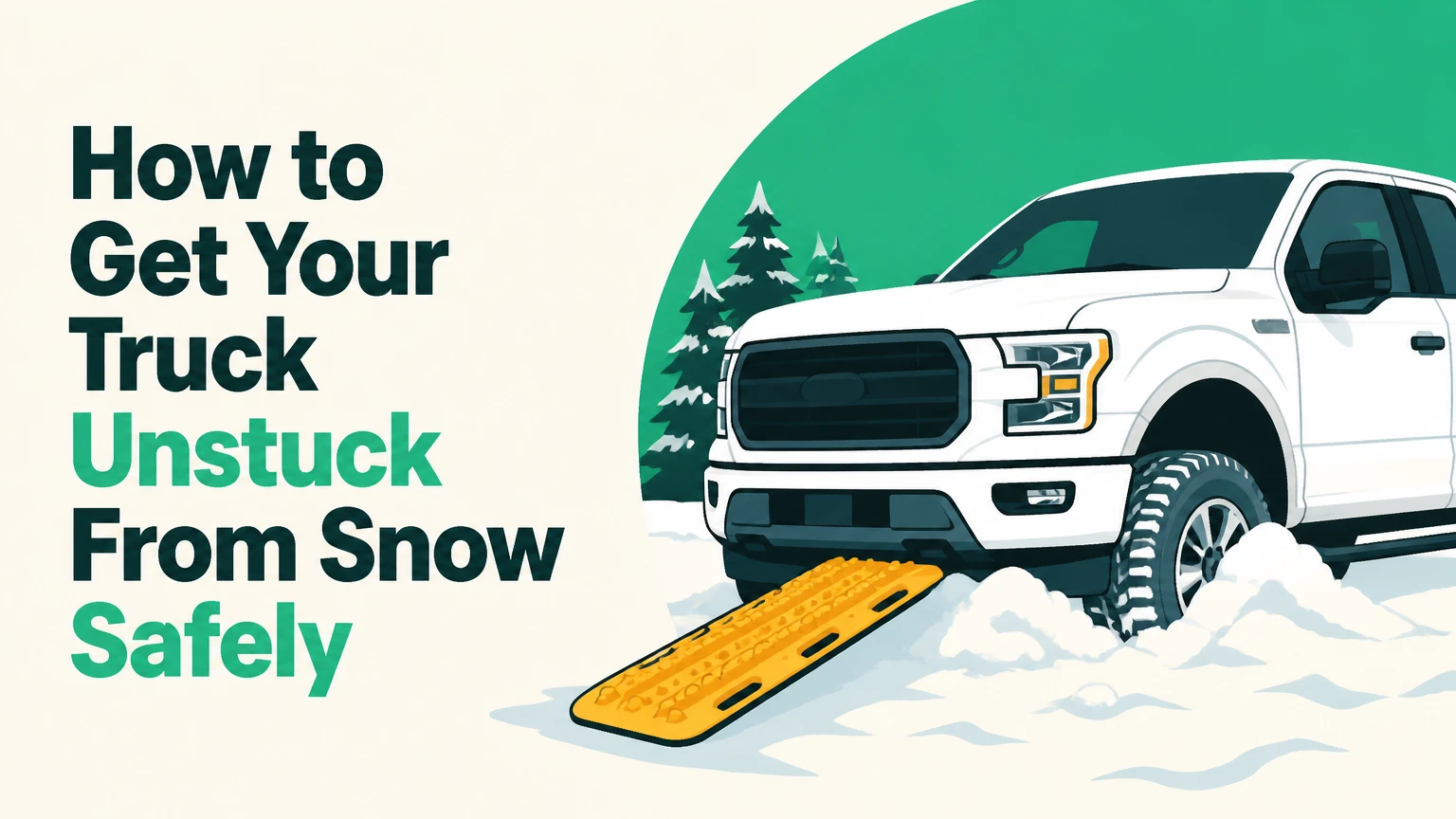
To get a truck unstuck from snow, stop wheelspin, clear the exhaust and packed snow, straighten the wheels, select the correct drivetrain setting, and restore traction beneath the drive tires. Start with gentle rocking only after digging a path, then use boards, chains, a properly rated pull, or professional recovery before the truck sinks deeper.
Key facts
A clear tailpipe is a life-safety requirement before occupants remain inside a snowbound truck.
Tire spinning can polish snow into ice and deepen the truck’s ruts within seconds.
Four-wheel drive improves power delivery, but it cannot create traction on an unloaded or high-centered tire.
Do not lower tire pressure to 12-15 PSI automatically; use the truck, tire, wheel, load, and manufacturer limits.
A kinetic rope attaches only to rated recovery points, never to a hitch ball or a tow hook of unknown strength.
Stop self-recovery when the truck is near traffic, the frame is buried, the drivetrain overheats, or no safe anchor exists.
Before You Start: Time, Tools, and Safety
A typical pickup recovery takes 15-45 minutes with a shovel and traction aid, while professional recovery may take 30 minutes to several hours depending on access and weather. The main success factor is removing resistance under the truck before applying more engine power.
| Requirement | Typical specification | Why it matters |
|---|---|---|
| Shovel | 1 full-size or compact snow shovel | Clears tire paths and packed underbody snow |
| Traction material | 2 boards, 4 mats, or 1-2 bags of sand | Creates a surface the tread can grip |
| Tire gauge | 0-60 PSI, accurate to approximately 1 PSI | Prevents unsafe pressure guesses |
| Gloves and eye protection | 1 insulated pair, sealed eyewear | Protects hands from ice, chains, and cable recoil |
| Recovery points | Factory-rated front or rear points | Transfers pulling force into the frame |
| Time limit per attempt | 10-15 seconds of throttle | Limits wheelspin, heat, and deeper rutting |
Turn on hazard lights if the truck is near a road, place warning triangles where local law permits, and keep bystanders outside the vehicle’s path. The National Highway Traffic Safety Administration advises drivers to “slow down” because snow-covered roads reduce vehicle control and stopping ability. A recovery operation beside moving traffic deserves the same caution as a roadside repair.
Never crawl beneath a truck supported only by a jack. Never stand between vehicles, inside a rope loop, or in line with a taut winch cable. If the exhaust cannot remain clear, move everyone into fresh air and call emergency services if anyone develops headache, dizziness, nausea, confusion, or unusual sleepiness.
Why Does a Truck Get Buried in Snow?
A truck becomes immobilized when available tire traction is lower than the resistance created by snow, ice, slope, or the vehicle’s underbody. Wheelspin removes loose snow, polishes the remaining surface, and can dig the drive axle below the surrounding grade.
An open differential sends more rotational speed to the tire with less resistance, so one tire may spin while the other receives insufficient usable torque. Traction control can reduce throttle or apply braking to control that spin, which may help on a road but can interrupt momentum during a carefully controlled extraction. Stability systems and traction systems are not identical, so the owner’s manual determines which mode to select.
High-centering is a separate problem. If snow supports the frame, axle housing, or differential instead of the tires, adding throttle usually increases digging without increasing tire load. A shovel is more useful than more horsepower in that situation.
Three Signs of High-Centering
- The truck’s frame or differential rests on compacted snow.
- The tires spin freely while the body barely moves.
- Digging only behind the tires produces no change in vehicle height or movement.
A heavy commercial truck may also be immobilized by packed snow between dual tires, a buried drive axle, or a trailer restricting the escape angle. Such vehicles generally require commercial recovery equipment rather than passenger-truck techniques.
How to Get Your Truck Unstuck From Snow
Use the following sequence: stop spinning, secure the scene, clear resistance, configure the drivetrain, attempt controlled movement, and add a traction or pulling aid only when the basic method fails. Each stage has a stopping point, because repeated unsuccessful attempts increase damage and reduce recovery options.
Step 1: Stop, Secure, and Assess
Set the parking brake, select Park or neutral as appropriate, and inspect the truck from outside. Confirm whether the vehicle is stuck on level ground, in a ditch, against a snowbank, or on a slope before choosing a direction.
Clear the tailpipe first. Snow can block exhaust gases and allow carbon monoxide to enter the passenger compartment, especially when the engine runs while occupants wait inside. Check the tailpipe again after every digging or rocking attempt.
Identify the drive wheels, the intended escape direction, nearby obstacles, and whether the truck is resting on its frame. Straighten the steering wheel unless the escape route requires a modest angle.
You will know the assessment worked when the exhaust is open, the escape route is visible, and you can name the resistance source. The common mistake is pressing the accelerator immediately because the truck appears only lightly buried.
Step 2: Clear the Tires and Underbody
Dig a ramp in the intended direction of travel, extending approximately 1-2 truck lengths when space allows. Clear snow from the front and rear of each drive tire, then remove packed snow around the differential, axle tubes, frame crossmembers, and skid plates.
For a rear-wheel-drive pickup, prioritize both rear tires and the path ahead of them. For a front-wheel-drive truck or crossover, clear both front tires. For a four-wheel-drive pickup, clear all four corners because the front tires must steer and climb while the rear tires provide push.
Do not throw snow beneath the truck where it can pack around a hot exhaust component. Place it outside the escape lane instead.
You will know it worked when the tires can rotate without immediately contacting a vertical wall of snow and the differential has visible clearance. The common mistake is clearing only the tire tread while leaving the truck’s frame supported by snow.
Step 3: Select Safe Truck Settings
Use the lowest appropriate gear and the truck’s prescribed four-wheel-drive mode. Engage 4-High for slippery travel and select 4-Low only when the vehicle is stopped or moving at the speed specified by the manufacturer; some systems require neutral before transfer-case selection.
| Truck condition | Starting setting | Driver action |
|---|---|---|
| 2WD pickup on level snow | Drive or low gear | Use gentle throttle and traction material |
| 4WD pickup on packed snow | 4-High | Keep wheels straight and avoid wheelspin |
| 4WD pickup in deep snow | 4-Low, if permitted | Use low speed after clearing underbody resistance |
| Automatic-locking differential | Manufacturer-prescribed mode | Engage before throttle, if the system allows |
| Manual-locking differential | Low-speed straight path | Unlock before tight turns on high-traction surfaces |
Use a differential lock only where the owner’s manual permits it. Locked axles can bind during turns and may damage driveline components on surfaces with different tire paths.
Do not universally disable electronic stability control. Some vehicles provide a partial traction-control-off mode for extraction, while others retain braking intervention or automatically restore the system above a set speed. Select the manufacturer’s snow, mud, sand, or recovery mode when available.
You will know it worked when the selected mode indicator appears and the truck responds smoothly at idle or light throttle. The common mistake is forcing a transfer-case lever or shifting between Drive and Reverse while the wheels are still spinning.
Step 4: Build a Runway With Gentle Rocking
Rock the truck only after clearing the tires and underbody. Select Reverse, apply light throttle for one or two seconds, release the accelerator before wheelspin begins, allow the vehicle to settle, then select Drive after the truck stops moving and the transmission permits the shift.
The aim is to compact a shallow runway, not to swing the truck violently. Keep the steering straight, use the lowest gear that provides control, and stop after three or four cycles if the truck gains no additional distance.
Automatic transmissions can overheat during repeated direction changes. If the transmission temperature warning appears, the fluid smells burned, or the truck stops responding, stop rocking and allow cooling according to the owner’s manual. Never rock a truck near a drop-off, another vehicle, a person, or an obstacle that could become a collision point.
You will know it worked when the truck advances several inches farther on each cycle and the tire tracks become firm. The common mistake is using high engine speed, which excavates holes faster than the truck can climb out.
Which Traction Aid Works Best?
Traction boards are the most predictable first upgrade for a pickup on loose snow, while chains provide the strongest tire-level grip when installed correctly. Sand, non-clumping litter, and floor mats can help on shallow snow, but they are temporary aids and cannot solve high-centering.
Place an aid under the drive tire’s contact patch, wedge its leading edge into the snow, and align it with the escape direction. Keep hands and feet away from the tire as the driver applies only enough throttle to climb onto the aid.
| Aid | Typical setup time | Best surface | Main limitation |
|---|---|---|---|
| Recovery boards | 5-15 minutes | Loose snow and shallow ruts | Can eject at high wheel speed |
| Tire chains | 15-30 minutes | Packed snow and ice | Must match tire size and clearance |
| Sand or tube sand | 5-10 minutes | Thin snow on firm ground | Sinks or disperses in deep powder |
| Non-clumping litter | 5-10 minutes | Small icy patches | Moisture reduces usefulness |
| Floor mats | 2-5 minutes | Emergency shallow rut | Can tear or become a projectile |
| Branches or brush | 5-15 minutes | Remote trail surface | Can damage tires or suspension |
Use chains on the axle or axles required by the truck and local law. Four-wheel-drive does not automatically mean chains belong on all four tires, because clearance, tire size, and the owner’s manual control the safe configuration.
Lowering pressure can enlarge the footprint, but pressure is not a universal cure. On a typical off-road tire, a driver may reduce pressure gradually on a suitable low-speed trail, then reinflate before paved travel; a street tire on a stock wheel can unseat, damage its sidewall, or trigger a TPMS warning if pressure falls too far. Use the tire placard, owner’s manual, tire manufacturer limits, and a gauge.
When Is a Rope or Winch Appropriate?
A vehicle-to-vehicle recovery or winch is appropriate only after the truck’s route, attachment points, equipment ratings, and exclusion zone are controlled. A rated kinetic rope can help a lightly buried truck, while a winch provides slower, more controllable force when no second vehicle is available.
A kinetic rope is elastic and must be attached to rated recovery points on both vehicles. The assisting vehicle should pull smoothly, not take a high-speed running start, because excessive speed transfers shock loads into frames, hooks, and suspension components.
A winch line should run from the truck’s rated recovery point to a suitable anchor, such as a properly protected tree or engineered ground anchor. Use a tree-protection strap, rated shackles, a line dampener, and a straight or controlled-angle pull. Keep everyone outside the winch line’s recoil zone.
Never attach a kinetic rope to a trailer hitch ball. A hitch receiver may be suitable with a rated recovery shackle or receiver-mounted recovery point, but the ball itself is not designed for shock loading. A casual tow strap is not a substitute for a kinetic rope, and an unknown hook can fail under tension.
| Method | Typical cost | Typical duration | Minimum control requirement |
|---|---|---|---|
| Manual digging and rocking | $0-$75 | 15-45 minutes | Clear exhaust and escape path |
| Recovery boards | $100-$500 | 5-20 minutes | Two boards rated for vehicle load |
| Tire chains | $100-$400 | 15-30 minutes | Exact tire size and clearance |
| Kinetic rope recovery | $100-$300 | 5-20 minutes | Rated points and trained spotter |
| Electric winch recovery | $800-$3,000 installed | 20-60 minutes | Rated anchor, dampener, exclusion zone |
| Professional recovery | $150-$600 or more | 30 minutes-several hours | Accessible truck and safe approach |
Prices are typical North American retail or service ranges, not fixed quotations. A remote mountain recovery, heavy-duty truck, or night call can cost substantially more.
Which Truck Situations Need Different Techniques?
A 2WD pickup requires more careful weight management because only one axle supplies engine force. Clear the driven axle first, place boards or abrasive material under both driven tires, remove unnecessary wheel angle, and avoid relying on engine torque to compensate for missing traction.
A 4WD pickup can still fail when one or more tires are unloaded, the frame is high-centered, or the tires are unsuitable for the surface. Four-wheel drive distributes torque; it does not replace winter-rated tread, tire loading, or a clear path.
A truck in a snowbank should be dug out parallel to the road before attempting to climb over the bank. A truck in a ditch needs a recovery assessment because a steep side slope can cause rollover or require a winch pull in a direction different from the visible road.
| Situation | First priority | Avoid |
|---|---|---|
| Shallow driveway snow | Dig both drive tires | Full-throttle wheelspin |
| Deep powder trail | Clear differential and frame | Driving with the frame supported |
| Icy roadside shoulder | Secure traffic area | Standing behind a spinning tire |
| Snow and mud mixture | Use boards or chains | Relying on loose litter alone |
| Ditch or side slope | Call or plan controlled extraction | Pulling sideways at high force |
| Heavy truck or trailer | Commercial recovery assessment | Passenger-grade rope or winch |
What If the Truck Shifts but Does Not Move?
If the truck shifts but the wheels do not turn, stop the attempt and inspect the transmission, transfer case, axle, and gear selection. A blinking drivetrain indicator, transmission-temperature warning, unusual odor, or delayed engagement requires mechanical cooling or professional diagnosis rather than more throttle.
If the wheels turn but the vehicle remains stationary, suspect high-centering, polished ice, or a vertical rut wall. Dig farther under the differential and create a longer ramp before trying a traction aid.
If boards shoot out, reduce throttle, reposition the board deeper under the tread, and lower the approach angle by digging a shallow pocket. Never hold a board in place with a hand or foot while the tire rotates.
Common Mistakes and How to Fix Them
- Spinning continuously: Release the accelerator, wait for the tire to stop, and dig the rut deeper and longer. Tire smoke or a burning smell means the attempt has already gone too far.
- Leaving the exhaust buried: Exit the cab, clear the tailpipe, and keep checking it after snow shifts. Carbon monoxide has no reliable odor warning.
- Using the wrong recovery point: Stop before tensioning the rope or winch. Locate the factory recovery point in the owner’s manual or call a recovery operator.
- Lowering pressure excessively: Reinflate to the placard pressure if the tire bead looks displaced, the sidewall folds sharply, or the truck must return to pavement.
- Rocking too long: Limit cycles to three or four, then change the method. Repeated shifts can overheat the transmission and enlarge the excavation.
- Pulling with people nearby: Stop the pull, establish a clear exclusion zone, and move spectators behind solid shelter or well away from the line.
One counterintuitive rule matters: more traction can increase driveline shock. A tire that suddenly grips after prolonged wheelspin can transfer a sharp load to an axle, U-joint, differential, or recovery attachment, so smooth throttle remains safer than an aggressive launch.
When Should You Call for Recovery?
Call a professional recovery operator when the truck is high-centered, in a ditch, near moving traffic, on a steep slope, mechanically damaged, or beyond the safe rating of available equipment. Professional assistance is also the correct choice when darkness, severe cold, poor visibility, or physical exhaustion makes continued digging unsafe.
Stop self-recovery immediately if the vehicle moves toward a hazard, a tire loses pressure rapidly, the winch anchor shifts, a rope or shackle shows damage, or the truck requires a sideways pull. A tow operator can choose a controlled line, appropriate equipment, and a recovery direction that prevents rollover.
A truck that is merely buried on level ground usually warrants one careful digging and traction attempt. A truck that has failed after those steps should not receive unlimited throttle. Recovery risk rises faster than the chance of success.
What Belongs in a Winter Recovery Kit?
A daily commuter benefits from a compact shovel, work gloves, a tire gauge, a flashlight, traction material, booster cables or a jump pack, reflective warning devices, and warm clothing. Store the kit where snow cannot bury it under unsecured cargo.
A rural worker should add correctly sized chains, a full-size shovel, a compressor, a tire plug kit, and rated recovery points. A Hi-Lift jack is not a general-purpose snow recovery tool because its base can sink and its lifting mechanism can become unstable; use a wide, stable base only within the jack and vehicle manufacturer’s limits.
An off-road driver should carry recovery boards, a deflator and compressor, a rated kinetic rope, soft shackles, tree protection, a winch dampener, and a communications plan. Inspect ropes, shackles, winch lines, and mounting bolts before every winter trip.
FAQ
Can I use salt to get a truck out of snow?
Salt can melt a small amount of ice near a tire, but it is slow and ineffective in deep, cold snow. Sand, traction boards, or chains provide immediate mechanical grip, while salt can corrode brake, suspension, and body components. Use salt only as a minor aid on a localized icy patch, not as the primary recovery method.
Should I put cardboard under the tires?
Cardboard can provide brief separation from a wet surface, but it tears quickly and offers little grip under a heavy pickup. A rubber floor mat is a stronger emergency option, although both materials can eject from beneath the tire. Recovery boards or chains are safer and more reusable when the truck is deeply stuck.
Does spinning the tires help in deep snow?
Controlled, brief wheel movement can polish a runway into a firmer surface, but continuous spinning usually worsens a stuck truck. Wheelspin removes snow from beneath the tread, creates ice, overheats tires and driveline parts, and digs the axle lower. Release the throttle as soon as the tire begins spinning faster than the truck moves.
Is 4WD enough for winter driving?
Four-wheel drive is not enough by itself. The system can send power to more tires, but braking and cornering still depend on tire grip, and a high-centered truck may have too little weight on its tires. Winter-rated tires, appropriate speed, adequate clearance, and a clear route remain necessary.
How long should I wait before trying again?
Wait until the tires stop spinning and inspect the truck before every attempt. After repeated rocking, allow the transmission and drivetrain to cool according to the owner’s manual, especially if a temperature warning, burning odor, or delayed gear engagement appears. A ten-minute idle period is not a universal overheating cure.
Can a tow truck pull me out from the rear?
A tow truck can pull from the rear when the rear recovery point, line angle, and escape direction are suitable. The operator must avoid attaching to a hitch ball, bumper skin, suspension component, or other unapproved point. Tell the operator whether the truck is 2WD, 4WD, high-centered, damaged, or carrying a trailer.
The Bottom Line
The safest way to get a truck unstuck from snow is to stop wheelspin, clear the exhaust and underbody, dig a usable ramp, select the correct drivetrain mode, and apply gentle throttle. Use boards or chains before escalating to a rated rope or winch, and call for professional recovery when traffic, slopes, high-centering, heat, or damaged equipment makes the operation unsafe.