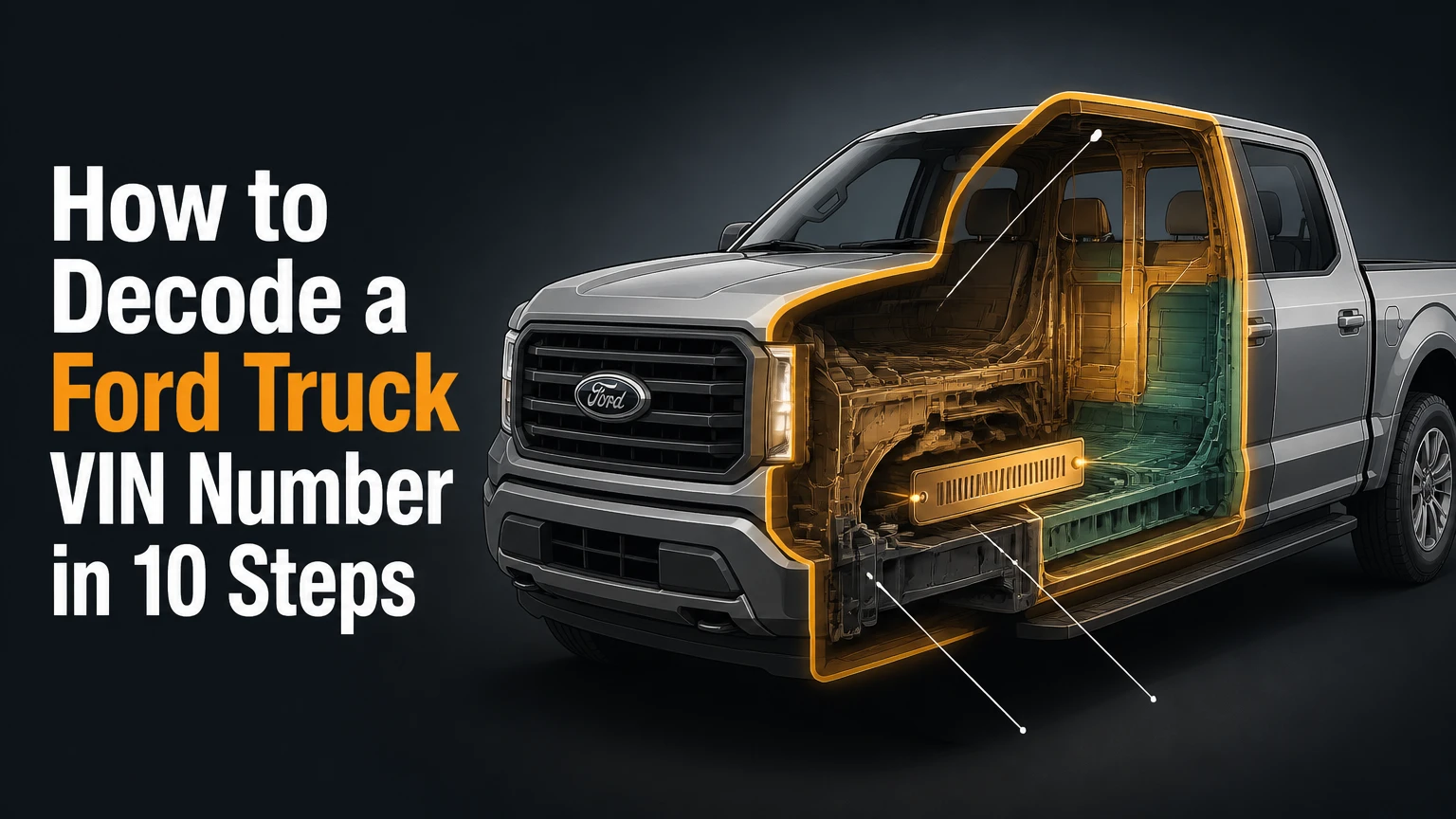
To decode a Ford truck VIN number, read its 17 characters from left to right, map positions 1-3 to the manufacturer, positions 4-8 to vehicle attributes, position 9 to the check digit, and positions 10-17 to model year, plant, and serial number. Confirm the result against the driver-door label, title, Ford records, and a history report.
Key Facts at a Glance
A modern Ford truck VIN contains 17 characters and excludes the letters I, O, and Q.
Positions 1-3 identify the World Manufacturer Identifier, or WMI.
Position 9 is a mathematical check digit, not an engine or trim code.
Position 10 identifies the model year, but the code can repeat after 30 years.
Position 11 identifies the assembly plant within Ford’s VIN system for that vehicle line and year.
A VIN decoder shows factory identity and specifications, not guaranteed current mileage, maintenance, or accident history.
What Is a Ford Truck VIN Number?
A Ford truck VIN number is a standardized 17-character identifier assigned to one specific vehicle. The National Highway Traffic Safety Administration, or NHTSA, regulates the modern VIN format under 49 CFR Part 565, while ISO 3779 and ISO 3780 define international principles for vehicle identification and manufacturer identifiers.
The VIN is divided into functional sections rather than being a random production number. Characters 1-3 form the WMI, characters 4-9 describe the vehicle and validate the number, and characters 10-17 identify the model year, assembly plant, and production sequence.
The format applies to Ford F-150, Super Duty, Ranger, Maverick, and other modern trucks, but Ford’s exact meaning for positions 4-8 changes by model line and model year. A 2024 F-150 engine code cannot safely be applied to a 1998 F-150.
Where can you find a Ford truck VIN?
The primary VIN location is the metal plate visible through the lower driver-side windshield. Ford also places the VIN on the certification label attached to the driver-side doorjamb or door edge. The title, registration, insurance documents, FordPass vehicle record, and original window sticker may show the same identifier.
Check at least two physical or documentary locations before decoding. A VIN that appears only in an online advertisement is not sufficient evidence of vehicle identity.
What Does Each Ford Truck VIN Position Mean?
The following map describes the modern North American structure, but Ford-specific codes in positions 4-8 must be verified against a source for the exact model year.
| Positions | Section | Typical Ford truck meaning |
|---|---|---|
| 1-3 | WMI | Country or region, manufacturer, vehicle type or division |
| 4 | VDS | Restraint system or vehicle attribute code |
| 5-7 | VDS | Model, series, cab, body, or vehicle configuration |
| 8 | VDS | Engine or additional vehicle attribute |
| 9 | Check digit | Mathematical validation character |
| 10 | VIS | Model year code |
| 11 | VIS | Assembly plant code |
| 12-17 | VIS | Sequential production number |
The WMI is assigned through the manufacturer identification system. Ford Motor Company commonly appears with WMIs such as 1FT for certain trucks built in the United States, but the first three characters vary by plant, market, vehicle category, and manufacturing entity. Do not infer the entire truck from “1FT” alone.
The Vehicle Descriptor Section, or VDS, occupies positions 4-9 under the standard structure. Ford uses the first eight vehicle characters to encode attributes, while position 9 validates the complete VIN. That distinction matters because the check digit does not identify a part or configuration.
How to Decode a Ford Truck VIN Number Step by Step
A manual Ford VIN decode takes about 10-20 minutes when the model year and a reliable code reference are available. The factor that most affects accuracy is the correct Ford coding table for the truck’s specific year and model line, not the arithmetic.
Before You Start
| Requirement | Typical value |
|---|---|
| Time | 10-20 minutes |
| Difficulty | Basic research and arithmetic |
| Cost | $0 for NHTSA lookup, $0-$45 for history data |
| Tools | Phone camera, paper, calculator, VIN reference |
| Minimum data | Complete 17-character VIN |
| Best confirmation | Door label plus title or registration |
Record the VIN exactly as printed. Use uppercase letters, preserve zeroes, and separate the characters into groups if that prevents transcription errors. Do not publish a complete VIN with a vehicle owner’s name, address, registration, or other personal information.
Step 1: Locate and Photograph the VIN
Find the windshield plate and the driver-door certification label, then photograph both in good light. Compare every character before entering the VIN into a decoder.
A modern VIN must contain 17 characters. The letters I, O, and Q are excluded from the standardized VIN alphabet because they can be confused with the numbers 1 and 0. A mark that looks like “O” is usually the number zero or a transcription mistake.
You will know this step worked when the windshield plate and door label match character for character. The common mistake is reading a dusty “8” as a “B” or a scratched “5” as an “S.”
Step 2: Confirm the VIN Has 17 Legal Characters
Count the characters without spaces or punctuation. Reject entries containing I, O, Q, spaces inside the sequence, or symbols that are not part of the VIN.
A VIN can be 17 characters and still be wrong. Cloned VINs, replacement labels, altered titles, and data-entry errors can all produce a syntactically valid sequence.
You will know this step worked when the string has 17 allowed characters and no unexplained gaps. The common mistake is adding a missing character because an online form accepts the entry anyway.
Step 3: Read Positions 1-3 as the WMI
Count from the first character and write down positions 1, 2, and 3 separately. These characters identify the vehicle’s manufacturing region, manufacturer, and vehicle category or division within the assigned WMI.
Examples include a first character of 1, 4, or 5 for vehicles associated with the United States, although the full WMI must be interpreted as a registered combination. A Canadian-built Ford truck may begin with 2, while a Mexican-built vehicle may use 3.
The WMI does not prove the truck’s current location, ownership, or legal import status. It identifies the assigned manufacturing identity.
| WMI example | General association | What still requires verification |
|---|---|---|
| 1FT | Ford truck, United States association | Exact model line and plant |
| 1FD | Ford commercial vehicle, United States association | Vehicle series and year |
| 2FT | Ford truck, Canada association | Exact production configuration |
| 3FT | Ford truck, Mexico association | Market and model-year coding |
| 1F7 | Ford-related vehicle identifier | Specific manufacturer record |
WMI examples are not universal substitutes for Ford’s VIN reference data. Ford has used different identifiers across eras and vehicle categories.
Step 4: Decode Positions 4-7 for Model and Configuration
Positions 4-7 usually contain Ford’s vehicle descriptor codes for restraint equipment, model series, cab style, body type, and related attributes. The exact allocation differs among F-150, Super Duty, Ranger, and older Ford truck families.
A code may distinguish a regular cab from a SuperCab or SuperCrew, but the VIN does not always expose every retail option in a simple one-character format. Bed length, axle ratio, package content, and dealer-installed equipment may require the original build sheet or window sticker.
Use the model-year-specific Ford table rather than assuming that position 5 means the same thing on every truck. A 2006 F-Series code can have a different interpretation from a 2023 F-Series code.
You will know this step worked when the decoded series and body description match the physical truck. The common mistake is treating “F-250” or “Super Duty” as a complete trim description without checking cab, drivetrain, and weight rating.
Step 5: Decode Position 8 for the Engine
Position 8 commonly identifies the engine in modern Ford truck VINs, but the code is meaningful only within the correct Ford model-year reference. The same letter can represent different engines in different vehicle lines or years.
Common modern Ford truck powertrains include the 2.7L EcoBoost V6, 3.5L EcoBoost V6, 5.0L V8, 3.5L PowerBoost hybrid, and 6.7L Power Stroke diesel. Those engine names do not themselves reveal the VIN code for every year.
| Ford truck powertrain | Common application | VIN interpretation caution |
|---|---|---|
| 2.7L EcoBoost V6 | F-150 | Code varies by model year |
| 3.5L EcoBoost V6 | F-150, some other Ford trucks | Standard and high-output versions may differ |
| 5.0L V8 | F-150 | Position 8 must be checked against year |
| 3.5L PowerBoost hybrid | F-150 | Hybrid code is not interchangeable with EcoBoost code |
| 6.7L Power Stroke diesel | Super Duty | Generation and output affect coding |
The engine code identifies the factory-installed powertrain configuration, not the engine currently installed. Fleet repairs, engine swaps, and replacement long blocks can make the VIN and mechanical contents disagree.
You will know this step worked when the engine description matches the under-hood equipment and Ford documentation. The common mistake is using a generic online chart that combines several years into one unverified code list.
Step 6: Verify Position 9 With the Check-Digit Algorithm
Position 9 is the Ford VIN check digit in the North American standardized format. It validates the characters mathematically and can expose a typing error, but it cannot prove that the vehicle is genuine or free of title problems.
Use these transliteration values: digits retain their values, letters A through Z receive assigned values, and I, O, and Q are invalid. The standard values include A=1, B=2, C=3, D=4, E=5, F=6, G=7, H=8, J=1, K=2, L=3, M=4, N=5, P=7, R=9, S=2, T=3, U=4, V=5, W=6, X=7, Y=8, and Z=9.
Multiply positions 1-8 and 10-17 by these weights:
| Position | 1 | 2 | 3 | 4 | 5 | 6 | 7 | 8 | 10 | 11 | 12-17 |
|---|---|---|---|---|---|---|---|---|---|---|---|
| Weight | 8 | 7 | 6 | 5 | 4 | 3 | 2 | 10 | 9 | 8 | 7, 6, 5, 4, 3, 2 |
Add the products and divide the total by 11. A remainder from 0-9 produces the corresponding digit. A remainder of 10 produces X. Compare the result with position 9.
The check digit catches many transcription errors. It does not detect a copied VIN that belongs to another similar truck, because a cloned VIN can pass the arithmetic perfectly.
Step 7: Decode Position 10 for the Model Year
Position 10 identifies the model year using a repeating code system. The year code cycles, so a character can represent two model years separated by 30 years.
| Year code | Possible model years | Example ambiguity |
|---|---|---|
| A | 1980, 2010, 2040 | 2010 versus 1980 |
| B | 1981, 2011, 2041 | 2011 versus 1981 |
| C | 1982, 2012, 2042 | 2012 versus 1982 |
| D | 1983, 2013, 2043 | 2013 versus 1983 |
| E | 1984, 2014, 2044 | 2014 versus 1984 |
| F | 1985, 2015, 2045 | 2015 versus 1985 |
Letters I, O, Q, U, Z, and the number zero are not used in the model-year cycle. The year code should be checked against the door label, title, registration, body design, and production date.
The model year is not necessarily the calendar year when the truck was built or sold. A truck assembled in late 2023 may be a 2024 model.
Step 8: Decode Position 11 for the Assembly Plant
Position 11 identifies the assembly plant code assigned to that Ford vehicle line and production period. Ford has used facilities including Kentucky Truck Plant, Dearborn Truck Plant, Michigan Assembly Plant, Kansas City Assembly, and plants outside the United States.
Plant letters are not universal across all Ford trucks and years. A plant code must be interpreted with the model line and model year, because Ford can reuse or change codes across production systems.
| Ford facility | Common associated vehicle context | Verification requirement |
|---|---|---|
| Kentucky Truck Plant | Super Duty and large Ford trucks | Year-specific plant table |
| Dearborn Truck Plant | Selected F-Series production | Model-year confirmation |
| Kansas City Assembly | F-Series production | VIN-specific decoding source |
| Michigan Assembly Plant | Ranger and other Ford production | Vehicle-line confirmation |
| Cuautitlán Assembly | Mexican Ford production | Market and year confirmation |
You will know this step worked when the plant result agrees with Ford documentation or a reputable decoder. The common mistake is treating a plant lookup from a different generation as authoritative.
Step 9: Read Positions 12-17 as the Production Sequence
Positions 12-17 usually provide the vehicle’s sequential production number within the manufacturer’s system. The sequence is useful for identifying the individual truck and comparing records, but it is not a universal ranking of all Ford trucks built that year.
The serial sequence does not reliably reveal exact production date, option order, dealer destination, or current mileage. Ford build records and the certification label provide better evidence for those details.
Step 10: Compare the Decode With the Truck and Records
Compare the decoded model, engine, weight class, and body style with the truck, title, door label, window sticker, service records, and a vehicle-history report. Resolve contradictions before purchasing or registering the truck.
The strongest identity check compares the VIN in four places: the windshield plate, door certification label, title, and frame or stamped chassis location where applicable. A mismatch is a stop-and-investigate condition, not a minor clerical issue.
Can a Ford VIN Decode GVWR and Truck Class?
A Ford VIN can help identify the model series associated with a truck, but the certification label is the authoritative practical source for that vehicle’s gross vehicle weight rating. GVWR is printed on the driver-door label and should not be reconstructed from the VIN alone.
| Truck category | Typical Ford example | Where to verify rating |
|---|---|---|
| Half-ton pickup | F-150 | Door certification label |
| Three-quarter-ton pickup | F-250 Super Duty | Door certification label and owner manual |
| One-ton pickup | F-350 Super Duty | Door certification label and axle labels |
| Chassis cab | F-350 or F-450 | Door label and upfitter documentation |
| Compact or midsize pickup | Maverick or Ranger | Door label and Ford specifications |
Payload, towing capacity, axle rating, tire rating, and actual equipment can differ substantially within one VIN series. A replacement suspension or aftermarket hitch does not automatically increase the legal or safe rating.
Which Ford VIN Decoder Is Most Reliable?
NHTSA’s vPIC decoder is the best free first check for basic standardized VIN data, while Ford records, a window sticker, and a reputable history provider provide more useful detail for equipment and ownership decisions. No single decoder should be treated as the complete authority.
| Source | Typical cost | Typical delivery | Best use | Main limitation |
|---|---|---|---|---|
| NHTSA vPIC | $0 | Seconds | Standard VIN fields and recall-related data | Limited Ford option detail |
| Ford dealer or Ford record search | $0-$50 typical | Minutes to several days | Build data and service verification | Access varies by vehicle |
| Window-sticker service | $0-$25 typical | Seconds to 24 hours | Original MSRP and factory options | Older trucks may be unavailable |
| Commercial history report | $15-$45 typical | Seconds to minutes | Title, mileage, auction, accident records | Reporting gaps remain possible |
| NICB VINCheck | $0 | Seconds | Theft and salvage indicators from participating records | Not a complete history report |
The National Insurance Crime Bureau’s VINCheck is useful for theft and salvage screening, but it does not replace a title search or comprehensive history report. Commercial providers aggregate data from insurers, auctions, repair facilities, states, and other sources, so coverage varies by jurisdiction.
A free decoder is not good enough for a high-value purchase when the truck has a reconstructed title, imported history, mileage discrepancy, or altered identification plate. Pay for records when the financial risk exceeds the report cost.
What Can a Ford VIN Reveal, and What Cannot It Prove?
A Ford VIN can reveal factory identity, model year, manufacturing origin, vehicle series, selected body attributes, engine coding, plant, and production sequence. It cannot independently prove current mileage, accident severity, maintenance quality, ownership history, or the condition of an engine and transmission.
VIN systems identify vehicles. They do not continuously monitor them.
A history report can miss accidents paid in cash, repairs performed by facilities that share no data, events in another country, and title delays. A clean report therefore reduces uncertainty but does not establish that the truck is undamaged.
How do you check for a cloned Ford VIN?
Check whether the VIN appears on more than one vehicle with the same model and configuration, compare the physical plates for tool marks or mismatched fonts, and obtain a title history from the relevant state or provincial authority. A cloned VIN may pass the check-digit calculation because the number itself is mathematically valid.
Look for conflicts such as a 2021 VIN attached to a body design from 2015, a diesel description on a gasoline truck, or a door label whose federal certification details do not match the title. Ask a Ford dealer, law-enforcement agency, or qualified inspection service to document the discrepancy.
Do not remove, restamp, or replace an identification label yourself. Altering a VIN plate can create serious legal problems even when the underlying truck is legitimately owned.
Why Does a Ford Truck VIN Decoder Reject the Number?
A Ford VIN decoder usually rejects a number because of a transcription error, an illegal character, an incomplete pre-1981 identifier, an incorrect country or model database, or a data provider that does not support that vehicle. The fastest fix is to recheck the physical plate and try NHTSA vPIC plus a Ford-specific source.
Use this troubleshooting sequence:
- Recount the characters and confirm exactly 17 positions.
- Replace visually confused characters only after checking the plate.
- Confirm that I, O, and Q are absent.
- Enter the VIN without spaces or punctuation.
- Test the check digit.
- Try a second decoder with Ford model-year coverage.
- Compare the result with the title and door label.
- Escalate pre-1981, imported, reconstructed, or altered vehicles to a specialist.
Ford trucks built before the modern 17-character system may have shorter serial numbers or different identification formats. A 1978 F-150 cannot be decoded through a modern VIN form simply because it is a Ford truck.
Canadian imports can also produce incomplete or different data in United States databases. The original Canadian registration, import documents, and provincial records may be necessary.
What Are the Most Common Ford VIN Decoding Mistakes?
The most expensive mistakes come from confusing model year with build year, assuming position 8 has one permanent engine meaning, and treating a clean check digit as proof of authenticity. Experienced inspectors validate the physical truck and records before relying on a decoded specification.
- Using the wrong year chart: Ford codes change across generations, so identify the model year before reading positions 4-8.
- Confusing GVWR with payload: GVWR is the maximum loaded vehicle weight, while payload is the remaining capacity after accounting for the truck’s actual weight.
- Assuming factory equipment remains installed: Engine swaps, axle changes, deleted emissions equipment, and aftermarket beds can invalidate a visual assumption.
- Ignoring the title brand: Salvage, rebuilt, flood, lemon, and odometer brands may be more important than the factory option list.
- Reading a partial VIN: The last six characters alone cannot identify the full truck.
- Trusting one database: Commercial records can contain typographical errors, delayed updates, or regional gaps.
A practical rule is to treat the VIN as an identity anchor, not a complete inspection. The VIN tells you what the truck was built as; the truck inspection tells you what remains.
How Should You Handle a VIN Mismatch?
Stop the transaction until the mismatch is explained by official documentation. A mismatch between the windshield plate, door label, title, or frame marking can indicate clerical error, replacement parts, theft, a rebuilt vehicle, or VIN tampering.
Document the discrepancy with dated photographs. Ask the seller for the complete title chain, repair invoices, insurance records, and import documents, then verify the explanation with the issuing authority or Ford service department.
Do not rely on a seller’s statement that a replacement door or windshield caused the discrepancy without checking the permanent identification points. The correct response depends on local law, but purchasing first and investigating later creates avoidable title and resale risk.
Frequently Asked Questions
Does a Ford VIN show the exact trim level?
A Ford VIN may identify a series or configuration related to the trim, but it does not always provide a plain-language retail trim such as XLT, Lariat, King Ranch, or Platinum. Use the Ford build sheet, original window sticker, or dealer record to verify packages, upholstery, technology, and optional equipment.
Can I decode a Ford truck VIN for free?
Yes. NHTSA’s vPIC decoder provides free standardized VIN information, and some Ford records or window-sticker services may also be free. Free results may omit factory packages, historical title events, and detailed equipment, so a paid history report can be justified for a purchase with significant financial risk.
Does position 10 identify the exact build date?
No. Position 10 identifies the model year, not the exact assembly date. The driver-door certification label normally provides a month and year of manufacture, while Ford production records may provide more precise information when available. A model year can begin before the calendar year printed on the sale paperwork.
Can the VIN tell me whether a Ford truck has four-wheel drive?
The VIN may encode drivetrain-related information within the model, series, body, or engine descriptor positions, but the precise interpretation is year-specific. Confirm four-wheel drive through the Ford build record, transfer case, front axle equipment, door label, and physical inspection rather than one generic VIN chart.
Does a check-digit match prove the Ford truck is legitimate?
No. A matching check digit proves only that the characters satisfy the mathematical validation rule. A copied or cloned VIN can also pass. Legitimacy requires matching physical identifiers, title records, vehicle configuration, theft and salvage checks, and applicable law-enforcement or registration records.
How do I decode an old Ford truck without 17 characters?
Identify the truck’s production era and use Ford’s historical serial-number or warranty-plate references instead of a modern VIN decoder. Pre-1981 Ford trucks may use shorter identifiers and different factory codes, so the title, warranty plate, chassis markings, and period service manual should be read together.
The Bottom Line
To decode a Ford truck VIN number accurately, verify the complete 17-character sequence, interpret positions 1-8 with a model-year-specific Ford reference, calculate position 9, and read positions 10-17 for year, plant, and production sequence. Then compare the result with the door label, title, physical truck, and history records. A VIN decode identifies factory configuration, but only independent records and inspection establish what the truck is today.