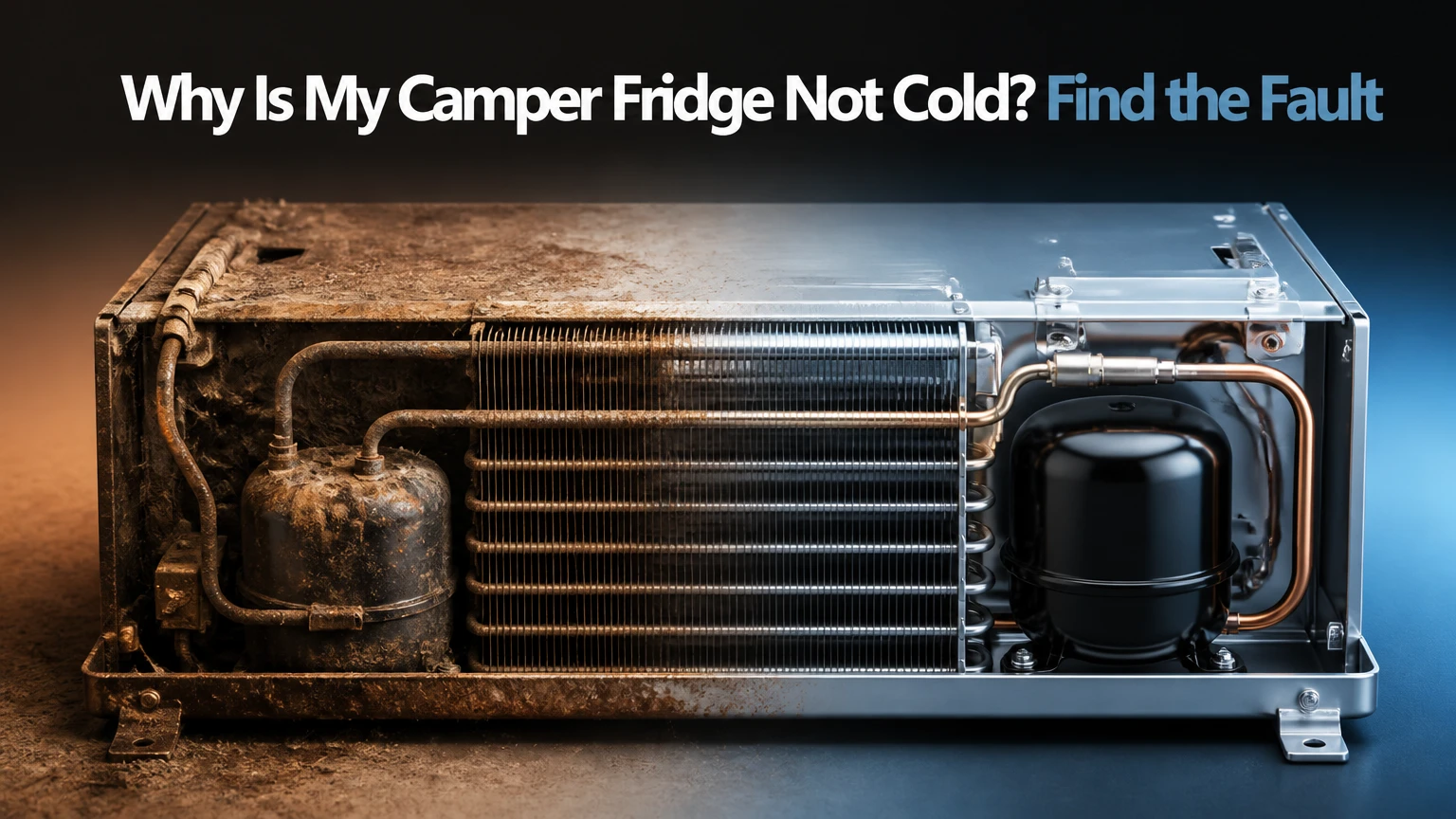
A camper refrigerator is usually not cold because it lacks a working heat source, has inadequate airflow, is parked too far out of level, has a control or sensor fault, or has a failed cooling system. First identify whether the appliance is absorption or compressor-based, then compare its performance on each available power source after measuring actual temperatures.
Key Facts at a Glance
- An absorption camper refrigerator needs heat from propane or an electric element to move refrigerant through its sealed cooling circuit.
- A compressor camper refrigerator needs stable DC voltage and normally produces an audible compressor cycle.
- A refrigerator compartment should remain at or below 40°F (4°C); use a thermometer rather than judging food by touch.
- An absorption refrigerator may need 8-24 hours to cool fully, while a compressor model commonly reaches operating temperature in 1-4 hours.
- A strong ammonia odor, yellow residue, or scorching near the burner requires immediate shutdown and professional service.
- A fridge that cools on propane but not 120V AC usually has an AC supply, heating-element, relay, or control fault.
Why Is My Camper Fridge Not Cold?
The most useful first distinction is whether the camper refrigerator is cooling partially or not cooling at all. A freezer that forms ice while the food compartment stays warm points toward airflow, door sealing, frost, or thermistor placement; a completely warm refrigerator after a full overnight run points toward a power, burner, heating-element, ventilation, or sealed-system problem.
Do not diagnose temperature by touching the evaporator plate. Metal can feel cold while the cabinet remains above a safe food-storage temperature. Place a refrigerator thermometer in the middle of the food compartment, away from the cooling fins, and record the temperature after the door has stayed closed for at least four hours.
A practical diagnosis begins with four observations:
- Refrigerator type: absorption or compressor.
- Cooling time: less than four hours or a complete overnight cycle.
- Power mode: propane, 120V AC, or 12V DC.
- Temperature pattern: entire cabinet warm, freezer cold only, or intermittent cooling.
Those observations narrow the fault faster than replacing parts at random.
How Does a Camper Refrigerator Cool?
An absorption refrigerator uses heat rather than a mechanical compressor. In a typical Dometic or Norcold absorption unit, a burner or electric heating element heats an ammonia-water solution in the generator, ammonia vapor separates from the water, and the refrigerant travels through the condenser, evaporator, and absorber before repeating the cycle.
The cooling sequence works as follows:
- The generator boils the ammonia-water solution.
- The separator directs ammonia vapor away from the water.
- The condenser rejects heat through the exterior coils.
- Ammonia evaporates in the evaporator and absorbs heat from inside the cabinet.
- The absorber combines ammonia vapor with water again.
Hydrogen gas helps lower the ammonia vapor’s partial pressure inside the evaporator. Sodium chromate is used inside some sealed systems as a corrosion inhibitor, but owners should not handle leaked residue or attempt to open the cooling unit.
A compressor refrigerator uses a motor-driven compressor, condenser, expansion device, and evaporator. The compressor model behaves more like a household refrigerator, cools faster, and tolerates vehicle angles better, but it depends on battery capacity and sufficient voltage.
Which Type of Camper Fridge Do You Have?
The control panel and the rear compartment usually identify the refrigerator type. A gas burner, flue, and selectable LP, AC, or DC modes indicate an absorption refrigerator; a compressor housing, cooling fan, and 12V or 24V input indicate a compressor refrigerator.
| Refrigerator type | Energy source | Typical full cool-down | Main diagnostic clue |
|---|---|---|---|
| 2-way absorption | LP gas and 120V AC | 8-24 hours | Silent operation with burner or heater activity |
| 3-way absorption | LP gas, 120V AC, and 12V DC | 8-24 hours | 12V mode draws high current through a heater |
| 12V compressor | 12V DC or 24V DC | 1-4 hours | Compressor starts, stops, and may hum |
| Household compressor | 120V AC | 2-6 hours | Requires inverter or shore power in many campers |
A 3-way absorption refrigerator’s 12V mode is usually designed to maintain temperature while driving. It often cannot cool a warm, empty cabinet efficiently because the heating element consumes substantial battery power.
What Is the Safest Diagnostic Sequence?
The safest sequence takes 10-20 minutes for initial checks, followed by a controlled cooling test lasting overnight for an absorption model. You need a refrigerator thermometer, a small level, a flashlight, and the owner’s manual; gas-valve disassembly and live electrical testing require a qualified technician.
Step 1: Measure the Cabinet Temperature
Put a thermometer in the center of the refrigerator compartment and note the freezer temperature separately. Keep the doors closed during the test, because repeated opening can add significant heat to a small cabinet.
You will know the measurement is useful when the refrigerator has operated for at least four hours, or overnight for an absorption unit, with minimal door opening. A reading above 40°F after a complete cycle confirms inadequate cooling rather than a perception problem.
Common mistake: placing the thermometer directly against the cold evaporator fin. That location measures the fin, not the food-storage air.
Step 2: Identify the Cooling System
Look for an LP selection, flame icon, or burner access area. A compressor refrigerator normally has no propane burner and may produce a low hum when the compressor operates.
Record the make, model, and serial number before ordering parts. Dometic RM and RML models, Norcold N-series models, and Furrion Arctic models use different sensors, boards, heaters, and diagnostic codes.
Common mistake: assuming every “RV fridge” uses absorption technology. A 12V compressor fault requires battery and voltage testing, not burner inspection.
Step 3: Confirm Leveling and Airflow
Park the camper on a reasonably level surface and check the refrigerator’s actual position with a small level on a shelf or freezer floor. Absorption models need reasonable leveling during operation because prolonged steep angles can restrict liquid circulation and overheat the boiler.
Exact tolerance varies by manufacturer and model. Do not treat a generic three-degree or five-degree figure as universal; consult the refrigerator manual. A short drive on a slope is different from operating for days with the cooling unit substantially tilted.
Inspect the upper and lower exterior vents. Remove leaves, wasp nests, insulation, and stored objects, but do not block the vents with cardboard or improvised covers. The condenser must release heat outdoors.
Common mistake: leveling the camper by its bumper while the refrigerator cabinet remains twisted or tilted. Check the appliance itself.
Step 4: Test Each Available Mode
Run a 2-way absorption unit on 120V AC and LP gas separately. A 3-way model can also be checked on 12V DC, although that mode is a poor stationary cooling test.
| Symptom during mode testing | Most likely area | Next check |
|---|---|---|
| Cold on LP, warm on AC | AC supply or heating element | Breaker, receptacle, heater circuit |
| Cold on AC, warm on LP | Gas delivery or ignition | Propane supply, burner flame, regulator |
| Warm on every absorption mode | Cooling unit, airflow, control board, leveling | Rear inspection and professional diagnosis |
| Cold on shore power, warm while driving | Vehicle charging or DC wiring | Fuse, connector, voltage under load |
| Compressor clicks but does not start | Low voltage or compressor circuit | Battery voltage, cable size, controller |
| Freezer cold, food compartment warm | Airflow, frost, thermistor, door seal | Interior inspection and sensor position |
A mode-specific failure is valuable because the sealed cooling circuit may still be working. If one heat source cools correctly, replacing the entire refrigerator is premature.
Step 5: Check the Result After a Full Cycle
An absorption refrigerator should show meaningful improvement within several hours, but a warm cabinet can require 8-24 hours to stabilize, especially in hot weather or after loading room-temperature food. A compressor model generally stabilizes sooner, often within 1-4 hours depending on cabinet size and ambient temperature.
Use chilled water bottles as a controlled load rather than filling the cabinet with hot groceries. The refrigerator should reach 34-40°F in the food compartment under normal conditions, although manufacturer settings and ambient temperature affect the exact result.
What Does Each Power Mode Tell You?
Power-mode behavior isolates the failed subsystem. If a camper refrigerator cools on one source but not another, the ammonia circuit or compressor may still be functional, making a source-specific repair the logical first step.
Why Does It Cool on Propane but Not Electric?
A refrigerator that cools on propane but not 120V AC usually has a tripped breaker, dead receptacle, failed electric heating element, loose connection, or control-board problem. Check the camper’s AC breaker and refrigerator receptacle, but disconnect shore power before inspecting wiring.
If the outlet has power and the refrigerator still fails on AC, the heating element is a common suspect. The element must match the refrigerator model and wattage, and access often requires removing a rear cover.
A 12V absorption heater can fail in the same way. Because that circuit draws high current, a corroded connector, blown fuse, undersized wire, or weak battery can prevent adequate heating even when the control panel operates.
Why Does It Cool on Electric but Not Propane?
A refrigerator that cools on AC but not LP gas usually has an empty tank, closed valve, low regulator pressure, blocked burner orifice, failed igniter, dirty electrode, or poor combustion. Light a stove burner briefly to confirm that propane reaches the camper, but do not use the stove test to prove correct refrigerator gas pressure.
A healthy burner flame is generally stable and predominantly blue. A yellow, lazy, lifting, or repeatedly extinguishing flame indicates combustion or airflow trouble. Spider webs and rust flakes commonly obstruct small burner assemblies, but forcing wire through a precision orifice can enlarge it and alter combustion.
Turn off the refrigerator if gas accumulates, ignition repeatedly fails, or the burner compartment shows scorching. Have a certified RV gas technician inspect pressure and combustion.
What If a 12V Compressor Fridge Has Power but Stays Warm?
A compressor refrigerator with a lit display can still have insufficient voltage at the compressor controller. Measure voltage at the refrigerator input while the compressor attempts to start, because long cable runs, poor crimp connections, discharged batteries, and a failing fuse holder can create a large voltage drop.
The compressor should normally start with a hum or vibration, then cycle off after reaching temperature. Rapid clicking every few minutes suggests a low-voltage shutdown, controller issue, or compressor-start problem. Check the model’s specified voltage range rather than applying a universal cutoff value.
Solar panels may show charging voltage while the battery cannot supply the compressor’s startup current. Test the system under load.
Why Is the Freezer Cold but the Fridge Warm?
A cold freezer with a warm refrigerator compartment usually indicates restricted internal airflow, excessive frost, a displaced thermistor, a damaged door seal, or food blocking the cold-air path. The sealed cooling system is producing some cold, so inspect the cabinet and sensor before suspecting an ammonia-loop failure.
Do not pack food tightly against the evaporator plate or vents. Absorption refrigerators depend heavily on natural convection, while compressor models may use a fan to distribute cold air. A solid shelf liner can also obstruct designed airflow openings.
The thermistor is commonly clipped to an evaporator fin. Its position tells the control system when to cycle or reduce cooling, but the correct position varies by model. Use the owner’s manual rather than moving it automatically to the highest or lowest fin.
Defrost safely with the refrigerator off and the door open. Do not chip ice with a knife or heat the plastic liner with a heat gun. Inspect the gasket with a strip of paper: resistance around the closed seal suggests contact, while loose paper in several locations suggests gasket or door-alignment trouble.
Can Heat and Blocked Vents Cause the Problem?
High ambient temperature and poor rear ventilation can reduce absorption refrigerator performance without any failed part. The refrigerator’s condenser must reject heat into the outside air, so direct sun on the vent side, blocked upper ventilation, or inadequate installation clearance can leave the cabinet warm.
A roof vent and exterior side vents should remain unobstructed. Do not place an improvised fan where it disrupts the burner or flue, but a properly installed ventilation fan can help some installations when the manufacturer permits it.
Typical practical measures include:
- Shade the refrigerator-side wall without sealing the vent openings.
- Leave internal air gaps around food and cooling fins.
- Pre-chill food at home before loading.
- Use frozen gel packs during the initial cool-down.
- Keep door openings short during hot afternoons.
An absorption unit often performs less effectively above 90-100°F ambient temperature. A compressor unit usually handles heat better, but its electrical consumption may rise as runtime increases.
When Should You Turn the Refrigerator Off?
Turn off a camper refrigerator immediately if you detect a strong ammonia odor, yellow-green residue, smoke, scorching, melted wiring, repeated gas ignition failure, or an unusually hot burner compartment. A damaged absorption cooling unit can release pressurized chemicals, and a combustion fault can create fire or carbon-monoxide hazards.
A suspected ammonia leak may produce a sharp, irritating odor near the exterior access panel or inside the camper. Yellow residue around the boiler or tubing can indicate leaked sodium chromate solution. Do not restart the unit to “see whether it recovers,” and do not attempt to repair or recharge the sealed cooling circuit.
Ventilate the camper if safe, shut off LP gas, disconnect electrical power, and arrange qualified service. Keep people and pets away from visible residue. Carbon-monoxide alarms and smoke alarms should be operational whenever an LP appliance runs.
A mild gurgling sound is not conclusive evidence of failure. Absorption refrigerators can make occasional fluid or bubbling sounds, so treat odor, residue, temperature behavior, and overheating as stronger evidence than sound alone.
Which Camper Refrigerator Type Is Better?
A compressor refrigerator is usually better for frequent travel, uneven terrain, hot climates, and solar-powered camper vans. An absorption refrigerator is better when propane autonomy and multiple energy sources matter more than rapid cooling and angle tolerance.
| Decision factor | Absorption refrigerator | 12V compressor refrigerator |
|---|---|---|
| Primary energy | LP gas, 120V AC, or 12V heater | 12V or 24V DC |
| Cool-down time | 8-24 hours | 1-4 hours |
| Noise | Nearly silent | Low compressor hum |
| Level sensitivity | Must be reasonably level | Far less angle-sensitive |
| Battery demand | Low on LP, high on 12V heater | Typical 35-70 Ah per day, model and weather dependent |
| Hot-weather behavior | Performance can decline | Usually more consistent |
| Off-grid strength | Long LP runtime | Requires battery, charging, and solar planning |
These are typical ranges, not guarantees. Cabinet size, insulation, ambient temperature, thermostat setting, installation, and door-opening frequency change actual performance.
An absorption refrigerator is not a good choice for unattended operation on a severely sloped driveway. A compressor refrigerator is not a good choice for an owner who has limited battery capacity and expects weeks of operation without solar, shore power, or generator charging.
How Much Does Repair or Replacement Cost?
Typical RV refrigerator service costs range from about $100 for diagnosis or a simple fuse-related visit to several thousand dollars for a sealed absorption cooling-unit replacement. Prices vary with region, access, brand, parts availability, and whether mobile service is required.
| Repair or replacement | Typical parts and labor range | Usual decision point |
|---|---|---|
| Thermistor or thermostat | $150-$350 | Cabinet otherwise cools normally |
| AC or DC heating element | $150-$450 | One electric mode fails |
| Burner, igniter, or electrode service | $150-$400 | AC works, LP mode fails |
| Control board replacement | $250-$600 | Multiple controls or modes malfunction |
| Absorption cooling-unit replacement | $2,400-$3,800 | Sealed system has leaked or failed |
| New 12V compressor refrigerator | $800-$2,200 | Replacement installation is practical |
A cooling-unit replacement may cost less than a complete refrigerator replacement when the cabinet, doors, controls, and installation opening remain usable. Replacement makes more sense when the appliance is old, the cabinet is damaged, multiple parts have failed, or the new unit offers a better energy system for the camper.
Get a written estimate that separates diagnosis, parts, labor, vent modifications, and disposal. A low parts quote can become expensive if the refrigerator must be removed from a tight cabinet.
What Expert Mistakes Commonly Waste Time?
The most expensive troubleshooting mistake is running an absorption refrigerator for days while substantially out of level. Leveling does not restore a confirmed failed cooling unit, but it prevents a potentially avoidable restriction and overheating event during testing.
The second mistake is replacing the control board before comparing modes. A refrigerator that cools normally on LP has already demonstrated that the sealed circuit can transfer heat; the AC heater or its supply deserves inspection first.
The third mistake is using the freezer’s ice formation as proof of safe refrigerator temperature. A freezer can freeze water while the food compartment remains above 40°F because air circulation, sensor placement, and cabinet loading are separate variables.
A fourth mistake is testing with the door open. Absorption refrigerators cool slowly, and repeated opening changes the result enough to conceal a modest improvement.
What Should You Do After the First Diagnosis?
Use the symptom and mode result to choose the next action:
- No display: check the battery disconnect, 12V fuse, battery state, and ground connection.
- Display works, no cooling in any mode: verify level, vents, run time, and rear-compartment safety signs.
- AC fails but LP works: inspect the AC breaker, receptacle, heater circuit, and element.
- LP fails but AC works: inspect tank supply, ignition, burner cleanliness, and regulator service.
- Freezer cools but cabinet does not: inspect frost, airflow, thermistor position, gasket, and loading.
- Compressor clicks repeatedly: measure voltage at the refrigerator under startup load.
- Ammonia odor or yellow residue: shut down and obtain professional service.
Only perform owner-level tasks permitted by the manual, such as resetting a breaker, replacing an accessible fuse with the specified rating, cleaning exterior vents, or repositioning food. Never bypass a thermal fuse, defeat an ignition lockout, substitute a larger fuse, or work on LP components without suitable training.
Frequently Asked Questions
Can I run an absorption fridge while driving?
Many 3-way absorption refrigerators can operate on 12V DC while driving, and some owners use LP gas only where local regulations and appliance instructions permit it. Confirm the vehicle manufacturer’s wiring, the refrigerator manual, and applicable fuel-station, tunnel, ferry, and campground rules before selecting a travel mode.
How long can a camper refrigerator take to get cold?
A compressor camper refrigerator commonly reaches operating temperature in 1-4 hours, while an absorption refrigerator commonly needs 8-24 hours after startup. Hot weather, warm food, frequent door openings, weak ventilation, and a large empty cabinet can extend the time.
Should I put ice in a warm camper fridge?
Ice can reduce the initial heat load, but it cannot repair a failed cooling system. Pre-chilled food and frozen gel packs help an absorption refrigerator stabilize, while loose melting ice creates water and contamination risks. Keep a thermometer in the cabinet and verify that food storage reaches 40°F or colder.
Why does my camper fridge work at home but not at a campsite?
A refrigerator that works at home but not at a campsite may be receiving poor shore power, low voltage, a tripped campground breaker, or inadequate LP supply. Test the camper’s refrigerator outlet with a suitable meter or appliance, inspect the onboard breaker, and compare performance on LP if the model supports it.
Can a bad door seal make the whole refrigerator warm?
A damaged or misaligned door seal can make a camper refrigerator warm by allowing humid air inside, increasing frost, and forcing longer cooling cycles. Inspect the gasket around its full perimeter, confirm that shelves are not preventing closure, and check that the door latch holds the gasket evenly against the cabinet.
When should I replace an RV refrigerator instead of repairing it?
Replace an RV refrigerator when the sealed cooling unit has failed and repair costs approach the price of a suitable replacement, or when the appliance has repeated control, wiring, and ventilation problems. Repair a source-specific heater, thermistor, fuse, or burner fault when the cabinet and cooling system remain sound.
The Bottom Line
Why is my camper fridge not cold? The answer is usually found by identifying the refrigerator type, measuring the cabinet temperature, checking level and ventilation, and comparing each power mode after the correct cooling period. Absorption units need heat and reasonable leveling; compressor units need stable DC voltage. Shut either system down for ammonia odor, residue, smoke, scorching, or suspected gas faults, then use the mode-specific result to guide repair rather than replacing parts blindly.