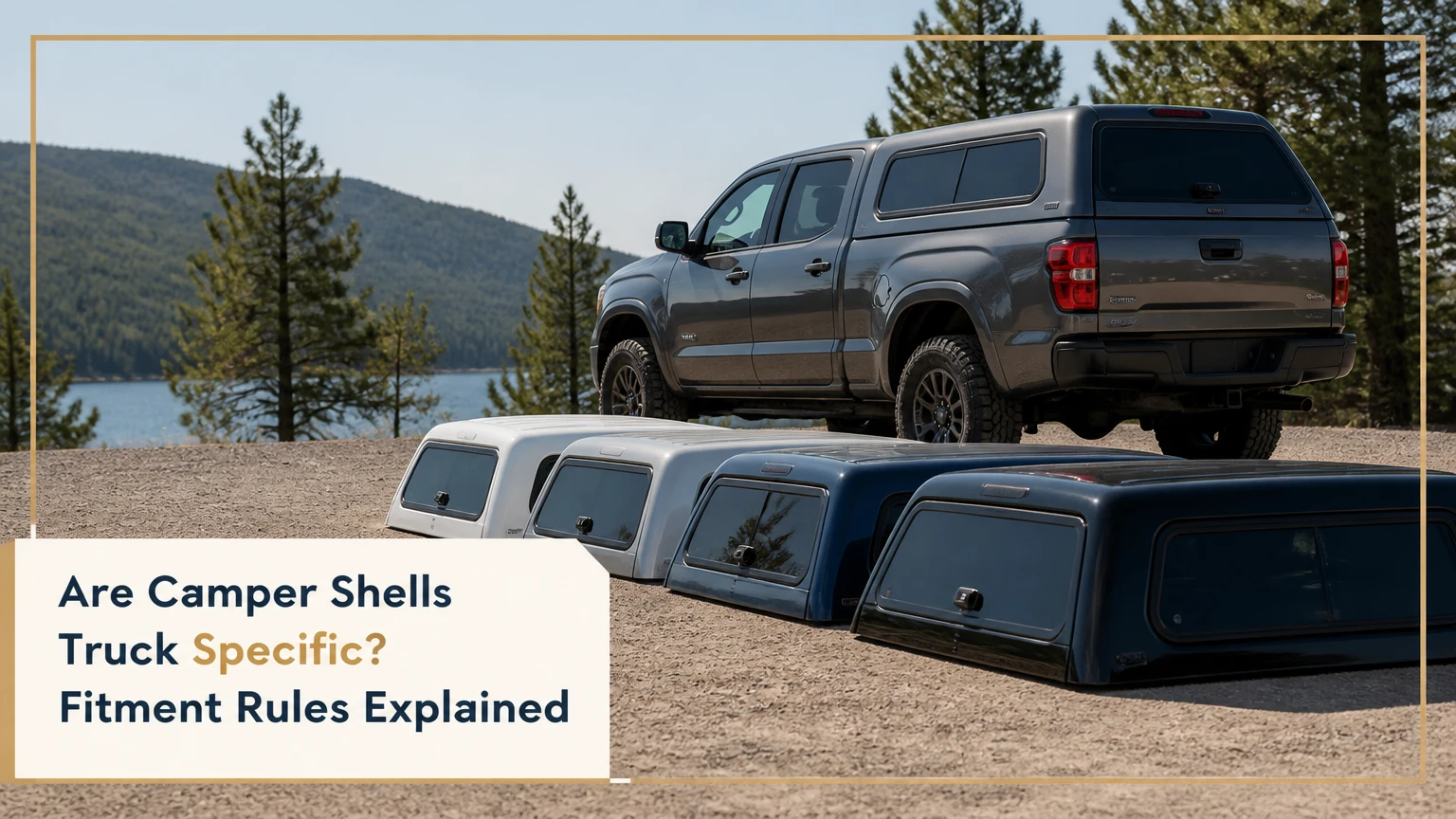
Yes, camper shells are generally truck-specific because each shell must match a pickup’s bed length, rail width, cab shape, tailgate geometry, and mounting points. A shell made for one truck rarely transfers directly to another, even when both beds are advertised as 6.5 feet. Some toppers fit several trucks only when the manufacturer explicitly confirms those applications.
Key Facts at a Glance
- Camper shells fit the truck bed, not merely the truck’s advertised bed length.
- Model year, bed length, cab configuration, bed style, and rail shape determine compatibility.
- A 6.5-foot Ford F-150 bed and a 6.5-foot Chevrolet Silverado bed do not have interchangeable topper fitment.
- A used shell needs a matching front bulkhead, side-rail profile, tailgate opening, and clamp layout.
- Most no-drill installations use four to six clamps and closed-cell EPDM sealing tape.
- A rooftop tent or cargo rack requires a shell with a documented dynamic and static roof-load rating.
Are Camper Shells Truck Specific?
Camper shells are truck specific in most buying situations, but “strictly” is too absolute. A shell can fit multiple truck models when its manufacturer lists the same dimensions and mounting geometry for those vehicles. The correct standard is verified shell fitment, not brand name, bed-length label, or visual similarity.
Truck beds change across generations and trim configurations. The relevant variables include the distance between the bed rails, the rail height, the angle of the front corners, the cab-to-bed gap, the tailgate lip, and the location of usable clamping surfaces. A topper that sits on the rails may still fail because its rear door strikes the tailgate or its front skirt touches the cab.
A practical fitment example is a 6.5-foot Ford F-150 shell compared with a 6.5-foot Chevrolet Silverado shell. Both labels describe an approximate nominal length, but the bed widths, rail contours, rear corners, and tailgate profiles differ. Cross-brand installation can create overhang, gaps, latch failure, or water entry.
What Does a Camper Shell Fit?
A camper shell fits a specific combination of truck generation, body style, bed length, and bed design. The combination is more precise than “2020 pickup with a long bed,” because a crew-cab truck may use a different bed from an extended-cab version of the same model.
Common fitment identifiers include:
- Manufacturer and model, such as Toyota Tacoma or Ram 1500
- Model year or generation range
- Bed length, such as 5.5, 6.5, or 8 feet
- Cab configuration, such as regular, extended, double, or crew cab
- Bed style, such as standard bed, stepside, flare-side, or dually
- Rail configuration, including utility tracks and factory tie-down systems
- Tailgate and spoiler shape
- Bed liner thickness and rail caps
Manufacturers often publish a fitment guide using model-year ranges. That guide outranks a seller’s statement that a shell “came off a 6.5-foot truck.”
Why Does Bed Length Alone Not Prove Fit?
Bed length alone does not prove compatibility because manufacturers measure and label beds differently. A nominal 6.5-foot bed may measure several inches differently depending on whether the stated dimension runs from the bulkhead to the closed tailgate, along the floor, or between selected reference points.
Measure the truck and the shell before committing money. Measure the truck bed from the inside front bulkhead to the inside tailgate with the tailgate closed, then compare side-rail width and front-corner shape with the topper’s specifications. Do not rely on the outside body length.
The following dimensions have the greatest effect on fit:
| Dimension or feature | Why it matters | Typical failure if mismatched |
|---|---|---|
| Inside bed length | Determines front-to-rear shell position | Rear door overlaps tailgate |
| Rail-to-rail width | Determines flange contact | Shell overhangs or rocks |
| Front rail height | Determines cab clearance | Front skirt touches cab |
| Tailgate opening width | Determines rear-door clearance | Glass door cannot latch |
| Rear corner radius | Determines side seal contact | Corner leaks during rain |
| Clamp access depth | Determines mounting security | Clamps cannot reach inner lip |
A factory or dealer fitment chart may list tolerances, but a buyer should still inspect the truck. Bed liners, aftermarket rail caps, and utility-track hardware can change the effective mounting surface by 0.25-1 inch.
Which Truck Details Must Match?
The truck’s bed length, rail geometry, generation, and tailgate design must match the camper shell. Cab configuration matters indirectly because the cab determines the bed length and front profile available on that truck, while a stepside or dually bed can make a standard shell unusable.
Model Year and Generation
Model-year changes can alter the bed without changing the model name. A shell for a 2004-2014 Ford F-150 should not be assumed to fit a 2015-2020 F-150, because Ford changed the body, rails, and rear geometry. Similar generation breaks occur with the Toyota Tacoma, Chevrolet Silverado, GMC Sierra, Ram 1500, and Nissan Frontier.
Some manufacturers carry a shell across several years when the bed dimensions remain sufficiently consistent. The listing must identify that range. “Fits F-150” is incomplete without a year range.
Bed Length and Body Style
Common pickup bed lengths include approximately 5-5.5 feet, 6-6.5 feet, and 8 feet. The actual label varies by manufacturer, and a short-bed shell cannot be safely converted into a long-bed shell by moving clamps.
Stepside, flare-side, and dually beds require special attention. Their outer fenders or narrower cargo boxes change the shell footprint. A standard-bed topper may sit on the wrong surfaces even when the floor length appears similar.
Bed Rails and Utility Systems
A camper shell’s bottom flange must sit continuously on the bed rails. Toyota deck rails, Ford BedRug systems, Ram utility rails, and aftermarket tie-down tracks can interfere with standard clamp positions.
Most conventional toppers use four to six internal C-clamps. Track-mounted shells may use T-slot adapters or dedicated brackets. A clamp that contacts only a plastic rail cap is not an equivalent substitute for a clamp that reaches the structural bed rail.
Tailgate, Spoiler, and Rear Door
Modern tailgates often have molded lips, cameras, spoilers, and complex seals. The shell’s rear skirt must clear these parts while allowing the glass or aluminum door to close and latch.
A rear door can appear aligned while its lower seal misses the tailgate. Test the door with the tailgate open and closed, and check both corners. A 0.25-inch interference can become a cracked latch or damaged tailgate seal after vibration.
How Does a Camper Shell Attach?
A camper shell attaches by placing its lower flange on sealed bed rails and securing the shell with clamps or model-specific brackets. The installation does not normally require drilling the truck bed, although some commercial and track-based systems use dedicated hardware.
A typical installation sequence is:
- Remove the old topper, rail accessories, and crushed seal tape.
- Clean the bed rails with a non-residue cleaner.
- Apply closed-cell EPDM foam tape around the full flange contact area.
- Lower the shell with two to four people or a ceiling hoist.
- Center the shell and confirm a consistent cab gap.
- Install four to six clamps, spacing them evenly.
- Close the rear door and tailgate to verify clearance.
- Connect the third-brake-light harness.
- Tighten clamps to the shell manufacturer’s specification.
- Perform a water test and short vibration inspection.
A typical professional installation takes 1-3 hours. A shell that requires extensive forcing, prying, or uneven clamping is probably mismatched.
What Seal and Clamp Details Matter?
Closed-cell EPDM foam tape creates the primary compression seal between the shell flange and truck rails. Reusing flattened tape often produces leaks at the front corners and rear rail transitions. Silicone can supplement a seal at a specific joint, but it should not compensate for a fundamentally incorrect shell footprint.
Clamp torque is manufacturer-specific. A typical range is 5-10 foot-pounds, but the installer should follow the shell maker’s instructions because fiberglass flanges can crack when overtightened. The correct checkpoint is firm, even compression without distortion, not maximum clamp force.
The shell should remain stable when pushed sideways by hand. The flange should contact the rail along its length, and the rear door should latch without lifting the shell.
What Electrical Requirements Should You Check?
A camper shell’s third brake light, commonly called the center high-mounted stop lamp, should connect to the truck’s brake-light circuit through a properly insulated harness. Federal Motor Vehicle Safety Standard 108 governs lighting equipment in the United States, while installation and inspection requirements can also depend on state law and the truck’s original configuration.
A plug-and-play harness is preferable to loose wire taps when available. Check polarity, ground quality, connector protection, and routing near the tailgate hinge. Interior LED lights, fans, and 12-volt outlets need a separate fused circuit if their current exceeds the shell’s supplied harness.
Test the following before delivery:
- Third brake light illuminates with both brake-pedal applications.
- Turn signals do not activate the shell lamp incorrectly.
- Wires clear exhaust heat, hinges, and sharp bed edges.
- Connectors remain protected from water and road spray.
- Added accessories use an appropriately rated fuse.
A shell can fit physically and still be unsuitable if its wiring cannot be integrated safely.
Which Camper Shell Material and Profile Fits Your Use?
Fiberglass suits owners who prioritize painted styling and weather sealing, while aluminum suits buyers who need lower weight, lower cost, or commercial storage. High-load overland systems require a documented structural rating rather than a material label alone.
| Shell type | Typical weight | Typical price | Typical roof load | Best-matched use |
|---|---|---|---|---|
| Fiberglass cab-high | 175-225 lb | $2,200-$4,500 | 100-150 lb dynamic | Daily driving and light camping |
| Casual aluminum | 70-110 lb | $1,200-$1,800 | 0-50 lb dynamic | Dry cargo and occasional use |
| Commercial aluminum | 150-200 lb | $2,500-$5,000 | 200-400 lb dynamic | Tools, contractors, ladder racks |
| Reinforced overland canopy | 210-260 lb | $3,500-$7,000 | 350-750 lb dynamic | Roof tents and trail equipment |
These figures are typical market ranges, not universal specifications. A manufacturer’s load table controls the decision. A shell’s static capacity while parked does not authorize the same load while driving.
| Profile | Roof relationship | Interior effect | Typical clearance concern |
|---|---|---|---|
| Cab-high | Approximately level with cab roof | Lowest headroom | Garage and low branches |
| Mid-rise or wedge | Approximately 3-4 inches above cab at rear | More sleeping volume | Moderate wind exposure |
| High-rise | Approximately 6-12 inches above cab | Maximum interior height | Highest drag and clearance risk |
| Commercial service body | Often above cab with side doors | Tool access and shelving | Rack and overhead clearance |
Fiberglass offers smooth body contours and paint matching, but its weight makes frequent removal difficult. Casual aluminum is easier to lift and cheaper, but its thin panels dent more readily and usually lack meaningful roof-load capacity. Reinforced steel or molded composite systems can carry more equipment, but continuous weight reduces payload and can increase fuel consumption.
How Much Payload Does a Topper Use?
A camper shell commonly consumes 70-260 pounds of payload before bedding, tools, passengers, water, or a roof rack are added. The truck’s door-jamb payload label and the shell’s verified weight determine whether the planned load is acceptable.
A simple payload calculation is:
Available payload = truck door-label payload – shell weight – passengers – cargo – accessories
For example, a truck with 1,850 pounds of rated payload carrying a 210-pound shell, two 170-pound adults, 250 pounds of camping gear, and a 160-pound rack and tent has 890 pounds remaining before additional water or equipment. Axle ratings and tire load ratings still matter.
Roof-tent buyers need two separate numbers:
- Dynamic roof load: weight allowed while driving.
- Static roof load: weight allowed while parked, often several times higher.
The tent, rack, bedding, and occupants must fit the applicable rating. A standard fiberglass shell without internal reinforcement is not automatically suitable for a rooftop tent.
Can a Used Camper Shell Fit a Different Truck?
A used camper shell can fit a different truck only when the shell footprint and mounting geometry match the new vehicle. The fact that a shell came from a similar pickup, or that both trucks have the same nominal bed length, is insufficient evidence.
Use this inspection sequence before buying:
| Used-shell check | Acceptable finding | Reject or investigate when |
|---|---|---|
| Manufacturer label | Model and year range are identifiable | Label is missing and fitment is unknown |
| Flange condition | Straight, continuous, no crushed sections | Fiberglass is cracked or badly warped |
| Rear door | Opens and latches smoothly | Door contacts tailgate or frame |
| Glass and seals | No cracks, hardening, or missing channels | Replacement parts are unavailable |
| Clamps | Four to six compatible clamps included | Hardware is bent, corroded, or absent |
| Wiring | Harness and lamp are intact | Wires are cut at the shell |
| Roof structure | Load rating is documented | Seller promises strength without data |
Bring a tape measure, flashlight, straightedge, and the truck’s fitment dimensions. Photograph the front corners, rear door, underside flange, and clamp locations. A professional topper dealer can often identify a shell by its serial plate or molded part number.
A shell may be economically unusable even when it is free. Replacement glass, a custom rear door, new clamps, professional paint, and sealing work can exceed the price of a correctly fitted used unit.
What Are the Alternatives to a Camper Shell?
A camper shell is best when the owner needs enclosed vertical cargo space, weather protection, or a sleeping platform. A tonneau cover, bed box, soft topper, or slide-in truck camper may be better when weight, removal speed, height, or living space matters more.
| Alternative | Typical weight | Typical price | Installation time | Best use |
|---|---|---|---|---|
| Hard folding tonneau | 50-100 lb | $800-$2,500 | 1-3 hours | Low-profile cargo security |
| Soft roll-up cover | 25-60 lb | $250-$1,200 | 30-90 minutes | Low cost and quick removal |
| Soft truck topper | 60-120 lb | $1,000-$3,000 | 1-3 hours | Flexible weather protection |
| Slide-in camper | 900-3,000 lb | $5,000-$40,000 used or new | 2-6 hours | Full camping facilities |
| Bed rack with tent | 150-350 lb before tent | $1,500-$8,000 | 2-6 hours | Elevated sleeping and gear |
A tonneau cover generally preserves garage clearance and uses less payload, but it cannot provide the same enclosed headroom. A slide-in camper provides beds, appliances, or water systems, but it demands substantial payload capacity and usually affects handling more than a shell.
What Are the Most Common Fitment Problems?
The most common camper-shell problems are water leaks, rear-door interference, unstable clamping, electrical faults, and excessive roof loading. Each problem usually traces to a geometry mismatch, worn seal, incorrect hardware, or an unsupported assumption about capacity.
Front-Corner Water Leaks
Front-corner leaks occur when the bed bulkhead and side rails do not create uniform flange compression. Replace old tape, clean the surfaces, and add a carefully fitted second layer only where the manufacturer permits it. Do not use thick sealant to force a shell onto incompatible rails.
Rear Glass Will Not Latch
A rear door that will not latch often indicates that the shell sits too far forward, the side rails are bowed, or the tailgate lip interferes with the lower skirt. Loosen the rear clamps, square the shell, and inspect the gap before retightening. Never slam the door to compensate for a poor fit.
Shell Moves on the Bed
Movement indicates insufficient clamp engagement, contaminated rails, damaged flange material, or incompatible clamp locations. Verify that each clamp contacts structural metal rather than a loose bed liner or plastic cap. A moving topper can damage paint and enlarge mounting cracks during highway vibration.
Condensation Forms Inside
Condensation forms when humid air contacts a cooler shell roof or metal surface. Ventilation, a carpeted headliner, and moisture control reduce the problem, but a vent fan works better than leaving a small window permanently open during rain.
Brake Light Does Not Work
A failed shell brake light commonly results from a poor ground, wrong connector pinout, damaged wire, or an incorrect tap into the truck harness. Test the lamp with a multimeter and inspect the ground connection before replacing the light assembly.
How Should You Choose a Shell for Your Situation?
Choose a shell by matching verified truck fitment to the intended load, access pattern, height, and removal frequency. The best configuration differs for a daily driver, contractor, camper, and rooftop-tent user.
- Daily driver: Choose a cab-high fiberglass topper with a documented model-year fit, side sliding windows, and a carpeted headliner. Expect approximately 175-225 pounds and $2,200-$4,500.
- Budget cargo user: Choose casual aluminum when weight and purchase price matter more than styling. Avoid roof racks unless the manufacturer gives a specific load rating.
- Contractor: Choose a commercial aluminum cap with side-access doors, internal tool storage, and a rack rated for the intended ladders or materials. Confirm axle and payload limits.
- Weekend camper: Choose a mid-rise or wedge shell when a sleeping platform needs more vertical room but the truck still enters a typical garage.
- Overlander: Choose a reinforced canopy only when its dynamic and static roof ratings cover the rack, tent, and occupants. The shell’s empty weight must fit the truck’s payload reserve.
A shell is not automatically a camper in the full recreational-vehicle sense. Most toppers provide an enclosed bed area, not insulation, ventilation, seating, plumbing, or certified occupant protection.
What Should You Verify Before Buying?
Verify the exact truck and shell identifiers, physical dimensions, structural limits, and included hardware before payment. A seller’s phrase “universal truck topper” should trigger a request for the manufacturer’s application chart and underside measurements.
Use this final checklist:
- Record the truck year, make, model, trim, cab, and bed length.
- Identify the truck generation and whether the bed is standard, stepside, or dually.
- Measure inside bed length, rail width, rail height, and cab-to-bed clearance.
- Photograph tailgate spoilers, rail caps, utility tracks, and bed liners.
- Obtain the shell model number, serial plate, and original fitment range.
- Compare clamp locations and flange width, not only outer dimensions.
- Confirm the shell weight against remaining payload.
- Confirm dynamic and static roof ratings separately.
- Inspect seals, glass, hinges, latches, wiring, and cracks.
- Price missing clamps, replacement seals, installation, and transport.
- Test-fit before finalizing a private-party purchase when possible.
- Schedule a water test after installation.
The most reliable purchase is a shell sold specifically for the truck’s generation and bed configuration. A bargain shell with uncertain fitment is often a repair project.
Frequently Asked Questions
Do camper shells fit all trucks with the same bed length?
No. A shared 5.5-foot, 6.5-foot, or 8-foot label does not establish compatible rail width, front corners, tailgate clearance, or clamp access. Camper shells fit all trucks only when the manufacturer lists those exact models and years, or when a qualified installer verifies every relevant dimension and mounting point.
Can a Ford topper fit a Chevy truck?
A Ford topper can fit a Chevrolet truck only in an explicitly documented cross-application. Most Ford and Chevrolet beds differ in width, rail shape, cab gap, and tailgate geometry, so a shell removed from an F-150 should not be purchased for a Silverado based on bed length alone.
Do bed liners affect camper-shell fit?
Yes. Thick spray-in liners, drop-in liners, rail caps, and BedRug materials can reduce flange contact or prevent clamps from reaching the inner rail lip. Measure the truck in its installed condition, because removing a liner after buying the shell may be difficult and can expose the bed to damage.
Can a camper shell be modified to fit another truck?
A qualified fabricator can sometimes modify brackets, seals, or wiring, but major changes to the fiberglass flange, rear door, or roof structure can weaken the shell and eliminate its load rating. Modification is usually practical only when the shell is inexpensive and the final fit can be professionally tested.
How long does a camper shell installation take?
A typical no-drill camper-shell installation takes 1-3 hours with two people, new seal tape, compatible clamps, and an accessible truck bed. Wiring, rack installation, damaged hardware, or fitment correction can extend the work to 4-6 hours. Water-test the installation before loading valuable cargo.
Is a camper shell worth buying for occasional camping?
A camper shell is worthwhile when enclosed cargo security and frequent bed access justify its weight and cost. For two or three camping trips per year, a tonneau cover, tent, or soft topper may cost less and remove faster. A shell becomes more useful when the truck carries gear every week or supports a permanent sleeping platform.
The Bottom Line
Are camper shells truck specific? Yes, in practical purchasing terms, because a shell must match the truck’s generation, bed length, rail geometry, cab clearance, tailgate design, and mounting system. The important exception is a manufacturer-approved multi-truck fitment, not an assumption based on a shared 6.5-foot or 8-foot label.
Measure the truck, identify the shell model, check payload and roof-load ratings, inspect used components, and verify the rear door before payment. Those steps prevent the most expensive mistakes: leaks, unsafe clamps, broken glass, damaged tailgates, and a topper that cannot be installed.