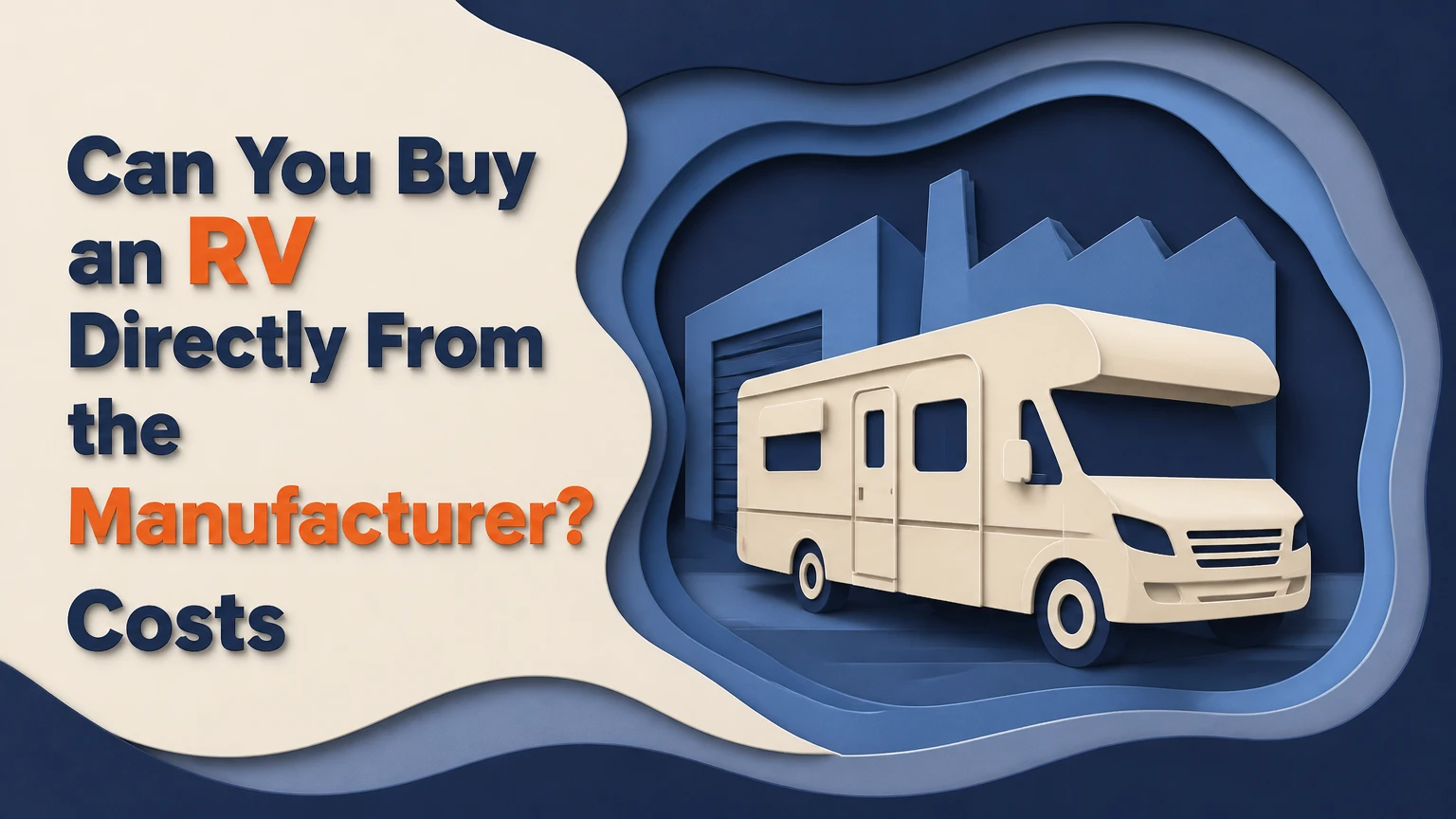
Yes, you can buy an RV directly from the manufacturer, but availability depends on the builder, RV type, and state law. Boutique trailer companies, custom van converters, and specialty motorhome builders commonly contract with customers themselves, while many mass-market brands sell through franchised dealers or route factory orders through those dealers.
Key Facts at a Glance
- Factory-direct RV purchases usually involve a build-to-order contract, rather than an RV selected from dealer inventory.
- Typical direct-purchase deposits range from 10% to 20%, and many deposits become nonrefundable after production begins.
- Molded fiberglass trailers commonly cost $25,000-$85,000, while custom motorhomes can exceed $400,000.
- A factory-direct build commonly takes 3-18 months, although complex overland vehicles can require 24 months.
- Direct purchasing can increase customization, but it rarely produces the lowest total price.
- Buyers must verify warranty service, title documents, sales tax, transportation, and payload before paying a deposit.
Can You Buy an RV Directly From the Manufacturer?
A factory-direct RV purchase means the buyer signs a sales agreement with the company that builds or converts the recreational vehicle, instead of purchasing through an independent RV dealership. The manufacturer may deliver the vehicle, arrange transport, or require pickup at its plant.
The answer is therefore yes, but the phrase “manufacturer” needs careful definition. A company that converts a Mercedes-Benz Sprinter into a camper van may sell directly, while Mercedes-Benz itself does not sell that finished RV. A dealer may also accept a factory order, but that remains a dealer transaction even when the vehicle is built specifically for you.
State franchise laws are the main reason direct purchasing is unavailable from many large RV groups. The Federal Trade Commission describes franchising as a relationship involving brand, operational, and commercial controls, but vehicle sales rules are primarily governed by state statutes. Those statutes differ, and RV treatment can differ from passenger-car treatment.
Is a factory order the same as a direct purchase?
A factory order is not automatically a direct purchase. A buyer can select options through a dealer, sign with the dealer, pay the dealer, and receive a vehicle built at the manufacturer’s plant. The transaction remains a dealership sale because the dealer controls the retail contract.
A direct order has a manufacturer or converter as the contracting seller. Check the legal seller shown on the purchase agreement, invoice, title paperwork, and Manufacturer’s Certificate of Origin. That single detail resolves many disputes about deposits, taxes, warranty obligations, and delivery responsibility.
Which RV Types Are Commonly Sold Direct?
Molded fiberglass trailers, custom camper vans, luxury motorhomes, and specialty off-road rigs are the most common direct-sale categories. Large-volume travel trailers and fifth wheels are more likely to use dealer distribution, although some manufacturers accept customer specifications through authorized retailers.
| RV category | Representative direct builders | Typical new price | Typical build time |
|---|---|---|---|
| Molded fiberglass trailer | Scamp, Casita, Oliver, Escape | $25,000-$85,000 | 3-12 months |
| Custom Class B van | Sportsmobile, Outside Van, Advanced RV | $120,000-$400,000+ | 6-18 months |
| Luxury motorhome | Newell, Prevost converters, custom builders | $500,000-$2 million+ | 12-30 months |
| Overland vehicle | EarthRoamer, Storyteller Overland, specialty converters | $150,000-$750,000+ | 9-24 months |
| Teardrop or small trailer | Timberleaf, nüCamp direct programs, boutique builders | $15,000-$60,000 | 2-10 months |
These figures are typical market ranges, not quotes. Chassis choice, battery capacity, cabinetry, heating systems, suspension, and imported components can change the final price substantially. A $180,000 van conversion may include a $70,000 chassis, leaving $110,000 for conversion labor, equipment, engineering, overhead, and profit.
Brand availability also changes. Some companies sell factory-direct in one period and add dealers later, while others accept deposits only through a regional distributor. Confirm the current sales channel from the builder’s written purchase instructions, not from an old forum post or social-media video.
How Does the Factory-Direct Process Work?
A direct RV purchase normally follows seven stages: specification, written quote, deposit, production, inspection, final payment, and delivery. The buyer’s success depends more on the contract and inspection than on the sales conversation.
1. Define the build before requesting a quote
Write down the intended occupancy, tow vehicle, climate, travel duration, electrical loads, and storage requirements. A full-time couple using induction cooking and air conditioning has a different electrical design from a weekend buyer running a refrigerator and lights.
Request a line-item build sheet covering the base vehicle, every option, installation labor, taxes, freight, documentation, inspection, and delivery. Ask whether listed options are standard, provisional, or subject to supplier availability.
2. Confirm the legal seller and deposit rules
The purchase agreement should identify the business name, physical address, license information where applicable, vehicle identification number process, deposit amount, cancellation policy, and estimated completion date. Typical deposits range from 10% to 20%, but custom builders may request milestone payments.
A deposit labeled “nonrefundable” still requires context. Ask when the deposit becomes committed to materials, what happens if the manufacturer misses delivery milestones, and whether the builder may substitute components without written approval.
3. Approve the final specification
Sign a dated build sheet that includes model numbers and measurable specifications. “Large solar system” is inadequate; “600 watts of roof solar, 400 amp-hours of lithium battery capacity, and a 3,000-watt inverter” is testable.
Every change should produce a revised price and delivery impact. Change orders made after cabinetry, wiring, or plumbing begins can create both cost increases and schedule delays.
4. Monitor production without assuming completion
Manufacturers may provide photographs, milestone notices, or remote video calls, but progress images do not prove that systems work. Ask for confirmation of chassis receipt, major component installation, water testing, electrical testing, and road testing.
Build schedules often move because of chassis allocation, appliances, windows, refrigeration units, semiconductors, or certification work. Treat the promised date as a planning estimate and maintain a buffer of at least 30-60 days before a major trip.
5. Complete an independent or factory inspection
Schedule a professional RV inspection where possible, even at the factory. A factory employee understands the product, but an independent inspector provides a separate acceptance record and may identify issues the buyer overlooks because of excitement.
Use a written punch list. Classify each item as safety-related, water-intrusion-related, functional, cosmetic, or documentation-related, then require a completion date for every unresolved item.
6. Pay the balance only after acceptance terms are clear
The final payment should correspond with the contract’s acceptance procedure. Confirm whether unresolved defects permit withholding funds, whether transport occurs before or after title transfer, and who bears damage risk during shipping.
Before departure, obtain the Manufacturer’s Certificate of Origin, final invoice, warranty documents, owner manuals, keys, spare parts, recall information, and a signed list of completed repairs.
7. Transport and register the RV
Factory pickup may involve airfare, hotel costs, temporary tags, insurance, and a long drive or tow. Transport can cost approximately $1,000-$5,000 for many domestic shipments, with larger motorhomes and remote destinations costing more.
The National Highway Traffic Safety Administration governs vehicle safety standards, but each state’s Department of Motor Vehicles controls registration procedures. A buyer should call the destination DMV before delivery, not after arrival.
How Much Does a Direct-Buy RV Cost?
A factory-direct RV costs approximately $25,000-$85,000 for a small molded trailer, $120,000-$400,000 or more for a custom van, and $150,000-$750,000 for many specialized overland vehicles. The invoice price is only one part of the ownership budget.
| Cost component | Small trailer example | Custom van example | Luxury or overland example |
|---|---|---|---|
| Base vehicle or trailer | $20,000 | $65,000 | $180,000 |
| Conversion or build work | $25,000 | $115,000 | $300,000 |
| Common options | $8,000 | $35,000 | $120,000 |
| Factory delivery or transport | $1,500 | $2,500 | $7,500 |
| Inspection and travel | $1,000 | $2,000 | $4,000 |
| Estimated pre-tax total | $55,500 | $219,500 | $611,500 |
Sales tax, registration fees, insurance, financing interest, storage, and equipment installed after delivery are additional. A buyer comparing a factory quote with a dealer’s advertised price must compare identical specifications and the same tax treatment.
Direct builders often charge closer to list price because they produce fewer units and carry less excess inventory. A dealer may discount mass-produced inventory by 10%-30% from MSRP during promotions or model-year clearance, although dealer fees, add-ons, financing products, and trade-in values can alter the final transaction.
Is buying directly cheaper than using a dealer?
Buying directly is usually not cheaper on the purchase invoice. Factory-direct value comes from customization, access to the builder, a lower risk of unwanted options, and a direct design relationship, while dealer value comes from inventory competition, trade-ins, local service, and negotiable pricing.
A direct purchase can still reduce waste. A buyer who avoids $15,000 of unwanted options may spend less overall, even if the custom RV has a higher published price. That calculation applies only when the buyer knows the required specification and does not add expensive upgrades during production.
How Do Financing and Payment Work?
Factory-direct RV financing is possible, but the process may require more preparation than dealer financing. Credit unions, banks, RV lenders, and specialty lenders may finance a direct purchase if the vehicle has a clear VIN, recognized classification, appraisal value, and acceptable title documents.
Ask the lender four questions before signing:
- Will the lender finance a custom conversion or only a factory-certified RV?
- Can the lender fund milestone payments, or does it release one amount at delivery?
- What documents are required, such as the invoice, MCO, build sheet, and appraisal?
- Does the lender cover the chassis and conversion under one security interest?
Some custom builders require cash during production, leaving the buyer to refinance after delivery. That arrangement creates liquidity risk and may produce a higher interest rate. Obtain written lender approval for the exact builder and vehicle type.
What Should the Purchase Contract Include?
A factory-direct RV contract should specify the legal seller, exact build, price, payment schedule, completion estimate, delivery responsibility, warranty, cancellation rights, and defect-resolution process. Verbal promises about solar capacity, delivery dates, or included accessories have little practical value unless they appear in the signed documents.
Include these details:
- Manufacturer legal name and business address
- Chassis make, model, wheelbase, and expected VIN process
- Gross Vehicle Weight Rating, cargo capacity, and completed weight target
- Appliance brands, model numbers, battery chemistry, and capacity
- Water-tank capacities and generator or inverter specifications
- Deposit refund conditions and change-order charges
- Delivery date range and delay remedies
- Shipping insurance and damage responsibility
- Warranty duration, exclusions, and labor reimbursement
- Approved service locations and parts availability
- MCO, invoice, title, recall, and tax-document obligations
The Federal Trade Commission advises consumers to get important promises in writing because written terms establish what the seller agreed to provide. That principle matters more with a custom RV because each unit can differ from the builder’s standard brochure.
What Should You Inspect Before Acceptance?
A factory PDI should test every installed system under operating conditions, not merely confirm that components are present. The buyer should inspect the roof, seals, chassis, plumbing, electrical system, appliances, safety equipment, documentation, and actual weight before accepting the RV.
| Inspection area | Test or measurement | Acceptance target |
|---|---|---|
| Water system | Pressurize fresh-water lines for 30 minutes | No leaks, pump cycles normally |
| Electrical system | Test shore power, inverter, outlets, and battery monitor | Every outlet works, voltage remains stable |
| Propane system | Leak test and appliance ignition | No detected leak, refrigerator and furnace operate |
| Roof and exterior | Inspect sealant, windows, doors, lights, and underbody | No gaps, cracks, water entry, or loose fixtures |
| Chassis and driving | Road test at city and highway speeds | No warning lights, abnormal vibration, or steering pull |
| Weight and payload | Certified scale measurement with normal load | Actual weight remains below GVWR and axle ratings |
Test the refrigerator on its available power modes, run the furnace through a complete cycle, fill and drain each tank, open every cabinet, operate every window, and confirm that smoke, carbon-monoxide, and propane detectors function.
A common practitioner rule is to inspect before final payment whenever the contract permits it. Cosmetic repairs are easier to resolve before the vehicle leaves the plant, while water leaks discovered after transport can create arguments about whether damage occurred in transit.
Where Do You Get Warranty Repairs?
Warranty service for a direct-built RV usually comes from the manufacturer, an approved independent RV shop, the chassis maker, or a component supplier. The chassis warranty and the coach-conversion warranty may have different administrators, exclusions, and service locations.
Before ordering, request the names of authorized or pre-approved service providers within 100-200 miles of your home. Ask each provider whether it has worked on that builder’s electrical, plumbing, structural, and software systems, and whether the manufacturer pays labor directly or reimburses the owner.
Warranty delays often result from parts approval rather than technical difficulty. Obtain written authorization before paying an independent shop for covered work, and retain photographs, diagnostic reports, invoices, and shipping records.
The chassis manufacturer handles many engine, transmission, brake, and emissions issues. The RV builder generally handles cabinetry, coach wiring, tanks, windows, insulation, and conversion-specific systems. A chassis recall should be completed and documented before handover.
How Do You Register a Factory-Direct RV?
Registering a direct-purchase RV requires the MCO, signed bill of sale, proof of insurance, odometer disclosure when applicable, sales-tax evidence, weight information, and any state inspection or emissions documents. The exact list varies by state and by whether the vehicle is a trailer, motorhome, or van conversion.
Call the destination DMV and ask how it classifies the vehicle. Some offices process a trailer through a separate title division, while a converted van may require inspection, photographs, a conversion affidavit, or confirmation that the completed vehicle meets state equipment rules.
Check these documents before leaving the factory:
- Manufacturer’s Certificate of Origin with correct buyer name
- Final invoice showing VIN or trailer identification number
- Weight certificate and axle information
- Sales-tax receipt or documentation of tax collection
- Lienholder information for financed purchases
- Safety, emissions, and inspection records
- Recall completion paperwork for the chassis
Do not assume factory pickup means the vehicle is immediately road-legal in your state. Temporary registration, transit plates, insurance coverage, and towing requirements must be arranged before travel.
Direct Manufacturer or Dealer: Which Is Better?
A direct manufacturer is usually better for buyers who need a specialized layout, unusual electrical capacity, off-road engineering, or a close relationship with the builder. A dealership is usually better for buyers who prioritize immediate availability, price negotiation, trade-in convenience, and nearby service.
| Decision factor | Factory-direct purchase | Dealer purchase | Practical advantage |
|---|---|---|---|
| Availability | 3-18 month typical build | Same day to 90 days | Dealer |
| Customization | Build sheet with selected options | Limited or factory-order options | Factory-direct |
| Typical discount | 0%-10% from listed price | 10%-30% during promotions | Dealer |
| Deposit | 10%-20%, often restricted | $500-$5,000 typical holding deposit | Dealer |
| Trade-in | Usually difficult or unavailable | Common at signing | Dealer |
| Warranty access | Factory and approved shops | Dealer plus manufacturer network | Dealer |
| Engineering contact | Direct builder communication | Sales and service departments | Factory-direct |
| Factory inspection | Usually available | Rare before delivery | Factory-direct |
The table compares typical patterns, not guaranteed terms. A reputable boutique builder can provide stronger technical support than a poorly managed dealership, while a specialized dealer may handle a factory order efficiently and offer better financing.
Who should choose a factory-direct RV?
A full-time RVer may justify direct construction when insulation, lithium power, water capacity, and serviceability affect daily living. An off-grid traveler may need engineering that a standard dealer model cannot provide.
A first-time buyer should be cautious. The buyer must understand payload, electrical loads, water systems, maintenance access, and warranty logistics before committing to a nonstandard build. Renting a similar RV or buying a lightly used model can expose unsuitable layouts at much lower risk.
A weekend traveler with a flexible floor-plan preference will often obtain better value from dealer inventory. The buyer can inspect the completed unit, negotiate the price, and obtain immediate support without accepting a long custom-build queue.
What Can Go Wrong With a Direct Purchase?
The most expensive direct-purchase failures involve unclear specifications, unrealistic delivery dates, restricted deposits, inadequate payload, incomplete paperwork, and weak warranty support. These problems are preventable when the buyer verifies the builder’s process before transferring money.
Deposit disputes
A buyer may assume a deposit is refundable because production has not started, while the contract defines the deposit as committed immediately. Require a written refund schedule tied to cancellation date and production milestones.
Payload errors
Options can consume hundreds or thousands of pounds of carrying capacity. Weigh the completed RV and compare the result with GVWR, axle ratings, tire ratings, and hitch limits. A large battery bank can improve autonomy while reducing legal payload.
Scope creep
Custom buyers frequently add roof solar, cabinetry, suspension, appliances, and storage after signing. Each change can increase both price and weight. Approve a final weight budget alongside the final dollar budget.
Service isolation
A builder may have excellent design skills but limited nationwide repair capacity. Ask how many units it has produced, which parts are proprietary, and whether common components can be sourced through RV suppliers.
Transport damage
A factory-perfect RV can arrive with cracked glass, scraped bodywork, or shifted interior fixtures. Photograph the vehicle before loading, obtain a signed condition report, and define the claims process before the carrier departs.
Documentation failures
Incorrect names, VINs, weights, or tax receipts can delay registration and financing. Review every document before signing, because correcting an MCO after delivery may require cooperation from both the builder and state agency.
What Are the Practical Alternatives?
The main alternatives are a dealer-stock RV, a dealer-arranged factory order, a used direct-built RV, or a professional conversion completed after purchasing a van. Each alternative changes the balance between customization, risk, price, and delivery time.
| Alternative | Typical price range | Typical availability | Main trade-off |
|---|---|---|---|
| Dealer-stock travel trailer | $20,000-$80,000 | 1-30 days | Less customization, easier comparison |
| Dealer factory order | $35,000-$150,000 | 3-9 months | Dealer remains contracting seller |
| Used boutique trailer | $18,000-$65,000 | 1-60 days | Prior wear, lower initial depreciation |
| Used custom camper van | $70,000-$250,000 | 1-90 days | Existing layout and unknown modifications |
| Van plus independent conversion | $80,000-$300,000 | 4-15 months | Separate builder, chassis, and warranty risks |
A used direct-built RV can be the strongest value when the first owner absorbed depreciation and documented maintenance. Inspect for water intrusion, battery age, structural modifications, accident history, and unpaid liens before purchase.
An independent conversion offers maximum design control, but the completed vehicle may have less predictable resale value and more fragmented warranty coverage. Confirm insurance eligibility before construction begins.
What Questions Should You Ask the Manufacturer?
Ask the manufacturer questions that reveal legal responsibility, technical limits, delivery reliability, and service capacity before paying a deposit. A builder’s willingness to provide specific written answers is itself useful evidence of process maturity.
Use this pre-order checklist:
- Who is the legal seller on the contract and title documents?
- Is the deposit refundable, and when does it become nonrefundable?
- What exact date range applies to completion and delivery?
- Which components may be substituted without approval?
- What is the target finished weight with full fluids?
- Which warranty claims are paid directly to local repair shops?
- Which service partners operate near my ZIP code?
- Who pays for factory-return shipping?
- What happens if the builder misses the delivery window?
- Which recalls and inspections must be completed before pickup?
- Can the lender fund the exact vehicle and payment schedule?
- What documents will the DMV receive at handover?
A builder that cannot answer payload, warranty, and documentation questions should not receive a large unrestricted deposit. Attractive cabinetry cannot compensate for an unusable service plan.
Frequently Asked Questions
Can you buy a new RV without using a dealership?
Yes, buyers can purchase new RVs without a dealership from eligible custom builders, boutique trailer manufacturers, and direct-to-consumer converters. The buyer should verify that the builder, rather than a dealer or distributor, appears as the seller on the contract and invoice, because a factory-built vehicle does not necessarily represent a factory-direct transaction.
Can I negotiate the price with a direct RV manufacturer?
You can request pricing concessions, but direct builders often have less room than dealers because they produce lower volumes and build each unit to a defined specification. Negotiation may work better on transport, accessories, inspection fees, or upgrade bundles than on the base price, especially after the builder reserves production capacity.
Can I buy an RV directly from a manufacturer in every state?
No. Sales-channel rules, vehicle-franchise statutes, registration procedures, and tax requirements vary by state. Some builders may sell directly nationwide, while others restrict sales, use authorized dealers, or require factory pickup. Confirm the transaction with the manufacturer and your state DMV before paying a deposit.
Does factory-direct purchasing include delivery?
Delivery terms vary. Some manufacturers include factory pickup, some charge transportation separately, and others allow the buyer to arrange a carrier. Confirm the delivery price, insurance, damage responsibility, temporary registration, and title-transfer timing in writing before final payment.
Is a factory-direct RV easier to resell?
A well-documented direct-built RV can attract buyers seeking its specific layout or equipment, but unusual designs can reduce the resale audience. Keep the signed build sheet, service records, component manuals, weight certificate, invoices, and warranty history because documentation can materially affect buyer confidence.
Should I inspect a direct-built RV myself?
You should perform your own inspection and consider hiring an independent RV inspector. Factory familiarity does not replace independent verification of leaks, electrical operation, appliance performance, road behavior, weight, safety equipment, and documentation. Resolve safety and water-intrusion defects before accepting delivery.
The Bottom Line
Can you buy an RV directly from the manufacturer? Yes, when the builder offers direct sales and your state permits the transaction. The strongest candidates are custom van converters, molded fiberglass trailer companies, luxury motorhome builders, and specialized overland manufacturers.
Factory-direct purchasing delivers design control and direct builder communication, but it commonly requires a 10%-20% deposit, a 3-18 month wait, careful financing, factory or independent inspection, and a service plan near home. Dealer inventory remains the better choice for many price-sensitive or first-time buyers because it offers faster delivery, trade-ins, discounts, and established warranty access.
The safest decision is based on the complete transaction, not the advertised build price. Compare the contract, finished weight, delivery cost, registration documents, warranty network, and realistic completion date before committing to a direct RV order.