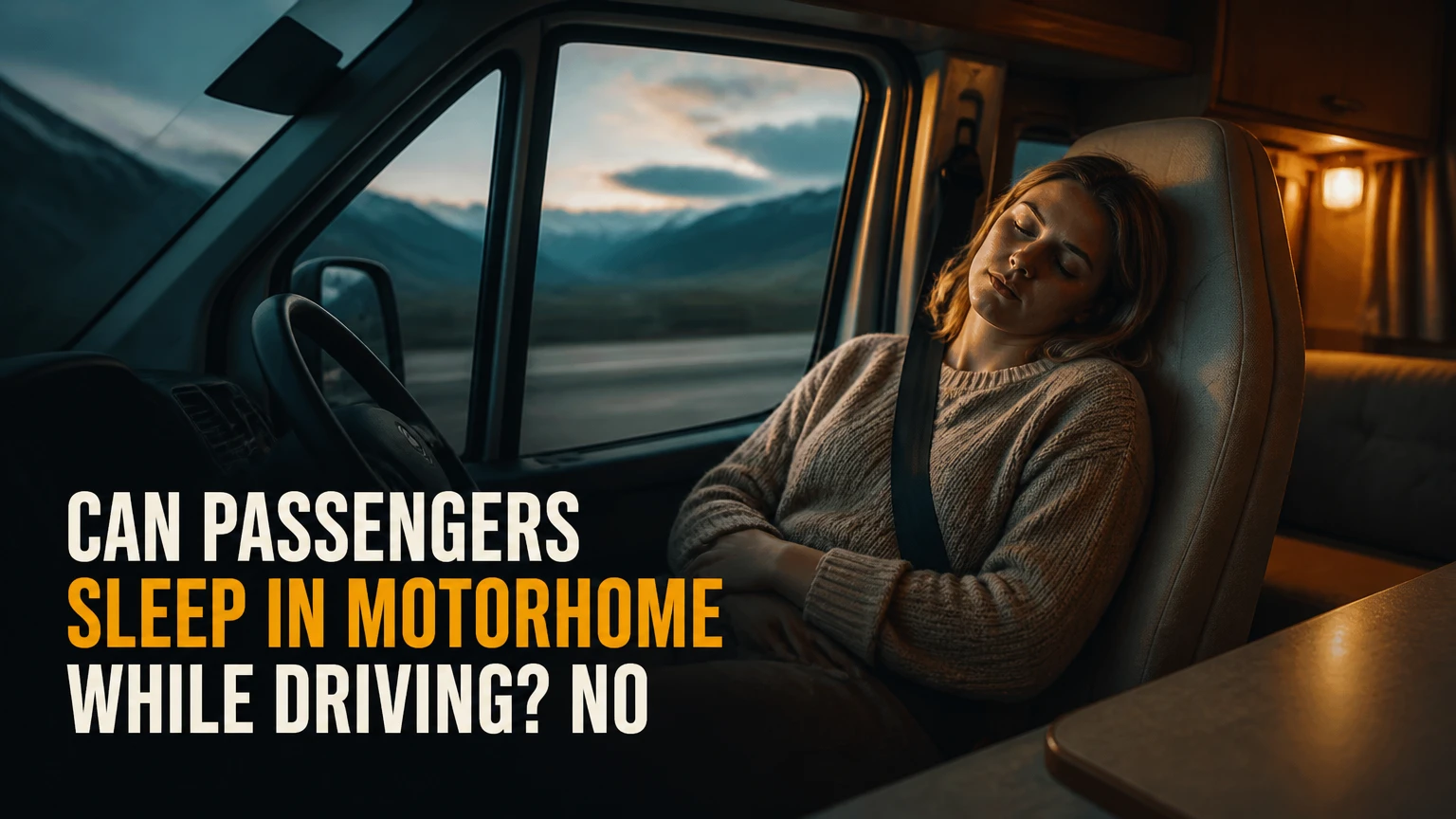
Passengers should not sleep in a motorhome bed, bunk, bathroom, or other unrestrained living-space position while the motorhome is moving. A sleeping passenger must remain in a designated travel seat with the available seat belt fastened, and the vehicle should stop in a legal, safe location before anyone uses a bed for real sleep.
Key facts at a glance
A motorhome bed is sleeping furniture, not a crash-tested passenger restraint.
A moving motorhome requires occupants to use designated travel seats wherever applicable law requires.
A seat belt attached to a dinette or sofa does not automatically prove that the position is safe for every passenger.
Class B camper vans usually preserve more of the original vehicle’s crash structure than Class A or Class C motorhomes.
Children should travel in an approved restraint installed on a compatible, forward-facing seating position.
The only dependable way to sleep horizontally during a journey is to stop, park securely, and turn the motorhome into a stationary accommodation.
Can Passengers Sleep in a Motorhome While Driving?
No. A passenger may doze while sitting upright in a properly equipped, belted travel seat, but a motorhome passenger should never lie in a bed while the vehicle is moving. The bed does not restrain the pelvis and torso during emergency braking, a collision, or a rollover, and ordinary bedding cannot substitute for an approved occupant restraint.
The legal answer depends on location. Seat-belt rules are enacted by states, provinces, territories, and countries, so a statement that the practice is “universally illegal” across the United States, Canada, Europe, and Australia is too broad. The consistent safety rule is stronger than the legal shortcut: use only manufacturer-designated travel positions and obey the law where the vehicle is operating.
The National Highway Traffic Safety Administration describes seat belts as “the single most effective way to reduce fatalities in motor vehicle crashes.” That principle applies to a motorhome even when the vehicle contains a kitchen, sofa, toilet, and bed. Once the engine is driving on a road, the living area is not a bedroom in crash-protection terms.
Where Does Motorhome Occupant Law Apply?
Motorhome seat-belt law applies according to the vehicle’s location, its classification, the passenger’s age, and the specific seating position. Some jurisdictions require every occupant to buckle up; others apply different rules to rear seats, older vehicles, buses, or vehicles without designated belts.
For example, the United Kingdom’s Highway Code requires seat belts to be worn where fitted, with limited exemptions that do not turn a motorhome bed into a travel seat. In the United States, New Hampshire is a notable exception for some adult occupants, but that exception does not make an unrestrained bed safe, and child-restraint requirements still apply. Canadian provincial and territorial rules also differ.
Check four sources before departure:
- The road rules for every state, province, or country on the route.
- The motorhome owner’s manual and compliance label.
- The seat-belt instructions for each designated seating position.
- A qualified RV service center or vehicle upfitter when the seating arrangement is unclear.
A rental agreement may impose stricter requirements than local law. Insurance and liability disputes can also become more difficult when occupants ignore the manufacturer’s travel instructions.
Why Is a Motorhome Bed Dangerous During a Crash?
A motorhome bed is dangerous in motion because the passenger’s body continues moving when the vehicle decelerates. At 60 mph, a 150-pound person is traveling with the vehicle at approximately 88 feet per second before a collision begins; a mattress cannot absorb and redirect that energy like a restraint system.
The passenger may strike a cabinet, refrigerator, table edge, window, windshield, or another occupant. A belt across the body controls forward movement and spreads load across designed contact areas; a blanket or mattress supplies neither controlled restraint nor predictable load distribution.
Rollover crashes add another hazard. The passenger can be thrown sideways or upward through the living area, where overhead cabinets, appliances, and structural fragments create impact points. The rear living compartment generally lacks the airbag coverage, belt geometry, energy-absorbing interior, and crumple-zone design found in the front cab.
The “30-45 mph is automatically fatal” claim is not a reliable safety threshold. Injury depends on crash direction, intrusion, restraint use, occupant size, vehicle structure, and secondary impacts. Even low-speed emergency braking can cause serious injury when a person is lying loose near hard furniture.
What happens during emergency braking?
Emergency braking can injure an unrestrained sleeper before a road collision occurs. A driver may brake for a stopped vehicle, animal, fallen object, or traffic queue, producing a rapid change in speed that sends the sleeper toward the footboard, wall, or floor.
A 150-pound occupant moving at 30 mph carries substantial kinetic energy despite the lower speed. The sleeper also has little time to wake, brace, or move into a safe position. Motorhome interiors contain dense objects that are harmless when stored but hazardous when struck at speed.
Expert insight: The most dangerous assumption is that a large RV stops gently because it feels heavy. A heavy vehicle has greater momentum, and its occupants still experience rapid deceleration when the tires and brakes stop the chassis.
Can a Passenger Sleep in a Belted Motorhome Seat?
Yes, a passenger can sleep while seated if the travel position is approved for occupancy and the belt remains correctly positioned. Sleeping upright is not the same as lying in a bed: the restraint must stay across the pelvis and shoulder, and the seat back should not be reclined so far that the occupant can slide under the belt.
A belted seat is not equally protective in every motorhome. Front cab seats normally have a documented automotive restraint system, while rear seats may use lap belts attached to a structure whose strength and geometry vary by model year and design. A lap belt reduces ejection risk but does not control the head and chest as well as a three-point belt.
Passengers should not sleep in a way that places the shoulder belt behind the back, under an arm, across the neck, or over bulky clothing. Pillows, blankets, and belt-positioning accessories must not interfere with the belt unless the vehicle or restraint manufacturer specifically approves them.
| Seating position | Typical restraint | Main limitation | Practical decision |
|---|---|---|---|
| Front cab captain’s chair | Three-point belt, frontal airbag in many models | Front crash exposure and limited legroom | Preferred travel position |
| Forward-facing rear seat | Two-point or three-point belt | Anchorage and structure vary by model | Use only after manual verification |
| Side-facing sofa | Often lap belt or no belt | Poor belt geometry in a frontal crash | Do not use unless explicitly approved |
| Dinette bench | Lap belt or integrated belt | Table and furniture can become impact hazards | Use only designated positions |
| Bed or bunk | No approved occupant restraint | Ejection and furniture impact | Never use while moving |
| Bathroom or kitchen | No travel restraint | Hard fixtures and zero belt protection | Never occupy while moving |
How Should Seat-Belt Positions Be Evaluated?
Evaluate the seat, belt, anchorage, direction, and occupant limit together. A visible belt alone is insufficient because the belt may be intended for a specific seating position, passenger size, or loading direction.
Use this inspection sequence:
- Identify the exact travel seats in the owner’s manual, not merely every place where a belt is visible.
- Confirm that each seat faces forward or has a manufacturer-approved travel direction.
- Check whether the belt anchors connect to the chassis, a tested seat frame, or another approved structural member.
- Confirm the belt type, occupant capacity, child-seat compatibility, and weight limits.
- Inspect for fraying, damaged buckles, loose hardware, rust, or belt webbing trapped under furniture.
- Ask a qualified technician to inspect uncertain anchorage rather than adding a belt through plywood.
Federal Motor Vehicle Safety Standard 208 addresses occupant crash protection in applicable motor vehicles, while seat-belt anchorage requirements and recreational-vehicle construction rules involve additional standards and vehicle classifications. A consumer should not infer compliance from a sofa’s appearance.
Expert insight: Retrofitting a belt is not the same as engineering a seating position. The load path must transfer crash forces through the seat and anchorage into a structure designed for them.
How Do Class A, B, and C Motorhomes Differ?
Class B motorhomes usually offer the strongest passenger-cell advantage because their living equipment is installed inside a factory van body. Class A and Class C motorhomes can have excellent front seats, but their rear living areas often use coach-built structures with more variable belt anchorage and less crash protection.
| Motorhome class | Common base vehicle | Typical travel-seat pattern | Main structural concern |
|---|---|---|---|
| Class A | Bus-style chassis | Two front seats, plus model-specific rear belts | Rear furniture and belt anchorage vary widely |
| Class B | Ford Transit, Ram ProMaster, Mercedes-Benz Sprinter | Factory van seats plus conversion seats | Conversion seats must retain approved anchorage |
| Class C | Ford E-Series, Chevrolet Express, Mercedes-Benz Sprinter | Front cab seats, optional rear dinette seats | Cab-over and coach structures provide different protection |
| Super C | Heavy-duty truck chassis | Truck cab seats and coach seats | Rear seating still depends on tested coach construction |
Class B is not automatically safe in every seat. A conversion company may remove factory seats, install swivels, or add a bench whose belt system has different instructions. The safest choice is the seating position documented by the manufacturer for the specific vehicle identification number and model year.
The cab-over bunk in a Class C is a sleeping compartment, not a travel compartment. Its mattress, ladder, and side walls do not provide a passenger restraint system.
What Changes for Children?
Children must travel in a child restraint appropriate for their height, weight, and developmental stage, installed according to the child-seat and motorhome instructions. A bunk, bed, dinette tabletop, or parent’s arms is not a substitute for a certified child restraint during movement.
Forward-facing child seats generally require a compatible forward-facing seating position with an appropriate belt or lower-anchor system. Side-facing motorhome seats are commonly unsuitable for child restraints because the belt path and crash direction do not match the seat’s approval conditions. Never install an infant seat sideways simply because it fits the furniture.
Before traveling, verify:
- The child restraint’s permitted installation method.
- The motorhome seat’s forward-facing direction.
- The belt length and buckle position.
- Whether tether anchorage is required.
- The child’s current height and weight limits.
- Whether the vehicle manufacturer prohibits that seating location.
A travel trailer creates an especially important distinction. Children should ride in the tow vehicle’s approved passenger seats, not inside the trailer, because the trailer typically lacks the occupant restraints and crash protection required for passenger travel.
Can Passengers Walk Around Briefly?
Passengers should remain seated and belted while a motorhome is moving. Using the bathroom, making food, reaching for a drink, or moving to a bed may be permitted by some local rules under narrow conditions, but the activity remains unrestrained and unsafe during braking or evasive maneuvers.
The safest operating procedure is simple: the driver stops before anyone unbuckles. Apply the parking brake, select park or the manufacturer’s required secure setting, assess the stopping location, and keep the vehicle stationary until everyone is seated and belted again.
A driver should not treat a passenger’s request as a reason to continue driving. A short stop at a fuel station or rest area costs less time than an injury caused by a sudden lane change. The bathroom exemption is therefore a poor planning strategy even where a jurisdiction has a legal exception.
What About a Travel Trailer?
A travel trailer is not a safe sleeping compartment while it is being towed. Passengers in the trailer have no conventional seat-belt seating system, may face severe interior impacts, and can be exposed to different motion from the tow vehicle during braking, sway, jackknifing, or rollover.
| Travel arrangement | Passenger location | Sleeping while moving | Safer use |
|---|---|---|---|
| Class B camper van | Factory or approved conversion seat | No in bed; seated dozing only | Use documented belted seats |
| Class C motorhome | Cab or approved coach seat | No in bunk or bed | Stop before using sleeping area |
| Class A motorhome | Cab or approved rear seat | No in bedroom or sofa without belt | Verify every rear position |
| Pickup and travel trailer | Pickup cab | No in trailer | Keep every passenger in the truck |
| Bus conversion | Approved forward-facing seat | No in berth unless certified for travel | Follow conversion documentation |
A trailer can be comfortable when parked but still be a poor passenger compartment. Comfort and crashworthiness are separate design questions.
What Is the Safe Alternative for a Tired Passenger?
The safe alternative is to stop and let the tired passenger sleep in the bed while the motorhome is parked. If stopping is not immediately possible, the passenger should remain upright in a designated seat with the belt fastened, while the driver reduces workload and reaches the first lawful stopping place.
Use a fatigue plan before departure:
- Set a realistic driving block, such as 90-120 minutes, rather than relying on a fixed mileage target.
- Mark fuel stations, rest areas, campgrounds, and truck stops that physically accommodate the motorhome.
- Stop when the driver shows lane drift, repeated yawning, missed signs, delayed braking, or poor judgment.
- Park fully off the travel lane, secure the vehicle, and confirm that the location permits overnight or extended rest.
- Sleep for a genuine rest period before continuing, instead of using caffeine to postpone exhaustion.
- Recheck belts, doors, cabinets, and loose equipment before rejoining traffic.
There is no universal “2/2/2” rule that makes a trip safe. Route elevation, weather, age, medication, driving experience, and overnight sleep quality change the appropriate schedule.
What should be secured before departure?
A 10-15 minute cabin check should close cabinets, latch refrigerator doors, store cookware, secure televisions, lock exterior compartments, and place pets in approved restraints. The inspection should also confirm that slide-outs are fully retracted and that no person remains in a bed or bathroom.
| Pre-drive item | Typical check time | Failure consequence | Correct action |
|---|---|---|---|
| Cabinet latches | 2 minutes | Dishes and cans become projectiles | Close and test every latch |
| Refrigerator door | 1 minute | Door opens during braking | Engage the travel lock |
| Table and loose furniture | 2 minutes | Furniture strikes occupants | Stow or lock components |
| Pet restraint | 2-4 minutes | Animal becomes a projectile | Use a crash-tested carrier or harness |
| Slide-outs and steps | 2 minutes | Mechanical damage or obstruction | Retract, lock, and verify indicators |
| Seat belts | 2-4 minutes | Occupant ejection or severe injury | Inspect and buckle each traveler |
The 15-minute figure is a typical planning allowance, not a regulated requirement. Older motorhomes may need longer because loose contents, unsecured televisions, and deteriorated latches are common.
How Should Pets and Cargo Be Secured?
Pets should ride in a secured carrier or a restraint system designed for vehicle travel, never loose on a bed or sofa. Cargo should be placed below beltline height where possible, latched inside strong compartments, and distributed so that braking does not shift the motorhome’s center of gravity.
A household leash clipped to a collar can injure a dog during a crash. A carrier that is merely placed on the floor can also slide or overturn. Follow the carrier maker’s anchorage instructions and keep the animal away from airbags.
Loose cargo can injure a belted passenger even when the passenger is correctly restrained. A metal mug, laptop, cast-iron pan, or unsecured television can cross the living area during a sudden stop.
When Can the Bed Be Used?
The bed can be used when the motorhome is completely stopped in a suitable location with the transmission and parking system secured. The vehicle should not be moving, rolling on a ferry ramp, or creeping through a campground while anyone lies down.
Before allowing passengers into the bed, confirm that:
- The motorhome is parked on stable ground.
- The parking brake is applied.
- The engine is off unless ventilation or climate equipment requires a manufacturer-approved exception.
- The vehicle cannot move because of traffic, slope, or a driver’s mistake.
- Slide-outs, steps, and leveling equipment are used according to the manual.
A parked motorhome bed is designed for accommodation, not for dynamic restraint. That distinction explains why the same mattress can be appropriate at a campsite and dangerous five minutes later on a highway.
What Are the Most Common Mistakes?
The most common mistake is confusing a seat belt’s presence with a seating position’s approval. Owners often count six visible belts without checking whether the belts are forward-facing, structurally anchored, and listed for passengers in the manual.
Other frequent failures include:
- Reclining a belted seat until the belt rides over the abdomen.
- Installing a child seat on a side-facing bench because the buckle is nearby.
- Allowing a passenger to lie on a sofa while someone else drives carefully.
- Leaving cookware, bottles, or laptops loose during a “short” trip.
- Assuming a newer coach has the same rear-seat protection as its donor chassis.
- Adding aftermarket belts without a documented structural design.
- Continuing after the driver becomes sleepy because the destination is close.
Expert insight: “Driving carefully” cannot compensate for a missing restraint. Defensive driving reduces crash probability, while a seat belt reduces occupant movement after a crash; those controls address different risks.
How Do the Options Compare?
A designated front travel seat is the best in-motion option, while a parked bed is the best sleep option. A belted rear seat can be acceptable when the manufacturer approves its direction and anchorage, but it should not be treated as equivalent to a factory cab position.
| Option | Moving use | Restraint condition | Sleep quality | Decision |
|---|---|---|---|---|
| Front captain’s chair | Permitted when occupied correctly | Three-point belt, documented seat | Low to moderate | Best moving option |
| Approved forward-facing rear seat | Model dependent | Two-point or three-point belt | Low to moderate | Verify before use |
| Motorhome bed or bunk | Not appropriate | No dynamic restraint | High when parked | Stop first |
| Travel-trailer bed | Not appropriate | No passenger restraint | High when parked | Use only at destination |
| Rest-area stop | Stationary | Vehicle secured | High | Best fatigue solution |
For a family, choose the layout with enough approved forward-facing seats for every passenger. For a couple, choose a safe stopping plan rather than relying on a partner sleeping in the rear. For a buyer, prioritize documented travel-seat construction over the number of beds or belts shown in a floor plan.
What Should Buyers Check Before Purchasing?
Buyers should inspect the exact travel seating positions during a walk-through and request written documentation for belt anchorage, occupant capacity, child-seat compatibility, and any restrictions on rear seating. A floor plan that sleeps eight may legally and safely transport far fewer people.
Ask the dealer or manufacturer:
- How many approved travel seats does this exact model have?
- Which seats use three-point belts?
- Where does each belt anchor?
- Are any belts attached only to the coach floor?
- Are side-facing seats approved during travel?
- Can a child restraint use the listed belt path?
- Are seats permitted when a slide-out is retracted?
- Does the owner’s manual identify a maximum passenger capacity separate from sleeping capacity?
A qualified RV technician can inspect questionable hardware, but an aftermarket inspection cannot transform a bed into a certified crash seat. When the documentation is absent, select the documented front or factory van seats and plan stops.
FAQ
Can two adults sleep in a motorhome while one person drives?
No. Both adults should remain in designated, belted travel seats while the motorhome is moving. The driver cannot monitor or protect a person lying in the rear, and a second adult in a bed can be seriously injured by braking, collision intrusion, or loose interior equipment even when the driver maintains a cautious speed.
Can a motorhome passenger lie down with a seat belt across the bed?
No. A seat belt installed across a mattress does not create a tested restraint system because the belt geometry, anchorage, seat structure, and occupant posture are uncontrolled. A passenger should use the belt in the designated seat for which it was designed, then lie down only after the motorhome is parked.
Are motorhome rear seat belts legally required?
Requirements vary by jurisdiction, vehicle age, seating direction, and motorhome classification. A rear belt may be required where fitted, while another jurisdiction may regulate only certain occupants or seats. The owner’s manual identifies approved positions, but local road law determines the legal obligation on a particular route.
Can a passenger sleep in a Class B camper van while driving?
A passenger may sleep while seated and belted in an approved Class B travel seat, subject to the vehicle instructions and local law. The rear bed remains unsuitable during motion. Class B construction often retains a steel van body, but conversion seats, swivel bases, and added furniture still require model-specific approval.
Can a child sleep in an RV car seat during a trip?
A child may sleep naturally in an appropriately installed child restraint while seated and buckled, provided the restraint and vehicle manufacturer permit that installation. A child should not sleep in an RV bed, bunk, or side-facing position while moving. Stop safely if the child needs repositioning or care.
What should a driver do if a passenger refuses to buckle up?
The driver should not begin or continue the journey with an unrestrained passenger where a belt is required. Stop in a safe location, explain the crash risk, and require the passenger to use the approved seat. If the passenger will not comply, ending the trip is safer than accepting the liability and injury risk.
The Bottom Line
Can passengers sleep in a motorhome while driving? They should not sleep horizontally in a bed, bunk, bathroom, or living-area position while the vehicle is moving. Passengers should sleep only in a properly used, designated travel seat with the seat belt fastened, and use the motorhome bed after the driver has parked safely. The most reliable plan is to verify every travel seat, secure the cabin, stop before fatigue becomes dangerous, and treat sleeping capacity as separate from passenger capacity.