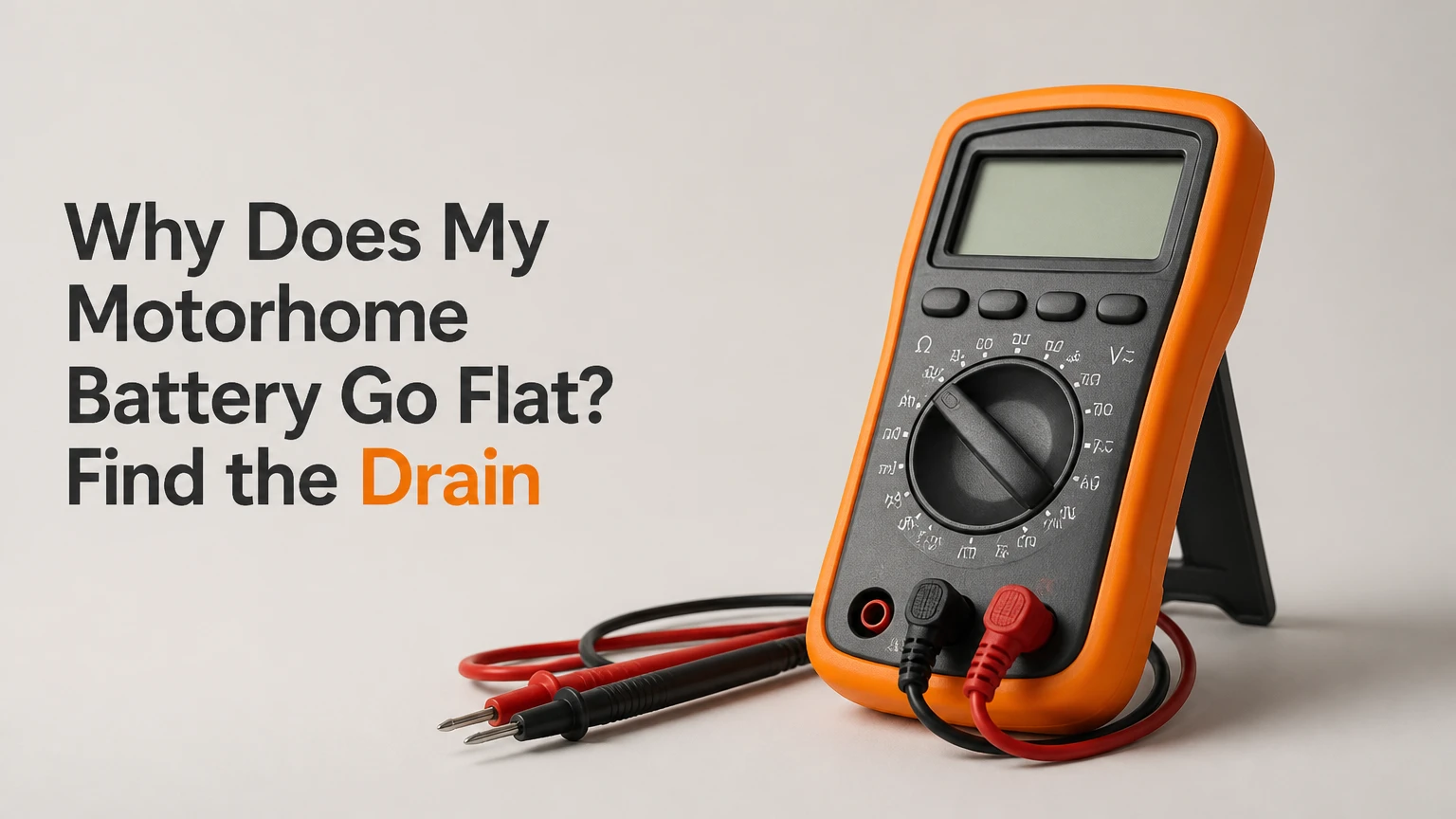
A motorhome battery goes flat when its electrical loads consume more energy than the alternator, solar charger, or mains charger replaces, or when battery damage has reduced its usable capacity. The first diagnosis is to identify whether the starter battery or leisure battery is losing charge, then test resting voltage, charging voltage, and parasitic current.
Key Facts at a Glance
- A motorhome normally has a starter battery for engine cranking and a leisure battery for habitation equipment.
- A healthy 12V lead-acid battery normally rests near 12.7-12.8V when fully charged, measured after several hours without charging or load.
- A resting reading near 12.2V indicates roughly 50% state of charge for many lead-acid batteries, but temperature and battery condition affect the estimate.
- A 100Ah lead-acid battery usually provides about 50Ah before repeated deep discharge begins shortening its life.
- A 100Ah LiFePO4 battery commonly provides 80-100Ah of rated capacity, subject to the manufacturer’s battery-management settings.
- A battery that reaches normal voltage immediately after charging can still have very little capacity because surface charge masks sulfation or a failed cell.
What Makes a Motorhome Battery Go Flat?
A motorhome battery goes flat for five main reasons: excessive consumption, inadequate charging, parasitic drain, incorrect charging settings, or internal battery failure. A battery can also appear flat because a corroded terminal or damaged cable prevents current from reaching the appliances, even when the battery itself retains charge.
The electrical balance is simple:
Energy stored + energy charged – energy consumed = remaining battery energy.
A 12V water pump, LED lighting, compressor fridge, heating controls, television, USB outlets, tracker, alarm, and inverter all draw from that balance. A 1,000W inverter powering a 230V appliance can draw roughly 90-100A from a 12V battery after inverter losses, so a seemingly short appliance run can remove more energy than several hours of lighting.
Which motorhome battery is going flat?
The starter battery is going flat if the engine cranks slowly, the dashboard resets, or the vehicle’s central locking becomes weak. The leisure battery is going flat if interior lights, the water pump, heating controls, USB sockets, or the control panel stop working while the engine still starts normally.
Do not assume both batteries charge together. Many motorhomes use a split-charge relay, battery-to-battery charger, voltage-sensitive relay, or habitation-control unit to manage the two banks. A faulty relay can leave the leisure battery uncharged while the starter battery appears healthy, whereas a failed alarm, tracker, or vehicle control module can discharge the starter battery independently.
How Does the Motorhome Electrical System Lose Energy?
Motorhome electrical systems lose energy when appliances and standby circuits draw more amp-hours than the available charging sources replace. Alternator charging occurs during driving, solar charging depends on sunlight and controller operation, and mains charging depends on the onboard charger, its fuse, and the selected battery profile.
A useful energy estimate is:
Amp-hours used = appliance current in amps × operating time in hours.
For example, a 4A compressor fridge running for an average 8 hours consumes approximately 32Ah per day. A 5A heating fan operating for 4 hours consumes another 20Ah, before adding lighting, pumps, phone charging, and standby loads. Real fridge and heater duty cycles vary, so these figures are planning estimates rather than meter readings.
How do inverters change the energy budget?
An inverter can flatten a leisure battery rapidly because it converts 12V battery current into 230V output and loses energy as heat. A 300W appliance typically requires about 28-30A from a 12V battery, while a 1,000W appliance can require approximately 90-100A.
| 230V appliance | Typical output | Approximate 12V input | 100Ah lead-acid runtime* |
|---|---|---|---|
| Laptop charger | 65W | 6-7A | 6-7 hours |
| Television | 100W | 9-11A | 4-5 hours |
| Coffee machine | 1,000W | 90-100A | 25-35 minutes |
| Microwave oven | 1,200W input | 110-125A | 15-25 minutes |
*Typical estimates include inverter losses and a conservative lead-acid usable capacity. Actual runtime changes with battery age, temperature, cable size, and appliance duty cycle.
An inverter can also consume 0.5-2A while switched on with no appliance connected, depending on its model and standby mode. Switch the inverter off at its own control when it is not needed. A habitation master switch may not disconnect every inverter, tracker, alarm, or entertainment circuit.
What Voltage Indicates a Flat Battery?
Resting voltage indicates approximate state of charge, not battery health. A lead-acid battery should rest for at least four hours, preferably overnight, with charging sources and significant loads disconnected; lithium batteries require the manufacturer’s voltage chart because their flat voltage curve makes simple voltage estimation less reliable.
| Battery condition | Lead-acid resting voltage | LiFePO4 resting voltage | Interpretation |
|---|---|---|---|
| Fully charged | 12.7-12.8V | 13.4-13.6V | Normal rested range |
| Approximately half charged | 12.2-12.3V | 13.1-13.3V | Recharge lead-acid soon |
| Low charge | 12.0-12.1V | 12.8-13.0V | Reduce loads and recharge |
| Severe discharge | Below 11.9V | Below about 12.5V | Investigate promptly |
| Possible failed cell | Around 10.5-11.0V | Battery-management shutdown possible | Stop using and test professionally |
The commonly quoted 10.5V figure represents approximately 1.75V per cell under a particular lead-acid test condition. It is not a universal definition of a dead battery, and a brief voltage collapse under load can indicate high internal resistance rather than zero state of charge. Conversely, a lead-acid battery can suffer permanent sulfation long before its meter reaches 10.5V.
A voltage reading taken while an onboard charger is active may show 13.6-14.7V and reveal almost nothing about stored capacity. Remove the charger, allow surface charge to dissipate, and test again.
Why Does a Charged Battery Go Flat Quickly?
A charged battery goes flat quickly when its plate capacity has been reduced by sulfation, a shorted or weak cell, repeated deep discharge, heat, age, or chronic undercharging. The battery may show 12.7V immediately after charging because surface charge raises terminal voltage, then fall sharply when a fridge, pump, or heater applies a load.
Lead-acid sulfation occurs when lead sulfate crystals remain on the plates during prolonged partial charge. Hard crystals occupy active plate area, increase internal resistance, and prevent the battery accepting or delivering its original amp-hour capacity. Repeatedly charging only to a nominal voltage can leave a battery chronically undercharged even when the control panel reports “full.”
A practical capacity test is more useful than a voltage snapshot. Fully charge the battery using the correct profile, disconnect it, apply a known load, and record the time until the manufacturer’s specified cutoff. A battery specialist can perform a controlled load or conductance test without risking a multimeter fuse.
Which battery type stays reliable longest?
LiFePO4 usually provides the greatest usable capacity and cycle life, while AGM offers a simpler lead-acid replacement with lower maintenance. Flooded lead-acid costs least initially, and gel batteries can suit particular low-rate applications, but gel charging voltage must match the manufacturer’s specification.
| Battery type | Typical usable capacity | Typical cycle range | Typical UK price, 100Ah | Main limitation |
|---|---|---|---|---|
| Flooded lead-acid | 50Ah from 100Ah | 200-400 cycles | £90-£160 | Ventilation, water checks, deep-discharge damage |
| AGM | 50-60Ah from 100Ah | 400-700 cycles | £150-£280 | High weight and charge-voltage sensitivity |
| Gel | 50-60Ah from 100Ah | 500-800 cycles | £170-£320 | Requires a compatible low-voltage profile |
| LiFePO4 | 80-100Ah from 100Ah | 2,000-5,000 cycles | £350-£900 | Higher purchase cost and cold-charge restrictions |
Cycle figures are typical manufacturer and industry ranges, not guarantees. Temperature, depth of discharge, charge completion, storage state, and current levels alter results substantially.
LiFePO4 is not automatically a repair for a faulty charging system. A lithium installation may need a compatible battery-to-battery charger, solar controller, mains charger, correctly rated cables, a fuse near the battery, and low-temperature charge protection. Lithium batteries are also a poor choice when the owner only uses mains hookup and wants the cheapest replacement.
Why Does Driving Fail to Recharge the Leisure Battery?
Driving fails to recharge the leisure battery when the split-charge relay, DC-DC charger, alternator feed, fuse, earth connection, or cable has failed. Modern smart alternators can reduce output voltage after starting, so a leisure battery may not receive a reliable charging profile through a traditional relay.
With the engine running, measure directly at the leisure battery terminals and compare the result with the starter battery and charger output. A conventional system may show approximately 13.8-14.4V during charging, but a smart-alternator system can show lower or fluctuating values unless a DC-DC charger actively regulates the input.
Voltage drop matters. If the charger output measures 14.2V but the leisure battery measures 13.1V under charge, inspect cable length, cable cross-section, fuse holders, relay contacts, and negative returns. A difference above roughly 0.3-0.5V under meaningful current warrants investigation.
Can solar prevent battery discharge?
Solar can prevent discharge only when panel output exceeds the motorhome’s daily consumption and the solar controller is correctly connected to the relevant battery. A 100W panel may produce approximately 20-35Ah on a good summer day in the UK, but winter shading, roof orientation, low sun, dirt, and controller losses can reduce output dramatically.
Check the controller’s battery voltage, charging current, fuse, and battery-type setting. A panel that shows normal open-circuit voltage but zero charging current may have a controller fault, a blown battery-side fuse, shading, or a disconnected battery connection. Solar is maintenance support, not a guaranteed winter replacement for a mains maintenance charger.
Why Does Mains Hookup Fail to Charge the Battery?
Mains hookup fails to charge the leisure battery when the EHU breaker, onboard charger fuse, charger output, battery connection, or charger profile is faulty. The 230V hookup can power sockets and appliances while the 12V battery charger remains isolated or defective, so working mains outlets do not prove that the battery is charging.
Inspect the consumer unit and charger indicator, then measure at the leisure battery with EHU connected. A typical lead-acid charging voltage rises above its rested voltage, often into the 13.6-14.7V range depending on the charger stage and battery type. Lithium chargers use different absorption and float strategies, and some should not remain on a continuous float setting.
A charger can also undercharge a battery without failing completely. An old transformer charger may supply enough current for lights but never reach the correct absorption voltage, leaving a lead-acid battery in a partial-charge state that encourages sulfation.
How Can You Test the Battery Safely?
You can test a motorhome battery in 30-60 minutes with a digital multimeter, a torch, and the vehicle handbook, provided you avoid placing the meter directly across the battery in current mode. The most important safety rule is that an ammeter becomes a short circuit if connected across battery terminals.
Step 1: Identify the battery bank
Turn off the engine, EHU, solar charging where practical, inverter, habitation loads, and battery master switches. Identify positive and negative terminals for both the starter and leisure banks, because testing the wrong battery produces a convincing but irrelevant result.
Checkpoint: The meter probes touch the intended battery terminals, not a nearby distribution stud or charger output.
Common mistake: Assuming the large battery under the bonnet is the leisure battery.
Step 2: Inspect cables and case condition
Look for loose clamps, green or white corrosion, overheated fuse holders, cracked insulation, swelling, leakage, and a bulging case. Do not use a swollen, leaking, hot, or cracked battery; isolate it and arrange professional replacement.
Clean external lead-acid corrosion with appropriate eye protection and battery-safe procedures. Baking soda can neutralise acid residue around external terminals, but do not allow the mixture into cells or vents.
Checkpoint: Terminals are tight, clean, and free from heat damage.
Common mistake: Replacing the battery before repairing a loose earth cable.
Step 3: Measure rested voltage
Set the multimeter to DC volts, place the red probe on positive and black probe on negative, and record the reading after at least four hours without charging or substantial load. Repeat after a full charge and overnight rest.
Checkpoint: A healthy lead-acid battery remains near 12.7V after resting; a battery that falls below 12.2V quickly needs further testing.
Common mistake: Measuring immediately after EHU and calling the charger voltage the battery’s state of charge.
Step 4: Check charging sources
Connect EHU and record the battery voltage. Disconnect EHU, start the engine, wait several minutes, and record leisure-battery voltage again. Check solar controller readings in daylight.
Checkpoint: Voltage rises meaningfully above rested voltage when each charging source is active.
Common mistake: Expecting 13.8-14.4V from every smart-alternator system at every moment.
Step 5: Measure parasitic current
Only measure current in series. Switch off all loads, disconnect the negative cable, move the red probe to the meter’s high-current socket, select the highest DC-amp range, and connect the meter between the negative post and disconnected cable. Use a fused current clamp when possible.
Do not unlock doors, start the engine, switch on lights, or operate high-current equipment while the meter is in series. After confirming a low current, change to a lower range only if the meter and circuit are protected.
Checkpoint: A stable reading above approximately 0.05A, or 50mA, deserves investigation, although some motorhomes legitimately retain a higher standby current.
Common mistake: Connecting the meter across positive and negative while set to amps, which can blow the meter fuse or damage wiring.
Step 6: Isolate the circuit
With the meter safely connected, remove habitation fuses one at a time and record the current change. Then check vehicle fuses, aftermarket accessories, solar controllers, alarms, trackers, radios, reversing cameras, electric steps, and inverter standby circuits.
Checkpoint: Current falls when the defective or unnecessary circuit is disconnected.
Common mistake: Pulling fuses before allowing control modules to enter sleep mode, which can create misleading readings.
Which Parasitic Loads Commonly Flatten a Battery?
Parasitic loads commonly include alarms, trackers, radio memories, reversing-camera modules, electric-step controllers, television antenna amplifiers, USB outlets, solar controllers, and inverter standby circuits. A small continuous load becomes significant during storage because a 0.1A drain consumes about 2.4Ah per day, or roughly 72Ah in 30 days.
| Standby load | Typical current | Approximate monthly consumption | Storage implication |
|---|---|---|---|
| Radio or clock memory | 10-30mA | 7-22Ah | Usually tolerable alone |
| Tracker or alarm | 20-60mA | 14-43Ah | Can flatten small batteries |
| Solar controller standby | 5-25mA | 4-18Ah | Disconnect if manufacturer permits |
| Inverter idle draw | 0.5-2.0A | 360-1,440Ah | Major drain unless switched off |
| Electric-step controller | 20-100mA | 14-72Ah | Common hidden habitation load |
The three-week storage estimate often quoted for a modern motorhome is only a rough scenario, not a service interval. Battery size, battery age, temperature, alarm current, and the starting state of charge can change the result from several days to several months.
How Should a Motorhome Battery Be Stored?
A motorhome battery should be stored fully charged, protected from continuing loads, and checked periodically rather than left flat. Lead-acid batteries should not remain discharged in freezing conditions because weakened electrolyte can freeze and damage the case or plates.
For lead-acid storage, fully charge the battery, disconnect the negative terminal or use a verified battery isolator, and check voltage every four to six weeks. Recharge when the rested reading approaches 12.4-12.5V. A suitable maintenance charger is preferable when mains power is available.
For lithium storage, follow the battery maker’s state-of-charge recommendation, commonly around 40-60%, disconnect unnecessary loads, and prevent charging below the specified temperature. A lithium battery-management system may disconnect output when nearly empty, but that protection does not remove the need to diagnose the underlying drain.
What Are the Most Common Diagnostic Mistakes?
The most common diagnostic mistake is replacing the battery before measuring the energy system. A new battery cannot compensate for a failed charger, an inverter left on, a damaged earth cable, or an alarm that draws excessive current.
- Testing only voltage: Normal voltage does not prove capacity. Add a controlled load test.
- Testing while charging: Charger voltage hides the true rested state.
- Ignoring the starter battery: The vehicle battery and leisure battery have separate failure paths.
- Using the wrong charger profile: AGM, gel, flooded lead-acid, and LiFePO4 require different limits.
- Trusting the control panel alone: Panel sensors can read at a distribution point with cable losses.
- Leaving an inverter enabled: Idle current can exceed the entire storage allowance.
- Assuming driving equals charging: Smart alternators and failed split-charge equipment can prevent leisure charging.
A practitioner rule is to test at the battery posts first, then at the charger output, and finally across the cable path. That sequence separates battery failure from connection failure quickly.
Another counterintuitive point is that a larger battery can hide a parasitic drain without fixing it. The drain continues, and the larger replacement eventually suffers the same deep-discharge damage.
What Does Replacement Usually Cost?
A typical UK replacement costs about £90-£320 for a 100Ah lead-acid battery and £350-£900 for a 100Ah LiFePO4 battery, excluding installation and any charging-system upgrades. A like-for-like AGM replacement is cheaper than a lithium conversion because lithium may require a DC-DC charger, revised fusing, cables, and a compatible mains charger.
| Repair or upgrade | Typical parts cost | Typical labour time | When it makes sense |
|---|---|---|---|
| Clean terminal and replace clamp | £10-£40 | 30-60 minutes | Corrosion or loose connection |
| Replace split-charge relay | £30-£120 | 1-2 hours | Leisure battery not charging while driving |
| Replace 100Ah AGM | £150-£280 | 30-90 minutes | Moderate off-grid use |
| Add 30A DC-DC charger | £180-£450 | 3-6 hours | Smart alternator or lithium conversion |
| Replace 100Ah LiFePO4 | £350-£900 | 1-3 hours | Frequent off-grid cycling |
| Replace mains charger | £150-£500 | 2-4 hours | EHU charging fault |
Prices vary by battery dimensions, brand, installation access, cable length, and vehicle layout. Never install lithium solely because the old lead-acid battery went flat; first prove that the charging and load circuits operate correctly.
Which Battery Setup Fits Each Camping Pattern?
A hookup-focused campsite user normally needs an 85-110Ah AGM or sealed lead-acid battery, while a weekend off-grid user often benefits from 110-130Ah AGM plus 100-150W solar. A full-time off-grid user may need 100-200Ah LiFePO4, a 30-50A DC-DC charger, and 300W or more of solar, subject to the energy audit.
| Camping pattern | Typical daily use | Suitable battery bank | Charging arrangement |
|---|---|---|---|
| EHU campsite user | 10-25Ah | 85-110Ah AGM | Onboard mains charger |
| Weekend off-grid user | 35-60Ah | 110-130Ah AGM | 100-150W solar and driving |
| Heating-heavy shoulder-season user | 60-100Ah | 150-200Ah AGM or lithium | 200W solar plus DC-DC |
| Full-time digital nomad | 80-150Ah | 100-200Ah LiFePO4 | 300W+ solar and 30-50A DC-DC |
Calculate consumption before choosing capacity. Add the daily amp-hours of each appliance, multiply by the number of off-grid days, then include charging inefficiency and reserve capacity. Lead-acid users should normally size the bank so ordinary use remains above about 50% state of charge; that is a longevity guideline, not an instant destruction threshold.
FAQ
Can a motorhome battery go flat in one night?
Yes, a motorhome battery can go flat overnight if an inverter, electric heater, compressor fridge, or unexpected fault draws high current. A 1,000W inverter load can consume around 90-100A from a 12V battery, while a small 50-100mA standby drain normally cannot flatten a healthy large battery in one night.
Why does my motorhome battery go flat after fitting a new one?
A new motorhome battery usually goes flat because the original drain or charging fault remains. Check for inverter standby consumption, trackers, alarms, electric steps, failed split-charge relays, blown charging fuses, and incorrect charger settings before condemning the replacement battery.
Should I disconnect the leisure battery when storing a motorhome?
Disconnecting the leisure battery is sensible when the motorhome has unknown standby loads and no reliable maintenance charger. Fully charge a lead-acid battery first, isolate the negative terminal, and inspect it every four to six weeks; follow the lithium manufacturer’s storage state-of-charge guidance.
Can a solar panel overcharge a motorhome battery?
A correctly sized solar controller should prevent overcharging by regulating voltage, but a failed controller, wrong battery profile, or direct panel connection can damage a battery. Confirm that the controller is connected to the battery, configured for AGM, gel, flooded, or lithium chemistry, and protected by the correct fuse.
Is a flat motorhome battery repairable?
A mildly discharged battery may recover after a correct full charge, but sulfation, a shorted cell, swelling, leakage, or severe capacity loss usually requires replacement. A specialist load test provides better evidence than a single voltage reading, especially when the battery reaches 12.7V and then collapses under load.
When should a motorhome battery be replaced?
Replace a motorhome battery when it repeatedly loses charge after the drain and charging systems test correctly, fails a capacity or load test, shows physical damage, or cannot hold a rested voltage after a complete charge. Battery age alone is not conclusive, although heavily cycled lead-acid batteries commonly need replacement after several years.
The Bottom Line
The answer to why does my motorhome battery go flat is usually an imbalance between consumption and charging, not a mysterious electrical event. Identify the failing battery bank, measure rested voltage, test charging sources at the terminals, and isolate parasitic circuits with a safely fused current measurement. Replace the battery only after those checks confirm lost capacity, then match the replacement to your actual off-grid energy use.