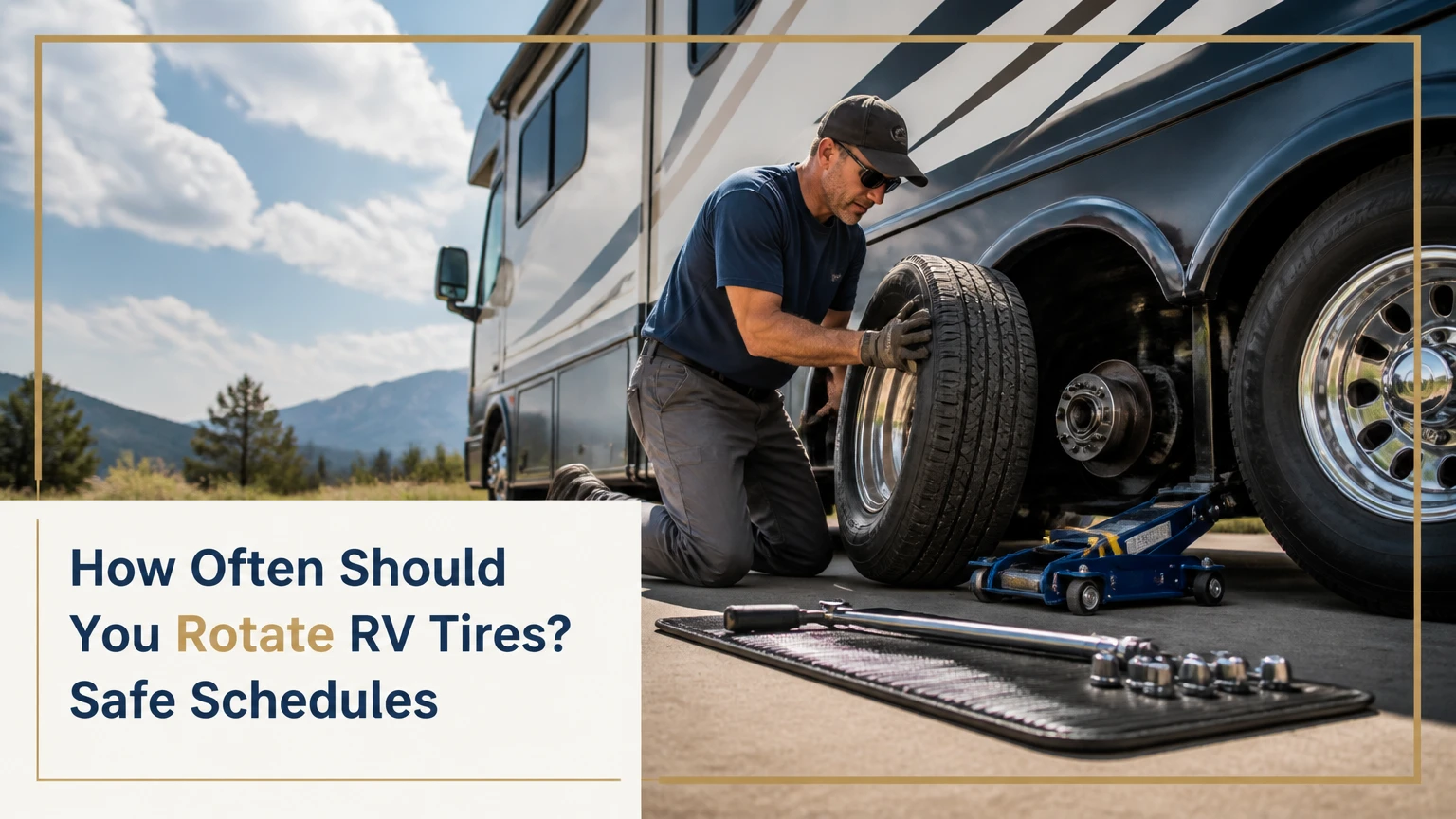
Rotate RV tires every 6,000-8,000 miles or every 6-12 months, whichever comes first, unless the RV, tire, or chassis manufacturer specifies a different interval. For low-mileage RVs, an annual inspection and rotation before the travel season is a practical minimum, while uneven wear, heavy towing, or severe service justifies earlier action.
Key Facts at a Glance
- Motorhome tires generally need rotation at 6,000-8,000 miles or every 6-12 months.
- Travel trailer tires do not automatically follow passenger-vehicle rotation patterns; the trailer and tire manufacturer’s instructions control.
- Tire rotation cannot make an overloaded, underinflated, misaligned, damaged, or aged tire safe.
- Measure cold inflation pressure against the vehicle placard or tire manufacturer’s load-and-inflation table.
- A full-size spare should rotate only when its wheel, tire size, construction, load range, tread, and age make it compatible.
- Wheel lug nuts require the exact chassis specification, not a generic torque range.
How Often Should You Rotate RV Tires?
RV tire rotation should follow a 6,000-8,000-mile interval or a 6-12-month interval, whichever occurs first. The time rule matters because many recreational vehicles accumulate few miles while their tires remain exposed to sunlight, heat, ozone, moisture, and long periods of static loading.
A full-time Class A motorhome that travels 12,000 miles annually may reach the mileage interval twice, while a weekend travel trailer may travel only 2,000 miles. The second vehicle still needs inspection at least every season and should not wait several years for a mileage trigger.
| RV use pattern | Typical annual mileage | Practical service interval | Priority check |
|---|---|---|---|
| Full-time Class A | 10,000-20,000 miles | Every 6,000 miles | Inflation, axle loads, alignment |
| Frequent Class C travel | 6,000-12,000 miles | Every 6,000-8,000 miles | Front-edge wear, balance |
| Weekend motorhome | 1,000-5,000 miles | Every 12 months | DOT age, sidewall cracking |
| Travel trailer | 500-5,000 miles | Annual inspection, rotate only if specified | Curbside damage, load range |
The interval is a maintenance starting point, not permission to ignore visible wear. A tire with rapidly increasing shoulder wear, cupping, exposed cords, sidewall cracking, or repeated pressure loss needs diagnosis immediately.
Should low-mileage RVs still have their tires rotated?
Low-mileage RVs should receive an annual tire inspection and rotation decision before the first major trip. The inspection matters more than the mileage because a parked RV can develop age-related sidewall cracking and localized flat spotting without accumulating tread wear.
Rotation is useful when tread depths or wear patterns differ between positions. If all tires have uniform wear and the manufacturer does not prescribe rotation, a technician may recommend inspection without a position change, particularly on a trailer with a specified one-way tire pattern.
Why Do RV Tires Wear Unevenly?
RV tires wear unevenly because an RV rarely carries equal weight at every wheel position, and each axle subjects its tires to different steering, braking, cornering, and scrub forces. Slide-outs, refrigerators, batteries, generators, water tanks, kitchen appliances, and stored cargo can create substantial side-to-side differences.
A motorhome’s front tires steer and absorb steering-related shoulder forces. Rear tires carry drive torque and may wear differently under acceleration and braking. Trailer tires experience lateral scrub during tight turns because many trailer axles do not steer, so their tread can slide across pavement instead of rolling cleanly.
The National Highway Traffic Safety Administration identifies underinflation, overloading, damage, and tire aging as major tire safety concerns. Rotation can equalize tread wear, but it cannot correct the cause of a dangerous wear pattern.
What does rotation actually change?
Tire rotation systematically moves tires to different wheel positions so no single tire performs the same job for its entire service life. A front tire that has developed mild shoulder wear may move to a less demanding rear position, provided the tire pattern, size, load rating, and vehicle instructions permit that move.
Rotation does not repair alignment, suspension, inflation, balance, or axle problems. A tire that moves from the front axle to the rear will carry its existing damage with it, so technicians should record tread depth at all major grooves and inspect the tire before installation.
Does the Rotation Pattern Depend on RV Type?
The correct RV tire rotation pattern depends on the chassis, drive configuration, number of axles, tire construction, tread direction, and manufacturer instructions. A universal X-pattern is unsafe advice because directional tires, staggered sizes, dually wheels, and trailer axles impose movement restrictions.
| RV configuration | Common permitted movement | Main restriction | Best practice |
|---|---|---|---|
| Class B, four matching tires | Front-to-rear or approved cross pattern | Directional tread stays on same side | Follow chassis manual |
| Class C, single rear tires | Forward cross or rearward cross | Load rating must remain correct | Confirm Ford, Mercedes-Benz, or Ram procedure |
| Class A, rear duals | Manufacturer-specific dually pattern | Inner and outer positions must remain compatible | Use a commercial RV tire shop |
| Travel trailer, tandem axle | Position changes only if approved | Tire scrub and axle alignment affect wear | Follow trailer and tire maker |
| Fifth wheel, tandem axle | Limited same-size rotation | Dual axle suspension can scrub tread | Inspect first, rotate selectively |
Front-to-rear movement is normally possible when all tires share the same size, construction, load range, and speed rating. Cross-movement may be prohibited by directional tread arrows or asymmetric tread designs. The sidewall marking and tire manufacturer’s service instructions settle that question.
How are Class A and Class C dually tires rotated?
Dually RV tires require a pattern specified for the chassis and wheel system, not a casually copied pickup-truck diagram. A common conceptual pattern moves front tires into rear dual positions, moves inner rear tires to outer rear positions, and moves outer rear tires forward, but the exact sequence varies by tire direction, wheel offset, and manufacturer requirements.
Dually wheels must also preserve safe spacing. The inner and outer tires need compatible dimensions, correct valve-stem access, matching inflation pressure, and no sidewall contact under load. “Dual tire kissing,” where the sidewalls rub, can generate heat and lead to a rapid failure.
A commercial tire technician should verify:
- Inner and outer tire size and load range.
- Wheel offset and approved dual spacing.
- Valve-stem position and inflation access.
- Tread direction and asymmetric-tread limits.
- Lug-nut torque and wheel-seating condition.
Should Travel Trailer Tires Be Rotated?
Travel trailer tires should be rotated only when the trailer manufacturer or a qualified tire technician approves the pattern. Trailer tires often experience scrub, curb strikes, axle misalignment, and long static storage, so moving a tire to another position may not solve the underlying problem.
Unlike a powered motorhome, a trailer has no steering axle and may have tandem or triple axles that pivot through turns. During a tight corner, the tires follow different arcs and slide across the pavement. That stress can produce shoulder wear even when tread depth appears adequate.
Do not rotate trailer tires merely to equalize wear if one axle is overloaded or bent. Have the trailer weighed in travel condition and inspect axle alignment, spring hardware, equalizers, shackles, and wheel bearings first.
When is replacement better than rotation for a trailer?
Replacement is better than rotation when a trailer tire has sidewall cracking, bulges, puncture damage, exposed cords, repeated pressure loss, severe one-sided wear, or an unknown load history. A new tire with the wrong load range is not an upgrade, so match or exceed the original specification without exceeding wheel or axle limits.
For trailers, tires on the curbside often encounter curbs, debris, drainage edges, and potholes more frequently. That does not create a special passenger-side rotation rule, but it does justify careful inspection of the curbside positions after every trip.
Can You Rotate RV Tires Yourself?
A capable owner can rotate some four-tire motorhome wheels, but most RV tire rotations are safer and more accurate at a shop with a commercial lift, high-capacity jack stands, calibrated torque equipment, and dually service knowledge. RV wheels can weigh more than 100 pounds each, and a loaded chassis can exceed several tons.
What should you prepare before rotating RV tires?
Prepare the vehicle-specific service manual, tire rotation diagram, wheel chocks, a rated hydraulic jack, jack stands, breaker bar, calibrated torque wrench, and a means of recording wheel positions. Never use stabilizing scissor jacks as lifting equipment because they are designed to level or steady an RV, not support its full weight.
Before you start:
- Typical time: 1-2.5 hours for a four- to six-wheel motorhome.
- Difficulty: High for heavy Class A and dually chassis.
- Typical professional cost: $60-$150 for lighter RVs; more for Class A commercial chassis.
- Typical DIY equipment cost: $150-$400 if suitable lifting and torque tools are not already owned.
- Prerequisite: Confirm approved lifting points and wheel torque in the chassis manual.
Step 1: Record the current tire positions
Park on level, stable pavement, set the parking brake, and chock wheels that remain on the ground. Record each tire’s position, DOT date code, tread depth, cold pressure, and visible wear before loosening anything.
The position record prevents an accidental pattern reversal. You will know the rotation succeeded when every tire has a documented destination and no tire violates a directional or dually-spacing restriction.
Common mistake: Starting with a generic diagram found online instead of the chassis manual.
Step 2: Loosen lug nuts on the ground
Break lug-nut resistance while the tire remains firmly on the ground. Do not remove the nuts at this stage, because the vehicle’s weight helps prevent the wheel from turning.
Use the correct socket and avoid impact-gun removal when the wheel manufacturer warns against it. You will know the step is complete when each nut turns slightly without being removed.
Common mistake: Applying a long cheater bar to damaged or swollen lug nuts, which can strip the fastener or distort the wheel.
Step 3: Lift the RV at approved points
Use only the chassis manufacturer’s lifting points and a jack rated for the actual axle load. GVWR alone does not tell you the load on a particular axle, and lifting an axle tube, suspension arm, or differential housing may damage components or create instability.
Raise one axle or one approved section at a time, then install jack stands rated for the load. You will know the support is adequate when the jack stands sit squarely on solid ground and the RV remains stable under a gentle visual check.
Common mistake: Lifting with a stabilizer jack or placing a stand on soft asphalt without a suitable load-spreading pad.
Step 4: Inspect each tire and wheel
Remove the wheel only after the RV is securely supported. Check the tread for cupping, scalloping, center wear, shoulder wear, embedded objects, and irregular groove depth; inspect sidewalls for cracks, bulges, abrasion, and bead damage.
Inspect wheel studs, nuts, valve stems, brake components, and, on duals, the clearance between inner and outer tires. You will know the tire is eligible for rotation when no safety defect requires repair or replacement.
Common mistake: Rotating an aged tire because it has remaining tread. Tire age and structure matter independently of tread depth.
Step 5: Move tires according to the approved pattern
Move each wheel to its documented destination, keeping directional arrows pointed in the correct rolling direction. Do not mix different tire sizes or constructions on an axle, and do not pair a radial tire with a bias-ply tire unless the vehicle manufacturer expressly permits that configuration.
Hand-start every lug nut to avoid cross-threading. You will know the pattern is correct when the tire size, load range, tread direction, and wheel position all agree with the service instructions.
Common mistake: Assuming a full-size spare belongs in the rotation without checking its age and tread compatibility.
Step 6: Lower and torque the wheels
Lower the RV until the tires contact the ground enough to prevent rotation, then tighten lug nuts in the manufacturer’s specified sequence and torque value. Torque specifications vary widely, so a generic figure such as 100-140 foot-pounds is not valid for every RV; heavy Class A wheels can require several hundred foot-pounds.
Recheck torque after the first 50-100 miles if the chassis or wheel manufacturer recommends it. You will know the final step is complete when the torque wrench reaches the specified value on every lug nut and the tire pressures are reset cold.
Common mistake: Using an impact wrench for final torque without verification by a calibrated torque wrench.
Should the Spare Tire Join the Rotation?
A full-size spare should join the rotation only when it matches the active tires in size, construction, load range, speed rating, wheel specification, tread condition, and usable age. A temporary spare, older emergency tire, different-load-range tire, or steel-wheel assembly should remain an emergency spare.
| Spare condition | Include in rotation? | Reason | Owner action |
|---|---|---|---|
| Same tire model, DOT age under 5 years | Usually, if approved | Comparable casing and tread | Follow five-tire pattern |
| Same size, different tread model | Usually no | Different handling and wear characteristics | Keep as emergency spare |
| Full-size tire, DOT age 8 years | No | Age-related risk outweighs tread benefit | Replace or retire |
| Temporary spare, limited-speed type | No | Emergency-use construction | Inspect pressure monthly |
| Matching tire with 2/32-inch tread | No | Excessive wear difference | Replace as a set or axle pair |
A five-tire rotation can distribute use across the set, but it does not extend the structural life of an aging tire. Michelin states, “Michelin recommends that tires be removed from service at 10 years from their date of manufacture,” while other RV and tire manufacturers recommend earlier replacement or annual professional inspection. The tire maker’s guidance and the tire’s condition control.
What Should You Check During Rotation?
Tire rotation should include a wear, pressure, load, and hardware inspection because uneven tread is often evidence of another fault. Measure pressure when the tires are cold, before driving, and use the vehicle placard or tire manufacturer’s load-and-inflation table rather than the maximum pressure molded into the sidewall.
| Wear or damage pattern | Likely cause | Immediate risk | Corrective action |
|---|---|---|---|
| Inner shoulder wear | Alignment or axle geometry | Reduced wet traction | Alignment and suspension inspection |
| Outer shoulder wear | Underinflation, cornering, overload | Heat buildup | Weigh axle, set cold pressure |
| Center tread wear | Excessive inflation | Smaller contact patch | Verify pressure against load table |
| Cupping or scalloping | Shocks, balance, bearings | Vibration and irregular contact | Inspect suspension and balance |
| Dual sidewall rubbing | Wrong spacing, overload, low pressure | Rapid heat and blowout | Stop driving, verify dual spacing |
| Cracks between tread blocks | Aging, ozone, storage exposure | Casing separation | Professional inspection or replacement |
A TPMS is valuable because an RV can lose pressure before a driver notices handling changes. TPMS does not replace a gauge check, since sensor accuracy, battery condition, and incorrect alert settings can hide a developing problem.
Does weighing the RV change the rotation schedule?
Weighing changes the pressure and load decision more directly than the rotation interval. Use individual wheel-position weights when possible, because axle totals can hide a heavily loaded left or right position caused by a slide-out, refrigerator, generator, or cargo compartment.
The RV Industry Association and tire manufacturers commonly emphasize loading within the vehicle’s certification limits and setting pressure for actual loads. A tire that is overloaded will generate excess heat regardless of rotation frequency.
How Much Does RV Tire Rotation Cost?
Professional RV tire rotation typically costs $60-$150 for a lighter motorhome or van-based RV, while a Class A motorhome, dually chassis, or commercial tire service may cost more because of wheel weight, equipment, and torque requirements. DIY equipment commonly costs $150-$400 when the owner needs a suitable jack, stands, and torque wrench.
| Service situation | Typical price | Typical time | Suitable provider |
|---|---|---|---|
| Class B or light Class C | $60-$100 | 45-90 minutes | Automotive tire shop |
| Single-rear-wheel Class C | $80-$150 | 1-2 hours | RV or light-truck tire shop |
| Class A dually rear axle | $120-$250 | 1.5-3 hours | Commercial truck tire shop |
| Travel trailer inspection | $50-$120 | 45-90 minutes | Trailer or RV service center |
Prices vary by region, access, wheel size, and whether balancing, alignment, valve stems, or tire removal is included. Ask whether the quoted service includes a torque check, tread-depth measurement, pressure adjustment, and inspection of the spare.
Does Rotation Extend RV Tire Life?
Rotation can extend usable tread life when tires experience unequal wear, but rotation does not establish a guaranteed service life. RV tires can become unsafe from age, ultraviolet exposure, heat, chronic overload, underinflation, or long storage before the tread reaches a replacement indicator.
Replace a tire immediately for a bulge, exposed cord, major cut, tread separation, severe cracking, or a repair that does not meet the tire maker’s policy. Replace tires as a set on an axle when tread-depth differences, construction differences, or irregular wear could affect handling.
The DOT tire identification number provides the manufacturing week and year in the final four digits. For example, “2322” indicates production in the 23rd week of 2022. Do not confuse the DOT date with the installation date.
How should stored RV tires be protected?
Store an RV with properly inflated tires on a clean, dry surface, reduce exposure to direct sunlight, and follow the manufacturer’s instructions for long-term parking. Tire covers can reduce ultraviolet exposure, but they do not reverse internal aging or make an overloaded tire safe.
Move the RV periodically only when the manufacturer’s storage instructions permit it, and inspect for flat spotting, pressure loss, and sidewall cracking before travel. A tire that looks clean externally can still require professional evaluation because internal deterioration is not always visible.
Common Rotation Mistakes and Their Fixes
- Using stabilizer jacks for lifting: Lower the RV, obtain a rated lifting jack, and use approved frame points and jack stands.
- Copying a passenger-car X-pattern: Stop and verify the RV chassis, tire tread direction, and wheel configuration.
- Ignoring a bent trailer axle: Measure alignment and inspect suspension components before moving tires.
- Mixing load ranges on a dual position: Match the approved tire specification and replace incompatible tires.
- Torquing by feel: Use the exact service-manual value with a calibrated torque wrench.
- Rotating past-due tires: Check the DOT date and replacement guidance before considering tread equalization.
The most important practitioner rule is simple: rotation is a wear-management operation, not a safety certification. If a technician cannot explain why the wear occurred, the service is incomplete.
What Is the Best Schedule for Your RV?
Full-time motorhome owners should plan inspection and rotation at 6,000-mile intervals, with tire-pressure checks before every travel day and a professional alignment inspection when wear changes. Frequent towing warrants the same conservative approach because heat and axle loads accumulate quickly.
Weekend RV owners should schedule a documented inspection every spring or before the first long trip, even when annual mileage is below 6,000 miles. Tire age, storage exposure, and pressure loss deserve more attention than tread wear in this use pattern.
Travel trailer owners should prioritize load measurement, cold pressure, axle alignment, bearing condition, and curbside damage. Rotate only when the trailer manufacturer or qualified tire technician provides an approved pattern.
Before a trip exceeding 500 miles, inspect all sidewalls, measure cold pressure, verify TPMS alerts, check lug torque according to the chassis procedure, and confirm that the spare is inflated and usable. A pre-trip inspection can find damage that a calendar-based rotation cannot.
Frequently Asked Questions
Can I rotate RV tires every 10,000 miles?
A 10,000-mile interval may be acceptable only when the RV and tire manufacturers specify it and wear remains uniform. The safer general interval is 6,000-8,000 miles or 6-12 months. Heavy loads, frequent mountain driving, visible wear, and high heat justify earlier inspection rather than extending the schedule.
Do RV tires need balancing after rotation?
RV tires do not automatically need balancing after every rotation if the wheel and tire assemblies are already balanced and no vibration exists. Balancing is appropriate when a tire changes wheels, weights are missing, steering vibration appears, or a technician identifies radial-force variation or an uneven assembly.
Can I rotate tires with different tread depths?
Tires with different tread depths should not be moved into a position where the difference violates the vehicle or tire manufacturer’s guidance. On a dual assembly, mismatched rolling circumference can overload the larger or smaller tire. Measure tread depth and consult a tire professional before repositioning them.
Should I replace all RV tires at once?
Replace all RV tires at once when they share the same age, show widespread cracking, or have a common overload history. If one tire suffers isolated road damage and the remaining tires are recent, correctly specified, and closely matched in tread depth, an axle-pair or single replacement may be possible under manufacturer guidance.
How often should RV tire pressure be checked?
Check RV tire pressure before every travel day while the tires are cold, and check again after extended storage or a substantial temperature change. Do not bleed air from hot tires to reach the cold-pressure target. Use a calibrated gauge and adjust pressure before driving.
The Bottom Line
For most motorhomes, rotate RV tires every 6,000-8,000 miles or every 6-12 months, whichever comes first. For low-mileage vehicles, make the annual pre-season inspection mandatory; for travel trailers, follow the trailer manufacturer’s approved pattern rather than assuming a motorhome rotation applies.
Inspect tread, sidewalls, pressure, wheel hardware, dual spacing, axle loads, and DOT age during every service. The answer to “how often should you rotate RV tires” is only complete when rotation is paired with correct inflation, safe loading, mechanical diagnosis, and timely replacement.