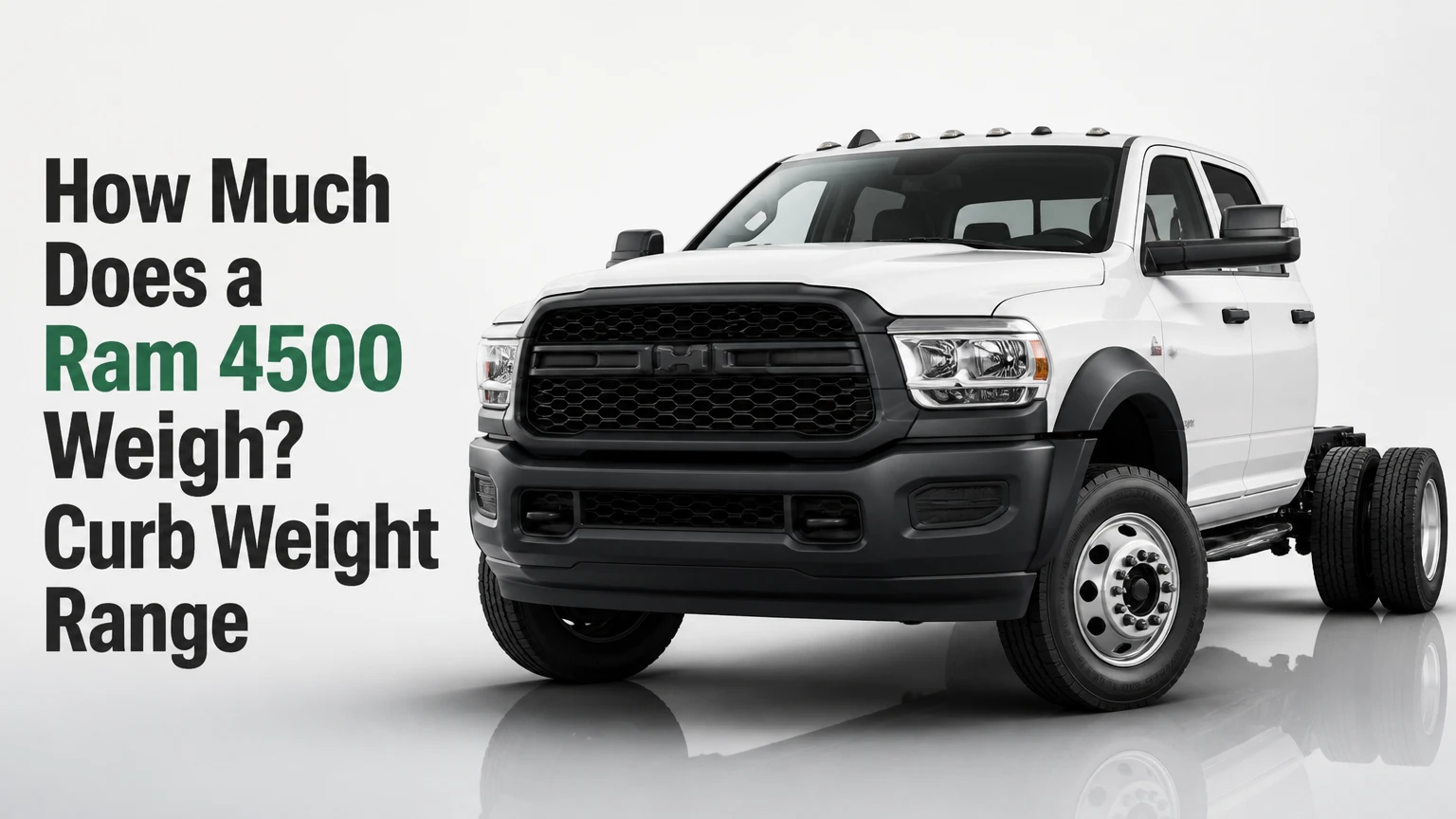
A Ram 4500 Chassis Cab typically weighs 7,121-8,483 pounds empty, depending on cab style, wheelbase, engine, and drivetrain. Its standard 16,500-pound GVWR includes the truck, passengers, fuel, tools, cargo, aftermarket body, and trailer tongue weight. A completed work truck can weigh several thousand pounds more than the bare chassis.
Key Facts at a Glance
- A bare Ram 4500 Chassis Cab typically weighs 7,121-8,483 pounds at curb weight.
- The Ram 4500’s commonly published GVWR is 16,500 pounds.
- A theoretical bare-chassis payload can reach approximately 9,390 pounds, calculated as GVWR minus curb weight.
- The 6.7-liter Cummins diesel generally weighs about 800-900 pounds more than the 6.4-liter HEMI V8.
- A Ram 4500 upfit body commonly adds 2,000-4,000 pounds, depending on the body type and equipment.
- Published front and rear GAWR figures can total more than GVWR, but 16,500 pounds remains the vehicle’s governing total-weight limit.
How Much Does a Ram 4500 Weigh Empty?
A bare Ram 4500 Chassis Cab weighs approximately 7,100-8,500 pounds, with regular-cab 4×2 trucks at the low end and crew-cab 4×4 diesel trucks near the high end. The exact figure depends on model year, wheelbase, engine, cab, axle ratio, fuel level, options, and factory equipment.
The quoted range describes a chassis cab before an aftermarket body is installed. It does not describe a finished dump truck, service truck, ambulance, box truck, or flatbed. Those vehicles carry the chassis weight plus the body, mounting hardware, hydraulic equipment, fuel, tools, occupants, and cargo.
Ram technical literature, dealer specifications, and vehicle certification labels can show different figures because “curb weight” is not always presented using identical equipment assumptions. Some sources use a base configuration, while others list shipping weight, estimated unloaded weight, or a configuration with options. The door-jamb certification label and a certified scale provide the most useful answer for a specific truck.
Ram 4500 weight by common configuration
| Configuration | Typical curb-weight range | Main weight driver | Typical use |
|---|---|---|---|
| Regular cab, 4×2, gas | 7,100-7,300 lb | Short cab and two-wheel-drive hardware | Flatbed, utility, light vocational body |
| Regular cab, 4×4, gas | 7,400-7,700 lb | Transfer case and front drive axle | Construction access, snow, rural work |
| Crew cab, 4×2, gas | 7,600-7,900 lb | Extended passenger compartment | Utility and municipal crews |
| Regular cab, 4×2, diesel | 7,900-8,200 lb | Cummins engine and emissions equipment | Towing-focused commercial work |
| Crew cab, 4×4, diesel | 8,200-8,500 lb | Largest cab, diesel, and 4×4 system | Heavy field service and remote worksites |
These are practical planning ranges, not substitutes for the build sheet. A particular truck can fall outside a simplified range when it has a longer wheelbase, upgraded trim, extra fuel capacity, snowplow preparation, or other options.
What Do Curb Weight, GVWR, Payload, and GAWR Mean?
Curb weight is the truck’s operating weight with standard equipment and necessary fluids, normally including fuel under the manufacturer’s stated definition, but excluding occupants, cargo, and an aftermarket body. GVWR is the maximum loaded weight assigned by Ram, while payload is the remaining carrying capacity after the actual truck weight is known.
The Federal Motor Carrier Safety Administration defines GVWR as “the value specified by the manufacturer” for the loaded vehicle. That distinction matters because a scale cannot legally increase the manufacturer’s rating. A Ram 4500 that weighs 10,900 pounds on a scale still has a 16,500-pound GVWR, not a new 18,000-pound allowance.
| Term | Ram 4500 meaning | What it includes or limits | Practical use |
|---|---|---|---|
| Curb weight | Approximately 7,121-8,483 lb | Bare vehicle, fluids, standard equipment | Starting point for estimates |
| GVWR | Commonly 16,500 lb | Truck plus all occupants, cargo, body, and tongue weight | Maximum loaded vehicle weight |
| Payload | GVWR minus actual empty weight | Available capacity after body and equipment | Determines remaining cargo capacity |
| Front GAWR | Up to about 7,000 lb | Maximum permitted front-axle load | Controls front-heavy equipment |
| Rear GAWR | Up to about 12,000 lb | Maximum permitted rear-axle load | Controls rear body and cargo placement |
| GCWR | Approximately 28,500-43,000 lb | Truck and loaded trailer combined | Controls combination weight |
The front and rear axle ratings are not additive permission to exceed GVWR. For example, a 7,000-pound front GAWR and 12,000-pound rear GAWR produce a 19,000-pound mathematical total, but the truck remains limited to its 16,500-pound GVWR.
How Is Ram 4500 Payload Calculated?
Ram 4500 payload equals 16,500 pounds minus the truck’s actual loaded empty weight. A bare 7,121-pound configuration therefore has a theoretical payload of 9,379 pounds, while an 8,483-pound configuration has approximately 8,017 pounds before any body, passengers, tools, or cargo are added.
Use the truck’s scale weight rather than a brochure estimate whenever possible. A simple calculation is:
Remaining payload = GVWR – scale weight
A completed commercial truck needs a second check:
Remaining cargo capacity = GVWR – chassis – body – occupants – fuel – tools – cargo already loaded
| Example configuration | Starting weight | Added equipment and people | Remaining capacity at 16,500 lb GVWR |
|---|---|---|---|
| Bare regular-cab gas chassis | 7,200 lb | 0 lb | 9,300 lb |
| Diesel chassis with 2,500-lb dump body | 8,100 lb | 2,500 lb | 5,900 lb |
| Crew-cab 4×4 diesel with 3,200-lb service body | 8,400 lb | 3,200 lb | 4,900 lb |
| Gas chassis with 4,000-lb crane body | 7,600 lb | 4,000 lb | 4,900 lb |
The table assumes the listed equipment is the only addition. A 4,000-pound crane body can consume nearly half of the bare chassis’s theoretical payload before a technician, hydraulic oil, tools, or material is loaded. The rear axle can also exceed its rating before the total reaches 16,500 pounds.
Which Ram 4500 Engine Weighs More?
The 6.7-liter Cummins turbo diesel makes a Ram 4500 substantially heavier than the 6.4-liter HEMI V8 gas model. A typical planning difference is 800-900 pounds, although the exact gap varies with transmission, emissions hardware, cooling components, option content, and model year.
The gas engine usually preserves more payload for a body and cargo. The diesel generally provides stronger low-speed torque, higher combination-weight capability, and better suitability for frequent heavy trailer work, but the heavier powertrain reduces the payload available before the truck reaches GVWR.
| Powertrain | Typical curb-weight effect | Typical GCWR range cited for configuration | Better fit |
|---|---|---|---|
| 6.4L HEMI V8 gas | Lightest engine choice | Up to about 28,500 lb | Dump, utility, local vocational work |
| 6.7L Cummins diesel | Adds about 800-900 lb | Up to about 43,000 lb | Frequent heavy towing |
| Gas with automatic transmission | Lower initial chassis mass | Configuration-dependent | Higher body-and-cargo payload |
| Diesel with automatic transmission | Higher initial chassis mass | Configuration-dependent | Long-haul and loaded-trailer duty |
GCWR is not the same as a trailer’s advertised maximum. The actual trailer rating must also account for hitch equipment, axle ratings, tire ratings, braking requirements, trailer tongue weight, and the truck’s specific certification label.
Does Cab Style and Drivetrain Change the Weight?
Cab style and drivetrain change Ram 4500 weight by hundreds of pounds. A regular cab 4×2 is normally the lightest combination, while a crew cab 4×4 adds passenger-compartment structure, rear seating, transfer-case hardware, a front drive axle, and related components.
Wheelbase also affects mass. A longer frame carries more steel and often accompanies a body designed for greater usable length, so comparing two trucks only by engine can produce a misleading payload estimate.
Main configuration effects
- Regular cab: Lowest body and passenger-compartment mass, with the greatest theoretical payload.
- Crew cab: More interior space and seating, but less available payload.
- 4×2: Lower curb weight and fewer driveline components.
- 4×4: Better traction on work sites, but additional front-axle and transfer-case weight.
- Long wheelbase: More body flexibility, with additional frame weight and potentially greater rear overhang.
- Higher trim: Added interior, electronic, and comfort equipment can reduce payload.
A crew-cab diesel 4×4 may weigh roughly 1,000-1,400 pounds more than a regular-cab gas 4×2. That difference comes directly out of the weight available for the body and cargo.
How Much Does a Ram 4500 Weigh With an Upfit Body?
A finished Ram 4500 commonly weighs 9,500-12,500 pounds before cargo, depending on the body and installed equipment. A light aluminum flatbed may add about 1,000-1,500 pounds, while a steel service body, dump body, or crane package can add 2,500-4,000 pounds.
| Upfit type | Typical added weight | Typical finished empty weight | Main capacity concern |
|---|---|---|---|
| Aluminum flatbed | 1,000-1,500 lb | 8,200-9,800 lb | Cargo distribution over rear axle |
| Steel flatbed | 1,500-2,300 lb | 8,700-10,800 lb | Deck, stake pockets, and payload reserve |
| Dump body | 2,200-3,200 lb | 9,500-11,600 lb | Hydraulic system and rear overhang |
| Service body | 2,500-3,500 lb | 10,000-11,900 lb | Tools, drawers, compressors, and shelving |
| Crane or mechanic body | 3,500-4,500 lb | 11,000-12,900 lb | Rear GAWR and concentrated loads |
| Box body with liftgate | 3,000-5,000 lb | 11,000-13,500 lb | Body, liftgate, cargo, and tongue weight |
Body weights are typical planning values, not certified specifications. Manufacturer body drawings should identify body weight, center of gravity, mounting position, and recommended axle placement.
A 7,600-pound gas chassis with a 2,500-pound dump body and 800 pounds of occupants, fuel, tools, and gear weighs about 10,900 pounds in operation. Its simple remaining-capacity calculation is 16,500 – 10,900 = 5,600 pounds, before additional material is loaded.
How Should You Weigh a Ram 4500?
Weigh a Ram 4500 axle by axle on a certified public truck scale, first empty and then in its normal working condition. Record total weight, front-axle weight, rear-axle weight, trailer-axle weight if towing, and the scale ticket date.
Follow these steps
- Prepare the truck as used. Fill the fuel tank to the normal operating level, install the body and tools, and place occupants in the cab.
- Use a certified platform scale. CAT Scale locations and commercial-public scales commonly provide separate axle readings.
- Make the first pass without a trailer. Compare total weight with 16,500-pound GVWR and each axle reading with its GAWR.
- Make a second pass with the trailer attached. Check the combined scale weight against the truck’s GCWR and the trailer’s own ratings.
- Reposition the load if needed. Move tools or material toward the correct axle position without exceeding the body maker’s loading instructions.
- Keep the ticket and configuration record. Record fuel level, occupants, body type, tire pressures, and equipment so later changes can be evaluated.
A truck can be below GVWR while exceeding a front or rear GAWR. That is why a single total-weight reading is incomplete for a service body, crane, winch, or heavily rear-loaded trailer.
What Is the Difference Between a Ram 3500, 4500, and 5500?
The Ram 4500 occupies the Class 4 space between the Ram 3500 and Ram 5500. The 3500 generally offers a lower GVWR and pickup-truck configuration, while the 5500 provides a higher 19,500-pound GVWR for heavier vocational bodies.
| Model | Common vehicle class | Maximum GVWR often published | Typical wheel format | Common application |
|---|---|---|---|---|
| Ram 3500 pickup or chassis cab | Class 3 | Up to about 14,000 lb | 17 or 18 in on many versions | Personal use, towing, lighter work bodies |
| Ram 4500 Chassis Cab | Class 4 | 16,500 lb | 19.5 in commercial wheels | Dump, flatbed, service, municipal work |
| Ram 5500 Chassis Cab | Class 5 | 19,500 lb | 19.5 in commercial wheels | Crane, heavy mechanic, large vocational bodies |
| Ram 4500 with heavy upfit | Class 4 | Still 16,500 lb | 19.5 in commercial wheels | Specialized work within axle limits |
The 4500 is preferable when a 3500 lacks frame, suspension, wheel, or body capacity, but a 5500 becomes the more defensible choice when the planned body consumes most of the 4500’s weight reserve. Buying the larger platform at the start can cost less than replacing an overloaded service truck later.
Is a Ram 4500 better than a Ram 3500?
A Ram 4500 is better for a permanently installed commercial body, higher body weight, and repeated vocational use. A Ram 3500 is often the better choice for a pickup bed, personal towing, lower purchase cost, easier parking, and a softer unloaded ride.
Should a crane operator choose a Ram 5500?
A crane operator should usually evaluate the Ram 5500 first when the crane, body, hydraulic system, tools, and personnel approach the Ram 4500’s 16,500-pound GVWR. The 5500’s 19,500-pound rating provides approximately 3,000 pounds more gross-weight headroom, although axle placement and center of gravity still require engineering review.
How Much Does a Ram 4500 Cost Before and After Upfitting?
A new bare Ram 4500 Chassis Cab commonly lists in the approximate $52,000-$68,000 range before an upfit, depending on trim, engine, options, incentives, and model year. Typical commercial bodies add about $5,000-$35,000, with a simple flatbed near the low end and a crane, refrigerated box, or specialized utility body near the high end.
| Purchase component | Typical price range | Typical lead time | Main variable |
|---|---|---|---|
| Bare chassis cab | $52,000-$68,000 | 12-24 weeks if factory-ordered | Trim and engine |
| Aluminum flatbed | $5,000-$10,000 | 2-8 weeks | Length and accessories |
| Dump body | $10,000-$20,000 | 4-12 weeks | Steel gauge and hydraulics |
| Service body | $12,000-$25,000 | 6-16 weeks | Shelving and electrical equipment |
| Crane or specialty body | $20,000-$35,000+ | 8-24 weeks | Crane rating and hydraulic package |
These figures are planning ranges, not quotes. Dealer inventory can shorten delivery, while factory chassis availability and body-builder scheduling can extend it.
What Problems Occur When a Ram 4500 Is Too Heavy?
The most serious Ram 4500 weight problems occur when the body and cargo exceed GVWR, an axle rating, a tire rating, or the body maker’s center-of-gravity limit. Mechanical symptoms such as repeated bump-stop contact, inner-edge tire wear, brake heat, and high transmission temperatures indicate a need for inspection, but they do not prove that the truck is within legal limits.
Common failure modes include:
- Heavy body selected from brochure payload. The buyer subtracts only the chassis curb weight and forgets the body, occupants, and tools. Recalculate from an actual scale ticket.
- Rear-heavy equipment placement. A crane, compressor, or dense tool cabinet sits behind the rear axle. Move equipment forward or choose a higher-capacity platform after checking axle weights.
- Trailer tongue weight omitted. A 2,000-pound tongue adds directly to the truck’s loaded weight, even though much of the trailer’s total mass rests on its own axles.
- Tire capacity overlooked. A tire’s load rating and inflation requirement can impose a lower practical limit than a marketing payload figure.
- Assuming suspension upgrades raise GVWR. Helper springs, air bags, and stiffer shocks can improve control, but they do not change the manufacturer’s GVWR or GAWR.
- Using a generic internet specification. Model year, cab, wheelbase, and drivetrain change the certified values. Confirm the VIN-specific label and build documentation.
An overloaded truck can also have reduced braking margin, altered steering response, accelerated tire wear, and increased rollover risk. Stopping distance and stability become more important as the center of gravity rises.
Which Ram 4500 Configuration Fits Each Job?
A regular-cab 4×2 gas Ram 4500 best preserves payload for a light body and dense cargo, while a crew-cab 4×4 diesel best supports personnel access and frequent towing. A heavy crane or mechanic body may justify moving directly to the Ram 5500 rather than consuming the 4500’s limited weight reserve.
| Work situation | Recommended starting configuration | Reason | Limitation |
|---|---|---|---|
| Local dump hauling | Regular cab, gas, 4×2 or 4×4 | Lower chassis weight and simpler operation | Lower heavy-trailer capability |
| Utility service crew | Crew cab, gas, 4×2 | More seats with useful payload reserve | Less traction than 4×4 |
| Remote construction | Regular or crew cab, diesel, 4×4 | Torque and traction for sites and trailers | Highest empty weight |
| Long-distance hotshot towing | Regular cab, diesel, 4×2 | Lower curb weight with diesel torque | Less body and passenger capacity |
| Crane or mechanic truck | Ram 5500 evaluation first | More GVWR headroom | Higher purchase and operating cost |
Honest limitation
The Ram 4500 is not automatically the best commercial truck because its chassis is heavier than a pickup and its 16,500-pound GVWR can disappear quickly after a substantial body installation. A lighter Ram 3500 may be more practical for a pickup-bed owner, while a Ram 5500 is safer to evaluate for a crane, large compressor, or heavily equipped mechanic body.
Frequently Asked Questions
Does a Ram 4500 weigh more than a Ram 3500?
A Ram 4500 usually weighs more than a comparable Ram 3500 because it uses a commercial chassis, 19.5-inch wheels, and heavier-duty suspension components. The actual difference depends on cab, drivetrain, engine, wheelbase, and whether the 3500 is a pickup or chassis-cab model.
How much does a Ram 4500 weigh with a diesel engine?
A diesel Ram 4500 typically weighs about 7,900-8,500 pounds before an aftermarket body, depending on cab, drivetrain, and wheelbase. The 6.7-liter Cummins commonly adds approximately 800-900 pounds compared with the 6.4-liter gas engine.
Can a Ram 4500 carry 10,000 pounds?
A bare, light Ram 4500 may have a theoretical payload near 9,390 pounds, so a 10,000-pound payload is generally above the standard 16,500-pound GVWR calculation. A body, passengers, tools, and fuel reduce capacity further, making a Ram 5500 or larger truck the appropriate comparison.
Does a Ram 4500 require a commercial driver’s license?
A Ram 4500’s 16,500-pound GVWR alone does not automatically require a commercial driver’s license under the federal threshold for a single vehicle, which is generally 26,001 pounds. Business use, interstate operation, passenger transport, hazardous materials, state rules, and the weight rating of a truck-trailer combination can create additional requirements.
How much does a Ram 4500 box truck weigh?
A Ram 4500 with a box body commonly weighs about 11,000-13,500 pounds before cargo, depending on box length, construction, liftgate, engine, and cab. A scale ticket is necessary because a liftgate and refrigeration equipment can add hundreds or thousands of pounds.
What is the safest way to confirm Ram 4500 weight?
The safest method is to compare the VIN-specific certification label with a certified scale ticket showing total, front-axle, and rear-axle weights. Weigh the truck in its normal operating condition, including body, fuel, occupants, tools, and installed equipment, then compare every reading with GVWR, GAWR, and tire limits.
The Bottom Line
A bare Ram 4500 Chassis Cab weighs approximately 7,121-8,483 pounds, while a finished work truck commonly weighs 9,500-12,500 pounds before cargo. The truck’s standard 16,500-pound GVWR determines legal loaded weight, so the useful answer to “how much does a ram 4500 weigh” depends on the exact VIN, engine, cab, drivetrain, body, equipment, occupants, and cargo. Confirm the result on a certified scale before selecting an upfit or loading a trailer.