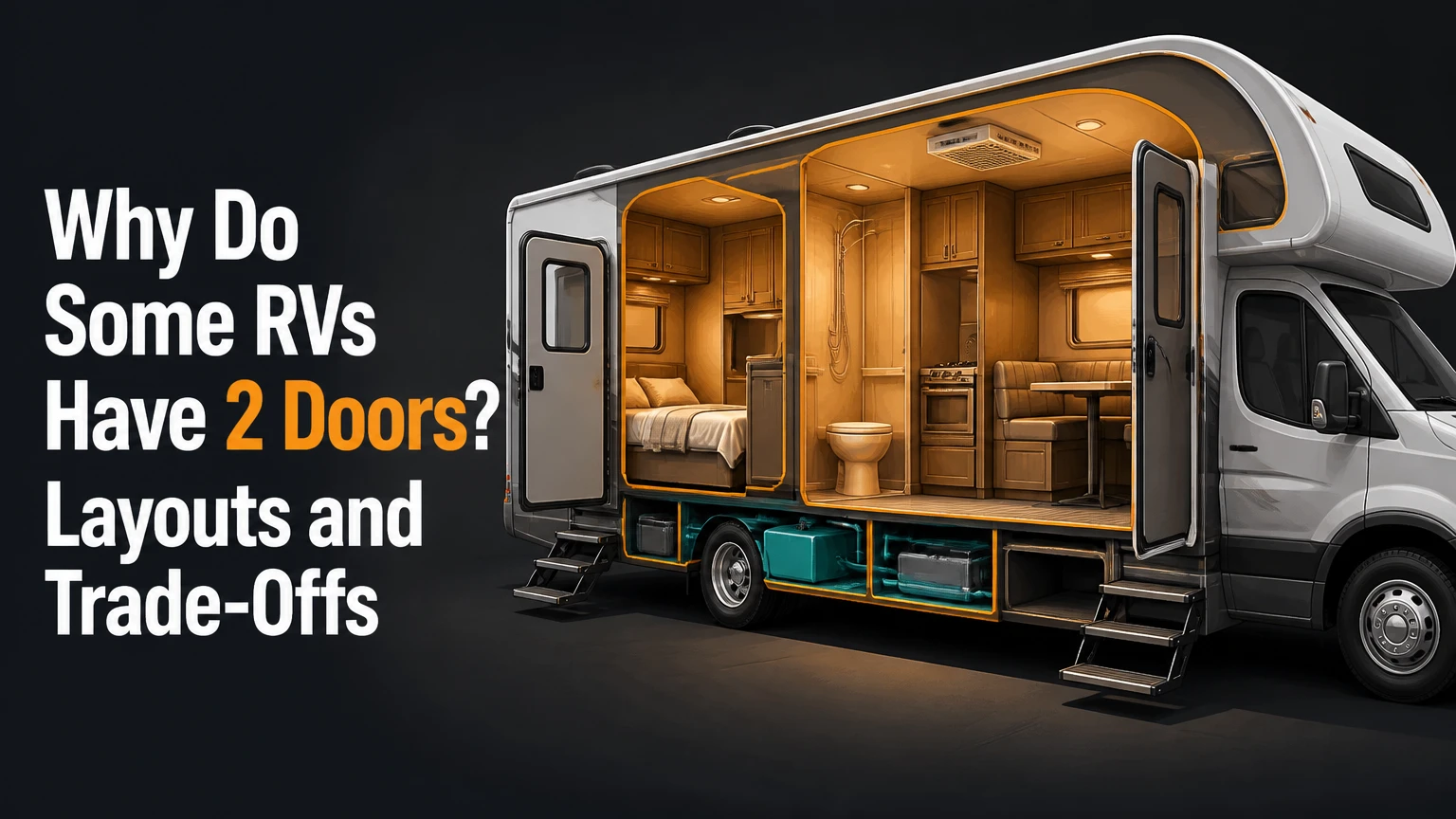
Some RVs have two doors because manufacturers use the second opening to separate living areas, provide convenient access to a bathroom, bedroom, bunkhouse, or garage, and create another usable exit. Dual-door layouts are most common in travel trailers, fifth wheels, and toy haulers, but the second opening is a floor-plan choice rather than a universal safety requirement.
Key Facts at a Glance
- A second RV door usually serves a bathroom, bedroom, bunkhouse, garage, or cargo area.
- A second door can improve evacuation options, but an emergency-exit window may provide the required alternate escape route instead.
- A bathroom-entry door helps keep mud, sand, rainwater, and pet mess away from the main living area.
- A toy-hauler ramp door is primarily a cargo loading system, not always a second everyday personnel entrance.
- A second door typically consumes interior wall space and adds another lock, hinge set, seal, and potential leak point.
- Aftermarket installation is a structural and water-intrusion project, not a simple cutout job.
Why Do Some RVs Have 2 Doors?
Two-door RVs use separate entrances to create functional zones inside the coach. The main door normally opens into the kitchen or living room, while the second opening serves a room that benefits from independent access, such as a rear bathroom, front bedroom, bunkhouse, or toy-hauler garage.
The arrangement also changes how people move through a campsite. A child can enter the bunk room without crossing the kitchen, a guest can reach the bathroom without walking through the bedroom, and a camper returning from a muddy trail can remove footwear in a more washable area. Those benefits explain the design better than the idea that every dual-door RV exists mainly to satisfy a regulation.
A second door has real safety value when the main entrance is blocked by a fire, collision, furniture, or campsite obstruction. However, RV manufacturers also use emergency-exit windows, roof hatches, and other designated egress openings. Buyers should inspect the specific floor plan and owner’s manual rather than assume that two visible doors equal two legally required exits.
Does a second door improve RV safety?
A second door can improve practical escape options, especially when it opens directly from a bedroom or bunkhouse. The safety benefit depends on door location, clear interior access, exterior obstructions, working latches, and whether occupants can open the door quickly under stress.
A bedroom door that opens onto a clear campsite may be more useful than a second door blocked by a slide, awning arm, bicycle rack, or neighboring vehicle. A narrow bathroom door may also be difficult for some occupants to use during an emergency. NFPA 1192, the recreational vehicle standard used by manufacturers and certification programs, addresses emergency egress and other construction requirements, but it does not mean every RV must have two conventional entry doors.
Treat both doors as emergency equipment. Keep aisles clear, test latches periodically, and verify that each designated escape opening operates without a key.
Which RV Types Commonly Have Two Doors?
Travel trailers and fifth wheels most often use two-door floor plans when the extra entrance supports a bathroom, bedroom, bunkhouse, or rear living zone. Toy haulers add another variation by combining a side personnel door with a large rear ramp.
| RV type | Common second opening | Typical purpose | Main trade-off |
|---|---|---|---|
| Travel trailer | Rear bathroom or bunkhouse door | Outside bathroom access or child separation | 24-30 inches of lost wall length |
| Fifth wheel | Bedroom or bathroom entry | Suite privacy and independent movement | More exterior seals and hardware |
| Toy hauler | Rear ramp, side cargo door, or both | Vehicle loading and garage access | Ramp may not function like a daily door |
| Class A motorhome | Usually no second exterior cabin door | Coach construction favors one main entry | Bedroom and bathroom access remain interior |
| Class C motorhome | Cab doors plus coach entry | Driver and passenger access, not room zoning | Cab doors may not connect conveniently to living space |
Class A and Class C motorhomes can appear to have several doors because the cab doors count as vehicle doors, but those openings usually do not provide direct access to a private bathroom or bedroom. A travel trailer with two side doors represents a different design objective.
What Is the Bathroom-Entry Layout?
A bathroom-entry RV places one exterior door beside or inside the bathroom zone, allowing users to enter the restroom without crossing the main living area. The design is particularly useful for beach trips, muddy campsites, children, pets, and guests who are using the coach temporarily.
The second doorway commonly opens into a bathroom or a small transitional space containing a sink, shower, toilet, storage, or washer-dryer cabinet. Manufacturers may call the area a “walk-through bath,” “rear bath,” “pass-through bath,” or “mudroom,” and the exact arrangement varies substantially.
A bathroom door does not make the RV mudproof. Wet clothing still needs a place to hang, and sand can pass through the threshold. The best versions provide a non-carpeted floor, a hand shower, ventilation, towel storage, and enough clearance to close the interior door before opening the exterior one.
Why do campers use a bathroom door from outside?
An exterior bathroom door reduces traffic through the kitchen and bedroom, which limits tracked dirt and protects privacy. At a crowded campsite, children and visitors can use the toilet without opening the main door or passing sleeping occupants.
The arrangement also helps when the main living area is occupied. A camper preparing breakfast can keep the main entrance closed while another person accesses the restroom. The limitation is weather exposure: the outside user needs a covered threshold, an operable screen door, and a latch that works when the frame is slightly twisted.
How Does a Bedroom or Bunkhouse Door Work?
A bedroom-entry door gives the sleeping area its own exterior access, while a bunkhouse door lets children or guests enter a separate room without crossing the main cabin. These layouts prioritize privacy and traffic control rather than dirt management.
A bedroom exit can be useful for couples with different schedules. One person can leave early for work, fishing, or a restroom visit without walking through the kitchen. A bunkhouse entrance can keep bicycles, shoes, backpacks, and children’s activity concentrated in the rear section.
Privacy has limits. Many RV bedroom doors are lightweight pocket doors or accordion doors, and a curtain is not a sound barrier. A door that opens directly onto a campsite also needs careful attention to lighting, visibility, and security after dark.
| Secondary room | Best use case | Typical access benefit | Common limitation |
|---|---|---|---|
| Rear bathroom | Beach, hunting, children | Keeps wet or dirty traffic outside living room | Small threshold and limited shelter |
| Front bedroom | Couples with separate schedules | Independent morning and nighttime exit | Reduced wardrobe or window wall |
| Bunkhouse | Families with older children | Separates sleeping and play traffic | Less supervision of younger children |
| Garage | Motorcycles, ATVs, tools | Direct loading and unloading | Cargo odors and heavier door hardware |
| Rear living room | Guests and entertaining | Direct patio-side access | Awning and campsite orientation matter |
Is a Toy-Hauler Ramp a Second Door?
A toy-hauler ramp is a large rear loading door, while a second side door is a conventional personnel entrance. The ramp allows motorcycles, ATVs, bicycles, generators, or bulky equipment to enter the garage; it may also convert into a patio when the manufacturer supplies rails and supports.
The ramp is not equivalent to a bedroom or bathroom door. It is heavier, wider, more exposed to weather, and dependent on cables, springs, hinges, seals, and locking hardware. Some owners use it as an outdoor living opening, but manufacturers may limit patio use to specified capacities and installation instructions.
Check whether a floor plan has a separate side cargo door. That smaller opening can provide daily access without lowering the ramp, while the ramp remains closed during ordinary camping.
What Does a Second Door Cost Inside the RV?
A second door typically removes usable wall area, adds structural framing, and displaces cabinets, pantry shelving, windows, or appliances. The real cost is therefore larger than the door assembly itself.
Manufacturers do not usually publish a universal “second-door premium,” because the door accompanies an entire floor plan rather than functioning as a simple package option. The following figures are typical planning ranges, not specifications for every brand.
| Item | Typical range | What changes the figure | Buyer consequence |
|---|---|---|---|
| Secondary personnel door width | 24-30 in | Model, bathroom access, accessibility target | Narrower furniture path |
| Primary RV entry width | 30-36 in | Trailer class and door supplier | Easier moving and boarding |
| Added door assembly weight | 50-80 lb | Glass, frame, steps, reinforcement | Small payload reduction |
| Dual-door floor-plan premium | $1,500-$3,500 | New model, trim, hardware | Higher purchase price |
| Replacement door assembly | $300-$1,200 | Size, window, lock, supplier | Parts availability matters |
| Seal or latch service | $50-$250 | DIY versus shop labor | Annual inspection is inexpensive |
The lost wall space can matter more than the added weight. A pantry cabinet may hold more value for a full-time couple than a private exit, while a family may accept the loss to gain an outside bunkhouse or bathroom entrance.
Does a second door affect insulation?
A second door creates another thermal bridge and another gasket line, so a dual-door RV usually has more potential air leakage than an otherwise comparable single-door model. The difference becomes more noticeable when the secondary door has a large window, a thin frame, or poor compression.
Cold-weather performance depends on more than door count. Wall insulation, heated underbelly design, window glazing, furnace capacity, slide-out seals, and plumbing protection can outweigh the second doorway. Still, winter campers should inspect both doors for daylight, damaged bulb seals, loose strike plates, and cold drafts.
Manufacturers rarely publish comparable whole-coach heat-loss data for single-door and dual-door floor plans. Treat claims about a precise percentage of heat loss as unverified unless a manufacturer provides test conditions.
How Much Do Two Doors Add to Weight and Price?
A typical second personnel door adds about 50-80 pounds, while a toy-hauler ramp can add substantially more because it uses a wide panel, reinforced hinges, cables, and patio hardware. A complete dual-door RV may cost approximately $1,500-$3,500 more than a similar single-door layout, but the floor plan drives the final price.
Payload is the practical measurement. If a trailer has 1,200 pounds of available cargo capacity, an extra 70-pound door consumes about 5.8% of that allowance before occupants, water, batteries, propane, and camping equipment are added.
| Decision factor | Single-door layout | Dual-door layout | Practical question |
|---|---|---|---|
| Interior wall space | Maximum available | Minus roughly 24-36 in at opening | Is pantry space more valuable? |
| Exterior hardware | One lock and seal set | Two lock and seal sets | Will both doors receive maintenance? |
| Egress options | Main door plus designated exits | Two doors plus designated exits | Are all openings unobstructed? |
| Payload impact | Lower baseline | Often 50-80 lb higher | What is the loaded hitch weight? |
| Draft exposure | Fewer gasket lines | Additional gasket and frame | Is winter camping frequent? |
| Camp traffic | Through main cabin | Can be separated by zone | Who needs independent access? |
Can You Add a Second Door to an RV?
An RV can receive a second door retrofit, but the project is high-risk and should be handled by a qualified RV body or sidewall technician. Cutting the opening can damage aluminum studs, wood framing, laminated fiberglass, electrical wiring, plumbing, insulation, and hidden structural members.
A typical professional retrofit may cost $1,200-$2,500 and take 2-4 days, but those figures exclude major repairs discovered after opening the wall. The shop must confirm the door size, locate framing, install a header and sill, seal the perimeter, restore interior trim, and test the wall for water entry.
Do not treat a door kit as permission to cut any convenient section. A factory wall may depend on the continuous panel for stiffness, and a poorly supported opening can cause delamination, door misalignment, or permanent leaks. Insurance, warranty, resale, and inspection consequences should be discussed before work begins.
Why Does the Second RV Door Stick or Leak?
A sticking RV door is often caused by an out-of-square frame, while a leaking door usually involves compressed seals, incorrect adjustment, blocked drainage, or failed sealant. Trailer leveling, chassis movement, and repeated vibration can change the relationship between the latch and strike plate.
How do you fix a binding door?
- Park the RV on a reasonably level surface and extend stabilizers according to the manufacturer’s procedure.
- Check whether the door gap is even on all four sides.
- Inspect hinge screws, latch screws, and the strike plate for looseness.
- Adjust the strike plate in small increments, usually 1/16 inch at a time.
- Close the door without slamming and confirm that the latch engages fully.
A successful adjustment produces even compression around the gasket and a latch that closes without excessive force. Do not force a door while the trailer is severely twisted by uneven jacks, because the temporary adjustment may hide a structural or leveling problem.
How do you stop water around the door?
Clean the rubber seal with mild soap and water, inspect it for tears or flattened sections, and examine the upper corners and threshold for gaps. Replace a permanently compressed gasket rather than coating it with random household sealants.
Use a manufacturer-approved rubber conditioner on the gasket. Dry graphite is appropriate for some lock cylinders, but the lock manufacturer’s instructions take priority; lubricants that collect dust can create a sticky cylinder. Do not drill drain holes or apply silicone across designed drainage paths.
| Symptom | Likely cause | First inspection | Typical remedy |
|---|---|---|---|
| Latch needs slamming | Frame misalignment | Door gap and strike plate | Re-level and adjust strike |
| Water at lower corner | Damaged bulb seal | Seal compression and tears | Replace gasket |
| Water above frame | Failed exterior sealant | Upper flange and screws | Reseal with RV-compatible product |
| Lock turns but does not secure | Cylinder or linkage issue | Interior actuator and cam | Replace worn lock assembly |
| Screen door will not close | Bent frame or latch | Hinge alignment | Adjust hardware, replace latch |
Which RV Layout Is Best for Different Campers?
The best two-door layout depends on who uses the RV, where the coach is parked, and whether the second entrance replaces valuable storage. Families and beach campers generally gain more from a bathroom door, while couples may prefer a bedroom exit only when independent schedules justify the lost wall space.
- Families with children: Choose a bunkhouse door when older children can manage their own entry, shoes, and lights.
- Beach and hunting campers: Choose a bathroom-entry layout with a hard floor and covered threshold.
- Full-time couples: Choose a bedroom exit if independent morning access matters more than wardrobe or pantry capacity.
- Winter campers: Prefer a single-door model unless the second door has strong seals, a thermal window, and good frame adjustment.
- ATV and motorcycle owners: Choose a toy hauler with a dedicated side personnel door if the ramp will remain closed during ordinary use.
- Accessibility-focused buyers: Measure the clear opening, threshold height, step depth, handle position, and turning space in person.
A second door is not automatically an upgrade. It is valuable when its location solves a repeated movement problem.
What Should You Inspect Before Buying?
Walk through both doors several times before signing a purchase agreement. Test each lock, screen door, step, grab handle, interior privacy door, and emergency opening while the trailer is hitched and again while it is leveled at the dealership.
Confirm that the main awning covers the secondary entrance if rain protection matters. Inspect whether the door conflicts with slide-outs, propane compartments, outdoor kitchens, storage doors, bicycles, or the neighboring campsite. Check the manufacturer’s cargo-carrying capacity after accounting for batteries, full propane cylinders, water, and the additional door hardware.
Ask the dealer for the exact door supplier, replacement seal part number, warranty coverage, and recommended inspection interval. A convenient floor plan becomes expensive when a proprietary latch or window is difficult to source.
Common Mistakes With Dual-Door RVs
- Counting a ramp as an everyday entrance: A toy-hauler ramp may be heavy and awkward for routine use. Confirm that a separate side personnel door exists.
- Ignoring awning coverage: A bathroom door outside the awning can become unusable during rain. Stand at the threshold and check the drip line.
- Leaving the screen door unlatched: Wind can damage hinges and allow insects inside. Secure both the screen and exterior door before leaving.
- Forgetting the second lock during travel: A loose interior latch can open against cabinetry or allow dust and water intrusion.
- Overlooking wall-space loss: Measure the displaced pantry, wardrobe, or counter instead of judging the benefit only from outside.
- Assuming two doors replace maintenance: Both openings need seal, latch, hinge, and frame inspections at least annually.
One practitioner rule is simple: evaluate the door from the campsite, not only from the showroom. A second entrance that faces the neighbor’s sewer connection may be less useful than one positioned beside the picnic table.
FAQ
Are two-door RVs harder to sell?
Two-door RVs are not universally harder to sell, but the buyer pool depends on the floor plan. Families may actively seek bunkhouse access, while winter campers or full-time couples may prefer the storage and insulation simplicity of one door. Condition, water history, payload, and maintenance usually matter more than door count alone.
Do two RV doors use the same key?
Many RVs use keyed-alike locks so one key operates both exterior doors, while others use separate keys for the main and secondary openings. Confirm the actual lock cylinders at delivery and record replacement part numbers. A master-key system may exist for dealers, but it does not guarantee that every coach uses one key.
Is a bathroom-entry RV more private?
A bathroom-entry RV can improve privacy because visitors avoid the bedroom and living area, but the exterior door does not prevent sound, visibility, or campsite exposure. Frosted glass, a working interior bathroom door, an exterior light, and a covered threshold make the arrangement more private and usable.
Does a second door reduce towing capacity?
A second door usually reduces available cargo capacity by its added weight rather than changing the trailer’s certified gross vehicle weight rating. The practical reduction is commonly about 50-80 pounds for a personnel door, but owners must also account for steps, batteries, water, propane, passengers, and cargo.
Can a second door be used while the RV is moving?
A second exterior door should remain closed and locked while the RV is moving. Passengers should not occupy bathrooms, bedrooms, bunkhouses, or toy-hauler garages during travel unless local law and the vehicle’s seating certification specifically allow it. RV floor-plan access does not establish approved passenger seating.
Are two doors worth it on a travel trailer?
Two doors are worth choosing when the second opening provides frequent bathroom, bunkhouse, bedroom, or cargo access. A single door is usually the better choice when maximum pantry space, lower maintenance, winter efficiency, or a simpler wall structure matters more. Compare the exact floor plans rather than the door count alone.
The Bottom Line
Why do some RVs have 2 doors? Manufacturers add them to separate traffic, provide direct access to private or dirty-use areas, support bunkhouse and toy-hauler layouts, and offer another practical escape route. The design does not automatically mean better safety or higher quality. Choose a dual-door RV when the second entrance solves a repeated camping problem, then verify its wall-space cost, payload effect, weather protection, and maintenance requirements before buying.