The 2022 Lordstown Endurance was a discontinued, battery-electric, full-size commercial pickup built in extremely small numbers by Lordstown Motors. Its defining feature was four Elaphe in-wheel hub motors, but bankruptcy, limited production, uncertain parts supply, recall history, and absent factory support make surviving examples collector or engineering projects rather than dependable work trucks.
What Are the 2022 Lordstown Endurance Facts?
The most important 2022 Lordstown Endurance facts are its discontinued status, four-wheel hub-motor drivetrain, approximately 200-mile EPA-targeted range, 109-kWh battery, and fleet-first design. Lordstown Motors entered Chapter 11 bankruptcy in June 2023 after production and funding problems, leaving owners without the normal support structure of a large automaker.
Lordstown Motors developed the Endurance for commercial customers such as utilities, municipalities, and service fleets. The company’s engineering argument was straightforward: motors mounted inside the wheel hubs could remove driveshafts, differentials, axles, and several other conventional drivetrain components.
That simplification created a different risk. A hub motor adds weight to the wheel assembly, and a damaged motor can be more difficult and expensive to replace than a conventional centralized electric motor. Elaphe, the motor supplier, described the vehicle in a company headline as “the world’s first all-electric commercial pickup truck,” a claim centered on its production-oriented hub-motor architecture.
Status at a glance
- Lordstown Motors filed for Chapter 11 bankruptcy in June 2023.
- Production was extremely limited, with approximately 31 trucks commonly reported as built and only a small number delivered to customers.
- The Endurance used four Elaphe L-1500 in-wheel motors.
- Published specifications generally cite about 550 horsepower, a 109-kWh battery, and approximately 200 miles of EPA-rated range.
- The truck was designed primarily for fleet duty, not broad consumer retail sales.
- Factory-backed warranty, software, service, and parts support cannot be assumed.
Is the Endurance Still Available?
The Lordstown Endurance is no longer in normal production, and no new-vehicle retail channel exists. Any surviving truck is likely to appear through a private sale, liquidation process, salvage auction, specialty collector listing, or a company fleet disposal.
Production figures require caution because Lordstown’s prototypes, validation vehicles, preproduction trucks, and customer units are not always separated consistently in secondary reporting. A listing that claims to be one of the few customer vehicles should be checked against its VIN, title history, build records, and delivery documentation.
| Status factor | Practical fact | Buyer implication |
|---|---|---|
| Manufacturer | Lordstown Motors | Original company support is unavailable |
| Bankruptcy filing | June 2023, Chapter 11 | Warranty and parts claims require special verification |
| Commonly reported production | About 31 vehicles | Replacement parts may have no economies of scale |
| Commonly reported customer deliveries | About 6 vehicles | Many apparent examples may be prototypes |
| Current sales channel | Private, auction, or liquidation | Vehicle condition and title status vary widely |
A low odometer reading does not prove a truck is desirable. A prototype may have incomplete software, nonstandard components, test-program modifications, or a battery that spent long periods at an unhealthy state of charge.
How Does the Hub-Motor Drivetrain Work?
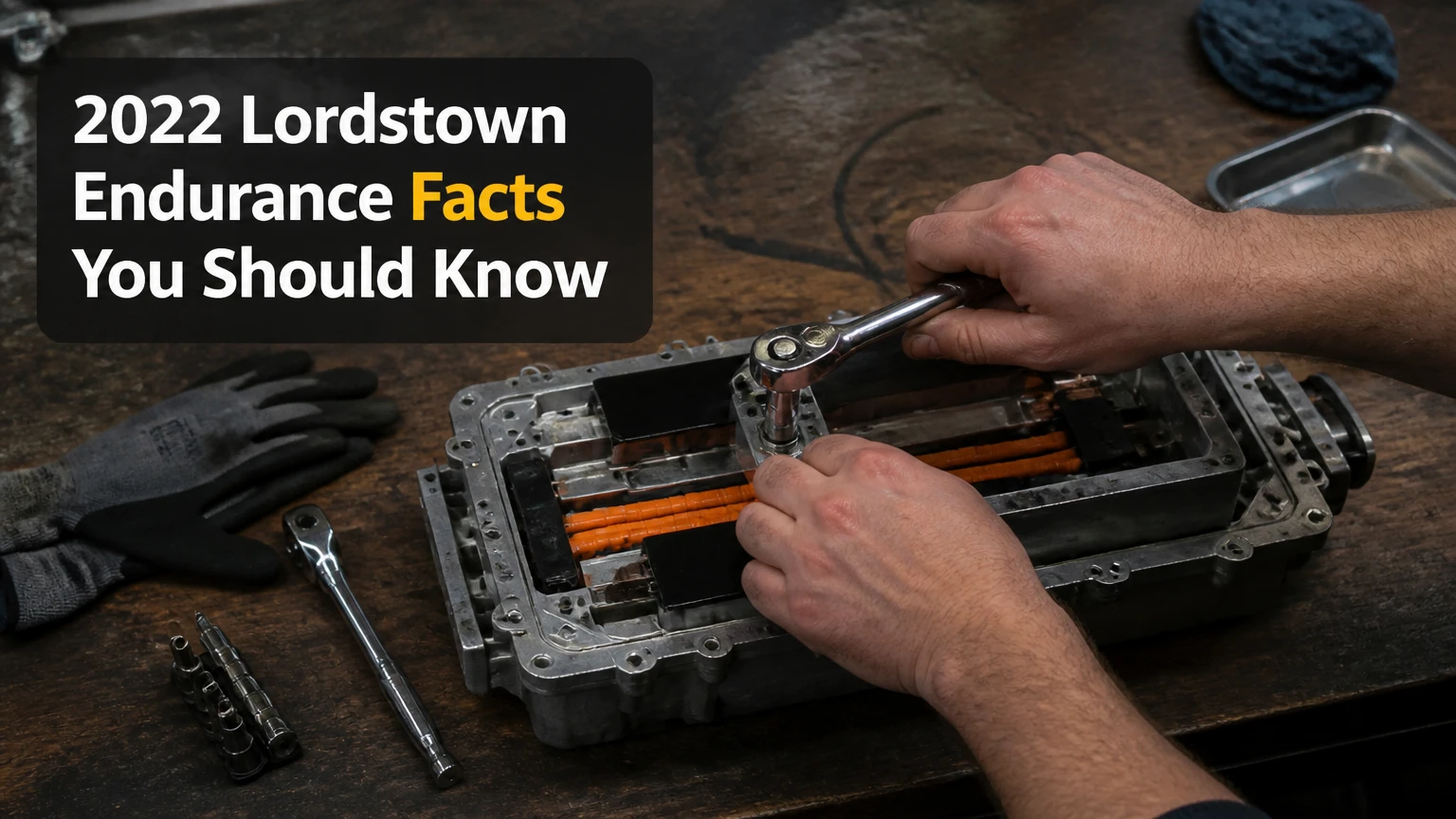
The Lordstown Endurance sends propulsion torque through four independent Elaphe L-1500 in-wheel motors, with software controlling each wheel separately. The layout eliminates mechanical connections between the front and rear axles, which can simplify packaging and enable software-based torque distribution.
A conventional electric pickup normally places one or two motors between the axles. Gears, half-shafts, differentials, and suspension components then transfer power to the wheels. The Endurance instead places the motor in the wheel assembly, alongside the friction-brake hardware.
The design produces a flat vehicle floor and allows independent wheel torque control. Torque vectoring can reduce wheel slip and influence cornering behavior, especially on loose or uneven surfaces. However, the motor becomes part of the unsprung mass, meaning the suspension must control more weight at each wheel.
Hub motors: benefits and penalties
| Engineering attribute | Endurance hub-motor result | Real-world consequence |
|---|---|---|
| Motor count | 4 independent motors | Fine-grained torque control |
| Driveline parts | No driveshaft or axle differential | Fewer conventional mechanical components |
| Motor location | Inside each wheel hub | More wheel-end exposure to impacts |
| Unsprung mass | Higher than centralized motor systems | Potentially harsher ride and reduced suspension compliance |
| Torque control | Software-managed per wheel | Useful traction response when software works correctly |
| Service strategy | Specialized wheel-end hardware | Replacement may require rare parts or custom expertise |
The hub-motor concept does not mean the truck has no drivetrain parts. Bearings, reduction gearing, brakes, wiring, suspension components, high-voltage connectors, and control electronics still require inspection and repair.
What Are the Key Specifications?
Published Endurance specifications commonly identify a 109-kWh battery, approximately 550 horsepower, about 4,971 pound-feet of cited peak wheel torque, and a roughly 200-mile EPA range. Some figures describe peak output or wheel torque rather than continuous motor performance, so they should not be compared directly with every competitor’s engine or axle-torque number.
| Specification | Commonly published figure | Interpretation |
|---|---|---|
| Battery capacity | 109 kWh gross, about 104 kWh usable in some listings | Confirm pack configuration and available diagnostic data |
| Peak power | About 410 kW, approximately 550 hp | Peak output is not continuous output |
| Cited torque | About 4,971 lb-ft | Usually treated as wheel torque, not conventional crank torque |
| EPA-targeted range | About 200 miles | Actual range depends on temperature, speed, load, and tires |
| Body | Four-door crew cab | Commercial full-size pickup format |
| Bed | Approximately 5.5 feet | Similar working format to mainstream crew-cab pickups |
| Towing | Commonly cited at 7,500-8,000 pounds | Verify the specific truck’s certification and hitch equipment |
| AC charging | About 11 kW | A full charge can take roughly 10 hours under suitable conditions |
| DC fast charging | Up to about 150 kW | Published peak; charger compatibility and battery temperature matter |
The torque figure deserves special attention. The Endurance’s roughly 4,971 lb-ft number is not equivalent to a gasoline truck’s crankshaft torque because electric wheel torque calculations depend on gearing and measurement location. For purchasing decisions, payload, towing certification, thermal behavior, and charge access matter more than the headline torque value.
What Range and Charging Should You Expect?
The Lordstown Endurance was generally associated with approximately 200 miles of EPA range, while practical driving can fall substantially below that figure. Cold weather, highway speeds, heavy payloads, towing, aggressive heating, tire pressure, battery age, and extended parking can all reduce usable range.
An 11-kW Level 2 connection could require about 10 hours for a near-empty-to-full charge, although charging losses and battery-management limits make the exact time longer or shorter. A compatible 150-kW DC fast charger was advertised as capable of charging from 20% to 80% in roughly 45 minutes under favorable conditions.
| Use case | Typical range effect | Planning rule |
|---|---|---|
| Mild-weather local driving | Near published range | Keep a 20% reserve |
| Winter operation | Material reduction possible | Precondition while plugged in |
| Highway driving | Lower than city-cycle results | Plan charging before 150 miles |
| Heavy payload | Lower energy efficiency | Treat the battery gauge conservatively |
| Towing | Large range reduction possible | Avoid routes with sparse chargers |
| Aged or stored battery | Unknown reduction | Require battery-health diagnostics |
Public charging is a particular concern because a discontinued vehicle may have incomplete charging software support. Before purchase, test the truck on the exact AC and DC networks available near the intended operating area. A successful home charge does not prove reliable public DC fast charging.
Can It Handle Fleet Work and Towing?
The Endurance was intended for fleet work, and published towing figures commonly range from 7,500 to 8,000 pounds. That capability is theoretical for a surviving truck unless the vehicle has verified certification, a functioning charge system, healthy battery capacity, and a documented hitch installation.
Towing an enclosed trailer can reduce electric range dramatically because aerodynamic drag rises quickly with speed. A truck that travels near 200 miles unloaded may require charging after substantially fewer miles while towing, particularly in cold weather or on steep terrain.
Fleet managers should calculate route energy rather than rely on the maximum tow rating. Include payload, trailer weight, elevation, winter conditions, charger downtime, and the consequence of a failed truck that cannot be repaired through a dealer network.
The Endurance is also a poor candidate for remote work sites. A centralized-motor EV can often draw on established manufacturer parts and service procedures, while a hub-motor failure may immobilize the vehicle and require specialist fabrication or reverse engineering.
What Was the Endurance Interior and Equipment Like?
The Endurance was a sparse, work-oriented crew-cab pickup with cloth seating, durable floor materials, and a large horizontal display used for driver information and infotainment. Most examples were associated with white exterior paint, while prototypes and promotional vehicles appeared in additional colors.
The interior prioritized fleet practicality over premium comfort. Screen-based controls reduce physical switchgear but create a serious usability issue if the display freezes or the vehicle’s low-voltage system becomes unstable. A 12-volt battery disconnect may restore operation in some situations, but repeated resets indicate an unresolved electrical fault.
| Configuration area | Endurance description | Ownership concern |
|---|---|---|
| Cab | Four-door crew cab | Suitable for a small work crew |
| Bed | Approximately 5.5 feet | Verify liner, tie-downs, and tailgate condition |
| Seating | Cloth, fleet-oriented | Durable but not luxury-focused |
| Flooring | Rubber or hard-wearing material | Inspect water intrusion and wear |
| Display | Large horizontal screen | Software support may be unavailable |
| Exterior | White common on fleet examples | Repainted or prototype panels need verification |
Do not assume a surviving truck has identical equipment to another Endurance. Prototype development can produce differences in displays, cameras, charging hardware, software, and trim components.
What Problems and Recalls Matter?
The most important Endurance risks involve high-voltage connections, propulsion loss, electronic parking-brake operation, software stability, and parts availability. NHTSA recall records should be checked by VIN because campaign applicability can vary by production batch and vehicle status.
A 2023 NHTSA recall campaign concerned a condition in which the electronic parking brake might fail to hold the vehicle, increasing rollaway risk. Other reported vehicle concerns included propulsion-loss warnings and high-voltage connection faults. A warning light that disappears after a reset is not proof of a safe repair.
Pre-purchase failure checks
- Scan the high-voltage system. Request diagnostic records showing battery faults, isolation faults, inverter errors, and propulsion events.
- Check recall completion. Use the VIN through NHTSA and obtain repair invoices rather than accepting a seller’s verbal assurance.
- Test the parking brake. Verify engagement on a controlled incline and confirm that no warning remains.
- Inspect each wheel motor. Look for impact marks, cracked housings, damaged cables, bearing noise, and uneven tire wear.
- Test charging. Use both Level 2 and a compatible DC fast charger if possible.
- Measure the 12-volt battery. Low-voltage instability can create misleading screens and propulsion warnings.
- Review storage history. Ask how long the truck sat, at what state of charge, and whether the battery was climate-controlled.
A propulsion-loss event is potentially expensive because a replacement inverter, motor, battery component, or high-voltage connector may not be available through ordinary channels. The purchase price should therefore be treated as only one part of the financial exposure.
How Should You Inspect One?
A buyer should inspect a Lordstown Endurance as an unsupported prototype-derived EV, not as an ordinary used pickup. The process should include VIN verification, title review, battery diagnostics, charging tests, wheel-end inspection, recall research, and a confirmed transport plan.
Before paying, obtain these documents:
- VIN photograph from the truck and title.
- Current title, lien release, and odometer history.
- Battery state-of-health report, if available.
- Recall completion records.
- Charging and repair invoices.
- Proof of ownership from the seller.
- Written confirmation of included keys, cables, adapters, and wheels.
A flatbed is the safest default transport method. Do not permit improvised towing with the driven wheels rotating unless a qualified technician confirms the manufacturer-approved procedure, because uncontrolled wheel rotation can create electrical and mechanical hazards in an in-wheel-motor vehicle.
Insurance also deserves advance confirmation. Some carriers may classify a rare, unsupported EV as a specialty or difficult-to-value vehicle, while salvage branding can restrict comprehensive coverage, financing, registration, or commercial use.
What Does a Used Endurance Cost?
There is no dependable national market price because the Endurance has too few surviving examples and too little transparent transaction data. Auction results, condition, title status, included charging equipment, battery health, and whether the truck is a prototype can move the value by many thousands of dollars.
| Cost category | Typical planning range or condition | Why it matters |
|---|---|---|
| Purchase price | Highly variable, often liquidation-driven | Rare sales do not establish a stable value |
| Flatbed transport | About $300-$1,500, location dependent | A non-running truck requires specialist recovery |
| Diagnostic inspection | About $150-$500, if a qualified shop accepts it | Generic OBD scans are insufficient |
| Battery evaluation | About $200-$1,000, availability dependent | Confirms more than the dashboard percentage |
| Custom repair reserve | Several thousand dollars or more | Parts may require fabrication or salvage sourcing |
| Insurance | Carrier-specific | Specialty valuation and salvage rules may apply |
These are planning ranges, not a price guide. A seller asking $10,000 or $20,000 is not offering a conventional bargain if one unavailable motor or battery component can immobilize the vehicle.
Which Electric Truck Is Safer to Own?
A Ford F-150 Lightning is the safer choice for most work and personal-use buyers because Ford provides a broad dealer network, established parts channels, and a larger population of vehicles. A Rivian R1T offers stronger performance and technology, but its service access and repair costs require separate evaluation.
| Decision factor | Lordstown Endurance | Ford F-150 Lightning | Rivian R1T |
|---|---|---|---|
| Drivetrain | 4 in-wheel motors | 2 inboard motors on most versions | Dual or quad inboard motors |
| Published range band | About 200 miles EPA | About 240-320 miles by configuration | About 270-400-plus miles by configuration |
| Towing claim | About 7,500-8,000 lb | Up to about 10,000 lb by configuration | Up to about 11,000 lb by configuration |
| Service access | No factory network assumed | Ford dealers and certified channels | Rivian service centers and mobile service |
| Software support | No future updates assumed | OTA updates supported | OTA updates supported |
| Primary market role | Fleet experiment and collector project | Work and personal use | Adventure and premium utility |
The comparison changes if the buyer values technical history above reliability. The Endurance is uniquely interesting because few production vehicles use four in-wheel motors, but engineering novelty does not compensate for unavailable parts during a workday.
Which alternative fits each buyer?
- Commercial fleet: Choose the F-150 Lightning or another supported fleet EV. Downtime, warranty administration, and repair logistics outweigh the Endurance’s drivetrain novelty.
- Daily driver: Avoid the Endurance. A supported EV with predictable charging and roadside assistance is materially safer.
- Collector: Consider an Endurance only with complete documentation, indoor storage, a flatbed plan, and a specialist capable of high-voltage work.
- EV engineer or researcher: The truck may have educational value, provided the buyer accepts limited documentation and treats it as a development platform.
- Towing user: Select a supported truck after comparing loaded range, charging locations, payload, and hitch certification.
Who Should Consider a 2022 Lordstown Endurance?
A 2022 Lordstown Endurance makes sense only for a collector, EV engineer, museum, or technically capable project owner who can tolerate permanent parts and software uncertainty. It does not make sense as a primary work truck, family vehicle, rural service vehicle, or low-cost substitute for a supported electric pickup.
The strongest reason to buy is historical scarcity. The truck captures a failed commercialization path for hub-motor technology and offers a physical example of a flat, software-controlled electric chassis.
The strongest reason to walk away is operational dependence. If the vehicle must start every morning, charge at public stations, carry employees, or tow equipment to a remote site, the Endurance creates unacceptable uncertainty.
An expert rule of thumb is simple: if a repair delay longer than 30 days would disrupt your work, do not buy an orphan vehicle with no confirmed parts pipeline. That threshold matters more than a low auction price.
Frequently Asked Questions
How many Lordstown Endurance trucks were built?
Approximately 31 Endurance trucks are commonly reported as built, with only about six often described as customer deliveries. The exact count varies by whether prototypes, validation vehicles, and preproduction units are included, so buyers should verify each truck through its VIN, title, and build documentation.
Does the Lordstown Endurance have four motors?
Yes. The Endurance uses four Elaphe L-1500 in-wheel motors, one at each wheel. Software can control wheel torque independently, but the arrangement increases wheel-end complexity and unsprung mass compared with an EV using one or two centralized motors connected to the axles.
Can the Endurance use Tesla Superchargers?
Compatibility should not be assumed. The Endurance was designed around its original charging hardware and software, and Tesla’s connector access varies by vehicle, adapter, network, and authorization requirements. Confirm the exact charging connector and test available networks before purchase.
Does Lordstown still provide a warranty?
Factory-backed warranty and service support cannot be treated as available in the ordinary sense after Lordstown Motors’ 2023 Chapter 11 filing. A buyer should request written evidence of any transferable coverage, but should financially assume that repairs, diagnostics, and parts are the owner’s responsibility.
Is the Endurance a good investment?
The Endurance is a speculative collector purchase rather than a conventional automotive investment. Scarcity may attract enthusiasts, but battery aging, software failure, missing parts, title problems, and uncertain resale demand can reduce its value. Buy only if the historical and technical interest justifies potentially unrecoverable repair costs.
The Bottom Line
The 2022 Lordstown Endurance is an important electric-vehicle engineering artifact, not a sensible unsupported fleet truck. Its four hub motors, approximately 200-mile range, 109-kWh battery, and commercial-pickup layout are genuine points of interest, but bankruptcy, tiny production, recall exposure, uncertain charging, and absent factory support dominate the ownership decision.
For most buyers, a Ford F-150 Lightning, Rivian R1T, or another supported electric truck is the rational choice. The 2022 Lordstown Endurance facts support one narrow conclusion: consider it only as a documented collector or engineering project, never as a dependable replacement for a supported work vehicle.