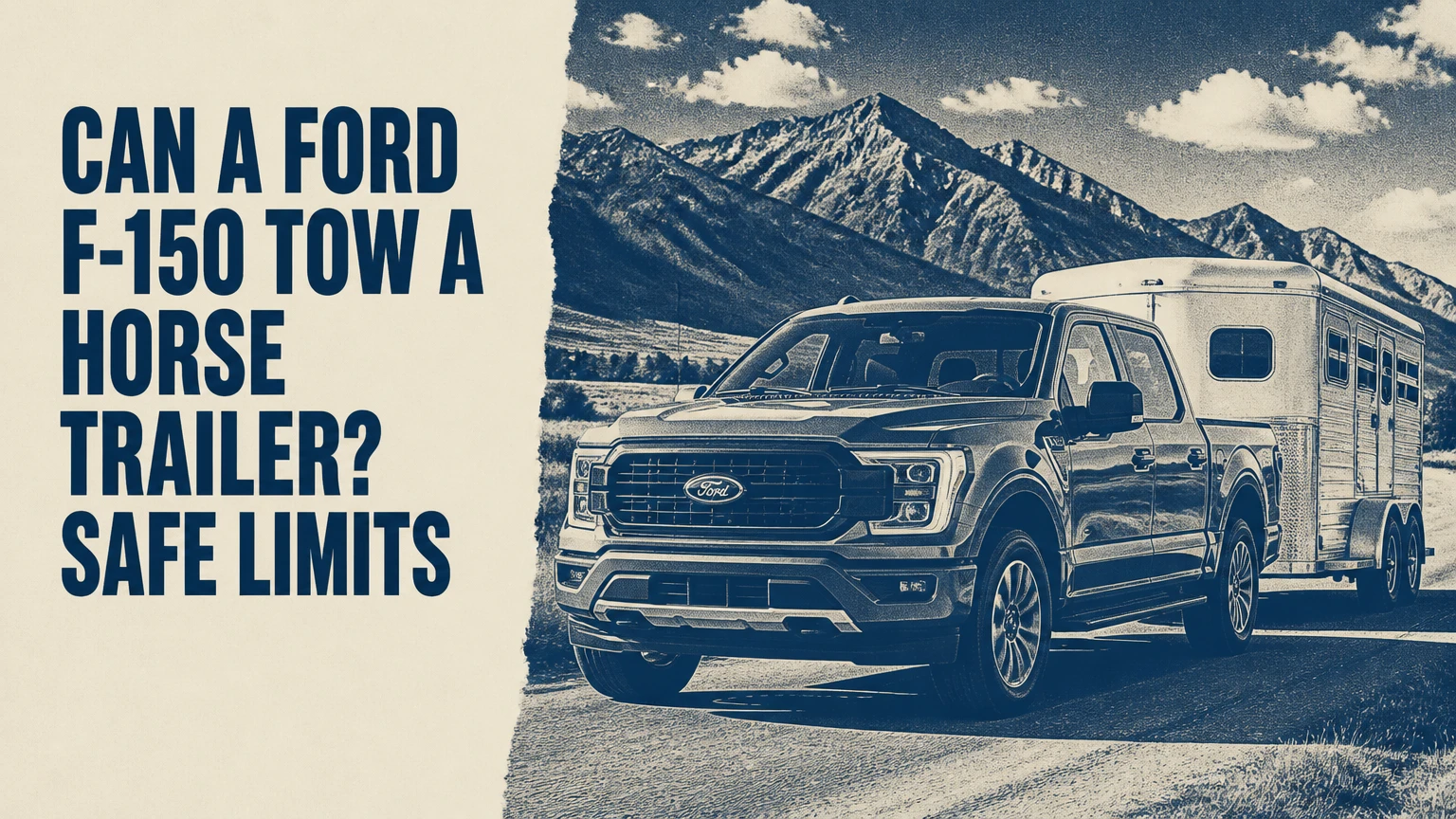
Yes, a Ford F-150 can tow many horse trailers, especially properly loaded two-horse bumper-pull models, but compatibility depends on the truck’s door-label payload, axle ratings, engine, cab, drivetrain, hitch, and trailer brakes. A loaded trailer must fit every applicable rating, not merely the F-150’s advertised maximum tow number.
Key Facts at a Glance
- A Ford F-150’s payload rating includes passengers, cargo, hitch equipment, and trailer tongue weight.
- A typical bumper-pull horse trailer places 10%-15% of its loaded weight on the hitch.
- A two-horse trailer commonly weighs about 5,500-8,500 pounds when loaded, depending on construction and equipment.
- Gooseneck horse trailers can fit within an F-150’s tow rating while exceeding its rear-axle or payload rating.
- A weight-distribution hitch can improve axle loading and control, but it cannot increase the truck’s GVWR, tire rating, or legal payload.
- The truck’s yellow-and-white Tire and Loading Information label provides the most useful payload number for that specific F-150.
Can a Ford F-150 Tow a Horse Trailer?
A Ford F-150 can safely tow a horse trailer when the trailer’s loaded weight, tongue weight, axle load, hitch rating, and braking equipment remain within the truck’s ratings. The easiest match is usually a two-horse aluminum bumper pull behind a properly equipped F-150 with adequate payload and an integrated trailer brake controller.
The answer changes with configuration. A regular-cab work truck may have substantially more payload than a well-equipped crew cab, while four-wheel drive, luxury options, a sunroof, passengers, and bed cargo consume capacity. Ford’s maximum tow figures apply only to specific configurations with the correct axle ratio, cooling equipment, hitch, and trailer package.
Ford’s owner information states the governing principle directly: “Never exceed the weight ratings of the vehicle or trailer.” That rule matters more than an advertising headline because horse trailers create a moving, elevated load that can affect stability and braking.
What determines compatibility?
The decisive figures are the F-150’s GVWR, front and rear GAWR, payload, receiver or gooseneck hitch rating, tire load rating, and GCWR. The trailer contributes its GVWR, actual loaded weight, tongue weight, axle ratings, and brake capacity.
Use the lowest applicable limit. A trailer can weigh less than the truck’s maximum tow rating and still overload the rear axle because tongue weight, passengers, tools, and bed cargo all load the F-150.
Which F-150 Ratings Must You Check?
The F-150’s payload rating is usually the first constraint when towing horses, while maximum tow rating is often the most visible but least complete number. Read the truck’s certification label and owner’s manual, then compare those values with actual scale weights.
| Rating | Meaning | Horse-trailer consequence |
|---|---|---|
| GVWR | Maximum truck weight with people and cargo | Includes tongue weight and hitch hardware |
| Payload | GVWR minus the truck’s empty certified weight | Subtract passengers, tack, tools, fuel effects, and tongue weight |
| GAWR | Maximum load on each axle | Rear axle can overload before total GVWR |
| GCWR | Maximum combined truck and trailer weight | Includes the loaded F-150 and loaded trailer |
| Tow rating | Maximum trailer weight for a specific configuration | Does not replace payload or axle checks |
| Hitch rating | Maximum trailer and tongue load for the installed hitch | Must match receiver, ball mount, and ball |
A Ford F-150 door label may show 1,400-2,200 pounds of payload on common configurations, but that range is only a planning estimate. Actual ratings can fall below or exceed it based on model year, cab, bed, engine, four-wheel drive, trim, options, and Heavy-Duty Payload Package equipment.
How do you calculate the available payload?
Subtract the loaded trailer tongue weight, every occupant, and all truck cargo from the door-label payload. For example, a truck with 1,850 pounds of labeled payload carrying 400 pounds of occupants, 150 pounds of tack, 80 pounds of tools, and a 900-pound tongue load has only 320 pounds remaining.
1,850 – 400 – 150 – 80 – 900 = 320 pounds remaining
That result is a planning margin, not a target. A scale ticket is preferable because the trailer’s actual tongue weight can differ significantly from a brochure estimate.
Why does gooseneck payload matter so much?
A gooseneck transfers a large vertical load directly into the bed, commonly around 20%-25% of the loaded trailer weight. That arrangement can improve tracking but consumes more payload than a typical bumper pull, whose tongue weight often falls near 10%-15%.
A 9,000-pound loaded gooseneck could place roughly 1,800-2,250 pounds on the truck. Many F-150s cannot carry that load after accounting for occupants and equipment, even if their tow rating exceeds 9,000 pounds.
What Horse Trailer Weights Can an F-150 Handle?
A Ford F-150 commonly handles a loaded two-horse aluminum bumper pull more comfortably than a steel trailer, large gooseneck, or living-quarters trailer. Trailer construction, horse size, water, hay, mats, partitions, and camping equipment can change the final weight by thousands of pounds.
| Trailer type | Typical empty weight | Typical loaded weight | Approximate tongue load |
|---|---|---|---|
| Two-horse aluminum bumper pull | 2,500-3,500 lb | 5,500-7,000 lb | 550-1,050 lb |
| Two-horse steel bumper pull | 4,000-5,000 lb | 7,000-8,500 lb | 700-1,275 lb |
| Two-horse gooseneck | 4,500-6,000 lb | 8,000-10,500 lb | 1,600-2,625 lb |
| Three-horse gooseneck | 5,500-7,500 lb | 9,000-12,000 lb | 1,800-3,000 lb |
| Two-horse living-quarters trailer | 6,500-9,000 lb | 9,500-13,000 lb | 1,425-3,250 lb |
These are typical planning ranges, not certified weights. A trailer’s VIN plate and scale reading control the decision. Two 1,200-pound horses add 2,400 pounds before hay, water, saddles, bedding, spare tires, and personal gear are counted.
Can an F-150 tow two horses?
A properly equipped F-150 can often tow two horses in an aluminum bumper-pull trailer, provided the loaded trailer remains within the truck’s ratings and the payload calculation leaves a meaningful margin. A steel trailer, large horses, full water tanks, or a crew cab with several passengers may eliminate that margin.
For a two-horse setup, weigh the trailer with the horses and normal travel equipment. Weigh the truck and trailer together, then obtain separate axle weights if possible. A certified public scale can reveal whether the rear axle, trailer axle, or combination has become the limiting factor.
Can an F-150 tow three horses?
An F-150 may tow a light three-horse bumper pull in a carefully matched configuration, but a three-horse gooseneck or living-quarters trailer usually creates a payload problem. The truck must carry the gooseneck pin weight, and the pin load commonly approaches or exceeds the payload of a half-ton pickup after occupants and gear are added.
For frequent three-horse hauling, an F-250 or heavier truck provides more payload, axle capacity, tire capacity, and braking reserve. More reserve also reduces sensitivity to wet roads, crosswinds, hills, and uneven loading.
Which Engine and F-150 Configuration Works Best?
The 3.5-liter EcoBoost generally offers the strongest F-150 towing performance, while the 5.0-liter V8 can provide useful payload in work-oriented configurations. Engine choice alone does not establish suitability because cab style, axle ratio, bed length, drivetrain, trim weight, and tow-package content determine the certified rating.
| F-150 powertrain or package | Typical recent-generation role | Main limitation |
|---|---|---|
| 3.5L EcoBoost V6 | Heavy bumper-pull work and high tow ratings | High tow rating does not guarantee payload |
| 5.0L Ti-VCT V8 | Conventional towing with strong engine braking feel | Heavier engine can reduce available payload |
| 2.7L EcoBoost V6 | Light two-horse aluminum bumper pulls | Less margin for heavy trailers and grades |
| 3.5L PowerBoost hybrid | Strong low-speed torque and useful towing range | Battery and equipment weight can reduce payload |
| Max Trailer Tow Package | Higher-rated hitch, cooling, axle, and trailer equipment | Must be present on the individual truck |
| Heavy-Duty Payload Package | More payload in selected configurations | Availability depends on model year and trim |
Ford publishes maximum F-150 tow ratings that can reach approximately 13,500-14,000 pounds in selected recent configurations, but those figures do not mean every F-150 can tow a 14,000-pound horse trailer. A truck with a high tow rating can still run out of payload when the trailer tongue, passengers, and tack are added.
Is the Max Trailer Tow Package enough?
The Max Trailer Tow Package improves the truck’s towing hardware and may raise the certified trailer rating, but it does not automatically solve payload. Confirm the exact truck’s door-label payload, receiver rating, axle ratio, and owner-manual limits.
An integrated trailer brake controller, seven-way connector, transmission cooling, a higher-capacity rear axle, and an appropriate hitch make the setup more complete. None permits exceeding GVWR, GAWR, tire capacity, or the trailer’s own ratings.
Is a Bumper Pull or Gooseneck Better for Horses?
A bumper pull is usually the better F-150 match because it requires less vertical truck payload and leaves the bed available for tack. A gooseneck can reduce sway and improve maneuverability, but its heavier pin weight often makes a half-ton truck the wrong platform.
| Decision factor | Bumper pull | Gooseneck |
|---|---|---|
| Typical loaded two-horse weight | 5,500-8,500 lb | 8,000-10,500 lb |
| Typical truck load percentage | 10%-15% tongue | 20%-25% pin |
| Hitch location | Rear receiver | Bed-mounted ball or ball-and-coupler system |
| Bed availability | Full bed remains usable | Hitch occupies bed space |
| Sway behavior | More sensitive to loading and wind | Usually more stable |
| Installation cost | About $350-$900 for weight distribution | About $700-$1,500 for hitch installation |
| Best F-150 use | Two horses and moderate gear | Light gooseneck with substantial payload margin |
A properly adjusted weight-distribution hitch can restore some weight to the F-150’s front axle and work with integrated sway control. It cannot transform an overloaded truck into a higher-rated truck.
When is a weight-distribution hitch needed?
Use the trailer manufacturer’s instructions and the hitch manufacturer’s rating to determine whether weight distribution is required. Many heavier bumper pulls benefit from it, particularly when tongue weight approaches the receiver’s weight-carrying limit or the truck’s rear suspension sags.
Do not use a weight-distribution system with a trailer or hitch that prohibits it. Some couplers, surge-brake systems, and specialized trailer designs require specific equipment, and the manufacturer’s instructions control.
How Do You Hitch and Test a Horse Trailer?
Hitching a horse trailer takes approximately 15-25 minutes when the driver checks the connection, tires, lights, brakes, and animals rather than simply locking the coupler. The most important checkpoint is a verified mechanical connection followed by a low-speed brake test before entering traffic.
- Confirm weights and tire pressures. Check the truck and trailer tire pressures when cold, inspect sidewalls, and verify that the trailer’s loaded weight fits the ratings.
- Match the ball and coupler. Confirm the diameter, shank size, height, and rating. A 2-5/16-inch coupler requires a correctly rated 2-5/16-inch ball, not merely a ball that fits visually.
- Lock the coupler. Lower the coupler fully, close the latch, and insert its safety pin. Lift the trailer tongue slightly with the jack to confirm the ball is captured.
- Attach safety chains. Cross the chains beneath the tongue and connect them to rated truck attachment points. Do not attach them to a thin bumper panel.
- Connect the breakaway cable. Attach the cable to the truck or hitch structure independently of the safety chains. The cable should pull the trailer’s emergency brake switch if the trailer separates.
- Plug in the seven-way connector. Check running lights, brake lights, turn signals, electric brakes, and any auxiliary functions required by the trailer.
- Set the brake controller. Begin with the manufacturer’s recommended gain, then test at low speed on a level surface. Increase gain until the trailer contributes firm braking without locking its tires.
- Load and secure the horses. Follow the trailer maker’s loading direction, close every divider and latch, and ensure ventilation and partitions are secure.
- Recheck after a short drive. Stop after several miles to inspect straps, coupler temperature, wheel hubs, tires, chains, and animal condition.
The National Highway Traffic Safety Administration recommends checking trailer connections and lights before travel and adjusting driving speed to conditions. Horse-trailer handling also requires gentler steering and longer stopping distances than an empty utility trailer.
What Does It Cost to Prepare an F-150?
A basic horse-trailer towing setup commonly costs $350-$1,500 before trailer purchase, while a complete setup with brake-controller work, hitch installation, tires, and inspection can exceed $2,000. Actual pricing varies by region, truck wiring, hitch type, and whether the trailer already has compatible brakes.
| Item | Typical price | Typical timing |
|---|---|---|
| Weight-distribution hitch with sway control | $350-$900 | Install and adjust in 1-3 hours |
| Gooseneck hitch installation | $700-$1,500 | Shop installation in 4-8 hours |
| Electric brake controller | $150-$450 installed | Same-day installation |
| Trailer tires, four-wheel set | $350-$800 | Replace by condition and age |
| Wheel-bearing service | $100-$250 | Every 12 months or 12,000 miles as a planning interval |
| Certified scale visit | $15-$40 | Repeat after major loading changes |
Trailer tires need inspection for age, cracking, uneven wear, and load rating. Bearing service intervals depend on the hub manufacturer and use, so the one-year or 12,000-mile interval is a conservative maintenance planning point, not a universal legal requirement.
What Are the Most Common F-150 Horse-Towing Failures?
The most common failures involve payload miscalculation, incorrect hitch hardware, poor trailer loading, inadequate brakes, and worn tires. Horse trailers magnify these errors because live animals shift weight and can react to noise, wind, braking, and road movement.
What should you do if the trailer sways?
If a horse trailer begins to sway, hold the steering wheel straight, release the accelerator gradually, and apply the trailer brakes manually without making a sudden truck-brake maneuver. Do not accelerate, sharply steer, or stomp the truck brakes while the trailer is oscillating.
After stopping safely, inspect loading and equipment. Excess rear weight, low tongue weight, incorrect tire pressure, a loose hitch, crosswinds, worn suspension parts, or an improperly adjusted sway-control system can cause repeated sway.
What does severe rear sag indicate?
Severe rear sag indicates excessive tongue or pin weight, overloaded cargo, incorrect weight-distribution adjustment, or a suspension problem. Sag reduces front-axle loading, which can weaken steering response and headlight aim.
Redistribute permissible cargo, remove unnecessary weight, and reweigh the combination. Air helper springs may reduce visible sag, but they do not increase GVWR, GAWR, tire capacity, or braking capacity.
Which mistakes create the greatest risk?
- Using a 5,000-pound ball on a trailer that weighs 7,500 pounds loaded.
- Counting only the empty trailer and ignoring horses, water, feed, hay, tack, and bedding.
- Assuming a Max Trailer Tow Package supplies additional payload.
- Running a bumper pull with low tongue weight because heavy gear was placed behind the trailer axles.
- Skipping the brake-controller test after changing trailers.
- Towing with tires that have adequate tread but insufficient load range or excessive age.
A practical rule is to weigh the complete combination in travel condition, then keep a visible margin rather than operating directly at the rating. Live cargo creates more variation than inert cargo.
When Should You Choose an F-250 Instead?
Choose an F-250 when the trailer is a heavy gooseneck, includes living quarters, carries three or more horses, or leaves little payload margin in the F-150. The larger truck is also the safer choice for frequent mountain travel, long highway trips, or substantial water, hay, and camping loads.
| Use case | Reasonable starting point | Better decision |
|---|---|---|
| One or two horses, aluminum bumper pull | F-150 with verified payload | Keep the F-150 if the scale confirms margin |
| Two horses, steel bumper pull | F-150 with high payload and proper hitch | Consider F-250 for frequent use |
| Two or three horses, light gooseneck | High-payload F-150 only after scale check | F-250 usually provides more reserve |
| Living-quarters trailer | Often near or above half-ton payload | F-250 or F-350 |
| Four or more horses | Heavy trailer and high pin load | F-350 or heavier platform |
| Commercial or frequent hauling | More braking and axle reserve needed | Super Duty or commercial truck |
The F-150 is not a poor tow vehicle; it is a half-ton pickup with finite payload. An F-250 can still be overloaded, so the same label-and-scale process remains necessary.
How Can You Verify a Used F-150 Before Buying?
Verify the used F-150’s door label, VIN-specific tow information, axle ratio, hitch equipment, tire ratings, and service history before buying. Online trim descriptions are insufficient because identical-looking trucks can differ materially in payload and towing certification.
Ask the seller for photographs of the certification label and Tire and Loading Information label. Confirm the truck has a factory seven-way connector, trailer brake controller if required, suitable receiver or gooseneck equipment, and tires with adequate load capacity.
Inspect the receiver for deformation, rust, or aftermarket modifications. Check transmission service, cooling-system condition, rear-axle leaks, brake wear, and suspension sag, particularly if the truck previously hauled livestock or heavy trailers.
FAQ
Can a 2.7L EcoBoost F-150 pull a two-horse trailer?
A 2.7L EcoBoost F-150 can pull a light two-horse aluminum bumper pull when its certified tow rating and payload support the loaded combination. The limiting factor is often tongue weight after passengers and tack are added, not engine power. Weigh the trailer in travel condition before regular highway use.
Does an F-150 need a diesel engine for horse trailers?
An F-150 does not need a diesel engine for a typical two-horse bumper-pull trailer. Gasoline EcoBoost and V8 engines can provide adequate power, while diesel or Super Duty trucks become more useful for heavy goosenecks, living quarters, steep grades, and frequent long-distance hauling.
How much tongue weight should a horse trailer have?
A bumper-pull horse trailer commonly needs about 10%-15% of its loaded weight on the hitch for stable handling, subject to the trailer manufacturer’s instructions. A 7,000-pound trailer therefore produces roughly 700-1,050 pounds of tongue weight. Gooseneck pin weight is commonly higher, around 20%-25%.
Can horses ride safely in an aluminum trailer behind an F-150?
Horses can ride safely in an aluminum trailer behind an F-150 when the trailer is structurally sound, correctly ventilated, properly loaded, and matched to the truck’s ratings. Aluminum construction reduces empty weight, but it does not remove the need for trailer brakes, rated tires, secure partitions, and careful driving.
Is a sway bar enough for a horse trailer?
A sway-control bar can reduce trailer movement, but it cannot correct low tongue weight, overloaded axles, bad tires, loose components, or excessive speed. Load the trailer correctly first, then use a compatible weight-distribution and sway-control system when the trailer and hitch manufacturers permit it.
What is the safest way to find the exact towing limit?
The safest method combines the F-150’s door labels, Ford’s VIN-specific towing information, the trailer’s certification plate, and certified scale tickets. Compare the loaded truck and trailer against GVWR, GAWR, GCWR, tow rating, hitch rating, tire ratings, and local trailer-brake requirements.
The Bottom Line
Can a Ford F-150 tow a horse trailer? Yes, a properly configured F-150 can tow many two-horse bumper-pull trailers, but the exact answer depends on payload and actual loaded weights more than the truck’s advertised maximum tow rating. Weigh the setup, verify every rating, use functioning trailer brakes, and choose an F-250 or larger truck when a gooseneck, living-quarters trailer, or limited payload margin leaves no practical reserve.