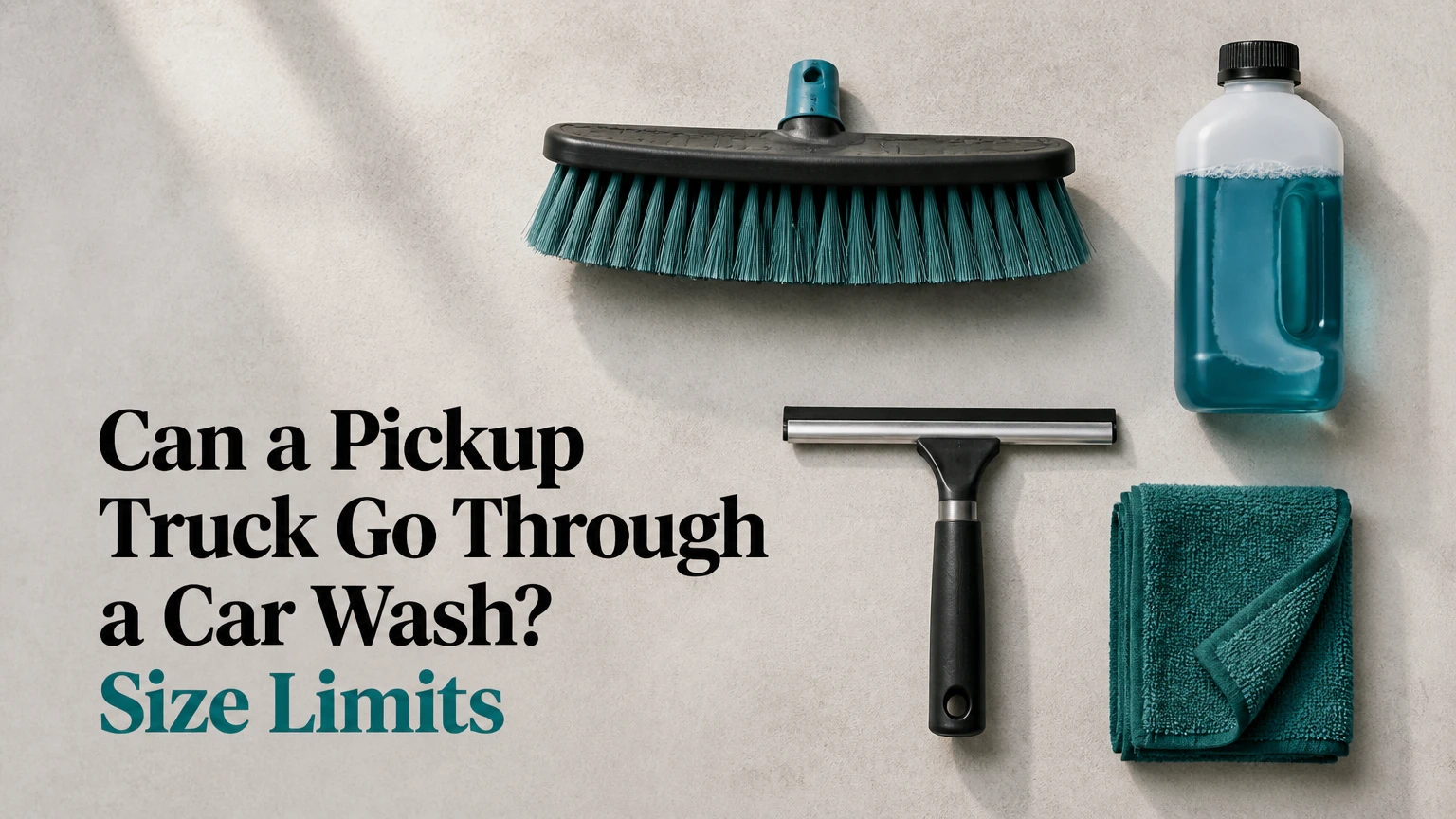
Yes, a pickup truck can go through most commercial car washes if its height, width, tire size, ground clearance, and accessories meet that facility’s restrictions. A stock half-ton pickup usually fits, while lifted trucks, dually models, roof racks, exposed equipment, and loose tonneau covers may require a self-serve bay or hand wash.
Key Facts at a Glance
- A commercial car wash’s posted vehicle restrictions control; there is no universal pickup-truck size limit.
- Typical automatic tunnels accept vehicles about 84-86 inches wide and up to 84-86 inches high, but individual sites differ.
- Touchless washing reduces contact with paint and accessories, but it may clean heavily baked-on mud less effectively.
- Friction tunnels clean road film and wheels more aggressively, but brushes can catch loose steps, antennas, straps, or damaged trim.
- Empty the pickup bed and secure or remove hitch-mounted accessories before entering any automated wash.
- A lifted, dually, heavily modified, or mud-covered pickup is usually safer in a self-serve spray bay or specialist hand wash.
Can a Pickup Truck Go Through a Car Wash?
A pickup truck can go through a car wash when the truck physically fits and the facility accepts its configuration. The deciding factors are not the word “truck” on the registration, but the wash’s maximum height, maximum width, conveyor design, tire dimensions, underbody clearance, and restrictions on accessories.
A standard Ford F-150, Chevrolet Silverado 1500, Ram 1500, or Toyota Tundra commonly fits a truck-friendly automatic wash in factory form. The answer changes after a lift kit, oversized tires, aftermarket running boards, a light bar, a bed-mounted toolbox, a camper shell, or a soft cover that cannot remain securely latched.
Wash operators can refuse a vehicle that may damage equipment or suffer damage during the cycle. The International Carwash Association advises operators to publish vehicle restrictions because automated equipment varies substantially between sites. A facility’s entrance sign and attendant’s instructions therefore outrank generic figures found online.
What Makes a Car Wash Truck-Compatible?
A truck-compatible car wash has enough vertical and lateral clearance for the vehicle and uses a conveyor or wash path that can guide larger tires safely. Truck acceptance does not mean every machine automatically maps the entire pickup bed or retracts equipment around every aftermarket component.
Automatic facilities may use photoelectric, infrared, or vehicle-presence sensors. Those systems detect position and clearance for specific equipment functions, but they do not guarantee that a brush cannot touch a loose accessory, an open tailgate, or a poorly secured cover. Sensor capability depends on the tunnel’s design and calibration.
Pickup beds also create a practical limitation. A top brush may pass over the cab and stop before the bed, while side brushes and dryers still act around the rear quarter panels. A fully enclosed camper shell presents a different profile from an open bed, so the operator may apply different restrictions.
Which pickup features matter most?
Height and width are usually the first screening measurements, but tire profile and protruding equipment create equally important risks. Measure the truck in its wash-ready configuration, including the tallest installed component and the widest tire sidewall, rather than relying on the manufacturer’s unmodified specifications.
The following figures are typical commercial limits, not industry guarantees:
| Measurement or feature | Typical automatic-wash limit | What to measure |
|---|---|---|
| Overall vehicle height | 84-86 inches | Roof, antenna, rack, or light bar, whichever is highest |
| Body width | 82-85 inches | Widest body point, excluding or including mirrors as posted |
| Tire width | 11.5-12.5 inches | Actual mounted tire width and sidewall bulge |
| Minimum ground clearance | 4-5 inches | Lowest fixed component near conveyor rails |
| Lift height | Often restricted above 2-3 inches | Total final height, not lift-kit height alone |
| Dually rear width | Often above standard limit | Outside sidewall to outside sidewall |
Manufacturers and operators publish different thresholds. For example, WOW Carwash lists site-specific clearance requirements, while Take 5 Car Wash publishes restrictions that can vary by wash location and vehicle type. Those differences explain why a truck accepted at one branch may be rejected at another.
Which Car Wash Type Is Safest?
A touchless wash is generally the safest automatic option for a pickup with delicate paint protection, a wrap, or securely mounted accessories. A self-serve bay is safer for a lifted, dually, heavily muddy, or unusually equipped truck because the driver controls the wand and avoids a fixed conveyor path.
No wash type is universally best. Touchless systems use detergent and high-pressure water without cloth contact, but they can leave bonded mud behind. Soft-cloth tunnels provide more physical cleaning, while self-serve bays provide the greatest control and clearance.
| Wash type | Typical cost | Typical time | Best truck profile | Main limitation |
|---|---|---|---|---|
| Touchless automatic | $10-$25 | 3-8 minutes | Stock truck, wrap, secure hard cover | Weak against baked-on mud |
| Soft-cloth tunnel | $8-$20 | 4-10 minutes | Factory-height truck with road grime | Contact can catch loose parts |
| Self-serve spray bay | $3-$10 | 10-25 minutes | Lifted, dually, muddy, modified truck | Requires manual cleaning |
| Hand wash or detail shop | $30-$150+ | 45 minutes-3 hours | High-value, modified, delicate truck | Higher cost and scheduling |
| Driveway wash | $5-$20 in supplies | 30-90 minutes | Any truck with suitable space | Water use and local rules |
Prices are typical United States ranges for 2025-2026 and vary by region, membership plan, package, and truck surcharge. A larger vehicle may require an oversized-vehicle price even when the wash physically accepts it.
Is touchless better for pickup paint?
Touchless washing is better for reducing mechanical contact, but it is not automatically better at removing contamination. Strong alkaline cleaners and acidic wheel chemicals can be harder on neglected wax, unprotected metal, or damaged clear coat when used frequently.
A soft-cloth tunnel can clean more completely because friction loosens road film. However, cloth material can carry abrasive grit, and it may contact protruding badges, loose trim, replacement mirrors, or a partially detached running board. The practical choice is condition-based: touchless for fragile surfaces and accessories, soft cloth for a sound stock truck with ordinary grime.
What Dimensions Must a Pickup Meet?
A pickup should remain below the wash’s posted maximum height and width, with enough underbody clearance for the conveyor or guide system. Typical limits cluster around 84-86 inches in height and 82-85 inches in body width, but those numbers must be confirmed at the specific location.
Do not subtract mirrors unless the facility explicitly says to do so. Foldable mirrors may still be struck by side equipment, and some wash entrances measure the full vehicle envelope. Measure with the fuel tank, bed contents, cover, rack, and antenna in their normal configuration.
How do you measure a truck before washing?
Measure the pickup on level ground using a tape measure, then compare each result with the facility’s posted restriction. Record the following:
- Measure from the ground to the highest fixed point, including a roof rack, antenna, cab marker, or light bar.
- Measure the widest body or tire point, then check whether the posted width includes mirrors.
- Inspect the lowest step, receiver, skid plate, differential, and suspension component for conveyor clearance.
- Check the tire sidewall for oversized flotation or mud-terrain dimensions.
- Call the facility if the measurement is within 1-2 inches of any limit.
A lift kit does not add only the advertised suspension height. Larger tires, altered suspension geometry, and roof-mounted equipment can raise the final truck beyond the entrance limit. A two-inch lift with 35-inch tires may be taller than a three-inch lift with factory tires.
What Accessories Change the Answer?
Aftermarket accessories change car-wash suitability when they protrude, flex, detach, trap water, or cannot withstand brushes and high-pressure dryers. Remove or secure receiver-mounted items, whip antennas, loose straps, bed cargo, flags, removable steps, and unsecured light-bar covers before an automatic wash.
| Accessory or condition | Automatic-wash risk | Safer action |
|---|---|---|
| Hard tonneau cover, fully latched | Low to moderate | Confirm the cover is locked and accepted |
| Soft roll-up tonneau cover | Moderate to high | Use touchless or hand wash if the operator restricts it |
| Bed-mounted toolbox | Moderate | Confirm lid latches and overall height |
| Trailer ball or hitch insert | Moderate | Remove removable hardware before tunnel entry |
| Roof rack or light bar | High if near limit | Measure total height and ask the operator |
| Running boards or side steps | Moderate | Inspect mounting and confirm brush clearance |
| Camper shell | Low to moderate | Check rear profile and roof height |
| Loose cargo in open bed | High | Empty the bed completely |
| Dually fenders and tires | High | Use a truck-rated self-serve or detail facility |
A hard tonneau cover is not automatically safe merely because it is hard. The latches, hinges, seals, and rear edge must be intact. A cover that lifts at highway speed can also lift under dryer airflow.
Ford, General Motors, Ram, and Toyota owner manuals commonly direct drivers to disable automatic functions and follow Neutral or car-wash-mode instructions for conveyor systems. The exact procedure differs by model year, transmission, electronic shifter, and parking-brake system, so the owner’s manual is the authoritative source for the truck.
How Should You Prepare and Enter?
Prepare a pickup truck by emptying the bed, removing vulnerable accessories, checking the restrictions, and following the tunnel’s Neutral procedure. The preparation normally takes five to ten minutes, while the automated wash itself takes about three to ten minutes.
Before entering the wash
- Remove tools, firewood, gravel, trash, coolers, and loose tie-downs from the bed.
- Close and latch the tailgate, tonneau cover, toolbox, doors, windows, and fuel door.
- Remove a hitch ball, cargo carrier, flag, whip antenna, or other detachable extension.
- Fold mirrors only when the facility instructs you to do so.
- Turn off rain-sensing wipers and automatic wiper functions.
- Check the truck’s owner manual for car-wash mode, neutral-tow, auto-hold, and parking-brake instructions.
- Tell the attendant about a lift, dually axle, camper shell, damaged trim, or unusual accessory.
Conveyor procedure
- Align the truck slowly. Follow the attendant’s hand signals and position the drive tire on the conveyor track or guide rail.
- Select the required gear. Most conveyor tunnels require Neutral, but some systems specify a dedicated car-wash mode.
- Release the pedals. Do not hold the brake or accelerator when the conveyor is pulling the truck.
- Disable automatic stopping systems. Auto-hold, electronic parking brakes, automatic emergency braking, and adaptive functions can interfere with conveyor movement.
- Keep the engine running if required. Some electronic shifters return to Park when the truck powers down.
- Remain in the cab. Do not open doors, tailgates, windows, or the tonneau cover during the cycle.
- Exit only when directed. Shift to Drive after the exit signal or attendant instruction, then leave at low speed.
The success checkpoint is continuous, smooth conveyor movement without braking, warning messages, or contact between a loose component and wash equipment. If the truck stops unexpectedly, keep the vehicle stationary and alert the attendant rather than attempting to drive off the track.
Why Should Heavily Muddy Trucks Avoid Friction Tunnels?
Heavily muddy trucks should avoid friction tunnels because large chunks of sand, clay, and gravel can clog equipment, scratch paint, and transfer abrasive debris to later vehicles. Pre-rinsing in a self-serve bay removes contamination from wheel wells, frame rails, suspension parts, and the bed before a touch or cloth wash.
Mud is not equivalent to ordinary road film. Dried off-road clay can contain quartz-rich sand and small stones, which behave like abrasive particles when dragged across paint by cloth strips. Some operators can refuse a truck covered in mud to protect their brushes and wastewater system.
Use a high-pressure wand from a safe distance. Avoid spraying directly into wheel-bearing seals, electrical connectors, camera modules, or delicate weatherstripping at close range. Rinse the underside, inner fenders, running boards, and tailgate seams, then inspect the truck before selecting an automatic cycle.
A useful practitioner rule is to remove visible clumps first. If mud falls from the truck when you tap a tire or step, the pickup needs a pre-rinse rather than a routine tunnel wash.
Can Lifted or Dually Trucks Use Automatic Washes?
Lifted and dually trucks can use automatic washes only when the specific facility confirms their dimensions and equipment compatibility. Many lifted pickups exceed height or tire-width limits, while dually models often exceed the conveyor’s lateral clearance because of their outer rear tires and fender profile.
A lift above two or three inches is not an automatic disqualifier, but it is a strong reason to measure and call ahead. Oversized tires can also alter conveyor engagement, and low-profile aftermarket suspension components may reduce clearance at the guide rail.
Dually pickups deserve special caution. The issue is not only overall body width; the outer rear tires can interfere with side guides, wheel brushes, or track geometry. A self-serve bay designed for commercial trucks or a hand-wash facility is usually the lower-risk option.
What Do Pickup-Truck Washes Cost?
A pickup-truck wash typically costs $8-$25 in an automatic facility, $3-$10 in a self-serve bay, and $30-$150 or more for hand washing or detailing. Monthly plans can reduce the per-wash price, but oversized trucks, ceramic-safe products, underbody cleaning, and interior services often cost extra.
| Service or add-on | Typical price | Typical duration | Pickup-specific value |
|---|---|---|---|
| Basic automatic wash | $8-$15 | 3-8 minutes | Removes loose road film |
| Premium automatic package | $15-$30 | 5-12 minutes | Adds wax, tire cleaner, or underbody spray |
| Self-serve bay | $3-$10 | 10-25 minutes | Allows controlled wheel-well rinsing |
| Truck hand wash | $30-$75 | 45-90 minutes | Avoids tunnel clearance and brush contact |
| Exterior detailing | $75-$200 | 2-5 hours | Removes bonded contamination and protects paint |
| Monthly wash membership | $20-$45 | Several visits monthly | Economical for frequent routine washing |
Regional labor costs and local water regulations produce wide price differences. Ask whether the quoted price includes an oversized-vehicle surcharge before choosing a package.
What Should You Do if Something Goes Wrong?
If a pickup stops on the conveyor, keep your feet off the pedals and notify the attendant immediately. If a mirror folds, a cover opens, or an accessory contacts equipment, remain stationary until the operator stops the system and records the condition.
Common problems require different responses:
- The truck stops moving: Confirm nothing yourself while the system is active. Signal the attendant, who can stop or reset the conveyor.
- The transmission shifts to Park: Do not force the shifter while the truck is constrained. Follow the facility’s emergency procedure and the owner manual.
- A mirror folds or moves: Report it before leaving and photograph the mirror, housing, and surrounding paint.
- The tailgate or cover opens: Alert the operator immediately. Do not reach outside the cab during the wash.
- A brush catches an accessory: Do not reverse or accelerate. The operator must stop the equipment first.
- New damage appears: Photograph the vehicle, retain the receipt, request an incident report, and document pre-existing damage separately.
A car wash is not automatically liable for every defect found afterward. Posted restrictions, visible pre-existing damage, defective aftermarket parts, and failure to follow instructions can affect a claim. Documentation improves the accuracy of any investigation.
When Is Hand Washing the Better Alternative?
Hand washing is better when a pickup is outside posted dimensions, has fragile or loose accessories, carries heavy mud, or contains paint protection that requires controlled chemicals. Hand washing also provides better access to the bed rails, tailgate gap, wheel wells, rocker panels, and frame.
A careful driveway wash requires a bucket or foam cannon, automotive shampoo, microfiber mitts, wheel brushes, and a hose with a suitable nozzle. Local water-use rules may restrict residential washing, and storm drains can carry detergent and contaminants into waterways. A commercial detailer avoids many of those disposal concerns.
Hand washing is not automatically gentler. A dirty sponge, household detergent, stiff brush, or pressure washer used too closely can damage clear coat, seals, decals, and trim. The safest method combines clean tools, vehicle-specific shampoo, separate wheel equipment, and low-pressure rinsing near vulnerable components.
FAQ
Can a pickup truck with a bed cover go through a car wash?
A pickup truck with a bed cover can use a car wash when the cover is fully closed, latched, and accepted by the operator. Hard covers usually tolerate ordinary washing better than soft vinyl covers, but loose hinges, damaged seals, roll-up sections, and exposed straps create risks. Touchless or hand washing is safer for questionable covers.
Can I leave items in the pickup bed during a wash?
Do not leave loose items in a pickup bed during an automatic wash. Tools, gravel, firewood, containers, and tie-downs can shift or blow out under high-pressure water and air dryers. Empty the bed, close the tailgate, and secure any permanently mounted equipment before entering a tunnel.
Can a truck go through a car wash with a trailer hitch?
A truck should not enter with a removable hitch ball, cargo carrier, bike rack, or extended hitch accessory attached unless the facility explicitly permits it. These parts can interfere with conveyor guides or brushes. A flush receiver may be acceptable, but the wash operator’s restriction remains controlling.
Are automatic car washes bad for truck paint?
Automatic car washes are not automatically bad for truck paint, but friction equipment can create fine marring when cloth carries grit or contacts damaged trim. Touchless systems reduce physical contact while relying more heavily on chemicals and pressure. A clean, well-maintained facility and a sound clear coat reduce risk.
How often should a pickup truck be washed?
Wash a pickup every one to two weeks when it encounters road salt, construction dust, mud, or coastal air, and at least monthly under light-use conditions. Rinse salt and mud promptly because corrosion begins at seams, frame cavities, brake components, and underbody areas that ordinary exterior washing may miss.
Can an electric pickup use a conveyor car wash?
An electric pickup can use a conveyor car wash only according to its owner manual and the facility’s procedure. The Rivian R1T, Ford F-150 Lightning, and other electric trucks may require specific Neutral, tow, parking-brake, or car-wash settings. Disable automatic functions exactly as the manufacturer directs, and never assume a silent drivetrain is in Neutral.
The Bottom Line
Can a pickup truck go through a car wash? Yes, if the truck fits the facility’s height, width, tire, and clearance limits and has no prohibited accessories. A stock pickup is usually suitable for touchless or soft-cloth washing, while a lifted, dually, heavily muddy, or modified truck should use a self-serve bay or specialist hand wash. Check the operator’s restrictions, empty the bed, secure the cover, remove detachable hitch equipment, and follow the exact Neutral or car-wash-mode instructions for the truck.