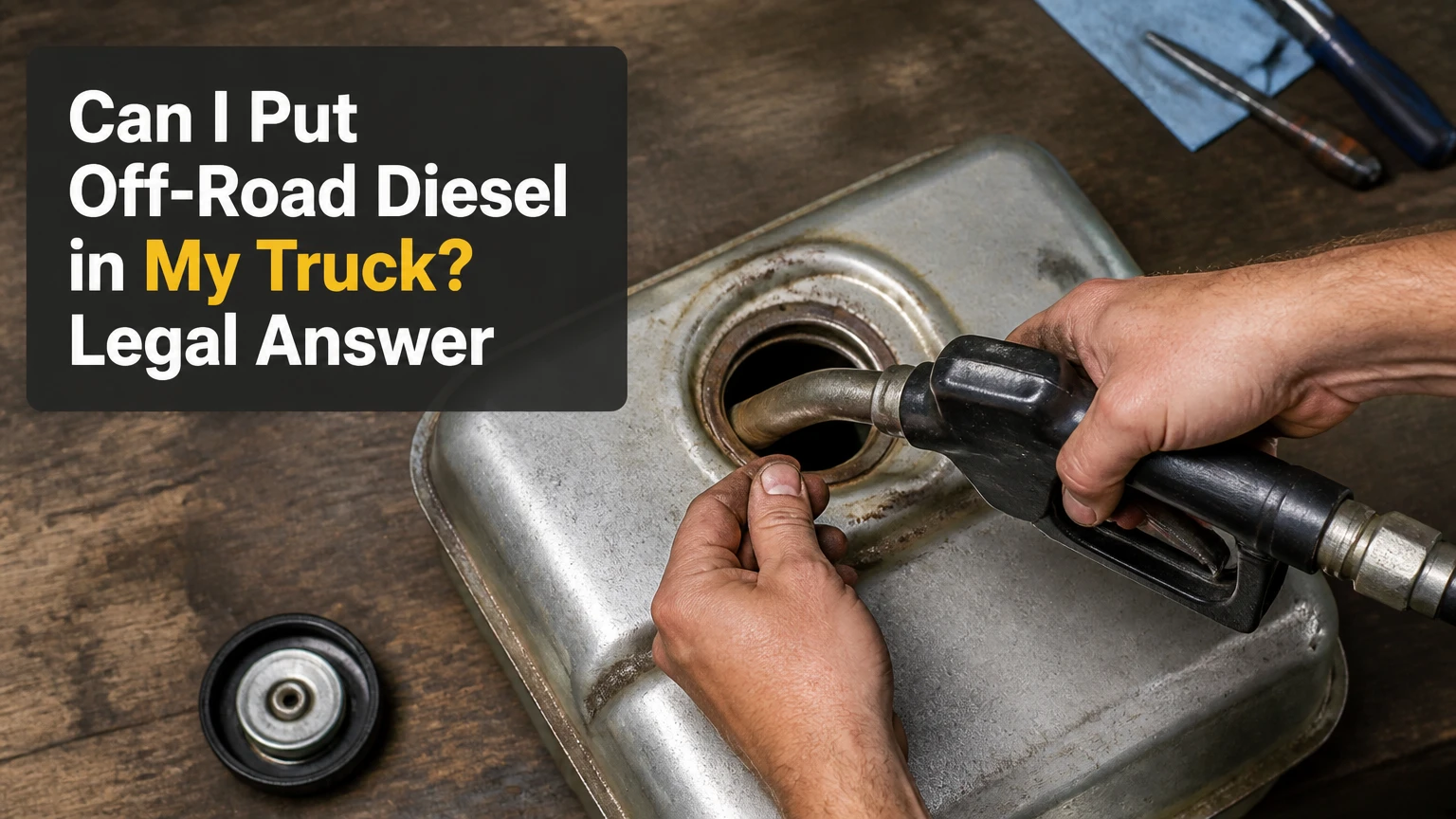
You can physically put off-road diesel in a diesel truck, and the engine will usually run because dyed diesel commonly uses the same ultra-low-sulfur diesel base as clear fuel. You generally cannot use that fuel in a truck operated on public roads, however, because the dye identifies fuel sold without highway taxes.
Key Facts at a Glance
- Off-road diesel, dyed diesel, and red diesel usually describe fuel marked with a red chemical dye for tax enforcement.
- A diesel engine generally cannot tell whether fuel is dyed, but a fuel sample can reveal the dye.
- A road-registered truck should use clear, taxed diesel, even when the truck spends most of its time on a farm or job site.
- Federal law generally prohibits dyed fuel in the fuel supply tank of a highway vehicle, with narrow statutory exceptions.
- The federal diesel excise tax is 24.4 cents per gallon, while state fuel taxes vary by location and year.
- Diluting, filtering, or chemically removing red dye does not make untaxed fuel lawful for highway use.
What Is Off-Road Diesel?
Off-road diesel is diesel fuel marked with a visible dye because the fuel was sold for a use that does not incur the federal highway excise tax. Retailers may call it dyed diesel, red diesel, farm diesel, or tax-exempt diesel. The color identifies its tax status, not a separate engine-fuel category.
The Internal Revenue Service administers federal fuel-tax rules under Internal Revenue Code Section 4082 and related regulations. IRS Publication 510 explains that dyed diesel is generally intended for nontaxable uses, while highway vehicles must use taxable fuel or satisfy a specific exception.
Most modern off-road diesel begins with petroleum diesel meeting the same basic ultra-low-sulfur requirements used for road diesel. The dye is added at a terminal or supplier location. Solvent Red 26 and Solvent Red 164 are commonly associated with dyed diesel, although the exact marker and state handling rules can differ.
The important distinction is tax treatment. A red color does not automatically mean poor-quality fuel, and clear color does not guarantee that a truck is legally fueled in every situation.
Is Red Diesel Chemically Different?
Dyed diesel is often chemically similar to clear diesel, but “identical” is too broad. Both products may meet ASTM International D975 diesel specifications, yet suppliers can use different additive packages, seasonal blends, cetane improvers, detergents, lubricity additives, and cold-flow treatments.
The Environmental Protection Agency’s ultra-low-sulfur diesel standard limits sulfur to 15 parts per million for highway diesel. That sulfur limit concerns emissions and fuel composition, not whether a product is dyed. A supplier’s certificate of analysis or product specification is the reliable way to verify fuel quality.
For a current common-rail engine, the bigger risks are contaminated fuel, water, poor storage, microbial growth, and inadequate winterization. Dye itself normally does not damage injectors or a diesel particulate filter.
Can I Put Off-Road Diesel in My Truck?
You should not use off-road diesel in a truck that operates on public highways. The legal issue is not whether the engine runs; the issue is whether untaxed, dyed fuel is in the fuel supply of a highway vehicle when the law requires taxable fuel.
A truck used exclusively on private property may qualify for a nontaxable use, but “mostly private” is not the same as “exclusively off-highway.” Driving from one field to another on a public road, crossing a public street, or traveling to a public fuel station can change the analysis. State law can add registration, agricultural, licensing, recordkeeping, and penalty requirements.
A road-registered pickup used for farm work is a common trap. The pickup may spend 95 percent of its hours inside the farm gate, but its public-road trips still make clear diesel the safer and usually required choice. A tractor that never enters a public road is a different case.
When Is Dyed Diesel Legal?
Dyed diesel is generally legal in equipment that operates solely off public roads, such as farm tractors, excavators, bulldozers, skid steers, stationary generators, and many forklifts. The exact rule depends on the equipment, location, fuel tank, and federal or state exception.
| Equipment or vehicle | Typical dyed-fuel status | Public-road condition | Practical fuel choice |
|---|---|---|---|
| Farm tractor | Generally permitted | Must remain off public highways | Dyed diesel in a labeled farm tank |
| Excavator | Generally permitted | Lowboy transport uses clear fuel in the truck | Dyed diesel at the job site |
| Road-legal pickup | Generally prohibited | Public-road operation triggers highway rules | Clear ULSD |
| Stationary generator | Generally permitted | Generator does not propel a highway vehicle | Dyed diesel if supplier approves |
| Forklift inside a warehouse | Generally permitted | No highway travel | Dyed diesel where lawful |
| Semi tractor | Generally prohibited | Highway propulsion requires taxable fuel | Clear ULSD |
| Trailer refrigeration unit | Separate treatment | Fuel must power the TRU, not the tractor | Approved reefer fuel tank |
Commercial marine, railroad, government, and emergency uses can have specialized federal rules. Do not infer eligibility from a machine’s size or from a supplier’s sales label. Confirm the applicable state revenue department and the IRS rule for the exact use.
Will Off-Road Diesel Damage a Truck?
Off-road diesel will usually power a diesel truck without an immediate drivability difference, provided the fuel meets the engine manufacturer’s specification and is clean. The red marker does not normally change combustion energy, ignition behavior, or fuel density enough for the driver to notice.
The mechanical answer does not override the tax answer. A truck can run normally and still contain fuel that creates a tax violation. This is why a successful start, normal exhaust, or ordinary fuel economy cannot prove lawful use.
Additive differences matter over time. A bulk supplier may sell a basic diesel blend without the detergent, cetane, lubricity, or winter-flow package found at a major retail station. That does not make every dyed product unsafe, but it makes supplier documentation and seasonal suitability important for high-pressure injection systems.
A practical rule is to prioritize fuel quality in this order: correct legal classification, clean and dry storage, verified specification, suitable cold-flow treatment, then brand preference. Dye color is not a quality score.
What About Diesel Exhaust Systems?
A single tank of properly specified dyed diesel does not usually destroy a diesel particulate filter, diesel oxidation catalyst, or selective catalytic reduction system. Sulfur, ash-forming contaminants, water, and incorrect fluids create more meaningful emissions-system risks.
The fuel must still be intended for the engine. Never treat off-road diesel as a substitute for diesel exhaust fluid. Diesel exhaust fluid belongs in the DEF tank, while diesel fuel belongs in the fuel tank. Confusing the two can cause expensive fuel-system damage regardless of color.
Clear Diesel Versus Off-Road Diesel
Clear on-road diesel is the correct default for any truck that uses public streets. Dyed diesel can reduce the purchase price for eligible off-road equipment because the supplier does not collect highway-use taxes, but the saving belongs to the permitted application rather than to the truck owner generally.
| Attribute | Clear on-road diesel | Dyed off-road diesel | Why the difference matters |
|---|---|---|---|
| Visible marker | Clear or pale straw color | Red marker dye | Inspectors can identify fuel status |
| Federal diesel tax | 24.4 cents per gallon | Generally removed at sale | Tax benefit depends on legal use |
| Highway truck use | Normally permitted | Generally prohibited | Truck operation determines compliance |
| Base specification | Often ASTM D975 ULSD | Often ASTM D975 ULSD | Verify each supplier’s specification |
| Typical purchase channel | Retail station or clear bulk tank | Dyed bulk tank or commercial supplier | Separate tanks prevent cross-fueling |
| Common equipment | Pickup, semi, delivery truck | Tractor, excavator, generator | Classification follows use |
| Main failure risk | Water, contamination, winter fuel | Misuse, contamination, weak additives | Fuel logs and storage both matter |
How Much Cheaper Is Off-Road Diesel?
A typical retail or bulk price difference may range from roughly $0.30 to $0.85 per gallon, but the actual spread changes with state tax, supplier margin, delivery volume, crude prices, and seasonal demand. The federal component alone is 24.4 cents per gallon.
At 100 gallons, a $0.50 spread saves $50 before delivery and storage costs. At 2,000 gallons, the same spread equals $1,000. Those savings can justify a compliant bulk-fuel system for a farm or contractor, but they do not justify putting dyed fuel in a road truck.
State fuel taxes vary substantially. A state may also impose environmental fees, inspection charges, sales-tax rules, or separate dyed-fuel penalties. Use the current state revenue department rate rather than a national estimate when calculating a fleet’s savings.
How Do Authorities Detect Dyed Fuel?
Authorities can draw a fuel sample from a vehicle tank and inspect the color or test the sample chemically. Federal and state inspectors may encounter dyed fuel during roadside inspections, tax audits, commercial compliance checks, agricultural investigations, or equipment reviews.
A fuel receipt does not erase the dye. The receipt can help prove an accidental supplier error or support a corrective explanation, but the physical fuel remains relevant evidence. An inspector may also examine tank labels, bulk-tank records, invoices, vehicle assignments, odometer readings, and the equipment’s operating location.
The IRS describes the federal penalty using the statutory formula, “the greater of $1,000 or $10 per gallon,” for certain misuse of dyed fuel. That phrase is a legal penalty formula, not a promise that every incident will produce the same final bill. Applicability, calculation, repeat violations, and state additions require a tax professional or revenue authority.
The AI Overview’s claim that every violation is a felony is too broad. Federal dyed-fuel misuse is commonly addressed through civil excise-tax penalties, while intentional fraud, obstruction, counterfeit documents, or state-specific offenses can create additional criminal exposure. Penalties vary by jurisdiction.
| Compliance event | Typical consequence | Variable that changes outcome | Immediate response |
|---|---|---|---|
| Small accidental fill | Tax assessment or investigation | Receipt and prompt correction | Stop driving and document |
| Intentional highway use | Federal civil penalty | Gallons and prior violations | Contact tax counsel |
| State-law violation | State tax, fine, or seizure risk | State and vehicle category | Check revenue department |
| Repeat misuse | Higher federal or state exposure | Compliance history | Preserve all fuel records |
| Dye-removal attempt | Possible added enforcement issue | Method and intent | Do not alter the fuel |
Can Clear Diesel Remove the Red Dye?
Adding clear diesel to dyed diesel does not reliably remove the dye and does not change the fuel’s legal classification. A diluted sample can still contain detectable marker, and the tank remains contaminated with fuel originally sold for a nontaxable use.
Do not use bleach, solvents, activated carbon, filtration rigs, or other improvised treatments. Those methods can leave water or chemical residues, alter lubricity, damage seals, and create disposal problems. They also look like an attempt to defeat an identification system rather than a legitimate correction.
The correct response is removal, not concealment. If a road truck receives dyed fuel, stop using it on public roads, retain the receipt, and arrange professional draining and compliant disposal or transfer.
What Should You Do After Accidental Contamination?
An accidentally contaminated truck should be parked away from public-road travel, drained by a qualified facility, and supported by a written record of the error and correction. The amount of work depends on whether the engine has run and how much fuel remains in the tank and lines.
Use this procedure:
- Stop road operation. Park safely on private property if possible. Do not drive to a repair shop unless the fuel issue has been addressed; arrange towing when necessary.
- Preserve evidence. Keep the receipt, supplier name, delivery ticket, pump number, date, and approximate gallons. Photograph the pump or tank label when available.
- Identify the fuel. Confirm whether the product was dyed diesel, dyed heating oil, kerosene, gasoline contamination, or water-contaminated fuel. Different contaminants require different handling.
- Drain the tank. Have a qualified technician remove the fuel into an approved, labeled container. Do not pour diesel onto soil, into drains, or into an unapproved waste drum.
- Flush appropriately. The technician should assess the tank, pickup tube, filters, and lines. A running engine may require filter replacement and additional flushing.
- Record the correction. Keep the work order, disposal or transfer receipt, photographs, fuel receipt, and date the truck returned to service.
- Check local reporting duties. State tax authorities differ. A tax attorney, enrolled agent familiar with fuel tax, or state revenue department can explain whether a voluntary disclosure is appropriate.
A small accidental fill is not the same as intentional tax evasion. Prompt, credible records improve the explanation, but they do not guarantee that a penalty will be waived.
How Much Flushing Is Needed?
There is no universal gallon or distance threshold that makes a contaminated truck legal. Dye can remain in tank residues, filters, lines, and low points, so the correct amount depends on tank design and whether the engine circulated the fuel.
A technician may drain the tank, replace the fuel filter, refill with clear diesel, and inspect the removed fuel. Modern high-pressure systems justify a conservative approach because injector or high-pressure-pump damage can cost far more than the original fuel.
What About Farm Trucks and Private Property?
A truck used only within a genuinely private, closed property may fall outside highway-use restrictions, but a road-legal pickup is rarely as isolated as its owner expects. Public-road crossings, maintenance trips, fuel runs, inspections, and movement between noncontiguous parcels create compliance risk.
| Farm or contractor scenario | Road exposure | Safer classification | Record to retain |
|---|---|---|---|
| Tractor stays inside one farm | 0 public miles | Dyed fuel | Tank and equipment log |
| Pickup drives between fields on county road | 2-20 public miles per trip | Clear diesel | Road-use fuel receipt |
| Excavator works inside a fenced site | 0 public miles | Dyed fuel | Job-site equipment log |
| Excavator travels on a public road | 1 or more public miles | Clear diesel if self-propelled | Transport and fuel records |
| Generator remains at a building | 0 vehicle miles | Dyed fuel if allowed | Delivery ticket and tank log |
| Semi tractor loads at a private yard | Public highway use | Clear diesel | Fleet fuel records |
Use dedicated, clearly labeled tanks when a business operates both highway and off-highway equipment. Color-coded hoses, separate keys, vehicle labels, and fuel logs prevent mistakes better than employee memory.
An expert fleet rule is simple: if a vehicle has a license plate, insurance for road travel, and a route that includes public pavement, fuel it from the clear tank. The extra administrative simplicity is often worth more than the tax spread.
Why Reefer Fuel Does Not Make Red Diesel Legal for the Truck
Reefer fuel is dyed diesel used by a trailer refrigeration unit, or TRU, rather than by the highway tractor that pulls the trailer. The separate reefer tank and standalone engine explain why dyed fuel may be physically present on an on-road semi without powering its propulsion engine.
A driver must not transfer reefer fuel into the tractor tank. The exception, where available, follows the equipment and use, not the entire vehicle combination. Fleet managers should label the TRU tank and propulsion tank separately, train drivers, and reconcile fuel purchases with unit identification.
The same principle applies to auxiliary engines and stationary equipment. A separate, lawful off-road engine does not authorize dyed fuel in the truck’s main propulsion tank.
What Fuel Should a Truck Owner Choose?
Choose clear ULSD for a personal pickup, work truck, delivery truck, or any diesel vehicle that travels on public roads. Choose dyed diesel only for equipment that qualifies for off-highway use and remains outside public-road operation under applicable federal and state rules.
| User situation | Recommended fuel | Reason | Avoid this mistake |
|---|---|---|---|
| Personal diesel pickup | Clear ULSD | Normal public-road travel | Using a farm tank for convenience |
| Road-going contractor pickup | Clear ULSD | Job-site travel includes highways | Assuming the job site controls |
| Farm tractor | Dyed diesel if state rules allow | Off-highway propulsion | Crossing a public road |
| Excavator on a private site | Dyed diesel if approved | No highway propulsion | Self-driving between sites |
| Semi tractor with reefer trailer | Clear diesel in tractor | Highway propulsion | Refueling the tractor from TRU tank |
| Backup generator | Dyed diesel if permitted | Stationary nontaxable use | Connecting the wrong hose |
Off-road diesel is not good for saving money in a personal truck. The expected saving is often tens of dollars per tank, while the legal exposure, cleanup cost, towing cost, and possible fuel-system repair can be much larger.
Frequently Asked Questions
Does off-road diesel get worse mileage?
Off-road diesel does not inherently produce worse fuel economy merely because it is dyed. Mileage depends more on cetane, density, additives, temperature, load, tire pressure, regeneration behavior, and fuel quality. A supplier’s product specification is more informative than the red color.
Can I use dyed diesel in a truck that never leaves my property?
Possibly, if the truck genuinely remains on private property and the federal and state rules recognize that use. A road registration alone does not answer every case, but any public-road travel generally changes the analysis. Confirm the rule with the state revenue department before changing fuel systems.
Does one gallon of red diesel contaminate a full tank?
One gallon can introduce dye into the tank and create a compliance problem, even when the final concentration is visually faint. There is no safe dilution ratio that authorizes highway use. Drain and document the tank instead of trying to calculate a passable mixture.
Can a diesel truck fail because the fuel is dyed?
A diesel truck can fail from contaminated, stale, wet, or poorly winterized fuel, but the dye itself is not normally the cause. Modern fuel systems require clean fuel with adequate lubricity and correct cold-flow properties. Obtain a sample test when symptoms include hard starting, injector noise, loss of power, or filter plugging.
Is off-road diesel legal in every state for farm equipment?
No. Federal rules provide the baseline, while states can add registration, refund, recordkeeping, and penalty requirements. A farm tractor may qualify federally but still require compliance with state purchasing or storage rules. Check the state revenue or taxation agency where the equipment operates.
Can a supplier accidentally sell dyed diesel as clear diesel?
A supplier error is possible, particularly in bulk-fueling operations, but the truck owner should stop road use and preserve evidence rather than assume the problem will resolve. Retain the invoice, notify the supplier promptly, obtain a written incident record, and document professional draining and refueling.
The Bottom Line
Can I put off-road diesel in my truck? Mechanically, a diesel truck will usually run on it, but a public-road truck should use clear, taxed diesel. Off-road diesel is intended for eligible equipment that stays off public highways, and dyed fuel in a road vehicle can lead to federal and state tax penalties.
If accidental contamination occurs, do not dilute or chemically remove the dye. Stop driving, drain the fuel professionally, preserve receipts and service records, and confirm local reporting requirements. For a personal or commercial truck that travels public roads, the correct choice is clear ULSD.