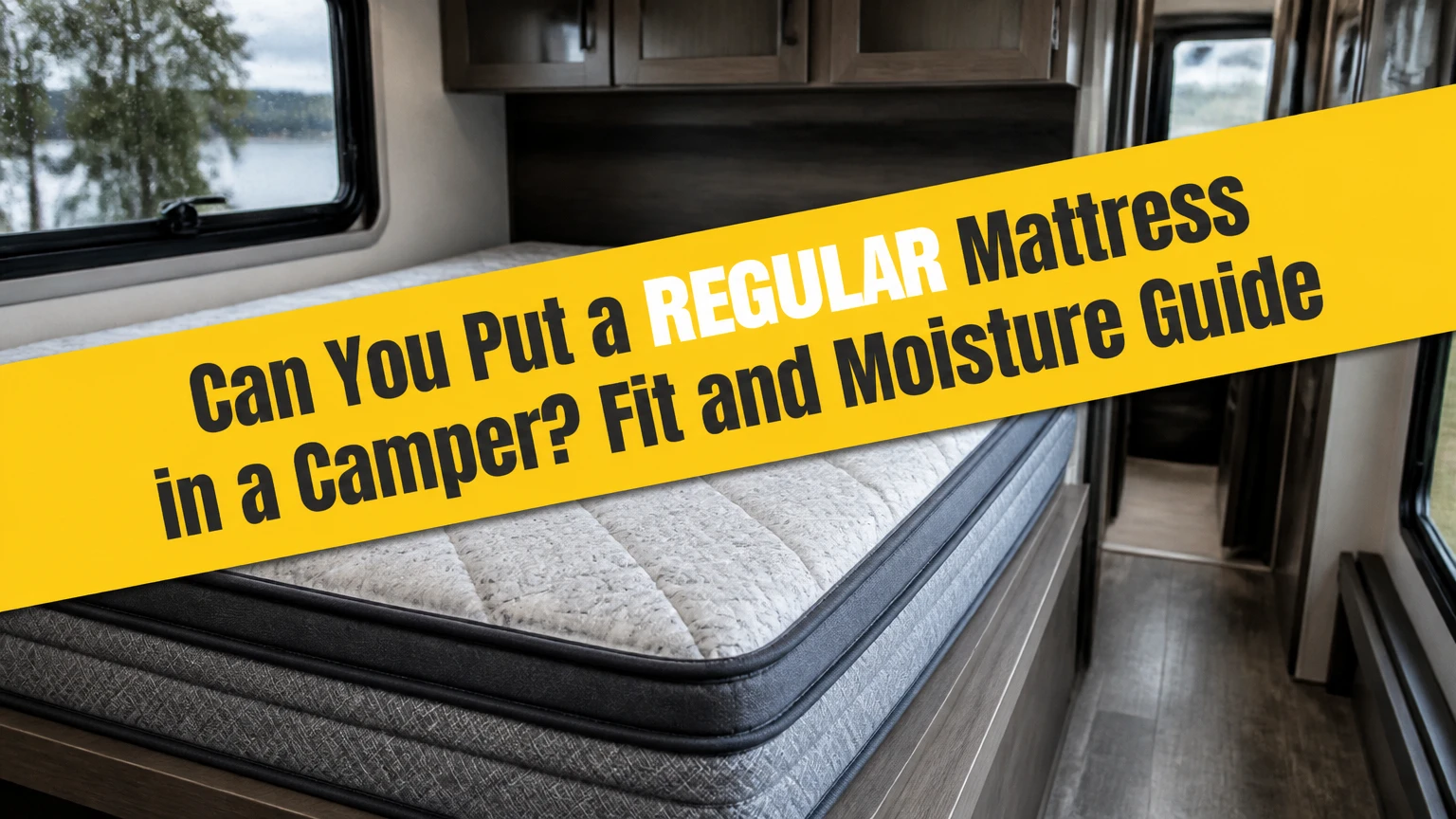
Yes, you can put a regular residential mattress in a camper when the bed platform supports its dimensions, weight, and height. The main risks are a mismatch with RV-specific dimensions, blocked slide-outs or doors, excessive platform load, and trapped moisture beneath the mattress. Measure the complete installation before buying.
Key Facts at a Glance
- A residential Queen usually measures 60 x 80 inches, while an RV Short Queen usually measures 60 x 74 inches.
- A regular mattress does not need to be labeled “RV” if its dimensions, weight, height, and support requirements suit the camper.
- A mattress placed directly on solid plywood needs a ventilation solution because warm, humid air can condense beneath it.
- A 10-14 inch residential mattress can obstruct windows, cabinets, reading lights, slide-outs, or storage-lid movement.
- All-foam mattresses are easier to maneuver through a camper door, but foam cannot be cut safely unless the construction allows modification.
- The mattress, sleepers, bedding, and stored items must remain within the platform and camper payload limits.
When Does a Regular Mattress Fit a Camper?
A regular mattress fits a camper when the mattress footprint sits on the platform without unsafe overhang, surrounding fixtures remain operational, and the base supports the combined load. A six-inch length difference may be harmless at an open footboard, but the same overhang can interfere with a wall, cabinet, bathroom door, or slide mechanism.
The phrase “regular mattress” usually means a residential Twin, Full, Queen, King, or California King. Camper manufacturers often use shortened or narrowed dimensions to preserve aisle space inside a travel trailer, fifth wheel, motorhome, truck camper, or campervan.
Physical fit is only the first test. Safe fit also includes vertical clearance, platform deflection, ventilation, fire-label compliance, and the weight of any lifting mechanism. A mattress that fits the rectangle can still make a hinged bed impossible to raise or prevent a slide-out from retracting.
What Must Be Measured Before Buying?
Measure the bare platform, not the old mattress. Record the usable width and length at several points because walls and cabinets are not always parallel. Then measure the height from the platform to every fixture that moves, opens, vents, or provides an emergency exit.
Check the mattress when the camper is both stationary and travel-ready. A slide-out may have different clearances when retracted, and a bed may shift during braking unless the mattress has a retaining edge or non-slip layer.
What Mattress Sizes Are Common in Campers?
Camper mattresses use many residential sizes, but RV Short Queen and RV King dimensions are common exceptions. The most reliable specification is the actual platform measurement, because manufacturers can vary a nominal size by several inches and custom camper beds may have angled corners.
| Mattress type | Typical width | Typical length | Common camper issue |
|---|---|---|---|
| Residential Twin | 38 in | 75 in | May leave side gaps on a wide platform |
| Residential Full | 54 in | 75 in | Often too short for a long rear bed |
| Residential Queen | 60 in | 80 in | Six inches longer than a Short Queen |
| Residential King | 76 in | 80 in | Usually too wide for camper aisles |
| RV Short Queen | 60 in | 74 in | Common replacement for a camper Queen |
| RV King | 72 in | 80 in | Narrower than a residential King |
| Three-quarter custom | 48 in | 75 in | Frequent in compact campervans |
| Truck-camper custom | 60-80 in | 74-80 in | May have radiused or cut corners |
A regular Queen is often the easiest residential replacement because its 60-inch width matches an RV Short Queen. Its extra six inches of length require a clear foot area or a properly supported extension.
Can You Use a Regular Queen on a Short Queen Platform?
You can use a regular Queen on an RV Short Queen platform if the extra six inches have structural support and do not obstruct camper hardware. Do not leave the additional length unsupported when the mattress edge will carry body weight, because repeated flexing can damage the mattress and the platform.
A supported extension should match the existing platform height and be fastened to framing rather than thin panel material alone. The extension must not cover storage access, block ventilation openings, or alter the clearance required by a slide-out.
A narrow gap is generally safer than forced compression against a wall. Compressing a mattress against a hard cabinet can create permanent edge deformation and may prevent the bed from returning to its travel position.
Are Residential Mattresses Too Heavy for Campers?
Residential mattresses are often heavier than RV mattresses, but weight becomes a problem only when it exceeds the bed platform, lifting hardware, axle, hitch, or vehicle payload limits. A typical residential Queen weighs about 60-120 pounds, while many lightweight RV mattresses weigh about 30-70 pounds.
The relevant calculation includes two separate loads. First, calculate the static bed load: mattress, sleepers, bedding, and anything stored on the platform. Second, verify the camper’s total payload and, for towables, the effect of added weight on tongue or pin load.
| Mattress construction | Typical Queen weight | Typical thickness | Handling concern |
|---|---|---|---|
| Basic polyurethane foam | 35-65 lb | 6-10 in | Lightest residential option |
| Memory foam | 45-85 lb | 8-12 in | Flexible but heat-retentive |
| Foam-latex hybrid | 70-110 lb | 10-14 in | Dense and difficult to lift |
| Innerspring | 70-120 lb | 10-14 in | Rigid coil perimeter |
| Pocket-spring hybrid | 80-130 lb | 11-16 in | Highest combined weight and height |
| RV foam mattress | 30-60 lb | 5-8 in | Easier for hinged platforms |
A manufacturer’s stated bed-platform capacity is more useful than a generic mattress recommendation. If the camper manual gives no separate bed rating, inspect the platform framing, hinges, fasteners, and support legs before adding a heavy mattress.
What Happens to a Hinged Camper Bed?
A heavy residential mattress can make a hinged camper bed difficult or dangerous to lift. Gas struts are selected for a particular lid weight and leverage position, so adding 40 pounds near the hinge or foot can change the lifting force substantially.
Never hold a raised platform with a mattress-sized prop while working beneath it. If the lid drops, the mattress can become a dangerous moving load. A qualified RV technician can calculate replacement strut force and confirm that the hinges and mounting screws can handle the new load.
Which Residential Mattress Material Works Best?
A medium-thickness all-foam mattress is usually the easiest residential choice for a camper because it weighs less, bends through a narrow door, and tolerates unusual platform shapes better than a coil mattress. Foam still requires ventilation and must not be treated as automatically resistant to condensation or mold.
| Material | Typical Queen weight | Airflow behavior | Modification and camper fit |
|---|---|---|---|
| Polyurethane foam | 35-65 lb | Low to moderate | May be trimmed only if manufacturer permits |
| Memory foam | 45-85 lb | Low | Bends easily; retains more body heat |
| Latex foam | 80-120 lb | Moderate | Resilient, heavy, difficult to trim |
| Innerspring | 70-120 lb | Moderate to high | Rigid; do not fold or cut |
| Hybrid | 80-130 lb | Moderate | Comfortable but heavy and tall |
Memory foam is practical for a weekend camper, especially in a 6-10 inch profile. Its weakness is heat and moisture management: dense foam permits less air movement than an open coil structure, so the underside deserves frequent inspection.
Latex resists dust mites and has durable elasticity, but “mold-resistant” is not the same as mold-proof. A wet plywood platform can support mold growth beneath any mattress, including latex. Latex also adds substantial weight to a lifting bed.
Innerspring and hybrid mattresses provide familiar residential support and some internal air volume. Their rigid perimeter wires make tight corners, narrow doors, and short platforms difficult. Sealy’s consumer handling guidance gives the direct instruction, “Do not fold the mattress,” which is especially relevant to innerspring constructions.
How Do You Control Moisture Under a Camper Mattress?
Moisture control requires an air gap or ventilated support layer between the mattress and the platform, plus periodic drying and inspection. A mattress on sealed plywood has little underside airflow, while occupants release water vapor during sleep and temperature changes can create condensation below the mattress.
A vapor barrier alone does not solve the problem. Impermeable plastic can trap water against the mattress or plywood, particularly when the platform is cooler than the cabin air. A three-dimensional spacer mesh, ventilated underlay, or properly designed slatted base creates channels for air movement without sacrificing support.
Which Ventilation Methods Work?
| Base treatment | Typical height added | Material cost range | Best use |
|---|---|---|---|
| Three-dimensional spacer mesh | 0.4-0.8 in | $80-$200 Queen | Existing solid platform |
| Slats with 2-3 inch gaps | 0.75-1.5 in | $40-$150 | Platform modification permitted |
| Perforated support panel | 0.5-1 in | $60-$180 | Stronger continuous support |
| Thin felt pad | 0.1-0.25 in | $20-$60 | Noise reduction, not primary airflow |
| Plastic sheet barrier | 0 in | $10-$30 | Not recommended as sole moisture control |
Keep the mattress dry during storage. Prop the mattress vertically or open the bed platform for several hours after sleeping, particularly after cooking, showering, or camping in humid weather. Inspect the underside after the first week, then monthly during regular use.
Musty odor, dark spotting, damp plywood, and a cool wet underside indicate a ventilation failure. Drying the mattress without correcting the base only postpones recurrence.
How Do You Install a Regular Mattress in a Camper?
Installing a regular mattress usually takes 30-45 minutes after measuring and requires a tape measure, straightedge, marker, non-slip material, and the selected ventilation layer. The most important step is measuring retracted slide-outs and moving hardware, not carrying the mattress through the door.
Before You Start
| Requirement | Typical specification |
|---|---|
| Measurement time | 20-40 minutes |
| Installation time | 30-45 minutes |
| Basic tools | 25-foot tape, marker, straightedge, screwdriver |
| Materials | Spacer mesh or slats, non-slip pad, edge fasteners |
| Purchase cost | $300-$1,500 for a residential Queen |
| Prerequisite | Camper manual and platform weight information |
Step 1: Measure the Bare Platform
Remove bedding and the old mattress, then measure width and length at the head, center, and foot. Record the smallest usable measurement, not the largest one.
Success checkpoint: The new mattress dimensions are smaller than the tightest platform measurement, or a designed extension provides full support.
Common mistake: Measuring the old mattress, which may have compressed or stretched over time.
Step 2: Check Every Clearance
Measure the distance to walls, wardrobes, windows, reading lights, bathroom doors, and electrical controls. Operate every slide-out through its complete travel with the old mattress removed, and identify where the new mattress could be pinched.
Success checkpoint: The mattress does not touch a moving slide, door, or cabinet at any position.
Common mistake: Checking only the slide-out when extended. Retracted travel clearance can be tighter.
Step 3: Select a Safe Thickness
Choose a mattress thickness that preserves access to windows, vents, overhead cabinets, and charging ports. A 14-inch mattress can consume 6-8 inches of usable sitting height compared with a 6-8 inch RV mattress.
Success checkpoint: A seated occupant has adequate headroom and all emergency exits remain reachable.
Common mistake: Treating thickness as a comfort-only decision. In a camper, thickness changes access, ventilation, and moving clearance.
Step 4: Verify the Load
Add the mattress weight to the maximum expected sleeper weight, bedding, and stored items. Confirm the platform, hinges, gas struts, and camper payload can handle the total.
Success checkpoint: The platform does not sag visibly, fasteners remain tight, and the storage lid stays controlled.
Common mistake: Checking only the mattress weight while ignoring two adults and stored equipment.
Step 5: Add Ventilation
Install spacer mesh or a properly supported slatted base over the plywood. Seal exposed wood where appropriate, but do not seal the system so tightly that moisture has nowhere to escape.
Success checkpoint: Air can move beneath the mattress, and the support surface remains level across the entire sleeping area.
Common mistake: Using soft carpet or a thin blanket as an airflow layer. Those materials compress and hold moisture.
Step 6: Load and Secure the Mattress
Move an all-foam mattress through the camper door on its side, following the manufacturer’s bending limits. Do not force-fold an innerspring or hybrid mattress unless the manufacturer specifically designed it for folding.
Place the mattress squarely on the base and use a non-slip pad or retaining system suitable for the platform. Avoid screws, staples, or adhesives that could contact the mattress cover.
Success checkpoint: The mattress stays centered during a firm hand push and does not slide during normal travel.
Common mistake: Carrying a rigid Queen horizontally through a narrow doorway, damaging walls or the mattress edge.
Residential Mattress Versus RV Mattress: Which Is Better?
A residential mattress usually wins on comfort range, availability, and long-term sleeping feel, while an RV mattress usually wins on weight, dimensions, ventilation planning, and clearance. The right choice depends on whether the camper is used occasionally, moved frequently, or occupied full time.
| Decision factor | Residential mattress | RV mattress | Practical winner |
|---|---|---|---|
| Typical Queen length | 80 in | 74 in Short Queen | RV mattress in compact rooms |
| Typical thickness | 10-14 in | 5-8 in | RV mattress for clearance |
| Typical Queen weight | 60-120 lb | 30-70 lb | RV mattress for lifting beds |
| Selection | Hundreds of models | Fewer specialized models | Residential mattress |
| Custom dimensions | Limited | Common from RV suppliers | RV mattress |
| Price, typical Queen | $300-$1,500 | $400-$1,800 | Depends on construction |
| Replacement availability | Retail and online stores | Specialty suppliers | Residential mattress |
| Platform ventilation | Often assumes slats | Must match camper base | Neither without inspection |
A residential mattress is a sensible upgrade when the camper platform has enough length, the bed is not frequently lifted, and the owner values a familiar home mattress. An RV model is usually more efficient when every inch, pound, and hinge movement matters.
What Does a Camper Mattress Conversion Cost?
A camper mattress conversion typically costs $350-$1,800 for a Queen-sized mattress and ventilation materials, with installation taking 30-45 minutes after the correct product arrives. A basic foam mattress may cost $300-$600, while a dense latex or hybrid model can exceed $1,000 before platform work.
| Conversion item | Typical low cost | Typical high cost | Typical time |
|---|---|---|---|
| Residential foam mattress | $300 | $800 | 1-3 days delivery |
| Residential hybrid mattress | $600 | $1,500 | 1-3 days delivery |
| Spacer-mesh underlay | $80 | $200 | 15-30 minutes |
| Slatted platform materials | $40 | $250 | 1-3 hours |
| Mattress extension | $50 | $250 | 1-2 hours |
| Higher-force gas struts | $60 | $250 | 30-90 minutes |
| RV technician inspection | $100 | $300 | 30-60 minutes |
Prices vary by country, size, brand, and tax. The Bangladeshi taka figures sometimes quoted in search results are not universal market prices, so local buyers should replace these North American retail ranges with current regional quotes.
What Problems Can Occur After Installation?
The most common post-installation problems are blocked hardware, underside dampness, excessive height, platform flex, mattress movement, and an overloaded lifting mechanism. Each symptom identifies a different failure, so adding a thicker topper or more padding is rarely the correct first fix.
The Mattress Overhangs the Platform
A supported overhang can work at the foot of an open bed, but an unsupported overhang should not carry regular body weight. Build a level extension from structural plywood or framing, then verify that the extension does not block storage doors or vents.
The Mattress Feels Damp or Smells Musty
Remove bedding, lift the mattress, and dry both surfaces completely. Install spacer mesh or slats, improve cabin ventilation, and inspect for roof, window, plumbing, or condensation leaks before reinstalling the mattress.
The Bed Lid Will Not Stay Open
The mattress may exceed the original gas-strut rating or place weight in a different position. Do not rely on a broom handle during normal use. Have the strut force and hinge mounts recalculated for the complete lid assembly.
The Mattress Slides During Travel
A smooth plywood surface and braking forces can move a residential mattress several inches. Use a correctly sized non-slip pad, raised retaining edge, or manufacturer-approved restraint that does not compress the mattress permanently.
The Camper Feels Cramped
The mattress may be too thick rather than too wide. Test a seated position, cabinet opening, window access, and aisle passage before accepting a 12-14 inch model as a permanent installation.
Which Choice Fits Different Camper Owners?
Weekend users can often choose a 6-8 inch residential foam mattress because lower weight and easy handling outweigh the benefits of a complex hybrid. The mattress should still receive an airflow layer, especially when the camper is stored closed between trips.
Full-time occupants generally benefit from a residential mattress with stronger edge support and a ventilation system designed for daily use. A 10-12 inch foam or hybrid model may improve sleep, but the platform, payload, and condensation controls need inspection every month.
Boondockers should prioritize weight, drying ability, and electrical independence. Dense latex is durable but heavy, so a lighter open-cell foam or purpose-built RV mattress may be a better match when payload and lifting effort matter more than maximum material longevity.
Truck campers and small campervans have the tightest tolerances. A custom-cut mattress, hinged folding design, or RV Short Queen often produces a safer result than forcing a residential Queen into a space designed around a 74-inch bed.
Expert Rules That Prevent Expensive Mistakes
A mattress can be dimensionally correct and mechanically wrong. The platform may support the rectangle while the slide-out, hinge, or cabinet requires clearance beyond the sleeping surface. Test all moving components before installation.
Ventilation is a system, not a sheet. Spacer mesh improves air channels, but it cannot dry a leak or replace cabin ventilation. If the plywood remains wet, find the water source before changing mattress materials.
Weight at the wrong location matters more than weight on paper. A mattress added to the outer edge of a lifting lid creates more leverage than the same mattress weight near the hinge. Gas-strut performance must be judged by position, not pounds alone.
Do not cut a mattress to solve an unknown fit problem. An all-foam mattress may be physically trimmable, but cutting can expose unsuitable foam layers, void the warranty, and change support. Obtain written manufacturer approval first.
FAQ
Can I use a box spring under a residential mattress in a camper?
Usually, no. Campers generally use a plywood or fiberglass platform because interior height and weight are limited. A residential box spring can add 8-10 inches and 40-100 pounds, potentially blocking cabinets, overloading hinges, and reducing headroom. Use the existing platform with an approved ventilated layer unless the camper was engineered for a box spring.
Can a regular mattress block an RV emergency exit?
Yes, a mattress can block an emergency exit if its length, thickness, or storage position covers the window or prevents the exit from opening. Check every designated escape route after installation, including windows hidden behind a tall mattress. Do not treat a partially accessible exit as compliant or safe.
Can you cut a regular memory-foam mattress to fit?
You can cut some single-layer polyurethane foam mattresses, but only with the manufacturer’s written approval and appropriate support afterward. Do not cut memory-foam hybrids, latex mattresses, innerspring mattresses, or reinforced-edge constructions without engineering instructions. Modification can expose layers, alter fire safety, and invalidate the warranty.
Should the mattress be removed during winter storage?
Remove or vertically prop the mattress when practical, particularly in an unheated camper stored in a humid climate. Open the platform, dry the interior, and avoid covering the mattress with an airtight plastic sheet. Temperature swings can produce condensation even when the camper appears dry at storage time.
How much gap should a camper mattress have around the edges?
A universal gap does not exist, because the correct clearance depends on the platform and nearby hardware. A small perimeter gap can help installation and ventilation, but large gaps reduce usable support. Measure the manufacturer’s tolerance and keep the sleeping surface fully supported rather than choosing a gap by appearance.
Is a special RV mattress necessary for a camper?
A special RV mattress is not necessary when a residential model matches the platform and operating clearances. An RV mattress becomes the better choice when the bed uses a Short Queen, an angled corner, a slide-out, a lifting lid, or a strict weight limit. The label matters less than verified dimensions and construction.
The Bottom Line
You can put a regular mattress in a camper if the platform supports its full footprint and combined load, all doors and slide-outs remain clear, and the underside receives adequate ventilation. A 60 x 80 inch residential Queen can replace a 60 x 74 inch Short Queen only when the extra length is supported and harmless to nearby fixtures.
For most campers, a 6-10 inch all-foam residential mattress is the simplest upgrade. Choose a hybrid or latex model only after confirming weight, height, hinge force, and payload. Measure first, ventilate the base, test every moving component, and inspect beneath the mattress during the first month. That is the safe answer to “can you put a regular mattress in a camper?”