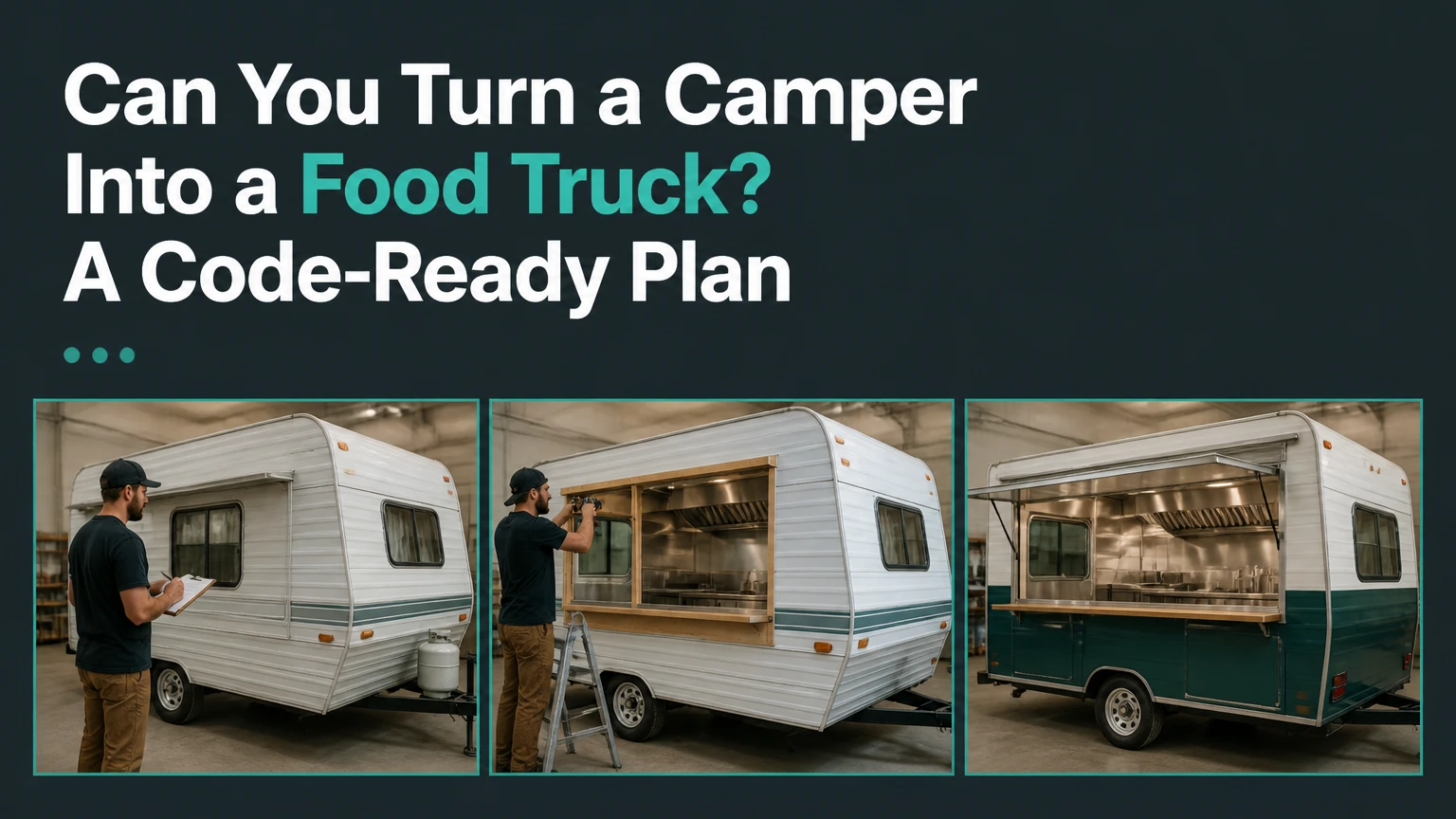
Yes, you can turn a camper into a food truck, but the finished unit is usually classified as a mobile food unit or concession trailer because it has no engine. A compliant conversion normally requires removing residential components, rebuilding the kitchen, upgrading utilities, balancing payload, and obtaining health, fire, electrical, and vehicle approvals.
Key Facts
A camper without an engine is a towable concession trailer, not a self-propelled food truck.
A typical professionally equipped conversion costs about $29,000-$77,500 before unusual restoration work.
A used camper’s GVWR, axle rating, tire rating, and available payload determine whether the project is viable.
Commercial cooking usually requires NSF-listed equipment, a Type 1 hood, and an approved fire-suppression system.
Most jurisdictions require a plan review before construction and a final inspection before selling food.
A square dual-axle cargo trailer is usually easier and safer to convert than a vintage camper.
Is a Camper a Food Truck or a Concession Trailer?
A camper becomes a concession trailer when it is converted into a towable commercial food facility. The distinction matters because a concession trailer needs a tow vehicle, trailer registration, parking arrangements, and a safe way to connect utilities at each operating location.
A self-propelled food truck contains the kitchen and motor in one vehicle. A converted camper does not. The operator must account for towing capacity, trailer brakes, hitch rating, turning clearance, roadside recovery, and setup time after arrival.
The legal name varies by jurisdiction. Local agencies may use terms such as mobile food unit, mobile food establishment, mobile kitchen, catering trailer, or temporary food facility. Ask the health department for its exact classification before buying a shell.
The camper’s recreational certification does not automatically transfer to commercial food use. Residential cabinetry, upholstery, carpet, shower assemblies, domestic refrigerators, and lightweight plumbing may need complete replacement.
Can Any Camper Be Converted?
Almost any structurally sound camper can be modified, but not every camper makes an economical or safe commercial kitchen. The best candidate has a sound frame, enough payload, a usable floor plan, accessible utility routes, and sufficient ceiling height for required equipment.
A vintage canned-ham camper can work for coffee, packaged pastries, shaved ice, or other low-weight concepts. A larger dual-axle toy hauler can support heavier cooking equipment, although its existing walls and electrical system still require commercial review.
Water intrusion deserves special attention. A camper can look attractive while concealed rot weakens the floor, wall framing, roof joints, or axle mounting points. A professional inspection before purchase can prevent demolition costs from exceeding the shell’s value.
Which Camper Works Best for Each Food Concept?
| Camper or trailer type | Typical shell price | Typical payload concern | Suitable concept |
|---|---|---|---|
| Vintage canned ham | $3,000-$8,000 | Often 1,000-2,000 lb payload | Coffee, pastries, cold desserts |
| Vintage Airstream | $15,000-$35,000 | Curved walls and restoration weight | Boutique drinks, premium snacks |
| Late-model toy hauler | $12,000-$25,000 | Better axle capacity, heavy shell | Frying, grilling, catering |
| 6×12 dual-axle cargo trailer | $5,000-$12,000 | Payload commonly 3,000-5,000 lb | Tacos, sandwiches, compact hot line |
| Purpose-built concession trailer | $25,000-$90,000 | Factory-selected commercial systems | High-volume daily operation |
A vintage camper is a branding asset, not automatically a cost-saving asset. Curved aluminum, damaged insulation, custom windows, and unavailable trim can add thousands of dollars without increasing kitchen capacity.
How Much Weight Can a Converted Camper Carry?
A converted camper must carry the shell, commercial equipment, water, propane, food, workers, personal protective equipment, and spare supplies without exceeding its GVWR or either axle rating. Available payload equals GVWR minus the actual empty weight, not the optimistic dry weight shown in an old brochure.
Water creates a large hidden load. One US gallon weighs about 8.34 pounds, so a 40-gallon fresh tank adds approximately 334 pounds before the tank, pump, fittings, and wastewater are counted. A full 40-gallon fresh tank plus a 46-gallon waste tank adds roughly 718 pounds of water.
Use certified scales after the build reaches operating condition. Weigh the total trailer, each axle, and the tongue separately. The loaded tongue weight commonly needs to remain around 10%-15% of trailer weight for stable towing, subject to the trailer manufacturer’s instructions and local law.
| Load item | Typical weight | Planning implication |
|---|---|---|
| Commercial under-counter refrigerator | 180-300 lb | Place near the axle, then verify side balance |
| 36-inch gas griddle | 250-450 lb | Requires floor reinforcement and gas planning |
| 40-gallon fresh water | 334 lb | Mount low and secure against movement |
| 46-gallon wastewater | 384 lb | Confirm axle and tank-support capacity |
| Propane cylinders and cage | 100-250 lb | Exterior mounting may alter tongue weight |
| Generator or battery system | 150-500 lb | Balance against the cooking line |
| Two operators and food stock | 350-600 lb | Include people in the operating calculation |
A useful practitioner rule is to reserve 15%-20% of rated payload for supplies and uncertainty. A trailer that is technically legal when empty can become unsafe after food, water, propane, and staff are added.
What Must the Commercial Kitchen Contain?
The required equipment depends on the menu and local food code, but most full-service units need a dedicated handwashing sink, a three-compartment warewashing sink, hot and cold potable water, wastewater storage, refrigeration, washable work surfaces, and protected food storage.
The Food and Drug Administration Food Code 2022 describes food-contact surfaces as “smooth, easily cleanable, and resistant to damage.” Local inspectors apply that principle through their own adopted code, so an FRP panel, stainless sheet, or approved composite may be acceptable while raw wood, fabric, and deteriorated laminate are not.
Residential appliances create two separate risks. Household refrigerators may not be listed for commercial sanitation, and residential ranges generally lack the required ventilation, temperature control, restraint, and fire protection.
Minimum Equipment Planning Table
| Component | Typical specification | Verification point |
|---|---|---|
| Hand sink | Dedicated basin, soap, paper towels, splash protection | Located for immediate employee access |
| Three-compartment sink | Wash, rinse, sanitize basins sized for utensils | Confirm basin dimensions with the inspector |
| Fresh tank | Commonly 30-50 gallons | Local multiplier and potable-water rating |
| Waste tank | Commonly 36-75 gallons | Often 15%-50% larger than fresh capacity |
| Refrigerator | NSF-listed commercial unit, 33-41°F holding target | Confirm thermometer and power load |
| Prep surfaces | Stainless steel or approved nonabsorbent surface | Seal wall and counter junctions |
| Fire extinguisher | Class K for cooking oils plus required general extinguisher | Fire marshal determines placement and rating |
Menu design should precede equipment purchasing. A coffee trailer may need an espresso machine, ice machine, under-counter refrigerator, blender circuit, and hand sink, while a fryer concept adds hood, suppression, make-up air, grease management, and higher electrical or propane demand.
How Do You Convert the Camper?
A compliant camper conversion normally takes six phases: approve the layout, demolish residential components, repair the shell, install utilities, build cleanable surfaces and ventilation, then complete equipment installation and inspections. Part-time DIY work commonly takes 6-12 months; a fabrication shop may finish in 6-12 weeks after design approval.
Step 1: Confirm the Business and Site Requirements
Write the menu, production method, staffing level, service volume, operating locations, and storage plan before drawing the floor plan. Contact the health department, fire marshal, building department, electrical authority, and motor-vehicle agency because each may impose different requirements.
Ask whether the unit needs a commissary. Some jurisdictions require mobile food operators to store food, fill potable tanks, wash equipment, dispose of wastewater, and receive deliveries at an approved commissary.
Checkpoint: Obtain written plan-review instructions and a list of required permits.
Common mistake: Buying a camper before learning that the jurisdiction prohibits on-site food preparation or requires a specific commissary.
Step 2: Draw a Scaled Floor Plan
Map the service window, cooking line, sinks, refrigerator, tanks, generator, propane enclosure, doors, aisle, ventilation path, and employee movement on a scaled drawing. Include equipment dimensions, door swings, maintenance access, and the location of every electrical outlet.
Submit the plan before cutting the shell. A health reviewer may reject a sink position, aisle width, waste-tank access, or handwashing location that becomes expensive to relocate after construction.
Checkpoint: The approved plan identifies model numbers, utility loads, tank capacities, and equipment clearances.
Common mistake: Designing around a generic “36-inch griddle” without checking its actual depth, clearance, gas input, or service access.
Step 3: Gut and Inspect the Shell
Remove beds, toilets, showers, sofas, domestic cabinetry, carpet, old insulation, and residential appliances. Open suspect walls and floors so a qualified person can inspect water damage, corrosion, wiring, framing, axle mounts, brakes, tires, and the coupler.
Replace rotten wood with suitable structural material and repair steel corrosion before installing new finishes. Do not treat severe frame corrosion with surface rust converter alone; a trailer repair specialist may need to weld or replace structural sections.
Checkpoint: The bare shell passes a structural and towing inspection before interior construction begins.
Common mistake: Preserving attractive but porous wall panels that later fail cleanability or conceal mold.
Step 4: Reinforce Openings and Heavy Loads
Cutting a service window changes the wall’s load path. Install an engineered header and side supports sized for the opening, then seal the exterior against water intrusion. Reinforce floor areas beneath refrigerators, griddles, fryers, tanks, and generators.
Do not assume the original camper floor can support commercial equipment. Heavy appliances can concentrate loads over a small area, while transit vibration adds forces that a stationary kitchen never experiences.
Checkpoint: The window frame is rigid, sealed, and free of roof or wall movement.
Common mistake: Cutting first and asking a structural professional to solve sagging later.
Step 5: Install Electrical, Gas, and Water Systems
Replace the original recreational vehicle wiring where commercial loads require it. A small camper may have a 30-amp, 120-volt system, while a commercial build may need a 50-amp service, 240-volt circuits, a generator, shore-power inlet, or a hybrid system. The correct configuration depends on equipment nameplates and local electrical rules.
Install listed breakers, grounding and bonding, GFCI protection where required, weatherproof exterior connections, and accessible disconnects. A licensed electrician should calculate load rather than selecting a panel by habit.
Propane work requires listed components, correct regulators, shutoff valves, leak testing, ventilation, and protected cylinder storage. A licensed gas fitter or qualified technician should perform the installation and pressure test.
Use potable-water-rated tanks and lines, a commercial pump sized for the fixtures, a water heater if hot water is required, and an air gap or approved backflow arrangement. Route wastewater to a properly supported tank with accessible cleanouts and valves.
Checkpoint: Electrical, gas, and plumbing systems pass pressure, continuity, leak, and functional tests.
Common mistake: Retaining a 12-volt RV pump that cannot maintain useful pressure when several commercial fixtures operate.
Step 6: Build Washable Finishes and Ventilation
Use smooth, sealed, nonabsorbent surfaces on walls, ceilings, floors, counters, and splash zones. FRP panels can reduce cost, while stainless steel tolerates heat, impact, and repeated cleaning better in cooking areas. Seal seams with an approved product and eliminate exposed raw edges.
Grease-producing appliances generally require a Type 1 hood connected to an approved exhaust system and automatic fire suppression. Steam-producing appliances may require Type 2 ventilation, but classification depends on the equipment and local code.
A sealed camper can develop negative pressure when a hood exhausts air faster than replacement air enters. Install an approved make-up-air solution or designed intake path, because smoke migration, poor burner performance, and door problems can result.
Checkpoint: The hood, duct, fan, clearances, suppression nozzles, and make-up air match the approved plan.
Common mistake: Installing a residential range hood that moves air but lacks commercial grease control and fire protection.
Step 7: Install and Secure Commercial Equipment
Set equipment according to the approved layout, then secure every movable appliance against trailer vibration. Use listed commercial equipment where required, maintain manufacturer clearances, and leave access to filters, drains, controls, shutoffs, and refrigeration service panels.
Complete commissioning before inspection. Test refrigerator temperatures, hot-water delivery, sink drainage, pump pressure, generator output, hood airflow, propane shutoffs, emergency controls, lighting, and fire-suppression interlocks.
Checkpoint: The unit operates continuously for a full service simulation without overheating, leaking, tripping breakers, or losing water pressure.
Common mistake: Waiting until inspection day to discover that the refrigerator and water heater cannot run together on the generator.
How Much Does Camper Conversion Cost?
A realistic camper-to-food-trailer conversion costs about $29,000-$77,500 for a used shell and substantial DIY or mixed labor. Professional turnkey fabrication often reaches $75,000-$140,000 or more because engineering, fabrication, equipment procurement, certification, and project management replace owner labor.
| Cost category | Typical range | Main cost driver |
|---|---|---|
| Used camper shell | $3,000-$20,000 | Age, frame condition, brand, restoration |
| Demolition and structural repair | $2,000-$12,000 | Rot, corrosion, window framing |
| FRP, stainless, insulation, flooring | $4,000-$8,000 | Surface area and heat zones |
| Electrical and plumbing | $3,500-$10,000 | Service size, tanks, pump, generator |
| Hood and fire suppression | $5,500-$9,500 | Hood length, duct route, suppression design |
| NSF commercial equipment | $12,000-$30,000 | Refrigeration and cooking method |
| Permits and professional design | $1,500-$4,000 | Stamps, reviews, local fees |
| Contingency | 10%-20% of build | Hidden damage and redesign |
The shell is rarely the dominant cost. A $5,000 camper with $15,000 of structural repairs is more expensive than a sound $12,000 trailer that needs only layout and finish work.
Used commercial equipment can reduce the budget, but verify electrical phase, gas input, certification labels, dimensions, service history, and replacement-part availability before purchase. A cheap appliance that cannot pass inspection is not a saving.
How Long Does the Conversion Take?
A full-time DIY conversion commonly takes 3-5 months, part-time work takes 6-12 months, and a professional shop often requires 6-12 weeks after design approval. Structural surprises, permit revisions, custom stainless fabrication, and backordered refrigeration create the longest delays.
| Project stage | DIY working time | Shop schedule | Typical dependency |
|---|---|---|---|
| Menu, layout, plan review | 2-6 weeks | 1-3 weeks | Required before construction |
| Demolition and structural repair | 2-8 weeks | 1-3 weeks | Depends on hidden damage |
| Utility rough-in | 2-5 weeks | 1-2 weeks | Requires equipment loads |
| Walls, floor, hood | 3-8 weeks | 2-4 weeks | Hood approval may control |
| Equipment and commissioning | 2-6 weeks | 1-3 weeks | Depends on deliveries |
| Final inspections | 1-6 weeks | 1-4 weeks | Agency availability and corrections |
Do not advertise a launch date based only on fabrication time. Local plan review and final inspection can add weeks even when the physical build is complete.
What Health, Fire, and Vehicle Approvals Are Needed?
A converted camper normally needs health-department plan approval, a mobile-food operating permit, fire inspection, electrical approval, propane or fuel-system approval, vehicle or trailer registration, and business licensing. Zoning, wastewater disposal, signage, parking, and event permits may add separate requirements.
Requirements vary by city, county, state, province, and operating venue. The local health department is the controlling source for food-facility details, while the fire marshal controls hood suppression and cooking clearances; national model codes provide useful references but do not replace local approval.
Keep a compliance file containing approved plans, equipment cut sheets, NSF documentation, hood specifications, suppression certificates, tank information, scale tickets, electrical records, gas test results, insurance, and registration documents.
Can the Business Operate Without a Commissary?
A camper business can operate without a commissary only where the local authority permits self-contained preparation, storage, potable-water filling, wastewater disposal, and cleaning. Many jurisdictions require a commissary even when the trailer has its own tanks and sinks.
A commissary may provide refrigeration, dry storage, food preparation, utensil washing, waste disposal, and overnight parking. Include its monthly fee, travel time, utility access, and contract terms in the business plan before selecting the trailer.
Camper Conversion Versus Other Mobile Food Options
A camper is strongest when visual identity and a compact menu matter more than maximum production. A cargo trailer is usually the better build platform for daily hot-food service because square walls simplify insulation, equipment placement, ventilation, and future repairs.
| Option | Typical purchase or build range | Setup characteristic | Best operating case |
|---|---|---|---|
| Converted vintage camper | $29,000-$90,000 total | High customization, towing required | Weddings, markets, brand-led concepts |
| Cargo concession trailer | $35,000-$100,000 total | Square walls, efficient fit-out | Daily service and standard menus |
| Self-propelled food truck | $60,000-$180,000 total | Drives to site, engine maintenance | Multiple locations and rapid relocation |
| Coffee cart or kiosk | $10,000-$45,000 total | Limited storage and utilities | Espresso, cold drinks, low-volume sites |
| Commissary-supported pop-up | $5,000-$30,000 total | Lowest vehicle infrastructure | Testing a concept before committing |
Choose a camper when the shell is structurally sound, the menu is compact, the brand benefits from a distinctive appearance, and the tow vehicle is adequate. Choose a cargo trailer when payload, repairability, sanitation, and predictable daily throughput matter more than vintage character.
What Commonly Goes Wrong?
The most expensive failures occur when builders treat a recreational shell as a finished kitchen rather than as a lightweight platform requiring commercial redesign. The following problems deserve correction before the first inspection.
- Excess weight: Calculate every installed and operating load, then verify axle, tire, hitch, and tongue ratings on a certified scale.
- Uneven side loading: Balance refrigerators, griddles, tanks, and generators across the trailer instead of placing every heavy item on one wall.
- Residential equipment: Replace household refrigerators and ranges with equipment accepted by the local authority and appropriate for commercial temperatures and cleaning.
- Equal tank sizes: If the jurisdiction requires wastewater capacity above fresh-water capacity, install the required multiplier rather than two matching tanks.
- Unapproved service window: Reinforce the opening and provide a sealed sill, insect control, and a layout that prevents customer contact with food-contact surfaces.
- Insufficient ventilation: Match hood type, exhaust rate, ducting, suppression, and make-up air to the cooking equipment and fire code.
- No maintenance access: Leave removable panels and clearances around pumps, shutoffs, filters, refrigeration compressors, and electrical equipment.
- Towing neglect: Replace aged tires, inspect wheel bearings and brakes, verify breakaway equipment, and confirm TPMS function before road use.
A camper can pass a health inspection and still be unsafe to tow. Health approval does not certify frame integrity, axle capacity, brake performance, or highway stability.
How Do You Fix Smoke, Water, and Power Problems?
Smoke inside a camper usually indicates inadequate exhaust design, blocked filters, missing make-up air, or a hood that does not match the cooking equipment. Water-pressure loss commonly comes from an undersized pump, restricted filters, trapped air, inadequate tank venting, or simultaneous fixture demand.
| Symptom | Likely cause | Corrective action |
|---|---|---|
| Hood fills the room with smoke | Negative pressure or undersized exhaust | Add designed make-up air and recheck hood sizing |
| Burner flame pulses | Low propane flow or regulator problem | Test pressure under load with a qualified technician |
| Sink pressure drops | Small RV pump or blocked filter | Use a commercial demand pump and serviceable filter |
| Wastewater backs up | Poor slope, blocked vent, full tank | Clear line, improve venting, monitor tank level |
| Generator trips | Load exceeds continuous rating | Perform a load calculation and shed nonessential circuits |
| Refrigerator warms | Low voltage, dirty condenser, bad seal | Measure voltage, clean condenser, inspect door gasket |
Never solve kitchen smoke by opening a random wall panel after the hood has been approved. Uncontrolled openings can affect fire separation, insects, weather resistance, and pressure balance.
Which Option Fits Your Situation?
Choose a Camper for a Distinctive Event Brand
A vintage camper suits weddings, breweries, farmers markets, and seasonal festivals where customers value appearance and the menu remains compact. Keep the cooking line light if the shell has limited payload, and use commissary preparation when local rules permit it.
Choose a Cargo Trailer for Daily Hot Food
A dual-axle 6×12 or 7×14 cargo trailer usually provides straighter walls, better equipment clearances, simpler FRP installation, and easier future repairs. This option fits tacos, fried food, burgers, sandwiches, and catering menus with substantial hot holding.
Choose a Food Truck for Frequent Relocation
A self-propelled truck avoids hitching and towing at every site, but it introduces engine, transmission, chassis, and commercial-vehicle maintenance. The higher purchase price can make sense when the business changes locations several times per day.
Choose a Cart or Pop-Up to Test Demand
A cart, tent, or commissary-supported pop-up limits equipment and menu capacity, but it reduces initial infrastructure risk. Test sales volume, average ticket, service speed, and site demand before committing to a $50,000-plus mobile kitchen.
FAQ
Can I keep the camper’s original kitchen cabinets?
You can keep a cabinet only if the local authority accepts its material, cleanability, construction, and condition. Most original camper cabinets contain porous wood, difficult-to-clean joints, or residential hardware. Retain them only after plan review confirms that they can be sealed and maintained safely.
Do I need a commercial generator?
You need a generator only when shore power cannot supply the approved electrical load. Calculate the continuous and starting watts for refrigeration, water heating, espresso equipment, pumps, lighting, and HVAC. A generator must also meet noise, fuel-storage, exhaust, grounding, and local fire requirements.
Can propane appliances operate inside a camper?
Propane appliances can operate inside a converted camper when the equipment, gas piping, ventilation, clearances, cylinder storage, regulators, and fire protection comply with local requirements. A licensed gas professional should perform pressure testing, and the fire marshal may require automatic shutoffs linked to suppression.
Is a vintage Airstream worth converting?
A vintage Airstream is worth converting when its brand appeal increases bookings or customer demand enough to offset curved-wall fabrication, aluminum repair, limited ceiling clearance, and restoration costs. It is usually a poor choice for a low-margin, high-volume menu requiring large square appliances.
How do I dispose of wastewater legally?
Dispose of wastewater through an approved sanitary sewer, commissary, dump station, or other location authorized by the local health authority. Never discharge greywater onto pavement, soil, storm drains, or a public street. Keep disposal receipts or logs when the jurisdiction requires operating records.
Can I sell food during the build?
Do not sell food from the camper until required permits and final approvals are complete. A temporary event permit, approved commissary, or separate licensed kitchen may allow earlier sales, but those permissions do not automatically authorize operation from the unfinished trailer.
The Bottom Line
Can you turn a camper into a food truck? Yes, provided the camper can safely carry the commercial kitchen and the finished unit meets local mobile-food, health, fire, electrical, plumbing, towing, and registration requirements. Treat the project as a concession-trailer rebuild, not an appliance installation.
The best first step is plan review, not demolition. Confirm the menu, payload, tank rules, hood requirements, commissary obligations, and operating locations before spending on a shell. A square cargo trailer is often the rational choice, while a structurally sound vintage camper makes sense when its distinctive appearance has measurable business value.