No, you cannot turn a half-ton truck into a true 3/4-ton truck through aftermarket modifications. A Ford F-150, Chevrolet Silverado 1500, GMC Sierra 1500, or Ram 1500 keeps its manufacturer-assigned GVWR, axle ratings, brake capacity, frame design, and certified towing limits, even after installing air bags, heavier springs, brakes, or tires.
Key Facts at a Glance
- A suspension kit can reduce rear sag, but it does not increase the truck’s factory payload rating.
- The driver-side certification label and owner’s manual identify the applicable GVWR, GAWR, and maximum combined weight limits.
- Air bags support the load carried by the suspension; they do not strengthen the frame, axle housing, brakes, wheels, or transmission.
- A 3/4-ton truck normally has greater axle, brake, cooling, wheel, frame, and payload capacity than a comparable half-ton model.
- Actual payload equals the truck’s rated GVWR minus occupants, fuel, accessories, hitch equipment, and cargo.
- A half-ton can often tow a moderate bumper-pull trailer safely when measured weights remain within every applicable rating.
Can a Half-Ton Become a True 3/4-Ton Truck?
A half-ton cannot become a true 3/4-ton truck because a 3/4-ton rating describes an integrated vehicle design, not one replaceable component. The manufacturer’s certification covers the frame, suspension, axles, wheels, tires, brakes, steering, powertrain, cooling system, hitch structure, and electronic controls as a tested combination.
The “half-ton” and “three-quarter-ton” labels are historical classes, not precise payload promises. Modern 1500 trucks may have payload ratings above 2,000 pounds, while some heavily optioned 2500 trucks have less payload than a lightly equipped version. The correct comparison is the specific truck’s door label and manufacturer documentation.
A suspension conversion can make a half-ton sit level under a load. That result is useful, but it changes load support rather than certified load capacity. The distinction matters because a level truck can still have an overloaded rear axle, overheated brakes, excessive tire load, or an overstressed transmission.
What Do GVWR, GAWR, and GCWR Mean?
GVWR is the maximum allowable loaded weight of the truck. GAWR is the maximum allowable load on the front or rear axle, and GCWR is the maximum combined weight of the truck, trailer, passengers, and cargo when specified by the manufacturer.
The certification label commonly states the truck’s GVWR and front and rear GAWR. Ford’s owner documentation uses the direct warning, “The combined weight of occupants and cargo should never exceed” the value on the vehicle’s Tire and Loading Information label. That label is a vehicle-specific limit, not a generic 1,000- or 2,000-pound assumption.
Registration rules vary by jurisdiction. A suspension modification may affect inspection, commercial registration, lighting, bumper height, or insurance requirements, but an aftermarket part generally does not re-certify the original vehicle at a higher manufacturer GVWR. Ask the local transport authority and insurer about unusual chassis modifications.
What Does a 3/4-Ton Truck Have That Upgrades Cannot Copy?
A stock 3/4-ton truck has a higher-capacity system from the factory, including stronger axle assemblies, larger brakes, more robust cooling, higher-rated wheels and tires, and a chassis designed for greater sustained loading. Aftermarket parts can improve one subsystem without duplicating that complete engineering package.
| Component | Typical 1500 configuration | Typical 2500 configuration | Why the difference matters |
|---|---|---|---|
| Vehicle class | Ford F-150, Silverado 1500, Ram 1500 | Ford F-250, Silverado 2500, Ram 2500 | 1500 and 2500 are separate engineering platforms |
| Rear axle | Often semi-floating, model dependent | Often full-floating, model dependent | Full-floating hubs carry vehicle weight separately from axle shafts |
| Rear brakes | Light-duty discs, model dependent | Larger rotors and calipers, model dependent | Greater thermal reserve under repeated braking |
| Suspension | Softer spring rates, comfort-biased | Higher spring and shock capacity | Better control under sustained payload |
| Cooling | Light-duty engine and transmission packages | Larger radiators, coolers, and airflow capacity | More heat-management margin during towing |
| Wheels and tires | P-metric or lower-rated LT options | Higher-rated LT tires and wheels | Higher individual tire and wheel load ratings |
| Payload | Commonly 1,200-2,300 pounds | Commonly 2,500-4,500 pounds | Exact rating depends on cab, engine, axle, and options |
These are typical architecture patterns, not universal rules. Some 1500 trucks use robust full-floating rear axles, and some 2500 models have configurations that differ by engine, drivetrain, or market. The axle identification, door label, and service information for the specific vehicle control.
Can You Replace the Frame or Axles?
Technically, a builder can install a different frame, axles, brakes, wheels, suspension, powertrain, and body into a custom project. That is a complete chassis redesign, not a practical half-ton-to-3/4-ton conversion.
The frame governs suspension attachment, hitch loading, cab mounting, crash behavior, and torsional stiffness. A heavier rear spring does not increase the frame’s section strength or change how the frame transfers tongue weight into the front axle. Frame reinforcement also requires engineering, welding quality, corrosion protection, and inspection; a few bolt-on plates do not create a factory 2500 chassis.
Rear axle swaps have similar limits. A larger axle may improve axle strength, but the original driveshaft, differential ratio, brakes, wheels, wheel bearings, parking brake, ABS sensors, spring perches, and axle alignment still require compatibility. The truck remains limited by the weakest applicable component and its certification.
Do Air Bags Increase Payload or Towing Capacity?
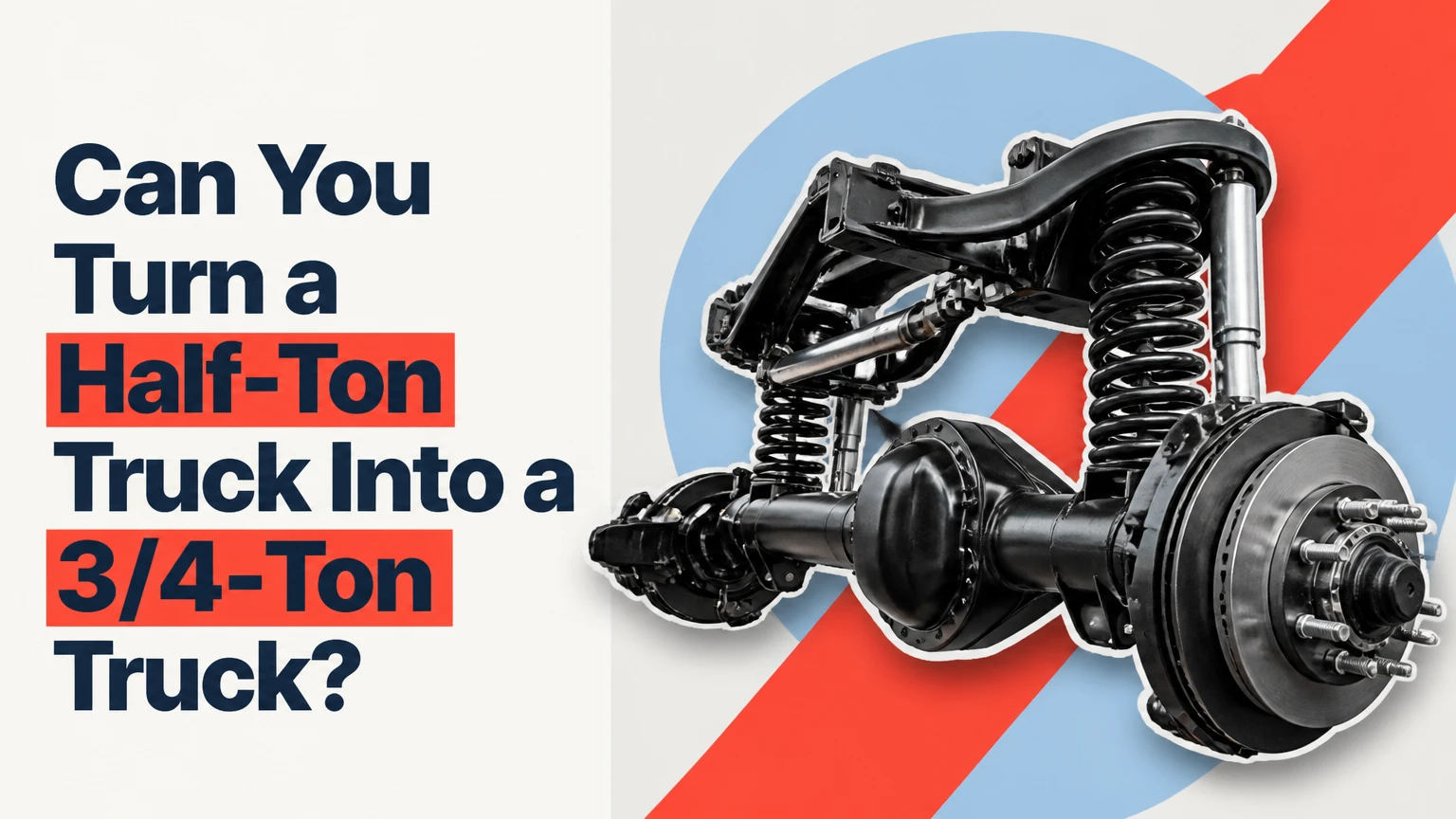
Air bags do not increase payload, GVWR, GAWR, or maximum towing capacity. Air bags add adjustable spring force between the frame and axle, which can reduce squat and maintain ride height when the load is already within the truck’s factory limits.
Typical air-bag kits operate around 5-100 psi, depending on the manufacturer and load. Parts commonly cost $400-$1,200, and installation usually takes 4-6 hours when brackets fit the vehicle without drilling or welding. An onboard compressor adds convenience, wiring, and cost.
Air bags are useful for a variable tongue weight or a truck camper that remains within payload. They are poor substitutes for capacity when the load exceeds the rear GAWR or tire rating. Excessive pressure can transfer too much force into the frame, reduce suspension travel, create a harsh ride, and unload the front axle.
The practical rule is simple: inflate the bags only enough to restore near-level ride height, then confirm axle weights. Never treat the kit’s advertised “supports 5,000 pounds” wording as permission to carry 5,000 additional pounds.
Which Suspension Upgrade Best Stops Rear-End Sag?
The best upgrade depends on whether the truck carries a variable load, a constant load, or a trailer with properly distributed tongue weight. Air bags suit changing loads, helper springs suit repeated payload, and progressive bump stops suit moderate loads where simplicity matters.
| Upgrade | Typical parts cost | Typical installation | Best use | Main limitation |
|---|---|---|---|---|
| Add-a-leaf or helper spring | $150-$400 | 2-4 hours | Repeated bed cargo | Can stiffen empty ride and raise unloaded ride height |
| Air-bag kit | $400-$1,200 | 4-6 hours | Variable tongue or camper load | Needs pressure management and careful frame inspection |
| Timbrens or foam bump stops | $250-$500 | About 1 hour | Intermittent moderate loads | Can feel harsh when frequently engaged |
| Progressive spring replacement | $600-$1,500 | 4-8 hours | Frequent payload with better spring matching | Higher parts and alignment cost |
| Weight-distribution hitch | $300-$900 | 1-2 hours setup | Bumper-pull trailer tongue transfer | Does not increase truck or axle ratings |
A weight-distribution hitch is different from a helper spring. Spring bars use leverage to move part of trailer tongue load toward the truck’s front axle and the trailer axles, while a suspension aid mainly supports the rear suspension. Neither device makes an overloaded combination compliant.
What Should You Check After Installing Suspension Parts?
Check ride height, suspension travel, tire clearance, brake-line routing, bump-stop contact, driveshaft angle, and front axle loading after installation. A rear lift or over-sprung setup can change steering geometry and reduce front-tire traction.
Use heavy-duty shocks only when their valving and mounting fit the truck. Shocks control motion; they do not carry payload. A thicker rear sway bar may reduce body roll, but it cannot correct excessive tongue weight, a poorly loaded trailer, worn tires, or inadequate hitch adjustment.
How Do You Calculate a Half-Ton’s Real Remaining Payload?
Calculate remaining payload by subtracting the truck’s actual ready-to-travel weight from its door-label GVWR, then subtracting every person, accessory, hitch component, and item added for the trip. Use axle weights as a second check because staying below GVWR does not guarantee that each axle remains below its GAWR.
For example:
- Door-label GVWR: 7,100 pounds
- Actual truck with fuel and driver: 5,350 pounds
- Remaining payload before passengers and equipment: 1,750 pounds
- Two passengers: 340 pounds
- Weight-distribution hitch: 90 pounds
- Bed cargo: 500 pounds
- Remaining payload: 820 pounds
If trailer tongue weight is 900 pounds, that example is already 80 pounds over GVWR before adding a cooler, tools, or a dog. The rear axle could also exceed its GAWR even if the arithmetic appears close.
A public CAT Scale provides separate steer, drive, and trailer weights. Weigh the truck alone, then weigh the complete combination, and compare the results with the door label, tire sidewalls, hitch rating, and trailer certification label. Do not rely on the truck’s advertised maximum tow number for this calculation.
What Does a Half-Ton Versus a 3/4-Ton Cost to Operate?
A half-ton usually costs less to buy and can return better unloaded fuel economy, while a 3/4-ton generally costs more but provides greater payload margin and component durability for regular heavy work. The financially sensible choice depends on frequency, not one weekend’s load.
| Decision factor | Upgraded half-ton | Stock 3/4-ton | Practical consequence |
|---|---|---|---|
| Suspension improvement | $150-$1,500 parts | Included in factory design | Upgrade cost fixes sag, not certification |
| Brake reserve | Original 1500 system | Larger HD system, model dependent | 2500 is better for repeated heavy descents |
| Empty ride | Usually softer before upgrades | Usually firmer | 1500 remains more comfortable for daily commuting |
| Typical payload range | 1,200-2,300 pounds | 2,500-4,500 pounds | Door-label configuration remains decisive |
| Used purchase alternative | Existing truck plus parts | Older 2500 often $15,000-$35,000 typical | Replacement may cost less than a complete build |
| Heavy-load maintenance | Higher risk of heat and wear | More capacity margin | Constant work favors the 2500 platform |
The 3/4-ton is not automatically safer for every trailer. A poorly maintained 2500 with old tires, incorrect brake controller settings, or excessive trailer weight remains unsafe. Capacity margin improves the decision, but setup and maintenance still govern actual performance.
When Is a Half-Ton the Wrong Tow Vehicle?
A half-ton is usually the wrong tow vehicle when the loaded trailer consumes most of the truck’s payload, when tongue weight overloads the rear axle, or when the trailer uses fifth-wheel or gooseneck pin weight that lands directly in the bed. Large travel trailers and fifth wheels can exceed a 1500’s payload before cargo is added.
A typical bumper-pull travel trailer may impose 10-15% of its loaded weight on the hitch. A 7,500-pound loaded trailer therefore may place 750-1,125 pounds on the truck, before passengers, hitch hardware, and bed cargo. Actual tongue weight must be measured or obtained from a properly loaded scale, not inferred from dry brochure weight.
Fifth-wheel pin weight commonly falls near 20-25% of loaded trailer weight. A 10,000-pound fifth wheel can therefore place roughly 2,000-2,500 pounds in the bed, which exceeds many half-ton payload labels immediately. A 2500 or 3500 is normally the correct starting point for that use.
Which Truck Fits Each Use Case?
| Use case | Typical loaded demand | Half-ton recommendation | 3/4-ton recommendation |
|---|---|---|---|
| 4×8 utility trailer | 2,000-3,500 pounds trailer | Suitable if hitch and payload remain compliant | More capacity than necessary |
| 6,000-pound boat trailer | 600-900 pounds tongue | Often suitable after scale check | Useful for frequent long-distance towing |
| 7,500-pound travel trailer | 750-1,125 pounds tongue | Configuration dependent | Better margin for passengers and cargo |
| 10,000-pound fifth wheel | 2,000-2,500 pounds pin | Usually unsuitable | Minimum class to evaluate |
| Daily landscaping tools | 1,000-2,500 pounds bed load | Suitable only at the low end | Better for constant heavy payload |
| Heavy camper with supplies | 1,500-3,000 pounds payload | Model-specific and often marginal | Usually the safer platform |
What Problems Appear After Over-Springing a Half-Ton?
Over-springing can create a harsh empty ride, reduced suspension travel, axle wrap, tire wear, steering changes, and a false impression that the truck has more capacity. The most serious failures occur when a level stance hides overloaded tires, wheels, axles, brakes, or frame components.
Common symptoms include:
- Porpoising after a helper-spring installation: Match shocks to the new spring rate, verify correct rebound control, and inspect tire pressure.
- Trailer sway after adding air bags: Check tongue weight, trailer loading, hitch height, sway control, and front axle restoration; air bags alone do not stabilize a poorly balanced trailer.
- Front-end lightness: Reduce rear load or tongue weight and confirm steer-axle weight on a scale.
- Transmission overheating: Use the manufacturer’s tow mode, maintain fluid condition, monitor temperature where supported, and consider an approved auxiliary cooler.
- Uneven tire wear: Check alignment, tire load range, cold pressure, wheel offset, and axle alignment after suspension changes.
- Frame or bracket damage: Inspect mounting points, cracks, corrosion, fastener torque, and clearance after the first loaded trip.
A heavier tire does not automatically solve these problems. An LT tire with a higher load index must still be mounted on a wheel rated for the intended load, inflated according to the tire and vehicle requirements, and compatible with the truck’s TPMS system.
Are Heavier Tires and Brakes Enough for the Conversion?
Heavier tires and upgraded brakes can improve a half-ton’s safety margin in specific areas, but they cannot complete the conversion. Tires are limited by their load index and wheel rating, while brakes are limited by rotor size, caliper design, cooling airflow, hydraulic balance, ABS calibration, and the truck’s total mass.
Replacing P-metric tires with LT tires may reduce sidewall flex during towing, but LT tires can weigh more, ride harder, reduce fuel economy, and require different inflation pressures. Choose the tire’s load index from the vehicle manufacturer’s requirements and the actual axle load, not solely from a “Load Range E” label.
Brake pads with a higher friction rating do not create larger rotors or more thermal mass. Repeated mountain descents can still produce fade when a trailer pushes a light-duty truck. Use a properly adjusted trailer brake controller, downshift within the manufacturer’s instructions, and maintain a safe descent speed.
What Legal and Insurance Limits Apply?
The manufacturer’s GVWR, GAWR, GCWR, tire ratings, hitch rating, and local vehicle regulations all constrain legal operation. A modification does not generally change the numbers printed on the certification label, and liability can increase when an owner knowingly operates above those limits.
The exact legal treatment varies across the United States, Canada, and individual states or provinces. Some jurisdictions regulate registered weight, commercial use, trailer brakes, safety chains, lighting, and combination length separately from manufacturer ratings. An insurer may also ask whether suspension, axle, wheel, or brake modifications were disclosed.
Keep installation records, part numbers, alignment results, scale tickets, and maintenance documents. Those records do not create additional capacity, but they help demonstrate responsible maintenance if a claim or inspection follows a collision.
When Should You Replace the Truck Instead?
Replace the half-ton when the required payload or trailer pin weight exceeds the label, when heavy towing is frequent, or when achieving adequate margin would require changing the axle, brakes, frame, and powertrain. Buying a used, properly rated 2500 is usually more rational than building a pseudo-2500 from a 1500.
A weekend user carrying a modest boat or utility trailer may need only a correctly adjusted weight-distribution hitch, suitable tires, and a modest leveling solution. A tradesperson carrying tools every day needs capacity that remains available after fuel, workers, racks, compressors, and materials occupy the truck.
The replacement decision should use loaded scale weights and annual usage. If the truck is overloaded on most trips, suspension parts treat the symptom while the operating pattern continues to stress the original platform.
FAQ
Can I legally increase my truck’s payload rating?
Aftermarket parts generally do not increase the manufacturer’s certified payload rating. Some jurisdictions may recognize a professionally engineered or re-rated vehicle under specific procedures, but the owner must obtain approval from the relevant authority. Without that process, use the original GVWR, GAWR, tire, wheel, hitch, and GCWR limits.
Can a half-ton safely tow 10,000 pounds?
A half-ton can tow a 10,000-pound trailer only if the specific truck’s tow rating, payload, tongue weight, axle weights, hitch, tires, brakes, and GCWR all remain within limits. A 10,000-pound trailer with 10-15% tongue weight can consume 1,000-1,500 pounds before passengers and equipment, making many 1500 configurations unsuitable.
Will airbags stop my truck from squatting?
Air bags can reduce visible rear sag by adding spring support, provided the kit fits the vehicle and is correctly adjusted. Air bags do not transfer all tongue weight away from the rear axle, increase brake capacity, strengthen the frame, or authorize heavier loading. Level stance is a suspension result, not a capacity measurement.
Should I install add-a-leafs or Timbrens?
Add-a-leafs suit trucks carrying repeated bed loads and can provide a firmer spring rate across more of the suspension travel. Timbrens or progressive bump stops suit intermittent moderate loads and require less maintenance. Neither choice is appropriate for exceeding the original payload or rear-axle rating.
Can I convert a half-ton to use a fifth wheel?
A half-ton should use a fifth wheel only when its payload, rear axle, tires, wheels, hitch system, and manufacturer tow documentation support the loaded pin weight. Because fifth-wheel pin weight often reaches 20-25% of loaded trailer weight, many 1500 trucks exceed payload before passengers and supplies are counted.
Is a 2500 truck uncomfortable as a daily driver?
A 2500 truck typically rides more firmly empty because its springs, tires, and dampers support greater loads. Modern cab design, tire selection, and suspension tuning can make a 2500 manageable as a daily vehicle, but a half-ton remains the better comfort and fuel-economy choice when heavy capacity is unnecessary.
The Bottom Line
You cannot turn a half-ton truck into a true 3/4-ton truck by installing air bags, helper springs, Timbrens, LT tires, shocks, or a weight-distribution hitch. Those parts can improve leveling, tire stability, or trailer control within the original ratings, but they cannot change the truck’s GVWR, GAWR, GCWR, frame design, axle capacity, brake thermal reserve, or certified towing limits.
For a moderate trailer, weigh the loaded combination and select the least invasive upgrade that solves the actual problem. For a heavy fifth wheel, constant commercial payload, or recurring overload, replace the half-ton with a properly rated 2500 or 3500. That is the safe answer to “can you turn a half ton truck into a 3 4 ton.”